北京大学学报(医学版) ›› 2025, Vol. 57 ›› Issue (3): 592-598. doi: 10.19723/j.issn.1671-167X.2025.03.025

• 论著 • 上一篇    下一篇

单绒毛膜双羊膜囊双胎妊娠双胎之一胎死宫内对妊娠结局的影响

卞雯*, 周文君*, 吴天晨, 朱培静, 陈一诺, 原鹏波, 王学举, 王颖, 魏瑗*(), 赵扬玉*()   

  1. 北京大学第三医院妇产科,北京 100191
  • 收稿日期:2022-06-21 出版日期:2025-06-18 发布日期:2025-06-13
  • 通讯作者: 魏瑗, 赵扬玉
  • 作者简介:

    * These authors contributed equally to this work

Perinatal outcomes of single intrauterine fetal demise in monochorionic diamniotic twins

Wen BIAN, Wenjun ZHOU, Tianchen WU, Peijing ZHU, Yinuo CHEN, Pengbo YUAN, Xueju WANG, Ying WANG, Yuan WEI*(), Yangyu ZHAO*()   

  1. Department of Obstetrics and Gynecology, Peking University Third Hospital, Beijing 100191, China
  • Received:2022-06-21 Online:2025-06-18 Published:2025-06-13
  • Contact: Yuan WEI, Yangyu ZHAO

RICH HTML


摘要:

目的: 比较单绒毛膜双羊膜囊(monochorionic diamniotic,MCDA)双胎妊娠选择性减胎和自发双胎之一胎死宫内(single intrauterine fetal demise,sIUFD)后的存活儿妊娠结局,并探索预后的影响因素。方法: 收集2010年9月至2021年8月北京大学第三医院收治的219例MCDA双胎妊娠中一胎宫内死亡病例,根据胎死方式分为自发sIUFD组(120例)和选择性减胎组(99例),采集孕期母体情况、宫内死亡胎儿情况和妊娠结局资料进行回顾性病例分析。结果: 自发sIUFD组和选择性减胎组的存活儿活产率分别为85.0%及81.8%,存活儿总围生期存活率则分别为73.3%及81.8%,差异均无统计学意义。与自发sIUFD组相比,选择性减胎组的分娩孕周更大, < 37周早产率、新生儿窒息率和早期新生儿死亡率更低。以分娩孕周为结局变量,采用Cox回归分析发现,胎死方式并非影响存活儿分娩孕周的风险因素,而妊娠期高血压和胎死孕周为影响存活儿分娩孕周的独立风险因素;分别以是否出现 < 37周早产、存活儿宫内死亡和新生儿颅脑B超异常为结局变量,采用非条件Logistics回归分析发现,胎死方式、胎死孕周、死胎位置和胎儿并发症等为影响上述存活儿结局的独立风险因素;根据单因素分析结果,将上述风险因素纳入多因素回归分析,结果与单因素分析相同。结论: 对于存在严重双胎并发症的MCDA双胎妊娠患者,进行选择性减胎术后的存活儿预后更好,积极的宫内干预治疗对于改善存活儿预后具有重要的意义。

关键词: 单绒毛膜双羊膜囊, 胎死宫内, 选择性减胎术, 妊娠结局

Abstract:

Objective: To compare the pregnancy outcomes of surviving fetuses in monochorionic diamniotic (MCDA) twin pregnancies after selective feticide or spontaneous single intrauterine fetal demise (sIUFD), and to explore the influencing factors of prognosis. Methods: A total of 219 cases of intra-uterine death of one fetus in MCDA twin pregnancies admitted to Peking University Third Hospital from September 2010 to August 2021 were collected. According to the mode of fetal death, they were divided into the spontaneous sIUFD group (120 cases) and the selective feticide group (99 cases). Data on the maternal conditions during pregnancy, the situation of the intrauterine-dead fetus, and pregnancy outcomes were collected for retrospective case-analysis. Results: The live-birth rates of surviving fetuses in the spontaneous sIUFD group and the selective feticide group were 85.0% and 81.8% respectively, and the total perinatal survival rates of surviving fetuses were 73.3% and 81.8% respectively, and there were no statistically significant differences. Compared with the spontaneous sIUFD group, the selective feticide group had a greater gestational week at delivery, and lower rate of preterm birth before 37 weeks, neonatal asphyxia, and early neonatal mortality. Using the gestational week at delivery as the outcome variable, Cox regression analysis showed that the mode of fetal death was not a risk factor affecting the gestational week at delivery of the surviving fetus, while gestational hypertension and the gestational week of fetal death were independent risk factors affecting the gestational week at delivery of the surviving fetus. Using preterm birth before 37 weeks, intrauterine death of the surviving fetus, and abnormal neonatal cranial ultrasound as outcome variables respectively, unconditional logistic regression analysis showed that the mode of fetal death, the gestational week of fetal death, the position of the dead fetus, and fetal complications were independent risk factors affecting the outcomes of the above-mentioned surviving fetuses. According to the results of the univariate analysis, the above risk factors were included in the multivariate regression analysis, and the results were the same as those of the univariate analysis. Conclusion: For MCDA twin pregnancy patients with severe twin-related complications, the prognosis of surviving fetuses after selective feticide is better. The proactive intrauterine intervention and treatment are of great significance for improving the prognosis of surviving fetuses.

Key words: Monochorionic diamniotic, Intrauterine fetal demise, Selective feticide, Pregnancy outcome

中图分类号: 

  • R714.2

表1

自发sIUFD组和选择性减胎组的一般情况比较"

Variables Spontaneous sIUFD group (n=120) Selective feticide group (n=99) P
Age/years, M (P25, P75) 30.00 (27.00, 32.75) 31.00 (29.00, 34.00) 0.013a
BMI/(kg/m2), M (P25, P75) 21.89 (19.52, 24.83) 21.88 (19.96, 24.22) 0.968a
Conception method, n (%) 0.669b
    Spontaneous pregnancy 107 (89.2) 90 (90.9)
    Assisted reproduction 13 (10.8) 9 (9.1)
Parity, n (%) 0.130b
    Primipara 90 (75.0) 65 (65.7)
    Multipara 30 (25.0) 34 (34.3)
Hypertensive disorders of pregnancy, n (%) 18 (15.0) 18 (18.2) 0.527b
Gestational diabetes mellitus, n (%) 11 (9.2) 19 (19.2) 0.032b
Other comorbidities, n (%) 23 (19.2) 21 (21.2) 0.707b

表2

自发sIUFD组和选择性减胎组胎儿合并症及胎儿宫内死亡情况"

Variables Spontaneous sIUFD group (n=120) Selective feticide group (n=99) P
Fetal complications, n (%) < 0.001a
    TTTS 41 (34.2) 14 (14.1)
    sIUGR 23 (19.2) 29 (29.3)
    TRAPs 2 (1.7) 19 (19.2)
    MTFDA 4 (3.3) 15 (15.2)
    Multiple 19 (15.8) 19 (19.2)
    None 31 (25.8) 3 (3.0)
Gestational weeks of sIUFD/feticide/weeks, M(P25,P75) 26.78 (22.71, 30.57) 21.64 (18.96, 24.71) < 0.001b
< 28 gestational weeks, n (%) 71 (59.2) 98 (99.0) < 0.001a
Location of the dead fetus, n (%) 0.213a
    Lower 77 (66.4) 72 (74.2)
    Higher 39 (33.6) 25 (25.8)

表3

自发sIUFD组与选择性减胎组活产胎儿的妊娠结局"

Variables Spontaneous sIUFD group (n=102) Selective feticide group (n=81) P
Cesarean section, n (%) 45 (44.1) 39 (48.1) 0.587a
Gestational week of delivery/weeks, M (P25, P75) 35.71 (32.36, 38.04) 37.43 (33.86, 38.93) 0.014b
PPROM, n (%) 18 (17.5) 19 (21.8) 0.449c
Preterm birth/weeks, n (%)
     < 30 10 (9.8) 5 (6.2) 0.374a
     < 32 24 (23.5) 13 (16.0) 0.211a
     < 33 37 (36.3) 21 (25.9) 0.135a
     < 37 60 (58.8) 34 (42.0) 0.024a
Transferred to NICU, n (%) 42 (41.2) 33 (40.7) 0.953a
Neonatal asphyxia, n (%) 14 (13.7) 1 (1.2) 0.002a
Neonatal birth weight/g, M (P25, P75) 2 295.00 (1 660.00, 2 962.50) 2 690.00 (1 880.00, 3 090.00) 0.064b
Small for gestational age infant, n (%) 35 (34.3) 22 (27.2) 0.299a
Early neonatal death, n (%) 14 (13.7) 0 (0) 0.001a
Abnormal neonatal cranial ultrasound, n (%) 25 (24.5) 19 (23.5) 0.868a

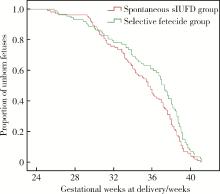
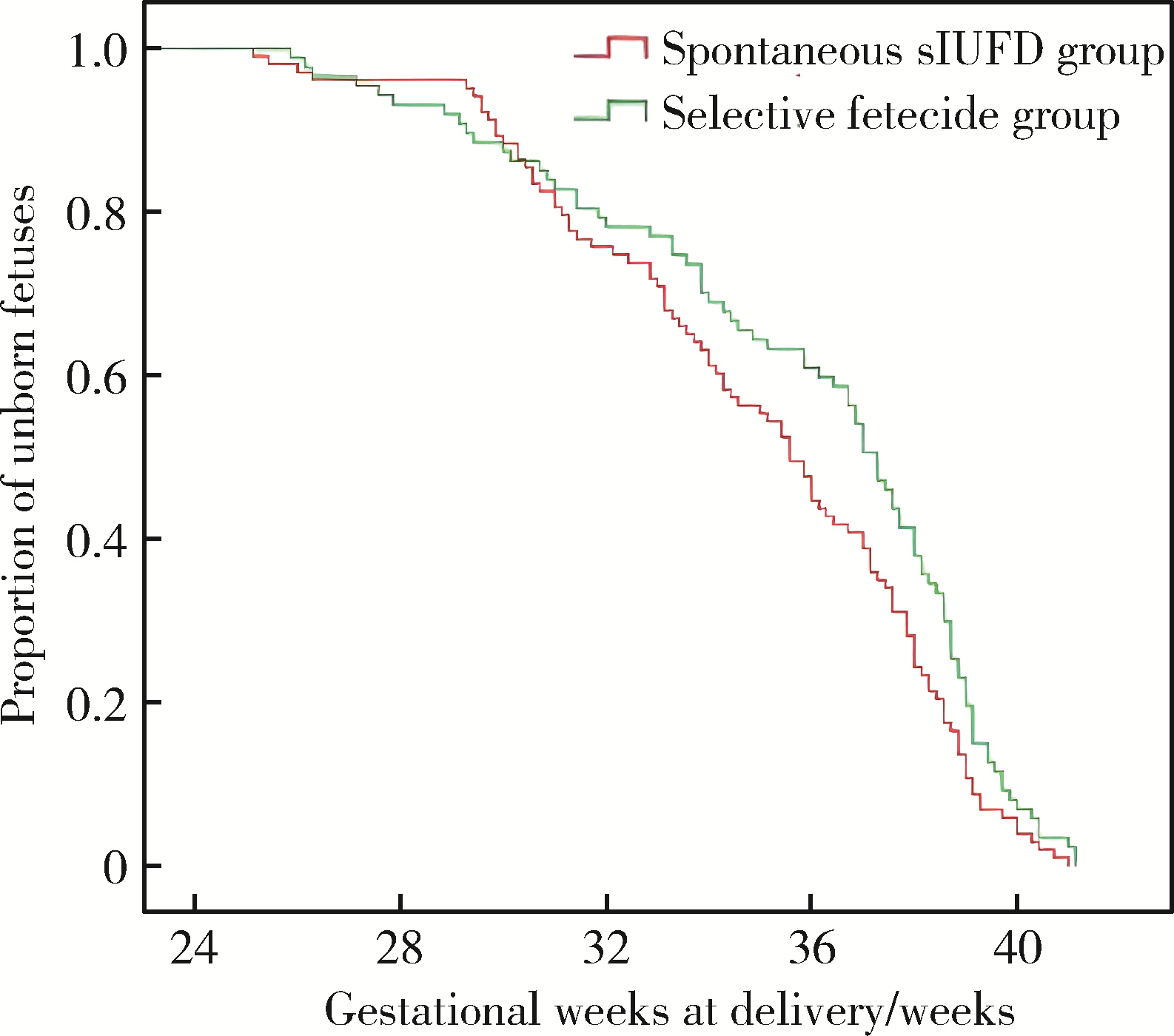
图1

自发sIUFD组和选择性减胎组的分娩孕周"

表4

影响妊娠结局的风险因素分析"

Variables Gestational weeks of delivery, HR (95%CI) Preterm birth (< 37 weeks), OR (95%CI) Viable fetus died in utero, OR (95%CI) Abnormal neonatal cranial ultrasound, OR (95%CI)
Age 0.984(0.911-1.062)
Hypertensive disorders of pregnancy 1.644 (1.116-2.423)* 2.072 (0.839-5.117)
Gestational diabetes mellitus 0.564 (0.177-1.799)
Selective feticide 1.102 (0.727-1.672) 2.298 (0.912-5.791) 0.333 (0.141-0.788)* 2.505 (0.906-6.924)
Gestational weeks of fetal death 1.070 (1.034-1.107) 1.204 (1.107-1.310) 0.934 (0.863-1.009) 1.129 (1.034-1.232)#
Dead fetus lies lower 2.232 (1.047-4.760)*
TTTS 1.359 (0.842-2.193) 1.838 (0.648-5.213) 9.524 (2.025-44.798)# 1.840 (0.600-5.645)
TRAPs 0.789 (0.399-1.558) 0.400 (0.085-1.884) 8.964 (1.369-58.681)* 0.234 (0.022-2.450)
sIUGR 0.783 (0.264-2.322) 0.706 (0.233-2.141) 7.138 (1.364-37.342)* 0.642 (0.189-2.176)
MTFDA 0.627 (0.130-3.028) 0.727 (0.144-3.671) 10.506 (1.638-67.394)* 1.027 (0.195-5.397)
Multiple complications 1.464 (0.467-4.592) 1.322 (0.414-4.223) 7.292 (1.401-37.943)* 0.765 (0.210-2.785)
1
Gratacós E , Ortiz JU , Martinez JM . A systematic approach to the differential diagnosis and management of the complications of monochorionic twin pregnancies[J]. Fetal Diagn Ther, 2012, 32 (3): 145- 155.

doi: 10.1159/000342751
2
Hillman SC , Morris RK , Kilby MD . Co-twin prognosis after single fetal death: A systematic review and meta-analysis[J]. Obstet Gynecol, 2011, 118 (4): 928- 940.

doi: 10.1097/AOG.0b013e31822f129d
3
Rahimi-Sharbaf F , Ghaemi M , Nassr AA , et al. Radiofrequency ablation for selective fetal reduction in complicated monochorionic twins; comparing the outcomes according to the indications[J]. BMC Pregnancy Childbirth, 2021, 21 (1): 189.

doi: 10.1186/s12884-021-03656-1
4
Peng R , Xie HN , Lin MF , et al. Clinical outcomes after selective fetal reduction of complicated monochorionic twins with radiofrequency ablation and bipolar cord coagulation[J]. Gynecol Obstet Invest, 2016, 81 (6): 552- 558.

doi: 10.1159/000445291
5
Rossi AC , D'Addario V . Umbilical cord occlusion for selective feticide in complicated monochorionic twins: A systematic review of literature[J]. Am J Obstet Gynecol, 2009, 200 (2): 123- 129.

doi: 10.1016/j.ajog.2008.08.039
6
中华医学会围产医学分会胎儿医学学组, 中华医学会妇产科学分会产科学组. 双胎妊娠临床处理指南(2020年更新)[J]. 中国产前诊断杂志(电子版), 2021, 13 (1): 51- 63.
7
van Klink JM , Koopman HM , Rijken M , et al. Long-Term neurodevelopmental outcome in survivors of twin-to-twin transfusion syndrome[J]. Twin Res Hum Genet, 2016, 19 (3): 255- 261.

doi: 10.1017/thg.2016.26
8
谢家磊, 吴天晨, 王晓莉, 等. 微波消融和射频消融减胎术治疗复杂性单绒毛膜妊娠的比较[J]. 中国生育健康杂志, 2022, 33 (1): 14- 17.
9
Meng X , Yuan P , Gong L , et al. Forty-five consecutive cases of complicated monochorionic multiple pregnancy treated with microwave ablation: A single-center experience[J]. Prenat Diagn, 2019, 39 (4): 293- 298.

doi: 10.1002/pd.5423
10
Dadhwal V , Sharma KA , Rana A , et al. Perinatal outcome in monochorionic twin pregnancies after selective fetal reduction using radiofrequency ablation[J]. Int J Gynaecol Obstet, 2022, 157 (2): 340- 346.

doi: 10.1002/ijgo.13785
11
Kumar S , Paramasivam G , Zhang E , et al. Perinatal- and procedure-related outcomes following radiofrequency ablation in monochorionic pregnancy[J]. Am J Obstet Gynecol, 2014, 210 (5): 454.e1- 454.e6.

doi: 10.1016/j.ajog.2013.12.009
12
Gaerty K , Greer RM , Kumar S . Systematic review and metaanalysis of perinatal outcomes after radiofrequency ablation and bipolar cord occlusion in monochorionic pregnancies[J]. Am J Obstet Gynecol, 2015, 213 (5): 637- 643.

doi: 10.1016/j.ajog.2015.04.035
13
王颖, 魏瑗, 原鹏波, 等. 单绒毛膜双胎之一胎死宫内的共存儿预后分析[J]. 中华医学杂志, 2016, 96 (37): 3003- 3007.
14
Ting YH , Poon LCY , Tse WT , et al. Outcome of radiofrequency ablation for selective fetal reduction before vs at or after 16 gestational weeks in complicated monochorionic pregnancy[J]. Ultrasound Obstet Gynecol, 2021, 58 (2): 214- 220.

doi: 10.1002/uog.22160
15
Shinar S , Agrawal S , El-Chaar D , et al. Selective fetal reduction in complicated monochorionic twin pregnancies: A comparison of techniques[J]. Prenat Diagn, 2021, 41 (1): 52- 60.

doi: 10.1002/pd.5830
16
Ong SS , Zamora J , Khan KS , et al. Prognosis for the co-twin following single-twin death: A systematic review[J]. BJOG, 2006, 113 (9): 992- 998.

doi: 10.1111/j.1471-0528.2006.01027.x
17
Mackie FL , Rigby A , Morris RK , et al. Prognosis of the co-twin following spontaneous single intrauterine fetal death in twin pregnancies: A systematic review and meta-analysis[J]. BJOG, 2019, 126 (5): 569- 578.

doi: 10.1111/1471-0528.15530
18
O'Donoghue K , Rutherford MA , Engineer N , et al. Transfusional fetal complications after single intrauterine death in monochorionic multiple pregnancy are reduced but not prevented by vascular occlusion[J]. BJOG, 2009, 116 (6): 804- 812.

doi: 10.1111/j.1471-0528.2009.02128.x
19
van Klink JM , van Steenis A , Steggerda SJ , et al. Single fetal demise in monochorionic pregnancies: incidence and patterns of cerebral injury[J]. Ultrasound Obstet Gynecol, 2015, 45 (3): 294- 300.

doi: 10.1002/uog.14722
20
van den Bos EM , van Klink JM , Middeldorp JM , et al. Perinatal outcome after selective feticide in monochorionic twin pregnancies[J]. Ultrasound Obstet Gynecol, 2013, 41 (6): 653- 658.

doi: 10.1002/uog.12408
21
van Klink J , Koopman HM , Middeldorp JM , et al. Long-term neurodevelopmental outcome after selective feticide in mono-chorionic pregnancies[J]. BJOG, 2015, 122 (11): 1517- 1524.

doi: 10.1111/1471-0528.13490
22
Fusi L , McParland P , Fisk N , et al. Acute twin-twin transfusion: A possible mechanism for brain-damaged survivors after intra-uterine death of a monochorionic twin[J]. Obstet Gynecol, 1991, 78 (3 Pt 2): 517- 520.
23
Counsell SJ , Rutherford MA , Cowan FM , et al. Magnetic resonance imaging of preterm brain injury[J]. Arch Dis Child Fetal Neonatal Ed, 2003, 88 (4): 269- 274.

doi: 10.1136/fn.88.4.F269
24
中国妇幼保健协会双胎妊娠专业委员会. 双胎输血综合征诊治及保健指南(2020)[J]. 中国实用妇科与产科杂志, 2020, 36 (8): 714- 721.
25
中国妇幼保健协会双胎妊娠专业委员会. 选择性胎儿宫内生长受限诊治及保健指南(2020)[J]. 中国实用妇科与产科杂志, 2020, 36 (7): 618- 625.
26
中国妇幼保健协会双胎妊娠专业委员会. 双胎反向动脉灌注序列征诊治及保健指南(2020)[J]. 中国实用妇科与产科杂志, 2020, 36 (6): 524- 530.
27
中华医学会围产医学分会胎儿医学学组, 中华医学会妇产科学分会产科学组. 双胎妊娠临床处理指南(第二部分): 双胎妊娠并发症的诊治[J]. 中国产前诊断杂志(电子版), 2015, 7 (4): 57- 64.
28
Yinon Y , Ashwal E , Weisz B , et al. Selective reduction in complicated monochorionic twins: prediction of obstetric outcome and comparison of techniques[J]. Ultrasound Obstet Gynecol, 2015, 46 (6): 670- 677.

doi: 10.1002/uog.14879
29
Sun L , Zou G , Yang Y , et al. Risk factors for fetal death after radiofrequency ablation for complicated monochorionic twin pregnancies[J]. Prenat Diagn, 2018, 38 (7): 499- 503.

doi: 10.1002/pd.5269
30
Ward PL , Reidy KL , Palma-Dias R , et al. Single intrauterine death in twins: The importance of fetal order[J]. Twin Res Hum Genet, 2018, 21 (6): 556- 562.

doi: 10.1017/thg.2018.57
[1] 王文琼, 侯玉珂, 李春, 张学武. 系统性红斑狼疮患者不良妊娠结局的预测因素[J]. 北京大学学报(医学版), 2025, 57(3): 599-603.
[2] 杨树涵, 李奕昕, 崔浩亮, 王佑新, 吴玉莹, 王明月, 杨依凡, 恩卡尔·努尔, 杨磊, 王辉. 代谢相关脂肪性肝病及其心脏代谢风险指标异常与不良妊娠结局的相关性[J]. 北京大学学报(医学版), 2025, 57(3): 487-495.
[3] 马会超,李军,王永清. 妊娠合并炎症性肠病的临床特点[J]. 北京大学学报(医学版), 2024, 56(2): 260-266.
[4] 游芳凝,罗靓,刘香君,张学武,李春. 未分化结缔组织病患者的妊娠结局、疾病演变及其影响因素[J]. 北京大学学报(医学版), 2023, 55(6): 1045-1052.
[5] 孙希雅,陈艺璐,曾琳,闫丽盈,乔杰,李蓉,智旭. 不孕女性维生素D水平与抗苗勒氏管激素的相关性及对妊娠结局的预测[J]. 北京大学学报(医学版), 2023, 55(1): 167-173.
[6] 郑晓娟, 邓晓莉, 刘湘源. 54例抗磷脂综合征患者的妊娠结局[J]. 北京大学学报(医学版), 2014, 46(2): 323-328.
[7] 任昀,杨硕,杨蕊,李蓉,陈新娜,王海燕,马彩虹,刘平,乔杰. 促性腺激素释放激素激动剂长方案与拮抗剂方案对体外受精治疗妊娠结局的影响[J]. 北京大学学报(医学版), 2013, 45(6): 877-881.
[8] 陈倩, 郭燕燕. 妊娠合并慢性肾炎19例临床分析及随访[J]. 北京大学学报(医学版), 2002, 34(1): 93-94.
Viewed
Full text


Abstract

Cited

  Shared   
  Discussed   
No Suggested Reading articles found!