北京大学学报(医学版) ›› 2025, Vol. 57 ›› Issue (5): 989-995. doi: 10.19723/j.issn.1671-167X.2025.05.026

• 论著 • 上一篇    下一篇

姿势性微笑的三维形态学研究

肖宇嘉, 毛渤淳, 周彦恒*()   

  1. 北京大学口腔医学院·口腔医院正畸科,国家口腔医学中心,国家口腔疾病临床医学研究中心,口腔生物材料和数字诊疗装备国家工程研究中心,口腔数字医学北京市重点实验室,国家卫生健康委员会口腔医学计算机应用工程技术研究中心,国家药品监督管理局口腔生物材料重点实验室,北京 100081
  • 收稿日期:2022-10-08 出版日期:2025-10-18 发布日期:2024-04-03
  • 通讯作者: 周彦恒
  • 基金资助:
    国家自然科学基金(62076011); 北京大学口腔医学院青年科研基金(PKUSS20200114)

Three-dimensional morphological analysis of posed smile

Yujia XIAO, Bochun MAO, Yanheng ZHOU*()   

  1. Department of Orthodontics, Peking University School and Hospital of Stomatology & National Center of Stomatology & National Clinical Research Center for Oral Diseases & National Engineering Research Center of Oral Biomaterials and Digital Medical Devices & Beijing Key Laboratory of Digital Stomatology & NHC Research Center of Engineering and Technology for Computerized Dentistry & NMPA Key Laboratory for Dental Materials, Beijing 100081, China
  • Received:2022-10-08 Online:2025-10-18 Published:2024-04-03
  • Contact: Yanheng ZHOU
  • Supported by:
    the National Natural Science Foundations of China(62076011); the Research Foundation of Peking University School and Hospital of Stomatology(PKUSS20200114)

RICH HTML


摘要: 目的: 研究姿势性微笑时三维面部软组织变化和对称性,并分析姿势性微笑的性别差异,同时验证姿势性微笑的一致性。方法: 应用光学面部三维扫描设备获取41名成年志愿者每一张休息位和两张姿势位的面部软组织图像,其中男性16人,女性25人,年龄(26.76±2.70)岁。将面部图像数据导入三维分析软件进行模型定位后应用三维可变模型(3-dimensional morphable face model method, 3DMM)标定软组织特征点,选取眼部、面颊部、鼻部及口周测量指标进行软组织分析,比较两种表情状态下的面中下部软组织变化情况和对称性,并分析男女差异,同时对两次姿势性微笑的测量结果进行统计学检验。结果: 与休息位相比,除鼻唇角变化量(1.45°±7.65°)差异无统计学意义外,姿势性微笑时其余软组织测量值均有改变,且眼部区域也有显著变化(P < 0.001)。面下部软组织主要表现为鼻基底变宽,上下唇区域后向运动,颏部前移,唇红变窄变薄,颏唇沟变浅;姿势性微笑时不对称性以口角点[2.78 (1.73,3.49) mm]、眶下中点[2.36 (1.22, 3.27) mm]和外眼角点[2.31(1.29,2.80) mm]最为显著,另外与休息位相比,除口角点和鼻翼基部外不对称性变化差异无统计学意义(P>0.05);姿势性微笑时,男性右眼高和下唇红深度变化量大于女性(P < 0.05),外眼角点和脸颊点的不对称性增加程度较女性大(P < 0.05);两次姿势性微笑的一致性较好。结论: 姿势性微笑时眼部、面颊部、鼻部及口周软组织存在不同程度的变化,且口角和鼻翼基部不对称性较休息位增加;另外,姿势性微笑时面部软组织的一致性较好,可为临床面部微笑美学研究提供参考。

关键词: 姿势性微笑, 三维软组织分析, 三维可变模型, 对称性, 一致性

Abstract: Objective: To investigate the changes and symmetry of facial soft tissue during posed smile, to analyze the feature of posed smile in different gender, and verify the reproducibility of posed smile. Methods: Three-dimensional (3D) facial images of 41 adults (16 males and 25 females with an average age of 26.76±2.70 years) which were taken by FaceScan three-dimensional sensor, including one rest position and two posed smile images. Then these images were imported into 3D soft tissue analysis software for model repositioning. 3D morphable model method (3DMM) was carried out to automatic landmarks setting. After that, the measurement of the eyes, cheeks, nose and perioral area were carried out for 3D soft tissue analysis. Finally, the changes and symmetry of the soft tissues between the two expression states and the gender differences during the posed smiles were compared. Meanwhile, the reproducibility of posed smile was statistically tested. Results: Compared with the rest position, except for nasolabial angle (1.45°±7.65°), the measurements of 3D soft tissue in other region were changed in posed smile (P < 0.001). It should be noted that the eye region was also significantly changed (P < 0.001). Furthermore, the prominent feature of posed smile was that the alar base length became longer, the upper and lower vermilions were narrow and thin, and the mentolabial furrows became shallow. Meanwhile the chin extended anteriorly while the mouth retracted; During posed smile, the labial fissure asymmetry [2.78 (1.73, 3.49) mm], mid-infraorbital asymmetry [2.36 (1.22, 3.27) mm] and outercanthal asymmetry [2.31(1.29, 2.80) mm] were most apparent. Compared with the rest position, the asymmetry was not significantly increased except for cheilion and alar curvature points during the posed smile (P>0.05). In the posed smile, the changes of the right palpebral fissure height and the thickness of lower vermilion (|Li-Stoi| z) of males were greater than those of females (P < 0.05), and asymmetry of exocanthion and cheekbone increased more than that of females (P < 0.05). There was no obvious difference between the two posed smiles. Conclusion: In this study, during the posed smile the soft tissues of the eyes, cheeks, nose, lips and chin changed in different degrees, and the asymmetry of cheilion and alar curvature point was greater than that of the rest position; In addition, the reproducibility of posed smile was excellent, which can be a reference for clinical aesthetics and functional research of smile.

Key words: Posed smile, Three-dimensional(3D)facial analysis, 3D morphable model, Symmetry, Reproducibility

中图分类号: 

  • R782

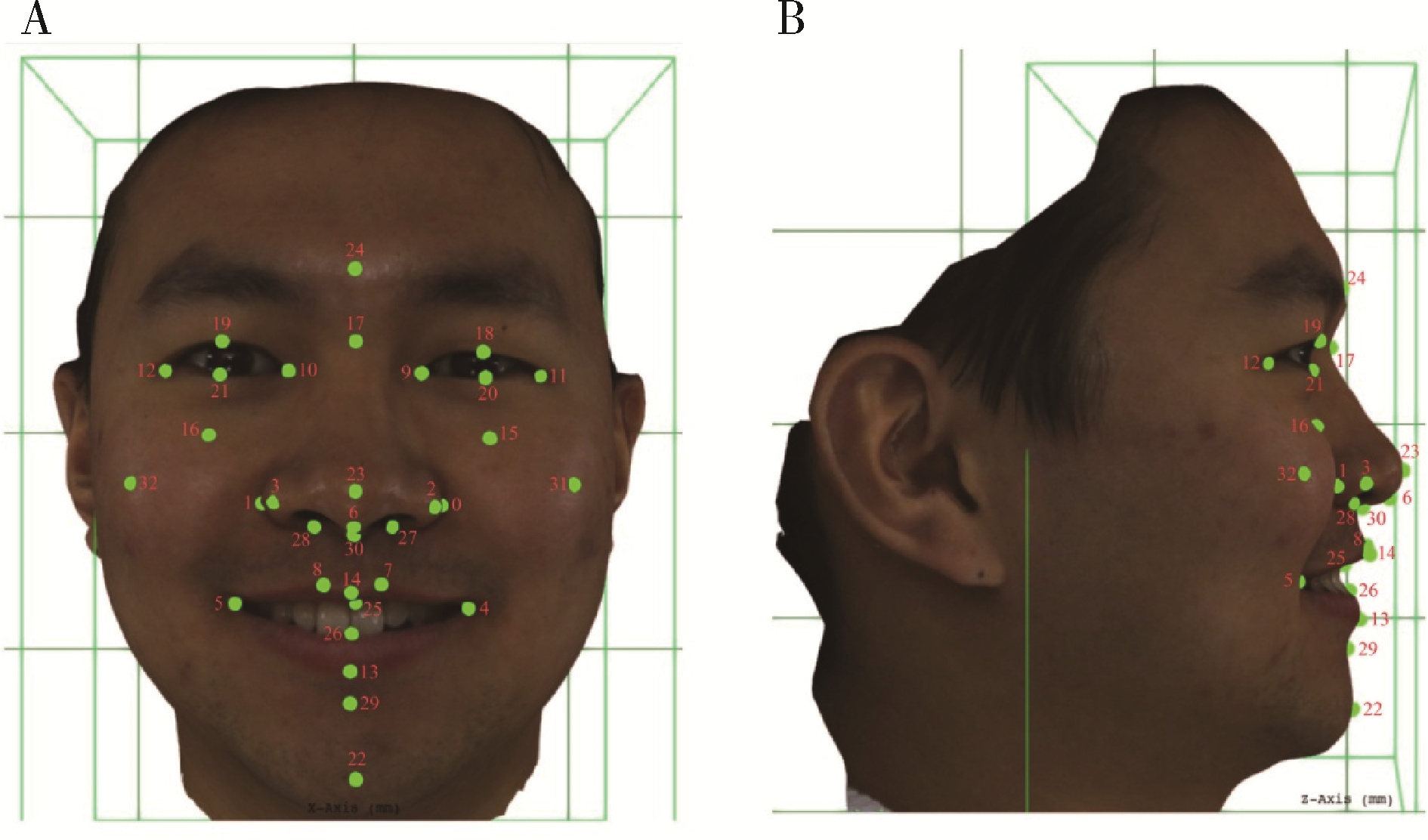
图1

三维面部软组织特征点标定"

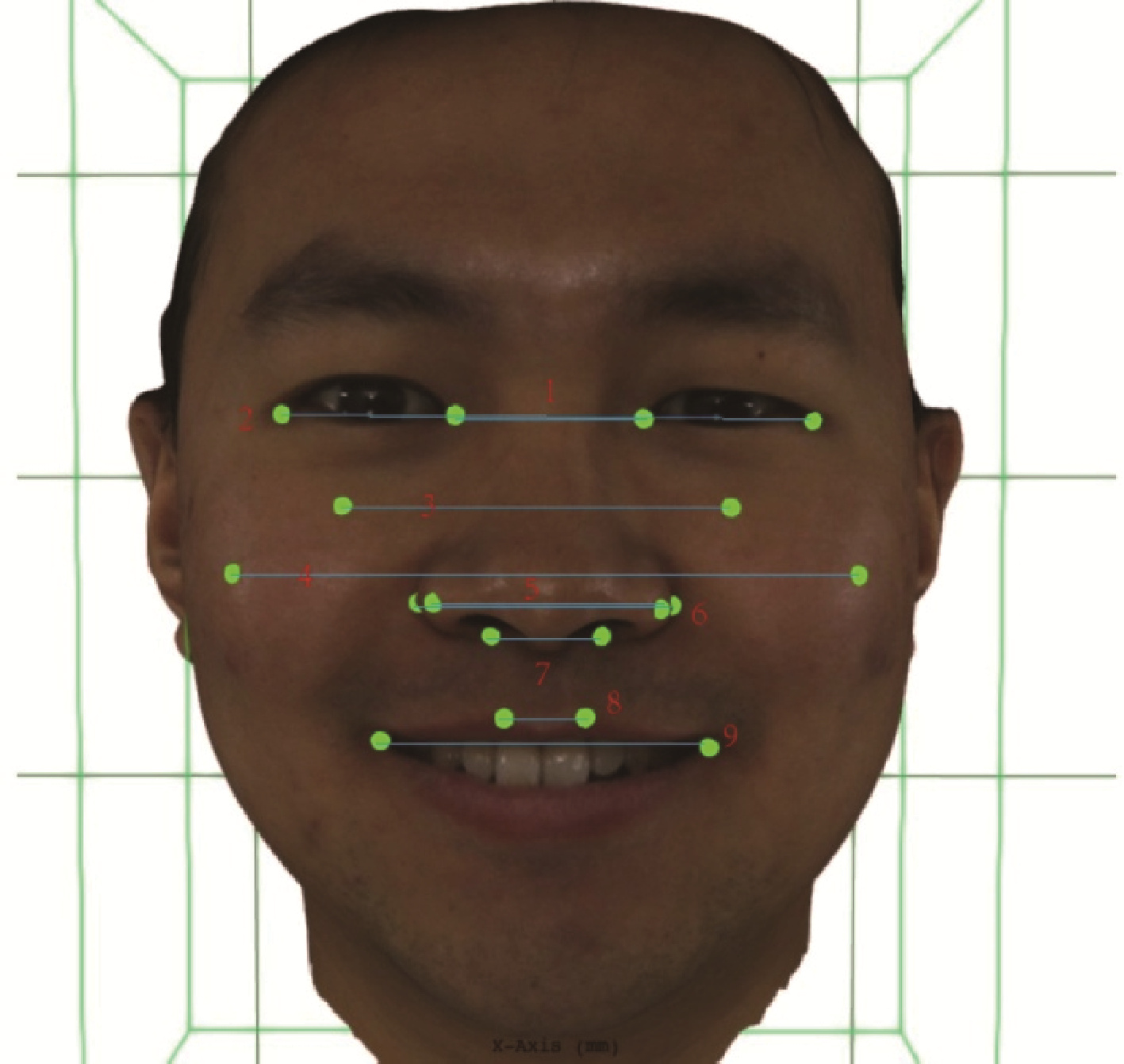
图2

面部对称性测量示意图"

表1

休息位和姿势性微笑三维软组织测量项目定义"

Measurement items Definition
Palpebral fissure length (L/R)/mm Horizontal distance between the exocanthion and endocanthion
Palpebral fissure height (L/R)/mm Vertical distance between the upper and lower eyelids
Facial convexity/(°) Angle at Sn subtended by side Gl-Pg
Cheekbone width/mm Distance between the L/R cheekbone
Outer canthal nasal angel/(°) Angle at Sn subtended by the outer canthi of the eyes
Nasal width/mm Horizontal width of the nose at the base of the nasal alare
Nasolabial angle /(°) Angle at Sn subtended by side Prn-Ls
Philtral length/mm Distance between the Sn and Ls
Philtral width/mm Distance between the philtral ridges,measured just above the vermilion border
Labial width/mm Distance between L/R cheilion
Upper vermilion height/mm Vertical distance between Sn and Stos
Upper lip height/mm Vertical distance between Sn and Ls
Lower vermilion height/mm Vertical distance between Sl and Li
Lower lip height/mm Vertical distance between Sl and Li
Upper lip protrusion(|Prn-Ls|z)/mm Sagittal distance between Prn and Ls
Lower lip protrusion(|Prn-Li|z)/mm Sagittal distance between Prn and Li
Mentolabial furrows depth(|Ls-Sl|z)/mm Sagittal distance between Li and Sl
Thickness of upper vermilion (|Ls-Stos|z)/mm Sagittal distance between Ls and Stos
Thickness of lower vermilion (|Li-Stoi|z)/mm Sagittal distance between Li and Stoi

表2

姿势性微笑与休息位三维软组织测量结果"

Measurement items Rest (n=41) Posed smile (n=41) Deviation t P
Palpebral fissure length (L)/mm 31.28±1.66 31.97±1.90 0.69±1.16 3.79 < 0.001
Palpebral fissure height (R)/mm 31.86±1.58 32.80±2.06 0.94±1.39 4.33 < 0.001
Palpebral fissure height (L)/mm 10.29±1.46 8.47±1.39 -1.81±1.45 -8.00 < 0.001
Palpebral fissure height (R)/mm 10.48±1.42 8.52±1.35 -1.96±1.37 -9.11 < 0.001
Facial convexity /(°) 169.64±5.27 171.19±4.93 1.54±1.68 5.88 < 0.001
Cheekbone width/mm 107.46±3.73 112.75±4.11 5.30±1.95 17.37 < 0.001
Outer canthal nasal angel/(°) 93.76±3.64 96.42±3.93 2.66±1.77 9.62 < 0.001
Nasal width/mm 34.58±2.32 36.72±2.33 2.14±0.89 15.43 < 0.001
Nasolabial angle/(°) 98.30±8.46 99.75±7.95 1.45±7.65 1.22 0.231
Philtral length/mm 15.17±1.74 12.82±1.77 -2.35±1.34 -11.27 < 0.001
Philtral width/mm 13.52±1.39 14.71±1.37 1.19±1.33 5.74 < 0.001
Labial width/mm 49.26±4.36 59.65±5.24 10.39±3.51 18.98 < 0.001
Upper vermilion height/mm 7.50±1.11 5.51±1.19 -1.99±1.12 -11.32 < 0.001
Upper lip height/mm 14.52±1.70 12.57±1.66 -1.96±1.40 -8.93 < 0.001
Lower vermilion height/mm 8.90±1.54 8.42±1.67 -0.48±1.51 -2.05 0.047
Lower lip height/mm 7.00±1.84 7.92±1.92 0.92±1.40 4.21 < 0.001
Upper lip protrusion(|Prn-Ls|z)/mm 8.70±2.24 11.33±2.34 2.63±1.16 14.51 < 0.001
Lower lip protrusion(|Prn-Li|z)/mm 12.17±3.56 14.13±3.39 1.96±1.28 9.82 < 0.001
Mentolabial furrows depth(|Ls-Sl|z)/mm 5.45±1.45 4.18±1.75 -1.27±1.07 -7.64 < 0.001
Thickness of upper vermilion (|Ls-Stos|z)/mm 4.43±1.30 5.59±1.85 1.16±1.81 4.11 < 0.001
Thickness of lower vermilion (|Li-Stoi|z)/mm 1.26±1.29 3.62±1.81 2.36±1.91 7.89 < 0.001

表3

不同性别受试者姿势性微笑时三维软组织变化量的比较"

Deviation (posed smile-rest) Female (n=25) Male (n=16) t P
Palpebral fissure length (L)/mm 0.77±1.04 0.56±1.35 -0.52 0.610
Palpebral fissure height (R)/mm 0.80±1.38 1.16±1.42 0.80 0.431
Palpebral fissure height (L)/mm -1.33±1.20 -2.57±1.53 -2.76 0.100
Palpebral fissure height (R)/mm -1.38±1.03 -2.86±1.38 -3.69 0.010#
Facial convexity /(°) 1.53±1.59 1.57±1.87 0.09 0.932
Cheekbone width /mm 5.22±1.76 5.43±2.28 0.32 0.750
Outer canthal nasal angel/(°) 2.54±1.85 2.84±1.68 0.54 0.593
Nasal width/mm 2.23±1.00 2.00±0.69 -0.85 0.399
Nasolabial angle /(°) 0.96±6.60 2.23±9.24 0.48 0.638
Philtral length/mm -2.19±1.13 -2.61±1.62 -0.90 0.377
Philtral width/mm 1.33±1.39 0.97±1.25 -0.87 0.392
Labial Width/mm 11.09±3.66 9.29±3.04 -1.70 0.097
Upper vermilion height/mm -1.83±0.87 -2.23±1.43 -1.02 0.321
Upper lip height/mm -1.77±1.10 -2.26±1.78 -0.99 0.332
Lower vermilion height/mm -0.81±1.39 0.04±1.57 1.78 0.086
Lower lip height /mm 0.75±1.36 1.18±1.46 0.94 0.356
Upper lip protrusion(|Prn-Ls|z)/mm 2.53±0.86 2.78±1.53 0.60 0.556
Lower lip protrusion(|Prn-Li|z)/mm 2.06±1.29 1.81±1.29 0.60 0.552
Mentolabial furrows depth(|Ls-Sl|z)/mm -1.44±1.08 -1.01±1.01 1.30 0.205
Thickness of upper vermilion (|Ls-Stos|z)/mm 1.02±1.33 1.39±2.42 0.59 0.583
Thickness of lower vermilion (|Li-Stoi|z)/mm 1.67±1.82 3.45±1.56 3.33 0.002#

表4

姿势性微笑与休息位时左右面部对称性"

Symmetry Rest(n=41) Posed smile (n=41) Deviation Z P
Endocanthion 1.35 (0.95,1.70) 1.51 (0.95,1.77) 0.01 (-0.53,0.61) 0.60 0.551
Exocanthion 2.25 (1.42,2.93) 2.31 (1.29,2.80) -0.05 (-0.80,0.52) 0.51 0.613
Mid-infraorbital 2.25 (1.18,2.91) 2.36 (1.22,3.27) 0.26 (-0.74,0.89) 0.98 0.330
Cheekbone 1.16 (0.74,1.30) 1.25 (0.81,1.60) 0.23 (-0.29,0.71) 1.72 0.085
Alar curvature point 1.08 (0.74,1.45) 1.27 (0.60,1.77) 0.15 (-0.17,0.56) 2.04 0.042
Alare 1.12 (0.68,1.32) 1.19 (0.78,1.64) 0.07 (-0.22,0.35) 1.08 0.282
Subalare 1.21 (0.78,1.58) 1.14 (0.71,1.54) -0.21 (-0.41,0.30) 0.87 0.385
Crista philtri 1.12 (0.72,1.26) 1.18 (0.66,1.41) 0.00 (-0.43,0.55) 0.28 0.778
Cheilion 1.93 (1.13,2.42) 2.78 (1.73,3.49) 1.07 (-0.10,2.03) 3.23 0.001

表5

不同性别受试者姿势性微笑时对称性变化的比较"

Symmetry (posed smile-rest) Female(n=25) Male(n=16) Z P
Endocanthion 0.01 (-0.37,0.87) -0.45 (-0.73,0.53) -1.22 0.227
Exocanthion -0.48 (-1.08,0.15) 0.20 (-0.13,0.85) -2.38 0.017
Mid-infraorbital 0.28 (-0.67,0.83) 0.03 (-0.76,1.06) -0.04 0.968
Cheekbone 0.05 (-0.47,0.35) 0.49 (-0.15,1.11) -2.13 0.032
Alar curvature point 0.14 (-0.14,0.45) 0.35 (-0.38,0.76) -0.83 0.419
Alare 0.07 (0.07,0.29) 0.20 (-0.30,0.54) -0.98 0.333
Subalare -0.27 (-0.49,0.16) -0.12 (-0.30,0.43) -1.67 0.095
Crista philtri 0.10 (-0.33,0.61) -0.41 (-0.66,0.47) -1.74 0.085
Cheilion 1.30 (0.04,2.03) 0.62 (-0.53,2.02) -0.54 0.606

表6

姿势性微笑的一致性"

Measurement items Posed smile 1 (n=41) Posed smile 2 (n=41) Deviation t P
Palpebral fissure length (L)/mm 31.97±1.90 31.75±1.79 -0.22±1.06 -1.31 0.197
Palpebral fissure height (R)/mm 32.80±2.06 32.59±1.67 -0.21±1.01 -1.31 0.197
Palpebral fissure height (L)/mm 8.47±1.39 8.54±1.29 0.07±0.75 0.56 0.581
Palpebral fissure height (R)/mm 8.52±1.35 8.65±1.41 0.12±0.74 1.00 0.325
Facial convexity/(°) 171.19±4.93 171.16±5.00 -0.03±0.82 -0.26 0.799
Cheekbone width/mm 112.75±4.11 112.77±4.15 -0.02±1.35 0.10 0.932
Outer canthal nasal angel/(°) -96.42±3.93 -96.04±3.67 0.38±1.55 1.56 0.126
Nasal width/mm 36.72±2.33 36.77±2.30 0.05±0.56 0.59 0.560
Nasolabial angle /(°) 99.75±7.95 99.93±7.05 0.18±4.65 0.24 0.809
Philtral length/mm 12.82±1.77 12.75±1.96 -0.07±1.10 -0.43 0.668
Philtral width/mm 14.71±1.37 14.47±1.23 -0.23±0.95 -1.56 0.127
Labial width/mm 59.65±5.24 59.45±5.46 -0.20±2.41 -0.96 0.600
Upper vermilion height/mm 5.51±1.19 5.45±1.10 -0.06±0.67 -0.59 0.556
Upper lip height/mm 12.57±1.66 12.53±1.89 -0.03±1.12 -0.20 0.847
Lower vermilion height/mm 8.42±1.67 8.37±1.74 -0.05±0.68 -0.48 0.635
Lower lip height/mm 7.92±1.92 8.23±1.83 0.27±1.05 1.67 0.104
Upper lip protrusion (|Prn-Ls|z)/mm 11.33±2.34 11.31±1.92 -0.02±0.83 -0.13 0.896
Lower lip protrusion (|Prn-Li|z)/mm 14.13±3.39 14.26±3.45 0.13±0.97 0.83 0.412
Mentolabial furrows depth (|Ls-Sl|z)/mm 4.18±1.75 4.10±1.61 -0.08±0.79 -0.66 0.512
Thickness of upper vermilion (|Ls-Stos|z)/mm 5.59±1.85 5.72±1.93 0.13±1.86 0.45 0.658
Thickness of lower vermilion (|Li-Stoi|z)/mm 3.62±1.81 3.59±1.17 -0.04±1.61 -0.14 0.888
1
Ackerman JL , Ackerman MB , Brensinger CM , et al. A morphometric analysis of the posed smile[J]. Clin Orthod Res, 1998, 1 (1): 2- 11.

doi: 10.1111/ocr.1998.1.1.2
2
Dobreva D , Gkantidis N , Halazonetis D , et al. Smile reproducibility and its relationship to self-perceived smile attractiveness[J]. Biology (Basel), 2022, 11 (5): 719.
3
Koidou VP , Chatzopoulos GS , Rosenstiel SF . Quantification of facial and smile esthetics[J]. J Prosthet Dent, 2018, 119 (2): 270- 277.

doi: 10.1016/j.prosdent.2017.04.002
4
Armalaite J , Jarutiene M , Vasiliauskas A , et al. Smile aesthetics as perceived by dental students: A cross-sectional study[J]. BMC Oral Health, 2018, 18 (1): 225.

doi: 10.1186/s12903-018-0673-5
5
Dym H , Pierre R 2nd . Diagnosis and treatment approaches to a "gummy smile"[J]. Dent Clin North Am, 2020, 64 (2): 341- 349.

doi: 10.1016/j.cden.2019.12.003
6
Alagha MA , Ju X , Morley S , et al. Reproducibility of the dynamics of facial expressions in unilateral facial palsy[J]. Int J Oral Maxillofac Surg, 2018, 47 (2): 268- 275.

doi: 10.1016/j.ijom.2017.08.005
7
Pucciarelli V , Gibelli D , Barni L , et al. Assessing normal smiling function through 3D-3D surfaces registration: An innovative method for the assessment of facial mimicry[J]. Aesthetic Plast Surg, 2018, 42 (2): 456- 463.

doi: 10.1007/s00266-017-1028-3
8
Rao A , Badavannavar A , Acharya A . An orthodontic analysis of the smile dynamics with videography[J]. J Oral Biol Craniofac Res, 2021, 11 (2): 174- 179.

doi: 10.1016/j.jobcr.2021.01.001
9
Claes P , Walters M , Shriver MD , et al. Sexual dimorphism in multiple aspects of 3D facial symmetry and asymmetry defined by spatially dense geometric morphometrics[J]. J Anat, 2012, 221 (2): 97- 114.

doi: 10.1111/j.1469-7580.2012.01528.x
10
邱淑婷, 朱玉佳, 王时敏, 等. 姿势微笑位口唇对称参考平面的数字化构建及初步应用验证[J]. 北京大学学报(医学版), 2022, 54 (1): 193- 199.

doi: 10.19723/j.issn.1671-167X.2022.01.031
11
White JD , Ortega-Castrillón A , Matthews H , et al. MeshMonk: Open-source large-scale intensive 3D phenotyping[J]. Sci Rep, 2019, 9 (1): 6085.

doi: 10.1038/s41598-019-42533-y
12
Ekman P . Darwin, deception, and facial expression[J]. Ann N Y Acad Sci, 2003, 1000, 205- 221.

doi: 10.1196/annals.1280.010
13
Rigsbee OH 3rd , Sperry TP , BeGole EA . The influence of facial animation on smile characteristics[J]. Int J Adult Orthodon Orthognath Surg, 1988, 3 (4): 233- 239.
14
Maharjan S , Rajbhandari A , Pradhan R , et al. Average type smile in posed smile of individuals visiting department of orthodontics of a tertiary care hospital: A descriptive cross-sectional study[J]. JNMA J Nepal Med Assoc, 2022, 60 (247): 286- 289.

doi: 10.31729/jnma.7072
15
Lee K , Lee EC . Siamese architecture-based 3D densenet with person-specific normalization using neutral expression for spontaneous and posed smile classification[J]. Sensors (Basel), 2020, 20 (24): 7184.

doi: 10.3390/s20247184
16
Schmidt KL , Ambadar Z , Cohn JF , et al. Movement differences between deliberate and spontaneous facial expressions: Zygoma-ticus major action in smiling[J]. J Nonverbal Behav, 2006, 30 (1): 37- 52.

doi: 10.1007/s10919-005-0003-x
17
Park S , Lee K , Lim JA , et al. Differences in facial expressions between spontaneous and posed smiles: Automated method by action units and three-dimensional facial landmarks[J]. Sensors (Basel), 2020, 20 (4): 1199.

doi: 10.3390/s20041199
18
Kawulok M , Nalepa J , Kawulok J , et al. Dynamics of facial actions for assessing smile genuineness[J]. PLoS One, 2021, 16 (1): e0244647.

doi: 10.1371/journal.pone.0244647
19
Guo H , Zhang XH , Liang J , et al. The dynamic features of lip corners in genuine and posed smiles[J]. Front Psychol, 2018, 9, 202.

doi: 10.3389/fpsyg.2018.00202
20
Yasuda K , Nakano H , Yamada T , et al. Identifying differences between a straight face and a posed smile using the homologous modeling technique and the principal component analysis[J]. J Craniofac Surg, 2019, 30 (8): 2378- 2380.

doi: 10.1097/SCS.0000000000005969
21
Burstone CJ . Part 1 facial esthetics. Interview by ravindra Nanda[J]. J Clin Orthod, 2007, 41 (2): 79- 87.
22
Gunnery SD , Hall JA , Ruben MA . The deliberate Duchenne smile: Individual differences in expressive control[J]. J Nonverbal Behav, 2013, 37 (1): 29- 41.

doi: 10.1007/s10919-012-0139-4
23
Parra M , Pardo R , Haidar ZS , et al. Three-dimensional analysis of nasolabial soft tissues while smiling using stereophotogrammetry (3dMDTM)[J]. Int J Morphol, 2019, 37 (1): 232- 236.

doi: 10.4067/S0717-95022019000100232
24
Rubin LR , Mishriki Y , Lee G . Anatomy of the nasolabial fold: The keystone of the smiling mechanism[J]. Plast Reconstr Surg, 1989, 83 (1): 1- 10.

doi: 10.1097/00006534-198901000-00001
25
Freytag DL , Alfertshofer MG , Frank K , et al. The difference in facial movement between the medial and the lateral midface: A 3-dimensional skin surface vector analysis[J]. Aesthet Surg J, 2022, 42 (1): 1- 9.

doi: 10.1093/asj/sjab152
26
Lindell A . Lateralization of the expression of facial emotion in humans[J]. Prog Brain Res, 2018, 238, 249- 270.
27
Tanikawa C , Takada K . Test-retest reliability of smile tasks using three-dimensional facial topography[J]. Angle Orthod, 2018, 88 (3): 319- 328.

doi: 10.2319/062617-425.1
[1] 陈逸凡,刘中砥,张鹏,黄伟. 严重创伤患者损伤严重度评分的一致性[J]. 北京大学学报(医学版), 2024, 56(1): 157-160.
[2] 何颖, 郭传瑸, 邓旭亮, 王兴, 王晓霞. 北方正常人群颅颌面三维比例测量及面部对称性分析[J]. 北京大学学报(医学版), 2015, 47(4): 708-713.
Viewed
Full text


Abstract

Cited

  Shared   
  Discussed   
No Suggested Reading articles found!