论著

基于临床特征和多参数MRI的前列腺癌盆腔淋巴结转移的术前预测模型

  • 王泽远 ,
  • 于栓宝 ,
  • 郑浩轲 ,
  • 陶金 ,
  • 范雅峰 ,
  • 张雪培 , *
展开
  • 郑州大学第一附属医院泌尿外科, 郑州 450000

收稿日期: 2025-02-27

  网络出版日期: 2025-08-02

基金资助

河南省青年科学基金(232300420254)

河南省科技攻关项目(242102311074)

版权

版权所有,未经授权,不得转载。

A preoperative prediction model for pelvic lymph node metastasis in prostate cancer: Integrating clinical characteristics and multiparametric MRI

  • Zeyuan WANG ,
  • Shuanbao YU ,
  • Haoke ZHENG ,
  • Jin TAO ,
  • Yafeng FAN ,
  • Xuepei ZHANG , *
Expand
  • Department of Urology, the First Affiliated Hospital of Zhengzhou University, Zhengzhou 450000, China
ZHANG Xuepei, e-mail,

Received date: 2025-02-27

  Online published: 2025-08-02

Supported by

the Youth Science Fund of Henan Province(232300420254)

the Key Scientific and Technological Projects of Henan Province(242102311074)

Copyright

All rights reserved. Unauthorized reproduction is prohibited.

摘要

目的: 分析与前列腺癌患者盆腔淋巴结转移(pelvic lymph node metastasis, PLNM)相关的临床特征, 构建PLNM的术前预测模型, 以减少不必要的扩大盆腔淋巴结清扫(extended pelvic lymph node dissection, ePLND)。方法: 根据纳入与排除标准, 回顾性收集2014—2024年间在郑州大学第一附属医院接受前列腺癌根治术和ePLND的344例患者, 其中77例(22.4%)患者淋巴结阳性。收集患者的临床特征、MRI报告和组织病理结果, 将数据随机分为训练集(241例, 70%)和验证集(103例, 30%), 采用单因素和多因素Logistic回归分析构建PLNM的术前预测模型。结果: 单因素Logistic回归分析表明, 总前列腺特异性抗原(total prostate specific antigen, tPSA) (P=0.021)、游离前列腺特异性抗原(free prostate specific antigen, fPSA) (P=0.002)、fPSA/tPSA (P=0.011)、穿刺阳性针数百分比(P < 0.001)、前列腺影像报告和数据系统(prostate imaging reporting and data system, PI-RADS)评分(P=0.004)、穿刺病理Gleason评分≥8 (P=0.005)、临床T分期(P < 0.001)和MRI显示的淋巴结受累(MRI-indicated lymph node involvement, MRI-LNI) (P < 0.001)是预测PLNM的显著因素。多因素Logistic回归分析表明, 穿刺阳性针数百分比(OR=91.24, 95%CI: 13.34~968.68)、PI-RADS评分(OR=7.64, 95%CI: 1.78~138.06)和MRI-LNI (OR=4.67, 95%CI: 1.74~13.24)是预测PLNM的独立危险因素。基于此构建列线图, 多因素模型的预测效果[曲线下面积(area under curve, AUC)=0.883]显著优于单一指标[阳性针数百分比(AUC=0.806)、PI-RADS评分(AUC=0.679)和MRI-LNI(AUC=0.768)]。校准曲线和决策曲线表明, 多因素模型具有较高的预测准确度和显著的净收益, 在6%的截断值下只漏检了约5.2%的PLNM(4/77), 而减少了约53%的ePLND(139/267), 显示出较好的预测效果。结论: 穿刺阳性针数百分比、PI-RADS评分和MRI-LNI是PLNM的独立危险因素, 构建多因素模型可显著提高预测效果, 为指导临床ePLND策略提供了有价值的参考。

本文引用格式

王泽远 , 于栓宝 , 郑浩轲 , 陶金 , 范雅峰 , 张雪培 . 基于临床特征和多参数MRI的前列腺癌盆腔淋巴结转移的术前预测模型[J]. 北京大学学报(医学版), 2025 , 57(4) : 684 -691 . DOI: 10.19723/j.issn.1671-167X.2025.04.009

Abstract

Objective: To analyze the clinical features associated with pelvic lymph node metastasis (PLNM) in prostate cancer and to construct a preoperative prediction model for PLNM, thereby reducing unnecessary extended pelvic lymph node dissection (ePLND). Methods: Based on predefined inclusion and exclusion criteria, 344 patients who underwent radical prostatectomy and ePLND at the First Affiliated Hospital of Zhengzhou University between 2014 and 2024 were retrospectively enrolled, among whom, 77 patients (22.4%) were pathologically confirmed to have lymph node-positive disease. The clinical characteristics, MRI reports, and pathological results were collected. The data were then randomly divi-ded into a training cohort (241 cases, 70%) and a validation cohort (103 cases, 30%). Univariate and multivariate Logistic regression analysis were employed to construct a preoperative prediction model for PLNM. Results: Univariate Logistic regression analysis revealed that total prostate specific antigen (tPSA) (P=0.021), free prostate specific antigen (fPSA) (P=0.002), fPSA to tPSA ratio (fPSA/tPSA) (P=0.011), percentage of positive biopsy cores (P < 0.001), prostate imaging reporting and data system (PI-RADS) score (P=0.004), biopsy Gleason score ≥8 (P=0.005), clinical T stage (P < 0.001), and MRI-indicated lymph node involvement (MRI-LNI) (P < 0.001) were significant predictors of PLNM. Multivariate Logistic regression analysis demonstrated that the percentage of positive biopsy cores (OR=91.24, 95%CI: 13.34-968.68), PI-RADS score (OR=7.64, 95%CI: 1.78-138.06), and MRI-LNI (OR=4.67, 95%CI: 1.74-13.24) were independent risk factors for PLNM. And a novel nomogram for predicting PLNM was developed by integrating all these three variables. Compared with the individual predictors: percentage of positive biopsy cores [area under curve (AUC)=0.806], PI-RADS score (AUC=0.679), and MRI-LNI (AUC=0.768), the multivariate model incorporating all three variables demonstrated significantly superior predictive performance (AUC=0.883). Consistently, calibration curves and decision curve analyses confirmed that the multivariable model had high predictive accuracy and provided significant net clinical benefit relative to single-variable models. And using a cutoff of 6%, the multiparameter model missed only approximately 5.2% of PLNM cases (4/77), while reducing approximately 53% of ePLND procedures (139/267), demonstrating favorable predictive efficacy. Conclusion: Percentage of positive biopsy cores, PI-RADS score and MRI-LNI are independent risk factors for PLNM. The constructed multivariate model significantly improves predictive efficacy, offering a valuable tool to guide clinical decisions on ePLND.

目前,全球约有1 000万前列腺癌患者,其中约1.1%~26%的患者伴有盆腔淋巴结转移(pelvic lymph node metastasis,PLNM)[1-2]。尽管盆腔淋巴结清扫术(pelvic lymph node dissection,PLND)在治疗局限性前列腺癌方面仍存在争议,但根治性前列腺切除术(radical prostatectomy, RP)联合PLND仍是治疗伴有PLNM前列腺癌的重要方法[3],不仅能有效去除转移灶,还能提供准确的N分期等关键信息,对患者的预后判断和后续治疗策略都具有重要影响[4]。前列腺的淋巴引流复杂,目前针对前列腺癌的淋巴结清扫区域主要有:闭孔区域的局限淋巴结清扫,闭孔和髂外区域的标准淋巴结清扫,闭孔、髂外和髂内区域的扩大淋巴结清扫,以及闭孔、髂外、髂内、髂总和骶前区域的超扩大淋巴结清扫[5-6]。然而,随着淋巴结清扫范围扩大,手术时间、失血量、住院时间和围手术期并发症(如淋巴囊肿、深静脉血栓和盆腔淋巴结脓肿)的风险也随之增加[7-8]
传统的影像学检查在诊断前列腺癌PLNM时的效果相对欠佳,CT和MRI作为临床上诊断前列腺癌的重要工具,在诊断PLNM时存在特异性高而灵敏度欠佳的问题,极易造成PLNM的漏诊[9-10]。多参数MRI(multi-parametric MRI,mpMRI)虽然对PLNM的诊断效果有所提升,但灵敏度和特异度也仅为0.45和0.92[11]。因此,本研究旨在利用无创、经济易得的临床参数与影像学特征预测前列腺癌PLNM的风险,以减少不必要的手术创伤和手术风险,为手术方案的选择提供科学依据。

1 资料与方法

1.1 患者基本资料

本研究回顾性收集了2014年10月至2024年10月期间在郑州大学第一附属医院行前列腺癌根治手术的患者。纳入标准:(1)术前行mpMRI和血清前列腺特异性抗原(prostate specific antigen,PSA)检测;(2)于我院行前列腺穿刺活检病理检查示前列腺腺泡腺癌;(3)接受机器人辅助腹腔镜前列腺根治性切除术加闭孔、髂外、髂内淋巴结的扩大淋巴结清扫术。排除标准:(1)因前列腺电切术确诊前列腺腺癌的患者;(2)术前骨扫描考虑可能骨转移的患者;(3)临床或病理学资料缺失的患者。
共入组344例患者,随机分为训练集(241例,70%)和验证集(103例,30%)。

1.2 临床、影像和病理参数

收集的临床、影像和病理参数包括患者行前列腺穿刺时的年龄、血清总前列腺特异性抗原(total prostate specific antigen, tPSA)、游离前列腺特异性抗原(free prostate specific antigen, fPSA)、前列腺体积(prostate volume, PV)、临床T分期、mpMRI检查报告、穿刺阳性针数百分比、Gleason评分及病理结果。
血清tPSA和fPSA通过免疫荧光法测定。前列腺体积通过使用3.0-T磁共振成像系统(德国西门子公司)进行mpMRI检查来测量。mpMRI检查遵循欧洲泌尿外科放射学会的前列腺影像报告和数据系统(prostate imaging reporting and data system, PI-RADS)2.1版,包括T2加权成像(T2 weighted imaging,T2WI)、弥散加权成像(diffusion weighted imaging,DWI)和动态对比增强(dynamic contrast enhanced,DCE)成像。前列腺mpMRI图像的解读由两位至少具有3年以上前列腺mpMRI诊断经验的放射科医生进行。根据mpMRI报告,将前列腺癌的可能性分为阴性、不确定、可疑三组,分别对应于PI-RADS评分1或2分、3分、4或5分。MRI显示的淋巴结受累(MRI-indicated lymph node involvement, MRI-LNI)定义为在MRI上短轴直径大于8 mm,或在DWI高B值弥散受限呈现高信号,在DCE成像上表现为对比增强[12]。所有患者均接受了前列腺12针系统穿刺,若mpMRI和超声检查发现可疑恶性结节,进行1~5针靶向穿刺。根据国际泌尿病理协会(International Society of Urological Pathology, ISUP)标准对穿刺结果进行分析[13]

1.3 统计学分析

数据统计学分析使用R 4.3.3软件,计量资料采用M (P25, P75)描述,计数资料采用构成比描述。采用Mann-Whitney U检验分析连续性数据,采用χ2检验或Fisher ’ s精确检验分析分类数据,采用单因素Logistic回归和逐步多因素Logistic回归分析PLNM的相关因素,并构建PLNM的术前预测模型。采用受试者工作特征(receiver operating characteristic, ROC)曲线下面积(area under curve, AUC)、校准曲线和决策曲线评估临床参数和多因素模型的诊断效果和临床效用,采用DeLong检验比较AUC之间的差异。双侧检验,检验水准为α=0.05。

2 结果

2.1 患者临床资料比较

本研究共纳入344例患者,患者年龄为68 (64, 73)岁,BMI为24.9 (23.0, 26.7) kg/m2,tPSA为19.5 (11.6, 50.4) ng/mL;PI-RADS评分≤2分者25例(7%),3分者65例(19%),≥4分者254例(74%);穿刺病理Gleason评分3+3分者48例(14%),3+4分者65例(19%),4+3分者74例(22%),≥8分者157例(46%);临床T分期≤T2期者249例(72%),>T2期者95例(28%);MRI示N0患者284例(83%),N1患者60例(17%)。组织病理检查显示,267例(77.6%)患者无PLNM,77例(22.4%)存在PLNM。盆腔淋巴结转移组和非转移组在tPSA、fPSA、fPSA/tPSA、PSA密度、前列腺体积、穿刺阳性针数百分比、PI-RADS、穿刺病理Gleason评分、临床T分期和MRI-LNI上差异有统计学意义,具体见表 1
表1 盆腔淋巴结转移组和非转移组的临床资料比较

Table 1 Comparison of clinical characteristics between pelvic lymph node metastasis and non-metastasis groups

Parameter Total (n=344) Pelvic lymph node metastasis Statistic P
Positive (n=77) Negative (n=267)
Age/years, M (P25, P75) 68 (64, 73) 68 (64, 73) 68 (64, 75) Z=-0.39 0.699
BMI/(kg/m2), M (P25, P75) 24.9 (23.0, 26.7) 25.4 (23.7, 26.6) 24.8 (22.9, 26.8) Z=-0.71 0.475
tPSA/(ng/mL), M (P25, P75) 19.5 (11.6, 50.4) 48.5 (24.2, 100.0) 16.8 (10.1, 34.3) Z=-6.44 < 0.001
fPSA/(ng/mL), M (P25, P75) 2.28 (1.13, 5.57) 5.28 (2.71, 11.90) 1.68 (0.99, 4.02) Z=-6.03 < 0.001
fPSA/tPSA, M (P25, P75) 0.103 (0.074, 0.150) 0.121 (0.082, 0.175) 0.098 (0.071, 0.148) Z=-2.59 0.01
PSAD/(ng/mL2), M (P25, P75) 0.62 (0.33, 1.24) 1.08 (0.61, 2.18) 0.54 (0.28, 0.95) Z=-4.90 < 0.001
Volume/mL, M (P25, P75) 40 (29, 59) 46 (34, 71) 38 (28, 55) Z=-2.30 0.021
Positive biopsy cores/%, M (P25, P75) 0.63 (0.38, 1.00) 1.00 (0.92, 1.00) 0.53 (0.29, 0.85) Z=-7.84 < 0.001
PI-RADS score, n (%) χ2=31.77 < 0.001
  ≤2 25 (7.27) 0 (0) 25 (9.36)
  3 65 (18.90) 1 (1.30) 64 (23.97)
  ≥4 254 (73.84) 76 (98.70) 178 (66.67)
Biopsy Gleason score, n (%) χ2=42.01 < 0.001
  3+3 48 (13.95) 3 (3.90) 45 (16.85)
  3+4 65 (18.90) 7 (9.09) 58 (21.72)
  4+3 74 (21.51) 7 (9.09) 67 (25.09)
  ≥8 157 (45.64) 60 (77.92) 97 (36.33)
Clinical T stage, n (%) χ2=47.16 < 0.001
  ≤T2 249 (72.38) 32 (41.56) 217 (81.27)
  >T2 95 (27.62) 45 (58.44) 50 (18.73)
MRI-LNI, n (%) χ2=75.97 < 0.001
  N0 284 (82.56) 38 (49.35) 246 (92.13)
  N1 60 (17.44) 39 (50.65) 21 (7.87)

Z, Mann-Whitney test, χ2, Chi-square test. BMI, body mass index; tPSA, total prostate specific antigen; fPSA, free prostate specific antigen; fPSA/tPSA, fPSA to tPSA ratio; PSAD, prostate specific antigen density; PI-RADS, prostate imaging reporting and data system; MRI-LNI, MRI-indicated lymph node involvement.

2.2 训练集与验证集的基线特征比较

将344例患者数据随机分为训练集(241例, 70%)和验证集(103例, 30%),两组数据间差异无统计学意义(表 2)。
表2 训练集与验证集的基线特征比较

Table 2 Comparison of baseline characteristics between training and validation cohort

Characteristic Training cohort (n=241) Validation cohort (n=103) Statistic P
Age/years, M (P25, P75) 69 (64, 73) 68 (64, 74) Z=-0.05 0.959
BMI/(kg/m2), M (P25, P75) 25.0 (22.8, 26.8) 4.5 (23.5, 25.9) Z=-0.35 0.726
tPSA/(ng/mL), M (P25, P75) 19.1 (11.1, 47.7) 20.2 (13.1, 51.7) Z=-0.88 0.376
fPSA/(ng/mL), M (P25, P75) 2.41 (1.07, 5.39) 2.20 (1.28, 6.12) Z=-0.52 0.606
Positive biopsy cores/%, M (P25, P75) 0.62 (0.39, 1.00) 0.63 (0.38, 0.92) Z=-0.78 0.433
Volume/mL, M (P25, P75) 39.0 (29.0, 55.0) 43.0 (27.5, 61.5) Z=-0.66 0.511
PSAD/(ng/mL2), M (P25, P75) 0.63 (0.32, 1.23) 0.62 (0.33, 1.25) Z=-0.09 0.929
fPSA/tPSA, M (P25, P75) 0.10 (0.08, 0.14) 0.11 (0.07, 0.16) Z=-0.001 0.999
PI-RADS score, n (%) χ2=0.09 0.955
  ≤2 17 (7.05) 8 (7.77)
  3 45 (18.67) 20 (19.42)
  ≥4 179 (74.27) 75 (72.82)
Biopsy Gleason score, n (%) χ2=3.17 0.365
  3+3 29 (12.03) 19 (18.45)
  3+4 49 (20.33) 16 (15.53)
  4+3 51 (21.16) 23 (22.33)
  ≥8 112 (46.47) 45 (43.69)
Clinical T stage, n (%) χ2=2.06 0.152
  ≤T2 169 (70.12) 80 (77.67)
  >T2 72 (29.88) 23 (22.33)
MRI-LNI, n (%) χ2=0.30 0.583
  N0 189 (78.42) 78 (75.73)
  N1 52 (21.58) 25 (24.27)

Abbreviations as in Table 1.

2.3 训练集的单因素Logistic回归分析

对训练集进行单因素Logistic回归分析显示,tPSA (P=0.021)、fPSA (P=0.002)、fPSA/tPSA (P=0.011)、穿刺阳性针数百分比(P < 0.001)、PI-RADS (P=0.004)、穿刺病理Gleason评分≥8 (P=0.005)、临床T分期(P < 0.001)和MRI-LNI (P < .001)与PLNM显著相关(表 3)。
表3 单因素与多因素Logistic回归分析训练集中预测PLNM的临床参数

Table 3 Univariate and multivariate Logistic regression analyses of clinical parameters for predicting PLNM in the training cohort

Characteristic Univariate analysis Multivariable analysis
OR (95%CI) Z P Coefficient Z OR (95%CI) P
Age 1.006 (0.957, 1.057) 0.231 0.817
BMI 1.093 (0.924, 1.294) 1.039 0.299
tPSA 1.007 (1.001, 1.014) 2.315 0.021
fPSA 1.099 (1.037, 1.166) 3.171 0.002
fPSA/tPSA 591.8 (4.3, 81 857.0) 2.538 0.011
PSAD 1.111 (0.926, 1.333) 1.136 0.256
PV 1.008 (0.998, 1.019) 1.556 0.120
Positive biopsy cores 232.4 (30.3, 1 780.0) 5.245 < 0.001 4.513 4.188 91.24 (13.34, 968.68) < 0.001
PI-RADS score 18.30 (2.56, 130.60) 2.898 0.004 2.034 2.078 7.64 (1.78, 138.06) 0.038
Biopsy Gleason score
  3+3 1.000 (Reference)
  3+4 0.880 (0.138, 5.606) -0.135 0.893
  4+3 1.149 (0.197, 6.692) 0.154 0.877
≥8 8.413 (1.904, 37.180) 2.809 0.005
Clinical T stage 0.150 (0.077, 0.291) -5.594 < 0.001
MRI-LNI 9.268 (4.386, 19.580) 5.834 < 0.001 1.540 2.995 4.67 (1.74, 13.24) 0.003

Abbreviations as in Table 1.

2.4 多因素Logistic回归分析以及预测列线图的构建

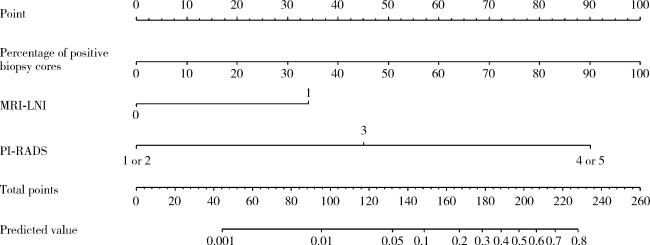
多因素Logistic回归分析表明,穿刺阳性针数百分比(P < 0.001)、PI-RADS (P=0.038)和MRI-LNI (P=0.003)是PLNM的独立预测因素,通过上述三个因素构建预测前列腺癌PLNM的列线图(图 1),并进行模型评价。
图1 预测前列腺癌PLNM的列线图

Figure 1 Nomogram for predicting PLNM in prostate cancer

PLNM, pelvic lymph node metastasis; PI-RADS, prostate imaging reporting and data system; MRI-LNI, MRI-indicated lymph node involvement.

2.5 多因素模型的ROC、校准图和决策曲线

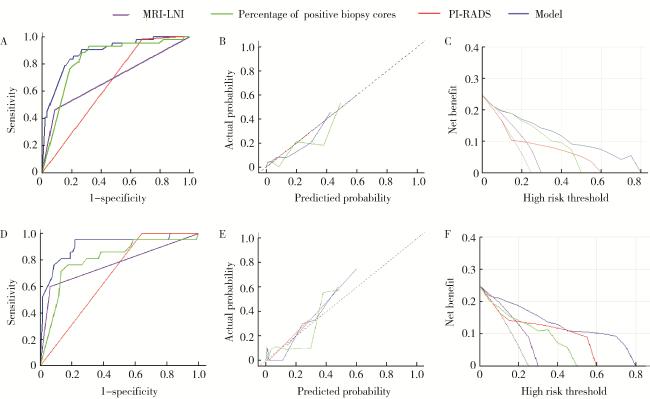
多因素模型的预测性能(AUC=0.883)显著优于穿刺阳性针数百分比(AUC=0.806, P=0.001)、PI-RADS (AUC=0.679, P < 0.001) 和MRI-LNI (AUC=0.768, P=0.018) (图 2AD)。校准图显示,多因素模型预测概率与实际概率具有极佳一致性(图 2BE)。决策曲线分析表明,当阈值概率>10%时,多因素模型的临床净获益最高(图 2CF)。
图2 MRI-LNI、PI-RADS、穿刺阳性针数百分比和多因素模型对于可疑PLNM的ROC、校准图和决策曲线分析

Figure 2 ROC curve, calibration plots and DCA of MRI-LNI, PI-RADS, percentage of positive biopsy cores, and the multivariable model for suspected PLNM

A, ROC curve in the training cohort; B, calibration plot in the training cohort; C, DCA in the training cohort; D, ROC curve in the validation cohort; E, calibration plot in the validation cohort; F, DCA in the validation cohort. ROC, receiver operating characteristic; DCA, decision curve analysis; PLNM, pelvic lymph node metastasis; PI-RADS, prostate imaging reporting and data system; MRI-LNI, MRI-indicated lymph node involvement.

2.6 多因素模型在不同截断值时对PLNM的诊断表现

表 4显示,多因素模型具有较高的预测准确度和显著的净收益,在6%的截断值下只漏检了约5.2%的PLNM(4/77),而减少了约53%的ePLND(139/267),显示出较好的预测效果。
表4 多因素模型在不同截断值时对PLNM的诊断表现

Table 4 Diagnostic performance of the multivariable model at different cutoff values for PLNM

Cutoff value Below the cutoff (PLND not recommended), n (%) Above the cutoff (PLND recommended), n (%)
Total Without PLNM With PLNM Total Without PLNM With PLNM
2% 92 (26.7) 90 (97.8) 2 (2.2) 252 (73.3) 177 (70.2) 75 (29.8)
3% 111 (32.3) 108 (97.3) 3 (2.7) 233 (67.7) 159 (68.2) 74 (31.8)
4% 120 (34.9) 116 (96.7) 4 (3.3) 224 (65.1) 151 (67.4) 73 (32.6)
5% 129 (37.5) 125 (96.9) 4 (3.1) 215 (62.5) 142 (66.0) 73 (34.0)
6% 143 (41.6) 139 (97.2) 4 (2.8) 201 (58.4) 128 (63.7) 73 (36.3)
7% 146 (42.4) 141 (96.6) 5 (3.4) 198 (57.6) 126 (63.6) 72 (36.4)
8% 159 (46.2) 152 (95.6) 7 (4.4) 185 (53.7) 115 (62.2) 70 (37.8)
9% 167 (48.5) 159 (95.2) 8 (4.8) 177 (51.5) 108 (61.0) 69 (39.0)
10% 182 (52.9) 174 (95.6) 8 (4.4) 162 (47.1) 93 (57.4) 69 (42.6)

PLNM, pelvic lymph node metastasis; PLND, pelvic lymph node dissection.

3 讨论

临床上常用列线图预测分析前列腺癌患者是否应进行PLND。中华医学会泌尿外科学分会和美国泌尿外科学分会认可列线图对高危前列腺癌PLNM的识别作用,并肯定了其在肿瘤分期与后期治疗中的作用,但其对于手术指征尚无绝对定论[14]。欧洲泌尿外科协会建议应用Briganti列线图评估淋巴结转移的风险,如果风险超过5%,则应进行ePLND,而美国国立综合癌症网络(National Comprehensive Cancer Network, NCCN)则认为,如果风险超过2%,就应进行ePLND[15-16]
由于不同的列线图是基于不同穿刺方法、手术方式和不同种族的患者构建的,因此在应用时也存在一定差异。目前,临床上应用最广泛的列线图是MSKCC列线图和Briganti列线图,它们综合了临床T分期、Gleason评分、PSA水平和穿刺阳性针数百分比来预测PLNM风险,两者的AUC分别为0.78和0.79,显示出良好的区分度[17-18]。值得注意的是,Briganti 2012列线图因未纳入机器人辅助手术的病例,存在一定的时代局限性,后续更新的Briganti 2017列线图通过引入组织活检病理学特征(最高级别癌占比、低级别癌占比),使该模型的诊断效果显著提升,在设定为7%风险阈值时,可减少69%的ePLND,而仅漏诊约1.5%的PLNM[19]。但是,随着前列腺靶向融合穿刺技术的兴起与发展,有研究发现,Briganti 2012和2017列线图等基于标准穿刺构建的模型在对于采用靶向融合穿刺的前列腺肿瘤患者时存在高估PLNM的风险[1, 19]。Briganti 2019列线图作为基于MRI靶向融合穿刺构建的列线图,其引入了PSA、临床分期、穿刺病理和MRI下病变的最大直径,其AUC为0.86,在7%的截断值下,可减少约60%的ePLND,而仅漏诊约1.6%的PLNM[20]。但是有研究发现,由于环境与种族的差异,Briganti列线图对于亚洲人可能并非最好的选择,基于日本前列腺癌患者人群构建的MSUG94列线图在预测前列腺癌PLNM时,内部验证与外部验证中的AUC可达0.84,优于Briganti列线图[21-22],也有研究报道,Briganti列线图可能并非中国患者最优的选择[23]
本研究纳入了穿刺确诊并行机器人辅助下前列腺根治性切除的患者,通过对临床特征与影像学特征进行单因素回归分析,选择了tPSA、fPSA、fPSA/tPSA、穿刺阳性针数百分比、PI-RADS、Gleason评分、临床T分期和MRI-LNI等变量,然后应用多因素Logistic回归分析构建最终模型,显示穿刺阳性针数百分比、PI-RADS和MRI-LNI是PLNM的独立预测因素。MRI作为识别前列腺癌PLNM最重要的指标之一,在识别PLNM时主要依据淋巴结的直径,一般认为,短轴大于8 mm的盆腔淋巴结为受累淋巴结,但这不可避免地导致约10%~35%的转移淋巴结被遗漏。在本研究建立的模型中,单纯依靠MRI识别前列腺癌PLNM的AUC仅为0.717,因此,单纯依靠MRI来预测PLNM是不够的[24]。与系统活检相似,本研究构建的基于靶向融合穿刺的模型也认为穿刺阳性针数百分比是预测前列腺癌PLNM最准确的预测指标,其AUC为0.805,这可能是因为我们穿刺前1~5针是基于mpMRI和超声检查发现的可疑恶性结节,而后又行12针系统穿刺所致,因此,对于穿刺阳性针数百分比较高的患者要特别警惕PLNM[1, 25]。PI-RADS也可作为评价前列腺癌PLNM的重要指标,Benidir等[26]的研究对45例术前PI-RADS≤3的前列腺癌患者行ePLND后,仅有1例术后发生PLNM,并且在后来的多因素Logistic回归分析中发现,相较于PSA等指标,PI-RADS对于预测前列腺癌的淋巴结转移更加重要,是独立影响因素。在本研究中,行ePLND的90例PI-RADS≤ 3的患者中仅有1人出现淋巴结阳性,因此,对于术前MRI考虑为PI-RADS≤3的患者,其发生PLNM的概率很低。但是,如果仅依靠PI-RADS,AUC仅为0.679,当我们将上述三个指标结合后,模型的AUC上升至0.883,诊断效果优于MSUG94列线图,显示出了多因素模型在预测前列腺癌PLNM上的巨大优势。我们的模型在6%的截断值下只漏检了约5.2%的PLNM(4/77),而减少了约53%的ePLND(139/267)。
需要明确的是,目前的研究暂未发现ePLND在前列腺癌的生化复发、转移和生存时间等方面有明显的肿瘤学获益[27-28]。相较于前列腺特异性膜抗原-正电子发射断层成像(positron emission tomography-prostate specific membrane antigen,PSMA-PET)等新技术、新方法的研究,我们的模型是基于传统影像学检查和临床参数构建的模型,在诊断准确度较高的基础上,花费少,可为中国前列腺癌患者的手术方案提供参考。但是需要指出的是,本研究是单中心回顾性研究,模型缺乏外部验证,研究仅纳入了ePLND的患者,可能导致样本选择偏倚,其代表性可能受到一定限制;但局限和/或标准淋巴结清扫范围有限,可能造成淋巴结转移的漏诊,从而影响模型的诊断准确性。
综上所述,本研究应用穿刺阳性针数百分比、PI-RADS、MRI-LNI等临床参数建立模型来预测前列腺癌PLNM的风险,可为中国前列腺癌患者的手术策略提供参考,有较高的准确度与临床实用性。

利益冲突    所有作者均声明不存在利益冲突。

作者贡献声明    张雪培、陶金、范雅峰:提出研究思路;于栓宝:设计研究方案;王泽远、郑浩轲:收集、分析、整理数据;王泽远:撰写论文;张雪培、于栓宝:总体把关和审定论文。

1
Briganti A, Larcher A, Abdollah F, et al. Updated nomogram predicting lymph node invasion in patients with prostate cancer undergoing extended pelvic lymph node dissection: the essential importance of percentage of positive cores[J]. Eur Urol, 2012, 61(3): 480- 487.

2
Sandhu S, Moore CM, Chiong E, et al. Prostate cancer[J]. Lancet, 2021, 398(10305): 1075- 1090.

3
Briganti A, Blute ML, Eastham JH, et al. Pelvic lymph node dissection in prostate cancer[J]. Eur Urol, 2009, 55(6): 1251- 1265.

4
Haiquel L, Cathelineau X, Sanchez-Salas R, et al. Pelvic lymph node dissection in high-risk prostate cancer[J]. Int Braz J Urol, 2022, 48(1): 54- 66.

5
Ploussard G, Briganti A, de la Taille A, et al. Pelvic lymph node dissection during robot-assisted radical prostatectomy: Efficacy, limitations, and complications: A systematic review of the literature[J]. Eur Urol, 2014, 65(1): 7- 16.

6
Dong B, Zhan H, Luan T, et al. The role and controversy of pelvic lymph node dissection in prostate cancer treatment: A focused review[J]. World J Surg Oncol, 2024, 22(1): 68.

7
Fossati N, Willemse PM, Van den Broeck T, et al. The benefits and harms of different extents of lymph node dissection during radical prostatectomy for prostate cancer: A systematic review[J]. Eur Urol, 2017, 72(1): 84- 109.

8
Touijer K, Fuenzalida RP, Rabbani F, et al. Extending the indications and anatomical limits of pelvic lymph node dissection for prostate cancer: Improved staging or increased morbidity?[J]. BJU Int, 2011, 108(3): 372- 377.

9
Woo S, Suh CH, Kim SY, et al. The diagnostic performance of MRI for detection of lymph node metastasis in bladder and prostate cancer: An updated systematic review and diagnostic meta-analysis[J]. AJR Am J Roentgenol, 2018, 210(3): W95- W109.

10
Hövels AM, Heesakkers RA, Adang EM, et al. The diagnostic accuracy of CT and MRI in the staging of pelvic lymph nodes in patients with prostate cancer: A meta-analysis[J]. Clin Radiol, 2008, 63(4): 387- 395.

11
Yang B, Dong H, Zhang S, et al. PSMA PET vs. mpMRI for lymph node metastasis of prostate cancer: A systematic review and head-to-head comparative meta-analysis[J]. Acad Radiol, 2024, 32(5): 2797- 2814.

12
Hou Y, Bao ML, Wu CJ, et al. A machine learning-assisted decision-support model to better identify patients with prostate cancer requiring an extended pelvic lymph node dissection[J]. BJU Int, 2019, 124(6): 972- 983.

13
van Leenders GJLH, van der Kwast TH, Grignon DJ, et al. The 2019 International Society of Urological Pathology (ISUP) Consensus Conference on grading of prostatic carcinoma[J]. Am J Surg Pathol, 2020, 44(8): e87- e99.

14
Eastham JA, Auffenberg GB, Barocas DA, et al. Clinically loca-lized prostate cancer: AUA/ASTRO guideline, Part Ⅰ: Introduction, risk assessment, staging, and risk-based management[J]. J Urol, 2022, 208(1): 10- 18.

15
Mottet N, van den Bergh RCN, Briers E, et al. EAU-EANM-ESTRO-ESUR-SIOG guidelines on prostate cancer-2020 update. Part 1: Screening, diagnosis, and local treatment with curative intent[J]. Eur Urol, 2021, 79(2): 243- 262.

16
Mohler JL, Antonarakis ES, Armstrong AJ, et al. Prostate cancer, version 2.2019, NCCN clinical practice guidelines in oncology[J]. J Natl Compr Canc Netw, 2019, 17(5): 479- 505.

17
Cagiannos I, Karakiewicz P, Eastham JA, et al. A preoperative nomogram identifying decreased risk of positive pelvic lymph nodes in patients with prostate cancer[J]. J Urol, 2003, 170(5): 1798- 1803.

18
Diamand R, Oderda M, Al Hajj Obeid W, et al. A multicentric study on accurate grading of prostate cancer with systematic and MRI/US fusion targeted biopsies: Comparison with final histopathology after radical prostatectomy[J]. World J Urol, 2019, 37(10): 2109- 2117.

19
Gandaglia G, Fossati N, Zaffuto E, et al. Development and internal validation of a novel model to identify the candidates for extended pelvic lymph node dissection in prostate cancer[J]. Eur Urol, 2017, 72(4): 632- 640.

20
Giorgio G, Guillaume P, Massimo V, et al. A novel nomogram to identify candidates for extended pelvic lymph node dissection among patients with clinically localized prostate cancer diagnosed with magnetic resonance imaging-targeted and systematic biopsies[J]. Eur Urol, 2019, 75(3): 506- 514.

21
Yusuke G, Takanobu U, Masafumi M, et al. Development and validation of novel nomogram to identify the candidates for exten-ded pelvic lymph node dissection for prostate cancer patients in the robotic era[J]. Int J Urol, 2023, 30(8): 659- 665.

22
Makoto K, Shin E, Tomoyuki T, et al. A nomogram for predicting prostate cancer with lymph node involvement in robot-assisted radical prostatectomy era: A retrospective multicenter cohort study in Japan (The MSUG94 Group)[J]. Diagnostics (Basel), 2022, 12(10): 2545.

23
Li Z, Huang Y, Zhao D, et al. Development and internal validation of a novel nomogram for predicting lymph node invasion for prostate cancer patients undergoing extended pelvic lymph node dissection[J]. Front Oncol, 2023, 13, 1186319.

24
Qin C, Goldberg O, Kakar G, et al. MRI fat fraction imaging of nodal and bone metastases in prostate cancer[J]. Eur Radiol, 2023, 33(8): 5851- 5855.

25
Heidenreich A, Pfister D, Thüer D, et al. Percentage of positive biopsies predicts lymph node involvement in men with low-risk prostate cancer undergoing radical prostatectomy and extended pelvic lymphadenectomy[J]. BJU Int, 2011, 107(2): 220- 225.

26
Benidir T, Lone Z, Nguyen JK, et al. The combination of prostate MRI PI-RADS scoring system and a genomic classifier is associated with pelvic lymph node metastasis at the time of radical prostatectomy[J]. Br J Radiol, 2023, 96(1144): 20220663.

27
Eastham JA, Auffenberg GB, Barocas DA, et al. Clinically loca-lized prostate cancer: AUA/ASTRO guideline, Part Ⅱ: Principles of active surveillance, principles of surgery, and follow-up[J]. J Urol, 2022, 208(1): 19- 25.

28
Cornford P, van den Bergh RCN, Briers E, et al. EAU-EANM-ESTRO-ESUR-ISUP-SIOG guidelines on prostate cancer-2024 update. Part Ⅰ: Screening, diagnosis, and local treatment with curative intent[J]. Eur Urol, 2024, 89(2): 148- 163.

文章导航

/