论著

前列腺体积不同的患者经尿道光纤铥激光前列腺剜除术的有效性及安全性比较

  • 左超 1, 2, * ,
  • 王国立 1, * ,
  • 杨昆霖 1 ,
  • 车新艳 1 ,
  • 孟一森 , 1, * ,
  • 张凯 , 1, *
展开
  • 1. 北京大学第一医院泌尿外科, 北京 100034
  • 2. 北京市密云区医院泌尿外科, 北京 101500
MENG Yisen, e-mail,
ZHANG Kai, e-mail,

* These authors contributed equally to this work

收稿日期: 2025-03-03

  网络出版日期: 2025-08-02

基金资助

研究型病房卓越临床研究计划(BRWEP2024W054070103)

中央高水平医院临床科研专项-北京大学第一医院科技成果转化孵育引导基金(2023CX01)

版权

版权所有,未经授权,不得转载。

Comparison of efficacy and safety of transurethral thulium fiber laser enucleation of prostate in patients with different prostate volumes

  • Chao ZUO 1, 2 ,
  • Guoli WANG 1 ,
  • Kunlin YANG 1 ,
  • Xinyan CHE 1 ,
  • Yisen MENG , 1, * ,
  • Kai ZHANG , 1, *
Expand
  • 1. Department of Urology, Peking University First Hospital, Beijing 100034, China
  • 2. Department of Urology, Beijing Miyun District Hospital, Beijing 101500, China

Received date: 2025-03-03

  Online published: 2025-08-02

Supported by

the Clinical Research Program for Researching Hospital Wards(BRWEP2024W054070103)

the National High Level Hospital Clinical Research Funding-Scientific and Technological Achievements Transformation Incubation Guidance Fund Project of Peking University First Hospital(2023CX01)

Copyright

All rights reserved. Unauthorized reproduction is prohibited.

摘要

目的: 评估采用光纤铥激光前列腺剜除术(thulium fiber laser enucleation of the prostate,ThuFLEP)治疗超大体积(>200 mL)前列腺的有效性和安全性。方法: 回顾性分析2022年1月至2024年5月,于北京大学第一医院由同一泌尿外科医师进行手术的485例良性前列腺增生(benign prostatic hyperplasia, BPH)患者的临床资料,患者均采用光纤铥激光,根据前列腺总体积(total volume of the prostate,TPV)将患者分为三组:A组TPV < 100 mL、B组100 mL≤TPV < 200 mL、C组TPV≥200 mL。三组患者的年龄[(69.38±7.79)岁、(69.64±8.69)岁、(70.32±7.44)岁]、国际前列腺症状评分(International Prostate Symptom Score,IPSS)[(22.7±1.9)分、(22.8±2.7)分、(25.8±3.7)分]、最大尿流率(maximum urinary flow rate,Qmax)[(7.9±2.7) mL/s、(9.3±4.3) mL/s、(9.9±3.3) mL/s]差异均无统计学意义(P>0.05);三组患者的前列腺体积[(103.49±46.19) mL、(75.73±30.69) mL、(273.49±49.19) mL]、前列腺特异性抗原(prostate specific antigen, PSA)[3.52 (1.05, 8.76) μg/L、6.78 (1.61, 7.45) μg/L、8.52 (5.05, 12.76) μg/L]差异均有统计学意义(P < 0.05)。结果: 所有患者的手术均顺利完成,三组患者的剜除时间[30.0 (21.2, 44.5) min、41.6 (31.2, 52.5) min、45.1 (35.2, 50.0) min]、住院时间[(6.06±1.21) d、(6.15±1.50) d、(7.71±1.74) d]差异均无统计学意义(P>0.05);而三组患者的术后留置导尿管时间[(4.0±1.4) d、(4.0±1.3) d、(6.6±1.1) d]、手术时间[61 (42, 89) min、82 (62, 105) min、115 (96, 142) min]、剜除效率[1.29 (0.71, 1.56) g/min、1.67 (1.23, 2.15) g/min、2.74 (2.20, 3.34) g/min]、血红蛋白下降值[12 (7, 19) g/L、17 (11, 24) g/L、27 (19, 35) g/L]差异均有统计学意义(P < 0.05)。线性回归分析显示,剜除效率与剜除重量之间存在较强的正向线性相关(r=0.880,P < 0.001),剜除效率随着前列腺体积增加而提高。术后三组患者之间的IPSS[(6.6±1.7)分、(6.2±1.4)分、(4.6±1.1)分]、Qmax[(18.9±3.1) mL/s、(16.8±3.8) mL/s、(22.9±7.1) mL/s]差异均无统计学意义(P>0.05)。术后的IPSS、Qmax与术前比较差异均有统计学意义,但术后C组Qmax的提高明显高于其他两组(P < 0.05)。术后并发症以Clavien-Dindo并发症系统评分为标准,分为Clavien-Dindo Ⅰ (尿潴留、持续性血尿)、Clavien-Dindo Ⅱ (腺体残余、泌尿系感染、输血)和Clavien-Dindo Ⅲ (尿道狭窄、膀胱颈挛缩、出血并再次手术),三组患者术后均随访3个月,Clavien-Dindo的并发症发生率分别为5.2% (13例)、6.7% (12例)和12.1% (7例),组间差异有统计学意义(P < 0.05),其中,泌尿系感染、输血及出血并再次手术的组间差异有统计学意义(P < 0.05),其他并发症的组间差异无统计学意义(P>0.05)。结论: 前列腺体积越大,输血及再次手术的风险增高,剜除效率随着前列腺体积的增加而提高,光纤铥激光前列腺剜除术治疗超大体积的BPH安全、有效。

本文引用格式

左超 , 王国立 , 杨昆霖 , 车新艳 , 孟一森 , 张凯 . 前列腺体积不同的患者经尿道光纤铥激光前列腺剜除术的有效性及安全性比较[J]. 北京大学学报(医学版), 2025 , 57(4) : 711 -716 . DOI: 10.19723/j.issn.1671-167X.2025.04.013

Abstract

Objective: To evaluate the effectiveness and safety of thulium fiber laser enucleation of the prostate (ThuFLEP) in the treatment of oversized (>200 mL) prostate. Methods: Clinical data of 475 benign prostatic hyperplasia (BPH) patients operated by the same urologist at Peking University First Hospital from January 2022 to May 2024 were retrospectively analyzed, all of whom were treated with thulium fiber laser, and the patients were divided into three groups according to the total volume of the prostate (TPV): group A (TPV < 100 mL), group B (100 mL≤TPV < 200 mL), and group C (TPV≥200 mL). The age of the patients in the three groups [(69.38±7.79) years, (69.64±8.69) years, (70.32±7.44) years], International Prostate Symptom Score (IPSS) [(22.7±1.9), (22.8±2.7), (25.8±3.7)], and the maximum urinary flow rate (Qmax) [(7.9±2.7) mL/s, (9.3±4.3) mL/s, (9.9±3.3) mL/s] were not statistically significant (P>0.05). The prostate volume in the three groups [(103.49±46.19) mL, (75.73±30.69) mL, (273.49±49.19) mL] and prostate specific antigen (PSA) [3.52 (1.05, 8.76) μg/L, 6.78 (1.61, 7.45) μg/L, 8.52 (5.05, 12.76) μg/L] were statistically significant (P < 0.05). Results: All surgeries were successfully completed. The dif-ferences in enucleation time [30.0 (21.2, 44.5) min, 41.6 (31.2, 52.5) min, 45.1 (35.2, 50.0) min] and hospitalization time [(6.06±1.21) d, (6.15±1.50) d, (7.71±1.74) d] among the three groups were not statistically significant (P>0.05); and the differences in the postoperative indwelling catheter time [(4.0±1.4) d, (4.0±1.3) d, (6.6±1.1) d], operative time [61 (42, 89) min, 82 (62, 105) min, 115 (96, 142) min], enucleation efficiency [1.29 (0.71, 1.56) g/min, 1.67 (1.23, 2.15) g/min, 2.74 (2.20, 3.34) g/min], and hemoglobin drop values [12 (7, 19) g/L, 17 (11, 24) g/L, 27 (19, 35) g/L] were statistically different (P < 0.05). Linear regression ana-lysis was used to show a strong positive linear correlation between enucleation efficiency and enucleation weight (r=0.880, P < 0.001), and the enucleation efficiency increased with the increase of prostate volume. The differences in IPSS [(6.6±1.7), (6.2±1.4), (4.6±1.1)] and Qmax [(18.9±3.1) mL/s, (16.8±3.8) mL/s, (22.9±7.1) mL/s] were not statistically significant among the three groups (P>0.05), and the differences in IPSS and Qmax were statistically significant compared with those before surgery. The differences were statistically significant in preoperative comparisons, but the postoperative urinary flow rate of group C increased significantly more than the remaining two groups in terms of Qmax (P < 0.05). The patients in the three groups were followed up for 3 months, and post-operative complications were categorized into Clavien-Dindo Ⅰ (urinary retention, persistent hematu-ria), Clavien-Dindo Ⅱ (glandular remnants, urinary tract infection, blood transfusion) and Clavien-Dindo Ⅲ (urethral stenosis, contracture of the bladder neck, and reoperation for hemorrhage) based on the Clavien-Dindo Complications System score, the incidence of Clavien-Dindo in the three groups was 5.2% (13 cases), 6.7% (12 cases) and 12.1% (7 cases), respectively, with statistically significant differences (P < 0.05); among them, there were statistically significant differences in urinary infection, blood transfusion and bleeding reoperation (P < 0.05), and there was no statistically significant difference in the remaining complications (P>0.05). Conclusion: The risk of blood transfusion and re-hemostasis increases with larger prostate volume, the efficiency of enucleation increases with the increase of prostate vo-lume, and thulium fiber laser prostate enucleation is safe and effective in the treatment of large-volume BPH.

良性前列腺增生(benign prostatic hyperplasia, BPH)是老年男性的常见疾病,其导致的膀胱出口梗阻是老年男性下尿路症状的常见原因。随着老龄化人口的增加,BPH的患病率也随之增加,出现BPH并发症的患者也呈显著增加趋势[1]。随着年龄增长,BPH患病率呈升高趋势,早期应用药物治疗能够减轻患者前列腺增生症状,但随着前列腺体积增大,症状逐渐加重,大部分患者的最终结局为外科手术治疗[2],从而也导致当前的BPH患者进行手术时,前列腺体积明显增大,临床上越来越多见超大体积前列腺(>200 mL)进行外科治疗,腺体越大意味着手术风险越高[3]
前列腺解剖内镜下剜除术(anatomical endoscopic enucleation of the prostate,AEEP)遵循前列腺的解剖平面,能够实现与开放手术同等的效果[4],理论上,该手术能以微创的方式达到最大疗效,应用激光完成解剖性剜除,目前主要使用的是钬激光和铥激光,是欧洲泌尿外科协会[2]唯一推荐的用于前列腺体积>80 mL患者的内镜良性前列腺梗阻手术。近年来,经尿道铥激光/钬激光前列腺剜除术因其与经尿道前列腺电切术(transurethral resection of prostate, TURP)一致的疗效和更好的安全性而成为主流术式[5],但对于大体积前列腺,尤其是>200 mL的超大体积前列腺的研究尚不足。本文旨在评估光纤铥激光前列腺剜除术(thulium fiber laser enucleation of the prostate,ThuFLEP)治疗超大体积(>200 mL)前列腺的有效性和安全性,并总结ThuFLEP治疗超大体积(>200 mL)前列腺的经验及教训。

1 资料与方法

1.1 一般资料

回顾性分析2022年1月至2024年5月就诊于北京大学第一医院,由同一泌尿外科医师进行手术的485例BPH患者的临床资料,患者均采用光纤铥激光,根据前列腺总体积(total volume of the prostate,TPV)将患者分为A组(TPV<100 mL,248例)、B组(100 mL≤TPV<200 mL,179例)和C组(TPV≥200 mL,58例)。
纳入标准:患者术前诊断为BPH、有外科手术的绝对或相对指征。排除标准:前列腺癌、膀胱逼尿肌收缩无力、膀胱颈挛缩、尿道狭窄等。
血清前列腺特异性抗原(prostate specific antigen, PSA)由前列腺上皮细胞产生,前列腺体积增大(如BPH)时,上皮细胞总量增加,导致PSA分泌增多,有研究显示,前列腺体积每增加1 cm3,PSA平均升高约0.03~0.05 μg/L[6]。因此,PSA异常者[如总前列腺特异性抗原(total prostate specific antigen, tPSA)≥10.0 μg/L,或tPSA为4.0~10.0 μg/L且游离前列腺特异性抗原(free prostate specific antigen, fPSA)/tPSA<0.16],应参考前列腺MRI检查结果,行前列腺穿刺活检以除外前列腺癌。本研究遵循的程序符合2013年修订的《赫尔辛基宣言》要求,并获得北京大学第一医院生物医学伦理委员会审查批准(批件号:2024研604-001)。

1.2 手术方法

手术设备为光纤铥激光治疗机(55 W-1.0 J,脉冲波模式)。采用“U”形整叶法前列腺剜切术的关键步骤如下[7]:观察前列腺尿道、膀胱,确认外括约肌位置后,在精阜近端尿道黏膜做倒“U”形切开,在精阜的一侧拨出前列腺外科包膜层次并扩大,将尖部撬起到3点钟位置,同法处理另一侧到9点钟位置。沿括约肌内侧与前列腺尖部的间隙向12点钟方向锐性分离,确定前列腺尖部12点钟位置。弧形切开12点钟位置的尿道黏膜及前列腺组织,由外向内直至膀胱颈,深及环形纤维,向两侧扩大,至少达到1点钟和11点钟位置,形成“12点钟的沟”(顶沟)。沿顶沟向左叶扩展平面,使左叶上半部分游离;沿顶沟向右叶扩展平面,使右叶上半部分游离。在左侧叶下半部分沿外科包膜平面及膀胱颈进行剜切,与左侧叶上半部分相连通,使左侧叶与外科包膜完全离断。采用剜切结合方式处理中叶、右侧叶,离断呈“U”形的增生腺体。最后进行止血,修整创面,粉碎并吸出剜除的前列腺组织(若腺体>300 mL,则于耻骨上开放取出前列腺标本),称重并记录。

1.3 观察指标

观察指标包括:三组患者的年龄、国际前列腺症状评分(International Prostate Symptom Score, IPSS)、最大尿流率(maximum urinary flow rate,Qmax)、前列腺体积、PSA、剜除时间、住院时间、术后留置导尿管时间、手术时间、剜除效率(剜除重量/剜除时间)、血红蛋白下降值、术后并发症。术后并发症以Clavien-Dindo并发症系统评分为标准,分为Clavien-Dindo Ⅰ (尿潴留、持续性血尿)、Clavien-Dindo Ⅱ (腺体残余、泌尿系感染、输血)和Clavien-Dindo Ⅲ (尿道狭窄、膀胱颈挛缩、出血并再次手术)。患者术后随访,出院后1个月及3个月复查尿流率、尿常规、IPSS、生活质量(quality of life,QoL)评分、泌尿系超声及残余尿,通过以上指标比较三组之间的差异。

1.4 统计学分析

采用SPSS 22.0统计软件分析数据,符合正态分布的计量资料采用${\bar x}$±s表示,组间比较采用独立样本t检验,手术前后数据的比较采用配对t检验;不符合正态分布的计量资料以M(P25, P75)表示,组间比较采用Wilcoxon秩和检验;计数资料用构成比表示,组间比较采用χ2检验;两两比较采用最小显著差异(least significant difference,LSD)法,不符合正态分布的采用非参数检验,n>10采用Bonferroni较正法,两两比较采用Kruskal-Wallis H检验;手术剜除效率与剜除质量的关系采用线性相关分析。以P<0.05为差异有统计学意义。

2 结果

2.1 患者一般临床资料比较

三组患者的年龄、IPSS、Qmax差异均无统计学意义,部分患者tPSA高于正常,但经过前列腺穿刺活检除外前列腺癌,可见C组患者(大体积前列腺组)的tPSA明显高于其他两组,差异有统计学意义(P=0.012),具体见表 1
表1 BPH患者的一般资料

Table 1 General characteristic of BPH patients

Items Group A Group B Group C F/H P
Age/years, ${\bar x}$±s 69.38±7.79 69.64±8.69 70.32±7.44 1.48 0.231
Prostate volume/mL, ${\bar x}$±s 103.49±46.19 75.73±30.69 273.49±49.19 1.134 0.007
tPSA/(μg/L), M(P25, P75) 3.52 (1.05, 8.76) 6.78 (1.61, 7.45) 8.52 (5.05, 12.76) 0.981 0.012
IPSS, ${\bar x}$±s 22.7±1.9 22.8±2.7 25.8±3.7 1.897 0.543
Qmax/(mL/s), ${\bar x}$±s 7.9±2.7 9.3±4.3 9.9±3.3 1.008 0.238

Group A, the total volume of the prostate (TPV)<100 mL; Group B, 100 mL≤TPV<200 mL; Group C, TPV≥200 mL. Kruskal-Wallis H test for tPSA between groups: Group A vs. Group B, P=0.06 (non-significant); Group A vs. Group C, P=0.027 (statistically significant); Group B vs. Group C, P=0.588 (non-significant). tPSA, total prostate specific antigen; IPSS, International Prostate Symptom Score; Qmax, maximum urinary flow rate.

2.2 围手术期各项指标的比较

所有患者的手术均顺利完成,三组患者的剜除时间、住院时间差异均无统计学意义(P>0.05);术后留置导尿管时间、手术时间、剜除效率、血红蛋白下降值三组间差异有统计学意义(P<0.05)。C组患者(前列腺体积>200 mL组)术后留置尿管时间和手术时间较其他两组均明显延长,但剜除效率明显提升,同时,C组患者血红蛋白下降值较其他两组明显增加,A组与B组间差异无统计学意义,具体见表 2
表2 BPH患者围手术期资料

Table 2 Perioperative characteristics of BPH patients

Items Group A Group B Group C F/Z P
Operative time/min, M(P25, P75) 61 (42, 89) 82 (62, 105) 115 (96, 142) 1.917 0.004
Enucleation time/min, M(P25, P75) 30.0 (21.2, 44.5) 41.6 (31.2, 52.5) 45.1 (35.2, 50.0) 10.07 0.673
Hospitalization period/d, ${\bar x}$±s 6.06±1.21 6.15±1.50 7.71±1.74 23.05 0.165
Enucleation efficacy/(g/min), M(P25, P75) 1.29 (0.71, 1.56) 1.67 (1.23, 2.15) 2.74 (2.20, 3.34) 16.29 <0.001
Catheterization period/d, ${\bar x}$±s 4.0±1.4 4.0±1.3 6.6±1.1 2.178 0.045
Decrease in hemoglobin/(g/L), M(P25, P75) 12 (7, 19) 17 (11, 24) 27 (19, 35) 3.984 0.003

Group A, the total volume of the prostate (TPV)<100 mL; Group B, 100 mL≤TPV<200 mL; Group C, TPV≥200 mL. Kruskal-Wallis H test for enucleation time between groups: Group A vs. Group B, P=0.009; Group A vs. Group C, P<0.001; Group B vs. Group C, P=0.030. Kruskal-Wallis H test for enucleation efficiency between groups: Group A vs. Group B, P=0.018; Group A vs. Group C, P<0.001; Group B vs. Group C, P<0.001. Least significant difference (LSD) test for catheter indwelling time between groups: Group A vs. Group B, P=0.29; Group A vs. Group C, P<0.001; Group B vs. Group C, P=0.030. Kruskal-Wallis H test for hemoglobin decline between groups: Group A vs. Group B, P=0.38; Group A vs. Group C, P<0.001; Group B vs. Group C, P<0.001.

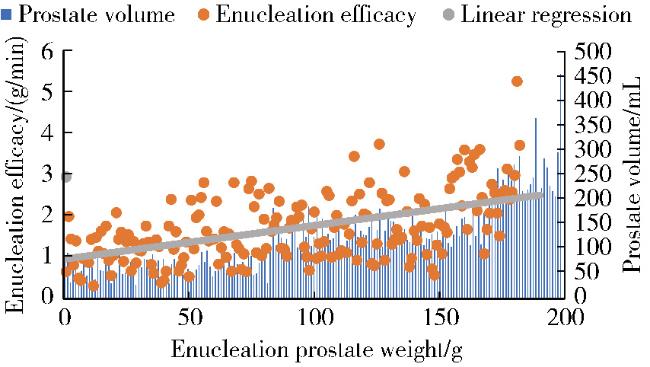
采用散点图可视化剜除效率与剜除重量的关系,简单线性回归分析显示,剜除效率与剜除重量之间存在较强的正向线性相关(r=0.880,P<0.001),回归方程为y=0.25+1.08x(R2=0.774),剜除效率随前列腺体积增加而提高(图 1)。术后三组患者之间的IPSS[(6.6±1.7)分、(6.2±1.4)分与(4.6±1.1)分]和Qmax[(18.9±3.1) mL/s、(16.8±3.8) mL/s与(22.9±7.1) mL/s]差异均无统计学意义(P>0.05),但术后与术前比较,三组患者的IPSS、Qmax差异均有统计学意义,术后尿流率比较,C组Qmax的提高明显大于其余两组(P<0.05)。
图1 前列腺体积与剜除效率的线性回归分析

Figure 1 Linear regression analysis of prostate volume and enucleation efficacy

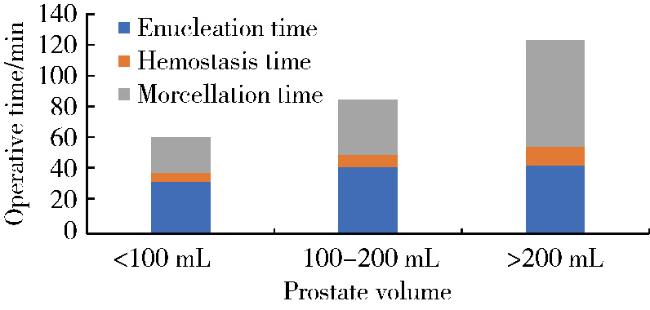
经尿道前列腺剜除手术包括三个主要的手术时间阶段:剜除时间、止血时间及粉碎取出时间。总体手术时间三组之间存在差异,前列腺体积超过200 mL的患者手术时间明显延长,中位手术时间115 min,但剜除时间三组间无明显差异,大体积前列腺患者手术时间的延长主要是因为止血时间长和取出标本时间长(图 2)。
图2 不同体积前列腺剜除手术的时间(剜除时间+止血时间+粉碎取出时间)

Figure 2 Operative time of enucleation of prostate with different volumes (enucleation+hemostasis+morcellation)

2.3 术后并发症的比较

三组患者均随访3个月,术后并发症以Clavien-Dindo并发症系统评分为标准,分为Clavien-Dindo Ⅰ (尿潴留、持续性血尿)、Clavien-Dindo Ⅱ (腺体残余、泌尿系感染、输血)和Clavien-Dindo Ⅲ (尿道狭窄、膀胱颈挛缩、出血并再次手术),三组患者Clavien-Dindo的发生率分别为5.2% (13例)、6.7% (12例)和12.1% (7例),差异有统计学意义(P<0.05)。并发症中,泌尿系感染、输血和出血并再次手术这几项组间差异有统计学意义(P<0.05),其余并发症组间差异无统计学意义(P>0.05)。前列腺体积大于100 mL者,输血和出血并再次手术的概率增加(P<0.05),见表 3
表3 术后并发症(Clavien-Dindo)

Table 3 Postoperative complications (Clavien-Dindo)

Complications Group A Group B Group C P
Overall adverse events, n(%) 13 (5.2) 12 (6.7) 7 (12.1) 0.004
Clavien-Dindo Ⅰ, n 2 1 2
    Recatheterization 1 1 1 0.446
    Hematuresis 1 0 1 0.166
Clavien-Dindo Ⅱ, n 2 6 4
    Clot retention 0 2 0 0.213
    Urinary tract infection 1 1 2 0.041
    Transfusion 1 3 2 0.013
Clavien-Dindo Ⅲ, n 9 5 1
    Urethral stricture 4 1 0 0.420
    Bladder neck contracture 5 0 0 0.033
    Reoperation 0 4 1 0.034

Group A, the total volume of the prostate (TPV)<100 mL; Group B, 100 mL≤TPV<200 mL; Group C, TPV≥200 mL.

3 讨论

BPH是中老年男性常见的排尿障碍性疾病,是泌尿外科最常见的疾病之一[2, 6]。在评估由BPH引起的膀胱出口梗阻的各种治疗方式时,前列腺体积大小是一个主要考虑因素。TURP是BPH外科治疗的基石,但仍具有较高的出血风险,随着前列腺体积的增大,该手术并发症的发生率增加[8]。患者围手术期并发症的发病率与前列腺大小密切相关,随着手术时间的延长,出血量和经尿道前列腺电切综合征的发生率明显增加[9]。近年来,激光手术因其出血少、围手术期并发症发生率低、术后恢复时间短和不出现经尿道前列腺电切综合征等优势,在BPH外科治疗中的应用越来越广泛[10]。《欧洲泌尿外科指南》推荐了激光切除、汽化或剜除等术式用于不同体积的前列腺增生,对于体积大于80 mL的BPH患者,推荐使用前列腺剜除术,可代替TURP和开放手术治疗中重度下尿路症状的BPH患者,经尿道激光前列腺剜除术有望成为BPH治疗的新标准[2]。目前仅有少量研究提示,对于较大体积的前列腺,尤其是体积大于200 mL的前列腺,钬激光前列腺剜除术存在一定优势,但存在出血量较多的风险[11]。光纤铥激光为1 940 nm的激光,属于铥激光的一种,具有精准切割、快速止血的特性,在前列腺剜除中具有一定优势[6, 12],且铥激光剜除手术更易于学习[13]
本研究中,大体积BPH组(前列腺体积大于100 mL)的患者术前留置尿管且无拔除的患者比例(78.1% vs. 23.6%)明显较高,这可能是由于大体积前列腺增生手术相对复杂,存在高危因素,患者倾向于坚持更长时间的药物治疗。目前国内外在超大体积前列腺的手术治疗方面均缺乏经验,手术时间是重要的考虑因素,因为全身麻醉持续时间越长,发生心血管事件的风险越大。经尿道前列腺剜除手术包括三个主要的手术时间阶段:剜除时间、止血时间及标本取出时间。本研究发现,总体手术时间三组之间存在差异,前列腺体积超过200 mL的患者手术时间明显延长,中位手术时间115 min,但剜除时间三组间无明显差异,大体积前列腺患者手术时间的延长主要是因为止血时间长和标本取出时间长,因为前列腺体积越大意味着创面越大,止血时间相对延长,切除组织越多,粉碎时间越长。值得关注的是,剜除效率在三组患者间存在明显差异,剜除效率随着前列腺体积的增加而增加。Zell等[14]也报道了类似的结果。前列腺体积过大可能更适合内镜下解剖性前列腺剜除术。
C组(超大体积BPH组,前列腺体积>200 mL)患者术后留置尿管的时间相对较长,明显高于前列腺体积小于200 mL的患者,平均留置尿管时间为6~7 d,可能与术后血尿时间相对较长相关,主要由于患者存在二次出血及再次手术的顾虑,故保留尿管的时间相对较长。C组患者术后血红蛋白下降较多(P<0.05),中位下降值27 g/L,这与手术时间长、术后创面较大相关,另外两组间差异无统计学意义(P>0.05)。
术后并发症方面,膀胱颈挛缩主要局限于A组(前列腺体积<100 mL组)。以往研究表明,不同手术方式膀胱颈挛缩的发生率大致相同,小体积前列腺、多次保留尿管与TURP或ThuLEP术后膀胱颈挛缩的发生呈正相关[15]。术后泌尿系感染与输血主要集中于前列腺体积>100 mL组(B组和C组),术后发生的泌尿系感染可能与手术时间长、术前留置尿管时间长相关,建议术前给予患者积极抗炎,术后适当延长抗生素的使用时间。输血在前列腺体积>100 mL组(B组和C组)中发生概率较高,考虑可能与术后创面较大相关,B组和C组间差异无统计学意义(P>0.05)。
在手术难度方面,C组(前列腺体积>200 mL)患者相对来说手术难度较大,本组患者中,前列腺体积最大约为550 mL,存在多种挑战与困难,我们总结了本组手术中的经验和教训如下:(1)因血运极其丰富,存在大量粗大血管,视野不清,需要实时止血尽量保持视野清晰,术后前列腺创面较大、创面存在广泛渗血者建议更换等离子球形电切环彻底止血;(2)由于前列腺体积较大,偶尔会遇到激光镜长度不足的情况,过于狭窄的空间和膀胱镜的锐角不断干扰膀胱镜视野,此时可采取分叶法或适当延长激光光纤伸出长度;(3)大体积前列腺往往存在多发性腺瘤结节,容易进入结节间层面,导致迷失方向,建议严格沿着包膜平面推进,若存在较大结节嵌入包膜内,可发挥铥激光的汽化优势将结节汽化;(4)前列腺体积较大而膀胱颈相对较小,腺体无法推入至膀胱内,此时可行分叶法,将腺体分块推入至膀胱;(5)前列腺中叶突入膀胱覆盖三角区及输尿管口,导致无法看清输尿管口,剜除过程中有损伤输尿管口及膀胱三角区的可能,建议严格沿包膜平面及膀胱颈剜除,尽量于6点钟方向离断前列腺,避免引起副损伤;(6)剜除后前列腺体积较大,粉碎时间延长,可行耻骨上开放切开取出标本,留置膀胱造瘘管,此法增加了冲洗通道,可避免术后出血及血块梗阻导致膀胱填塞的可能。
综上所述,对于不同体积的前列腺,甚至于超大体积的前列腺,经尿道行ThuFLEP安全、有效,剜除效率随着前列腺体积增加而提高。

利益冲突  所有作者均声明不存在利益冲突。

作者贡献声明  左超:收集、分析、整理数据,撰写论文;王国立:撰写论文;杨昆霖、车新艳:收集、分析、整理数据;孟一森、张凯:提出研究思路,总体把关和审定论文。

1
Zhu C , Wang DQ , Zi H , et al. Epidemiological trends of urinary tract infections, urolithiasis and benign prostatic hyperplasia in 203 countries and territories from 1990 to 2019[J]. Mil Med Res, 2021, 8 (1): 64- 76.

2
Baboudjian M , Hashim H , Bhatt N , et al. Summary paper on underactive bladder from the European Association of Urology guidelines on non-neurogenic male lower urinary tract symptoms[J]. Eur Urol, 2024, 86 (3): 213- 220.

3
Tallè M , Giulioni C , Papaveri A , et al. Influence of preoperative indwelling urinary catheter on outcomes of high-power holmium laser enucleation for very large prostate (≥ 200 mL)[J]. World J Urol, 2025, 43 (1): 223- 229.

4
Gabrielson AT , Tanidir Y , Castellani D , et al. A global survey of ergonomics practice patterns and rates of musculoskeletal pain among urologists performing retrograde intrarenal surgery[J]. J Endourol, 2022, 36 (9): 1168- 1176.

5
Doizi S . Lasers for benign prostatic hyperplasia (hybrid, blue diode, TFL, Moses). Which one to choose?[J]. Curr Opin Urol, 2022, 32 (4): 438- 442.

6
Nunes RV , Manzano J , Truzzi JC , et al. Treatment of benign prostatic hyperplasia[J]. Rev Assoc Med Bras (1992), 2017, 63 (2): 95- 99.

7
左超, 杨昆霖, 车新艳, 等. "U"形整叶法经尿道光纤铥激光前列腺剜切术治疗良性前列腺增生的疗效和安全性[J]. 中华泌尿外科杂志, 2024, 45 (7): 515- 520.

8
Sandhu JS , Bixler BR , Dahm P , et al. Management of lower urinary tract symptoms attributed to benign prostatic hyperplasia (BPH): AUA guideline amendment 2023[J]. J Urol, 2024, 211 (1): 11- 19.

9
Bulai CA , Multescu RD , Geavlete PA , et al. The impact of transurethral enucleation therapeutic approach in all-size benign prostatic obstruction pathology: From contemporary technological advances to evidence-based clinical progresses[J]. Diagnostics (Basel), 2025, 15 (4): 416- 421.

10
中华医学会泌尿外科学分会激光学组, 微创学组, 尿控学组. 经尿道激光前列腺剜除术热点问题中国专家共识[J]. 中华泌尿外科杂志, 2024, 45 (7): 489- 496.

11
Boxall NE , Georgiades F , Miah S , et al. A call for HoLEP: AEEP for mega-prostates (≥ 200 cc)[J]. World J Urol, 2021, 39 (7): 2347- 2353.

12
Wang J , Wu S , Wang M . Role of thulium laser and holmium laser in the surgical treatment of benign prostatic hyperplasia: A systemic review and meta-analysis[J]. Iran J Public Health, 2024, 53 (3): 495- 507.

13
左超, 杨昆霖, 李志存, 等. "双沟双环法"经尿道铥激光前列腺剜除术单一术者学习曲线分析[J]. 中华医学杂志, 2023, 103 (20): 1563- 1567.

14
Zell MA , Abdul-Muhsin H , Navaratnam A , et al. Holmium laser enucleation of the prostate for very large benign prostatic hyperplasia (≥ 200 cc)[J]. World J Urol, 2021, 39 (1): 129- 134.

15
Chen YZ , Lin WR , Chow YC , et al. Analysis of risk factors of bladder neck contracture following transurethral surgery of prostate[J]. BMC Urol, 2021, 21 (1): 59- 63.

文章导航

/