论著

敲减Blimp1基因表达对CCl4诱导的小鼠肝纤维化模型早期肝损伤的保护作用

  • 秦秋实 1 ,
  • 李蕊 2, 3 ,
  • 周妍希 2, 3 ,
  • 张玥 2, 3 ,
  • 韩铭 2, 3 ,
  • 朱鏐娈 , 1, 2, 3, *
展开
  • 1. 北京大学地坛医院教学医院, 北京 100015
  • 2. 首都医科大学附属北京地坛医院传染病研究所, 新发突发传染病研究北京市重点实验室, 北京 100015
  • 3. 北京市感染性疾病研究中心, 北京 100015
ZHU Liuluan, e-mail,

收稿日期: 2022-09-16

  网络出版日期: 2025-08-02

基金资助

国家自然科学基金(81871586)

国家自然科学基金(81671940)

版权

版权所有,未经授权,不得转载。

Protective effect of knock-down the expression of Blimp1 gene on early liver injury in CCl4-induced mouse model of liver fibrosis

  • Qiushi QIN 1 ,
  • Rui LI 2, 3 ,
  • Yanxi ZHOU 2, 3 ,
  • Yue ZHANG 2, 3 ,
  • Ming HAN 2, 3 ,
  • Liuluan ZHU , 1, 2, 3, *
Expand
  • 1. Peking University Ditan Teaching Hospital, Beijing 100015, China
  • 2. Beijing Key Laboratory of Emerging Infectious Diseases, Institute of Infectious Diseases, Beijing Ditan Hospital, Capital Medical University, Beijing 100015, China
  • 3. Beijing Institute of Infectious Diseases, Beijing 100015, China

Received date: 2022-09-16

  Online published: 2025-08-02

Supported by

the National Natural Science Foundation of China(81871586)

the National Natural Science Foundation of China(81671940)

Copyright

All rights reserved. Unauthorized reproduction is prohibited.

摘要

目的: 探讨敲减转录因子B淋巴细胞诱导成熟蛋白1(B lymphocyte induced maturation protein 1, Blimp1)基因对四氯化碳(carbon tetrachloride, CCl4)诱导的小鼠肝纤维化模型早期肝损伤的保护作用。方法: 采用C57BL/6小鼠腹腔注射5%(体积分数)CCl4橄榄油溶液制备肝纤维化小鼠模型,采用小鼠腹腔注射短发夹RNA (short hairpin RNA, shRNA)腺相关病毒(adeno-associated virus, AAV)敲减Blimp1基因表达。将小鼠随机分为3组,空白实验组(n=10),无意义RNA对照组(n=10)和Blimp1敲减组(n=10)。CCl4诱导的小鼠肝纤维化模型制备27 d后取材,通过Western blot和real-time PCR检测小鼠肝组织Blimp1蛋白、α平滑肌肌动蛋白(α-smooth muscle actin, α-SMA)、Ⅰ型胶原蛋白(collagen type Ⅰ alpha 1, COL1A1)、Ⅲ型胶原蛋白(collagen type Ⅲ alpha 1, COL3A1)及其mRNA表达水平;测定各组小鼠血清中天门冬氨酸氨基转移酶(aspartate transaminase, AST)、丙氨酸氨基转移酶(alanine transaminase, ALT)水平;采用苏木素-伊红染色、Masson染色和天狼星红染色法鉴定小鼠肝组织的病理变化及肝纤维化程度。结果: 与空白实验组相比,无意义RNA对照组小鼠肝脏Blimp1蛋白表达水平显著升高(2.036±0.244, t=3.690, P=0.002),Blimp1敲减组小鼠Blimp1蛋白表达降低至基础水平(0.783±0.249, t=6.223, P=0.003)。与无意义RNA对照组小鼠血清ALT [(1 957.8±633.6) U/L]和AST [(1 808.8±260.1) U/L]相比,Blimp1敲减组小鼠血清ALT [(894.0±360.1) U/L, t=3.998, P=0.003]和AST [(820.0±100.6) U/L, t=6.141, P=0.004]水平均显著降低,肝组织炎性细胞浸润减少、纤维化程度减轻,肝脏α-SMA(0.676±0.064, t=7.930, P=0.001)、COL1A1(1.426±0.143, t=6.364, P=0.003)、COL3A1(1.124±0.198, t=3.440, P=0.026)蛋白表达水平降低,且mRNA表达与蛋白水平变化一致。结论: Blimp1在CCl4诱导的小鼠肝纤维化中发挥重要作用,敲减Blimp1表达有利于保护小鼠的早期肝损伤。

本文引用格式

秦秋实 , 李蕊 , 周妍希 , 张玥 , 韩铭 , 朱鏐娈 . 敲减Blimp1基因表达对CCl4诱导的小鼠肝纤维化模型早期肝损伤的保护作用[J]. 北京大学学报(医学版), 2025 , 57(4) : 727 -734 . DOI: 10.19723/j.issn.1671-167X.2025.04.016

Abstract

Objective: To explore the protective effect of knock-down the expression of B lymphocyte induced maturation protein 1 (Blimp1) gene on early liver injury in carbon tetrachloride (CCl4)-induced mouse model of liver fibrosis. Methods: C57BL/6 mice were intraderitoneal injected with 5% CCl4 olive oil solution to create mouse model of hepatic fibrosis. The expression of Blimp1 gene in the mice was reduced by intraderitoneal injection of short hairpin RNA (shRNA) adeno-associated virus (AAV). The mice were randomly divided into 3 groups: blank test group (n=10), CCl4+AAV-shRNA-NC group (n=10) and CCl4+AAV-shRNA-Blimp1 group (n=10). After 27 days of preparation of the CCl4 mouse model, animal materials were carried out. Western blot and real-time PCR were used to detect the levels of Blimp1, α-smooth muscle actin (α-SMA), collagen type Ⅰ alpha 1 (COL1A1), collagen type Ⅲ alpha 1 (COL3A1), and their mRNA expression levels of liver tissue in each group. The serum of each group was separated to measure aspartate transaminase (AST) and alanine transaminase (ALT) by automatic biochemical analyzer. The pathological changes of liver tissue and the degree of liver fibrosis in the mice were detected by pathological staining including hematoxylin-eosin staining, Masson, and Sirius red. Results: The expression levels of Blimp1 protein in the liver of CCl4+AAV-shRNA-NC group (2.036±0.244, t=3.690, P=0.002) were significantly increased than that of the blank test group. In the CCl4+AAV-shRNA-Blimp1 group, the expression of Blimp1 protein decreased to the basal level (0.783±0.249, t=6.223, P=0.003). Compared with the serum levels of ALT [(1 957.8±633.6) U/L] and AST [(1 808.8±260.1) U/L] in the CCl4+AAV-shRNA-NC group, the serum levels of ALT [(894.0±360.1) U/L, t=3.998, P=0.003] and AST [(820.0±100.6) U/L, t=6.141, P=0.004] in the CCl4+AAV-shRNA-Blimp1 group were significantly decreased. The pathological results of the CCl4+AAV-shRNA-Blimp1 group showed that compared with the CCl4+AAV-shRNA-NC group, the infiltration of inflammatory cells in the liver tissue was reduced and the degree of fibrosis was alleviated. The level of α-SMA (0.676±0.064, t=7.930, P=0.001), COL1A1 (1.426±0.143, t=6.364, P=0.003) and COL3A1 (1.124±0.198, t=3.440, P=0.026) of liver in the CCl4+AAV-shRNA-Blimp1 group were significantly decreased than that of CCl4+AAV-shRNA-NC group, and the mRNA expression levels were altered as well as their protein levels. Conclusion: Blimp1 plays an important role in CCl4-induced liver fibrosis in mice, and knock-down the expression of Blimp1 gene is beneficial to protect early liver injury in mice.

目前全球有8.4亿人患有慢性肝病[1],每年约200万人死于慢性肝病[2]。肝纤维化是多种慢性肝病共同的病理过程,是肝脏内弥漫性细胞外基质过度沉积的一种损伤修复反应,肝纤维化的严重程度是慢性肝病临床预后的最有力预测因素之一[3]。肝纤维化是一种动态发展的病理过程,早期干预可以逆转肝纤维化,一旦进展为肝硬化,患者罹患肝癌的风险则显著升高[4]。目前,临床尚无获得批准的抗纤维化药物[1, 3-4],因此亟需深入研究肝纤维化的形成机制和干预靶点,尽早阻断肝纤维化的进展。
PR结构域锌指蛋白1(PR domain zinc finger protein 1, PRDM1)/B淋巴细胞诱导成熟蛋白1(B lymphocyte induced maturation protein 1, Blimp1)是一个具有转录抑制功能的锌指蛋白,最早发现于B细胞,是浆细胞分化和功能的主要调节因子[5-6]。以往的研究发现,Blimp1在调控T细胞稳态、促进髓系细胞终末分化方面也发挥了重要作用[7-10]。作为调控免疫细胞发育的关键因子,Blimp1参与了自身免疫性疾病、癌症和传染病等多种疾病的发生发展[11-13]
近期研究发现,慢性乙型肝炎病毒感染者血清中的Blimp1含量升高,且与肝硬化、肝细胞癌进展密切相关[14],但Blimp1在肝纤维化中的作用机制仍有待阐明。CCl4是广泛使用的一种诱导实验动物产生肝纤维化和肝硬化的肝毒物[15],本研究采用CCl4诱导的小鼠肝纤维化模型为研究对象,探索Blimp1在肝纤维化早期肝损伤中的作用及潜在治疗策略。

1 材料与方法

1.1 实验动物

实验采用C57BL/6小鼠30只,清洁级,6~8周龄,雄性,体重(20±2) g,购于北京华阜康生物科技股份有限公司[许可证号:SCXK(京)2019-0008]。实验前适应性饲养1周,室温20~25 ℃,12 h昼夜交替。造模前12 h禁食,自由饮水。

1.2 实验试剂与仪器

设计3条Blimp1短发夹RNA (short hairpin RNA, shRNA)序列和1条无意义对照shRNA,分别克隆到慢病毒载体pWSLV-Sh08-GFP-Puro(Noweton Bioscience公司)中,用shRNA慢病毒颗粒感染RAW264.7细胞,2 d后检测shRNA-Blimp1干扰效率。shRNA-Blimp1及shRNA-NC序列如表 1所示。
表1 shRNA-Blimp1和shRNA-NC序列

Table 1 The sequences of shRNA-Blimp1 and shRNA-NC

shRNA Oligonucleotides (5′-3′)
shRNA-NC CCGGCAACAAGATGAAGAGCACCAACTCGAGTTGGTGCTCTTCATCTT
shRNA-Blimp1-1 AAAAGGTGCAGCCTTTATGAGTCCTCGAGGACTCATAAAGGCTGCACC
shRNA-Blimp1-2 AAAACTCTCGACAGCAAATGGTTCTCGAGAACCATTTGCTGTCGAGAG
shRNA-Blimp1-3 AAAAGCAGGATTACCCAAGAATACTCGAGTATTCTTGGGTAATCCTGC

shRNA, short hairpin RNA; Blimp1, B lymphocyte induced maturation protein 1; NC, non-specific control.

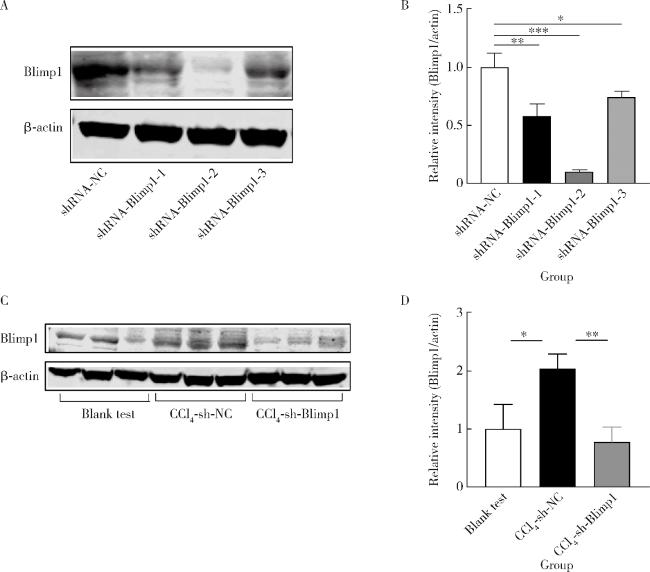
腺相关病毒(adeno-associated virus, AAV)-Blimp1 shRNA载体及AAV-NC shRNA载体委托上海吉凯基因医学科技股份有限公司构建,根据3条shRNA干扰实验结果(图 1),选择AAV-Blimp1 shRNA2载体进行后续实验。
图1 RAW264.7细胞(A、B)和小鼠肝组织中(C、D)Blimp1表达水平

Figure 1 Expression levels of Blimp1 in RAW264.7 cells(A, B) and the liver of mice(C, D)

The interference efficiency of three shRNA-Blimp1 in RAW264.7 cells and the expression levels of Blimp1 in the liver of blank test, CCl4+AAV-shRNA-NC and CCl4+AAV-shRNA-Blimp1 group mice (n=10). *P < 0.05, **P < 0.01, ***P < 0.001. shRNA, short hairpin RNA; Blimp1, B lymphocyte induced maturation protein 1; CCl4, carbon tetrachloride; AAV, adeno-associated virus; NC, non-specific control; CCl4-sh-NC, CCl4+AAV-shRNA-NC group; CCl4-sh-Blimp1, CCl4+AAV-shRNA-Blimp1 group.

CCl4购自北京化工厂(分析纯),橄榄油购自成都市科龙化工试剂厂,丙氨酸氨基转移酶(alanine transaminase, ALT)和天门冬氨酸氨基转移酶(aspartate transaminase, AST)试剂盒购自Maccura公司,PrimeScriptTM RT试剂盒购自TaKaRa公司,Power SYBR® Green PCR Master Mix试剂盒和Pierce ECL Western增强化学发光检测试剂盒购自ThermoFisher公司。实验仪器包括离心机(ThermoFisher公司)、全自动生化分析仪(Hitachi公司)、Olympus显微镜、全自动酶标仪(Thermo公司)、曝光仪(Bio-Rad公司)。

1.3 溶液配制

在通风橱内配制5%(体积分数)的CCl4橄榄油溶液(体积比1 ∶ 20),按200 μL/只小鼠进行腹腔注射。在通风橱内将滴度为2.18×1013 vg/mL[vg指病毒基因组拷贝数(vector genomes)]的AAV-shRNA Blimp1和滴度为1.18×10¹³ vg/mL的AAV-shRNA NC溶解于生理盐水中,配制成1.09×10¹² vg/mL,按200 μL/只小鼠进行腹腔注射。

1.4 动物分组、给药与造模

将30只C57BL/6J小鼠随机分为3组,即空白实验组、无意义RNA对照组和Blimp1敲减组,每组10只。无意义RNA对照组小鼠和Blimp1敲减组小鼠处理步骤为:将2.18×1011 μg的AAV-shRNA溶于生理盐水进行腹腔注射,1 h后注射5% CCl4橄榄油溶液(15 mL/kg),每3天1次,连续27 d;空白实验组小鼠腹腔注射等体积的橄榄油溶液。各组小鼠在末次腹腔注射CCl4 12 h后麻醉处死,立即采集肝脏标本和血清。

1.5 检测血清中ALT、AST

小鼠采血后,样本以2 000 r/min离心15 min,离心半径r=186 mm。留取血清,使用自动化生化仪(Hitachi,日本)检测ALT和AST水平。

1.6 肝组织病理染色

小鼠肝脏以10%(体积分数)甲醛溶液固定24 h,经脱水、透明浸蜡、包埋、切片,以苏木素-伊红(hematoxylin-eosin, HE)染色、Masson染色和天狼星红染色后,显微镜下观察小鼠肝组织改变及纤维化改变。

1.7 Western blot检测蛋白表达水平

肝纤维化以细胞外基质的过度沉积为主要特征,Ⅰ型胶原蛋白(collagen type Ⅰ alpha 1, COL1A1) 和Ⅲ型胶原蛋白(collagen type Ⅲ alpha 1, COL3A1)是细胞外基质的主要成分[16-17]。α平滑肌肌动蛋白(α-smooth muscle actin, α-SMA)是肝星状细胞活化的标志分子[18]。我们采用Western blot检测肝脏α-SMA、COL1A1和COL3A1表达水平。每只小鼠切取约100 mg肝脏,用组织蛋白裂解液提取总蛋白。采用BCA法检测蛋白浓度后,加入上样缓冲液,在SDS-PAGE凝胶电泳中进行蛋白分离,转膜,以5%(体积分数)牛血清白蛋白(bovine serum albumin,BSA)封闭1 h,分别采用抗α-SMA(1 ∶ 1 000, CST, #19245)、COL1A1(1 ∶ 1 000, Santa Cruz, sc-293182)、COL3A1(1 ∶ 1 000, Biodragon, BD-PM3123)、β-actin(1 ∶ 2 000,Cell Signaling Technology,#4970)、Blimp1(1 ∶ 1 000,Thermo Fisher,MA5-14879)一抗4 ℃杂交过夜,TBST洗膜后,采用辣根过氧化物酶标记的二抗(1 ∶ 5 000,北京友谊中联生物科技有限公司,P03S02)室温孵育1 h,TBST洗膜,使用增强化学发光法(enhanced chemiluminescence, ECL)显影、曝光。

1.8 逆转录

采用5×PrimeScript缓冲液2 μL,PrimeScript逆转录酶混合液0.5 μL,Oligo dT引物0.5 μL,随机引物0.5 μL,无RNA酶水,样本总RNA,每10 μL反应体系逆转500 ng总RNA。反应条件为37 ℃ 15 min,85 ℃ 15 s,4 ℃ 10 min。

1.9 Real-time PCR

每只小鼠切取约10 mg肝脏放入研钵中,加入液氮研磨,加入1 mL Trizol充分裂解组织,转入EP管中,室温静置5 min,按照说明书提取RNA,定量后反转录成cDNA,使用ABI 7500 real-time PCR仪进行实时荧光定量PCR扩增,反应条件为50 ℃ 2 min,1个循环;95 ℃ 10 min,1个循环;95 ℃ 15 s,60 ℃ 60 s,50个循环。
α-SMA的编码基因Acta2的上游引物序列为5′-CCCAGACATCAGGGAGTAATGG-3′,下游引物序列为5′-TCTATCGGATACTTCAGCGTCA-3′;Col1a1的上游引物序列为5′-GCTCCTCTTAGGGGCCACT-3′,下游引物序列为5′-ATTGGGGACCCTTAGGCCAT-3′;Col3a1的上游引物序列为5′-CTGTAACATGGAAACTGGGGAAA-3′,下游引物序列为5′-CCATAGCTGAACTGAAAACCACC-3′;GAPDH的上游引物序列为5′-AATGGATTTGGACGCATTGGT-3′,下游引物序列为5′-TTTGCACTGGTACGTGTTGAT-3′。数据分析用2-ΔΔCt法计算相对基因表达量。

1.10 统计学分析

采用GraphPad Prism 9软件对数据进行统计学分析,结果以均数±标准差表示。先采用单因素方差分析多组间差异,差异具有统计学意义时,使用两独立样本t检验比较两组间的统计学差异,P<0.05为差异有统计学意义。

2 结果

2.1 shRNA-Blimp1干扰效率与小鼠肝脏Blimp1表达水平

3条shRNA-Blimp1序列中,单因素方差分析结果显示各组shRNA-Blimp1干扰效率差异有统计学意义(P<0.01)。shRNA-Blimp1-1干扰效率为0.582±0.134,shRNA- Blimp1-2干扰效率为0.104± 0.010,shRNA-Blimp1-3干扰效率为0.745±0.045,与空白实验组(0.996±0.119)相比,shRNA-Blimp1-2干扰效率最高(t=12.980, P<0.001, 图 1AB),因此采用该序列构建shRNA-Blimp1 AAV进行后续实验。
通过Western blot检测小鼠肝脏Blimp1蛋白表达水平,单因素方差分析结果显示各组小鼠肝脏Blimp1蛋白表达水平差异有统计学意义(P<0.000 1,图 1CD),与空白实验组(1.000±0.420)相比,无意义RNA对照组(CCl4+AAV-shRNA-NC组)小鼠肝脏Blimp1表达明显升高(2.036±0.244, t=3.690, P=0.002)。与无意义RNA对照组相比,Blimp1敲减组(CCl4+AAV-shRNA-Blimp1组)小鼠Blimp1蛋白表达显著降低(0.783±0.249, t=6.223, P=0.003)。

2.2 小鼠体重动力学变化

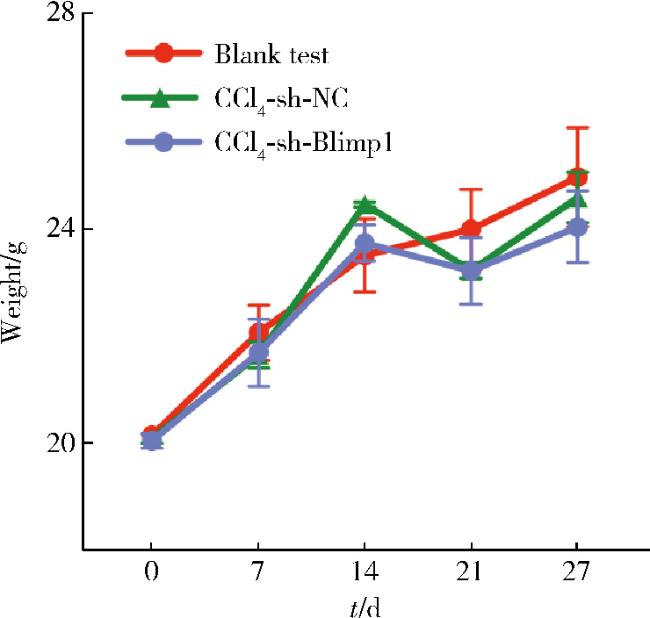
在造模过程中,小鼠毛色没有显著变化,各组小鼠每周体重变化如图 2所示,空白实验组小鼠体重稳定增长,CCl4模型小鼠在造模21 d前后体重出现波动,三组小鼠在各个时间点体重基本一致,组间差异无统计学意义。
图2 造模过程中各组小鼠体重动力学变化

Figure 2 The dynamic changes of body weight in each group mice during modeling

The dynamic changes of body weight in the blank test, CCl4+AAV-shRNA-NC and CCl4+AAV-shRNA-Blimp1 group mice (n=10). Abbreviations as in Figure 1.

2.3 小鼠肝功能变化

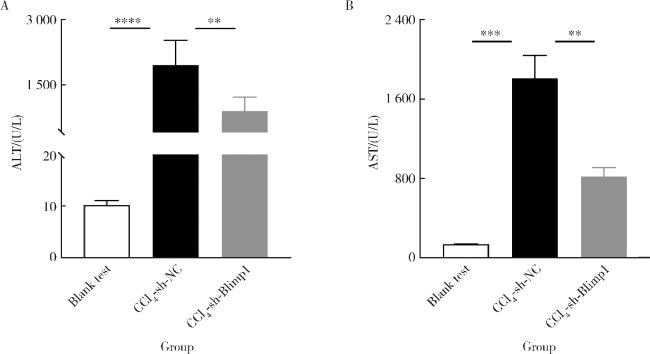
单因素方差分析结果显示,各组小鼠肝功能ALT、AST差异均有统计学意义(P<0.01, 图 3)。与空白实验组小鼠血清ALT [(10.2±1.0) U/L]和AST [(136.0±1.9) U/L]相比,无意义RNA对照组的ALT [(1 957.8±633.6) U/L, t=8.419, P<0.000 1]和AST [(1 808.8±260.1) U/L, t=11.140, P=0.000 4]活性明显升高;与无意义RNA对照组相比,Blimp1敲减组小鼠的ALT [(894.0± 360.1) U/L, t=3.998, P=0.003]和AST [(820.0± 100.6) U/L, t=6.141, P=0.004]活性明显降低。
图3 各组小鼠血清ALT、AST水平

Figure 3 The ALT and AST levels of serum in each group mice

The ALT(A) and AST(B) levels of serum in the blank test, CCl4+AAV-shRNA-NC and CCl4+AAV-shRNA-Blimp1 group mice (n=10). **P < 0.01, ***P < 0.001, ****P < 0.000 1. AST, aspartate transaminase; ALT, alanine transaminase; Other abbreviations as in Figure 1.

2.4 肝组织病理染色结果

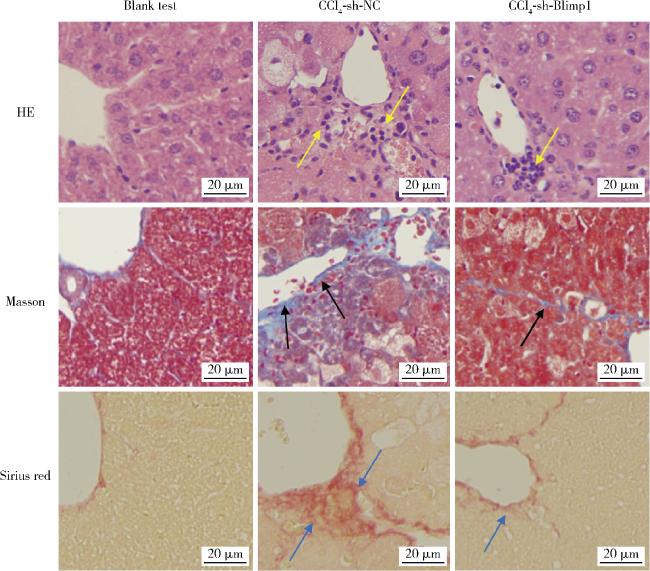
HE染色结果显示,空白实验组小鼠肝细胞大小和形态正常,肝小叶结构排列有序,肝细胞索围绕中央静脉均匀呈放射状有序排列,未见肝细胞脂肪变性以及肝纤维组织增生,未见炎性细胞浸润;无意义RNA对照组肝小叶严重破坏,肝索排列紊乱、明显肿胀变形,肝纤维组织增生所形成的假小叶结构内有大量形态各异、大小不均的脂肪变性肝细胞及显著炎性细胞浸润(黄色箭头);与无意义RNA对照组相比,Blimp1敲减组小鼠被破坏的肝小叶结构面积显著减少,正常的肝小叶结构增多,增生的胶原纤维组织间隔相对疏松,炎症细胞浸润程度明显减轻(图 4)。
图4 各组小鼠肝组织病理染色

Figure 4 Pathological staining of liver tissue in each group

Pathological staining of liver tissue in the blank test, CCl4+AAV-shRNA-NC and CCl4+AAV-shRNA-Blimp1 group mice (n=10). The yellow arrows represent inflammatory infiltration, the black arrows represent collagen deposition, and the blue arrows represent liver fibrosis. HE, hematoxylin-eosin staining; Other abbreviations as in Figure 1.

Masson染色结果显示,空白实验组小鼠肝小叶结构清晰可见,细胞排列有序,仅中央静脉区血管壁附近有少量蓝色胶原纤维排列,肝组织无胶原沉积;无意义RNA对照组小鼠可见大量增粗、增大的胶原纤维沉积(黑色箭头),增生的蓝色胶原纤维环绕、分割肝小叶,形成假小叶结构;Blimp1敲减组小鼠胶原纤维明显减少,但仍有部分可见,出现于汇管区内,纤维细薄,从中央静脉向四周延伸,与无意义RNA对照组小鼠相比,胶原纤维的增生有明显改善(图 4)。
天狼星红染色结果显示,空白实验组仅中央静脉区血管壁附近有少量红色胶原纤维排列,肝小叶结构正常,排列有序,肝组织中无胶原沉积;无意义RNA对照组的肝纤维化明显(蓝色箭头),肝小叶结构破坏,可见大量空泡,且肝组织中有大量胶原纤维沉积蔓延;与无意义RNA对照组小鼠相比,Blimp1敲减组的肝组织中空泡明显减少,肝小叶结构有所恢复,胶原纤维增生有显著改善(图 4)。

2.5 肝纤维化标志分子的变化情况

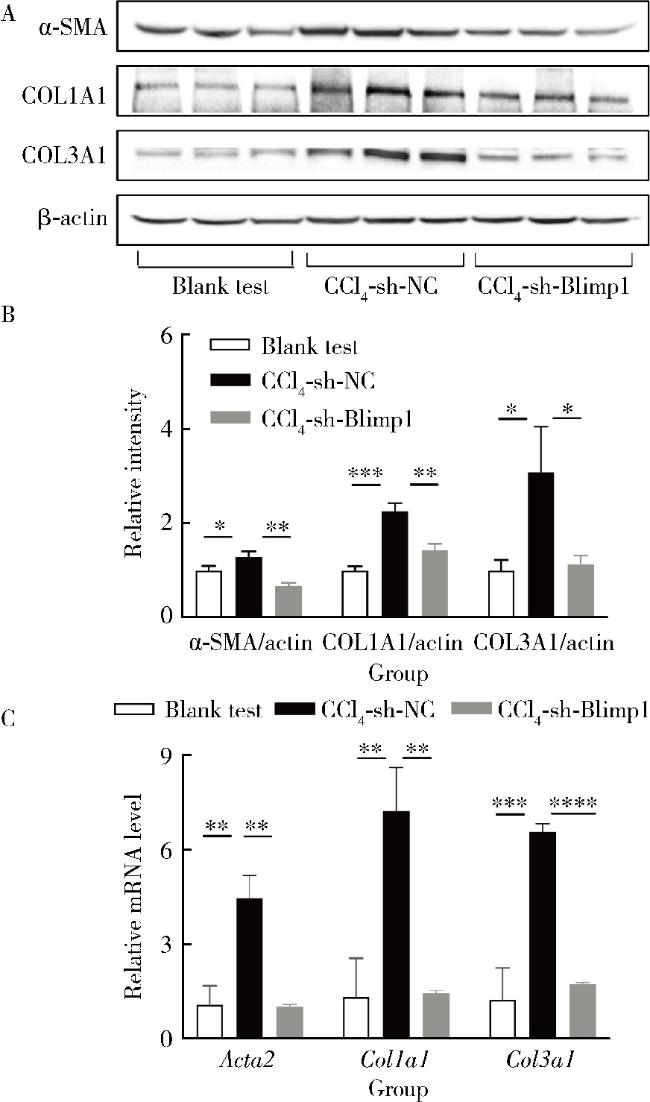
单因素方差分析结果显示,各组小鼠肝脏α-SMA、COL1A1和COL3A1表达水平差异均有统计学意义(P<0.01)。与空白实验组的α-SMA(0.999± 0.096)、COL1A1(1.000±0.088)和COL3A1(1.000±0.221)相比,无意义RNA对照组小鼠肝脏的α-SMA(1.288±0.117, t=3.296, P=0.030)、COL1A1(2.256±0.175, t=11.090, P<0.001)和COL3A1(3.081±0.965, t=3.640, P=0.022)表达显著升高;与无意义RNA对照组相比,Blimp1敲减组的α-SMA(0.676±0.064, t=7.930, P=0.001)、COL1A1(1.467±0.071, t=6.364, P=0.003)和COL3A1(1.746±0.048, t=3.220, P=0.026)表达水平显著降低(图 5A),图 5B为蛋白条带相对强度的分析结果。
图5 各组小鼠肝脏α-SMA、COL1A1和COL3A1表达情况

Figure 5 The α-SMA, COL1A1 and COL3A1 levels in liver of mice in each group

A and B, the α-SMA, COL1A1 and COL3A1 levels in liver of mice in each group (n=10); C, the mRNA levels of Acta2, Col1a1 and Col3a1 in liver of mice in each group (n=10). * P < 0.05, **P < 0.01, ***P < 0.001, ****P < 0.000 1. The Acta2, Col1a1 and Col3a1 is the coding gene of α-SMA, COL1A1 and COL3A1, respectively. Abbreviations as in Figure 1.

采用real-time PCR进一步检测α-SMA、COL1A1和COL3A1的编码基因Acta2Col1a1Col3a1的mRNA表达水平,单因素方差分析结果显示,各组小鼠肝脏Acta2Col1a1Col3a1的mRNA表达水平差异均有统计学意义(P<0.01)。如图 5C所示,与空白实验组小鼠肝脏的Acta2 (1.096±0.592)、Col1a1 (1.341±1.231)和Col3a1 (1.249±1.009)相比,无意义RNA对照组小鼠肝脏的Acta2 (4.462±0.721, t=6.248, P=0.003)、Col1a1 (7.228±1.387, t=5.498, P=0.005)和Col3a1 (6.565±0.262, t=8.827, P<0.001)表达水平显著上调;与无意义RNA对照组相比,Blimp1敲减组小鼠肝脏的Acta2 (1.023±0.077, t=8.214, P= 0.001)、Col1a1 (1.467±0.071, t=7.185, P=0.002) 和Col3a1 (1.746±0.048, t=31.37, P<0.000 1)表达水平显著降低。因此,干扰Blimp1表达可显著抑制肝脏细胞外基质蛋白表达,表明Blimp1在CCl4小鼠细胞外基质过度沉积中发挥重要作用。

3 讨论

肝纤维化是机体应对各种原因引起慢性肝损伤的一种过度修复反应,可导致胶原等细胞外基质大量沉积[17]。本研究发现,CCl4诱导肝纤维化小鼠的肝组织中,Blimp1表达明显增高。进一步采用shRNA体内敲减Blimp1表达,CCl4小鼠的肝功能指标明显降低,提示肝纤维化早期肝损伤得到了一定程度的改善;组织病理结果显示肝组织炎性细胞浸润程度减弱,胶原沉积得到显著改善;同时,纤维化标志分子α-SMA、COL1A1和COL3A1的表达水平降低。本研究结果表明,转录因子Blimp1在CCl4小鼠肝纤维化早期肝损伤过程中发挥了重要作用。本研究有助于拓宽对肝纤维化病理机制的认识,为预防肝硬化和终末器官衰竭提供了新的分子靶点。
肝星状细胞是一种驻留间充质细胞,具有正常基质中的成纤维细胞和附着在毛细血管内皮细胞上的周细胞的特征,约占正常人肝细胞总数的15%,占非实质细胞的1/3[19]。肝星状细胞是纤维生成的关键效应细胞,肝纤维化时,静止的肝星状细胞转分化为增生性、迁移性和收缩性肌成纤维细胞,表现出促纤维化的特性,并分泌细胞外基质分子,积聚形成瘢痕组织[19]
肝星状细胞的活化受到多种因素的调控,其中巨噬细胞是调控肝星状细胞活化和肝脏微环境的重要免疫调节细胞。肝脏浸润的巨噬细胞通过分泌白细胞介素-1β(interleukin 1β,IL-1β)和肿瘤坏死因子-α(tumor necrosis factor alpha, TNF-α)激活肝星状细胞的核因子κB(nuclear factor kappa-B,NF-κB)通路,促进肝纤维化[20]。我们最近的研究发现,肝脏2型巨噬细胞通过分泌前列腺素E2与肝星状细胞表面受体前列腺素E受体4(prostaglandin E receptor 4,PTGER4)结合,从而激活MAPK/ERK通路,促进肝星状细胞自噬和活化,在非酒精性脂肪性肝病相关的肝纤维化进展中发挥关键作用[21],该发现为本研究提供了重要的前期基础。此外,Toll样受体(Toll like receptors, TLRs)也是促进肝星状细胞活化的重要途径[22]。例如,脂多糖(lipopolysaccharide, LPS)与TLR4结合可通过MyD88/NF-κB通路诱导转化生长因子β (transforming growth factor-β, TGF-β)生成,激活肝星状细胞,促进CCl4小鼠肝纤维化[23]。研究表明,Blimp1可以抑制TLR激动剂引起的B淋巴细胞增殖[24],且Blimp1的缺失会抑制TLRs信号通路,使TLR7、TLR9配体无法激活浆细胞样树突状细胞,不能产生Ⅰ型干扰素抵抗病毒感染[25]。我们前期的研究发现,在巨噬细胞中,Blimp1通过调控NF-κB通路抑制多种TLRs介导的炎性细胞因子分泌,因此,Blimp1也可能通过TLRs途径调控肝星状细胞活化。本研究及上述发现为阐释Blimp1的促肝纤维化机制提供了重要线索,但Blimp1在巨噬细胞分化和功能中的作用仍有待进一步研究。
防止肝纤维化的进展或促进其消退、改善肝功能、延缓肝硬化和失代偿期的发生是治疗多种慢性肝病的主要目标[20]。TGF-β以往被认为是重要的促肝纤维化细胞因子[26],目前已开展多项靶向TGF-β的药物吡非尼酮治疗肝纤维化及肝硬化的临床试验[27]。然而,全球范围内仍缺乏特效抗肝纤维化的药物获批上市[20]。本研究利用AAV-shRNA体内干扰Blimp1表达,证实Blimp1在CCl4小鼠早期肝纤维化进展中发挥重要作用,提示Blimp1可能是抑制肝纤维化的新靶点。但是,本研究每组仅10只小鼠,存在样本量小的局限性,因此得出的初步结论仍需进一步扩大样本量重复验证。今后的研究中,通过进一步阐明Blimp1促进肝纤维化早期肝损伤的分子机制,将为临床改善肝纤维化提供重要的依据和思路。

利益冲突  所有作者均声明不存在利益冲突。

作者贡献声明  朱鏐娈、李蕊:设计研究方案;秦秋实、周妍希、张玥、韩铭:收集、分析、整理数据;秦秋实:撰写论文;朱鏐娈:提出研究思路,总体把关和审定论文。

1
Marcellin P , Kutala BK . Liver diseases: A major, neglected global public health problem requiring urgent actions and large-scale screening[J]. Liver Int, 2018, 38 (Suppl 1): 2- 6.

2
Ramachandran P , Dobie R , Wilson-Kanamori JR , et al. Resolving the fibrotic niche of human liver cirrhosis at single-cell level[J]. Nature, 2019, 575 (7783): 512- 518.

3
Friedman SL , Pinzani M . Hepatic fibrosis 2022:Unmet needs and a blueprint for the future[J]. Hepatology, 2022, 75 (2): 473- 488.

4
Rockey DC , Bell PD , Hill JA . Fibrosis: A common pathway to organ injury and failure[J]. N Engl J Med, 2015, 372 (12): 1138- 1149.

5
Shapiro-Shelef M , Lin KI , McHeyzer-Williams LJ , et al. Blimp-1 is required for the formation of immunoglobulin secreting plasma cells and pre-plasma memory B cells[J]. Immunity, 2003, 19 (4): 607- 620.

6
Minnich M , Tagoh H , Bönelt P , et al. Multifunctional role of the transcription factor Blimp-1 in coordinating plasma cell differentiation[J]. Nat Immunol, 2016, 17 (3): 331- 343.

7
Bankoti R , Ogawa C , Nguyen T , et al. Differential regulation of effector and regulatory T cell function by Blimp1[J]. Sci Rep, 2017, 7 (1): 12078.

8
Shin H , Blackburn SD , Intlekofer AM , et al. A role for the transcriptional repressor Blimp-1 in CD8(+) T cell exhaustion during chronic viral infection[J]. Immunity, 2009, 31 (2): 309- 320.

9
Savitsky D , Cimmino L , Kuo T , et al. Multiple roles for Blimp-1 in B and T lymphocytes[J]. Adv Exp Med Biol, 2007, 596, 9- 30.

10
Kim SJ , Zou YR , Goldstein J , et al. Tolerogenic function of Blimp-1 in dendritic cells[J]. J Exp Med, 2011, 208 (11): 2193- 2199.

11
Gateva V , Sandling JK , Hom G , et al. A large-scale replication study identifies TNIP1, PRDM1, JAZF1, UHRF1BP1 and IL10 as risk loci for systemic lupus erythematosus[J]. Nat Genet, 2009, 41 (11): 1228- 1233.

12
Ellinghaus D , Zhang H , Zeissig S , et al. Association between variants of PRDM1 and NDP52 and Crohn ' s disease, based on exome sequencing and functional studies[J]. Gastroenterology, 2013, 145 (2): 339- 347.

13
Boi M , Zucca E , Inghirami G , et al. PRDM1/BLIMP1:A tumor suppressor gene in B and T cell lymphomas[J]. Leuk Lymphoma, 2015, 56 (5): 1223- 1228.

14
Li N , Fan X , Wang X , et al. PRDM1 levels are associated with clinical diseases in chronic HBV infection and survival of patients with HBV-related hepatocellular carcinoma[J]. Int Immunopharmacol, 2019, 73, 156- 162.

15
Scholten D , Trebicka J , Liedtke C , et al. The carbon tetrachloride model in mice[J]. Lab Anim, 2015, 49 (Suppl 1): 4- 11.

16
Bárcena C , Aran G , Perea L , et al. CD5L is a pleiotropic player in liver fibrosis controlling damage, fibrosis and immune cell content[J]. EBioMedicine, 2019, 43, 513- 524.

17
Pellicano AJ , Spahn K , Zhou P , et al. Collagen characterization in a model of nonalcoholic steatohepatitis with fibrosis: A call for development of targeted therapeutics[J]. Molecules, 2021, 26 (11): 3316.

18
Fan W , Liu T , Chen W , et al. ECM1 prevents activation of transforming growth factor β, hepatic stellate cells, and fibrogenesis in mice[J]. Gastroenterology, 2019, 157 (5): 1352- 1367.

19
Friedman SL . Hepatic stellate cells: Protean, multifunctional, and enigmatic cells of the liver[J]. Physiol Rev, 2008, 88 (1): 125- 172.

20
Xu XY , Ding HG , Li WG , et al. Chinese guidelines on management of hepatic encephalopathy in cirrhosis[J]. World J Gastroenterol, 2019, 25 (36): 5403- 5422.

21
Cao Y , Mai W , Li R , et al. Macrophages evoke autophagy of hepatic stellate cells to promote liver fibrosis in NAFLD mice via the PGE2/EP4 pathway[J]. Cell Mol Life Sci, 2022, 79 (6): 303.

22
Kiziltas S . Toll-like receptors in pathophysiology of liver diseases[J]. World J Hepatol, 2016, 8 (32): 1354- 1369.

23
Seki E , De Minicis S , Osterreicher CH , et al. TLR4 enhances TGF-beta signaling and hepatic fibrosis[J]. Nat Med, 2007, 13 (11): 1324- 1332.

24
Genestier L , Taillardet M , Mondiere P , et al. TLR agonists selectively promote terminal plasma cell differentiation of B cell subsets specialized in thymus-independent responses[J]. J Immunol, 2007, 178 (12): 7779- 7786.

25
Ko YA , Chan YH , Liu CH , et al. Blimp-1-mediated pathway promotes type Ⅰ IFN production in plasmacytoid dendritic cells by targeting to interleukin-1 receptor-associated kinase M[J]. Front Immunol, 2018, 9, 1828.

26
Dewidar B , Meyer C , Dooley S , et al. TGF-β in hepatic stellate cell activation and liver fibrogenesis-updated 2019[J]. Cells, 2019, 8 (11): 1419.

27
Flores-Contreras L , Sandoval-Rodríguez AS , Mena-Enriquez MG , et al. Treatment with pirfenidone for two years decreases fibrosis, cytokine levels and enhances CB2 gene expression in patients with chronic hepatitis C[J]. BMC Gastroenterol, 2014, 14, 131.

文章导航

/