Journal of Peking University (Health Sciences) ›› 2026, Vol. 58 ›› Issue (3): 575-583. doi: 10.19723/j.issn.1671-167X.2026.03.018

Previous Articles     Next Articles

Cessation intention and behavior of e-cigarettes and associated factors among 18-44 Chinese adults: Based on protection motivation theory

Xiaoyue ZHANG1, Xiaochen YANG1, Haoxiang LIN2, Ying JI1, Wangnan CAO1, Chun CHANG1,*()   

  1. 1. Department of Social Medicine and Health Education, Peking University School of Public Health, Beijing 100191, China
    2. Institute for Global Health and Development, Peking University, Beijing 100871, China
  • Received:2026-02-25 Online:2026-06-18 Published:2026-04-15
  • Contact: Chun CHANG
  • Supported by:
    the National Natural Science Foundation of China(82173637)

RICH HTML


Abstract:

Objective: Based on protection motivation theory (PMT), this study aimed to examine the current status of e-cigarette cessation intention and cessation behavior, as well as their associated factors, among adult e-cigarette users in China. Methods: This was a cross-sectional study. The data were derived from a nationwide "E-cigarette Use Survey" conducted in 2023, covering 31 provinces (municipality, autonomous region) in China. A total of 550 current e-cigarette users aged 18-44 years were selected as the study population. After adjusting for sociodemographic variables, multiple linear regression models were used to identify factors associated with e-cigarette cessation intention, while binary Logistic regression models were applied to examine factors associated with e-cigarette cessation behavior. In addition, subgroup analyses were conducted according to smoking status to explore potential differences among exclusive e-cigarette users and dual users of e-cigarettes and combustible cigarettes. Results: The mean score of e-cigarette cessation intention was 3.52±0.96, and 31.64% of participants reported having attempted to quit e-cigarettes. After adjustment for covariates, cessation intention was associated with both the threat appraisal and coping appraisal pathways within the PMT framework. Specifically, in the threat appraisal pathway, severity (β=0.14) and vulnerability (β=0.12) were positively associated with cessation intention, whereas perceived extrinsic rewards (β=-0.12) were negatively associated. In the coping appraisal pathway, both response efficacy (β=0.26) and self-efficacy (β=0.28) were positively associated with cessation intention. Regarding cessation behavior, only severity (OR=1.58) in the threat appraisal pathway was positively associated, and cessation intention was also positively associated with cessation behavior. Subgroup analyses further showed that, regardless of smoking status, cessation intention was positively associated with both the threat appraisal pathway (β=0.20, β=0.31) and the coping appraisal pathway (β=0.23, β=0.21). Conclusion: PMT provides a valuable theoretical framework for understanding e-cigarette cessation among adults. Factors related to the threat appraisal pathway are associated not only with cessation intention but also with actual cessation behavior. More-over, the associations of PMT-related factors vary across different smoking status subgroups. These findings suggest that future e-cigarette control policies and interventions could focus on enhancing risk perception and cognitive awareness, and develop more targeted cessation strategies for specific subgroups.

Key words: E-cigarettes, Tobacco use cessation, Intention, Behavior and behavior mechanisms, Protection motivation theory, Adult

CLC Number: 

  • R163.2

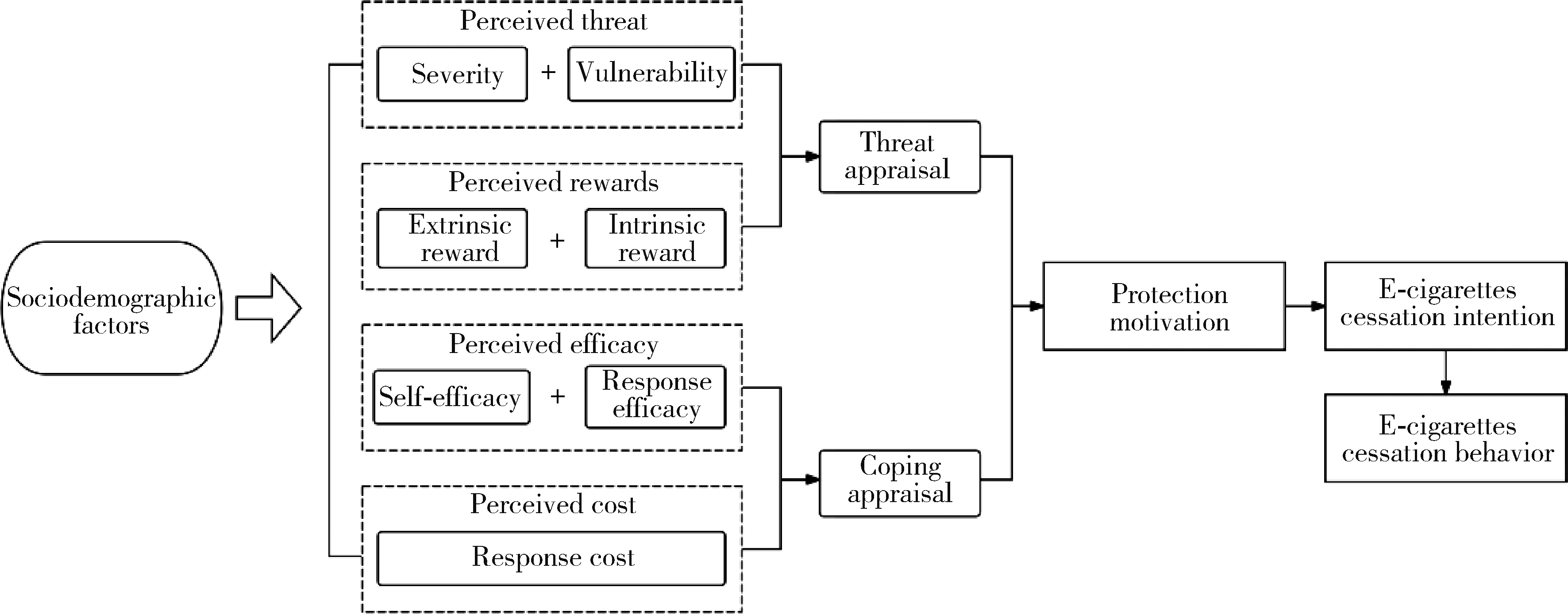
Figure 1

The framework of protection motivation theory in this study"

Table 1

Basic characteristics of the participants and their e-cigarette cessation intention and behavior (n=550)"

Characteristics Whole participants, n (%) E-cigarette cessation intention E-cigarette cessation behavior
$\bar x \pm s$ t P Yes, n (%) No, n (%) χ2 P
Age/years 0.176 0.839 1.214 0.545
  18-24 56 (10.18) 3.59±0.95 20 (11.49) 36 (9.57)
  25-34 307 (55.82) 3.52±0.93 100 (57.47) 207 (55.05)
  35-44 187 (34.00) 3.50±1.01 54 (31.03) 133 (35.37)
Gender -0.909 0.364 0.252 0.616
  Male 395 (71.82) 3.50±0.96 122 (70.11) 273 (72.61)
  Female 155 (28.18) 3.58±0.95 52 (29.89) 103 (27.39)
Marital status 0.012 0.990 2.429 0.119
  Married 418 (76.00) 3.52±0.96 140 (80.46) 278 (73.94)
  Widowed/Divorced or separated/ Never married 132 (24.00) 3.52±0.96 34 (19.54) 98 (26.06)
Education level 1.082 0.339 1.528 0.466
  High school and below 27 (4.91) 3.26±1.02 9 (5.17) 18 (4.79)
  College or undergraduate 480 (87.27) 3.54±0.95 155 (89.08) 325 (86.44)
  Master and above 43 (7.82) 3.51±0.96 10 (5.75) 33 (8.78)
Region -0.172 0.864 0.501 0.479
  Rural 118 (21.45) 3.51±0.95 41 (23.56) 77 (20.48)
  Urban 432 (78.55) 3.53±0.96 133 (76.44) 299 (79.52)
Smoke cigarettes -0.405 0.686 1.164 0.281
  Yes 373 (67.82) 3.53±0.93 124 (71.26) 249 (66.22)
  No 177 (32.18) 3.50±1.01 50 (28.74) 127 (33.78)
Cessation behavior -8.002 < 0.001
  Yes 174 (31.64) 3.95±0.79
  No 376 (68.36) 3.32±0.96
Total 550 (100.00) 3.52±0.96 174 (31.64) 376 (68.36)

Table 2

Descriptive statistics of PMT-related factors"

PMT variables Total, $\bar x \pm s$ Cessation intentiona(r) Cessation behavior, $\bar x \pm s$
Yes No P
Threat appraisal -3.75±6.49 0.32*** -1.55±6.62 -4.77±6.18 < 0.001
  Perceived threat 17.39±4.58 0.33*** 19.05±4.68 16.63±4.33 < 0.001
    Severity 8.87±2.46 0.32*** 9.78±2.52 8.46±2.31 < 0.001
    Vulnerability 8.52±2.60 0.28*** 9.28±2.57 8.17±2.54 < 0.001
  Perceived reward 21.15±3.84 -0.14** 20.60±4.12 21.40±3.68 0.029
    Intrinsic reward 11.19±2.09 -0.07 11.01±2.26 11.27±2.00 0.194
    Extrinsic reward 9.96±2.40 -0.16*** 9.59±2.58 10.13±2.29 0.018
Coping appraisal 11.75±4.50 0.34*** 11.89±4.56 11.69±4.47 0.633
  Perceived efficacy 20.21±3.80 0.40*** 20.68±3.77 19.99±3.79 0.045
    Response efficacy 9.55±2.53 0.30*** 9.58±2.61 9.53±2.49 0.837
    Self-efficacy 10.66±2.54 0.30*** 11.10±2.51 10.45±2.53 0.005
  Perceived cost 8.46±2.36 0.003 8.80±2.52 8.30±2.27 0.027
    Response cost 8.46±2.36 0.003 8.80±2.52 8.30±2.27 0.027

Table 3

Multiple linear regression analysis of e-cigarette cessation intention based on the PMT"

Variables E-cigarette cessation intention
Seven primary PMT sub-elements [Model 1, β (95%CI)]
  Severity 0.14 (0.02, 0.26)**
  Vulnerability 0.12 (0.01, 0.23)**
  Intrinsic rewards -0.07 (-0.19, 0.05)
  Extrinsic rewards -0.12 (-0.22, -0.01)**
  Response efficacy 0.26 (0.16, 0.35)***
  Response cost -0.01 (-0.10, 0.09)
  Self-efficacy 0.28 (0.20, 0.37)***
Four perceptions [Model 2, β (95%CI)]
  Perceived threat 0.26 (0.16, 0.36)***
  Perceived rewards -0.19 (-0.31, -0.08)***
  Perceived efficacy 0.54 (0.42, 0.66)***
  Perceived cost -0.01 (-0.11, 0.08)
Two pathways [Model 3, β (95%CI)]
  Threat appraisal 0.27 (0.20, 0.34)***
  Coping appraisal 0.22 (0.14, 0.29)***

Table 4

Binary Logistic regression analysis of e-cigarette cessation behavior based on the PMT"

Variables E-cigarette cessation behavior
Seven primary PMT sub-elements [Model 1, OR (95%CI)]
  Severity 1.58 (1.12, 2.23)***
  Vulnerability 1.03 (0.76, 1.39)
  Intrinsic rewards 0.97 (0.70, 1.35)
  Extrinsic rewards 0.85 (0.63, 1.15)
  Response efficacy 1.00 (0.77, 1.31)
  Response cost 1.27 (0.96, 1.68)
  Self-efficacy 0.77 (0.59, 1.00)
  Quitting intention 2.16 (1.66, 2.81)***
Four perceptions [Model 2, OR (95%CI)]
  Perceived threat 1.60 (1.20, 2.14)***
  Perceived rewards 0.84 (0.60, 1.16)
  Perceived efficacy 0.80 (0.56, 1.13)
  Perceived cost 1.32 (1.01, 1.73)**
  Quitting intention 2.13 (1.64, 2.77)***
Two pathways[Model 3, OR (95%CI)]
  Threat appraisal 1.41 (1.15, 1.72)***
  Coping appraisal 0.76 (0.62, 0.94)**
  Quitting intention 2.21 (1.71, 2.84)***

Table 5

Subgroup analysis of e-cigarette cessation intentions stratified by smoking cigarette"

Variables Exclusive e-cigarette users Dual users
Seven primary PMT sub-elements (Model 1,β)
  Severity 0.03 0.21***
  Vulnerability 0.14 0.10
  Intrinsic rewards -0.11 -0.05
  Extrinsic rewards -0.06 -0.13**
  Response efficacy 0.17** 0.31***
  Response cost 0.00 -0.02
  Self-efficacy 0.37*** 0.23***
Four perceptions (Model 2,β)
  Perceived threat 0.17* 0.31***
  Perceived rewards -0.19 -0.19***
  Perceived efficacy 0.53*** 0.55***
  Perceived cost -0.03 -0.01
Two pathways (Model 3,β)
  Threat appraisal 0.20*** 0.31***
  Coping appraisal 0.23*** 0.21***

Table 6

Subgroup analysis of e-cigarette cessation behaviour stratified by smoking cigarette"

Variables Exclusive e-cigarette users Dual users
Seven primary PMT sub-elements (Model 1, OR)
  Severity 2.18** 1.40
  Vulnerability 0.77 1.21
  Intrinsic rewards 0.86 1.09
  Extrinsic rewards 0.54 0.93
  Response efficacy 1.30 0.90
  Response cost 1.58 1.13
  Self-efficacy 0.66 0.82
  Quitting intention 2.10*** 2.30***
Four perceptions (Model 2, OR)
  Perceived threat 1.60 1.69***
  Perceived rewards 0.52 1.01
  Perceived efficacy 0.96 0.74
  Perceived cost 1.70** 1.14
  Quitting intention 1.87*** 2.30***
Two pathways (Model 3, OR)
  Threat appraisal 1.72*** 1.33**
  Coping appraisal 0.71 0.81
  Quitting intention 1.96*** 2.35***
1
Glantz SA , Bareham DW . E-cigarettes: Use, effects on smoking, risks, and policy implications[J]. Annu Rev Public Health, 2018, 39, 215- 235.

doi: 10.1146/annurev-publhealth-040617-013757
2
Brown CJ , Cheng JM . Electronic cigarettes: Product characterisation and design considerations[J]. Tob Control, 2014, 23 (Suppl 2): ii4- ii10.

doi: 10.1136/tobaccocontrol-2013-051476
3
Zhao Z , Zhang M , Wu J , et al. E-cigarette use among adults in China: Findings from repeated cross-sectional surveys in 2015-16 and 2018-19[J]. Lancet Public Health, 2020, 5 (12): e639- e649.

doi: 10.1016/S2468-2667(20)30145-6
4
Xu L , Shi J , Cao Y , et al. E-cigarette use behavior and influencing factors among people aged 15 years and above: Beijing muni-cipality, China, 2016-2023[J]. China CDC Wkly, 2025, 7 (22): 760- 765.

doi: 10.46234/ccdcw2025.125
5
Wang J , Xie CC , Jia XX , et al. E-cigarette awareness and use, among adult residents in Shanghai, China[J]. Tob Induc Dis, 2023, 21, 104.
6
Xie Y , Li Y , Su Z , et al. Prevalence of cigarette and e-cigarette dual use and associated factors among people who smoke in China aged 20-69 years[J]. BMC Public Health, 2025, 26 (1): 186.

doi: 10.1186/s12889-025-25529-4
7
Patel D , Davis KC , Cox S , et al. Reasons for current E-cigarette use among U.S. adults[J]. Prev Med, 2016, 93, 14- 20.

doi: 10.1016/j.ypmed.2016.09.011
8
Rutten LJF , Blake KD , Agunwamba AA , et al. Use of E-cigarettes among current smokers: Associations among reasons for use, quit intentions, and current tobacco use[J]. Nicotine Tob Res, 2015, 17 (10): 1228- 1234.

doi: 10.1093/ntr/ntv003
9
Wu AD, Conde M, Butler AR, et al. Electronic cigarettes for smoking cessation: An overview of systematic reviews and evidence and gap map[J/OL]. Addiction, 2026[2026-03-26]. https://pubmed.ncbi.nlm.nih.gov/41887411/.
10
O'Leary R , La Rosa GRM , Polosa R . Examining e-cigarettes as a smoking cessation treatment: A critical umbrella review analysis[J]. Drug Alcohol Depend, 2025, 266, 112520.

doi: 10.1016/j.drugalcdep.2024.112520
11
Chen R , Pierce JP , Leas EC , et al. Effectiveness of e-cigarettes as aids for smoking cessation: Evidence from the PATH study cohort, 2017-2019[J]. Tob Control, 2023, 32 (e2): e145- e152.

doi: 10.1136/tobaccocontrol-2021-056901
12
Sapru S , Vardhan M , Li Q , et al. E-cigarettes use in the United States: Reasons for use, perceptions, and effects on health[J]. BMC Public Health, 2020, 20 (1): 1518.

doi: 10.1186/s12889-020-09572-x
13
Floyd DL , Prentice-Dunn S , Rogers RW . A meta-analysis of research on protection motivation theory[J]. J Appl Soc Psychol, 2000, 30 (2): 407- 429.

doi: 10.1111/j.1559-1816.2000.tb02323.x
14
Yan Y , Jacques-Tiura AJ , Chen X , et al. Application of the protection motivation theory in predicting cigarette smoking among adolescents in China[J]. Addict Behav, 2014, 39 (1): 181- 188.

doi: 10.1016/j.addbeh.2013.09.027
15
Lin H , Chen M , Yun Q , et al. Protection motivation theory and smoking quitting intention: Findings based on structural equation modelling and mediation analysis[J]. BMC Public Health, 2022, 22 (1): 838.

doi: 10.1186/s12889-022-13263-0
16
Peraza N , Mayorga NA , Garey L , et al. Exploring positive expectancies and quit status among adult electronic cigarette users[J]. Cogn Behav Ther, 2020, 49 (6): 486- 500.

doi: 10.1080/16506073.2020.1771412
17
Pepper JK , Brewer NT . Electronic nicotine delivery system (electronic cigarette) awareness, use, reactions and beliefs: A systematic review[J]. Tob Control, 2014, 23 (5): 375- 384.

doi: 10.1136/tobaccocontrol-2013-051122
18
Zhao D , Zuo Y , Urmi DS , et al. Perception of E-cigarette use among adult users in China: A mixed-method study[J]. Int J Environ Res Public Health, 2020, 17 (8): 2754.

doi: 10.3390/ijerph17082754
19
国家卫生健康委员会. 中国卫生健康统计年鉴(2022)[M]. 北京: 中国协和医科大学出版社, 2022.
20
Chen Y , Wang Z , Xu J , et al. A protection motivation theory-based scale for e-cigarette use assessment among Chinese college students: Development and validation[J]. Tob Induc Dis, 2025, 23

doi: 10.18332/tid/209411
21
Jiang J , Zheng Z . A critical review of E-cigarette regulation in China: Challenges and prospects for youth prevention and tobacco control[J]. Nicotine Tob Res, 2024, 26 (2): 126- 134.

doi: 10.1093/ntr/ntad180
22
Rogers RW . A protection motivation theory of fear appeals and attitude Change1[J]. J Psychol, 1975, 91 (1): 93- 114.

doi: 10.1080/00223980.1975.9915803
23
Spoladore R , Daus F , Pezzini S , et al. The point on the electronic cigarette more than 10 years after its introduction[J]. Eur Heart J Suppl, 2022, 24 (Supplement_I): I148- I152.

doi: 10.1093/eurheartjsupp/suac105
24
Warner KE , Benowitz NL , McNeill A , et al. Nicotine e-cigarettes as a tool for smoking cessation[J]. Nat Med, 2023, 29 (3): 520- 524.

doi: 10.1038/s41591-022-02201-7
25
谢臣晨, 陈德, 承语芝, 等. 上海市电子烟使用者电子烟相关知识知晓及态度情况分析[J]. 中国慢性病预防与控制, 2023, 31 (6): 458- 461.
26
Sheeran P , Webb TL . The intention-behavior gap[J]. Soc Pers Psychol Compass, 2016, 10 (9): 503- 518.

doi: 10.1111/spc3.12265
27
Kim CY , Paek YJ , Seo HG , et al. Dual use of electronic and conventional cigarettes is associated with higher cardiovascular risk factors in Korean men[J]. Sci Rep, 2020, 10 (1): 5612.

doi: 10.1038/s41598-020-62545-3
28
Klemperer EM , Villanti AC . Why and how do dual users quit vaping? Survey findings from adults who use electronic and combustible cigarettes[J]. Tob Induc Dis, 2021, 19, 12.
29
Lee DN , Liu J , Oduguwa K , et al. Association of vaping identity and e-cigarette perceptions among young adults who vape[J]. Subst Use Misuse, 2023, 58 (11): 1418- 1424.

doi: 10.1080/10826084.2023.2223286
30
Blank ML , Hoek J . Navigating social interactions and constructing vaping social identities: A qualitative exploration with New Zealand young adults who smoke[J]. Drug Alcohol Rev, 2023, 42 (2): 268- 276.

doi: 10.1111/dar.13542
31
Lin HX , Chang C . Factors associated with the quitting intention among Chinese adults: Application of protection motivation theory[J]. Curr Psychol, 2023, 42 (2): 1083- 1091.

doi: 10.1007/s12144-021-01500-5
32
Rahman N , Sofija E , Sebar B . Examining intention to quit vaping among Australian young adults using social cognitive theory: A cross-sectional survey analysis[J]. Youth, 2024, 4 (1): 31- 41.
33
Smith DM , Christensen C , van Bemmel D , et al. Exposure to nicotine and toxicants among dual users of tobacco cigarettes and E-cigarettes: Population assessment of tobacco and health (PATH) study, 2013-2014[J]. Nicotine Tob Res, 2021, 23 (5): 790- 797.

doi: 10.1093/ntr/ntaa252
34
Heshmati J , Pandey A , Benjamen J , et al. Vaping cessation interventions: A systematic review and meta-analysis[J]. Tob Control, 2026, 35 (3): 382- 390.

doi: 10.1136/tc-2024-058798
35
Bhadania M , Yadav S , Mathur A , et al. Mapping the effectiveness of digital health interventions in promoting electronic cigarette cessation: A systematic review and meta-analysis of randomized controlled trials[J]. BMC Public Health, 2025, 25 (1): 3645.

doi: 10.1186/s12889-025-24990-5
[1] Wei PAN, Liangxia CHEN, Xiaofei ZHANG, Haoyu ZHANG, Hewei MIN, Xiaoyan LEI, Xinying SUN, Xuxi ZHANG. Policy logic and multiple challenges of meal assistance services for older adults under the goal of healthy aging [J]. Journal of Peking University (Health Sciences), 2026, 58(3): 560-566.
[2] Jiaqi GAO, Wenpeng LI, Xiaoyi LI, Yinxi TAN, Yixin LI, Liping DUAN, Tao WU, Dafang CHEN, Yonghua HU, Mengying WANG. Association between wearable-derived physical activity patterns and gut microbiota in older adults [J]. Journal of Peking University (Health Sciences), 2026, 58(3): 551-559.
[3] Xiuwen FEI,Si LIU,Bo WANG,Aimei DONG. Clinical characteristics and treatment in adults and children with histiocytic necroti-zing lymphadenitis [J]. Journal of Peking University (Health Sciences), 2024, 56(3): 533-540.
[4] Yifan WU,Yingxiang YU,Lan XIE,Zhida ZHANG,Cuiqing CHANG. Characteristics of resting energy expenditure and evaluation of prediction formulas in young men with different body mass indexes [J]. Journal of Peking University (Health Sciences), 2024, 56(2): 247-252.
[5] Hai-hong YAO,Fan YANG,Su-mei TANG,Xia ZHANG,Jing HE,Yuan JIA. Clinical characteristics and diagnostic indicators of macrophage activation syndrome in patients with systemic lupus erythematosus and adult-onset Still's disease [J]. Journal of Peking University (Health Sciences), 2023, 55(6): 966-974.
[6] Zi-xuan XUE,Shi-ying TANG,Min QIU,Cheng LIU,Xiao-jun TIAN,Min LU,Jing-han DONG,Lu-lin MA,Shu-dong ZHANG. Clinicopathologic features and prognosis of young renal tumors with tumor thrombus [J]. Journal of Peking University (Health Sciences), 2023, 55(5): 802-811.
[7] Ting WANG,Qiao-sheng LI,Hao-ran LIU,Wei-yan JIAN. Urban-rural differentials in the relationship between personality traits and changes in depressive symptoms [J]. Journal of Peking University (Health Sciences), 2023, 55(3): 385-391.
[8] Wei YONG,Kun QIAN,Wen-hao ZHU,Xiao-yi ZHAO,Chang LIU,Jie PAN. X-ray evaluation of pulp calcification in adult permanent teeth after pulpotomy [J]. Journal of Peking University (Health Sciences), 2023, 55(1): 88-93.
[9] Hai-long HE,Qing LI,Tao XU,Xiao-wei ZHANG. Treatment of adult-acquired buried penis with suprapubic liposuction combined with modified Devine operation [J]. Journal of Peking University (Health Sciences), 2022, 54(4): 741-745.
[10] LIU Xiao-qiang,YANG Yang,ZHOU Jian-feng,LIU Ming-yue,TAN Jian-guo. Three-dimensional movement of posterior teeth after losing the interproximal and occlusal contacts in adults [J]. Journal of Peking University (Health Sciences), 2021, 53(3): 594-597.
[11] Wei-liang WU,Xiao ZENG,Xiao-qiang LIU,Jian-guo TAN. Esthetic proportions of maxillary anterior teeth of 120 Chinese adults [J]. Journal of Peking University (Health Sciences), 2020, 52(6): 1130-1134.
[12] Shi-xiong WEI,Shu-jia LI,Yi LIU. Clinical characteristics and biological treatment of adult patient with juvenile idiopathic arthritis [J]. Journal of Peking University (Health Sciences), 2020, 52(6): 1014-1022.
[13] Jia-xuan XU,Hong-zhi WANG,Jun DONG,Xiao-jie CHEN,Yong YANG,Ren-xiong CHEN,Guo-dong WANG. Analysis of risk factors for acute lung injury/acute respiratory distress syndrome after esophagectomy [J]. Journal of Peking University(Health Sciences), 2018, 50(6): 1057-1062.
[14] JIA Li-jing, YI Liang, YANG Zhi-xu, WANG Shu-peng, LI Gang, ZHU Xi. Preventive effects of ulinastatin on acute respiratory distress syndrome [J]. Journal of Peking University(Health Sciences), 2016, 48(4): 672-679.
[15] WEN Quan, ZHAO Yu-ming, WANG Yuan-yuan, WANG Xu, LING Long, GE Li-hong. Effects of stromal cell-derived factor-1 on proliferation, migration, and odontoblastic differentiation of human dental pulp stem cells [J]. Journal of Peking University(Health Sciences), 2016, 48(1): 23-29.
Viewed
Full text


Abstract

Cited

  Shared   
  Discussed   
No Suggested Reading articles found!