Journal of Peking University (Health Sciences) ›› 2026, Vol. 58 ›› Issue (4): 877-880. doi: 10.19723/j.issn.1671-167X.2026.04.028

Previous Articles     Next Articles

Surgical approaches to different foreign bodies in the urinary bladder: A report of 2 cases

Shen WANG1, Xinyi SONG1, Xiaona SUN2, Jilu ZHENG1,*(), Ji LV1,*()   

  1. 1. Department of Urology, Qingdao Central Hospital, University of Health and Rehabilitation Sciences, Qingdao 266042, Shandong, China
    2. Nursing Department, Qingdao Central Hospital, University of Health and Rehabilitation Sciences, Qingdao 266042, Shandong, China
  • Received:2026-01-31 Online:2026-08-18 Published:2026-06-30
  • Contact: Jilu ZHENG, Ji LV

RICH HTML


Abstract:

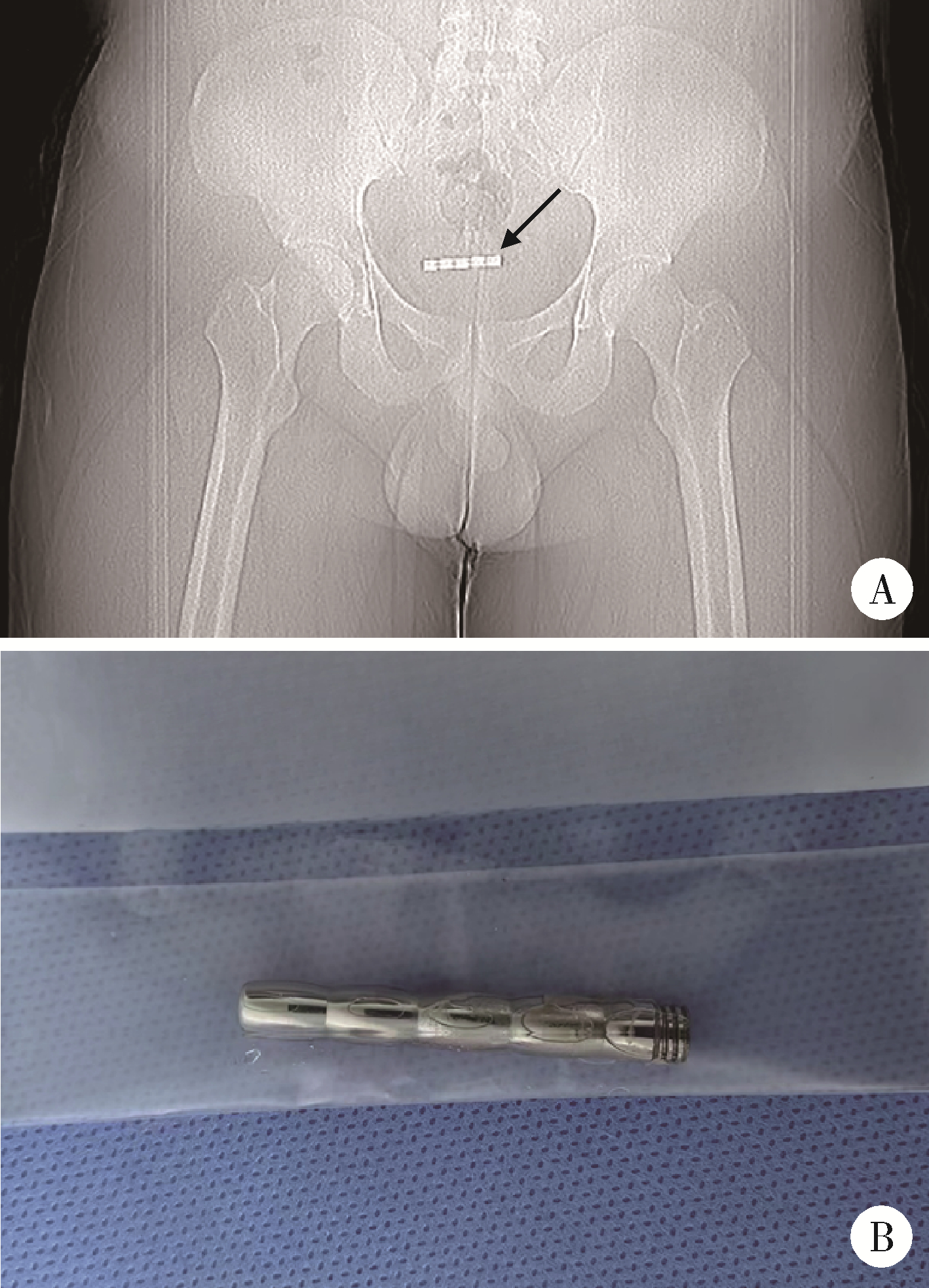
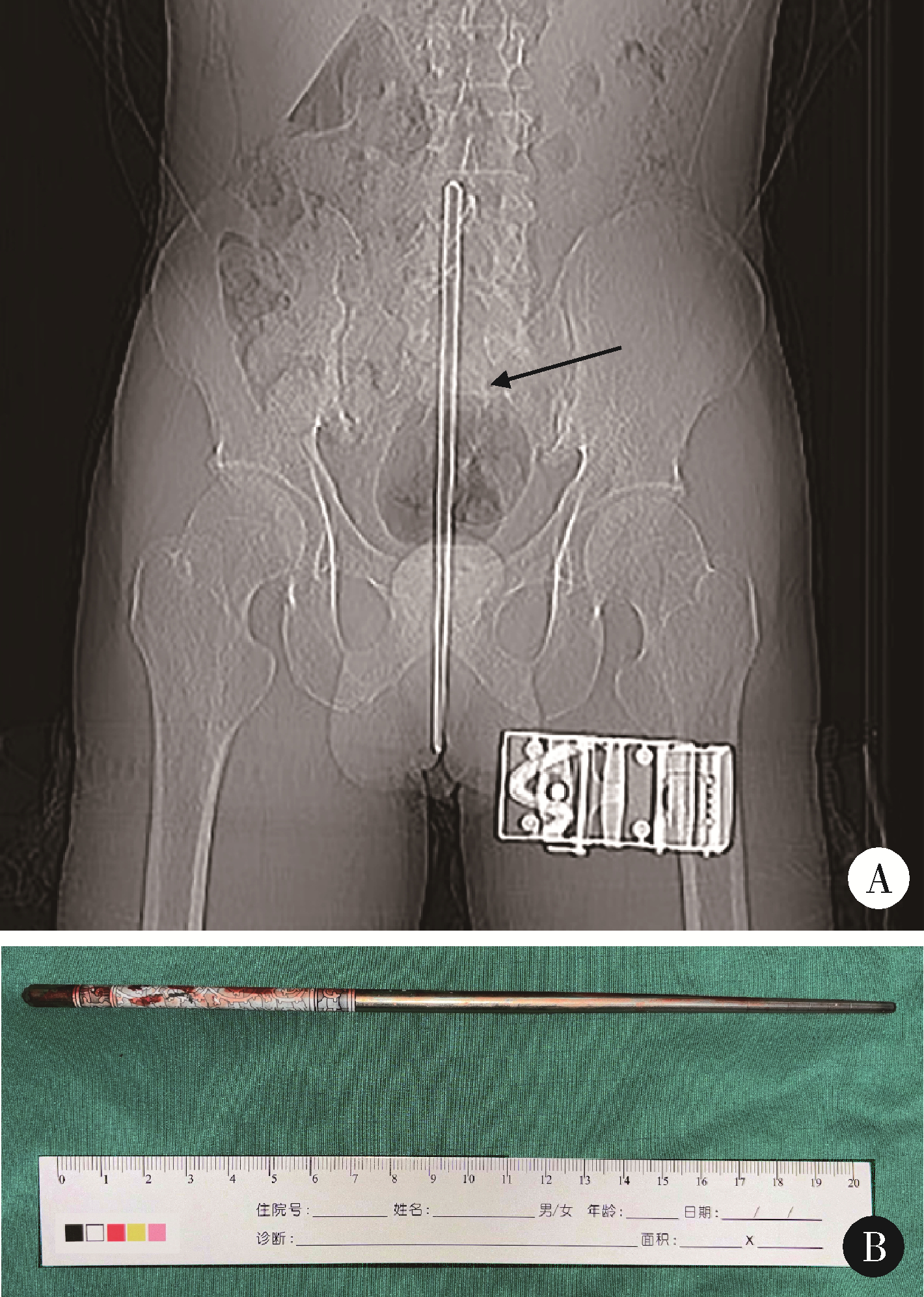
We reported the clinical records of 2 patients each with a foreign body in the urinary bladder admitted to Qingdao Central Hospital, University of Health and Rehabilitation Sciences. The size and shape of each foreign body in the urinary bladder were different, thus we chose different surgical approaches to remove them. Case 1 was a 21-year-old male patient. He presented to the outpatient service with urodynia. The patient currently complained of urodynia, and narrated that a foreign body was self-inserted via the urethra 2 days before. Physical examination revealed suprapubic pain. Ultimately he was admitted to the Department of Urology with a diagnosis of "bladder foreign body". A computed tomography (CT) scan of the pelvis was performed and the results demonstrated a linear metallic structure, mea-suring 4.2 cm in length, within the urinary bladder. Under general anesthesia, the patient was placed in lithotomy position and a rigid cystoscope was inserted into the bladder via urethra. The foreign body was a metal tubular structure and was located within the urinary bladder. Removal by foreign body forceps was attempted and long axis of the foreign body should be parallel to cystoscope. Removal was carefully performed after several attempts due to the smooth surface of the metal foreign body. Case 2 was a 42-year-old male patient. He presented to the outpatient service with dysuria and urodynia and was admitted to the Department of Urology. The patient narrated that a foreign body was self-inserted via the urethra 1 day before, and currently complained of dysuria, urodynia, and slight hematuria. A CT scan of the urologic system was performed and the results demonstrated a metal tubular structure, measuring 21.5 cm in length. The length of the foreign body was long (from top of iliac crest to perineum) and both ends were sharp, thus bladder perforation could not be excluded. Besides, with smooth metal surface, it was difficult to remove via cystoscopy and the risk of iatrogenic bladder perforation would increase simultaneously. Therefore, laparoscopic surgery was chosen to detect whether there would be a bladder perforation and could remove the foreign body. Under general anesthesia, the patient was placed in supine position and supraumbilical incision of 1 cm was performed. Pneumoperitoneum needle was used to establish a pneumoperitoneum and insufflation CO2 pressure was maintained at 12 mmHg. The peritoneum was accessed and a 10-mm trocar and laparoscopic camera were inserted. A 5-mm trocar was inserted at 2 cm below the umbilical level of lateral margin of left rectus abdominis muscle. While a 12-mm trocar was inserted at symmetrical site of his right rectus abdominis muscle. Under laparoscope, dome of the bladder was lifted into the abdominal cavity by the foreign body, then the bladder wall was incised to expose the foreign body. We pushed the bottom of the foreign body from the perineum extracorporally and removed the foreign body from the supraumbilicus trocar.

Key words: Foreign bodies, Urinary bladder, Laparoscopes, Cystoscopes

CLC Number: 

  • R694.7

Figure 1

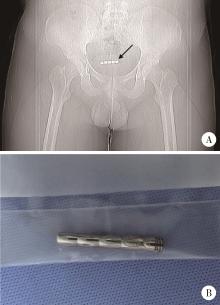
The pelvic CT image of Case 1 and the removed foreign body A, CT scan of the pelvis, indicating a metal tubular structure within the urinary bladder (arrow); B, extracted foreign body (a metal tube)."

Figure 2

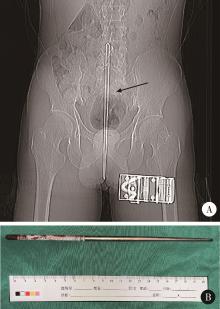
CT image of the urinary system in Case 2 and the removed foreign body A, CT scan of the urologic system, indicating a metal tubular structure(arrow) in the urinary bladder (bladder perforation can not be excluded); B, extracted foreign body (a metal chopstick)."

1
Winot S , Hill AC , Simon EL . A case report you can't make up: A bladder foreign body[J]. J Emerg Med, 2021, 61 (1): 73- 75.

doi: 10.1016/j.jemermed.2021.02.026
2
Kochakarn W , Pummanagura W . Foreign bodies in the female urinary bladder: 20-year experience in ramathibodi hospital[J]. Asian J Surg, 2008, 31 (3): 130- 133.

doi: 10.1016/S1015-9584(08)60073-1
3
Bansal A , Yadav P , Kumar M , et al. Foreign bodies in the urinary bladder and their management: A single-centre experience from north India[J]. Int Neurourol J, 2016, 20 (3): 260- 269.

doi: 10.5213/inj.1632524.262
4
Al-Zubaidi M , McCombie S , Bangash H , et al. A novel technique to remove a urinary bladder foreign body endoscopically using an Endoloop[J]. Urol Case Rep, 2022, 40, 101899.
5
Zhang K , Zhang Y , Zhang Y , et al. Pneumovesicoscopy: An available technique for the retrieval of a rare foreign body in the urinary bladder[J]. Asian J Surg, 2022, 45 (5): 1180- 1181.

doi: 10.1016/j.asjsur.2022.01.095
6
Gibson E , Glaser Z , Joseph D , et al. Previously banned magnets as foreign bodies in the lower urinary system: A single-institution case series and review of the literature[J]. Clin Pediatr (Phila), 2019, 58 (1): 110- 113.

doi: 10.1177/0009922818805199
7
Walsh P , Moustafa M . Retention of urethrovesical foreign bodies: Case report and literature review[J]. J Emerg Med, 2000, 19 (3): 241- 243.

doi: 10.1016/S0736-4679(00)00232-8
8
Ortogǧlu F , Gürlen G , Altunkol A , et al. A rare foreign material in the bladder: Piece of pencil[J]. Arch Iran Med, 2015, 18 (9): 616- 617.
9
Lindsay JS . The practice of 'urethral sounding' complicated by retained magnetic beads within the bladder and urethra: Diagnosis and review of management[J]. Am J Case Rep, 2019, 20, 1841- 1844.

doi: 10.12659/AJCR.919439
10
Liu ZH , Zhu XF , Zhou N . Retrieval of 159 magnetic balls from urinary bladder: A case report and literature review[J]. Urol Case Rep, 2019, 26, 100975.
11
Ogbetere F , Irekpita E . A self-insertion of an uncommon urethrovesical foreign body for autoerotism[J]. Niger J Surg, 2021, 27 (1): 81- 83.

doi: 10.4103/njs.NJS_6_20
12
Fabià Mayans A , Segarra Tomás J , et al. Bladder foreign body[J]. Arch Esp Urol, 2018, 71 (2): 224.
13
Huang HH , Huang YH , Chang HC , et al. Foreign bodies in the urinary bladder and urethra: A case series[J]. Asian J Surg, 2023, 46 (4): 1649- 1650.

doi: 10.1016/j.asjsur.2022.09.110
14
Datta B , Ghosh M , Biswas S . Foreign bodies in urinary bladders[J]. Saudi J Kidney Dis Transpl, 2011, 22 (2): 302- 305.
15
Graziottin TM , de Freitas G Soares D , Da Ros CT , et al. Magne-tic spheres as foreign body into the bladder[J]. J Sex Med, 2013, 10 (10): 2590- 2592.

doi: 10.1111/j.1743-6109.2012.02772.x
16
Klingenberg C , Koehler T , Due J . A foreign body in the urinary bladder[J]. Tidsskr Nor Laegeforen, 2019, 139 (2)
17
Cardinale M , Scheiwe C , Boubotte-Salmon F , et al. A rare foreign body in the bladder: A surgical dressing as a bladder stone[J]. Med Sante Trop, 2019, 29 (2): 222- 224.
18
Schmitt BH , Feder MT , Rokke DL , et al. An unusual foreign body in the urinary bladder mimicking a parasitic worm[J]. J Clin Microbiol, 2012, 50 (7): 2520- 2522.

doi: 10.1128/JCM.00532-12
19
Jin C , Fan Y , Zhang Q , et al. Removal of foreign bodies embedded in the urinary bladder wall by a combination of laparoscopy and carbon dioxide cystoscopic assistance: Case report and literature review[J]. Investig Clin Urol, 2016, 57 (6): 449- 452.

doi: 10.4111/icu.2016.57.6.449
[1] Yongcun WANG, Hongchen SONG, Yiqing DU, Tao XU. CRISPR-Cas9 activation screening identifies candidate chemokine regulators of ter-tiary lymphoid structure formation in bladder cancer [J]. Journal of Peking University (Health Sciences), 2026, 58(4): 707-715.
[2] Guangwei ZHENG, Yun PENG, Yiqing DU, Tao XU. Expression characteristics and clinical significance of ERBB2 in bladder urothelial carcinoma based on the TCGA database [J]. Journal of Peking University (Health Sciences), 2026, 58(4): 818-826.
[3] Wanwei HUANG, Xianshen SHA, Yibao ZHANG, Guohao WU, Feng LUO, Zhihui CHEN, Dongming YE, Xuesong LI, Caiyong LAI. Total 3D laparoscopic ileal ureters replacement for bilateral ureters combined with bladder augmentation in the management of post-radiotherapy bilateral ureteral strictures and contracted bladder [J]. Journal of Peking University (Health Sciences), 2025, 57(4): 789-795.
[4] Junyong OU,Kunming NI,Lulin MA,Guoliang WANG,Ye YAN,Bin YANG,Gengwu LI,Haodong SONG,Min LU,Jianfei YE,Shudong ZHANG. Prognostic factors of patients with muscle invasive bladder cancer with intermediate-to-high risk prostate cancer [J]. Journal of Peking University (Health Sciences), 2024, 56(4): 582-588.
[5] Su-huan XU,Bei-bei WANG,Qiu-ying PANG,Li-jun ZHONG,Yan-ming DING,Yan-bo HUANG,Xin-yan CHE. Effect of equal temperature bladder irrigation in patients with transurethral resection of prostate: A meta-analysis [J]. Journal of Peking University (Health Sciences), 2023, 55(4): 676-683.
[6] WANG Jia-wen,LIU Jing-chao,MENG Ling-feng,ZHANG Wei,LIU Xiao-dong,ZHANG Yao-guang. Quality of life and related factors in patients with interstitial cystitis/bladder pain syndrome [J]. Journal of Peking University (Health Sciences), 2021, 53(4): 653-658.
[7] Tian WANG,Xin HONG,Xiao-feng WANG. Clinical application of the needle electrode in transurethral plasmakinetic resection of bladder tumor around ureteral orifice: A report of 16 cases [J]. Journal of Peking University (Health Sciences), 2020, 52(4): 632-636.
[8] Shi-ming ZHAO,Tie-jun YANG,Chun-miao XU,Xiao-feng GUO,Yong-kang MA,Xue-jun CHEN,Xiang LI,Chao-hong HE. Bladder cancer local staging about muscle invasion: 3.0T MRI performance following transurethral resection [J]. Journal of Peking University (Health Sciences), 2020, 52(4): 701-704.
[9] Wei-yu ZHANG,Qiu-xiang XIA,Hao HU,Jing-wen CHEN,Yi-ran SUN,Ke-xin XU,Xiao-peng ZHANG. Analysis of urodynamic study of female outpatients with lower urinary tract symptoms and follow-up of the patients with detrusor underactive [J]. Journal of Peking University(Health Sciences), 2019, 51(5): 856-862.
[10] Hai-wen HUANG,Bing YAN,Mei-xia SHANG,Li-bo LIU,Han HAO,Zhi-jun XI. Propensity-matched comparison of laparoscopic and open radical cystectomy for female patients with bladder cancer [J]. Journal of Peking University(Health Sciences), 2019, 51(4): 698-705.
[11] Chen LIANG,Wei-yu ZHANG,Hao HU,Qi WANG,Zhi-wei FANG,Ke-xin XU. Comparison of effectiveness and complications between two different methods of augmentation cystoplasty [J]. Journal of Peking University(Health Sciences), 2019, 51(2): 293-297.
[12] WANG Huan-rui, ZHANG Wei-yu, LIU Xian-hui, HU Hao, ZHANG Xiao-peng, XU Ke-xin. Clinical application of partial cystectomy with augmentation cystoplasty for invasive bladder cancer in elderly patients [J]. Journal of Peking University(Health Sciences), 2018, 50(4): 626-629.
[13] ZHOU Jian-hua, WANG Di, WANG Huan-rui, HOU Xiao-li,YU Wei-dong, XU Ke-xin, HU Hao. Cytotoxic effects of γδT cells on bladder cancer cells and expression of MICA/B in bladder cancer [J]. Journal of Peking University(Health Sciences), 2018, 50(4): 595-601.
[14] FU Tian-xu, WANG Xi, LIU Mei-lin. Airway foreign body caused by aspiration of artificial nasal sponge: a case report [J]. Journal of Peking University(Health Sciences), 2018, 50(2): 375-377.
[15] ZHAO Lei, MA Lu-lin, ZHANG Hong-xian, HOU Xiao-fei, LIU Lei, FU Yan, KOU Yun-geng, SONG Yi-meng. Technical improvement in retroperitoneal laparoscopic living donor nephrectomy: report of 193 cases [J]. Journal of Peking University(Health Sciences), 2017, 49(5): 867-871.
Viewed
Full text


Abstract

Cited

  Shared   
  Discussed   
No Suggested Reading articles found!