Journal of Peking University (Health Sciences) ›› 2025, Vol. 57 ›› Issue (3): 430-435. doi: 10.19723/j.issn.1671-167X.2025.03.004

Previous Articles     Next Articles

Association of triglyceride-glucose index and cardiovascular disease in a community-based Chinese cohort

Mengxi LU1, Qiuping LIU1, Tianjing ZHOU1, Xiaofei LIU1, Yexiang SUN2, Peng SHEN2, Hongbo LIN2, Xun TANG1,3,*(), Pei GAO1,3,4,*()   

  1. 1. Department of Epidemiology and Biostatistics, Peking University School of Public Health, Beijing 100191, China
    2. Yinzhou District Center for Disease Control and Prevention, Ningbo 315101, Zhejiang, China
    3. Key Laboratory of Epidemiology of Major Disease (Peking University), Ministry of Education, Beijing 100191, China
    4. Center for Real-World Evidence Evaluation, Peking University Clinical Research Institute, Beijing 100191, China
  • Received:2025-02-07 Online:2025-06-18 Published:2025-06-13
  • Contact: Xun TANG, Pei GAO
  • Supported by:
    the Noncommunicable Chronic Diseases-National Science and Technology Major Project(2024ZD0527406); the National Natural Sciences Foundation of China(82373662); the Beijing Natural Science Foundation(IS24047)

RICH HTML


Abstract:

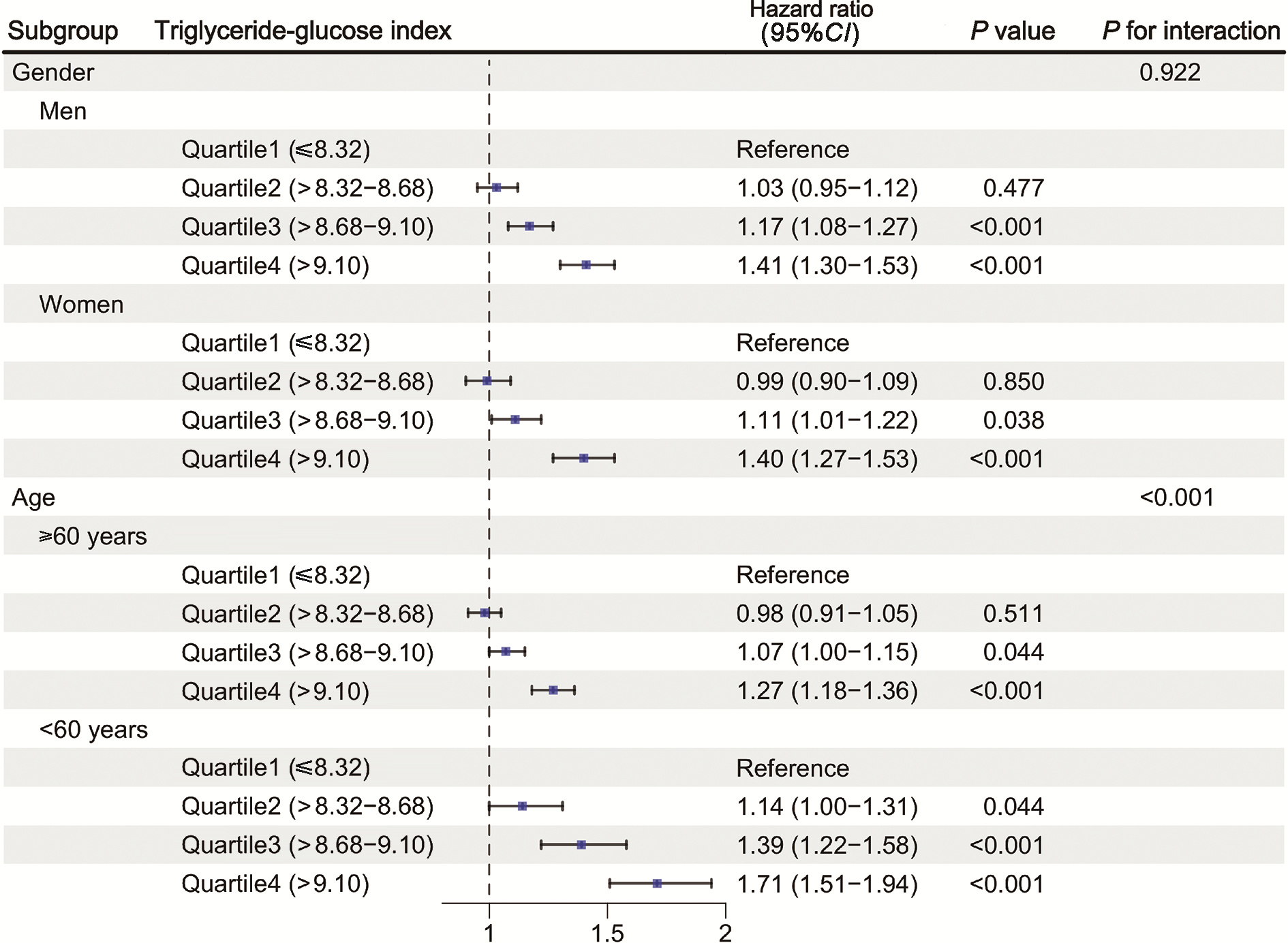
Objective: To investigate the association between the triglyceride-glucose (TyG) index and the incidence and mortality of cardiovascular disease (CVD) in a large population-based cohort. Methods: Participants aged 40-79 years without a history of CVD at baseline were drawn from the CHinese Electronic health Records Research in Yinzhou (CHERRY) study between January 1, 2010, and May 31, 2020. The TyG index was calculated using baseline triglyceride and fasting blood glucose. Cox proportional hazards models were used to assess the association between the TyG index and the composite outcome of CVD (incidence and mortality), adjusting for age, gender, education, region, smoking status, body mass index, systolic blood pressure, and total cholesterol. Hazard ratios (HR) and 95% confidence intervals (CI) were calculated. Nonlinear associations between the TyG index and CVD were further evaluated using restricted cubic splines, and subgroup analyses by gender and age were conducted to explore potential differences. Results: A total of 226 406 individuals were included, with a mean age of (55.0±9.7) years at baseline, 46.8% of whom were men, and a median TyG index of 8.68. Over a median follow-up of 7.99 years, 9 815 (4.34%) participants experienced CVD incidence or mortality. After adjusting for age, gender, education, region, smoking status, body mass index, systolic blood pressure and total cholesterol, the risk of CVD increased with higher TyG index levels (P < 0.001). The risk in the highest TyG quartile (TyG>9.10) was 42% higher than in the lowest quartile (TyG≤8.32) (HR=1.42, 95%CI: 1.34-1.51). Individuals under 60 years had a higher HR for CVD compared with those aged 60 years and above (HR: 1.71 vs. 1.27, P < 0.05). Restricted cubic spline analysis revealed a reverse L-shaped association between the TyG index and CVD risk in the overall population (P < 0.001 for nonlinear trend), with risk increasing after the TyG index exceeded 8.67. However, the threshold varied by gender, with a lower threshold in women (8.51) than in men (8.67). Conclusion: A significant nonlinear relationship was revealed between the TyG index and CVD risk, with a threshold effect. The risk of CVD increased once the TyG index surpassed a certain threshold, with a lower threshold in women than in men. These findings suggest that cardiovascular risk prediction and interventions based on the TyG index should be gender-stratified, and early intervention for individuals under 60 years old might have important public health implications.

Key words: Cardiovascular disease, Risk factors, Triglyceride-glucose index, Cohort study

CLC Number: 

  • R54

Table 1

Baseline characteristics of study participants"

Characteristic Total (n=226 406) Women (n=120 558) Men (n=105 848) P value*
Age/years 55.0±9.7 54.5±9.6 55.5±9.9 < 0.001
Education (senior high school or higher) 34 173 (15.1) 14 806 (12.3) 40 238 (38.0) < 0.001
Region (Urban) 154 444 (68.2) 81 099 (67.3) 73 345 (69.3) < 0.001
Current smoker 41 861 (18.5) 1 623 (1.3) 40 238 (38.0) < 0.001
Diabetes 19 701 (8.7) 10 475 (8.7) 9 226 (8.7) 0.823
Hypertension 74 319 (32.8) 39 305 (32.6) 35 014 (33.1) 0.016
Treated hypertension 69 047 (30.5) 34 237 (28.4) 348 100 (32.9) < 0.001
Family history of CVD 1 486 (0.7) 691 (0.6) 795 (0.8) < 0.001
SBP/mmHg 131.2±16.3 130.6±16.7 131.9±15.9 < 0.001
DBP/mmHg 81.6±9.6 80.8±9.6 82.5±9.5 < 0.001
BMI/(kg/m2) 23.3±2.8 23.2±2.9 23.3±2.7 < 0.001
FBG/(mg/dL) 103.6±30.8 101.8±27.2 105.7±34.3 < 0.001
TG/(mg/dL) 145.5 (111.5, 179.1) 141.6 (106.4, 172.8) 151.2 (116.4, 185.7) < 0.001
TC/(mg/dL) 190.2±37.8 194.3±37.7 185.6±37.3 0.030
HDL-C/(mg/dL) 50.3±12.9 52.0±12.4 48.5±13.1 < 0.001
LDL-C/(mg/dL) 109.7±31.0 111.5±31.3 107.2±30.6 < 0.001
TyG index 8.7 (8.3, 9.1) 8.7 (8.2, 9.0) 8.8 (8.3, 9.1) < 0.001

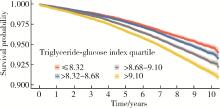
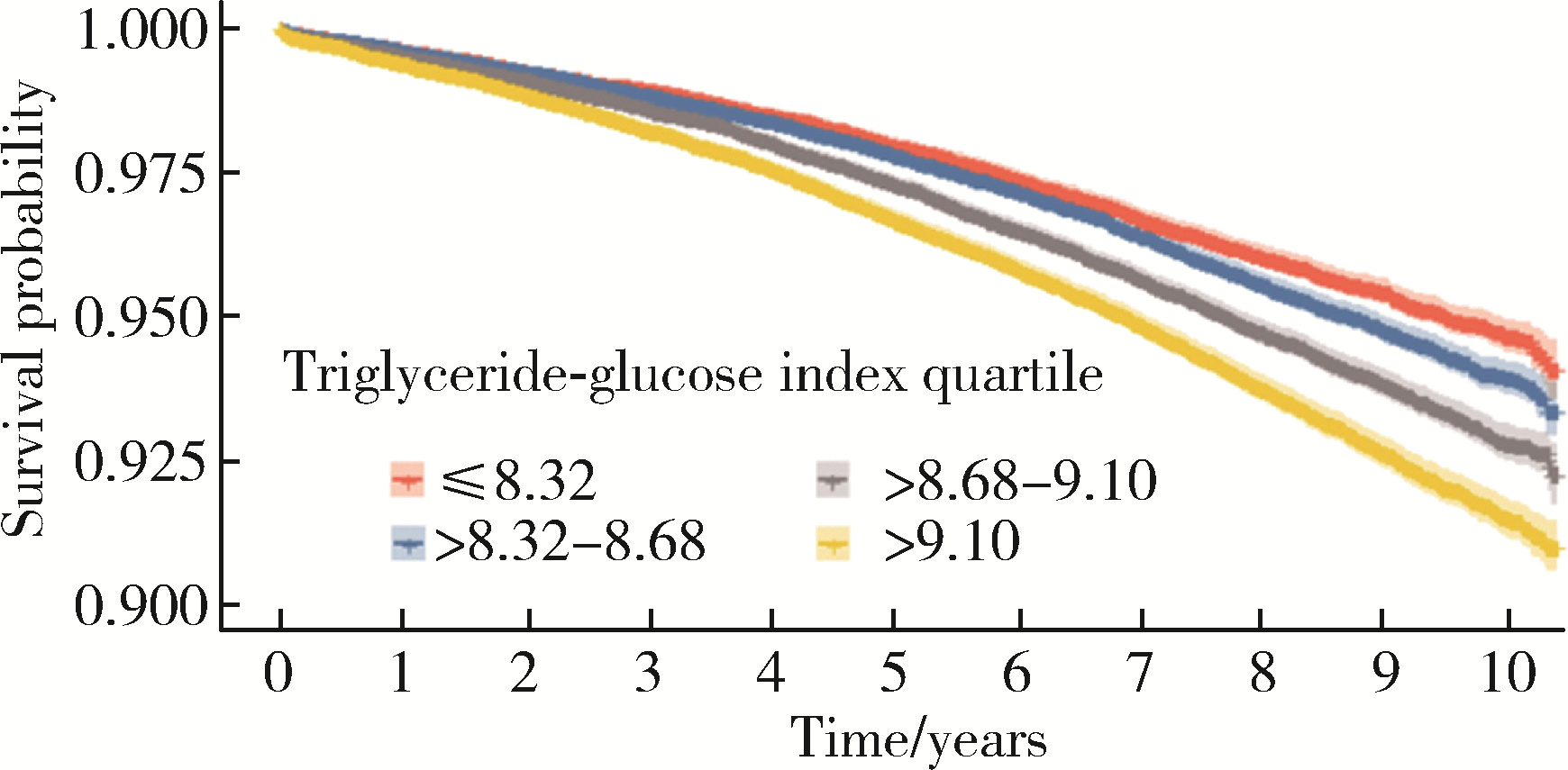
Figure 1

Kaplan-Meier curve of cardiovascular disease events by quartiles of triglyceride-glucose index"

Table 2

Association of triglyceride-glucose index and cardiovascular disease events"

Quartile Number of cases Case per 1 000 person-years Model 1 Model 2 Model 3 Model 4
HR (95%CI) P HR (95%CI) P HR (95%CI) P HR (95%CI) P
Quartile 1
(≤8.32)
1 890 4.93 Reference Reference Reference Reference
Quartile 2
(>8.32-8.68)
2 169 5.56 1.12
(1.05-1.19)
< 0.001 1.04
(0.98-1.10)
0.244 1.02
(0.96-1.08)
0.611 1.02
(0.96-1.08)
0.611
Quartile 3
(>8.68-9.10)
2 621 6.67 1.34
(1.26-1.42)
< 0.001 1.19
(1.12-1.26)
< 0.001 1.15
(1.08-1.22)
< 0.001 1.15
(1.08-1.22)
< 0.001
Quartile 4
(>9.10)
3 135 8.00 1.61
(1.52-1.70)
< 0.001 1.50
(1.41-1.58)
< 0.001 1.42
(1.34-1.51)
< 0.001 1.42
(1.34-1.51)
< 0.001

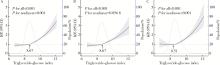
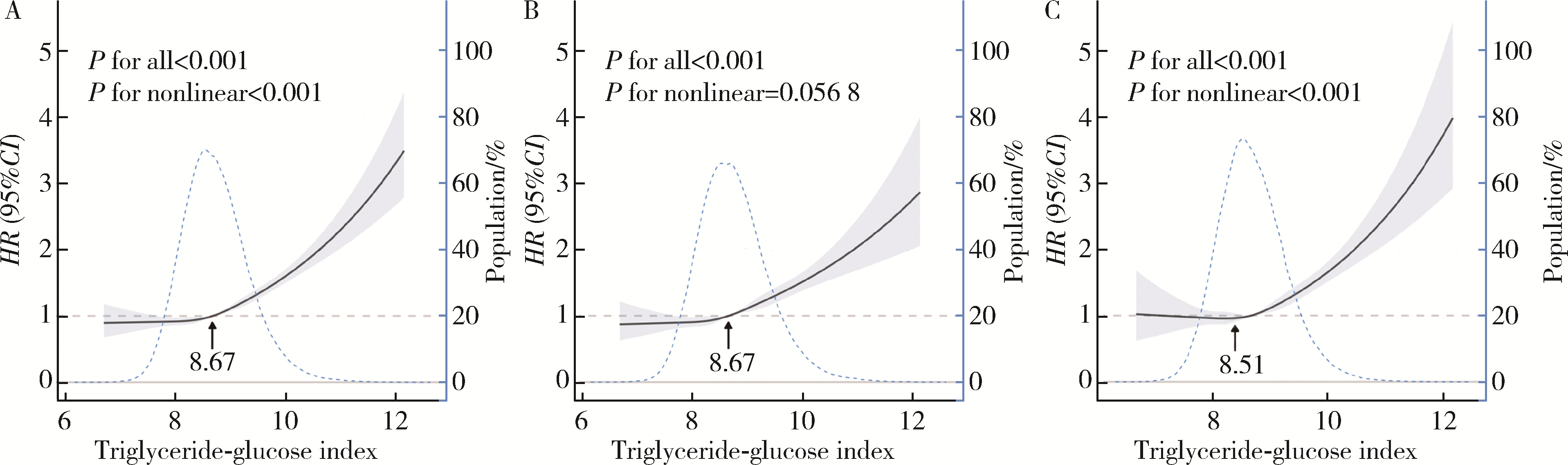
Figure 2

Nonlinear association of triglyceride-glucose index and cardiovascular disease events, by gender A, overall; B, men; C, women. P for all tested whether using splines improves the model compared to a simple linear term; P for nonlinear tested whether the nonlinear part of the spline model is statistically significant; Graphs show multivariate adjusted hazard ratios (HR; solid lines) and 95%CI (shaded areas). Dashed lines represent the proportion of the population with different levels of triglyceride-glucose index. Arrows indicate the triglyceride-glucose index at the point where risk crosses the reference line (HR=1)."

Figure 3

Association of triglyceride-glucose index and cardiovascular disease events, by gender and age groups"

1
Khan SS , Coresh J , Pencina MJ , et al. Novel prediction equations for absolute risk assessment of total cardiovascular disease incorporating cardiovascular-kidney-metabolic health: A scientific statement from the American Heart Association[J]. Circulation, 2023, 148 (24): 1982- 2004.

doi: 10.1161/CIR.0000000000001191
2
Arnett DK , Blumenthal RS , Albert MA , et al. 2019 ACC/AHA guideline on the primary prevention of cardiovascular disease: Executive summary: A report of the American College of Cardiology/American Heart Association task force on clinical practice guidelines[J]. J Am Coll Cardiol, 2019, 74 (10): 1376- 1414.

doi: 10.1016/j.jacc.2019.03.009
3
Silveira Rossi JL , Barbalho SM , Reverete de Araujo R , et al. Metabolic syndrome and cardiovascular diseases: Going beyond traditional risk factors[J]. Diabetes Metab Res Rev, 2022, 38 (3): e3502.

doi: 10.1002/dmrr.3502
4
Ding X , Wang X , Wu J , et al. Triglyceride-glucose index and the incidence of atherosclerotic cardiovascular diseases: A meta-analysis of cohort studies[J]. Cardiovasc Diabetol, 2021, 20 (1): 76.

doi: 10.1186/s12933-021-01268-9
5
Huang Y , Zhou Y , Xu Y , et al. Inflammatory markers link triglyceride-glucose index and obesity indicators with adverse cardiovascular events in patients with hypertension: Nsights from Three cohorts[J]. Cardiovasc Diabetol, 2025, 24 (1): 11.

doi: 10.1186/s12933-024-02571-x
6
Tao L C , Xu J N , Wang TT , et al. Triglyceride-glucose index as a marker in cardiovascular diseases: Landscape and limitations[J]. Cardiovasc Diabetol, 2022, 21 (1): 68.

doi: 10.1186/s12933-022-01511-x
7
Cui C , Liu L , Qi Y , et al. Joint association of TyG index and high sensitivity C-reactive protein with cardiovascular disease: A national cohort study[J]. Cardiovasc Diabetol, 2024, 23 (1): 156.

doi: 10.1186/s12933-024-02244-9
8
Lin H , Tang X , Shen P , et al. Using big data to improve cardiovascular care and outcomes in China: A protocol for the CHinese Electronic health Records Research in Yinzhou (CHERRY) Study[J]. BMJ Open, 2018, 8 (2): e019698.

doi: 10.1136/bmjopen-2017-019698
9
Hong S , Han K , Park CY . The triglyceride glucose index is a simple and low-cost marker associated with atherosclerotic cardiovascular disease: A population-based study[J]. BMC Med, 2020, 18 (1): 361.

doi: 10.1186/s12916-020-01824-2
10
WHO CVD risk chart working group . World Health Organization cardiovascular disease risk charts: Revised models to estimate risk in 21 global regions[J]. Lancet Glob Health, 2019, 7 (10): e1332- e1345.

doi: 10.1016/S2214-109X(19)30318-3
11
Harrell FE . Regression modeling strategies: With applications to linear models, logistic and ordinal regression, and survival analysis[M]. Cham: Springer International Publishing, 2015: 26- 28.
12
Liu X , Tan Z , Huang Y , et al. Relationship between the triglyceride-glucose index and risk of cardiovascular diseases and mortality in the general population: A systematic review and meta-analysis[J]. Cardiovasc Diabetol, 2022, 21 (1): 124.

doi: 10.1186/s12933-022-01546-0
13
Welsh A , Hammad M , Piña IL , et al. Obesity and cardiovascular health[J]. Eur J Prev Cardiol, 2024, 31 (8): 1026- 1035.

doi: 10.1093/eurjpc/zwae025
14
Li S , Guo B , Chen H , et al. The role of the triglyceride (triacylglycerol) glucose index in the development of cardiovascular events: A retrospective cohort analysis[J]. Sci Rep, 2019, 9 (1): 7320.

doi: 10.1038/s41598-019-43776-5
15
Dang K , Wang X , Hu J , et al. The association between triglyceride-glucose index and its combination with obesity indicators and cardiovascular disease: NHANES 2003-2018[J]. Cardiovasc Diabetol, 2024, 23 (1): 8.

doi: 10.1186/s12933-023-02115-9
16
Visseren F L J , Mach F , Smulders Y M , et al. 2021 ESC guidelines on cardiovascular disease prevention in clinical practice[J]. Eur Heart J, 2021, 42 (34): 3227- 3337.

doi: 10.1093/eurheartj/ehab484
17
Meng R , Wang W , Huang T , et al. Tackling social and behavioural risk factors for cardiovascular diseases in Chinese women[J]. BMJ, 2024, 386, e078638.
18
Van Daalen KR , Zhang D , Kaptoge S , et al. Risk estimation for the primary prevention of cardiovascular disease: considerations for appropriate risk prediction model selection[J]. Lancet Glob Health, 2024, 12 (8): e1343- e1358.

doi: 10.1016/S2214-109X(24)00210-9
19
Duan M , Zhao X , Li S , et al. Metabolic score for insulin resistance (METS-IR) predicts all-cause and cardiovascular mortality in the general population: Evidence from NHANES 2001-2018[J]. Cardiovasc Diabetol, 2024, 23 (1): 243.

doi: 10.1186/s12933-024-02334-8
20
Cui H , Liu Q , Wu Y , et al. Cumulative triglyceride-glucose index is a risk for CVD: A prospective cohort study[J]. Cardiovasc Diabetol, 2022, 21 (1): 22.

doi: 10.1186/s12933-022-01456-1
[1] Wei LIU, Wen GUO, Zhe GUO, Chunyan LI, Yunlong LI, Siqi LIU, Liang ZHANG, Hui SONG. Risk factors associated with non-radiographic bone erosion in patients with gout [J]. Journal of Peking University (Health Sciences), 2025, 57(4): 735-739.
[2] Huaqiu GUO, Zhe WANG, Xue YANG, Jie BAI. Clinical features and risk factors of patients with oral bleeding in dental emergency [J]. Journal of Peking University (Health Sciences), 2025, 57(1): 142-147.
[3] Minting DENG, Nan WANG, Bin XIA, Yuming ZHAO, Junxia ZHU. Factors associated with spontaneous re-eruption of traumatically intruded permanent anterior teeth in children and adolescents [J]. Journal of Peking University (Health Sciences), 2025, 57(1): 148-153.
[4] Yukai LI, Hongyan WANG, Liang LUO, Yun LI, Chun LI. Clinical significance of antiphospholipid antibodies in Behcet disease with thrombosis [J]. Journal of Peking University (Health Sciences), 2024, 56(6): 1036-1040.
[5] Yang TIAN, Yongzheng HAN, Jiao LI, Mingya WANG, Yinyin QU, Jingchao FANG, Hui JIN, Min LI, Jun WANG, Mao XU, Shenglin WANG, Xiangyang GUO. Incidence and risk factors of postoperative epidural hematoma following anterior cervical spine surgery [J]. Journal of Peking University (Health Sciences), 2024, 56(6): 1058-1064.
[6] Mingrui WANG, Jinhui LAI, Jiaxiang JI, Xinwei TANG, Haopu HU, Qi WANG, Kexin XU, Tao XU, Hao HU. Risk factors for decreased quality of life in patients with kidney stones predicted by the Chinese version of Wisconsin stone quality of life questionnaire [J]. Journal of Peking University (Health Sciences), 2024, 56(6): 1069-1074.
[7] Zhicun LI, Tianyu WU, Lei LIANG, Yu FAN, Yisen MENG, Qian ZHANG. Risk factors analysis and nomogram model construction of postoperative pathological upgrade of prostate cancer patients with single core positive biopsy [J]. Journal of Peking University (Health Sciences), 2024, 56(5): 896-901.
[8] Ye YAN,Xiaolong LI,Haizhui XIA,Xuehua ZHU,Yuting ZHANG,Fan ZHANG,Ke LIU,Cheng LIU,Lulin MA. Analysis of risk factors for long-term overactive bladder after radical prostatectomy [J]. Journal of Peking University (Health Sciences), 2024, 56(4): 589-593.
[9] Shengqi ZHENG,Tianchi HUA,Guicao YIN,Wei ZHANG,Ye YAO,Yifan LI. Association between the triglyceride-glucose index and the incidence of nephrolithiasis in male individuals [J]. Journal of Peking University (Health Sciences), 2024, 56(4): 610-616.
[10] Yan CHEN,Kuangmeng LI,Kai HONG,Shudong ZHANG,Jianxing CHENG,Zhongjie ZHENG,Wenhao TANG,Lianming ZHAO,Haitao ZHANG,Hui JIANG,Haocheng LIN. Retrospective study on the impact of penile corpus cavernosum injection test on penile vascular function [J]. Journal of Peking University (Health Sciences), 2024, 56(4): 680-686.
[11] Bo PANG,Tongjun GUO,Xi CHEN,Huaqi GUO,Jiazhang SHI,Juan CHEN,Xinmei WANG,Yaoyan LI,Anqi SHAN,Hengyi YU,Jing HUANG,Naijun TANG,Yan WANG,Xinbiao GUO,Guoxing LI,Shaowei WU. Personal nitrogen oxides exposure levels and related influencing factors in adults over 35 years old in Tianjin and Shanghai [J]. Journal of Peking University (Health Sciences), 2024, 56(4): 700-707.
[12] Jing HE,Zhongze FANG,Ying YANG,Jing LIU,Wenyao MA,Yong HUO,Wei GAO,Yangfeng WU,Gaoqiang XIE. Relationship between lipid metabolism molecules in plasma and carotid atheroscle-rotic plaques, traditional cardiovascular risk factors, and dietary factors [J]. Journal of Peking University (Health Sciences), 2024, 56(4): 722-728.
[13] Huangda GUO,Hexiang PENG,Siyue WANG,Tianjiao HOU,Yixin LI,Hanyu ZHANG,Mengying WANG,Yiqun WU,Xueying QIN,Xun TANG,Jing LI,Dafang CHEN,Yonghua HU,Tao WU. A ssociations of short-term ambient particulate matter exposure and MTNR1B gene with triglyceride-glucose index: A family-based study [J]. Journal of Peking University (Health Sciences), 2024, 56(3): 375-383.
[14] Shan CAI,Yihang ZHANG,Ziyue CHEN,Yunfe LIU,Jiajia DANG,Di SHI,Jiaxin LI,Tianyu HUANG,Jun MA,Yi SONG. Status and pathways of factors influencing physical activity time among elementary and junior high school students in Beijing [J]. Journal of Peking University (Health Sciences), 2024, 56(3): 403-410.
[15] Zuhong ZHANG,Tianjiao CHEN,Jun MA. Associations between puberty timing and cardiovascular metabolic risk factors among primary and secondary students [J]. Journal of Peking University (Health Sciences), 2024, 56(3): 418-423.
Viewed
Full text


Abstract

Cited

  Shared   
  Discussed   
No Suggested Reading articles found!