Journal of Peking University (Health Sciences) ›› 2025, Vol. 57 ›› Issue (4): 711-716. doi: 10.19723/j.issn.1671-167X.2025.04.013

Previous Articles     Next Articles

Comparison of efficacy and safety of transurethral thulium fiber laser enucleation of prostate in patients with different prostate volumes

Chao ZUO1,2, Guoli WANG1, Kunlin YANG1, Xinyan CHE1, Yisen MENG1,*(), Kai ZHANG1,*()   

  1. 1. Department of Urology, Peking University First Hospital, Beijing 100034, China
    2. Department of Urology, Beijing Miyun District Hospital, Beijing 101500, China
  • Received:2025-03-03 Online:2025-08-18 Published:2025-08-02
  • Contact: Yisen MENG, Kai ZHANG
  • Supported by:
    the Clinical Research Program for Researching Hospital Wards(BRWEP2024W054070103); the National High Level Hospital Clinical Research Funding-Scientific and Technological Achievements Transformation Incubation Guidance Fund Project of Peking University First Hospital(2023CX01)

RICH HTML


Abstract:

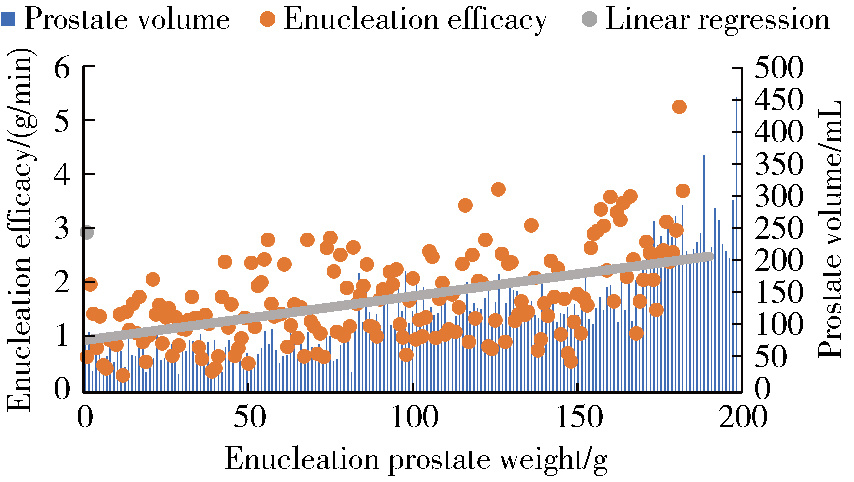
Objective: To evaluate the effectiveness and safety of thulium fiber laser enucleation of the prostate (ThuFLEP) in the treatment of oversized (>200 mL) prostate. Methods: Clinical data of 475 benign prostatic hyperplasia (BPH) patients operated by the same urologist at Peking University First Hospital from January 2022 to May 2024 were retrospectively analyzed, all of whom were treated with thulium fiber laser, and the patients were divided into three groups according to the total volume of the prostate (TPV): group A (TPV < 100 mL), group B (100 mL≤TPV < 200 mL), and group C (TPV≥200 mL). The age of the patients in the three groups [(69.38±7.79) years, (69.64±8.69) years, (70.32±7.44) years], International Prostate Symptom Score (IPSS) [(22.7±1.9), (22.8±2.7), (25.8±3.7)], and the maximum urinary flow rate (Qmax) [(7.9±2.7) mL/s, (9.3±4.3) mL/s, (9.9±3.3) mL/s] were not statistically significant (P>0.05). The prostate volume in the three groups [(103.49±46.19) mL, (75.73±30.69) mL, (273.49±49.19) mL] and prostate specific antigen (PSA) [3.52 (1.05, 8.76) μg/L, 6.78 (1.61, 7.45) μg/L, 8.52 (5.05, 12.76) μg/L] were statistically significant (P < 0.05). Results: All surgeries were successfully completed. The dif-ferences in enucleation time [30.0 (21.2, 44.5) min, 41.6 (31.2, 52.5) min, 45.1 (35.2, 50.0) min] and hospitalization time [(6.06±1.21) d, (6.15±1.50) d, (7.71±1.74) d] among the three groups were not statistically significant (P>0.05); and the differences in the postoperative indwelling catheter time [(4.0±1.4) d, (4.0±1.3) d, (6.6±1.1) d], operative time [61 (42, 89) min, 82 (62, 105) min, 115 (96, 142) min], enucleation efficiency [1.29 (0.71, 1.56) g/min, 1.67 (1.23, 2.15) g/min, 2.74 (2.20, 3.34) g/min], and hemoglobin drop values [12 (7, 19) g/L, 17 (11, 24) g/L, 27 (19, 35) g/L] were statistically different (P < 0.05). Linear regression ana-lysis was used to show a strong positive linear correlation between enucleation efficiency and enucleation weight (r=0.880, P < 0.001), and the enucleation efficiency increased with the increase of prostate volume. The differences in IPSS [(6.6±1.7), (6.2±1.4), (4.6±1.1)] and Qmax [(18.9±3.1) mL/s, (16.8±3.8) mL/s, (22.9±7.1) mL/s] were not statistically significant among the three groups (P>0.05), and the differences in IPSS and Qmax were statistically significant compared with those before surgery. The differences were statistically significant in preoperative comparisons, but the postoperative urinary flow rate of group C increased significantly more than the remaining two groups in terms of Qmax (P < 0.05). The patients in the three groups were followed up for 3 months, and post-operative complications were categorized into Clavien-Dindo Ⅰ (urinary retention, persistent hematu-ria), Clavien-Dindo Ⅱ (glandular remnants, urinary tract infection, blood transfusion) and Clavien-Dindo Ⅲ (urethral stenosis, contracture of the bladder neck, and reoperation for hemorrhage) based on the Clavien-Dindo Complications System score, the incidence of Clavien-Dindo in the three groups was 5.2% (13 cases), 6.7% (12 cases) and 12.1% (7 cases), respectively, with statistically significant differences (P < 0.05); among them, there were statistically significant differences in urinary infection, blood transfusion and bleeding reoperation (P < 0.05), and there was no statistically significant difference in the remaining complications (P>0.05). Conclusion: The risk of blood transfusion and re-hemostasis increases with larger prostate volume, the efficiency of enucleation increases with the increase of prostate vo-lume, and thulium fiber laser prostate enucleation is safe and effective in the treatment of large-volume BPH.

Key words: Prostatic hyperplasia, Thulium fiber laser, Enucleation, Postoperative complications

CLC Number: 

  • R697.3

Table 1

General characteristic of BPH patients"

Items Group A Group B Group C F/H P
Age/years, ${\bar x}$±s 69.38±7.79 69.64±8.69 70.32±7.44 1.48 0.231
Prostate volume/mL, ${\bar x}$±s 103.49±46.19 75.73±30.69 273.49±49.19 1.134 0.007
tPSA/(μg/L), M(P25, P75) 3.52 (1.05, 8.76) 6.78 (1.61, 7.45) 8.52 (5.05, 12.76) 0.981 0.012
IPSS, ${\bar x}$±s 22.7±1.9 22.8±2.7 25.8±3.7 1.897 0.543
Qmax/(mL/s), ${\bar x}$±s 7.9±2.7 9.3±4.3 9.9±3.3 1.008 0.238

Table 2

Perioperative characteristics of BPH patients"

Items Group A Group B Group C F/Z P
Operative time/min, M(P25, P75) 61 (42, 89) 82 (62, 105) 115 (96, 142) 1.917 0.004
Enucleation time/min, M(P25, P75) 30.0 (21.2, 44.5) 41.6 (31.2, 52.5) 45.1 (35.2, 50.0) 10.07 0.673
Hospitalization period/d, ${\bar x}$±s 6.06±1.21 6.15±1.50 7.71±1.74 23.05 0.165
Enucleation efficacy/(g/min), M(P25, P75) 1.29 (0.71, 1.56) 1.67 (1.23, 2.15) 2.74 (2.20, 3.34) 16.29 <0.001
Catheterization period/d, ${\bar x}$±s 4.0±1.4 4.0±1.3 6.6±1.1 2.178 0.045
Decrease in hemoglobin/(g/L), M(P25, P75) 12 (7, 19) 17 (11, 24) 27 (19, 35) 3.984 0.003

Figure 1

Linear regression analysis of prostate volume and enucleation efficacy"

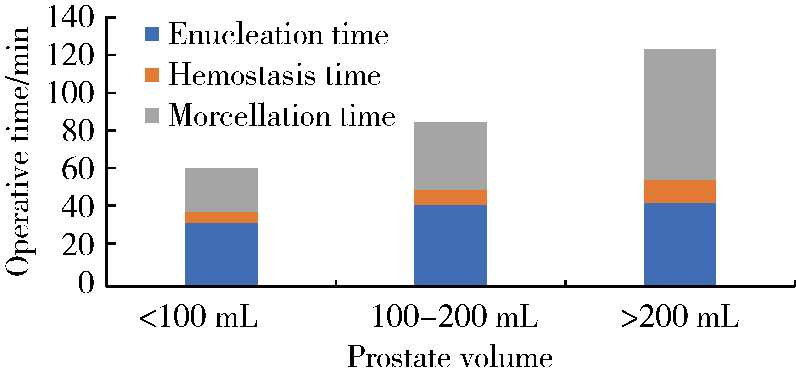
Figure 2

Operative time of enucleation of prostate with different volumes (enucleation+hemostasis+morcellation)"

Table 3

Postoperative complications (Clavien-Dindo)"

Complications Group A Group B Group C P
Overall adverse events, n(%) 13 (5.2) 12 (6.7) 7 (12.1) 0.004
Clavien-Dindo Ⅰ, n 2 1 2
    Recatheterization 1 1 1 0.446
    Hematuresis 1 0 1 0.166
Clavien-Dindo Ⅱ, n 2 6 4
    Clot retention 0 2 0 0.213
    Urinary tract infection 1 1 2 0.041
    Transfusion 1 3 2 0.013
Clavien-Dindo Ⅲ, n 9 5 1
    Urethral stricture 4 1 0 0.420
    Bladder neck contracture 5 0 0 0.033
    Reoperation 0 4 1 0.034
1
Zhu C , Wang DQ , Zi H , et al. Epidemiological trends of urinary tract infections, urolithiasis and benign prostatic hyperplasia in 203 countries and territories from 1990 to 2019[J]. Mil Med Res, 2021, 8 (1): 64- 76.
2
Baboudjian M , Hashim H , Bhatt N , et al. Summary paper on underactive bladder from the European Association of Urology guidelines on non-neurogenic male lower urinary tract symptoms[J]. Eur Urol, 2024, 86 (3): 213- 220.
3
Tallè M , Giulioni C , Papaveri A , et al. Influence of preoperative indwelling urinary catheter on outcomes of high-power holmium laser enucleation for very large prostate (≥ 200 mL)[J]. World J Urol, 2025, 43 (1): 223- 229.
4
Gabrielson AT , Tanidir Y , Castellani D , et al. A global survey of ergonomics practice patterns and rates of musculoskeletal pain among urologists performing retrograde intrarenal surgery[J]. J Endourol, 2022, 36 (9): 1168- 1176.
5
Doizi S . Lasers for benign prostatic hyperplasia (hybrid, blue diode, TFL, Moses). Which one to choose?[J]. Curr Opin Urol, 2022, 32 (4): 438- 442.
6
Nunes RV , Manzano J , Truzzi JC , et al. Treatment of benign prostatic hyperplasia[J]. Rev Assoc Med Bras (1992), 2017, 63 (2): 95- 99.
7
左超, 杨昆霖, 车新艳, 等. "U"形整叶法经尿道光纤铥激光前列腺剜切术治疗良性前列腺增生的疗效和安全性[J]. 中华泌尿外科杂志, 2024, 45 (7): 515- 520.
8
Sandhu JS , Bixler BR , Dahm P , et al. Management of lower urinary tract symptoms attributed to benign prostatic hyperplasia (BPH): AUA guideline amendment 2023[J]. J Urol, 2024, 211 (1): 11- 19.
9
Bulai CA , Multescu RD , Geavlete PA , et al. The impact of transurethral enucleation therapeutic approach in all-size benign prostatic obstruction pathology: From contemporary technological advances to evidence-based clinical progresses[J]. Diagnostics (Basel), 2025, 15 (4): 416- 421.
10
中华医学会泌尿外科学分会激光学组, 微创学组, 尿控学组. 经尿道激光前列腺剜除术热点问题中国专家共识[J]. 中华泌尿外科杂志, 2024, 45 (7): 489- 496.
11
Boxall NE , Georgiades F , Miah S , et al. A call for HoLEP: AEEP for mega-prostates (≥ 200 cc)[J]. World J Urol, 2021, 39 (7): 2347- 2353.
12
Wang J , Wu S , Wang M . Role of thulium laser and holmium laser in the surgical treatment of benign prostatic hyperplasia: A systemic review and meta-analysis[J]. Iran J Public Health, 2024, 53 (3): 495- 507.
13
左超, 杨昆霖, 李志存, 等. "双沟双环法"经尿道铥激光前列腺剜除术单一术者学习曲线分析[J]. 中华医学杂志, 2023, 103 (20): 1563- 1567.
14
Zell MA , Abdul-Muhsin H , Navaratnam A , et al. Holmium laser enucleation of the prostate for very large benign prostatic hyperplasia (≥ 200 cc)[J]. World J Urol, 2021, 39 (1): 129- 134.
15
Chen YZ , Lin WR , Chow YC , et al. Analysis of risk factors of bladder neck contracture following transurethral surgery of prostate[J]. BMC Urol, 2021, 21 (1): 59- 63.
[1] Zhao ZHAO, Weiyu ZHANG, Wenbo YANG, Yongjie ZHANG, Xiaopeng ZHANG, Huiying ZHAO, Gang ZHOU, Qiang WANG. Kidney transplantation in low-age, low-weight children: A report of two cases [J]. Journal of Peking University (Health Sciences), 2025, 57(4): 803-807.
[2] Ning LIU, Libo MAN, Feng HE, Guanglin HUANG, Jianpo ZHAI. Correlation between urination intermittences and urodynamic parameters in benign prostatic hyperplasia patients [J]. Journal of Peking University (Health Sciences), 2025, 57(2): 328-333.
[3] Su-huan XU,Bei-bei WANG,Qiu-ying PANG,Li-jun ZHONG,Yan-ming DING,Yan-bo HUANG,Xin-yan CHE. Effect of equal temperature bladder irrigation in patients with transurethral resection of prostate: A meta-analysis [J]. Journal of Peking University (Health Sciences), 2023, 55(4): 676-683.
[4] Hui LI,Yang-xu GAO,Shu-lei WANG,Hong-xin YAO. Surgical complications of totally implantable venous access port in children with malignant tumors [J]. Journal of Peking University (Health Sciences), 2022, 54(6): 1167-1171.
[5] LI Wei-hao,LI Wei,ZHANG Xue-min,LI Qing-le,JIAO Yang,ZHANG Tao,JIANG Jing-jun,ZHANG Xiao-ming. Comparison of the outcomes between open and hybrid approaches in the treatment of thoracoabdominal aortic aneurysms repair [J]. Journal of Peking University (Health Sciences), 2022, 54(1): 177-181.
[6] Jian GAO,Li-bao HU,Chen CHEN,Xin ZHI,Tao XU. Interventional treatment of hemorrhage after percutaneous nephrolithotomy [J]. Journal of Peking University (Health Sciences), 2020, 52(4): 667-671.
[7] Wen-min DONG,Ming-rui WANG,Hao HU,Qi WANG,Ke-xin XU,Tao XU. Initial clinical experience and follow-up outcomes of treatment for ureteroileal anastomotic stricture with Allium coated metal ureteral stent [J]. Journal of Peking University (Health Sciences), 2020, 52(4): 637-641.
[8] Ke LIU,Fan ZHANG,Chun-lei XIAO,Hai-zhui XIA,Yi-chang HAO,Hai BI,Lei ZHAO,Yu-qing LIU,Jian LU,Lu-lin MA. Low power seven-step two-lobe holmium laser enucleation of the prostate technique for surgical treatment of benign prostatic hyperplasia [J]. Journal of Peking University(Health Sciences), 2019, 51(6): 1159-1164.
[9] Kai MA,Xing-ke QU,Qing-quan XU,Liu-lin XIONG,Xiong-jun YE,Li-zhe AN,Wei-nan CHEN,Xiao-bo HUANG. Endoscopic treatment for ureterovesical junction stenosis in patients with kidney transplantation: 13 cases report [J]. Journal of Peking University(Health Sciences), 2019, 51(6): 1155-1158.
[10] Chen LIANG,Wei-yu ZHANG,Hao HU,Qi WANG,Zhi-wei FANG,Ke-xin XU. Comparison of effectiveness and complications between two different methods of augmentation cystoplasty [J]. Journal of Peking University(Health Sciences), 2019, 51(2): 293-297.
[11] Jia-xuan XU,Hong-zhi WANG,Jun DONG,Xiao-jie CHEN,Yong YANG,Ren-xiong CHEN,Guo-dong WANG. Analysis of risk factors for acute lung injury/acute respiratory distress syndrome after esophagectomy [J]. Journal of Peking University(Health Sciences), 2018, 50(6): 1057-1062.
[12] LI Xu, LI Feng-long, LU Yi, ZHU Yi-ming, GUO Si-yi, LI Yi-jun, JIANG Chun-yan. Clinical study on locking plate for the treatment of non-osteoporotic complex proximal humeral fractures [J]. Journal of Peking University(Health Sciences), 2017, 49(5): 855-860.
[13] HUANG Jun-jun, ZHANG Hong, ZHANG Wei, WANG Xi, GONG Yu-hong, WANG Guang-fa. Patient-related independent clinical risk factors for early complications following interventional pulmonology procedures [J]. Journal of Peking University(Health Sciences), 2016, 48(6): 1006-1011.
[14] GE Na, GUAN Ming, LI Xi, LI Shuai, WANG En-bo. Application of flexible laryngeal mask airway in oral & maxillofacial day surgery [J]. Journal of Peking University(Health Sciences), 2015, 47(6): 1010-1014.
[15] LIU Kun, XU Zong-yuan, MENG Jun-song, FU Guang-bo, GU Suo, GU Min. Impact of preoperative nutritional risk on complications after radical cystectomy [J]. Journal of Peking University(Health Sciences), 2015, 47(5): 800-803.
Viewed
Full text


Abstract

Cited

  Shared   
  Discussed   
No Suggested Reading articles found!