Journal of Peking University (Health Sciences) ›› 2025, Vol. 57 ›› Issue (6): 1051-1060. doi: 10.19723/j.issn.1671-167X.2025.06.006

Previous Articles     Next Articles

Clinical efficacy and safety of rituximab in treating renal injury in primary Sjögren syndrome

Yayun ZHAO1,2, Mengfan NI3, Xue LI1, Bei WANG1,4, Gong CHENG1, Jing HE1, Yuebo JIN1,*()   

  1. 1. Department of Rheumatology and Immunology, Peking University People' s Hospital, Beijing 100044, China
    2. Department of Rheumatology, Hebei Provincial Hospital of Chinese Medicine, Shijiazhuang 050000, China
    3. Department of Nephrology, Peking University People' s Hospital, Beijing 100044, China
    4. Department of Rheumatology and Immunology, Qiandongnan People' s Hospital, Kaili 556000, Guizhou, China
  • Received:2025-08-18 Online:2025-12-18 Published:2025-10-30
  • Contact: Yuebo JIN
  • Supported by:
    the National Key Research and Development Program(2022YFE0131700); the Research and Development Fund of Peking University People' s Hospital(RDZH2022-03); the Research and Development Fund of Peking University People' s Hospital(RDY2021-26); the Project for the Clinical Excellent Person Funded by the Hebei Provincial Government(ZF2025306); the Scientific Research Project of the Administration of Traditional Chinese Medicine of Hebei Province(2021039)

RICH HTML


Abstract:

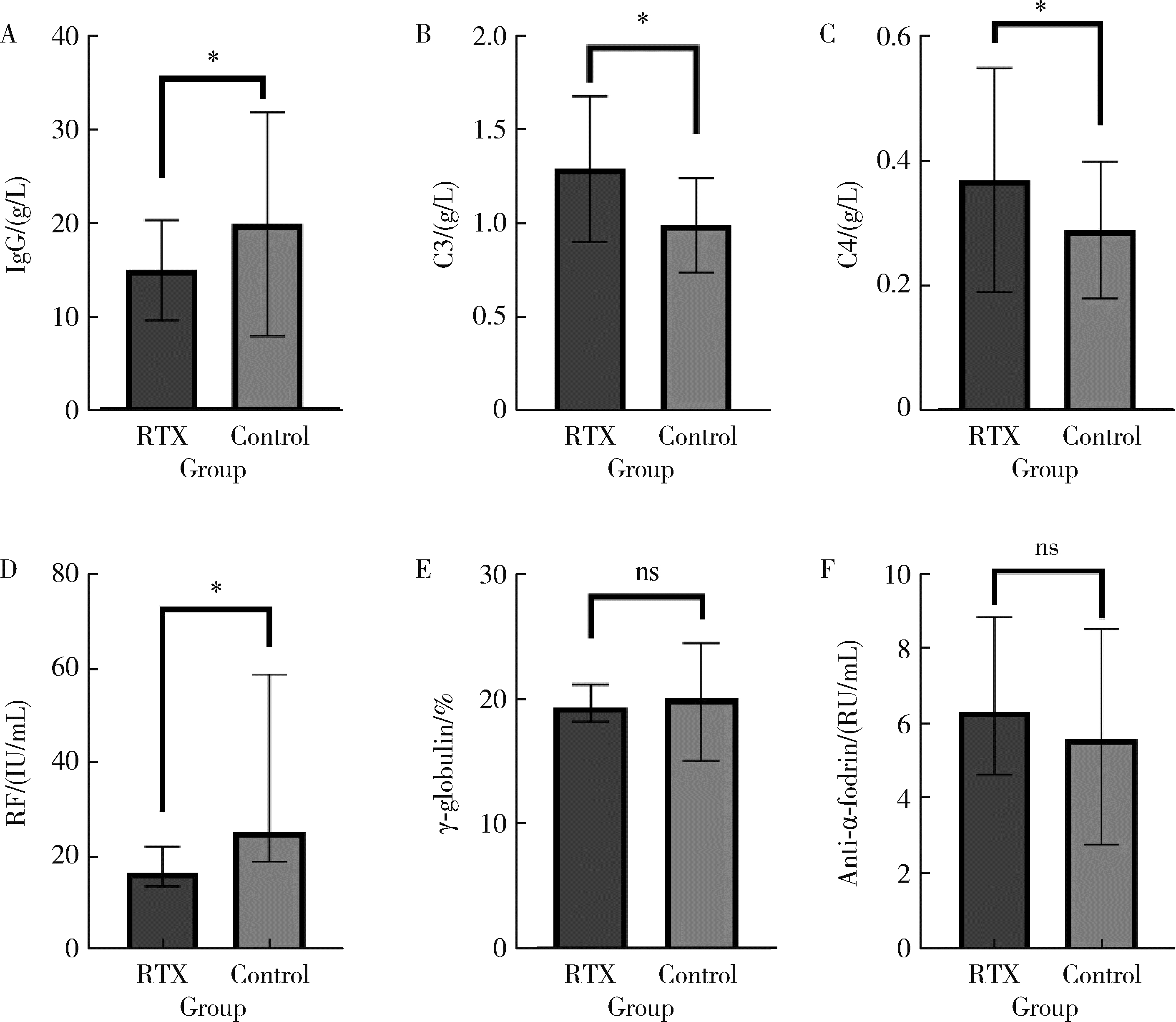
Objective: Renal involvement is a common extra-glandular lesion in primary Sjögren syndrome (pSS), generally associated with poor prognosis. Early immunotherapy might alleviate renal injury and improve long-term renal function. Growing evidence suggests that rituximab (RTX) is effective for systemic manifestations in pSS. In this retrospective study, we preliminarily investigated the efficacy of RTX on renal involvement in pSS. Methods: Clinical and laboratory data from the clinical large-scale data application platform of peking University People' s Hospital were collected. From July 2013 to January 2025, 17 patients with secondary renal damage due to pSS who were treated with RTX in the Department of Rheumatology and Immunology and the Department of Nephrology of Peking University People' s Hospital were consecutively included. During the same period, 34 patients treated with conventional immunosuppressive drugs were matched for age, gender, and baseline disease conditions. The RTX group received glucocorticoid therapy along with RTX, while the control group received glucocorticoid therapy along with immunosuppressive drugs for 6 months. We evaluated the effect of different treatments by comparing general laboratory parameters, renal injury index, and immunological features before and after treatment in the two groups. Results: After 6 months, renal function indices showed significant reductions in levels of the urinary N-acetyl-β-glucosaminidase (NAG), beta2-microglobulin (β2-MG), creatinine, and urea nitrogen in the RTX group ( P < 0.01, P < 0.05). It was shown that the levels of 24 h urinary total protein (24h UTP), urinary retinol-binding protein in the RTX group were lower, while the serum potassium in the RTX group were higher than those in the control group, all with no significant difference (P>0.05). Regarding immunological features, the RTX group had significantly lower levels of immunoglobulin G (IgG, P < 0.05) and rheumatoid factor (RF, P < 0.05), and higher levels of complement 3 (C3) and complement 4 (C4) compared with the control group ( P < 0.05). The total European League Against Rheumatism Sjögren syndrome disease activity index (ESSDAI) score and renal score in the RTX group were significantly lower than those in the control group, with statistically significant differences ( P < 0.05). Furthermore, after the 6-month treatment, a higher proportion of patients in the RTX group were able to taper their prednisone dose to lower levels (0-5 mg, quaque die) compared with the control group (64.71% vs. 32.35%, P=0.038). In addition to these positive outcomes, the incidence of infection was 1/17 in the RTX group and 3/34 in the control group. No serious adverse events were observed during the trial. Conclusion: Through targeted depletion of pathogenic B cells, RTX had the potential to ameliorate glomerular and tubulointerstitial damage, as well as modulate renal excretion and acid-base equilibrium in pSS patients. It was suggested that RTX might be superior to traditional immunosuppressive drugs, and helpful in glucocorticoid tapering. Meanwhile, medication adherence was guaranteed with a favorable safety profile. Thus, RTX is considered to be a promising option in clinical practice.

Key words: Rituximab, Sjögren syndrome, Renal injury, Immunosuppressive agents

CLC Number: 

  • R593.2

Table 1

Comparison of baseline general characteristic between the RTX group and the control group"

Items RTX group (n=17) Control group (n=34) P value
Demographic data
  Male/Female 1/16 2/32 >0.999
  Age of onset/years, $\bar x \pm s$ 38.35±14.81 40.97±12.37 0.508
  Course of disease/years, $\bar x \pm s$ 12.86±10.82 11.24±10.33 0.604
Symptom, n (%)
  Dry mouth 16 (94.12) 32 (94.12) >0.999
  Ocular dryness 17 (100.00) 33 (97.06) >0.999
  Edema 6 (35.29) 7 (20.59) 0.315
  Increased nocturia 3 (17.65) 9 (26.47) 0.728
Antibody, n (%)
  Anti-SSA60 antibodies 14 (82.35) 29 (85.29) >0.999
  Anti-Ro52 antibodies 16 (94.12) 26 (76.47) 0.241
  Anti-SSB antibodies 4 (23.53) 18 (52.94) 0.072
System involvement, n (%)
  Respiratory system 4 (23.53) 12 (35.29) 0.527
  Hematologic system 10 (58.82) 14 (41.18) 0.255
  Peripheral nervous system 4 (23.53) 4 (11.76) 0.416
Previous medication, n (%)
  HCQ 14 (82.35) 24 (70.59) 0.568
  MMF 14 (82.35) 25 (73.53) 0.728
  CTX 6 (35.29) 14 (41.18) 0.767
  IGU 2 (11.76) 6 (17.65) 0.703
  AZA 1 (5.88) 1 (2.94) >0.999
  CsA 1 (5.88) 2 (5.88) >0.999
  TAC 2 (11.76) 7 (20.59) 0.699
  LEF 1 (5.88) 1 (2.94) >0.999
  Tofacitinib 0 (0) 4 (11.76) 0.284
Using prednisone, n (%) 12 (70.59) 27 (79.41) 0.503

Table 2

Comparison of baseline laboratory parameters between the RTX group and the control group"

Items RTX group (n=17) Control group (n=34) P value
General laboratory parameter
  WBC/(×109/L) 5.36±2.73 5.78±2.10 0.544
  HGB/(g/L) 113.00±16.95 114.62±18.99 0.768
  PLT/(×109/L) 191.65±79.05 183.91±79.04 0.744
  CRP/(mg/L) 1.10 (0.50, 3.70) 1.00 (0.50, 2.70) 0.852
  ESR/(mm/h) 54.12±30.47 40.38±27.45 0.115
Renal injury index
  Scr/(μmol/L) 83.0 (64.0, 155.0) 76.0 (62.5, 96.5) 0.631
  BUN/(mmol/L) 6.00 (4.50, 10.95) 5.88 (4.40, 8.51) 0.920
  eGFR/[mL/(min·1.73 m2)] 73.00 (36.63, 102.14) 75.69 (49.95, 97.73) 0.910
  Serum potassium/(mmol/L) 3.80±0.57 3.77±0.57 0.845
  CO2CP/(mmol/L) 24.00 (21.70, 25.00) 23.65 (18.75, 27.80) 0.897
  24h UTP/(g/24 h) 0.30 (0.19, 4.53) 0.54 (0.21, 1.10) 0.933
  RBP/(mg/L) 3.17±3.34 3.04±3.84 0.916
  NAG/(U/L) 17.60±9.99 24.15±37.86 0.530
  β2-MG/(μg/L) 1 444.65 (325.08, 6 102.90) 1 091.00 (112.95, 7 170.25) 0.784
  Urine pH 6.50±0.77 6.61±0.77 0.647
  Bicarbonate/(mmol/L) 17.68±7.87 17.46±6.64 0.939
  Titratable acid/(mmol/L) 1.59 (0.55, 7.15) 6.00 (2.15, 10.46) 0.237
  Ammonium ion/(mmol/L) 18.99±10.49 30.01±14.78 0.065
Immunological features
  IgG/(g/L) 19.39±9.91 20.79±12.48 0.690
vC3/(g/L) 1.06±0.29 0.98±0.21 0.276
  C4/(g/L) 0.32±0.17 0.24±0.10 0.079
  RF/(IU/mL) 33.40 (17.90, 113.50) 67.65 (20.00, 173.75) 0.341
  γ-globulin/% 22.60 (18.30, 34.50) 26.15 (18.80, 30.50) 0.990
  Anti-α-fodrin/(RU/mL) 11.94 (6.46, 19.24) 8.61 (5.07, 17.00) 0.366

Table 3

Comparison of general laboratory parameters before and after treatment between the RTX group and the control group"

Items Group Before treatment After treatment P value
WBC/(×109/L) RTX group 4.50 (3.79, 6.55) 4.60 (3.53, 5.85) 0.518
Control group 5.38 (4.18, 7.59) 5.74 (4.29, 7.99) 0.480
HGB/(g/L) RTX group 112.00 (101.00, 130.00) 126.00 (115.50, 131.50) 0.097
Control group 116.50 (101.25, 126.25) 122.00 (110.00, 131.00) 0.111
PLT/(×109/L) RTX group 164.00 (139.00, 247.00) 178.00 (144.00, 230.50) 0.552
Control group 195.00 (120.75, 237.50) 183.00 (150.00, 256.50) 0.340
CRP/(mg/L) RTX group 1.10 (0.50, 3.70) 0.55 (0.50, 1.75) 0.333
Control group 1.00 (0.50, 2.70) 1.37 (0.50, 3.38) 0.020
ESR/(mm/h) RTX group 68.00 (24.00, 80.00) 15.00 (6.75, 30.75) 0.002
Control group 28.50 (19.25, 60.00) 23.00 (9.50, 38.00) 0.059

Figure 1

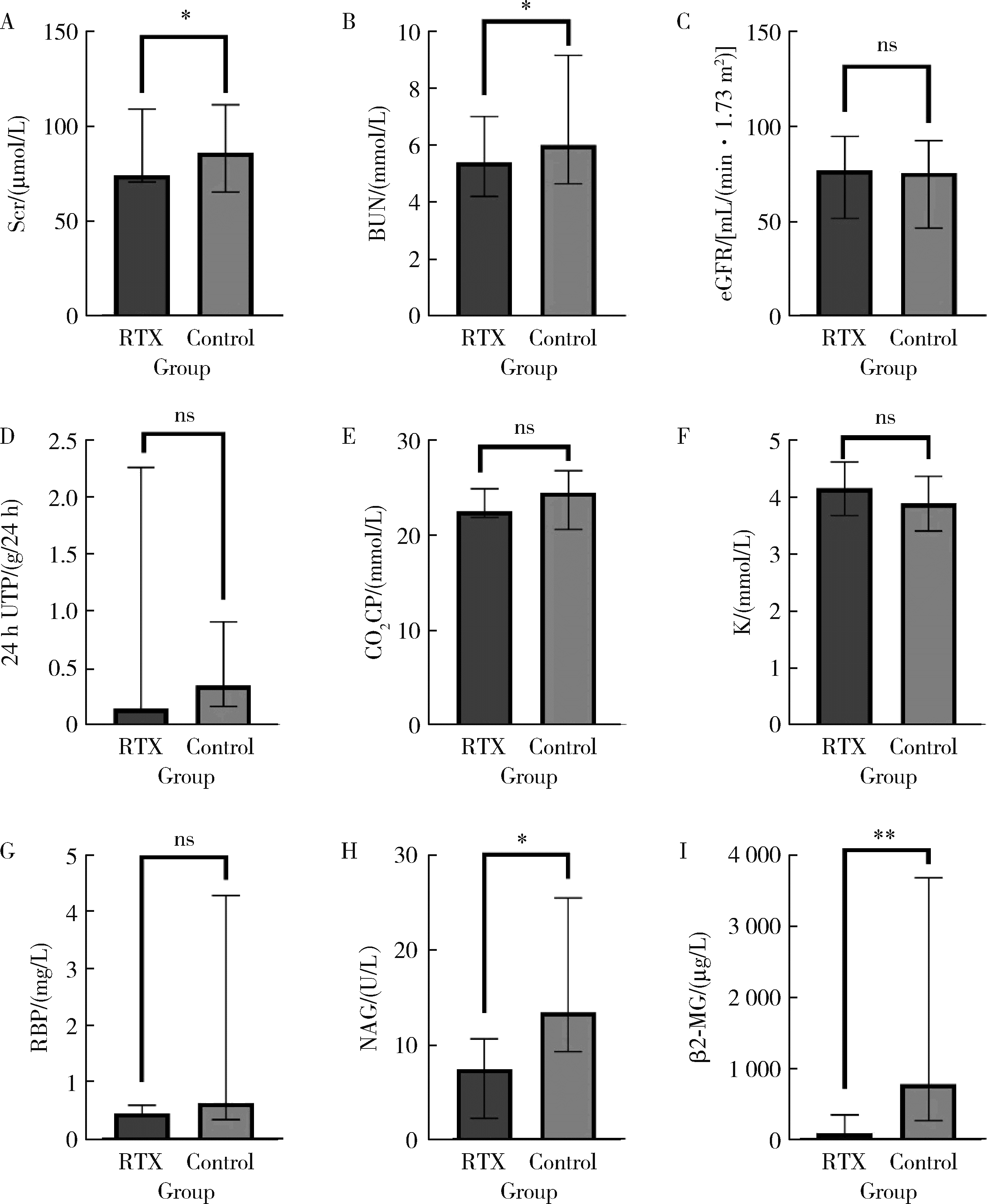
Comparison of renal injury index after treatment between the RTX group and the control group A, serum creatinine (Scr); B, blood urea nitrogen (BUN); C, estimated glomerular filtration rate (eGFR); D, 24 h urinary total protein (24h UTP); E, carbon dioxide combining power (CO2CP); F, serum potassium (K); G, retinol binding protein (RBP); H, N-acetyl-β-glucosaminidase (NAG); I, beta2-microglobulin (β2-MG). * P < 0.05, * * P < 0.01. RTX, rituximab; ns, no significance."

Table 4

Comparison of renal injury index before and after treatment between the RTX group and the control group"

Items Group Before treatment After treatment P value
Scr/(μmol/L) RTX group 83.00 (64.00, 155.00) 74.00 (70.50, 109.00) 0.049
Control group 76.00 (62.50, 96.50) 86.00 (65.25, 111.25) 0.112
BUN/(mmol/L) RTX group 6.00 (4.50, 10.95) 5.40 (4.20, 7.00) 0.011
Control group 5.88 (4.40, 8.51) 6.00 (4.65, 9.15) 0.859
eGFR/[mL/(min·1.73 m2)] RTX group 73.00 (36.63, 102.14) 76.71 (51.50, 94.86) 0.287
Control group 75.69 (49.95, 97.73) 75.35 (46.32, 92.56) 0.224
Serum potassium/(mmol/L) RTX group 3.80±0.57 4.15±0.47 0.005
Control group 3.77±0.57 3.89±0.48 0.137
CO2CP/(mmol/L) RTX group 24.00 (21.70, 25.00) 22.50 (21.90, 24.90) 0.687
Control group 23.65 (18.75, 27.80) 24.50 (20.60, 26.75) 0.586
24h UTP/(g/24 h) RTX group 0.30 (0.19, 4.53) 0.15 (0.14, 2.26) 0.333
Control group 0.54 (0.21, 1.10) 0.35 (0.17, 0.91) 0.055
RBP/(mg/L) RTX group 1.15 (0.74, 5.99) 0.46 (0.40, 0.60) 0.003
Control group 1.14 (0.32, 5.41) 0.64 (0.35, 4.31) 0.959
NAG/(U/L) RTX group 14.22 (10.53, 24.10) 7.45 (2.29, 10.65) 0.008
Control group 13.80 (7.25, 24.00) 13.45 (9.30, 25.50) 0.500
β2-MG/(μg/L) RTX group 1 444.65 (325.08, 6 102.90) 94.15 (10.88, 351.45) 0.002
Control group 1 091.00 (112.95, 7 170.25) 784.70 (267.20, 3 688.00) 0.918
Urine pH RTX group 6.44±0.81* 6.58±0.67 0.238
Control group 6.46±0.92* 6.63±0.92 0.465
Bicarbonate/(mmol/L) RTX group 18.46±9.20* 15.05±8.60 0.155
Control group 15.16±5.19* 11.64±4.46 0.359
Titratable acid/(mmol/L) RTX group 1.59 (0.55, 7.15) 2.00 (0.55, 6.15) 0.500
Control group 6.00 (2.15, 10.46) 5.50 (2.91, 11.65) 0.893
Ammonium ion/(mmol/L) RTX group 18.99 (8.36, 28.01) 17.44 (12.30, 26.91) 0.345
Control group 28.83 (17.69, 41.41) 17.37 (12.26, 28.33) 0.080

Figure 2

Comparison of immunological features after treatment between the RTX group and the control group A, immunoglobulin G (IgG); B, complement 3 (C3); C, complement 4 (C4); D, rheumatoid factor (RF); E, γ-globulin; F, anti-α-fodrin. * P < 0.05. RTX, rituximab; ns, no significance."

Table 5

Comparison of immunological features before and after treatment between the RTX group and the control group"

Items Group Before treatment After treatment P value
IgG/(g/L) RTX group 20.98±9.45* 14.97±5.39 0.013
Control group 21.25±12.85* 19.91±11.99 0.081
C3/(g/L) RTX group 1.03±0.30* 1.29±0.39 0.047
Control group 0.98±0.21 0.99±0.25 0.086
C4/(g/L) RTX group 0.29±0.14* 0.37±0.18 0.024
Control group 0.23±0.09* 0.29±0.11 0.001
RF/(IU/mL) RTX group 33.40 (17.90, 113.50) 16.40 (13.50, 22.00) 0.034
Control group 67.65 (20.00, 173.75) 25.00 (18.80, 58.80) 0.012
γ-globulin/% RTX group 22.60 (18.30, 34.50) 19.35 (18.18, 21.20) 0.005
Control group 26.15 (18.80, 30.50) 20.00 (15.05, 24.50) 0.002
Anti-α-fodrin/(RU/mL) RTX group 11.94 (6.46, 19.24) 6.37 (4.68, 8.90) 0.017
Control group 8.61 (5.07, 17.00) 5.64 (2.81, 8.58) 0.063
1
Mariette X , Criswell LA . Primary Sjögren' s syndrome[J]. N Engl J Med, 2018, 378(10): 931- 939.

doi: 10.1056/NEJMcp1702514
2
Maripuri S , Grande JP , Osborn TG , et al. Renal involvement in primary Sjögren' s syndrome: A clinicopathologic study[J]. Clin J Am Soc Nephrol, 2009, 4(9): 1423- 1431.

doi: 10.2215/CJN.00980209
3
Goules AV , Tatouli IP , Moutsopoulos HM , et al. Clinically signi-ficant renal involvement in primary Sjögren' s syndrome: Clinical presentation and outcome[J]. Arthritis Rheum, 2013, 65(11): 2945- 2953.

doi: 10.1002/art.38100
4
Ramos-Casals M , Brito-Zerón P , Bombardieri S , et al. EULAR recommendations for the management of Sjögren' s syndrome with topical and systemic therapies[J]. Ann Rheum Dis, 2020, 79(1): 3- 18.

doi: 10.1136/annrheumdis-2019-216114
5
Carubbi F , Cipriani P , Marrelli A , et al. Efficacy and safety of rituximab treatment in early primary Sjögren' s syndrome: A prospective, multi-center, follow-up study[J]. Arthritis Res Ther, 2013, 15(5): R172.

doi: 10.1186/ar4359
6
Baldini C , Fulvio G , La Rocca G , et al. Update on the pathophysiology and treatment of primary Sjögren syndrome[J]. Nat Rev Rheumatol, 2024, 20(8): 473- 491.

doi: 10.1038/s41584-024-01135-3
7
Lin DF , Yan SM , Zhao Y , et al. Clinical and prognostic characteristics of 573 cases of primary Sjögren' s syndrome[J]. Chin Med J (Engl), 2010, 123(22): 3252- 3257.
8
Qiu DD , Li Z , Wang JJ , et al. The spectrum and prognosis of Sjögren' s syndrome with membranous nephropathy[J]. Clin Kidney J, 2024, 18(2): sfae384.
9
北京大学医学部肾脏病学系专家组. 利妥昔单抗在膜性肾病中应用的专家共识[J]. 中华内科杂志, 2022, 61(3): 282- 290.
10
Odler B , Tieu J , Artinger K , et al. The plethora of immunomodulatory drugs: Opportunities for immune-mediated kidney diseases[J]. Nephrol Dial Transplant, 2023, 38(Suppl 2): ii19- ii28.
11
Jasiek M , Karras A , Le Guern V , et al. A multicentre study of 95 biopsy-proven cases of renal disease in primary Sjögren' s syndrome[J]. Rheumatology (Oxford), 2017, 56(3): 362- 370.
12
Longhino S , Chatzis LG , Dal Pozzolo R , et al. Sjögren' s syndrome: One year in review 2023[J]. Clin Exp Rheumatol, 2023, 41(12): 2343- 2356.
13
Lee DSW , Rojas OL , Gommerman JL . B cell depletion therapies in autoimmune disease: Advances and mechanistic insights[J]. Nat Rev Drug Discov, 2021, 20(3): 179- 199.

doi: 10.1038/s41573-020-00092-2
14
Kuijpers TW , Bende RJ , Baars PA , et al. CD20 deficiency in humans results in impaired T cell-independent antibody responses[J]. J Clin Invest, 2010, 120(1): 214- 222.

doi: 10.1172/JCI40231
15
Devauchelle-Pensec V , Pennec Y , Morvan J , et al. Improvement of Sjögren' s syndrome after two infusions of rituximab (anti-CD20)[J]. Arthritis Rheum, 2007, 57(2): 310- 317.

doi: 10.1002/art.22536
16
Mekinian A , Ravaud P , Hatron PY , et al. Efficacy of rituximab in primary Sjögren' s syndrome with peripheral nervous system involvement: Results from the AIR registry[J]. Ann Rheum Dis, 2012, 71(1): 84- 87.

doi: 10.1136/annrheumdis-2011-200086
17
Devauchelle-Pensec V , Mariette X , Jousse-Joulin S , et al. Treatment of primary Sjögren syndrome with rituximab: A randomized trial[J]. Ann Intern Med, 2014, 160(4): 233- 242.

doi: 10.7326/M13-1085
18
Ring T , Kallenbach M , Praetorius J , et al. Successful treatment of a patient with primary Sjögren' s syndrome with Rituximab[J]. Clin Rheumatol, 2006, 25(6): 891- 894.

doi: 10.1007/s10067-005-0086-0
19
Carubbi F , Alunno A , Cipriani P , et al. Rituximab in primary Sjögren' s syndrome: A ten-year journey[J]. Lupus, 2014, 23(13): 1337- 1349.

doi: 10.1177/0961203314546023
20
中国初级卫生保健基金会风湿免疫学专业委员会. 干燥综合征超药品说明书用药中国临床实践指南(2023版)[J]. 中华医学杂志, 2023, 103(43): 3445- 3461.
21
中国初级卫生保健基金会风湿免疫学分会干燥综合征和IgG4相关性疾病专委会, 系统性红斑狼疮专委会. 利妥昔单抗治疗风湿免疫病中国专家共识(2024版)[J]. 中华风湿病学杂志, 2024, 28(8): 521- 537.
22
Chen YH , Wang XY , Jin X , et al. Rituximab therapy for primary Sjögren' s syndrome[J]. Front Pharmacol, 2021, 12, 731122.

doi: 10.3389/fphar.2021.731122
[1] Yan DING, Lifang WANG, Chaoran LI, Zhemin LU, Lianjie SHI. Rheumatoid arthritis combined with IgG4-related disease successfully treated with rituximab: A case report [J]. Journal of Peking University (Health Sciences), 2025, 57(6): 1203-1207.
[2] Zhao XIANG, Li YANG, Jing YANG. Untargeted metabolomics reveals differential serum metabolites and metabolic pathways in patients with primary Sjögren syndrome and thrombocytopenia [J]. Journal of Peking University (Health Sciences), 2025, 57(6): 1042-1050.
[3] Wenhao LIN, Yang XIE, Fangqing WANG, Shuying WANG, Xiangjun LIU, Fanlei HU, Yuan JIA. Single-cell RNA sequencing of B cells reveals molecular typing in Sjögren syndrome [J]. Journal of Peking University (Health Sciences), 2025, 57(6): 1032-1041.
[4] Yuan LIU, Guixiu SHI. Change from Sjögren syndrome to Sjögren disease [J]. Journal of Peking University (Health Sciences), 2025, 57(6): 1015-1017.
[5] Lixiu ZHU, Renli CHEN, Sujuan ZHOU, Ye LIN, Yirong TANG, Zhen YE. Effect of aquaporin 5 on TLR4/MyD88/NF-κB signaling pathway in Sjögren syndrome rats [J]. Journal of Peking University (Health Sciences), 2025, 57(5): 875-883.
[6] Doudou MA, Zhemin LU, Qian GUO, Sha ZHU, Jin GU, Yan DING, Lianjie SHI. Successful treatment of rheumatoid arthritis complicated with myasthenia gravis with low-dose rituximab: A case report [J]. Journal of Peking University (Health Sciences), 2024, 56(6): 1110-1114.
[7] Jie WU,Wen ZHANG,Shu LIANG,Yi-lu QIN,Wen-qiang FAN. Pregnancy-associated neuromyelitis optical spectrum disorder combined with primary Sjögren's syndrome: A critical illness case report [J]. Journal of Peking University (Health Sciences), 2023, 55(6): 1118-1124.
[8] Cai-peng QIN,Fei WANG,Yi-qing DU,Xiao-wei ZHANG,Qing LI,Shi-jun LIU,Tao XU. Diagnosis and treatment of four cases of asymptomatic and non-hydrous ureteral calculi [J]. Journal of Peking University (Health Sciences), 2023, 55(5): 939-942.
[9] YI Wen-xia,WEI Cui-jie,WU Ye,BAO Xin-hua,XIONG Hui,CHANG Xing-zhi. Long-term rituximab treatment of refractory idiopathic inflammatory myopathy: A report of 3 cases [J]. Journal of Peking University (Health Sciences), 2021, 53(6): 1191-1195.
[10] Qiu-yu LI,Qin CHENG,Zhi-ling ZHAO,Ni-ni DAI,Lin ZENG,Lan ZHU,Wei GUO,Chao LI,Jun-hong WANG,Shu LI,Qing-gang GE,Ning SHEN. Severe acute respiratory syndrome coronavirus 2 infection in renal transplant recipients: A case report [J]. Journal of Peking University (Health Sciences), 2020, 52(4): 780-784.
Viewed
Full text


Abstract

Cited

  Shared   
  Discussed   
No Suggested Reading articles found!