Journal of Peking University (Health Sciences) ›› 2026, Vol. 58 ›› Issue (3): 543-550. doi: 10.19723/j.issn.1671-167X.2026.03.014

Previous Articles     Next Articles

Application of biological age for cardiovascular risk prediction in a community-based Chinese cohort

Mengxi LU1, Binghan WANG1, Jiali KANG1, Qiuping LIU1, Yifan ZHOU1, Yexiang SUN2, Peng SHEN2, Hongbo LIN2, Xun TANG1,3,4,*(), Pei GAO1,3,4,*()   

  1. 1. Department of Epidemiology and Biostatistics, Peking University School of Public Health, Beijing 100191, China
    2. Yinzhou District Center for Disease Control and Prevention, Ningbo 315101, Zhejiang, China
    3. Key Laboratory of Epidemiology of Major Disease (Peking University), Ministry of Education, Beijing 100191, China
    4. Center for Real-world Evidence Evaluation, Peking University Clinical Research Institute, Beijing 100191, China
  • Received:2026-02-24 Online:2026-06-18 Published:2026-04-29
  • Contact: Xun TANG, Pei GAO
  • Supported by:
    the Noncommunicable Chronic Diseases-National Science and Technology Major Project(2024ZD0527406); the National Natural Science Foundation of China(82373662); the Beijing Natural Science Foundation(IS24047)

RICH HTML


Abstract:

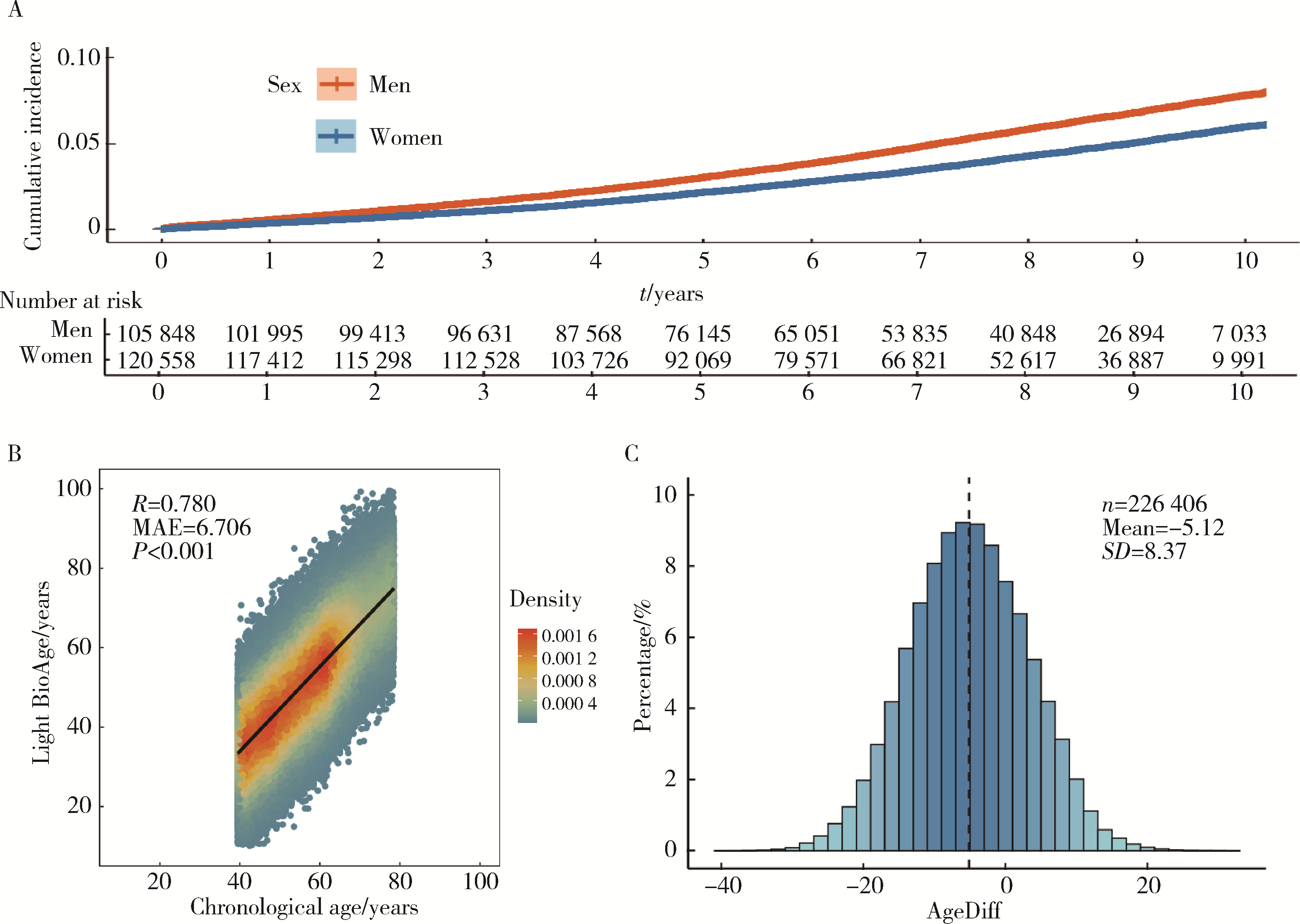
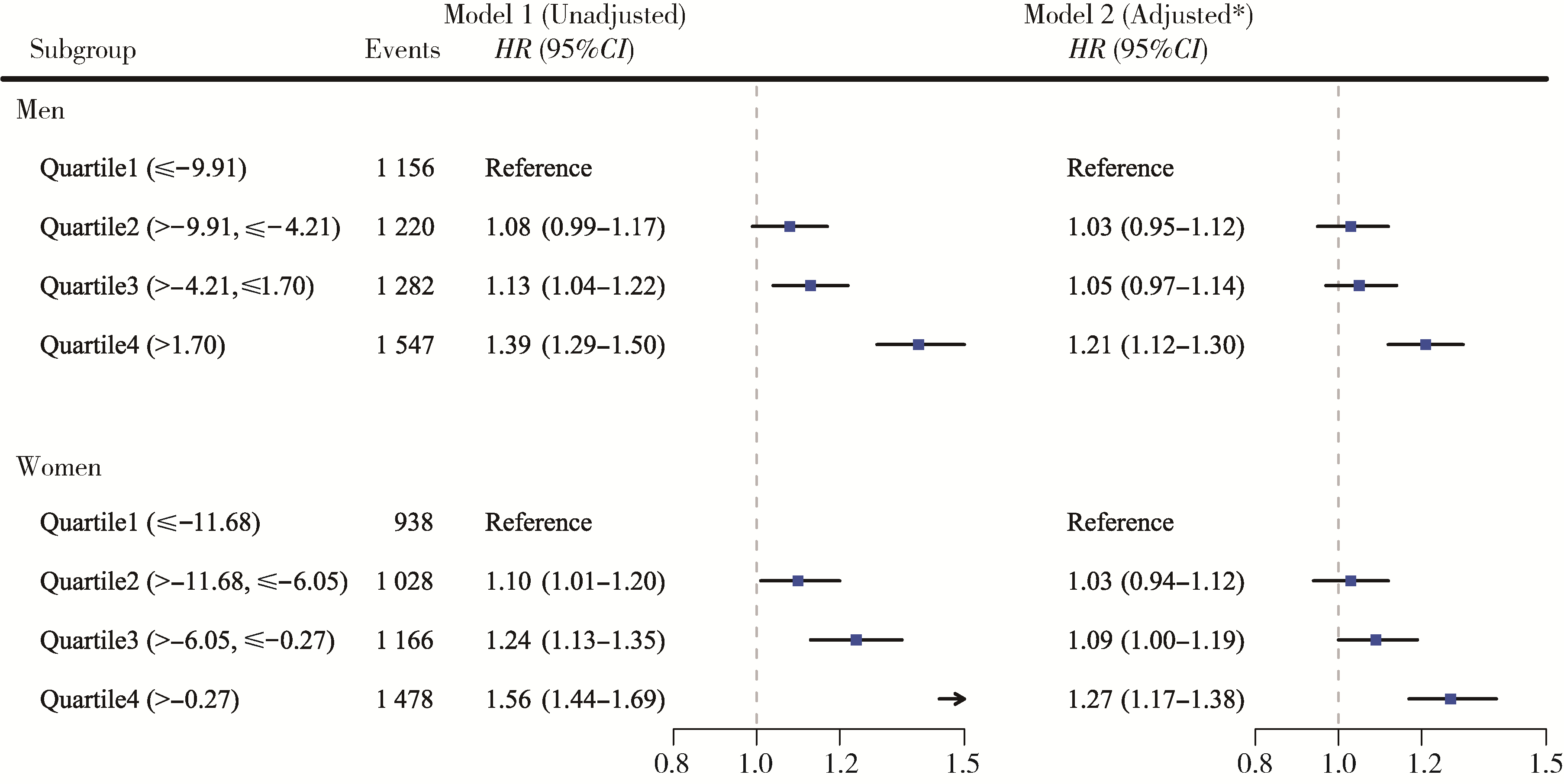
Objective: To independently evaluate the discrimination of the light version of biological age (Light BioAge) model for predicting all-cause mortality, to explore the association of the difference on Light BioAge and chronological age (AgeDiff) with the composite outcomes of cardiovascular disease (CVD), and to assess the performance of CVD risk prediction using the Light BioAge instead of chronological age in a large Chinese population-based cohort. Methods: Participants aged 40-79 years without a history of CVD at baseline were drawn from the CHinese Electronic health Records Research in Yinzhou (CHERRY) study. Harrell' s concordance index (C-index) was employed to assess the discrimination of Light BioAge in predicting all-cause mortality across the overall population and sex-specific subgroups. Cox proportional hazards models were used to assess the association between AgeDiff and the composite outcome of CVD onset and death, adjusting for chronological age, sex, education, region, smoking status, body mass index, systolic blood pressure, total cholesterol, and high-density lipoprotein cholesterol. Hazard ratios (HR) and 95% confidence intervals (CI) were calculated. Restricted cubic spline (RCS) regression was used to further analyze the potential nonlinear association between AgeDiff and CVD outcomes. Light BioAge was introduced to replace chronological age in the World Health Organization (WHO) non-laboratory CVD risk model to evaluate the discrimination and calibration in predicting 10-year CVD risk. Results: A total of 226 406 adults were included, with a mean age of 55.0 years at baseline, 53.2% of whom were women. During a median follow-up of 7.39 years (cumulative 1 562 141 person-years), 11 703 deaths (7.49 per 1 000 person-years) and 9 815 CVD events (6.30 per 1 000 person-years) occurred. The median Light BioAge and AgeDiff were 49.31 and -5.19 years, respectively, suggesting an underestimation of chronological age. Although the Light BioAge model demonstrated good discrimination for predicting all-cause mortality in the overall population (C-index: 0.742, 95% CI: 0.738-0.746), discrimination was lower in men (0.722, 95%CI: 0.714-0.730) than in women (0.755, 95%CI: 0.749-0.761). After adjusting for confounders, the risk of CVD events showed an elevated trend with increasing AgeDiff (Ptrend < 0.001). Compared with the lowest quartile of AgeDiff, the risk of CVD events in the highest quartile increased by 21% in men (HR=1.21, 95%CI: 1.12-1.30) and 27% in women (HR=1.27, 95%CI: 1.17-1.38). RCS regression further indicated that in the overall population, the risk of CVD events increased with AgeDiff. Besides, no significant thre-shold effect was observed in sex-specific subgroups (P for non-linearity >0.05). Replacing chronological age with the Light BioAge in the WHO model did not improve discrimination; however, it significantly enhanced calibration. Calibration improvement was especially evident in women: while chronological age overestimated risk by 20.5% [expected/observed ratio (EOR)=1.205, 95%CI: 1.167-1.246), the Light BioAge reduced this to a marginal 2.1% underestimation (EOR=0.979, 95%CI: 0.948-1.012). Conclusion: The discrimination of the Light BioAge in predicting all-cause mortality seems good, and a wider AgeDiff indicates higher cardiovascular risk in this large population-based Chinese cohort. Replacing chronological age with biological age in the WHO non-laboratory model significantly improved calibration for women.

Key words: Biological age, Cardiovascular disease, Cohort study, Risk assessment, Sex disparity

CLC Number: 

  • R181.2

Table 1

Baseline characteristics of study participants"

Characteristics Total (n=226 406) Men (n=105 848) Women (n=120 558) P value
Age/years, $\bar x \pm s$ 55.0±9.3 55.5±9.9 54.5±9.9 < 0.001
Region (urban), n(%) 154 444 (68.2) 73 345 (69.3) 81 099 (67.3) < 0.001
Education (senior high school or higher), n(%) 34 238 (15.1) 19 442 (18.4) 14 796 (12.3) < 0.001
Smoker, n(%) 41 861 (18.5) 40 238 (38.0) 1 623 (1.3) < 0.001
Hypertension, n(%) 74 319 (32.8) 35 014 (33.1) 39 305 (32.6) 0.016
Diabetes, n(%) 19 701 (8.7) 9 226 (8.7) 10 475 (8.7) 0.823
SBP/mmHg, $\bar x \pm s$ 131.2±16.3 131.9±15.9 130.6±16.7 < 0.001
DBP/mmHg, $\bar x \pm s$ 81.6±9.6 82.5±9.5 80.8±9.6 < 0.001
BMI/(kg/m2), $\bar x \pm s$ 23.3±2.8 23.3±2.7 23.2±2.9 < 0.001
TG/(mg/dL), M (IQR) 145.5
(111.5, 179.1)
141.6
(106.4, 172.8)
151.2
(116.4, 185.7)
< 0.001
TC/(mg/dL), $\bar x \pm s$ 190.2±37.8 185.6±37.3 194.3±37.7 0.030
HDL-C/(mg/dL), $\bar x \pm s$ 50.3±12.9 48.5±13.1 52.0±12.4 < 0.001
LDL-C/(mg/dL), $\bar x \pm s$ 109.7±31.0 111.5±31.3 107.2±30.6 < 0.001
GLU/(mmol/L), M (IQR) 5.3 (4.9, 5.9) 5.4 (5.0, 6.0) 5.3 (4.9, 5.8) < 0.001
Creatinine/(mg/dL), $\bar x \pm s$ 0.7±0.2 0.8±0.2 0.7±0.2 < 0.001
hs-CRP/(mg/dL), M (IQR) 0.6 (0.3, 1.7) 0.7 (0.3, 1.8) 0.6 (0.2, 1.7) < 0.001
Light BioAge, M (IQR) 49.3
(40.3, 58.9)
50.9
(41.7, 60.6)
47.9
(39.0, 57.4)
< 0.001
AgeDiff, $\bar x \pm s$ -5.1±8.3 -4.1±8.4 -6.0±8.3 < 0.001

Figure 1

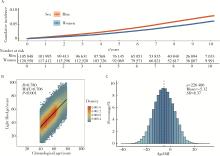
Distribution of cardiovascular composite outcome and Light BioAge of study participants A, Kaplan-Meier curve of cardiovascular composite outcome by sex; B, correlations of Light BioAge with chronological age; C, the distribution of age difference on Light BioAge and chronological age(AgeDiff). MAE, mean absolute error; SD, standard deviation."

Figure 2

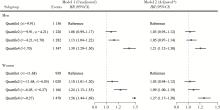
Association of age difference on Light BioAge and chronological age with cardiovascular composite outcome, by sex *Adjusted for chronological age, education, region, smoking status, body mass index, systolic blood pressure, total cholesterol, and high-density lipoprotein cholesterol. HR, hazard ratio; CI, confidence interval."

Figure 3

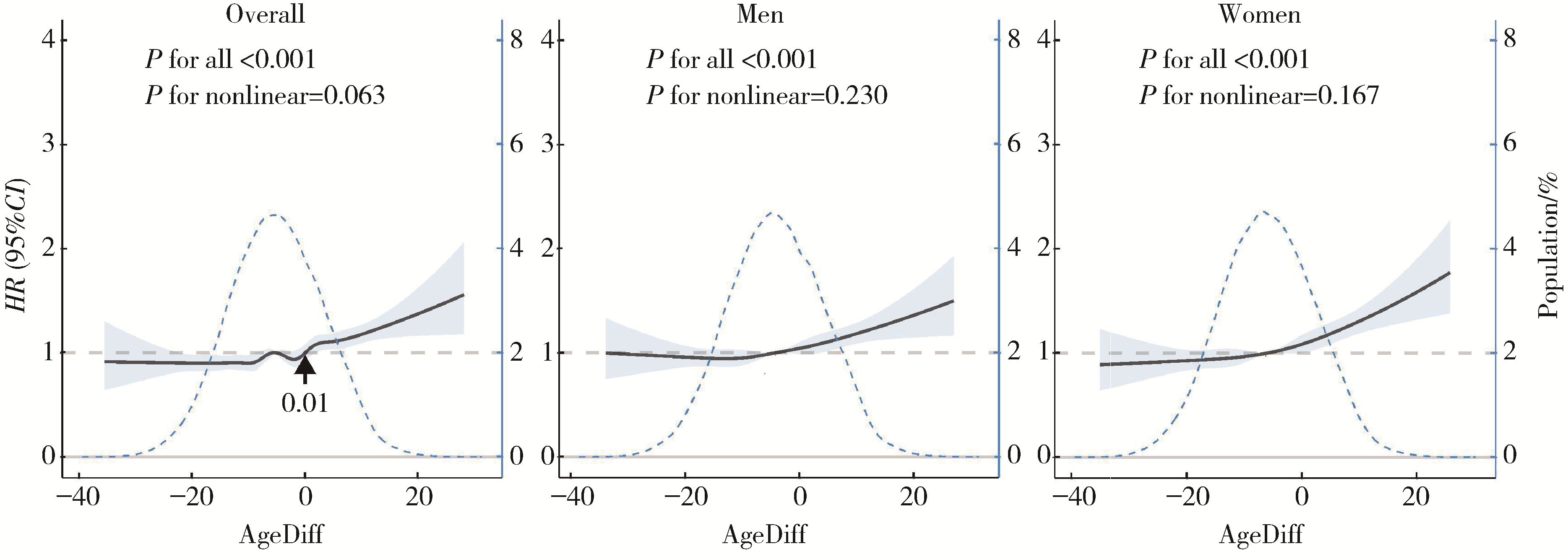
Nonlinear association of age difference on Light BioAge and chronological age with cardiovascular composite outcome, by sex P for all tested whether using splines improves the model compared to a simple linear term; P for nonlinear tested whether the nonlinear part of the spline model is statistically significant. Graphs show multivariate adjusted HR (solid lines) and 95%CI (shaded areas). Dashed lines represent the proportion of the population with different levels of age difference (AgeDiff) on Light BioAge and chronological age. Arrows indicate the age difference at the point where risk crosses the line (HR=1). Analyses used variables in the Model 2 (adjusted for chronological age, education, region, smoking status, body mass index, systolic blood pressure, total cholesterol, and high-density lipoprotein cholesterol). HR, hazard ratio; CI, confidence interval."

Figure 4

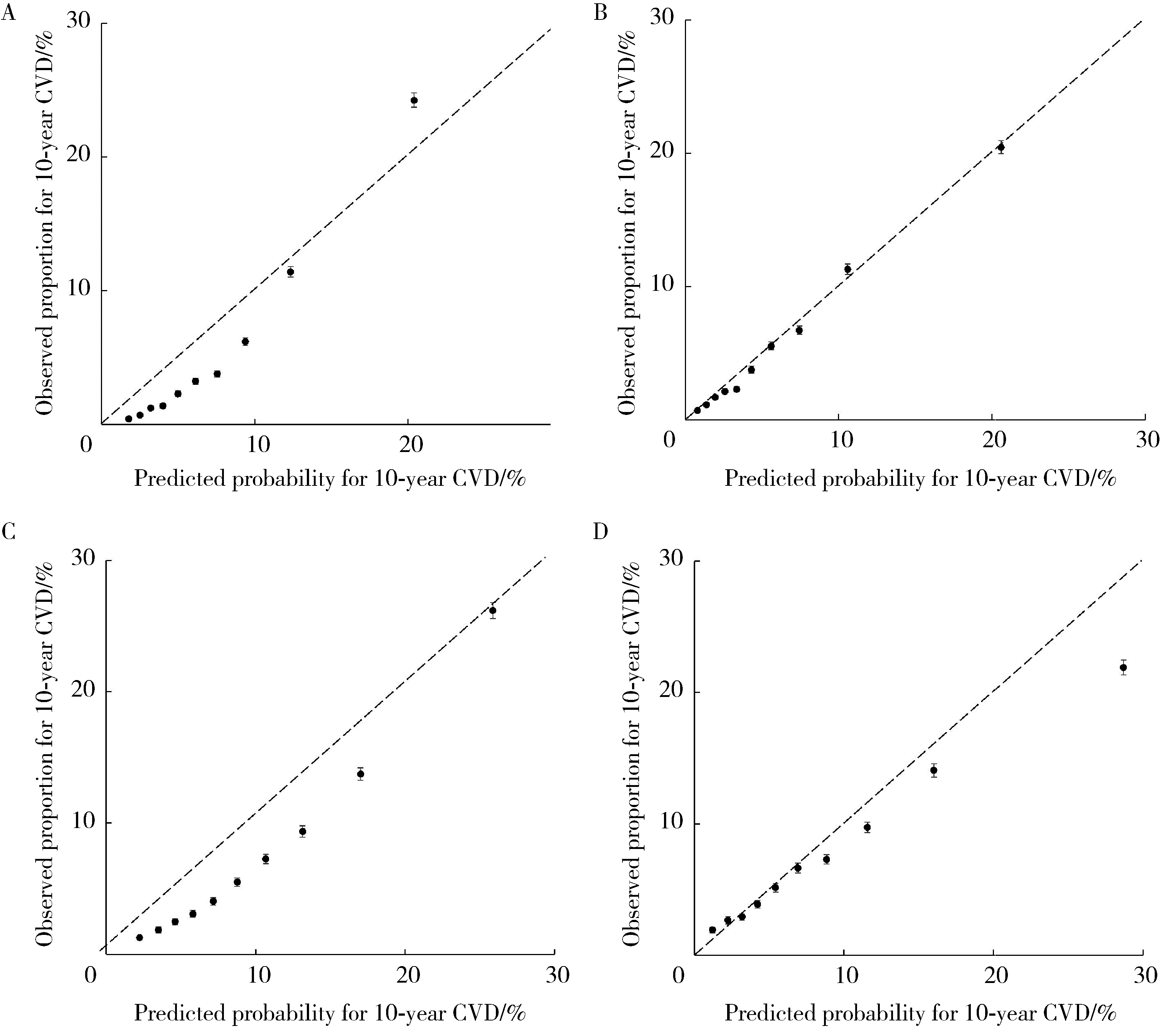
Calibration plots of the WHO cardiovascular risk models using chronological age or Light BioAge A, WHO model by chronological age (women); B, WHO model by Light BioAge (women); C, WHO model by chronological age (men); D, WHO model by Light BioAge (men). WHO, World Health Organization; CVD, cardiovascular disease."

1
van Daalen KR , Zhang D , Kaptoge S , et al. Risk estimation for the primary prevention of cardiovascular disease: Considerations for appropriate risk prediction model selection[J]. Lancet Glob Health, 2024, 12(8): e1343- e1358.
2
Ferrucci L , Gonzalez-Freire M , Fabbri E , et al. Measuring biological aging in humans: A quest[J]. Aging Cell, 2020, 19(2): e13080.

doi: 10.1111/acel.13080
3
Jiang M , Tian S , Liu S , et al. Accelerated biological aging elevates the risk of cardiometabolic multimorbidity and mortality[J]. Nat Cardiovasc Res, 2024, 3(3): 332- 342.

doi: 10.1038/s44161-024-00438-8
4
Moqri M , Herzog C , Poganik JR , et al. Biomarkers of aging for the identification and evaluation of longevity interventions[J]. Cell, 2023, 186(18): 3758- 3775.
5
Hamczyk MR , Nevado RM , Barettino A , et al. Biological versus chronological aging[J]. J Am Coll Cardiol, 2020, 75(8): 919- 930.

doi: 10.1016/j.jacc.2019.11.062
6
Pedretti RFE , Asteggiano R , Gevaert AB , et al. Cardiovascular risk factors management in older adults: A clinical consensus statement from the European Association of Preventive Cardiology of the ESC and the ESC Council for Cardiology Practice[J]. Eur J Prev Cardiol, 2025, zwaf175.
7
Joyce BT , Gao T , Zheng Y , et al. Epigenetic age acceleration reflects long-term cardiovascular health[J]. Circ Res, 2021, 129(8): 770- 781.

doi: 10.1161/CIRCRESAHA.121.318965
8
Cui X , Yi C , Zhang H , et al. DNA methylation algorithms of aging and incident cardiovascular disease: A prospective cohort study[J]. J Am Heart Assoc, 2025, 14(23): e045545.
9
Macdonald-Dunlop E , Taba N , Klarić L , et al. A catalogue of omics biological ageing clocks reveals substantial commonality and associations with disease risk[J]. Aging, 2022, 14(2): 623- 659.
10
Rutledge J , Oh H , Wyss-Coray T . Measuring biological age using omics data[J]. Nat Rev Genet, 2022, 23(12): 715- 727.
11
Khan SS , Greenland P , Hayman LL , et al. Criteria to assess the predictive and clinical utility of novel models, biomarkers, and tools for risk of cardiovascular disease: A scientific statement from the American Heart Association[J]. Circulation, 2026, 153(11): e953- e970.
12
Hao M , Zhang H , Wu J , et al. Gompertz law-based biological age (GOLD BioAge): A simple and practical measurement of biological ageing to capture morbidity and mortality risks[J]. Adv Sci, 2025, 12(32): e01765.
13
Lin H , Tang X , Shen P , et al. Using big data to improve cardiovascular care and outcomes in China: A protocol for the CHinese Electronic health Records Research in Yinzhou (CHERRY) Study[J]. BMJ Open, 2018, 8(2): e019698.
14
WHO CVD Risk Chart Working Group . World Health Organization cardiovascular disease risk charts: Revised models to estimate risk in 21 global regions[J]. Lancet Glob Health, 2019, 7(10): e1332- e1345.
15
Harrell FE . Regression modeling strategies: With applications to linear models, logistic and ordinal regression, and survival analysis[M]. Cham, Switzerland: Springer International Publishing, 2015: 26- 28.
16
Fransquet PD , Wrigglesworth J , Woods RL , et al. The epigenetic clock as a predictor of disease and mortality risk: A systematic review and meta-analysis[J]. Clin Epigenetics, 2019, 11(1): 62.
17
Liu Z , Kuo PL , Horvath S , et al. A new aging measure captures morbidity and mortality risk across diverse subpopulations from NHANES Ⅳ: A cohort study[J]. PLoS Med, 2018, 15(12): e1002718.
18
Lin S , Liu M , Lu X , et al. Association between biological aging and coronary heart disease: A secondary analysis of two observational studies[J]. iScience, 2025, 29(1): 114478.
[1] Yulin WANG, Xin GAO, Zhike LIU, Siyan ZHAN. Epidemiological characteristics of intussusception in children aged 0-3 years in Jiangsu Province from 2018 to 2023 [J]. Journal of Peking University (Health Sciences), 2026, 58(3): 490-495.
[2] Pei CAO, Qingxian LUAN. Periodontitis and systemic diseases: Thinking and explorations [J]. Journal of Peking University (Health Sciences), 2025, 57(5): 852-858.
[3] Mengxi LU, Qiuping LIU, Tianjing ZHOU, Xiaofei LIU, Yexiang SUN, Peng SHEN, Hongbo LIN, Xun TANG, Pei GAO. Association of triglyceride-glucose index and cardiovascular disease in a community-based Chinese cohort [J]. Journal of Peking University (Health Sciences), 2025, 57(3): 430-435.
[4] Tianjing ZHOU,Qiuping LIU,Minglu ZHANG,Xiaofei LIU,Jiali KANG,Peng SHEN,Hongbo LIN,Xun TANG,Pei GAO. Comparison of initiation of antihypertensive therapy strategies for primary prevention of cardiovascular diseases in Chinese population: A decision-analytic Markov modelling study [J]. Journal of Peking University (Health Sciences), 2024, 56(3): 441-447.
[5] Chu-yun CHEN,Peng-fei SUN,Jing ZHAO,Jia JIA,Fang-fang FAN,Chun-yan WANG,Jian-ping LI,Yi-meng JIANG,Yong HUO,Yan ZHANG. Related factors of endogenous erythropoietin and its association with 10-year risks of cardiovascular disease in a community-based Chinese study [J]. Journal of Peking University (Health Sciences), 2023, 55(6): 1068-1073.
[6] Huan YU,Ruo-tong YANG,Si-yue WANG,Jun-hui WU,Meng-ying WANG,Xue-ying QIN,Tao WU,Da-fang CHEN,Yi-qun WU,Yong-hua HU. Metformin use and risk of ischemic stroke in patients with type 2 diabetes: A cohort study [J]. Journal of Peking University (Health Sciences), 2023, 55(3): 456-464.
[7] Zi-wei ZHANG,Yu-meng HUA,Ai-ping LIU. Joint association of depression symptoms and 10-year risk of ischemic cardiovascular disease with the cardiovascular disease in middle-aged and elderly people in China [J]. Journal of Peking University (Health Sciences), 2023, 55(3): 465-470.
[8] Yun-jing ZHANG,Li-ying QIAO,Meng QI,Ying YAN,Wei-wei KANG,Guo-zhen LIU,Ming-yuan WANG,Yun-feng XI,Sheng-feng WANG. Development and validation of risk prediction model for new-onset cardiovascular diseases among breast cancer patients: Based on regional medical data of Inner Mongolia [J]. Journal of Peking University (Health Sciences), 2023, 55(3): 471-479.
[9] Ming-lu ZHANG,Qiu-ping LIU,Chao GONG,Jia-min WANG,Tian-jing ZHOU,Xiao-fei LIU,Peng SHEN,Hong-bo LIN,Xun TANG,Pei GAO. Comparison of aspirin treatment strategies for primary prevention of cardiovascular diseases: A decision-analytic Markov modelling study [J]. Journal of Peking University (Health Sciences), 2023, 55(3): 480-487.
[10] Zhe LIANG,Fang-fang FAN,Yan ZHANG,Xian-hui QIN,Jian-ping LI,Yong HUO. Rate and characteristics of H-type hypertension in Chinese hypertensive population and comparison with American population [J]. Journal of Peking University (Health Sciences), 2022, 54(5): 1028-1037.
[11] Chao GONG, Qiu-ping LIU, Jia-min WANG, Xiao-fei LIU, Ming-lu ZHANG, Han YANG, Peng SHEN, Hong-bo LIN, Xun TANG, Pei GAO. Effectiveness of statin treatment strategies for primary prevention of cardiovascular diseases in a community-based Chinese population: A decision-analytic Markov model [J]. Journal of Peking University (Health Sciences), 2022, 54(3): 443-449.
[12] Jia-min WANG,Qiu-ping LIU,Ming-lu ZHANG,Chao GONG,Shu-dan LIU,Wei-ye CHEN,Peng SHEN,Hong-bo LIN,Pei GAO,Xun TANG. Effectiveness of different screening strategies for type 2 diabete on preventing cardiovascular diseases in a community-based Chinese population using a decision-analytic Markov model [J]. Journal of Peking University (Health Sciences), 2022, 54(3): 450-457.
[13] LIU Jie,GUO Chao. A prospective cohort study of the influence of positive/negative effectivity on the mortality risk of the Chinese elderly [J]. Journal of Peking University (Health Sciences), 2022, 54(2): 255-260.
[14] GUO Zi-ning, LIANG Zhi-sheng, ZHOU Yi, ZHANG Na, HUANG Jie. Genetic study of cardiovascular disease subtypes defined by International Classification of Diseases [J]. Journal of Peking University (Health Sciences), 2021, 53(3): 453-459.
[15] LIU Qiu-ping,CHEN Xi-jin,WANG Jia-min,LIU Xiao-fei,SI Ya-qin,LIANG Jing-yuan,SHEN Peng,LIN Hong-bo,TANG Xun,GAO Pei. Effectiveness of different screening strategies for cardiovascular diseases prevention in a community-based Chinese population: A decision-analytic Markov model [J]. Journal of Peking University (Health Sciences), 2021, 53(3): 460-466.
Viewed
Full text


Abstract

Cited

  Shared   
  Discussed   
No Suggested Reading articles found!