Journal of Peking University (Health Sciences) ›› 2026, Vol. 58 ›› Issue (4): 779-786. doi: 10.19723/j.issn.1671-167X.2026.04.014

Previous Articles     Next Articles

Feasibility and clinical value of a prostate cancer screening model based on biparametric magnetic resonance imaging combined with prostate-specific antigen in a Chinese population

Mingjian RUAN, Yudong CAO*(), Jinchao MA, Chen LIN, Shuo WANG, Peng DU*()   

  1. Department of Urology, Peking University Cancer Hospital and Institute; Key Laboratory of Carcinogenesis and Translational Research (Ministry of Education), Beijing 100142, China
  • Received:2026-03-17 Online:2026-08-18 Published:2026-05-22
  • Contact: Yudong CAO, Peng DU
  • Supported by:
    the Capital' s Funds for Health Improvement and Research(2022-1G-1021); the National Foreign Expert Project(H20240719); the Beijing Hospitals Authority Innovation Studio of Young Staff Funding(202325); the Beijing Hospitals Authority's Ascent Plan(DFL20241101)

RICH HTML


Abstract:

Objective: To evaluate the feasibility and clinical value of a prostate cancer screening model incorporating total prostate-specific antigen (tPSA) and biparametric magnetic resonance imaging (bpMRI) in a Chinese population. Methods: Between May 2024 and May 2025, 2 251 men aged 50 years or older from three community health service centers in Beijing were enrolled, who were randomly assigned to the precise screening group and the standard screening group in a 2 ∶ 1 ratio in the community health service centers. In the precision screening group, participants with tPSA≥4 μg/L underwent bpMRI; those with a prostate imaging reporting and data system (PI-RADS) score≥3 were recommended to undergo systematic combined with targeted biopsy, while those with tPSA≥10 μg/L and PI-RADS < 3 were recommended to undergo systematic biopsy alone. In the standard screening group, participants with tPSA≥4 μg/L were recommended to undergo systematic biopsy. The number of participants who actually underwent biopsy, biopsy positivity rate, and Gleason score concordance rate was recorded. The primary outcome measure was the detection rate of clinically significant prostate cancer (csPCa), and the intergroup comparisons were performed using the Mann-Whitney U test. Results: A total of 2 251 men were included in the analysis, with a median age of 68 years (range: 57-90 years). In the precision screening group (n=985), 115 (11.7%) participants had tPSA≥4 μg/L, of whom 30 underwent bpMRI. The recommended biopsy rate was 2.9% (29/985), and 20 participants actually underwent prostate biopsy. A total of 15 prostate cancer cases were detected, including 14 csPCa and one clinically insignificant prostate cancer. In the standard screening group (n=1 266), 111 (8.8%) participants had tPSA ≥4 μg/L, with a recommended biopsy rate of 8.8% (111/1 266); 26 of them underwent systematic biopsy, and 14 prostate cancer cases were detected, including 7 csPCa and 7 clinically insignificant prostate cancer. The overall positive biopsy rate in the precision screening group was 75.0%, which was not statistically significant compared with that in the standard screening group (58.3%, P=0.141). However, the csPCa detection rate in the precision screening group reached 70.0%, which was significantly higher than that in the standard screening group (26.9%), and the difference was statistically significant (P=0.004). Among the 29 diagnosed prostate cancer patients, 17 (58.6%) had localized disease, 10 (34.5%) had locally advanced disease, and 2 (6.9%) had metastatic disease. Among the 21 patients who underwent radical surgery, the concordance rate between biopsy and post-operative pathological Gleason scores was 70.0% in the precision screening group, higher than that in the standard screening group (36.4%), although the difference was not statistically significant (P=0.198). Conclusion: The prostate cancer screening model based on serum tPSA combined with bpMRI demonstrates good feasibility, reduces unnecessary biopsies, optimizes the allocation of screening resources, and provides a basis for precision screening strategies.

Key words: Prostate cancer, Biparametric magnetic resonance imaging, Screening, Prostate-specific antigen

CLC Number: 

  • R737.25

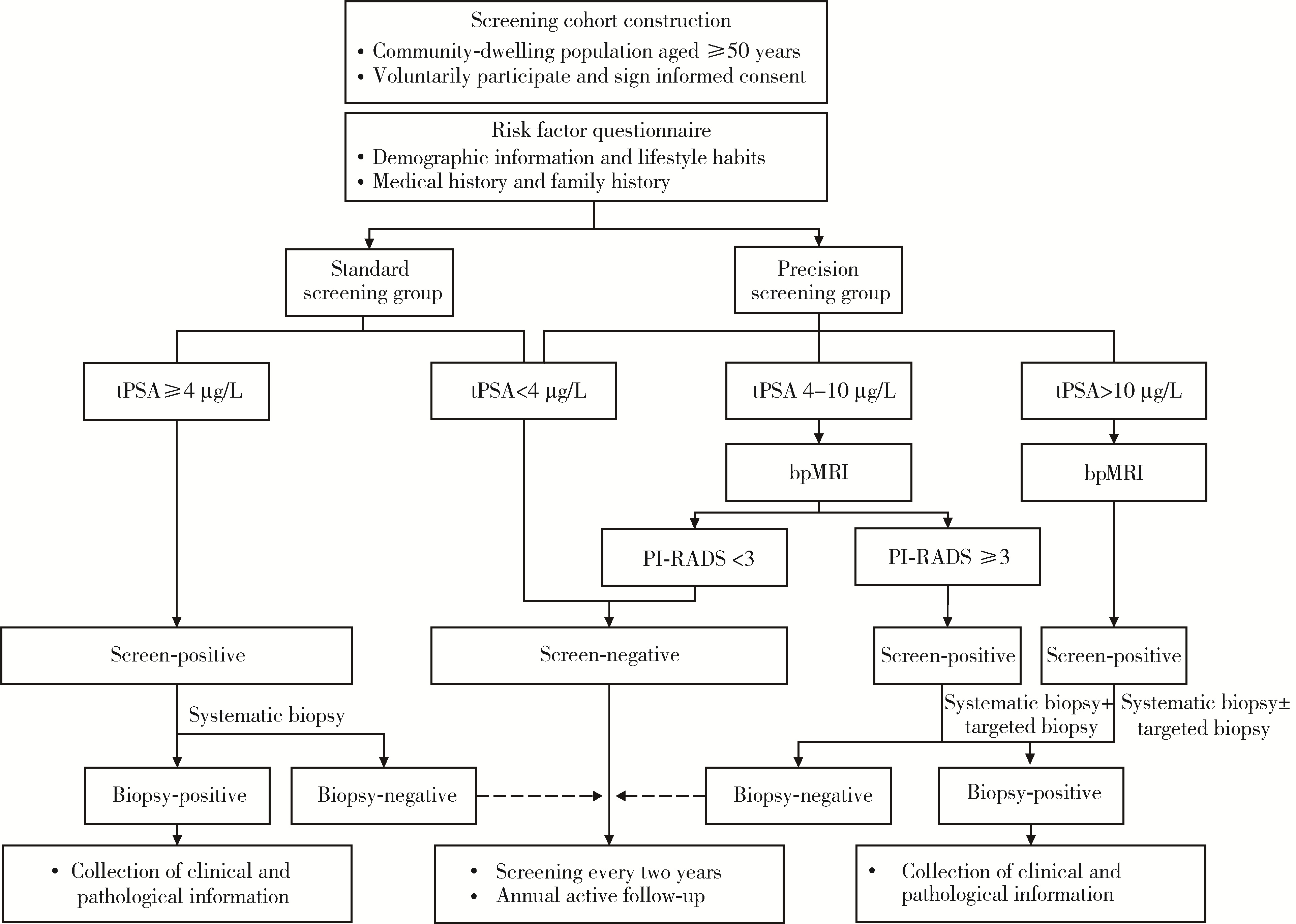
Figure 1

Flowchart of prostate cancer screening tPSA, total prostate-specific antigen; bpMRI, biparametric magnetic resonance imaging; PI-RADS, prostate imaging reporting and data system."

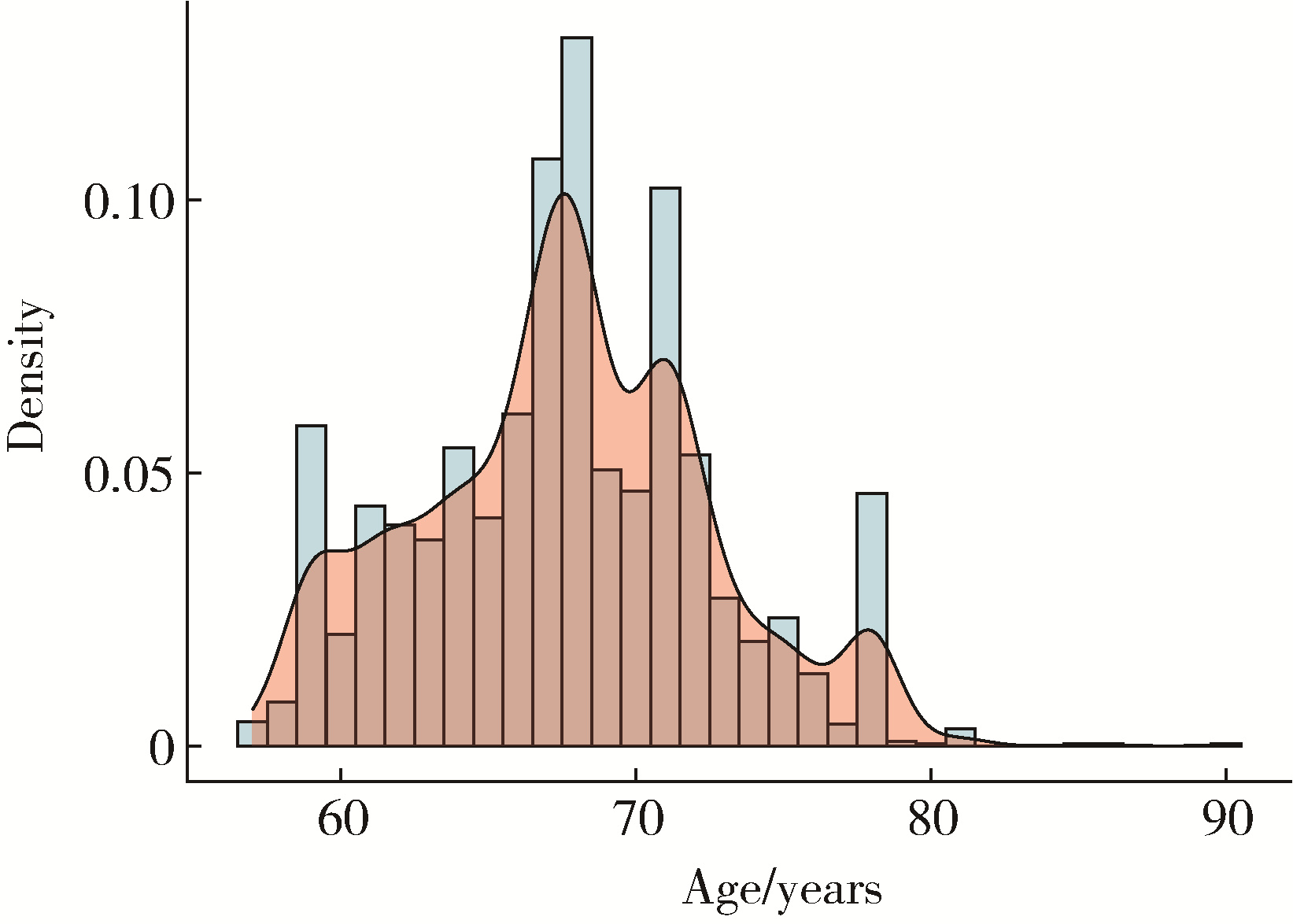
Figure 2

Age distribution and density curve of the screening population"

Table 1

Baseline characteristics of the screening population"

Variable Total Precision screening group Standard screening group P value
Number of participants 2 251 985 1 266
Age/years,M (P25, P75) 68 (64, 71) 68 (64, 71) 68 (64, 71) 0.666
tPSA/(μg/L), M (P25, P75) 1.32 (0.78, 2.30) 1.34 (0.77, 2.42) 1.31 (0.79, 2.25) 0.814
Recommended for biopsy, n(%) 140 (6.2) 29 (2.9) 111 (8.8)
Actual biopsy performed 46 20 26
PCa, n(%) 0.141
  Yes 29 (63.0) 15 (75.0) 14 (53.8)
  No 17 (37.0) 5 (25.0) 12 (46.2)
csPCa, n(%) 0.004
  Yes 21 (45.7) 14 (70.0) 7 (26.9)
  No 25 (54.3) 6 (30.0) 19 (73.1)
PCa detection rate/% 1.29 1.52 1.11 0.384
csPCa detection rate/% 0.93 1.42 0.55 0.033

Table 2

Clinical stage, pathological stage, and pathological grade of patients with prostate cancer"

Variable Total Precision screening group Standard screening group P value
PCa, n 29 15 14
ISUP grade 0.012
  1 8 (27.6) 1 (6.7) 7 (50.0)
  2-3 10 (34.5) 5 (33.3) 5 (35.7)
  4-5 11 (37.9) 9 (60.0) 2 (14.3)
Clinical T stage
  T1-T2 17 (58.6) 8 (53.3) 9 (64.3) 0.550
  T3-T4 12 (41.4) 7 (46.7) 5 (35.7)
Clinical N stage
  N0 27 (93.1) 13 (86.7) 14 (100.0) 0.483
  N1 2 (6.9) 2 (13.3) 0 (0)
Clinical M stage
  M0-Mx 27 (93.1) 13 (86.7) 14 (100.0) 0.483
  M1 2 (6.9) 2 (13.3) 0 (0)
Treatment selection, n (%) 0.170
  Radical surgery 21 (72.4) 10 (66.7) 11 (78.6)
  Radiotherapy 1 (3.4) 1 (6.7) 0 (0)
  Active surveillance 4 (13.8) 1 (6.7) 3 (21.4)
  Systemic therapy 3 (10.3) 3 (2.0) 0 (0)
1
Bray F , Laversanne M , Sung H , et al. Global cancer statistics 2022:GLOBOCAN estimates of incidence and mortality worldwide for 36 cancers in 185 countries[J]. CA Cancer J Clin, 2024, 74 (3): 229- 263.
2
李星, 曾晓勇. 中国前列腺癌流行病学研究进展[J]. 肿瘤防治研究, 2021, 48 (1): 98- 102.
3
Zhu Y , Mo M , Wei Y , et al. Epidemiology and genomics of prostate cancer in Asian men[J]. Nat Rev Urol, 2021, 18 (5): 282- 301.

doi: 10.1038/s41585-021-00442-8
4
Liu J , Dong L , Zhu Y , et al. Prostate cancer treatment: China' s perspective[J]. Cancer Lett, 2022, 550, 215927.

doi: 10.1016/j.canlet.2022.215927
5
Chen R , Sjoberg DD , Huang Y , et al. Prostate specific antigen and prostate cancer in Chinese men undergoing initial prostate biopsies compared with western cohorts[J]. J Urol, 2017, 197 (1): 90- 96.

doi: 10.1016/j.juro.2016.08.103
6
Wong MCS , Goggins WB , Wang HHX , et al. Global incidence and mortality for prostate cancer: Analysis of temporal patterns and trends in 36 countries[J]. Eur Urol, 2016, 70 (5): 862- 874.

doi: 10.1016/j.eururo.2016.05.043
7
Stabile A , Giganti F , Rosenkrantz AB , et al. Multiparametric MRI for prostate cancer diagnosis: Current status and future directions[J]. Nat Rev Urol, 2020, 17 (1): 41- 61.

doi: 10.1038/s41585-019-0212-4
8
Robinson D , Abdulkareem R , Nasrollah D , et al. Frequency of biopsy and tumor grade before vs after introduction of prostate magnetic resonance imaging[J]. JAMA Netw Open, 2023, 6 (8): e2330233.

doi: 10.1001/jamanetworkopen.2023.30233
9
Nordstr m T , Discacciati A , Bergman M , et al. Prostate cancer screening using a combination of risk-prediction, MRI, and targeted prostate biopsies (STHLM3-MRI): A prospective, population-based, randomised, open-label, non-inferiority trial[J]. Lancet Oncol, 2021, 22 (9): 1240- 1249.

doi: 10.1016/S1470-2045(21)00348-X
10
梁静, 赵晓智, 时静妍, 等. 南京地区前列腺癌筛查PSA-mpMRI-靶向穿刺模式的初步探索[J]. 中华男科学杂志, 2019, 25 (9): 815- 822.
11
Merriel SWD , Hall R , Walter FM , et al. Systematic review and narrative synthesis of economic evaluations of prostate cancer diagnostic pathways incorporating prebiopsy magnetic resonance imaging[J]. Eur Urol Open Sci, 2023, 52, 123- 134.

doi: 10.1016/j.euros.2023.03.010
12
Ng ABCD , Asif A , Agarwal R , et al. Biparametric vs. multiparametric MRI for prostate cancer diagnosis: The PRIME diagnostic clinical trial[J]. JAMA, 2025, 334 (13): 1170- 1179.

doi: 10.1001/jama.2025.13722
13
Strieder de Oliveira G, Altmayer S, Torri GB, et al. Diagnostic performance of biparametric versus multiparametric magnetic resonance imaging for prostate cancer diagnosis: An updated systematic review and meta-analysis[J/OL]. Eur Urol, 2026[2026-03-01]. https://doi.org/10.1016/j.eururo.2026.01.030.
14
Turkbey B , Rosenkrantz AB , Haider MA , et al. Prostate imaging reporting and data system version 2.1:2019 update of prostate imaging reporting and data system version 2[J]. Eur Urol, 2019, 76 (3): 340- 351.

doi: 10.1016/j.eururo.2019.02.033
15
Epstein JI , Egevad L , Amin MB , et al. The 2014 international society of urological pathology (ISUP) consensus conference on gleason grading of prostatic carcinoma: Definition of grading patterns and proposal for a new grading system[J]. Am J Surg Pathol, 2016, 40 (2): 244- 252.

doi: 10.1097/PAS.0000000000000530
16
Kasivisvanathan V , Rannikko AS , Borghi M , et al. MRI-targeted or standard biopsy for prostate-cancer diagnosis[J]. N Engl J Med, 2018, 378 (19): 1767- 1777.

doi: 10.1056/NEJMoa1801993
17
卢启基, 陈征, 秦晓平, 等. 根治性前列腺切除术后Gleason评分升级的研究进展[J]. 中华泌尿外科杂志, 2020, 41 (12): 953- 956.
18
戴波, 叶定伟, 顾成元, 等. 我国部分省市前列腺癌精准筛查初步结果分析[J]. 中华医学杂志, 2019, 99 (42): 3292- 3297.
19
郑利伟, 宋灵敏, 王钢, 等. 基层医院基于医共体模式下前列腺癌筛查模式的初步探索[J]. 中华泌尿外科杂志, 2024, 45 (6): 416- 419.
20
Roobol MJ , de Vos II , Månsson M , et al. European study of prostate cancer screening; 23-year follow-up[J]. N Engl J Med, 2025, 393 (17): 1669- 1680.

doi: 10.1056/NEJMoa2503223
21
Martin RM , Donovan JL , Turner EL , et al. Effect of a low-intensity PSA-based screening intervention on prostate cancer mortality: The CAP randomized clinical trial[J]. JAMA, 2018, 319 (9): 883- 895.

doi: 10.1001/jama.2018.0154
22
Pinsky PF , Miller E , Prorok P , et al. Extended follow-up for prostate cancer incidence and mortality among participants in the prostate, lung, colorectal and ovarian randomized cancer screening trial[J]. BJU Int, 2019, 123 (5): 854- 860.

doi: 10.1111/bju.14580
23
Schoots IG , Ahmed HU , Albers P , et al. Magnetic resonance imaging-based biopsy strategies in prostate cancer screening: A systematic review[J]. Eur Urol, 2025, 88 (3): 247- 260.

doi: 10.1016/j.eururo.2025.05.038
[1] Zhongyu TAN, Yiqing DU, Caipeng QIN, Tao XU. A multi-level study of androgen deprivation therapy on the immune microenvironment in prostate cancer [J]. Journal of Peking University (Health Sciences), 2026, 58(4): 770-778.
[2] Dandan SU, Baishun LI, Ruotao XIAO, Fan ZHANG, Shudong ZHANG. Comparison of clinical outcomes between radical prostatectomy and permanent prostate brachytherapy in patients with oligometastatic prostate cancer: A propensity score-matched study [J]. Journal of Peking University (Health Sciences), 2026, 58(4): 787-793.
[3] Mingjia YANG, Jiangxue WU, Jing WANG, Yang LIU, Zhongmin LI, Jingjing LI, Hongtian LI, Yubo ZHOU, Jianmeng LIU. A population-based survey of myopia on primary school students in an administrative district, 2019 to 2024 [J]. Journal of Peking University (Health Sciences), 2026, 58(3): 513-519.
[4] Shang XIE, Luming WANG, Xinyuan ZHANG, Qiushi FENG, Yangyang XIA, Ziwei DAI, Xiaofeng SHAN, Zhigang CAI. Construction and application of oral squamous cell carcinoma organoid bank [J]. Journal of Peking University (Health Sciences), 2025, 57(5): 847-851.
[5] Jie LIU, Mingwei MA, Qing'an WANG, Ming SHI, Jinpeng YIN, Zhanping WANG, Jingtao SHEN, Xianshu GAO. Comparison of setup errors between two immobilization methods in prostate cancer radiotherapy based on cone-beam computed tomography [J]. Journal of Peking University (Health Sciences), 2025, 57(4): 692-697.
[6] Ye YAN,Xiaolong LI,Haizhui XIA,Xuehua ZHU,Yuting ZHANG,Fan ZHANG,Ke LIU,Cheng LIU,Lulin MA. Analysis of risk factors for long-term overactive bladder after radical prostatectomy [J]. Journal of Peking University (Health Sciences), 2024, 56(4): 589-593.
[7] Sheng-jie LIU,Hui-min HOU,Zheng-tong LV,Xin DING,Lu WANG,Lei ZHANG,Ming LIU. Bipolar androgen therapy followed by immune checkpoint inhibitors in metastatic castration resistant prostate cancer: A report of 4 cases [J]. Journal of Peking University (Health Sciences), 2022, 54(4): 766-769.
[8] Jia-min WANG,Qiu-ping LIU,Ming-lu ZHANG,Chao GONG,Shu-dan LIU,Wei-ye CHEN,Peng SHEN,Hong-bo LIN,Pei GAO,Xun TANG. Effectiveness of different screening strategies for type 2 diabete on preventing cardiovascular diseases in a community-based Chinese population using a decision-analytic Markov model [J]. Journal of Peking University (Health Sciences), 2022, 54(3): 450-457.
[9] BAI Gao-chen,SONG Yi,JIN Jie,YU Wei,HE Zhi-song. Clinical efficacy of docetaxel combined with carboplatin in patients with metastatic castration-resistant prostate cancer [J]. Journal of Peking University (Health Sciences), 2021, 53(4): 686-691.
[10] LIU Qiu-ping,CHEN Xi-jin,WANG Jia-min,LIU Xiao-fei,SI Ya-qin,LIANG Jing-yuan,SHEN Peng,LIN Hong-bo,TANG Xun,GAO Pei. Effectiveness of different screening strategies for cardiovascular diseases prevention in a community-based Chinese population: A decision-analytic Markov model [J]. Journal of Peking University (Health Sciences), 2021, 53(3): 460-466.
[11] Kui-xia SUN,Cun-ling YAN,Zhi-yan LI,Ping LIU,Wei ZHANG,Qun HE. Clinical value of serum isoform [-2] proprostate-specific antigen and its derivatives in predicting aggressive prostate cancer [J]. Journal of Peking University (Health Sciences), 2020, 52(2): 234-239.
[12] Wen-qing LI,Si-mei REN,Xing-bo LONG,Yu-qing TIAN. Palmitoylome profiling indicates that androgens promote the palmitoylation of metabolism-related proteins in prostate cancer-derived LNCaP cells [J]. Journal of Peking University (Health Sciences), 2020, 52(2): 227-233.
[13] Le GAO,Shu-qing YU,Ji-chun YANG,Jun-ling MA,Si-yan ZHAN,Feng SUN. Quality assessment of global guidelines on colorectal cancer screening [J]. Journal of Peking University(Health Sciences), 2019, 51(3): 548-555.
[14] Kuan-gen ZHANG,Yu-he ZHOU,Ya-kun SHAO,Fang MEI,Jiang-feng YOU,Bei-ying LIU,Fei PEI. Novel tumor metastasis suppressorgene LASS2/TMSG1 S248A mutant promotes invasion of prostate cancer cells through increasing ATP6V0C expression [J]. Journal of Peking University(Health Sciences), 2019, 51(2): 210-220.
[15] TANG Xu, ZHAO Wei-hong, SONG Qin-qin, YIN Hua-qi, DU Yi-qing, SHENG Zheng-zuo, WANG Qiang, ZHANG Xiao-wei, LI Qing, LIU Shi-jun, XU Tao. Influence of SOX10 on the proliferation and invasion of prostate cancer cells [J]. Journal of Peking University(Health Sciences), 2018, 50(4): 602-606.
Viewed
Full text


Abstract

Cited

  Shared   
  Discussed   
No Suggested Reading articles found!