北京大学学报(医学版) ›› 2025, Vol. 57 ›› Issue (4): 721-726. doi: 10.19723/j.issn.1671-167X.2025.04.015

• 论著 • 上一篇    下一篇

辅助生殖技术周期中不同睾丸取精方式下非梗阻性无精子症患者的精子库供精比例

陈千喜1,2, 陈延1,2, 郑仲杰1,2, 唐文豪1,2, 刘镇1,2, 洪锴1,2,*(), 林浩成1,2,*()   

  1. 1. 北京大学第三医院泌尿外科, 北京 100191
    2. 北京大学第三医院生殖医学中心, 北京 100191
  • 收稿日期:2025-02-28 出版日期:2025-08-18 发布日期:2025-08-02
  • 通讯作者: 洪锴, 林浩成
  • 基金资助:
    国家自然科学基金(82371633)

Sperm donation utilization rates in nonobstructive azoospermia patients under different testicular sperm retrieval methods during assisted reproductive technology cycles

Qianxi CHEN1,2, Yan CHEN1,2, Zhongjie ZHENG1,2, Wenhao TANG1,2, Zhen LIU1,2, Kai HONG1,2,*(), Haocheng LIN1,2,*()   

  1. 1. Department of Urology, Peking University Third Hospital, Beijing 100191, China
    2. Center for Reproductive Medicine, Peking University Third Hospital, Beijing 100191, China
  • Received:2025-02-28 Online:2025-08-18 Published:2025-08-02
  • Contact: Kai HONG, Haocheng LIN
  • Supported by:
    the National Natural Science Foundation of China(82371633)

RICH HTML


摘要:

目的: 分析非梗阻性无精子症(nonobstructive azoospermia,NOA)患者在睾丸穿刺取精术(percutaneous testicular sperm aspiration,TESA)和显微镜下睾丸切开取精术(microdissection testicular sperm extraction,mTESE)两种取精方式下,选择精子库供精的比例及其影响因素。方法: 回顾性收集2019年1月至2023年12月北京大学第三医院生殖医学中心辅助生殖技术(assisted reproductive technology,ART)周期数据,选择数据完整的NOA患者及其伴侣的ART周期(以末次治疗周期为准),比较不同取精方式和精子状态(新鲜mTESE、新鲜TESA、解冻mTESE、解冻TESA)的精子库供精使用率,采用对数线性模型分析取精方式与精子来源的关系。结果: 在1 730对NOA患者及其伴侣中,总体精子库供精使用率为12.66%。新鲜mTESE组的精子库使用率最高(23.42%),其次为解冻mTESE组(5.87%)和新鲜TESA组(5.22%),而解冻TESA组无一例选择精子库供精。对数线性模型显示,取精方式与精子来源显著相关(mTESE:Estimate=4.499;TESA:Estimate=2.780;P < 0.001)。结论: ART周期中的总体精子库供精使用率较低,可能说明新鲜取精ART的高效性。NOA患者选择精子库供精的比例受取精方式影响,相比于采取TESA的患者,采取mTESE取精患者更倾向于失败后使用供精。

关键词: 非梗阻性无精子症, 精子库, 取精术, 辅助生殖技术

Abstract:

Objective: To analyze the proportion of nonobstructive azoospermia (NOA) patients opting for sperm bank donation under different sperm retrieval methods [percutaneous testicular sperm aspiration (TESA), microdissection testicular sperm extraction (mTESE)] and its influencing factors. Methods: Retrospective data from assisted reproductive technology (ART) cycles at the Center for Reproductive Medical, Peking University Third Hospital (from January 2019 to December 2023) were collected. Data-complete ART cycles involving NOA patients and their partners (using the last treatment cycle as the endpoint) were selected. Sperm donation utilization rates were compared across retrieval methods (fresh mTESE, fresh TESA, thawed mTESE, thawed TESA). Log-linear models were used to analyze the relationship between sperm retrieval method and sperm source. Results: Among the 1 730 couples, the overall sperm donation utilization rate was 12.66%. The highest rate occurred in the fresh mTESE group (23.42%), followed by the thawed mTESE group (5.87%). The rates for the fresh TESA and thawed TESA groups were 5.22% and 0%, respectively. Log-linear analysis demonstrated that sperm retrieval method was significantly associated with sperm source (mTESE: Estimate=4.499; TESA: Estimate=2.780; P < 0.001). Conclusion: The low overall sperm donation utilization rate in ART cycles may reflect the efficacy of synchronous sperm retrieval ART. The proportion of NOA patients opting for sperm donation was influenced by the retrieval method. Compared with patients undergoing TESA, those undergoing mTESE were more inclined to utilize donor sperm after retrieval failure.

Key words: Nonobstructive azoospermia, Sperm banks, Sperm retrieval, Assisted reproductive techniques

中图分类号: 

  • R698.2

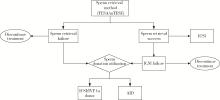
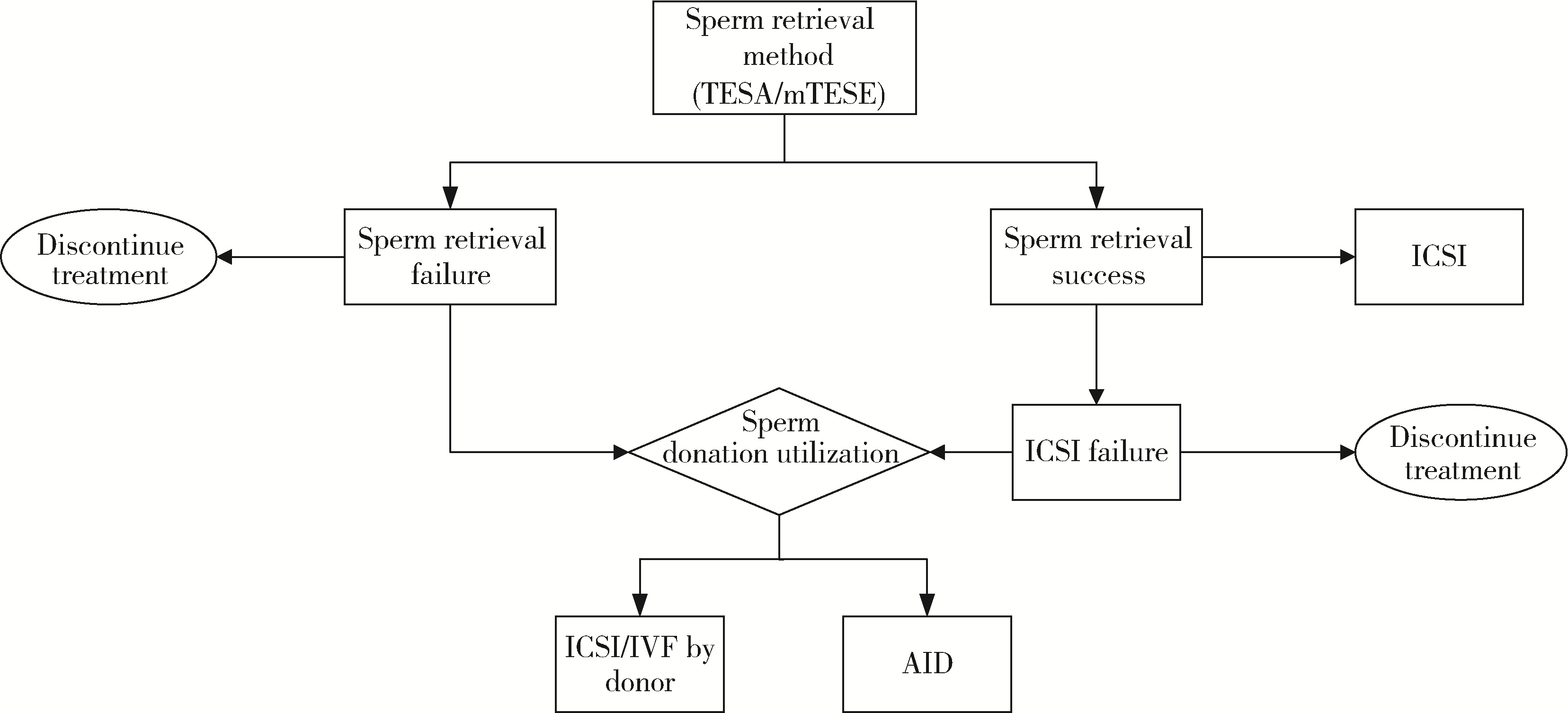
图1

NOA患者治疗决策流程图"

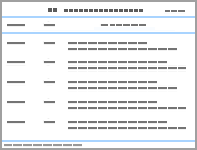
表1

NOA患者基线信息"

Parameters Total
(n=1 730)
Fresh sperm with synchronous ART Frozen-thawed sperm with non-synchronous ART
Fresh mTESE (n=696) Fresh TESA (n=632) Thawed mTESE (n=392) Thawed TESA (n=10)
Age/years, ${\bar x}$±s 30.43±4.21 29.76±3.97 30.79±4.33 30.97±4.22 32.7±5.66
BMI/(kg/m2), ${\bar x}$±s 25.57±3.89 25.46±4.07 25.38±3.63 26.03±3.91 26.97±4.48
Testicle volume/mL, ${\bar x}$±s
    Left 8.73±5.54 5.49±3.96 13.49±4.27 6.64±4.11 15.10±4.43
    Right 8.82±5.55 5.57±3.93 13.65±4.21 6.64±4.16 14.60±5.28

表2

不同取精方式对应患者例数"

Sperm source Fresh sperm with synchronous ART Frozen-thawed sperm with non-synchronous ART Total
Fresh mTESE Fresh TESA Thawed mTESE Thawed TESA
Total 696 632 392 10 1 730
Paternal 533 599 369 10 1 511
Donor 163 33 23 0 219
Donor proportion 23.42% 5.22% 5.87% 0.00% 12.66%

表3

对数线性模型饱和模型结果"

Parameters Estimate (95%CI) SE Z P
Whether fresh or frozen-thawed×Sperm retrieval method×Sperm source -0.177 (-0.538, 0.185) 0.185 -0.957 0.339
Whether fresh or frozen-thawed×Sperm retrieval method -0.743 (-1.105, -0.381) 0.185 -4.025 <0.001
Whether fresh or frozen-thawed×Sperm source -0.217 (-0.578, 0.145) 0.185 -1.173 0.241
Sperm retrieval method×Sperm source -0.249 (-0.611, 0.113) 0.185 -1.349 0.177
Whether fresh or frozen-thawed 1.320 (0.958, 1.681) 0.185 7.150 <0.001
Sperm retrieval method 1.110 (0.748, 1.472) 0.185 6.014 <0.001
Sperm source 1.233 (0.872, 1.595) 0.185 6.683 <0.001

表4

对数线性模型简约模型结果"

Parameters Estimate (95%CI) SE Z P
TESA×Paternal source 2.780 (2.359, 3.202) 0.215 12.941 <0.001
TESA×Donor source Reference
mTESE×Paternal source 4.499 (3.925, 5.072) 0.293 15.37 <0.001
mTESE×Donor source Reference
1
Jarow JP , Espeland MA , Lipshultz LI . Evaluation of the azoospermic patient[J]. J Urol, 1989, 142 (1): 62- 65.
2
Shin DH , Turek PJ . Sperm retrieval techniques[J]. Nat Rev Urol, 2013, 10 (12): 723- 730.
3
Piechka A , Sparanese S , Witherspoon L , et al. Molecular mechanisms of cellular dysfunction in testes from men with non-obstructive azoospermia[J]. Nat Rev Urol, 2024, 21 (2): 67- 90.
4
Aboulghar M , Aboulghar M . Perinatal outcome of assisted reproductive technology: Is stillbirth of significant importance?[J]. Fertil Steril, 2021, 116 (3): 670- 671.
5
Tournaye H , Krausz C , Oates RD . Concepts in diagnosis and therapy for male reproductive impairment[J]. Lancet Diabetes Endocrinol, 2017, 5 (7): 554- 564.
6
Dabaja AA . Microdissection testicular sperm extraction: An update[J]. Asian J Androl, 2013, 15 (1): 35- 39.
7
洪伟, 王莹, 朱琳, 等. 显微镜下睾丸切开取精术在非梗阻性无精子症助孕治疗中的应用[J]. 陆军军医大学学报, 2023, 45 (3): 251- 256.
8
Minhas S , Bettocchi C , Boeri L , et al. European Association of Urology guidelines on male sexual and reproductive health: 2021 update on male infertility[J]. Eur Urol, 2021, 80 (5): 603- 620.
9
Sangster P . Sperm retrieval: Who does it best?[J]. Eur Urol, 2022, 82 (4): 385- 386.
10
Zhang HL , Zhao LM , Mao JM , et al. Sperm retrieval rates and clinical outcomes for patients with different causes of azoospermia who undergo microdissection testicular sperm extraction-intracytoplasmic sperm injection[J]. Asian J Androl, 2021, 23 (1): 59- 63.
11
Suleymanova L , Bayram H , Dönmez Çakıl Y , et al. Pregnancy outcomes in patients with non-obstructive azoospermia undergoing micro-TESE: Comparison of fresh vs. frozen-thawed testicular sperm[J]. J Assist Reprod Genet, 2024, 41 (12): 3399- 3404.
12
Borate GM , Meshram A . Cryopreservation of sperm: A review[J]. Cureus, 2022, 14 (11): e31402.
13
Zheng JF , Chen XB , Zhao LW , et al. ICSI treatment of severe male infertility can achieve prospective embryo quality compared with IVF of fertile donor sperm on sibling oocytes[J]. Asian J Androl, 2015, 17 (5): 845- 849.
[1] 毛加明,赵连明,刘德风,林浩成,杨宇卓,张海涛,洪锴,李蓉,姜辉. Y染色体无精子症因子c区缺失男性不育患者同步显微取精术后行卵胞浆内单精子显微注射的临床结局[J]. 北京大学学报(医学版), 2022, 54(4): 652-657.
[2] 冯科,倪菁菁,夏彦清,曲晓伟,张慧娟,万锋,洪锴,张翠莲,郭海彬. 3例SUN5基因变异导致无头精子症的遗传学分析和助孕治疗结局[J]. 北京大学学报(医学版), 2021, 53(4): 803-807.
[3] 毛加明,刘德风,赵连明,洪锴, 张丽,马潞林,姜辉,乔杰. 睾丸穿刺活检对特发性非梗阻性无精子症患者显微取精成功率的影响[J]. 北京大学学报(医学版), 2018, 50(4): 613-616.
[4] 洪锴,毛加明. 显微镜下睾丸切开取精术在非梗阻性无精子症治疗中的临床应用新进展[J]. 北京大学学报(医学版), 2018, 50(4): 585-589.
[5] 朱文兵, 卢光琇, 范立青. 精子库的设立及面临的伦理问题[J]. 北京大学学报(医学版), 2004, 36(6): 670-672.
Viewed
Full text


Abstract

Cited

  Shared   
  Discussed   
No Suggested Reading articles found!