北京大学学报(医学版) ›› 2026, Vol. 58 ›› Issue (3): 575-583. doi: 10.19723/j.issn.1671-167X.2026.03.018

• 论著 • 上一篇    下一篇

基于保护动机理论的我国18~44岁成年人电子烟戒断意愿和戒断行为的影响因素

张晓悦1, 杨晓晨1, 林昊翔2, 纪颖1, 曹望楠1, 常春1,*()   

  1. 1. 北京大学公共卫生学院社会医学与健康教育系,北京 100191
    2. 北京大学全球健康发展研究院,北京 100871
  • 收稿日期:2026-02-25 出版日期:2026-06-18 发布日期:2026-04-15
  • 通讯作者: 常春
  • 基金资助:
    国家自然科学基金(82173637)

Cessation intention and behavior of e-cigarettes and associated factors among 18-44 Chinese adults: Based on protection motivation theory

Xiaoyue ZHANG1, Xiaochen YANG1, Haoxiang LIN2, Ying JI1, Wangnan CAO1, Chun CHANG1,*()   

  1. 1. Department of Social Medicine and Health Education, Peking University School of Public Health, Beijing 100191, China
    2. Institute for Global Health and Development, Peking University, Beijing 100871, China
  • Received:2026-02-25 Online:2026-06-18 Published:2026-04-15
  • Contact: Chun CHANG
  • Supported by:
    the National Natural Science Foundation of China(82173637)

RICH HTML


摘要:

目的: 基于保护动机理论(protection motivation theory,PMT),探讨中国成年人电子烟使用者的戒断意愿和戒断行为的现状及其影响因素。方法: 本研究为横断面研究,数据来源于2023年开展的一项针对我国18~44岁成年人的“电子烟使用调查”,覆盖全国31个省(自治区、直辖市),选取其中550名当前电子烟使用者作为研究对象。在控制社会人口学因素后,采用多重线性回归模型,分析电子烟戒断意愿的影响因素;采用二元Logistic回归分析电子烟戒断行为的影响因素。此外,根据研究对象的吸烟状态进行亚组分析。结果: 研究对象的电子烟戒断意愿得分为3.52±0.96,31.64%的研究对象曾尝试戒断电子烟。调整协变量后发现,戒断意愿与PMT结构中的威胁评估路径和应对评估路径均存在关联,在威胁评估路径中,严重性(β=0.14)和易感性(β=0.12)与戒断意愿呈正相关,而外在回报(β=-0.12)呈负相关;在应对评估路径中,反应效能(β=0.26)和自我效能(β=0.28)均与戒断意愿呈正相关。戒断行为仅与威胁评估路径中的严重性(OR=1.58)呈正相关,同时与戒断意愿呈正相关。亚组分析结果显示,无论何种吸烟状态,其电子烟戒断意愿均与威胁评估路径(β=0.20,β=0.31)和应对评估路径(β=0.23,β=0.21)呈正相关。结论: PMT为解释成年人电子烟戒断行为的影响因素提供了有价值的理论框架。威胁评估路径相关因素不仅影响戒断意愿,也影响实际戒断行为。PMT相关因素的作用在不同吸烟状态人群中存在差异,提示未来的政策制定和干预措施应关注认知提升,并针对不同亚组电子烟使用者制定更具针对性的电子烟戒断策略。

关键词: 电子烟, 吸烟戒断, 意愿, 行为和行为机制, 保护动机理论, 成年人

Abstract:

Objective: Based on protection motivation theory (PMT), this study aimed to examine the current status of e-cigarette cessation intention and cessation behavior, as well as their associated factors, among adult e-cigarette users in China. Methods: This was a cross-sectional study. The data were derived from a nationwide "E-cigarette Use Survey" conducted in 2023, covering 31 provinces (municipality, autonomous region) in China. A total of 550 current e-cigarette users aged 18-44 years were selected as the study population. After adjusting for sociodemographic variables, multiple linear regression models were used to identify factors associated with e-cigarette cessation intention, while binary Logistic regression models were applied to examine factors associated with e-cigarette cessation behavior. In addition, subgroup analyses were conducted according to smoking status to explore potential differences among exclusive e-cigarette users and dual users of e-cigarettes and combustible cigarettes. Results: The mean score of e-cigarette cessation intention was 3.52±0.96, and 31.64% of participants reported having attempted to quit e-cigarettes. After adjustment for covariates, cessation intention was associated with both the threat appraisal and coping appraisal pathways within the PMT framework. Specifically, in the threat appraisal pathway, severity (β=0.14) and vulnerability (β=0.12) were positively associated with cessation intention, whereas perceived extrinsic rewards (β=-0.12) were negatively associated. In the coping appraisal pathway, both response efficacy (β=0.26) and self-efficacy (β=0.28) were positively associated with cessation intention. Regarding cessation behavior, only severity (OR=1.58) in the threat appraisal pathway was positively associated, and cessation intention was also positively associated with cessation behavior. Subgroup analyses further showed that, regardless of smoking status, cessation intention was positively associated with both the threat appraisal pathway (β=0.20, β=0.31) and the coping appraisal pathway (β=0.23, β=0.21). Conclusion: PMT provides a valuable theoretical framework for understanding e-cigarette cessation among adults. Factors related to the threat appraisal pathway are associated not only with cessation intention but also with actual cessation behavior. More-over, the associations of PMT-related factors vary across different smoking status subgroups. These findings suggest that future e-cigarette control policies and interventions could focus on enhancing risk perception and cognitive awareness, and develop more targeted cessation strategies for specific subgroups.

Key words: E-cigarettes, Tobacco use cessation, Intention, Behavior and behavior mechanisms, Protection motivation theory, Adult

中图分类号: 

  • R163.2

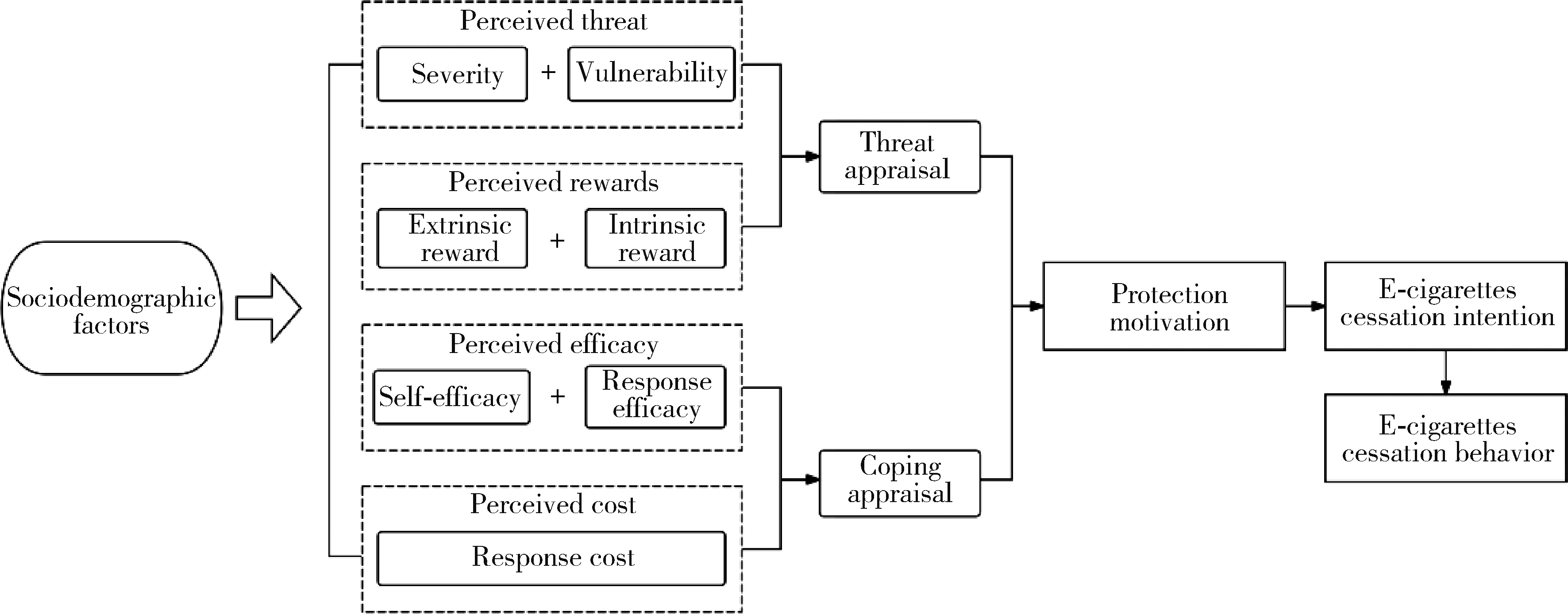
图1

本研究中保护动机理论的要素框架图"

表1

研究对象电子烟戒断意愿与戒烟行为的基本特征描述(n=550)"

Characteristics Whole participants, n (%) E-cigarette cessation intention E-cigarette cessation behavior
$\bar x \pm s$ t P Yes, n (%) No, n (%) χ2 P
Age/years 0.176 0.839 1.214 0.545
  18-24 56 (10.18) 3.59±0.95 20 (11.49) 36 (9.57)
  25-34 307 (55.82) 3.52±0.93 100 (57.47) 207 (55.05)
  35-44 187 (34.00) 3.50±1.01 54 (31.03) 133 (35.37)
Gender -0.909 0.364 0.252 0.616
  Male 395 (71.82) 3.50±0.96 122 (70.11) 273 (72.61)
  Female 155 (28.18) 3.58±0.95 52 (29.89) 103 (27.39)
Marital status 0.012 0.990 2.429 0.119
  Married 418 (76.00) 3.52±0.96 140 (80.46) 278 (73.94)
  Widowed/Divorced or separated/ Never married 132 (24.00) 3.52±0.96 34 (19.54) 98 (26.06)
Education level 1.082 0.339 1.528 0.466
  High school and below 27 (4.91) 3.26±1.02 9 (5.17) 18 (4.79)
  College or undergraduate 480 (87.27) 3.54±0.95 155 (89.08) 325 (86.44)
  Master and above 43 (7.82) 3.51±0.96 10 (5.75) 33 (8.78)
Region -0.172 0.864 0.501 0.479
  Rural 118 (21.45) 3.51±0.95 41 (23.56) 77 (20.48)
  Urban 432 (78.55) 3.53±0.96 133 (76.44) 299 (79.52)
Smoke cigarettes -0.405 0.686 1.164 0.281
  Yes 373 (67.82) 3.53±0.93 124 (71.26) 249 (66.22)
  No 177 (32.18) 3.50±1.01 50 (28.74) 127 (33.78)
Cessation behavior -8.002 < 0.001
  Yes 174 (31.64) 3.95±0.79
  No 376 (68.36) 3.32±0.96
Total 550 (100.00) 3.52±0.96 174 (31.64) 376 (68.36)

表2

PMT相关因素的描述性分析"

PMT variables Total, $\bar x \pm s$ Cessation intentiona(r) Cessation behavior, $\bar x \pm s$
Yes No P
Threat appraisal -3.75±6.49 0.32*** -1.55±6.62 -4.77±6.18 < 0.001
  Perceived threat 17.39±4.58 0.33*** 19.05±4.68 16.63±4.33 < 0.001
    Severity 8.87±2.46 0.32*** 9.78±2.52 8.46±2.31 < 0.001
    Vulnerability 8.52±2.60 0.28*** 9.28±2.57 8.17±2.54 < 0.001
  Perceived reward 21.15±3.84 -0.14** 20.60±4.12 21.40±3.68 0.029
    Intrinsic reward 11.19±2.09 -0.07 11.01±2.26 11.27±2.00 0.194
    Extrinsic reward 9.96±2.40 -0.16*** 9.59±2.58 10.13±2.29 0.018
Coping appraisal 11.75±4.50 0.34*** 11.89±4.56 11.69±4.47 0.633
  Perceived efficacy 20.21±3.80 0.40*** 20.68±3.77 19.99±3.79 0.045
    Response efficacy 9.55±2.53 0.30*** 9.58±2.61 9.53±2.49 0.837
    Self-efficacy 10.66±2.54 0.30*** 11.10±2.51 10.45±2.53 0.005
  Perceived cost 8.46±2.36 0.003 8.80±2.52 8.30±2.27 0.027
    Response cost 8.46±2.36 0.003 8.80±2.52 8.30±2.27 0.027

表3

基于PMT的电子烟戒断意愿多重线性回归分析"

Variables E-cigarette cessation intention
Seven primary PMT sub-elements [Model 1, β (95%CI)]
  Severity 0.14 (0.02, 0.26)**
  Vulnerability 0.12 (0.01, 0.23)**
  Intrinsic rewards -0.07 (-0.19, 0.05)
  Extrinsic rewards -0.12 (-0.22, -0.01)**
  Response efficacy 0.26 (0.16, 0.35)***
  Response cost -0.01 (-0.10, 0.09)
  Self-efficacy 0.28 (0.20, 0.37)***
Four perceptions [Model 2, β (95%CI)]
  Perceived threat 0.26 (0.16, 0.36)***
  Perceived rewards -0.19 (-0.31, -0.08)***
  Perceived efficacy 0.54 (0.42, 0.66)***
  Perceived cost -0.01 (-0.11, 0.08)
Two pathways [Model 3, β (95%CI)]
  Threat appraisal 0.27 (0.20, 0.34)***
  Coping appraisal 0.22 (0.14, 0.29)***

表4

基于PMT的电子烟戒断行为二元Logistic回归分析"

Variables E-cigarette cessation behavior
Seven primary PMT sub-elements [Model 1, OR (95%CI)]
  Severity 1.58 (1.12, 2.23)***
  Vulnerability 1.03 (0.76, 1.39)
  Intrinsic rewards 0.97 (0.70, 1.35)
  Extrinsic rewards 0.85 (0.63, 1.15)
  Response efficacy 1.00 (0.77, 1.31)
  Response cost 1.27 (0.96, 1.68)
  Self-efficacy 0.77 (0.59, 1.00)
  Quitting intention 2.16 (1.66, 2.81)***
Four perceptions [Model 2, OR (95%CI)]
  Perceived threat 1.60 (1.20, 2.14)***
  Perceived rewards 0.84 (0.60, 1.16)
  Perceived efficacy 0.80 (0.56, 1.13)
  Perceived cost 1.32 (1.01, 1.73)**
  Quitting intention 2.13 (1.64, 2.77)***
Two pathways[Model 3, OR (95%CI)]
  Threat appraisal 1.41 (1.15, 1.72)***
  Coping appraisal 0.76 (0.62, 0.94)**
  Quitting intention 2.21 (1.71, 2.84)***

表5

不同吸烟状况下电子烟戒断意愿的亚组分析"

Variables Exclusive e-cigarette users Dual users
Seven primary PMT sub-elements (Model 1,β)
  Severity 0.03 0.21***
  Vulnerability 0.14 0.10
  Intrinsic rewards -0.11 -0.05
  Extrinsic rewards -0.06 -0.13**
  Response efficacy 0.17** 0.31***
  Response cost 0.00 -0.02
  Self-efficacy 0.37*** 0.23***
Four perceptions (Model 2,β)
  Perceived threat 0.17* 0.31***
  Perceived rewards -0.19 -0.19***
  Perceived efficacy 0.53*** 0.55***
  Perceived cost -0.03 -0.01
Two pathways (Model 3,β)
  Threat appraisal 0.20*** 0.31***
  Coping appraisal 0.23*** 0.21***

表6

不同吸烟状况下电子烟戒断行为的亚组分析"

Variables Exclusive e-cigarette users Dual users
Seven primary PMT sub-elements (Model 1, OR)
  Severity 2.18** 1.40
  Vulnerability 0.77 1.21
  Intrinsic rewards 0.86 1.09
  Extrinsic rewards 0.54 0.93
  Response efficacy 1.30 0.90
  Response cost 1.58 1.13
  Self-efficacy 0.66 0.82
  Quitting intention 2.10*** 2.30***
Four perceptions (Model 2, OR)
  Perceived threat 1.60 1.69***
  Perceived rewards 0.52 1.01
  Perceived efficacy 0.96 0.74
  Perceived cost 1.70** 1.14
  Quitting intention 1.87*** 2.30***
Two pathways (Model 3, OR)
  Threat appraisal 1.72*** 1.33**
  Coping appraisal 0.71 0.81
  Quitting intention 1.96*** 2.35***
1
Glantz SA , Bareham DW . E-cigarettes: Use, effects on smoking, risks, and policy implications[J]. Annu Rev Public Health, 2018, 39, 215- 235.

doi: 10.1146/annurev-publhealth-040617-013757
2
Brown CJ , Cheng JM . Electronic cigarettes: Product characterisation and design considerations[J]. Tob Control, 2014, 23 (Suppl 2): ii4- ii10.

doi: 10.1136/tobaccocontrol-2013-051476
3
Zhao Z , Zhang M , Wu J , et al. E-cigarette use among adults in China: Findings from repeated cross-sectional surveys in 2015-16 and 2018-19[J]. Lancet Public Health, 2020, 5 (12): e639- e649.

doi: 10.1016/S2468-2667(20)30145-6
4
Xu L , Shi J , Cao Y , et al. E-cigarette use behavior and influencing factors among people aged 15 years and above: Beijing muni-cipality, China, 2016-2023[J]. China CDC Wkly, 2025, 7 (22): 760- 765.

doi: 10.46234/ccdcw2025.125
5
Wang J , Xie CC , Jia XX , et al. E-cigarette awareness and use, among adult residents in Shanghai, China[J]. Tob Induc Dis, 2023, 21, 104.
6
Xie Y , Li Y , Su Z , et al. Prevalence of cigarette and e-cigarette dual use and associated factors among people who smoke in China aged 20-69 years[J]. BMC Public Health, 2025, 26 (1): 186.

doi: 10.1186/s12889-025-25529-4
7
Patel D , Davis KC , Cox S , et al. Reasons for current E-cigarette use among U.S. adults[J]. Prev Med, 2016, 93, 14- 20.

doi: 10.1016/j.ypmed.2016.09.011
8
Rutten LJF , Blake KD , Agunwamba AA , et al. Use of E-cigarettes among current smokers: Associations among reasons for use, quit intentions, and current tobacco use[J]. Nicotine Tob Res, 2015, 17 (10): 1228- 1234.

doi: 10.1093/ntr/ntv003
9
Wu AD, Conde M, Butler AR, et al. Electronic cigarettes for smoking cessation: An overview of systematic reviews and evidence and gap map[J/OL]. Addiction, 2026[2026-03-26]. https://pubmed.ncbi.nlm.nih.gov/41887411/.
10
O'Leary R , La Rosa GRM , Polosa R . Examining e-cigarettes as a smoking cessation treatment: A critical umbrella review analysis[J]. Drug Alcohol Depend, 2025, 266, 112520.

doi: 10.1016/j.drugalcdep.2024.112520
11
Chen R , Pierce JP , Leas EC , et al. Effectiveness of e-cigarettes as aids for smoking cessation: Evidence from the PATH study cohort, 2017-2019[J]. Tob Control, 2023, 32 (e2): e145- e152.

doi: 10.1136/tobaccocontrol-2021-056901
12
Sapru S , Vardhan M , Li Q , et al. E-cigarettes use in the United States: Reasons for use, perceptions, and effects on health[J]. BMC Public Health, 2020, 20 (1): 1518.

doi: 10.1186/s12889-020-09572-x
13
Floyd DL , Prentice-Dunn S , Rogers RW . A meta-analysis of research on protection motivation theory[J]. J Appl Soc Psychol, 2000, 30 (2): 407- 429.

doi: 10.1111/j.1559-1816.2000.tb02323.x
14
Yan Y , Jacques-Tiura AJ , Chen X , et al. Application of the protection motivation theory in predicting cigarette smoking among adolescents in China[J]. Addict Behav, 2014, 39 (1): 181- 188.

doi: 10.1016/j.addbeh.2013.09.027
15
Lin H , Chen M , Yun Q , et al. Protection motivation theory and smoking quitting intention: Findings based on structural equation modelling and mediation analysis[J]. BMC Public Health, 2022, 22 (1): 838.

doi: 10.1186/s12889-022-13263-0
16
Peraza N , Mayorga NA , Garey L , et al. Exploring positive expectancies and quit status among adult electronic cigarette users[J]. Cogn Behav Ther, 2020, 49 (6): 486- 500.

doi: 10.1080/16506073.2020.1771412
17
Pepper JK , Brewer NT . Electronic nicotine delivery system (electronic cigarette) awareness, use, reactions and beliefs: A systematic review[J]. Tob Control, 2014, 23 (5): 375- 384.

doi: 10.1136/tobaccocontrol-2013-051122
18
Zhao D , Zuo Y , Urmi DS , et al. Perception of E-cigarette use among adult users in China: A mixed-method study[J]. Int J Environ Res Public Health, 2020, 17 (8): 2754.

doi: 10.3390/ijerph17082754
19
国家卫生健康委员会. 中国卫生健康统计年鉴(2022)[M]. 北京: 中国协和医科大学出版社, 2022.
20
Chen Y , Wang Z , Xu J , et al. A protection motivation theory-based scale for e-cigarette use assessment among Chinese college students: Development and validation[J]. Tob Induc Dis, 2025, 23

doi: 10.18332/tid/209411
21
Jiang J , Zheng Z . A critical review of E-cigarette regulation in China: Challenges and prospects for youth prevention and tobacco control[J]. Nicotine Tob Res, 2024, 26 (2): 126- 134.

doi: 10.1093/ntr/ntad180
22
Rogers RW . A protection motivation theory of fear appeals and attitude Change1[J]. J Psychol, 1975, 91 (1): 93- 114.

doi: 10.1080/00223980.1975.9915803
23
Spoladore R , Daus F , Pezzini S , et al. The point on the electronic cigarette more than 10 years after its introduction[J]. Eur Heart J Suppl, 2022, 24 (Supplement_I): I148- I152.

doi: 10.1093/eurheartjsupp/suac105
24
Warner KE , Benowitz NL , McNeill A , et al. Nicotine e-cigarettes as a tool for smoking cessation[J]. Nat Med, 2023, 29 (3): 520- 524.

doi: 10.1038/s41591-022-02201-7
25
谢臣晨, 陈德, 承语芝, 等. 上海市电子烟使用者电子烟相关知识知晓及态度情况分析[J]. 中国慢性病预防与控制, 2023, 31 (6): 458- 461.
26
Sheeran P , Webb TL . The intention-behavior gap[J]. Soc Pers Psychol Compass, 2016, 10 (9): 503- 518.

doi: 10.1111/spc3.12265
27
Kim CY , Paek YJ , Seo HG , et al. Dual use of electronic and conventional cigarettes is associated with higher cardiovascular risk factors in Korean men[J]. Sci Rep, 2020, 10 (1): 5612.

doi: 10.1038/s41598-020-62545-3
28
Klemperer EM , Villanti AC . Why and how do dual users quit vaping? Survey findings from adults who use electronic and combustible cigarettes[J]. Tob Induc Dis, 2021, 19, 12.
29
Lee DN , Liu J , Oduguwa K , et al. Association of vaping identity and e-cigarette perceptions among young adults who vape[J]. Subst Use Misuse, 2023, 58 (11): 1418- 1424.

doi: 10.1080/10826084.2023.2223286
30
Blank ML , Hoek J . Navigating social interactions and constructing vaping social identities: A qualitative exploration with New Zealand young adults who smoke[J]. Drug Alcohol Rev, 2023, 42 (2): 268- 276.

doi: 10.1111/dar.13542
31
Lin HX , Chang C . Factors associated with the quitting intention among Chinese adults: Application of protection motivation theory[J]. Curr Psychol, 2023, 42 (2): 1083- 1091.

doi: 10.1007/s12144-021-01500-5
32
Rahman N , Sofija E , Sebar B . Examining intention to quit vaping among Australian young adults using social cognitive theory: A cross-sectional survey analysis[J]. Youth, 2024, 4 (1): 31- 41.
33
Smith DM , Christensen C , van Bemmel D , et al. Exposure to nicotine and toxicants among dual users of tobacco cigarettes and E-cigarettes: Population assessment of tobacco and health (PATH) study, 2013-2014[J]. Nicotine Tob Res, 2021, 23 (5): 790- 797.

doi: 10.1093/ntr/ntaa252
34
Heshmati J , Pandey A , Benjamen J , et al. Vaping cessation interventions: A systematic review and meta-analysis[J]. Tob Control, 2026, 35 (3): 382- 390.

doi: 10.1136/tc-2024-058798
35
Bhadania M , Yadav S , Mathur A , et al. Mapping the effectiveness of digital health interventions in promoting electronic cigarette cessation: A systematic review and meta-analysis of randomized controlled trials[J]. BMC Public Health, 2025, 25 (1): 3645.

doi: 10.1186/s12889-025-24990-5
[1] 袁思妍, 闵鹤葳, 陈平, 吴一波, 崔红霞, 张旭熙, 孙昕霙. 基于大五人格特质的2型糖尿病患者健康教育偏好[J]. 北京大学学报(医学版), 2026, 58(3): 600-605.
[2] 陈子砚, 张晓悦, 顾亦梧, 常春. 2型糖尿病患者使用E-health管理疾病意愿与影响机制[J]. 北京大学学报(医学版), 2025, 57(3): 522-528.
[3] 王婷,李乔晟,刘皓冉,简伟研. 人格特征、城乡差异与抑郁症状变化的关系[J]. 北京大学学报(医学版), 2023, 55(3): 385-391.
[4] 何海龙,李清,徐涛,张晓威. 耻骨上吸脂术联合改良Devine术治疗成人获得性隐匿性阴茎[J]. 北京大学学报(医学版), 2022, 54(4): 741-745.
[5] 刘晓强,杨洋,周建锋,刘明月,谭建国. 成年人后牙失去邻牙合接触后的三维位置变化[J]. 北京大学学报(医学版), 2021, 53(3): 594-597.
[6] 吴为良,曾筱,刘晓强,谭建国. 120例中国成年人上前牙美学比例分析[J]. 北京大学学报(医学版), 2020, 52(6): 1130-1134.
[7] 唐顺, 郭卫, 杨荣利, 汤小东, 李大森, 董森. 40岁以上成年骨肉瘤患者的外科治疗及预后因素[J]. 北京大学学报(医学版), 2015, 47(1): 165-169.
[8] 张崔建 , 李学松 , 虞巍 , 吴问汉, 何志嵩 , 金杰 , 周利群. 成人肾母细胞瘤的治疗及其长期随访结果[J]. 北京大学学报(医学版), 2012, 44(4): 535-538.
[9] 关志忱, 魏本林, 孟作为. 远程无线排尿日记开发及20例年轻人客观排尿情况报告[J]. 北京大学学报(医学版), 2010, 42(4): 476-479.
[10] 牟向东, 宿利, 聂立功, 那加, 王仁贵, 李海潮. 成人特发性肺含铁血黄素沉着症二例报道及文献回顾[J]. 北京大学学报(医学版), 2008, 40(6): 595-599.
[11] 瓦斯里江·瓦哈甫, 何志嵩, 周利群. 成人肾母细胞瘤一例[J]. 北京大学学报(医学版), 2008, 40(3): 334-338.
[12] 廖晓耘, 王颖, 骆丽, 姜宝玉, 虞有智, 回允中. 年轻胃癌患者临床病理分析及免疫组化研究[J]. 北京大学学报(医学版), 2005, 37(5): 555-557.
[13] 李向东, 高雪梅, 曾祥龙. 83例无鼾男性上气道及周围组织的磁共振研究[J]. 北京大学学报(医学版), 2005, 37(2): 190-194.
Viewed
Full text


Abstract

Cited

  Shared   
  Discussed   
No Suggested Reading articles found!