北京大学学报(医学版) ›› 2026, Vol. 58 ›› Issue (3): 624-630. doi: 10.19723/j.issn.1671-167X.2026.03.024

• 论著 • 上一篇    下一篇

感染性肺炎与免疫相关间质性肺病中淋巴细胞亚群的表达

赵豆豆1,2,*, 齐晅1,3,*, 黄博1, 高伟波4, 裴源源4, 金月波1, 邵苗1, 何菁1,*()   

  1. 1. 北京大学人民医院风湿免疫科, 北京 100044
    2. 晋城市人民医院风湿免疫科, 山西晋城 048000
    3. 河北医科大学第二医院风湿免疫科, 石家庄 050000
    4. 北京大学人民医院急诊科, 北京 100044
  • 收稿日期:2024-07-26 出版日期:2026-06-18 发布日期:2026-04-09
  • 通讯作者: 何菁
  • 作者简介:

    * These authors contributed to this work equally

Expression and clinical significance of lymphocyte subsets in infectious pneumonia and immune-related interstitial lung disease

Doudou ZHAO1,2, Xuan QI1,3, Bo HUANG1, Weibo GAO4, Yuanyuan PEI4, Yuebo JIN1, Miao SHAO1, Jing HE1,*()   

  1. 1. Peking University People's Hospital, Rheumatology and Immunology Department, Beijing 100044, China
    2. Jincheng People's Hospital, Rheumatology and Immunology Department, Jincheng 048000, Shanxi, China
    3. The Second Hospital of Hebei Medical University, Rheumatology and Immunology Department, Shijiazhuang 050000, China
    4. Peking University People's Hospital, Emergency Department, Beijing 100044, China
  • Received:2024-07-26 Online:2026-06-18 Published:2026-04-09
  • Contact: Jing HE

RICH HTML


摘要:

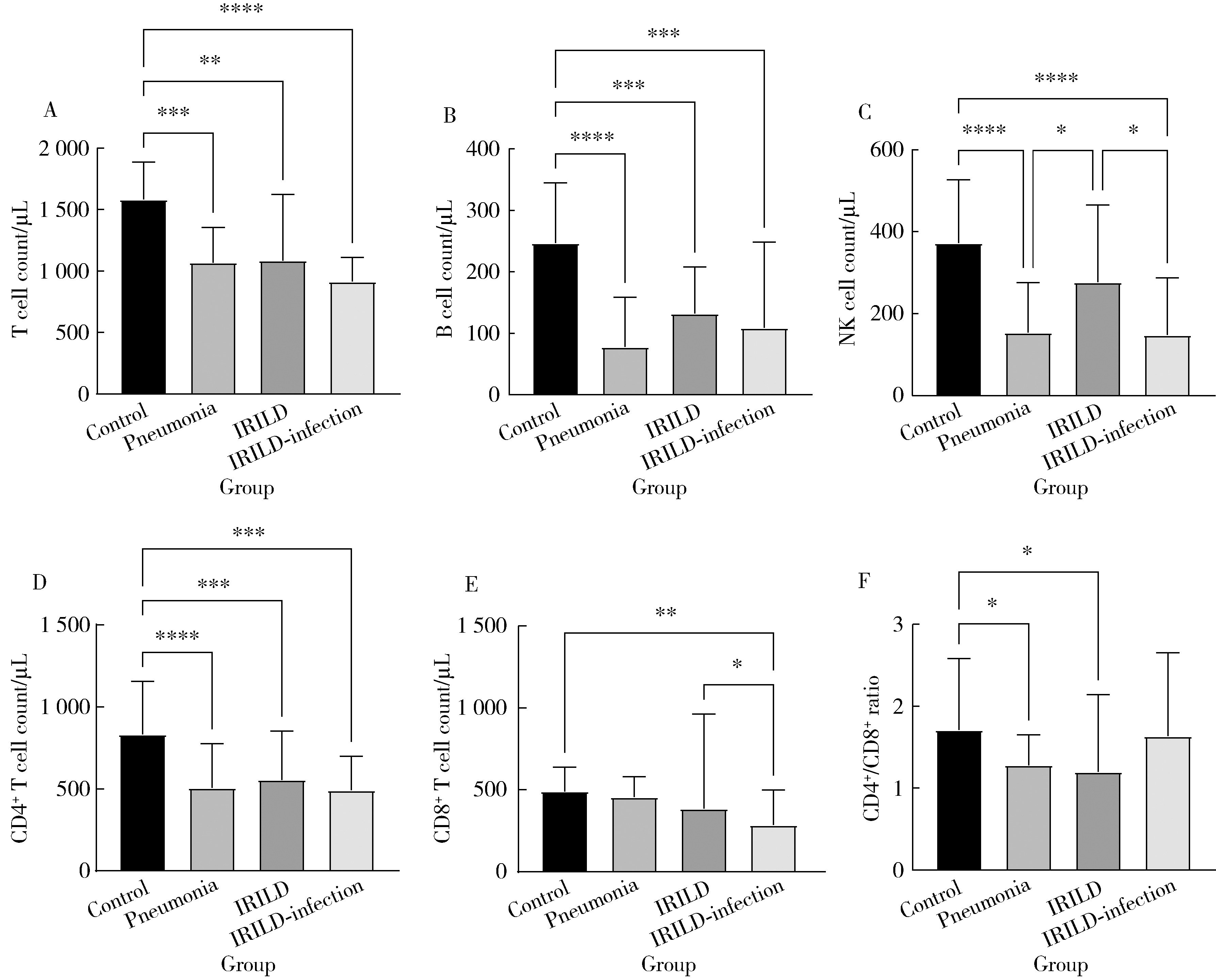
目的: 比较感染性肺炎和免疫相关间质性肺病(immune-related interstitial lung disease, IRILD)患者淋巴细胞亚群表达的差异,评估不同肺炎患者的免疫状态,从免疫学的角度为有效鉴别不同肺炎提供新的实验室指标。方法: 连续纳入2023年1月至2024年3月就诊于北京大学人民医院风湿免疫科的感染性肺炎患者27例、单纯IRILD患者27例以及IRILD合并感染患者24例,并选择同期进行体检的50名健康志愿者作为对照组。采用流式细胞术检测各组淋巴细胞亚群水平。结果: 病例组与对照组间年龄差异无统计学意义(P>0.05)。在实验室指标方面,与IRILD组相比,感染性肺炎组患者中性粒细胞、C反应蛋白、降钙素原(procalcitonin,PCT)、红细胞沉降率(erythrocyte sedimentation rate,ESR)、D-二聚体、纤维蛋白原水平增高(P<0.05),IRILD合并感染组患者PCT、ESR、免疫球蛋白G水平增高(P<0.05)。在淋巴细胞亚群水平方面,与对照组相比,感染性肺炎组患者的T、B、自然杀伤(natural killer,NK)、CD4+T细胞数,CD4+/CD8+比值明显降低(P<0.05),IRILD组患者的T、B,CD4+T细胞数、CD4+/CD8+比值明显降低(P<0.05),IRILD合并感染组患者T、B、NK、CD4+T、CD8+T细胞数明显降低(P<0.05)。与IRILD组患者相比,感染性肺炎组患者NK细胞数明显下降(P<0.05),IRILD合并感染组患者NK、CD8+T细胞数明显降低(P<0.05)。结论: 不同肺炎淋巴细胞亚群水平存在一定差异,为有效鉴别不同肺炎提供了新的思路。

关键词: 感染性肺炎, 免疫相关间质性肺病, 淋巴细胞亚群

Abstract:

Objective: To delineate differences in lymphocyte subset expression between patients with infectious pneumonia and immune-related interstitial lung disease (IRILD), to assess the immune status across distinct pneumonia types, and to provide novel laboratory markers through immunological profiling to effectively differentiate pneumonias. Methods: A total of 78 patients sequentially enrolled from Peking University People' s Hospital between January 2023 and March 2024 were stratified into three groups: 27 with infectious pneumonia, 27 with isolated immune-related interstitial lung disease (IRILD), and 24 with IRILD complicated by infection. Fifty age-matched healthy individuals undergoing routine physical examinations during the same period served as controls. Peripheral lymphocyte subsets were quantified in all subjects by multiparametric flow cytometry. Results: There was no statistically significant difference in age between the pneumonia patients and the healthy control group in this study (P>0.05). Analysis of laboratory parameters revealed that compared with the IRILD group, the infectious pneumonia group demonstrated significantly elevated levels of neutrophils, C-reactive protein, procalcitonin (PCT), erythrocyte sedimentation rate (ESR), D-dimer, and fibrinogen (P < 0.05), while the IRILD with superimposed infection group exhibited significantly increased levels of PCT, ESR, and immunoglobulin G (P < 0.05). At the lymphocyte subset level, compared with the control group, the infectious pneumonia group exhibited significantly decreased counts of T cells, B cells, natural killer (NK) cells, CD4+T cells, and the CD4+/CD8+ ratio (P < 0.05). Similarly, compared with the control group, the IRILD group showed significantly reduced counts of T cells, B cells, CD4+T cells, and the CD4+/CD8+ ratio (P < 0.05). Furthermore, compared with the control group, the IRILD-with-infection group demonstrated significantly lower counts of T cells, B cells, NK cells, CD4+T cells, and CD8+T cells (P < 0.05). Compared with the IRILD group, the infectious pneumonia group had a significantly lower NK cell count (P < 0.05). Additionally, compared with the IRILD group, the IRILD-with-infection group displayed significantly reduced counts of NK cells and CD8+T cells (P < 0.05). Conclusion: The study revealed significant variations in lymphocyte subset profiles among the distinct pneumonia groups, providing novel insights with potential diagnostic value for differentiating between pneumonia types.

Key words: Infectious pneumonia, Immune-related interstitial lung disease, Lymphocyte subpopulations

中图分类号: 

  • R563

表1

患者基线资料比较"

Items Control (n=50) Infectious pneumonia (n=27) IRILD (n=27) IRILD with infection (n=24) F/χ2 P
Male 17 (34.0) 19 (70.4) 8 (29.6) 9 (37.5) χ2=11.82 P<0.05
Age/years 55.3±9.4 60.3±16.9 60.5±13.9 60.0±12.8 F=1.50 P>0.05
Infection type χ2=2.06 P>0.05
  Virus 10 (37.0) 6 (25.0)
  Bacteria 14 (51.9) 17 (70.8)
  Bacteria + virus 2 (7.4)
  Fungus 1 (3.7) 1 (4.2)
IRILD etiology χ2=5.56 P>0.05
  IIM 12 (44.4) 12 (50.0)
  RA 2 (7.4) 3 (12.5)
  SS 2 (7.4) 3 (12.5)
  SSc 2 (8.3)
  AAV 1 (4.2)
  IPAF 11 (40.8) 3 (12.5)

表2

患者组间临床特征比较"

Characteristics Infectious pneumonia group(n=27) IRILD group(n=27) IRILD with infection group(n=24) F/x2/H P value
Common symptoms
  Fever 24 (88.9) 2 (7.4)a 13 (54.2)a,b χ2=36.09 P<0.001
  Cough 18 (66.7) 8 (29.6)a,c 19 (79.2) χ2=14.14 P<0.001
  Dyspnea 5 (18.5) 3 (11.1) 7 (29.2) χ2=2.59 0.321#
Co-existing complications
  Other 11 (40.7) 17 (63.0) 14 (58.3) χ2=2.96 0.222
  Hypertension 14 (51.9) 8 (29.6) 6 (25.0) χ2=4.69 0.101
  Diabetes 11 (40.7) 6 (22.2) 4 (16.7) χ2=4.96 0.20#
  CVD 2 (7.4) 2 (7.4) 4 (16.7) χ2=1.45 0.577#
Biochemical indexes
  WBC/(×109/L) 8.73 (5.61, 10.75) 7.80 (6.39, 8.30) 7.09 (5.15, 9.63) H=3.59 0.166
  LYM/(×109/L) 1.32±0.77 1.73±0.91 1.28±0.64 F=2.61 0.080
  NEU/(×109/L) 6.72 (4.42, 8.30)b 4.85 (3.80, 5.58) 5.17 (3.68, 7.27) H=6.57 0.038
  HB/(g/L) 110.40±21.78 129.89±16.90a 122.25±16.24a F=7.55 0.001
  PLT/(×109/L) 234.48±127.90 230.89±76.54 262.38±101.67 F=0.68 0.509
  ALT/(U/L) 22.00 (12.00, 36.00) 18.00 (13.00, 27.00) 15.00 (11.25, 49.75) H=0.38 0.828
  AST/(U/L) 21.00 (15.00, 28.00) 21.00 (16.00, 24.00) 26.00 (18.00, 37.75) H=2.13 0.346
  Scr/(μmol/L) 77.00 (60.00, 138.96) 65.00 (55.00, 79.00) 72.00 (56.25, 83.00) H=3.46 0.177
  CRP/(mg/L) 55.40 (14.20, 91.80) 1.10 (0.50, 3.90)a 5.90 (1.30, 24.70)a H=28.95 P<0.001
  PCT/(μg/L) 0.15 (0.10, 0.61)b 0.04 (0.03, 0.07) 0.20 (0.06, 0.52)b H=21.42 P<0.001
  ESR/(mm/h) 47.32 (39.00, 53.00)b 13.00 (7.00, 18.00) 33.50 (11.00, 70.00)b H=28.95 P<0.001
  D-dimer/(μg/L) 477.00 (203.00, 1 146.00)b 112.00 (75.00, 322.80) 254.00 (92.75, 496.25) H=14.67 P<0.001
  FIB/(mg/dL) 417.50±105.09 330.58±54.89a 377.33±115.00 F=5.72 0.005
  IgG/(g/L) 9.40±3.66c 11.49±3.66c 15.81±4.47 F=17.37 P<0.001
  IgA/(g/L) 2.00 (1.48, 2.26) 2.37 (1.63, 2.79) 2.65 (1.94, 3.36) H=5.79 0.055
  IgM/(g/L) 0.91 (0.43, 1.07) 1.05 (0.67, 1.52) 1.14 (0.77, 2.07) H=5.34 0.069
  C3/(g/L) 1.29±0.29c 1.34±0.18c 1.14±0.29 F=3.73 0.028
  C4/(g/L) 0.38 (0.36, 0.41)c 0.34 (0.27, 0.41) 0.26 (1.94, 3.36) H=11.18 0.004
Initial treatment
  GC therapy 0 (0) 23 (85.2)a 21 (87.5)a χ2=61.00 P<0.001#
  csDMARDs 0 (0) 23 (85.2)a 22 (91.7)a χ2=64.43 P<0.001#
  tDMARDs 0 (0) 1 (3.7) 5 (20.8)a χ2=7.02 0.012#

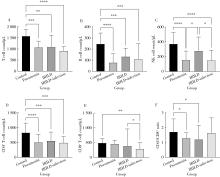
图1

淋巴细胞亚群表达水平对比"

1
Gopallawa I , Dehinwal R , Bhatia V , et al. A four-part guide to lung immunology: Invasion, inflammation, immunity, and intervention[J]. Front Immunol, 2023, 14, 1119564.

doi: 10.3389/fimmu.2023.1119564
2
Lletí MS , Cabañero Navalón MD , Pitarch MT , et al. Etiology, diagnosis, and management of pneumonia in immunosuppressed patients[J]. Rev Esp Quimioter, 2022, 35 (Suppl 1): 89- 96.
3
Sverzellati N , Lynch DA , Hansell DM , et al. American thoracic society-European respiratory society classification of the idiopathic interstitial pneumonias: Advances in knowledge since 2002[J]. Radiographics, 2015, 35 (7): 1849- 1871.

doi: 10.1148/rg.2015140334
4
Spagnolo P , Cordier JF , Cottin V . Connective tissue diseases, multimorbidity and the ageing lung[J]. Eur Respir J, 2016, 47 (5): 1535- 1558.

doi: 10.1183/13993003.00829-2015
5
葛均波, 徐永健, 王辰. 内科学[M]. 9版. 北京: 人民卫生出版社, 2018: 41- 44.
6
中华医学会健康管理学分会. TBNK淋巴细胞检测在健康管理中的应用专家共识[J]. 中华健康管理学杂志, 2023, 17 (2): 85- 95.
7
Wang J , Pei L , Zhao T , et al. CD4+ T cells related to disease severity in elderly and frailty community-acquired pneumonia patients: A retrospective cohort study[J]. Immun Inflamm Dis, 2023, 11 (9): e1009.

doi: 10.1002/iid3.1009
8
Qin L , Duan X , Dong JZ , et al. The unreversible reduced but persistent activated NK and CD8+ T cells in severe/critical COVID-19 during omicron pandemic in China[J]. Emerg Microbes Infect, 2023, 12 (1): 2208679.

doi: 10.1080/22221751.2023.2208679
9
Doughty L . Adaptive immune function in critical illness[J]. Curr Opin Pediatr, 2016, 28 (3): 274- 280.

doi: 10.1097/MOP.0000000000000357
10
Finfer S , Venkatesh B , Hotchkiss RS , et al. Lymphopenia in sepsis: An acquired immunodeficiency[J]. Immunol Cell Biol, 2023, 101 (6): 535- 544.

doi: 10.1111/imcb.12611
11
Shi L , Wang J , Guo HX , et al. Circulating Th2 cell reduction and Th1/Th2 imbalance are correlated with primary Sjögren ' s syndrome-associated interstitial lung disease[J]. Arthritis Res Ther, 2022, 24 (1): 121.

doi: 10.1186/s13075-022-02811-z
12
Cheng L , Li Y , Luo Y , et al. Decreased Th1 cells and Increased Th2 cells in peripheral blood are associated with Idiopathic Inflammatory myopathies patients with Interstitial lung disease[J]. Inflammation, 2023, 46 (1): 468- 479.

doi: 10.1007/s10753-022-01747-5
13
Feng M , Guo H , Zhang C , et al. Absolute reduction of regulatory T cells and regulatory effect of short-term and low-dose IL-2 in polymyositis or dermatomyositis[J]. Int Immunopharmacol, 2019, 77, 105912.

doi: 10.1016/j.intimp.2019.105912
14
Kotsianidis I , Nakou E , Bouchliou I , et al. Global impairment of CD4+CD25+FOXP3+ regulatory T cells in idiopathic pulmonary fibrosis[J]. Am J Respir Crit Care Med, 2009, 179 (12): 1121- 1130.

doi: 10.1164/rccm.200812-1936OC
15
Moyé S , Bormann T , Maus R , et al. Regulatory T cells limit pneumococcus-induced exacerbation of lung fibrosis in mice[J]. J Immunol, 2020, 204 (9): 2429- 2438.

doi: 10.4049/jimmunol.1900980
16
左艳华, 刘靓, 许化恒, 等. 结缔组织病相关性间质性肺炎患者涎液化糖链抗原与T细胞亚群水平变化及其临床意义[J]. 临床军医杂志, 2021, 49 (3): 336- 337.
17
张晶晶, 陈智勇, 王红, 等. 特发性炎性肌病间质性肺炎患者并发肺部感染的临床特征[J]. 中华风湿病学杂志, 2020, 24 (4): 253- 257.
18
耿陶然, 韩扬, 邱志峰, 等. 重症流行性感冒患者T淋巴细胞与预后研究[J]. 中华内科杂志, 2020, 59 (3): 200- 206.
19
Deng Y , Ou YY , Mo CJ , et al. Characteristics and clustering analysis of peripheral blood lymphocyte subsets in children with systemic lupus erythematosus complicated with clinical infection[J]. Clin Rheumatol, 2023, 42 (12): 3299- 3309.

doi: 10.1007/s10067-023-06716-3
20
Luzina IG , Todd NW , Iacono AT , et al. Roles of T lymphocytes in pulmonary fibrosis[J]. J Leukoc Biol, 2008, 83 (2): 237- 244.
21
Qin L , Wang WZ , Liu HR , et al. CD4+ and CD8+ T lymphocytes in lung tissue of NSIP: Correlation with T lymphocytes in BALF[J]. Respir Med, 2013, 107 (1): 120- 127.

doi: 10.1016/j.rmed.2012.09.021
[1] 林文灏, 谢阳, 王芳晴, 王淑盈, 刘香君, 胡凡磊, 贾园. 基于B细胞单细胞转录组测序的干燥综合征分子分型[J]. 北京大学学报(医学版), 2025, 57(6): 1032-1041.
[2] 赵亮, 史成龙, 马柯, 赵静, 王潇, 邢晓燕, 莫万星, 练益瑞, 高超, 李玉慧. 抗合成酶综合征重叠类风湿关节炎患者的免疫学特征[J]. 北京大学学报(医学版), 2024, 56(6): 972-979.
[3] 李敏,侯林卿,金月波,何菁. 系统性红斑狼疮合并视网膜病变的临床及免疫学特点[J]. 北京大学学报(医学版), 2022, 54(6): 1106-1111.
[4] 包芳,史尉利,胡静,张娣,高东晗,夏云霞,景红梅,克晓燕,葛庆岗,沈宁. 新型冠状病毒肺炎淋巴细胞亚群与严重程度的相关分析[J]. 北京大学学报(医学版), 2020, 52(6): 1075-1081.
[5] 朱明霞,万文丽,李海申,王晶,王艳芳,胡凯,克晓燕. 造血干细胞移植后的早期免疫重建[J]. 北京大学学报(医学版), 2016, 48(3): 505-522.
[6] 邵彬,李惠平,邸立军,宋国红,姜晗昉,梁旭,王超颖,严颖,林晓琳,王丽娜,宛凤玲,. 外周血淋巴细胞亚群监测对复发转移性乳腺癌的预测及预后价值[J]. 北京大学学报(医学版), 2016, 48(2): 304-309.
[7] 孙佳鹏,卢新天,赵卫红,华瑛. 自身免疫性淋巴细胞增生综合征1例并文献复习[J]. 北京大学学报(医学版), 2015, 47(6): 1022-1027.
[8] 赵翔宇,赵晓甦,王亚哲,常英军,吕萌,王洪涛,韩婷婷,黄晓军. 自然杀伤细胞表面杀伤免疫球蛋白样受体和CD57分子的表达及其功能[J]. 北京大学学报(医学版), 2014, 46(1): 115-119.
[9] 李百花, 张秋香, 董殿军, 林晓明. 番茄红素对急性肺损伤大鼠免疫细胞和炎性细胞因子的影响[J]. 北京大学学报(医学版), 2007, 39(1): 77-82.
[10] 尤鹏, 刘玉兰, 陈国栋. 大鼠肝移植自发免疫耐受模型CD4+CD25+和CD8+CD28-调节性T细胞的变化[J]. 北京大学学报(医学版), 2006, 38(3): 266-270.
[11] . ApoE基因缺陷鼠免疫、血液稳态和抗氧化功能改变[J]. 北京大学学报(医学版), 2001, 33(4): 347-350.
Viewed
Full text


Abstract

Cited

  Shared   
  Discussed   
No Suggested Reading articles found!