北京大学学报(医学版) ›› 2026, Vol. 58 ›› Issue (4): 729-737. doi: 10.19723/j.issn.1671-167X.2026.04.008

• 论著 • 上一篇    下一篇

儿童肾移植术后6个月贫血的发生率及相关因素

李汶霖, 余磊, 杨文博, 董健康, 杨宇杰, 赵兆, 王健飞, 张维宇*(), 王强*()   

  1. 北京大学人民医院泌尿外科,北京大学器官移植研究所,北京大学应用碎石技术研究所,北京 100044
  • 收稿日期:2026-02-09 出版日期:2026-08-18 发布日期:2026-05-06
  • 通讯作者: 张维宇, 王强
  • 基金资助:
    国家自然科学基金(82570886); 北京大学人民医院研究与发展基金(RDGS2023-09)

Incidence and associated factors of anemia within six months after kidney transplantation in pediatric recipients

Wenlin LI, Lei YU, Wenbo YANG, Jiankang DONG, Yujie YANG, Zhao ZHAO, Jianfei WANG, Weiyu ZHANG*(), Qiang WANG*()   

  1. Department of Urology, Peking University People' s Hospital; Peking University Institute of Organ Transplantation; Institute of Applied Lithotripsy Technology, Peking University; Beijing 100044, China
  • Received:2026-02-09 Online:2026-08-18 Published:2026-05-06
  • Contact: Weiyu ZHANG, Qiang WANG
  • Supported by:
    the National Natural Science Foundation of China(82570886); Peking University People' s Hospital Research and Development Fund(RDGS2023-09)

RICH HTML


摘要:

目的: 贫血是儿童肾移植术后常见的并发症,其流行病学特征与相关因素尚未完全明确。本研究通过分析儿童肾移植术后6个月内贫血的临床特征,探寻贫血发生的相关因素,为精准防控提供循证依据。方法: 采用单中心回顾性队列研究,纳入2022年1月至2025年8月期间北京大学人民医院完成的儿童肾移植病例的临床资料。采集患者人口学信息、围手术期及术后6个月的动态实验室指标,依据世界卫生组织(World Health Organization,WHO)年龄分层标准诊断贫血。通过单因素分析、多因素二元Logistic回归及受试者工作特征(receiver operating characteristic, ROC)曲线,筛选独立相关因素并评估诊断价值。结果: 本研究队列共纳入46例患儿,术后6个月贫血的发生率为41.3%(19/46),贫血类型以正细胞性贫血为主(63.1%,12/19)。多因素二元Logistic回归分析显示,年龄(OR=0.293,P=0.018)、术后6个月血尿素(OR=3.281,P=0.006)和估算肾小球滤过率(estimated glomerular filtration rate, eGFR)(OR=0.893,P=0.030)与贫血独立相关。探索性分层分析提示,年龄 < 13岁、血尿素>7 mmol/L和eGFR < 120 mL/(min·1.73 m2)可能作为临床筛查的参考阈值。ROC曲线分析显示,术后血尿素水平对贫血的诊断价值最优(曲线下面积=0.890,P < 0.001)。结论: 儿童肾移植术后贫血发生率较高,以轻中度正细胞性贫血为主,与低龄及移植肾功能相关,贫血组与非贫血组患儿血红蛋白水平的差异自术后第3个月开始显现。临床中应重点监测年龄 < 13岁、血尿素水平>7 mmol/L、术后eGFR < 120 mL/(min·1.73 m2)的高危患儿,及时干预有助于减少术后贫血的发生或改善其严重程度。

关键词: 儿童, 肾移植, 贫血, 尿素, 肾小球滤过率

Abstract:

Objective: Anemia is a common complication following kidney transplantation in children, yet its epidemiological characteristics and associated factors are not fully understood. This study aimed to investigate the incidence and clinical features of anemia within six months after pediatric kidney transplantation and to identify its associated factors, thereby providing evidence for management. Methods: A single-center retrospective cohort study was conducted on pediatric patients who underwent kidney transplantation at Peking University People' s Hospital from January 2022 to August 2025. Demographic, perioperative, and serial laboratory data up to 6 months post-transplantation were collected. Anemia was diagnosed according to the World Health Organization (WHO) age-specific criteria. Univariate analysis, multivariate binary Logistic regression, and receiver operating characteristic (ROC) curve analysis were performed to identify associated factors and assess their diagnostic value. Results: The study included 46 pediatric recipients. The incidence of anemia within 6 months post-transplantation was 41.3% (19/46), with normocytic anemia being the most prevalent type (63.1%, 12/19). Multivariate binary Logistic regression analysis showed that age (OR=0.293, P=0.018), postoperative serum urea at 6 months (OR=3.281, P=0.006), and estimated glomerular filtration rate (eGFR) (OR=0.893, P=0.030) were independently associated with anemia. Exploratory stratified analysis suggested that age < 13 years, serum urea >7 mmol/L, and eGFR < 120 mL/(min·1.73 m2) might serve as reference thresholds for clinical screening. ROC curve analysis indicated that postoperative serum urea had the best diagnostic value for anemia (area under the curve=0.890, P < 0.001). Hemoglobin levels began to differ significantly between the anemic and non-anemic groups from the third month postoperative onward, with the gap widening over time. Conclusion: This study demonstrates a high incidence of early-onset anemia after pediatric kidney transplantation, primarily mild to moderate normocytic anemia. It is associated with younger age and suboptimal allograft function, with the divergence in hemoglobin levels becoming apparent from the third month postoperative. Close monitoring of high-risk children, particularly those aged < 13 years or with serum urea >7 mmol/L and eGFR < 120 mL/(min·1.73 m2), and early intervention may help reduce the occurrence or severity of post-transplant anemia.

Key words: Child, Kidney transplantation, Anemia, Urea, Glomerular filtration rate

中图分类号: 

  • R699.2

表1

儿童肾移植受者的基线临床资料及人口学特征"

Items Values
Demographic characteristics
  Age/years 11.8±3.2
  Gender (male) 28 (60.9)
  Height/cm 147.3±19.9
Weight/kg 36.6±13.5
  BMI/(kg/m2) 16.4±3.2
Etiology of end-stage renal disease
  Glomerular disease 10 (21.7)
  Hereditary kidney disease 7 (15.2)
  CAKUT 6 (13.0)
  Tubulointerstitial disease 2 (4.3)
  Neoplastic kidney disease 1 (2.2)
  Unknown 20 (43.5)
Preoperative renal replacement therapy
  HD 16 (34.8)
  PD 20 (43.5)
  Both HD and PD 6 (13.0)
  No dialysis 4 (8.7)
Clinical indicators
  Hb/(g/L) 107.2±23.8
  Scr/(μmol/L) 756.7±266.4
  eGFR/[mL/(min·1.73 m2)] 8.7±5.7

表2

儿童肾移植术后临床观察指标的变化"

Time points RBC/(×1012/L) Hb/(g/L) HCT/% MCV/fL MCH/pg MCHC/(g/L) RDW-CV/%
Preoperatively 3.6±0.9 107.2±23.8 32.3±7.5 89.0±6.8 29.6±2.4 332.5±15.5 13.4±1.4
1 month postoperatively 3.8±0.6 114.2±15.6 35.5±4.6 93.4±6.1 30.0±2.2 321.3±11.1 15.3±2.0
2 months postoperatively 4.2±0.5 124.0±14.0 37.8±4.3 89.4±6.1 23.3±2.2 328.2±11.3 13.2±1.0
3 months postoperatively 4.3±0.7 123.1±17.7 37.8±5.4 87.4±6.3 28.5±2.3 326.3±11.8 12.8±1.3
4 months postoperatively 4.4±0.6 123.5±16.1 38.0±4.7 85.8±6.0 27.9±2.4 325.4±11.8 12.7±1.2
5 months postoperatively 4.4±0.7 121.2±15.4 37.3±4.7 84.4±5.7 27.5±2.4 325.0±13.2 13.0±1.1
6 months postoperatively 4.5±0.6 122.4±14.1 37.8±4.4 83.6±5.7 27.1±2.2 324.3±12.7 13.2±1.3
Time points RDW-SD/fL Serum urea/(mmol/L) Scr/(μmol/L) eGFR/[mL/(min·1.73 m2)] UA/(μmol/L) Tacrolimus blood concentration/(μg/L)
Preoperatively 42.9±6.1 21.3±6.4 756.7±266.4 8.7±5.7 435.7±112.2
1 month postoperatively 51.5±7.4 7.8±2.8 67.5±23.8 130.8±29.8 302.2±108.2 11.1±4.3
2 months postoperatively 43.1±4.0 6.6±2.3 72.7±31.1 127.0±32.4 342.9±113.4 10.4±2.7
3 months postoperatively 40.5±3.8 7.1±5.2 77.2±59.4 129.0±35.4 340.2±106.6 9.3±2.0
4 months postoperatively 39.4±3.8 6.6±2.2 71.4±42.8 130.7±29.8 364.0±92.6 9.4±2.0
5 months postoperatively 37.8±3.6 6.9±3.1 70.7±46.4 132.7±32.4 368.1±81.8 9.4±3.1
6 months postoperatively 39.9±3.8 6.7±2.8 73.2±62.9 133.7±33.7 367.8±94.8 9.2±2.8

表3

PTA相关因素的单因素分析"

Variables PTA group Non-PTA group P value
Number of cases 19 27
Age/years, $\bar x \pm s$ (range) 11.2±3.4 (3-17) 12.3±3.0 (6-17) 0.222
BMI/(kg/m2), $\bar x \pm s$ 16.4±3.7 16.4±2.8 0.973
Gender, n (%) 0.337
  Male 10 (35.7) 18 (64.3)
  Female 9 (50.0) 9 (50.0)
Preoperative renal replacement therapy 0.368
  No dialysis 3 1
  HD 7 9
  PD 6 14
  Both HD and PD 3 3
Graft dysfunction 1 0 0.228
Viral infection 6 8 0.888
  BKV 4 8
  B19 1 0
  EBV 1 0
Postoperative complications, n (%)
  Myelosuppression 5 (26.3) 9 (33.3) 0.611
  Gout 10 (52.6) 15 (55.6) 0.845
  Renal osteodystrophy 9 (47.4) 12 (44.4) 0.845
  Hypothyroidism 4 (21.1) 5 (18.5) 0.831
  Hyperparathyroidism 3 (15.8) 6 (22.2) 0.588
  Perirenal hematoma 1 (5.3) 0 (0) 0.228
  Renal cyst 0 (0) 3 (11.1) 0.133
Preoperative indicators, $\bar x \pm s$
  MCHC/(g/L) 328.2±12.9 335.5±16.6 0.058
  MCH/pg 29.1±2.2 29.9±2.5 0.195
  MCV/fL 88.7±5.9 89.3±7.4 0.885
  RBC/(×1012/L) 3.6±2.4 3.7±0.9 0.859
  Hb/(g/L) 105.4±28.2 108.4±20.6 0.600
  HCT/% 32.1±8.4 32.4±6.9 0.780
  Serum urea/(mmol/L) 20.5±5.7 21.8±6.9 0.600
  Scr/(μmol/L) 721.5±294.2 781.6±247.8 0.289
  eGFR/[mL/(min·1.73 m2)] 9.4±5.4 8.2±5.9 0.489
  UA/(μmol/L) 415.3±115.2 450.1±109.9 0.300
Indicators at 6 months postoperatively, $\bar x \pm s$
  Serum urea/(mmol/L) 8.4±3.5 5.5±1.3 0.001
  eGFR/[mL/(min·1.73 m2)] 120.6±42.9 142.9±21.9 0.025
  Scr/(μmol/L) 94.1±93.0 58.6±17.7 0.058
  UA/(μmol/L) 371.4±72.5 365.3±109.1 0.832
  MCV/fL 82.9±5.4 84.2±6.0 0.624
  MCH/pg 26.9±2.2 27.3±2.3 0.584
  MCHC/(g/L) 324.6±11.9 324.2±13.4 0.893
  Tacrolimus blood concentration/(μg/L) 9.2±2.4 9.3±3.1 0.933

表4

PTA相关因素的Logistic多因素回归分析"

Variables B SE Wald P Exp (B) (95%CI)
Age -0.670 0.284 5.554 0.018 0.512 (0.293, 0.893)
Postoperative urea 1.188 0.435 7.465 0.006 3.281 (1.399, 7.695)
Postoperative eGFR -0.113 0.052 4.715 0.030 0.893 (0.807, 0.989)
Postoperative Scr -0.047 0.027 3.163 0.075 0.954 (0.906, 1.005)
Constant 118.005 110.220 3.104 0.078

表5

PTA相关因素的分层分析"

PTA group Non-PTA group P value
Age ≤5 years 1/18 0/27 0.228
Age ≤9 years 5/14 5/22 0.307
Age ≤13 years 16/3 14/13 0.032
Serum urea >7 mmol/L 9/10 1/26 < 0.001
eGFR < 120 mL/(min·1.73 m2) 7/12 2/25 0.037

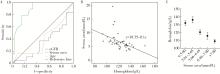
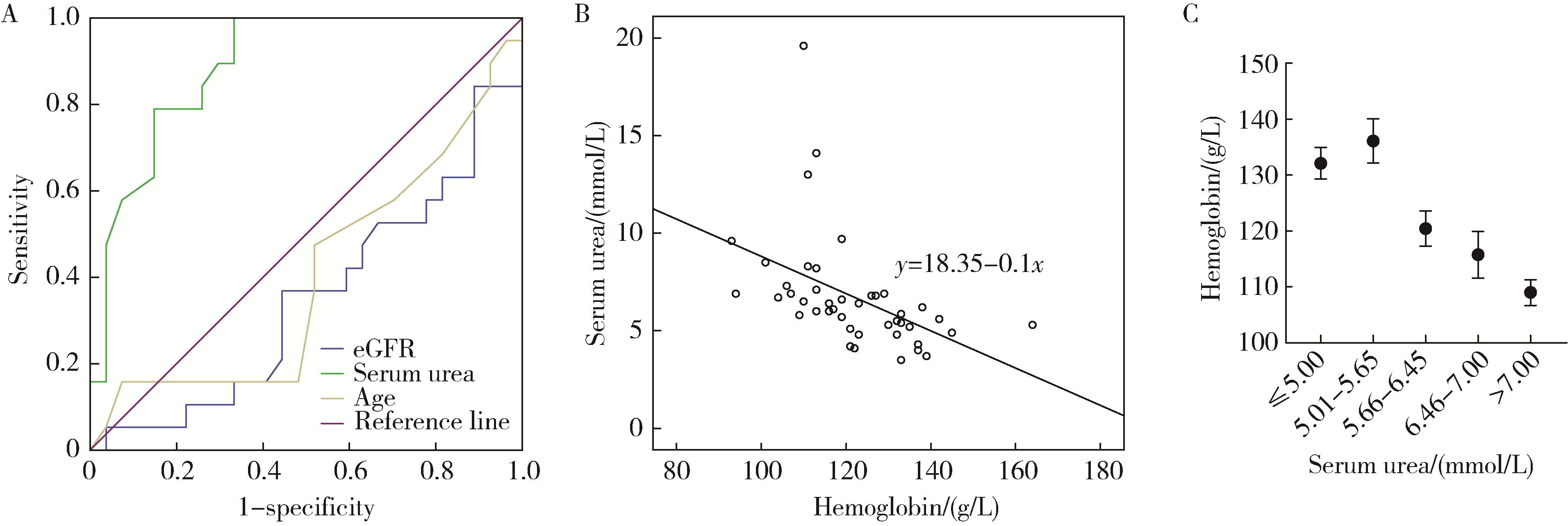
图1

移植肾功能与Hb水平的相关性分析"

1
赵兆, 张维宇, 杨文博, 等. 低龄、低体重儿童肾移植2例[J]. 北京大学学报(医学版), 2025, 57(4): 803- 807.

doi: 10.19723/j.issn.1671-167X.2025.04.028
2
黄正宇, 李敏如, 洪良庆, 等. 肾移植术后贫血的危险因素分析[J]. 中山大学学报(医学科学版), 2010, 31(1): 129- 133.
3
李明霞, 叶啟发, 彭贵主. 肾移植术后一年贫血危险因素分析[J/OL]. 中华移植杂志(电子版), 2017, 11(01): 15-18. [2025-10-22]. https://zhyzzz.cma-cmc.com.cn/CN/10.3877/cma.j.issn.1674-3903.2017.01.004.
4
Vanrenterghem Y . Anemia after kidney transplantation[J]. Transplantation, 2009, 87(9): 1265- 1267.

doi: 10.1097/TP.0b013e3181a170b7
5
Guzzo I , Atkinson MA . Anemia after kidney transplantation[J]. Pediatr Nephrol, 2023, 38(10): 3265- 3273.

doi: 10.1007/s00467-022-05743-7
6
Limm-Chan B , Wesseling-Perry K , Pearl MH , et al. Associations among erythropoietic, iron-related, and FGF23 parameters in pediatric kidney transplant recipients[J]. Pediatr Nephrol, 2021, 36(10): 3241- 3249.

doi: 10.1007/s00467-021-05081-0
7
Engelen W , Verpooten GA , van der Planken M , et al. Four cases of red blood cell aplasia in association with the use of mycophenolate mofetil in renal transplant patients[J]. Clin Nephrol, 2003, 60(8): 119- 124.

doi: 10.5414/CNP60119
8
Al Riyami MS , Al Gaithi B , Al Alawi I , et al. Autoimmune hemolytic anemia following kidney transplant: The role of tacrolimus and transition to everolimus in a pediatric case[J]. Pediatr Transplant, 2025, 29(4): e70104.

doi: 10.1111/petr.70104
9
Jefferies R , Puttagunta H , Krishnan A , et al. mTOR inhibitors induce erythropoietin resistance in renal transplant recipients[J]. Front Med (Lausanne), 2022, 9, 722058.
10
马强, 徐虹, 沈茜, 等. 儿童肾移植术后微小病毒B19感染致难治性贫血2例[J/OL]. 中华临床医师杂志(电子版), 2018, 12(12): 704-706. [2025-11-09]. https://www.cnki.com.cn/Article/CJFDTOTAL-zlyd201812013.htm.
11
Aghaei M , Sarabi MA . A are cause of post-renal transplant anemia by parvovirus-B19: Case report[J]. Transpl Immunol, 2024, 87, 102118.

doi: 10.1016/j.trim.2024.102118
12
Sabanci M , Taşdemir M , Öksüz B , et al. Managing recurrent parvovirus B19-associated anemia after a pediatric kidney transplant[J]. Pediatr Nephrol, 2024, 39(10): 2923- 2925.

doi: 10.1007/s00467-024-06378-6
13
Berti GM , Manaresi E , Vischini G , et al. Exploring parvovirus B19 pathogenesis and therapy among kidney transplant recipients: Case report and review of literature[J]. Lancet Infect Dis, 2025, 25(6)
14
祝藩原, 郑鳕洋, 杨璟辉, 等. 单中心儿童肾移植81例临床特点及并发症相关危险因素分析[J]. 中华器官移植杂志, 2024, 45(6): 391- 398.
15
Oruç Ç , Canpolat N , Pehlivan E , et al. Anemia after kidney transplantation: Does its basis differ from anemia in chronic kidney disease?[J]. Pediatr Transplant, 2020, 24(8): e13818.

doi: 10.1111/petr.13818
16
Yorgin PD , Belson A , Sanchez J , et al. Unexpectedly high prevalence of posttransplant anemia in pediatric and young adult renal transplant recipients[J]. Am J Kidney Dis, 2002, 40(6): 1306- 1318.

doi: 10.1053/ajkd.2002.36910
17
Miettinen J , Tainio J , Jahnukainen T , et al. Anemia and low-grade inflammation in pediatric kidney transplant recipients[J]. Pediatr Nephrol, 2017, 32(2): 347- 358.

doi: 10.1007/s00467-016-3481-7
18
Krischock LA , van Stralen KJ , Verrina E , et al. Anemia in children following renal transplantation: Results from the ESPN/ERA-EDTA Registry[J]. Pediatr Nephrol, 2016, 31(2): 325- 333.

doi: 10.1007/s00467-015-3201-8
19
Ogura T , Shiraishi C , Tamura Y , et al. Comparison of adverse events following immunosuppressant administration for pediatric patients with renal transplants categorized by two-year age increments using the U.S. food and drug administration adverse event reporting system[J]. Cureus, 2024, 16(7): e65300.
20
Kouri A , Balani S , Kizilbash S . Anemia in pediatric kidney transplant recipients: Etiologies and management[J]. Front Pediatr, 2022, 10, 929504.

doi: 10.3389/fped.2022.929504
21
Chienwichai K , Phirom S , Wuttiputhanun T , et al. A systematic review and meta-analysis of factors contributing to post-kidney transplant anemia and the effect of erythropoietin-stimulating agents[J]. Syst Rev, 2024, 13(1): 278.

doi: 10.1186/s13643-024-02709-8
[1] 单子桐, 魏书豪, 韩佳皓, 司燕, 荣文笙, 郑树国, 刘晓默, 张珊珊. 西藏那曲儿童青少年口腔健康素养横断面调查[J]. 北京大学学报(医学版), 2026, 58(4): 848-854.
[2] 魏慧, 张警丰, 姚中强, 赵金霞. 类风湿关节炎合并慢性病贫血患者的临床特征及相关因素[J]. 北京大学学报(医学版), 2026, 58(2): 307-312.
[3] 李宗瀚, 黄洋阅, 李宁, 李明磊, 宋宏程, 张潍平, 刘超. 国产单孔蛇形臂机器人手术系统在儿童肾盂成形术中的应用[J]. 北京大学学报(医学版), 2025, 57(4): 662-665.
[4] 张启鸣, 陈泽波, 田雨, 潘大猛, 刘磊, 张洪宪, 赵磊, 张树栋, 马潞林, 侯小飞. 机器人辅助腹腔镜移植肾切除术经验总结[J]. 北京大学学报(医学版), 2025, 57(4): 666-669.
[5] 赵兆, 张维宇, 杨文博, 张勇杰, 张晓鹏, 赵慧颖, 周刚, 王强. 低龄、低体重儿童肾移植2例[J]. 北京大学学报(医学版), 2025, 57(4): 803-807.
[6] 张依航, 蔡珊, 陈子玥, 刘云飞, 党佳佳, 师嫡, 李佳欣, 黄天彧, 宋逸. 基于RE-AIM框架儿童青少年近视与肥胖共病综合干预实施性研究结局指标的构建[J]. 北京大学学报(医学版), 2025, 57(3): 436-441.
[7] 唐孟利, 刘扬, 秦冉, 郭欣, 李宏田. 我国10省幼儿园5~6岁儿童近视和近视前期流行特征[J]. 北京大学学报(医学版), 2025, 57(3): 442-447.
[8] 刘光旭, 张良, 赵厚宇, 邓思危, 杨君婷, 李宁, 马瑞, 何艳, 许国章, 刘志科, 詹思延. 2015—2021年宁波市6岁以下儿童热性惊厥的流行病学特征[J]. 北京大学学报(医学版), 2025, 57(3): 584-591.
[9] 李琳, 廖津津. 应用ROC曲线评估久坐行为对儿童青少年视力不良的预测价值[J]. 北京大学学报(医学版), 2025, 57(3): 614-619.
[10] 王紫薇, 李闵, 高慧, 邓芳. 链球菌感染与过敏性紫癜肾炎患儿肾损害的相关性[J]. 北京大学学报(医学版), 2025, 57(2): 284-290.
[11] 余磊, 杨文博, 杨宇帆, 王强. 自体肾移植术治疗患儿复杂肾动脉瘤1例[J]. 北京大学学报(医学版), 2025, 57(2): 396-399.
[12] 邓敏婷, 王楠, 夏斌, 赵玉鸣, 朱俊霞. 儿童及青少年挫入恒前牙自行再萌出的相关影响因素[J]. 北京大学学报(医学版), 2025, 57(1): 148-153.
[13] 杨颖婷, 李若竹, 窦桂丽, 雷玥, 夏斌. iRoot BP Plus用于年轻恒牙外伤部分牙髓切断治疗的临床随机对照研究[J]. 北京大学学报(医学版), 2024, 56(6): 1083-1088.
[14] 赵双云, 邹思雨, 李雪莹, 沈丽娟, 周虹. 中文版口腔健康素养量表简版(HeLD-14)在学龄前儿童家长中应用的信度和效度评价[J]. 北京大学学报(医学版), 2024, 56(5): 828-832.
[15] 陈心心, 唐哲, 乔艳春, 荣文笙. 北京市密云区4岁儿童患龋状况及其与龋活跃性检测的相关性[J]. 北京大学学报(医学版), 2024, 56(5): 833-838.
Viewed
Full text


Abstract

Cited

  Shared   
  Discussed   
No Suggested Reading articles found!