
1 资料与方法
1.1 研究对象
1.2 实验设备及软件
1.3 研究方法
1.3.1 多源数据获取
1.3.2 多源数据整合
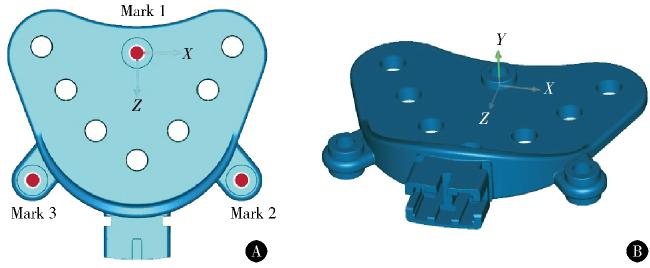
图1 标准上颌叉三维模型Figure 1 Standard maxillary fork three-dimensional model A, the red dots indicate the relationship between three mark points and the standard maxillary fork model; B, the coordinate system for the standard maxillary fork model. |
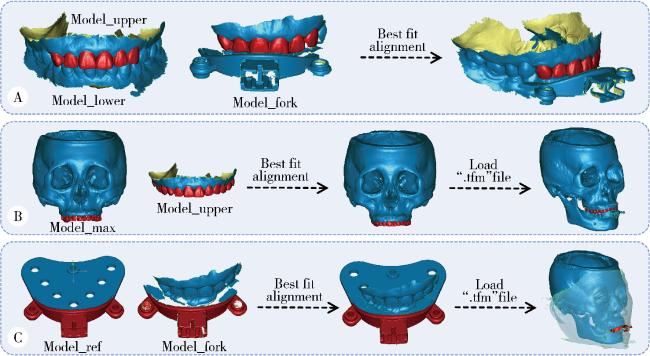
图2 颌面部三维多源数据整合流程Figure 2 3D multi-source data integration process for the maxillofacial region A, select the labial region of the anterior teeth as the registration area, unify the coordinate systems of Model_fork and Model_upper; B, select the maxillary dental arch region as the registration area, unify the coordinate systems of Model_upper and Model_max, load ".tfm" file to align the coordinate systems of Model_lower and Model_fork; C, select the upper surface region of the maxillary fork as the registration area, unify the coordinate systems of Model_fork and Model_ref, load ".tfm" file to align all 3D models to the coordinate system where Model_ref resides. |
1.3.3 参考平面坐标系的建立
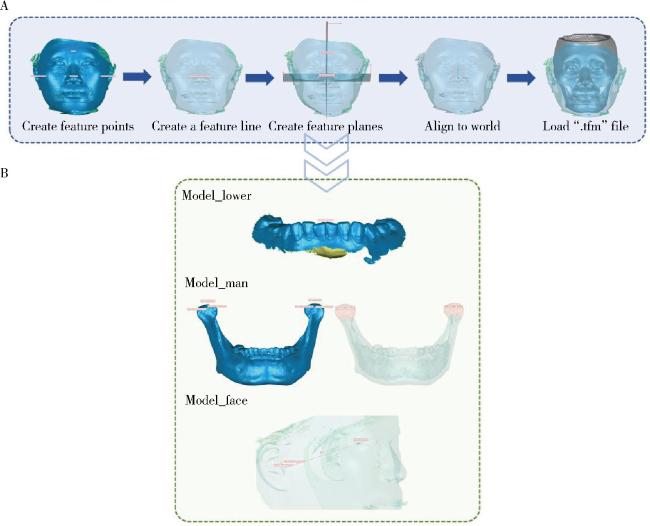
图3 参考平面坐标系建立及参考点选取Figure 3 Establishment of a reference plane coordinate system and selection of reference points A, procedure for establishing a reference plane coordinate system; B, select reference points based on the reference plane coordinate system, select mandibular incisor point on Model_lower, select bilateral condylar apex, medial condylar pole, lateral condylar pole and condylar center on Model_man, select bilateral empirical hinge axis points on Model_face. |
1.3.4 参考点选取
1.3.5 参考点三维运动轨迹生成
1.3.6 基于参考点轨迹的𬌗架关键参数计算
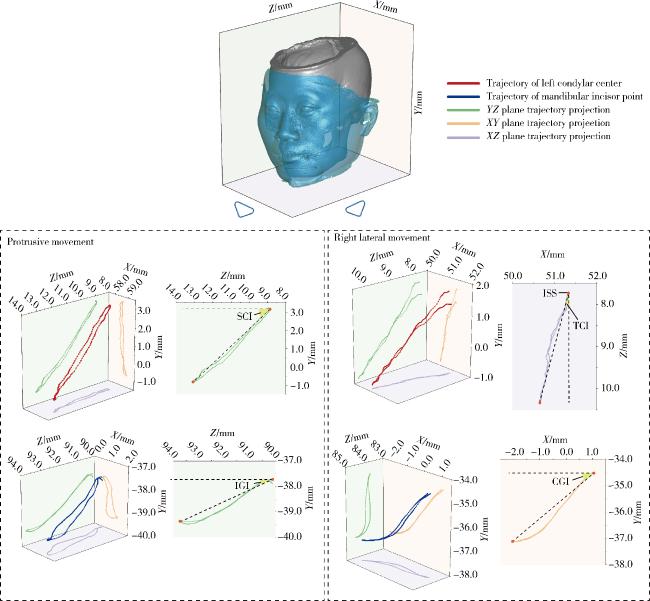
图5 基于参考点轨迹计算𬌗架关键参数Figure 5 Calculate key articulator parameters based on reference point trajectories Using trajectories of left condylar center and mandibular incisor point as examples to demonstrate the mathematical calculation method of SCI, TCI, ISS, IGI and CGI. SCI, sagittal condylar inclination; TCI, transversal condylar inclination; ISS, immediate side shift; IGI, incisal guidance inclination; CGI, canine guidance inclination. |
1.4 统计学分析
2 结果
2.1 各实验组及对照组SCI、TCI、ISS及尖导斜度左右侧差异
表1 各实验组及对照组SCI、TCI、ISS左右侧比较Table 1 Comparison of left and right SCI, TCI, ISS among experimental groups and the control group |
| Group | n | SCI/(°),${\bar x}$±s | TCI/(°),${\bar x}$±s | ISS/mm, M (IQR) | |||||||||||
| Left | Right | t | P | Left | Right | t | P | Left | Right | Z | P | ||||
| EG_condylar apex | 20 | 39.7±7.3 | 40.0±8.5 | -0.270 | 0.790 | 6.6±5.1 | 4.8±7.1 | 1.129 | 0.273 | 0.0(0.0) | 0.0(0.0) | 0.000 | >0.999 | ||
| EG_medial condylar pole | 20 | 39.8±7.1 | 39.9±8.0 | -0.191 | 0.851 | 9.0±5.6 | 6.6±7.5 | 1.453 | 0.162 | 0.0(0.0) | 0.0(0.0) | 0.000 | >0.999 | ||
| EG_lateral condylar pole | 20 | 40.0±7.2 | 40.3±8.4 | -0.214 | 0.833 | 11.0±5.3 | 9.1±5.8 | 1.374 | 0.185 | 0.0(0.0) | 0.0(0.0) | 0.000 | >0.999 | ||
| EG_condylar center | 20 | 39.9±7.1 | 40.1±8.2 | -0.240 | 0.813 | 10.7±5.5 | 8.6±6.5 | 1.367 | 0.188 | 0.0(0.0) | 0.0(0.0) | 0.000 | >0.999 | ||
| EG_empirical hinge axis point | 20 | 39.9±7.4 | 40.5±8.9 | -0.346 | 0.733 | 10.2±5.6 | 8.9±6.3 | 1.068 | 0.299 | 0.0(0.0) | 0.0(0.0) | 0.000 | >0.999 | ||
| CG | 20 | 37.3±8.6 | 36.5±9.1 | 0.639 | 0.531 | 9.8±6.5 | 8.6±6.8 | 1.019 | 0.321 | 0.0(0.0) | 0.0(0.0) | -0.272 | 0.785 | ||
SCI, sagittal condylar inclination; TCI, transversal condylar inclination; ISS, immediate side shift; EG, experimental group; CG, control group. |
表2 实验组_下颌切点及对照组尖导斜度左右侧比较Table 2 Comparison of left and right canine guidance inclination in EG_mandibular incisor point and the control group |
| Group | n | Canine guidance inclination/(°),${\bar x}$±s | |||
| Left | Right | t | P | ||
| EG_mandibular incisor point | 20 | 33.9±9.3 | 32.7±6.5 | 0.900 | 0.379 |
| CG | 20 | 29.7±11.5 | 32.8±8.7 | -1.611 | 0.124 |
EG, experimental group; CG, control group. |
2.2 各实验组与对照组间𬌗架关键参数差异
表3 各实验组与对照组SCI、TCI、ISS成对比较Table 3 Pairwise comparisons of SCI, TCI, ISS between experimental groups and the control group |
| Group | SCI/(°),${\bar x}$±s | t | P | TCI/(°),${\bar x}$±s | t | P | ISS/mm, M (IQR) | Z | P |
| EG_condylar apex | 39.8±7.8 | -4.635 | < 0.001 | 5.7±6.1 | 5.023 | < 0.001 | 0.0(0.0) | -1.633 | 0.102 |
| EG_medial condylar pole | 39.8±7.5 | -4.586 | < 0.001 | 7.8±6.7 | 1.971 | 0.056 | 0.0(0.0) | -1.633 | 0.102 |
| EG_lateral condylar pole | 40.1±7.7 | -5.206 | < 0.001 | 10.1±5.6 | -1.213 | 0.233 | 0.0(0.0) | -1.633 | 0.102 |
| EG_condylar center | 40.0±7.6 | -4.963 | < 0.001 | 9.7±6.0 | -0.655 | 0.517 | 0.0(0.0) | -1.633 | 0.102 |
| EG_empirical hinge axis point | 40.2±8.1 | -5.318 | < 0.001 | 9.5±5.9 | -0.539 | 0.593 | 0.0(0.0) | -1.633 | 0.102 |
| CG | 36.9±8.8 | 9.2±6.6 | 0.0(0.0) |
SCI, sagittal condylar inclination; TCI, transversal condylar inclination; ISS, immediate side shift; EG, experimental group; CG, control group. |
2.3 各实验组与对照组𬌗架关键参数的一致性
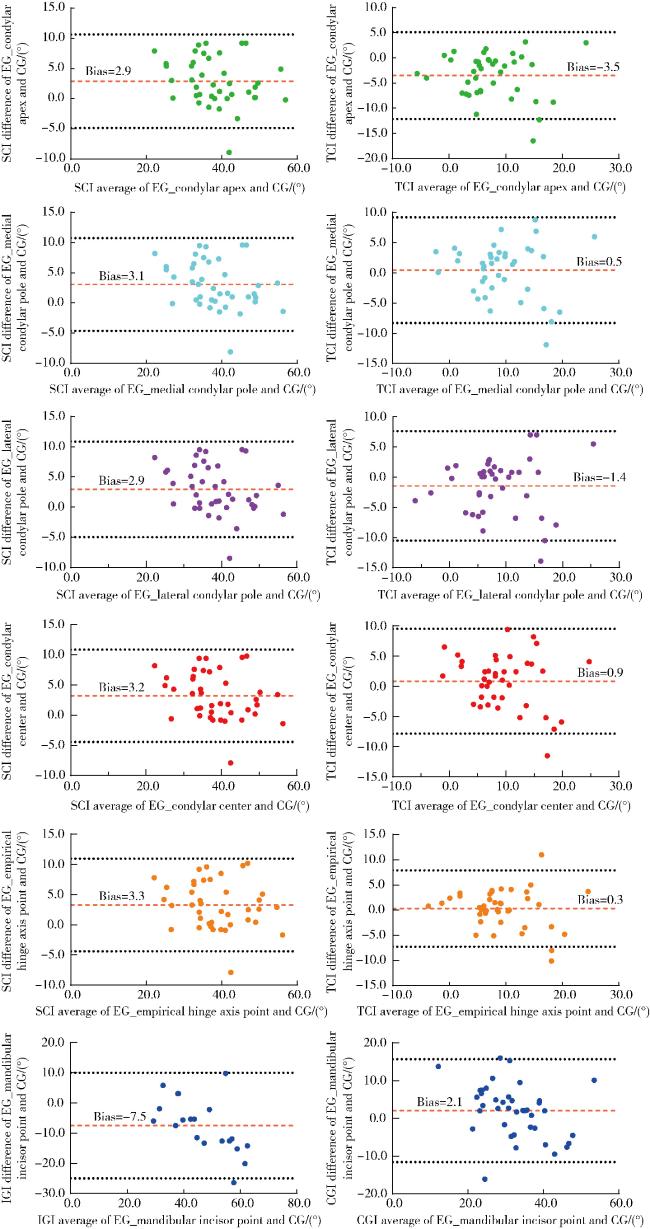
图6 各实验组与对照组𬌗架关键参数一致性的Bland-Altman图Figure 6 Bland-Altman plots for consistency of key articulator parameters between experimental and control groups SCI, sagittal condylar inclination; TCI, transversal condylar inclination; IGI, incisal guidance inclination; CGI, canine guidance inclination; EG, experimental group; CG, control group. |



