Journal of Peking University (Health Sciences) ›› 2025, Vol. 57 ›› Issue (6): 1024-1031. doi: 10.19723/j.issn.1671-167X.2025.06.003

Previous Articles     Next Articles

Serum inter-alpha-trypsin inhibitor heavy chain H3 is identified as a potential biomarker for myopenia in patients with rheumatoid arthritis using proteomic profiling

Tao WU1, Jianzi LIN1, Yafeng ZHU2, Jianda MA1, Peiwen JIA1, Lijuan YANG1, jie PAN1, Yaowei ZOU1, Ying YANG1, Ye LU1, Lie DAI1,*()   

  1. 1. Department of Rheumatology and Immunology, Sun Yat-Sen Memorial Hospital, Sun Yat-Sen University, Guangzhou, 510120, China
    2. Basic and Translational Medical Research Center, Sun Yat-Sen Memorial Hospital, Sun Yat-Sen University, Guangzhou, 510120, China
  • Received:2025-08-14 Online:2025-12-18 Published:2025-10-24
  • Contact: Lie DAI
  • Supported by:
    National Natural Science Foundation of China(82471832); Guangzhou Science and Technology Joint Funding Project for University-Enterprise Collaboration(2024A03J0912); Guangzhou Municipal Science and Technology Project and Yat-sen Excellent Yong Scientists Fund(2023A03J0709); Yixian Clinical Research 5010 Program Project(SYS-5010-202407)

RICH HTML


Abstract:

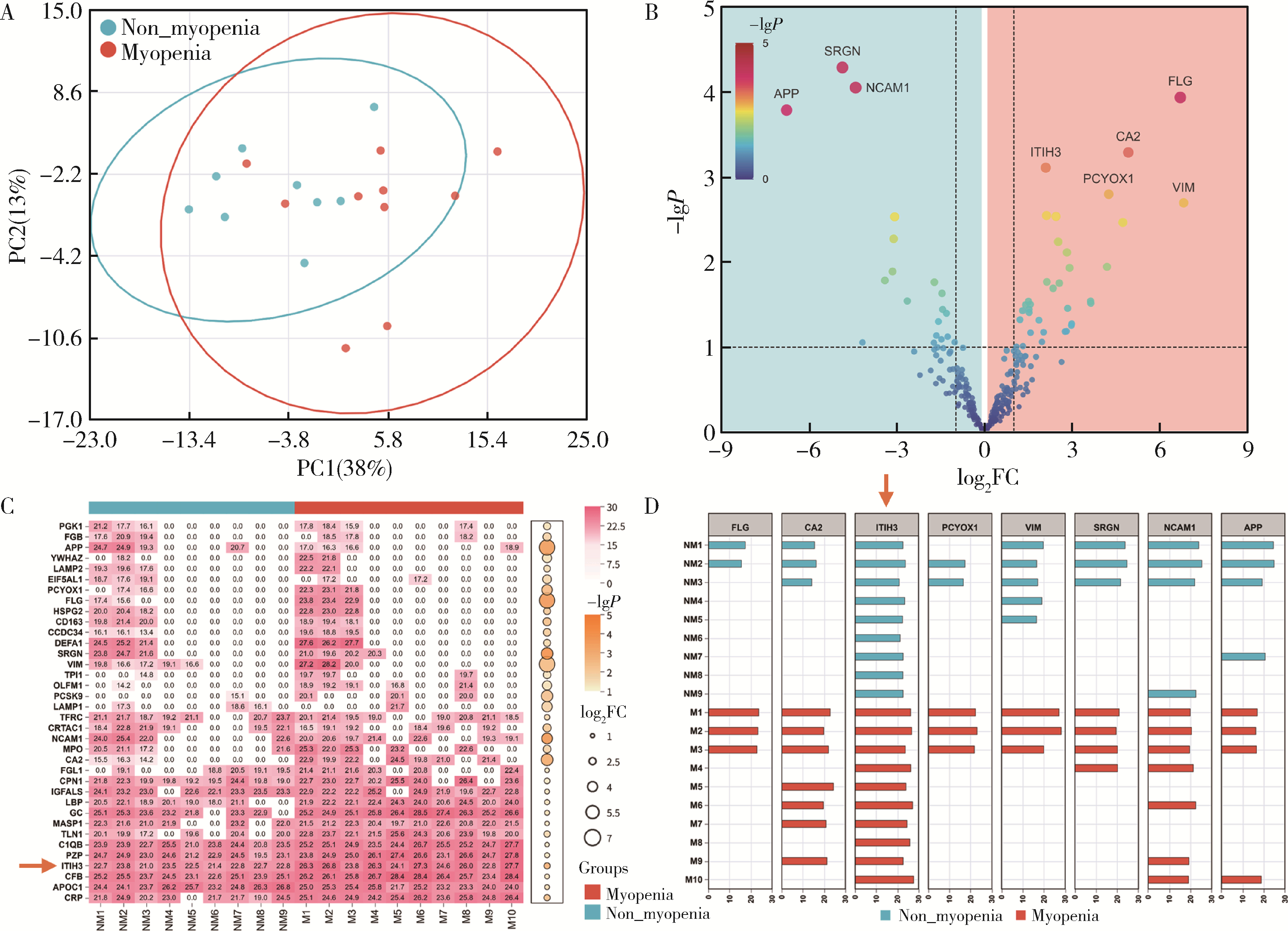
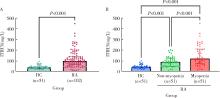
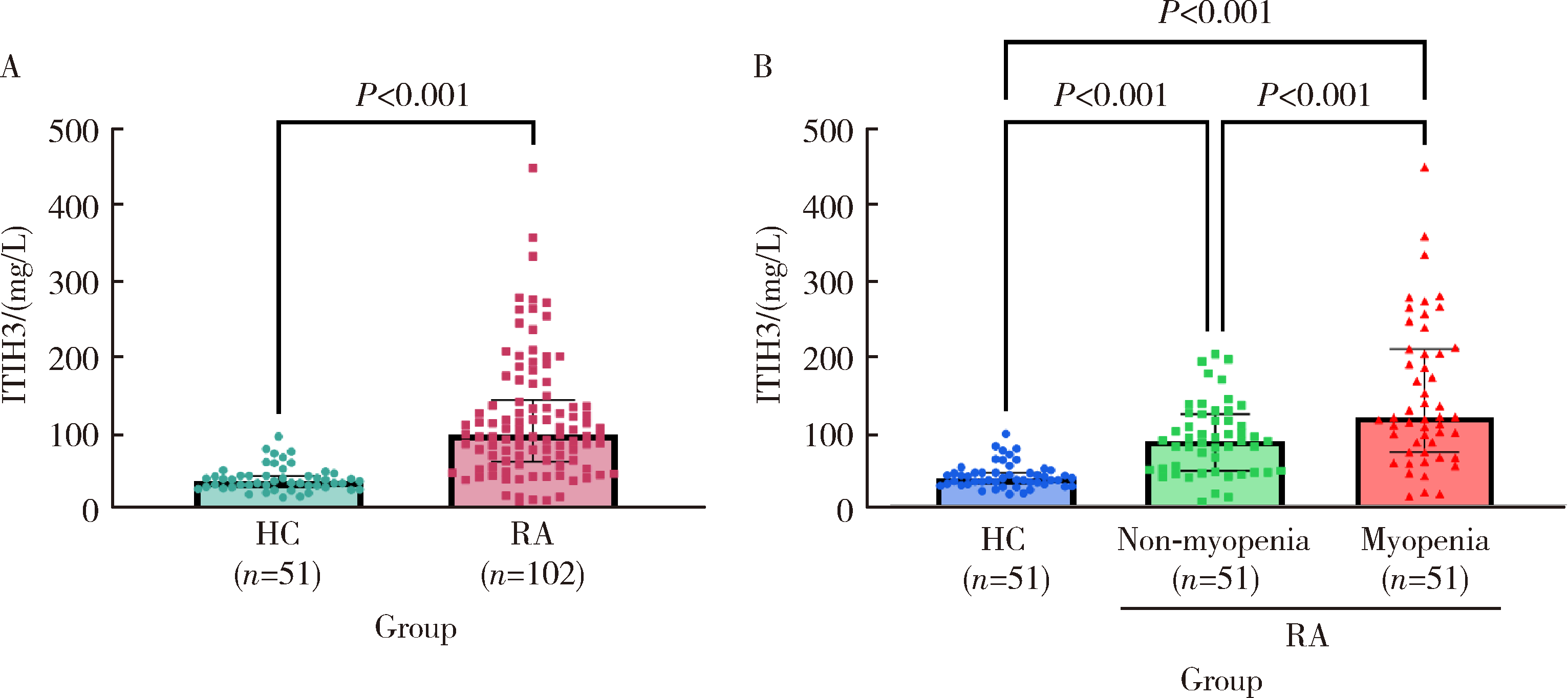
Objective: To explore the serum biomarkers of myopenia in patients with rheumatoid arthritis (RA) via serum proteomic profiling. Methods: This cross-sectional study recruited active RA patients who either sustained non-myopenic or myopenia state over a 2-year follow-up period and unlabeled liquid chromatography-tandem mass spectrometry (LC-MS/MS) was used to analyze the serum proteomic profiles. Bioinformatics analyses were then applied to identify differentially expressed proteins between the two groups. Further validation cohort enrolled 102 RA patients (including 51 cases of non-myopenia group and 51 cases of myopenia group) and 51 healthy controls (HC) with age- and gender- matched propensity score at a 1 ∶ 1 ∶ 1 ratio. Enzyme-linked immunosorbent assay (ELISA) was used to verify the expression levels of the candidate protein. Multivariate logistic regression analysis was performed to identify baseline factors associated with myopenia in the RA patients. Results: Initial proteomic analysis of baseline serum samples from 9 non-myopenia RA patients and 10 myopenia RA patients identified 38 differentially expressed proteins. Among them, inter-alpha-trypsin inhibitor heavy chain H3 (ITIH3) showed a significant upregulation in the myopenia group (log2FC=2.09) and was consistently detected across all the samples. Subsequent ELISA validation confirmed that the serum ITIH3 level in 102 RA patients was significantly higher than that in 51 HC [(119.4±79.7) mg/L vs. (42.3±16.6) mg/L, P < 0.001], in which both myopenia group and non-myopenia group of the RA patients showed higher levels of serum ITIH3 than the HC group (both P < 0.001). Importantly, the serum ITIH3 level in the 51 patients with myopenia were significantly higher than that in the 51 patients without myopenia [(148.1±94.7) mg/L vs. (90.8±46.6) mg/L, P < 0.001]. After adjustment for confounding covariates including gender, age, disease duration, erythrocyte sedimentation rate (ESR), C-reactive protein (CRP), radiological joint destruction and previous treatment, the multivariate Logistic regression analysis showed that the baseline serum ITIH3 level was an independent risk factor for myopenia in the RA patients (OR=1.024, 95%CI: 1.013-1.038, P < 0.001). Conclusion: This study identifies serum ITIH3 as a significant and independent risk factor for myopenia in patients with RA, which imply that ITIH3 might be a potential biomarker of myopenia. Further longitudinal large-sample multicenter validation is warranted to elucidate the precise role of ITIH3 in the pathophysiology of RA-associated myopenia and the clinical utility in risk stratification and management.

Key words: Rheumatoid arthritis, Myopenia, Proteomics, Biomarker, Inter-alpha-trypsin inhibitor heavy chain H3 (ITIH3)

CLC Number: 

  • R593.22

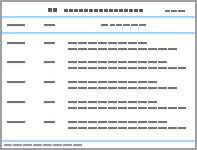
Table 1

Comparisons of baseline characteristics of RA patients in serum LC-MS/MS analysis"

Items Non-myopenia RA patients (n=9) Myopenia RA patients (n=10) Statistics P
Female, n (%) 7(77.8) 8(80.0) χ2=0.000 >0.999
Age/years, $\bar x \pm s$ 45.1±9.5 40.0±10.0 t=1.139 0.271
ASMI/(kg/m2), $\bar x \pm s$ 6.50±0.55 5.17±0.62 t=4.932 <0.001
Disease duration/month, M (Q1, Q3) 8.0(5.5, 10.0) 10.0(1.0, 12.5) Z=-0.369 0.712
Active smoking, n (%) 0(0.0) 1(10.0) - >0.999*
CDAI, M (Q1, Q3) 19.0(14.5, 29.0) 22.5(11.8, 27.0) Z=-0.286 0.775

Figure 1

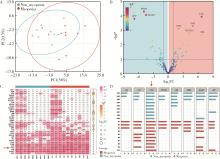
Serum LC-MS/MS and bioinformatics analysis of myopenia and non-mypoenia RA patients Serum protein profile analysis showing principal component analysis plot (A), DEPs volcano plot (B), DEPs heatmap (C), DEPs sample distribution plot (D) of myopenia and non-mypoenia RA patients. DEPs, differentially expressed proteins; PC, principal component; FC, fold change."

Table 2

Comparisons of baseline characteristics between RA patients and healthy controls"

Items HC(n=51) Non-myopenia RA patients (n=51) Myopenia RA patients (n=51) All RA patients(n=102) Statistics P
Female, n (%) 44 (86.3) 39(76.5) 42(82.4) 81 (79.4) χ2 =2.753a 0.252
Age/years, $\bar x \pm s$ 46.9±8.8 48.7±9.8 49.5±13.0 49.1±11.5 F=0.811a 0.446
ASMI/(kg/m2), $\bar x \pm s$ 6.31±0.73 6.81±0.67 5.23±0.63 6.0±1.0 F=72.335a < 0.001
Myopenia, n (%) 10 (19.6) 0(0.0) 51(100.0) 51 (50.0) - < 0.001b*
Disease duration/month, M(Q1, Q3) - 39 (6, 111) 65 (14, 133) 41 (10, 120) Z=-2.202c 0.028
Active smoking, n (%) - 7(13.7) 6(11.8) 13 (14.6) χ2=0.088c 0.767
Positive RF, n (%) - 38(74.5) 42(82.4) 80 (78.4) χ2=0.927c 0.336
Positive ACPA, n (%) - 37(72.5) 41(80.4) 78 (76.5) χ2=0.872c 0.350
28TJC, M (Q1, Q3) - 3 (1, 8) 4 (1, 7) 3 (1, 7) Z=-0.199c 0.842
28SJC, M (Q1, Q3) - 2 (1, 6) 2 (0, 5) 2 (1, 5) Z=-0.149c 0.882
PtGA/cm, M (Q1, Q3) - 4 (2, 7) 4 (3, 6) 4 (2, 6) Z=-0.236c 0.814
PrGA/cm, M (Q1, Q3) - 3 (2, 7) 4 (3, 6) 4 (2, 6) Z=-0.508c 0.611
Pain VAS/cm, M (Q1, Q3) - 3 (2, 7) 4 (2, 5) 4 (2, 5) Z=-0.784c 0.433
ESR/(mm/h), M (Q1, Q3) - 32 (19, 50) 49 (24, 77) 37 (21, 64) Z=-2.534c 0.011
CRP/(mg/L), M (Q1, Q3) - 5.9 (3.3, 10.6) 10.2 (3.3, 25.5) 6.8 (3.3, 17.9) Z=-1.581c 0.114
CDAI, M (Q1, Q3) - 13 (6, 28) 16 (9, 23) 14 (8, 24) Z=-0.378c 0.705
Active disease, n (%) 44 (86.3) 43(84.3) 87 (85.3) χ2=0.078c 0.780
HAQ-DI, M (Q1, Q3) - 0.25 (0.00, 1.00) 0.50 (0.13, 1.25) 0.38 (0.00, 1.06) Z=-0.892c 0.372
Physical dysfunction, n (%) 14 (27.5) 15(29.4) 29(28.4) χ2=0.048c 0.826
mTSS, M (Q1, Q3) - 5 (0, 32) 11 (3, 46) 8 (0, 36) Z=-1.564c 0.118
Radiological joint destruction, n (%) 19 (37.3) 27 (52.9) 46 (45.1) χ2=2.534c 0.111

Figure 2

Comparisons of baseline serum ITIH3 levels of RA patients and healthy controls A, the serum ITIH3 levels of RA patients and healthy controls were detected by ELISA; B, comparison of serum ITIH3 levels among myopenia/non-mypoenia RA patients and healthy controls. RA, rheumatoid arthritis; HC, healthy controls; ELISA, enzyme- linked immunosorbent assay; ITIH3, inter- alpha-trypsin inhibitor heavy chain 3."

Table 3

Logistic regression analysis of factors related to baseline myopenia in RA patients"

Items Univariate Multivariate1 Multivariate2
OR(95%CI) P OR(95%CI) P OR(95%CI) P
ITIH3 1.012 (1.005-1.019) < 0.001 1.018 (1.009-1.029) < 0.001 1.024 (1.013-1.038) < 0.001
Female 1.436 (0.548-3.875) 0.462 1.137 (0.215-6.436) 0.880
Age 1.006 (0.972-1.042) 0.721 1.002 (0.949-1.059) 0.939
Disease duration 1.004 (0.999-1.009) 0.112 1.000 (0.993-1.007) 0.977 1.000 (0.993-1.008) 0.960
Active smoking 0.813 (0.241-2.667) 0.731
Positive RF 1.596 (0.619-4.271) 0.335
Positive ACPA 1.551 (0.619-4.003) 0.350
28TJC 0.990 (0.918-1.065) 0.779
28SJC 0.961 (0.865-1.063) 0.442
PtGA 1.002 (0.874-1.150) 0.972
PrGA 1.010 (0.877-1.165) 0.886
Pain VAS 1.036 (0.885-1.215) 0.660
ESR 1.016 (1.003-1.031) 0.013 1.021 (1.000-1.045) 0.056 1.024 (0.999-1.052) 0.065
CRP 1.009 (0.995-1.026) 0.213 0.986 (0.959-1.015) 0.321 0.986 (0.954-1.022) 0.403
CDAI 0.995 (0.966-1.026) 0.761
HAQ-DI 1.039 (0.617-1.758) 0.884
Physical dysfunction 1.112 (0.449-2.771) 0.818
mTSS 1.005 (0.996-1.016) 0.289
Radiological joint destruction 1.945 (0.851-4.531) 0.115 1.435 (0.4595-4.463) 0.530 1.833 (0.521-6.576) 0.344
Previous treatment
Treatment naÏve 0.804 (0.316-2.013) 0.641 0.805 (0.052-16.06) 0.881
Glucocorticoids 1.314 (0.569-3.060) 0.522 3.126 (0.874-13.37) 0.097
csDMARDs 1.458 (0.545-4.013) 0.453 0.436 (0.040-5.478) 0.494
bDAMRDs/tsDMARDs 1.537 (0.243-12.12) 0.644 1.022 (0.099-10.94) 0.985
1
中华医学会老年医学分会, 国家老年疾病临床医学研究中心(湘雅医院). 中国肌肉减少症诊疗指南(2024版)[J]. 中华医学杂志, 2025, 105(3): 181- 203.
2
Jin H , Wang G , Lu Q , et al. Pathophysiology of myopenia in rheumatoid arthritis[J]. Bone Res, 2025, 13(1): 64.

doi: 10.1038/s41413-025-00438-9
3
Fearon K , Evans WJ , Anker SD . Myopenia: A new universal term for muscle wasting[J]. J Cachexia Sarcopenia Muscle, 2011, 2(1): 1- 3.

doi: 10.1007/s13539-011-0025-7
4
Lin JZ , Liang JJ , Ma JD , et al. Myopenia is associated with joint damage in rheumatoid arthritis: A cross-sectional study[J]. J Cachexia Sarcopenia Muscle, 2019, 10(2): 355- 367.

doi: 10.1002/jcsm.12381
5
Ma JD , Chen CT , Lin JZ , et al. Muscle wasting, a neglected complication associated with physical dysfunction in elderly patients with rheumatoid arthritis: A cross-sectional observational study[J]. Scand J Rheumatol, 2021, 50(4): 280- 289.

doi: 10.1080/03009742.2020.1842902
6
Bennett JL , Pratt AG , Dodds R , et al. Rheumatoid sarcopenia: Loss of skeletal muscle strength and mass in rheumatoid arthritis[J]. Nat Rev Rheumatol, 2023, 19(4): 239- 251.

doi: 10.1038/s41584-023-00921-9
7
Tosato M , Marzetti E , Cesari M , et al. Measurement of muscle mass in sarcopenia: From imaging to biochemical markers[J]. Aging Clin Exp Res, 2017, 29(1): 19- 27.

doi: 10.1007/s40520-016-0717-0
8
Jia PW , Lin JZ , Zou YW , et al. The characteristic of muscle function for sarcopenia in patients with rheumatoid arthritis: A large-scale real-world cross-sectional study[J]. Medicina, 2025, 61(4): 551.

doi: 10.3390/medicina61040551
9
Pan J , Zou YW , Zhu YY , et al. Muscle mass loss is associated with physical dysfunction in patients with early rheumatoid arthritis[J]. Front Nutr, 2022, 9, 1007184.

doi: 10.3389/fnut.2022.1007184
10
Lin JZ , Liu Y , Ma JD , et al. Reduced skeletal muscle inde-pendently predicts 1-year aggravated joint destruction in patients with rheumatoid arthritis[J]. Ther Adv Musculoskelet Dis, 2020, 12, 1759720X20946220.

doi: 10.1177/1759720X20946220
11
国家皮肤与免疫疾病临床医学研究中心(北京协和医院), 中国医师协会风湿免疫专科医师分会, 中国康复医学会风湿免疫病康复专业委员会, 等. 2024中国类风湿关节炎诊疗指南[J]. 中华内科杂志, 2024, 63(11): 1059- 1077.
12
贾霈雯, 杨迎, 邹耀威, 等. 类风湿关节炎患者低肌肉量综合征的临床特征及其对躯体功能的影响[J]. 北京大学学报(医学版), 2024, 56(6): 1009- 1016.
13
Adair JE , Stober V , Sobhany M , et al. Inter-α-trypsin inhibitor promotes bronchial epithelial repair after injury through vitronectin binding[J]. J Biol Chem, 2009, 284(25): 16922- 16930.

doi: 10.1074/jbc.M808560200
14
Okroj M , Holmquist E , Sjölander J , et al. Heavy chains of inter alpha inhibitor (IαI) inhibit the human complement system at early stages of the cascade[J]. J Biol Chem, 2012, 287(24): 20100- 20110.

doi: 10.1074/jbc.M111.324913
15
Karuna N , Tonry C , Ledwidge M , et al. Proteomic-based bio-marker discovery reveals panels of diagnostic biomarkers for early identification of heart failure subtypes[J]. J Transl Med, 2025, 23(1): 546.

doi: 10.1186/s12967-025-06563-7
16
de Almeida LGN , Young D , Chow L , et al. Proteomics and metabolomics profiling of platelets and plasma mediators of thrombo-inflammation in gestational hypertension and preeclampsia[J]. Cells, 2022, 11(8): 1256.

doi: 10.3390/cells11081256
17
Schroeter CB , Nelke C , Stascheit F , et al. Inter-alpha-trypsin inhibitor heavy chain H3 is a potential biomarker for disease activity in myasthenia gravis[J]. Acta Neuropathol, 2024, 147(1): 102.

doi: 10.1007/s00401-024-02754-6
[1] Zhao XIANG, Li YANG, Jing YANG. Untargeted metabolomics reveals differential serum metabolites and metabolic pathways in patients with primary Sjögren syndrome and thrombocytopenia [J]. Journal of Peking University (Health Sciences), 2025, 57(6): 1042-1050.
[2] Yan DING, Lifang WANG, Chaoran LI, Zhemin LU, Lianjie SHI. Rheumatoid arthritis combined with IgG4-related disease successfully treated with rituximab: A case report [J]. Journal of Peking University (Health Sciences), 2025, 57(6): 1203-1207.
[3] Xiangyu SUN, Chao YUAN, Xinzhu ZHOU, Jing DIAO, Shuguo ZHENG. Application of salivary micro-ecosystem in early prevention and control of oral and systemic diseases [J]. Journal of Peking University (Health Sciences), 2025, 57(5): 859-863.
[4] Congyi YANG, Xiaowen ZHENG, Jingyi CHEN, Jun XU, Feng CHEN, Yang CHEN, Ning CHEN. Protein biomarker screening and functional analysis of salivary exosomes in patients with ulcerative colitis [J]. Journal of Peking University (Health Sciences), 2025, 57(5): 895-902.
[5] Ju YANG, Jing XU, Juhua DAI, Lianjie SHI. Expression of lumican protein in serum of patients with rheumatoid arthritis and its correlation with disease and immune activities [J]. Journal of Peking University (Health Sciences), 2025, 57(5): 911-918.
[6] Lianghua FENG, Lirong HONG, Yujia CHEN, Xueming CAI. Role and mechanism of ubiquitin-specific protease 35 in ferroptosis of rheumatoid arthritis-fibroblast like synoviocytes [J]. Journal of Peking University (Health Sciences), 2025, 57(5): 919-925.
[7] Peiwen JIA, Ying YANG, Yaowei ZOU, Zhiming OUYANG, Jianzi LIN, Jianda MA, Kuimin YANG, Lie DAI. Clinical characteristics of overlapping syndromes of low muscle mass in patients with rheumatoid arthritis and their impact on physical function [J]. Journal of Peking University (Health Sciences), 2024, 56(6): 1009-1016.
[8] Doudou MA, Zhemin LU, Qian GUO, Sha ZHU, Jin GU, Yan DING, Lianjie SHI. Successful treatment of rheumatoid arthritis complicated with myasthenia gravis with low-dose rituximab: A case report [J]. Journal of Peking University (Health Sciences), 2024, 56(6): 1110-1114.
[9] Rui YAN, Dan KE, Yan ZHANG, Li LI, Huanran SU, Wei CHEN, Mingxia SUN, Xiaomin LIU, Liang LUO. Diagnostic significance of serum chemokine CXCL-10 and Krebs von den lungen-6 level in patients with rheumatoid arthritis associated interstitial lung disease [J]. Journal of Peking University (Health Sciences), 2024, 56(6): 956-962.
[10] Liang ZHAO, Chenglong SHI, Ke MA, Jing ZHAO, Xiao WANG, Xiaoyan XING, Wanxing MO, Yirui LIAN, Chao GAO, Yuhui LI. Immunological characteristics of patients with anti-synthetase syndrome overlap with rheumatoid arthritis [J]. Journal of Peking University (Health Sciences), 2024, 56(6): 972-979.
[11] Yijun HAN, Xiaoli CHEN, Changhong LI, Jinxia ZHAO. Application status of methotrexate in patients with rheumatoid arthritis [J]. Journal of Peking University (Health Sciences), 2024, 56(6): 994-1000.
[12] Dongwu LIU, Jie CHEN, Mingli GAO, Jing YU. Rheumatoid arthritis with Castleman-like histopathology in lymph nodes: A case report [J]. Journal of Peking University (Health Sciences), 2024, 56(5): 928-931.
[13] Huina HUANG,Jing ZHAO,Xiangge ZHAO,Ziran BAI,Xia LI,Guan WANG. Regulatory effect of lactate on peripheral blood CD4+ T cell subsets in patients with rheumatoid arthritis [J]. Journal of Peking University (Health Sciences), 2024, 56(3): 519-525.
[14] Xiaofei TANG,Yonghong LI,Qiuling DING,Zhuo SUN,Yang ZHANG,Yumei WANG,Meiyi TIAN,Jian LIU. Incidence and risk factors of deep vein thrombosis in patients with rheumatoid arthritis [J]. Journal of Peking University (Health Sciences), 2024, 56(2): 279-283.
[15] Xue ZOU,Xiao-juan BAI,Li-qing ZHANG. Effectiveness of tofacitinib combined with iguratimod in the treatment of difficult-to-treat moderate-to-severe rheumatoid arthritis [J]. Journal of Peking University (Health Sciences), 2023, 55(6): 1013-1021.
Viewed
Full text


Abstract

Cited

  Shared   
  Discussed   
No Suggested Reading articles found!