Journal of Peking University (Health Sciences) ›› 2025, Vol. 57 ›› Issue (6): 1136-1144. doi: 10.19723/j.issn.1671-167X.2025.06.018

Previous Articles     Next Articles

Association between socioeconomic status and vision impairment among Chinese elderly

Yuehui WEI, Weiyan JIAN*()   

  1. Department of Health Policy and Management, Peking University School of Public Health, Beijing 100191, China
  • Received:2025-02-09 Online:2025-12-18 Published:2025-09-24
  • Contact: Weiyan JIAN
  • Supported by:
    the National Social Science Fund of China (Major Project)(22&ZD143)

RICH HTML


Abstract:

Objective: To assess the association between socioeconomic status and vision impairment (Ⅵ) among Chinese elderly aged 65 years and above, and explore its comparison and contrast from 2008 to 2018. Methods: Using the 2008 and 2018 waves of cross-sectional data from the Chinese Longitudinal Healthy Longevity Survey (CLHLS), which included 12970 and 9702 participants, respectively. Logistic regression models with a stepwise forward approach were employed to assess the association between the household income, educated level, job before retirement and Ⅵ. Results: In 2008, the prevalence of Ⅵ among the elderly aged 65 years and above in China was 16.92% (95%CI: 15.91%-17.98%), which increased to 18.45% (95%CI: 17.41%-19.53%) in 2018. In terms of household income, the highest and upper middle income groups had lower odds of Ⅵ compared with the lowest one in 2008. By 2018, only the upper middle had lower odds (OR=0.761, 95%CI: 0.603-0.961), with its disparity narrowing compared with 2008. For educated level, in 2008, individuals with primary school education, and those with junior high school education or above had lower odds of Ⅵ compared with illiterate individuals. By 2018, the disparity in Ⅵ between the illiterate individuals and those with primary school education widened, while the gap between the illiterate ones and those with junior high school education or above decreased. In addition, after controlling for other factors, the odds of Ⅵ for the individuals educated by junior high school and above was higher than for those educated by primary school (OR=0.691, 95%CI: 0.533-0.896; OR=0.592, 95%CI: 0.494-0.708). Regarding job before retirement, in 2008, compared with the professional, technical or managerial personnel, those engaged in agriculture or domestic work had higher odds of Ⅵ. In 2018, this disparity persisted (OR=1.707, 95%CI: 1.319-2.210; OR=1.925, 95%CI: 1.310-2.829), with the gaps widening compared with the reference group. Conclusion: The prevalence of Ⅵ among Chinese elderly increased from 2008 to 2018, with socioeconomic status, specifically household income, educated level, and job before retirement, demonstrating associations with Ⅵ. To be specific, the gap in the odds of Ⅵ across household income strata decreased from 2008 to 2018; disparities among different educated levels generally diminished, while the gap between illiterate individuals and ones educated by primary school widened; and job-before-retirement groups exhibited expanding disparities over time.

Key words: Vision disorders, Socioeconomic status, Aged, Correlational research

CLC Number: 

  • R197.1

Table 1

Characteristics of participants"

Variables Year 2008 (n=12 970), n (%) Year 2018 (n=9 702), n (%)
Age/years
  65-74 2 485 (19.16) 2 392 (24.65)
  75-84 2 576 (19.86) 2 401 (24.75)
  85 and above 7 909 (60.98) 4 909 (50.60)
Gender
  Female 7 340 (56.59) 5 350 (55.14)
  Male 5 630 (43.41) 4 352 (44.86)
Marital status
  Others 8 255 (63.65) 5 167 (53.26)
  Currently married 4 715 (36.35) 4 535 (46.74)
Household income quintile
  Lowest 2 857 (22.03) 1 970 (20.31)
  Lower middle 2 926 (22.56) 1 973 (20.34)
  Middle 2 442 (18.83) 1 861 (19.18)
  Upper middle 2 472 (19.06) 2 000 (20.61)
  Highest 2 273 (17.53) 1 898 (19.56)
Educated level
  Illiterate 8 024 (61.87) 4 678 (48.22)
  Primary school 3 653 (28.16) 3 140 (32.36)
  Junior high school and above 1 293 (9.97) 1 884 (19.42)
Job before retirement
  Professional, technical or managerial personnel 956 (7.37) 1 084 (11.17)
  Commercial, service or industrial worker 1 734 (13.37) 1 403 (14.46)
  Self-employed 249 (1.92) 181 (1.87)
  Agriculture 8 592 (66.25) 5 980 (61.64)
  Houseworker 1 075 (8.29) 655 (6.75)
  Military personnel 85 (0.66) 90 (0.93)
  Never worked 86 (0.66) 143 (1.47)
  Others 193 (1.49) 166 (1.71)
Residence
  Rural 7 771 (59.92) 4 173 (43.01)
  Urban 5 199 (40.08) 5 529 (56.99)
Location
  East 5 202 (40.11) 4 554 (46.94)
  Middle 3 200 (24.67) 2 166 (22.33)
  West 3 510 (27.06) 2 514 (25.91)
  North-east 1 058 (8.16) 468 (4.82)
Smoking
  Never 8 610 (66.38) 6 688 (68.93)
  Past or current 4 360 (33.62) 3 014 (31.07)
Drinking
  Never 8 953 (69.03) 7 080 (72.97)
  Past or current 4 017 (30.97) 2 622 (27.03)
Regular exercising
  Never 7 812 (60.23) 5 919 (61.01)
  Past or current 5 158 (39.77) 3 783 (38.99)
Fruit
  Not often 7 704 (59.40) 5 222 (53.82)
  Often 5 266 (40.60) 4 480 (46.18)

Table 2

Prevalence of vision impairment among Chinese elderly grouped by socioeconomic status, residence, and location from 2008 to 2018"

Variables Year 2008, n (%)a Year 2018, n (%)a
Household income quintile
  Lowest 1 237 (19.87) 774 (20.59)
  Lower middle 1 218 (17.87) 807 (20.73)
  Middle 981 (16.37) 654 (17.45)
  Upper middle 881 (14.73) 728 (15.73)
  Highest 802 (15.70) 611 (17.75)
F=2.924b, P=0.020 F=3.218b, P=0.012
Educated level
  Illiterate 3 855 (22.99) 2 388 (28.49)
  Primary school 1 029 (14.24) 816 (14.82)
  Junior high school and above 235 (9.53) 370 (13.47)
F=46.582b, P < 0.001 F=69.762b, P < 0.001
Job before retirement
  Professional, technical or managerial personnel 215 (11.69) 245 (12.37)
  Commercial, service or industrial worker 499 (13.70) 414 (15.33)
  Self-employed 88 (12.46) 60 (17.14)
  Agriculture 3 574 (18.61) 2 380 (19.94)
  Houseworker 606 (26.24) 321 (23.44)
  Military personnel 23 (13.62) 25 (17.51)
  Never worked 45 (21.32) 78 (22.85)
  Others 69 (13.84) 51 (18.23)
F=5.804b, P < 0.001 F=4.356b, P < 0.001
Residence
  Rural 3 142 (17.30) 1 631 (19.63)
  Urban 1 977 (16.50) 1 943 (17.29)
F=0.556b, P=0.456 F=4.789b, P=0.029
Location
  East 2 048 (17.02) 1 639 (17.24)
  Middle 1 291 (17.83) 830 (18.77)
  West 1 394 (16.97) 972 (20.76)
  North-east 386 (14.10) 133 (16.61)
F=1.086b, P=0.353 F=2.531b, P=0.055

Table 3

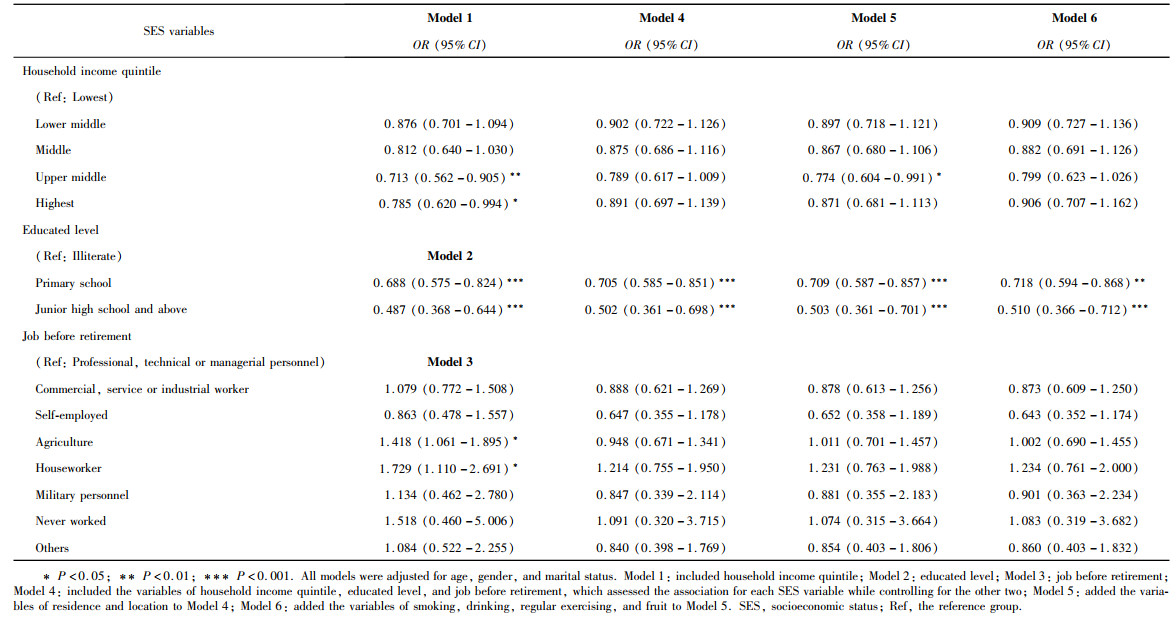
Logistic regression analyses on vision impairment among Chinese elderly in 2018 (n=12 970)"

Table 4

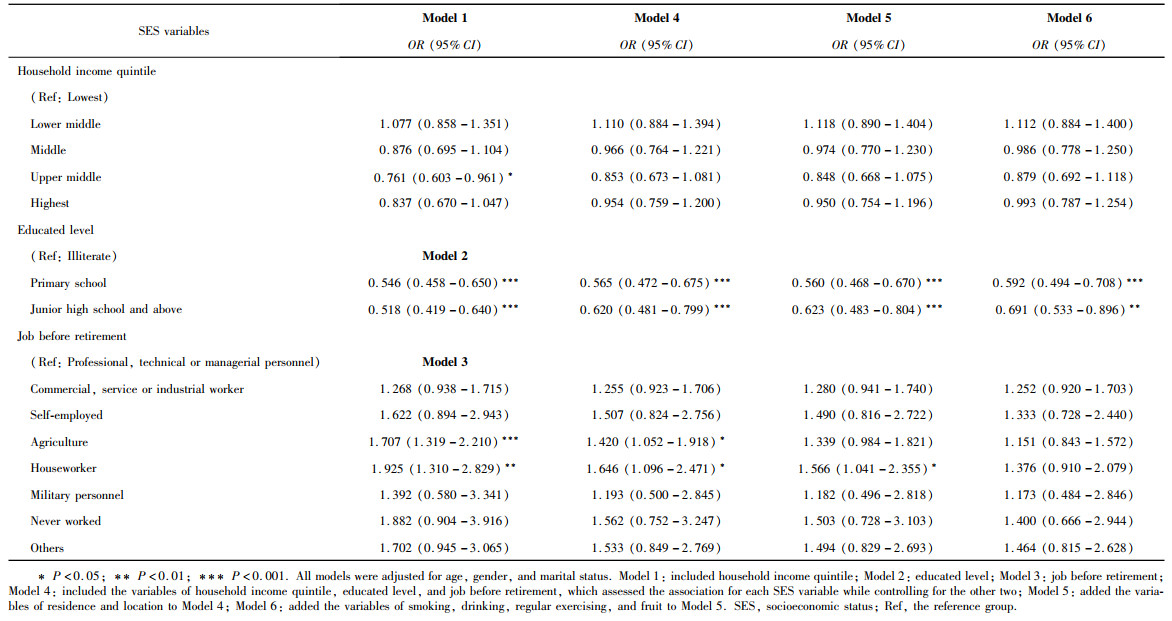
Logistic regression analyses on vision impairment among Chinese elderly in 2018 (n =9 702)"

1
Swenor BK , Ehrlich JR . Ageing and vision loss: Looking to the future[J]. Lancet Glob Health, 2021, 9 (4): e385- e386.

doi: 10.1016/S2214-109X(21)00031-0
2
Cao GY , Chen ZS , Yao SS , et al. The association between vision impairment and cognitive outcomes in older adults: A systematic review and meta-analysis[J]. Aging Ment Health, 2023, 27 (2): 350- 356.

doi: 10.1080/13607863.2022.2077303
3
Ehrlich JR , Ramke J , MacLeod D , et al. Association between vision impairment and mortality: A systematic review and meta-analysis[J]. Lancet Glob Health, 2021, 9 (4): e418- e430.

doi: 10.1016/S2214-109X(20)30549-0
4
VanNasdale DA , Jones-Jordan LA , Hurley MS , et al. Association between vision impairment and physical quality of life assessed using national surveillance data[J]. Optom Vis Sci, 2021, 98 (9): 1063- 1069.

doi: 10.1097/OPX.0000000000001773
5
Zhang T , Jiang W , Song X , et al. The association between visual impairment and the risk of mortality: A meta-analysis of prospective studies[J]. J Epidemiol Community Health, 2016, 70 (8): 836- 842.

doi: 10.1136/jech-2016-207331
6
World Health Organization. World report on vision. Geneva: World Health Organization [EB/OL]. (2019-12-08) [2025-01-26]. https://www.who.int/publications/i/item/9789241516570.
7
GBD 2017 DALYs and HALE Collaborators . Global, regional, and national disability-adjusted life-years (DALYs) for 359 diseases and injuries and healthy life expectancy (HALE) for 195 countries and territories, 1990-2017: A systematic analysis for the Global Burden of Disease Study 2017[J]. Lancet, 2018, 392 (10159): 1859- 1922.

doi: 10.1016/S0140-6736(18)32335-3
8
Thapa R , Bajimaya S , Paudyal G , et al. Prevalence and causes of low vision and blindness in an elderly population in Nepal: The Bhaktapur retina study[J]. BMC Ophthalmol, 2018, 18 (1): 42.

doi: 10.1186/s12886-018-0710-9
9
国家卫生健康委. 国家卫生健康委关于印发"十四五"全国眼健康规划(2021—2025年)的通知[EB/OL]. (2022-01-04) [2025-01-26]. https://www.gov.cn/zhengce/zhengceku/2022-01/17/content_5668951.htm.
10
Luo Y , Zhang Q , Han L , et al. Trends in the prevalence of vision impairment among the oldest-old Chinese population from 1998 to 2018[J]. J Glob Health, 2022, 12, 11006.

doi: 10.7189/jogh.12.11006
11
Ulldemolins AR , Lansingh VC , Valencia LG , et al. Social inequalities in blindness and visual impairment: A review of social determinants[J]. Indian J Ophthalmol, 2012, 60 (5): 368- 375.

doi: 10.4103/0301-4738.100529
12
Cumberland PM , Rahi JS , Biobank Eye and Vision Consortium UK . Visual function, social position, and health and life chances: The UK biobank study[J]. JAMA Ophthalmol, 2016, 134 (9): 959- 966.
13
Zhu RR , Shi J , Yang M , et al. Prevalences and causes of vision impairment in elderly Chinese: A socioeconomic perspective of a comparative report nested in Jiangsu eye study[J]. Int J Ophthalmol, 2016, 9 (7): 1051- 1056.
14
Pan CW , Qian DJ , Sun HP , et al. Visual impairment among older adults in a rural community in Eastern China[J]. J Ophthalmol, 2016, 2016, 9620542.
15
Tang Y , Wang X , Wang J , et al. Prevalence and causes of visual impairment in a Chinese adult population: The Taizhou eye study[J]. Ophthalmology, 2015, 122 (7): 1480- 1488.

doi: 10.1016/j.ophtha.2015.03.022
16
Yan X , Chen L , Yan H . Socio-economic status, visual impairment and the mediating role of lifestyles in developed rural areas of China[J]. PLoS One, 2019, 14 (4): e0215329.

doi: 10.1371/journal.pone.0215329
17
Zeng Y , Feng Q , Hesketh T , et al. Survival, disabilities in activities of daily living, and physical and cognitive functioning among the oldest-old in China: A cohort study[J]. Lancet, 2017, 389 (10079): 1619- 1629.

doi: 10.1016/S0140-6736(17)30548-2
18
北京大学健康老龄与发展研究中心. 中国老年健康影响因素跟踪调查(CLHLS)-追踪数据(1998-2018) [EB/OL]. (2020-04-03) [2025-02-06]. https://doi.org/10.18170/DVN/WBO7LK.
19
Xiao Z , Vaupel JW , Zeng Y . The healthy longevity survey and the active life expectancy of the oldest old in China[J]. Population, 2001, 56 (HS1): 95- 116.

doi: 10.3917/popu.p2001.13n1.0116
20
Cao G , Wang K , Han L , et al. Visual trajectories and risk of physical and cognitive impairment among older Chinese adults[J]. J Am Geriatr Soc, 2021, 69 (10): 2877- 2887.

doi: 10.1111/jgs.17311
21
Vargas V , Radner W , Allan BD , et al. Methods for the study of near, intermediate vision, and accommodation: An overview of subjective and objective approaches[J]. Surv Ophthalmol, 2019, 64 (1): 90- 100.

doi: 10.1016/j.survophthal.2018.08.003
22
Daly MC , Duncan GJ , McDonough P , et al. Optimal indicators of socioeconomic status for health research[J]. Am J Public Health, 2002, 92 (7): 1151- 1157.

doi: 10.2105/AJPH.92.7.1151
23
Feng Y , Jia S , Zhao W , et al. Independent and joint associations of socioeconomic status and lifestyle behaviors with cognitive impairment among elderly Chinese population[J]. J Prev Alzheimers Dis, 2024, 11 (5): 1513- 1522.

doi: 10.14283/jpad.2024.127
24
Chen H , Hu H . The relationship and mechanism between education and functional health status transition among older persons in China[J]. BMC Geriatr, 2018, 18 (1): 89.

doi: 10.1186/s12877-018-0785-4
25
Gao M , Kuang W , Qiu P , et al. The time trends of cognitive impairment incidence among older Chinese people in the community: Based on the CLHLS cohorts from 1998 to 2014[J]. Age Ageing, 2017, 46 (5): 787- 793.

doi: 10.1093/ageing/afx038
26
Xu T , Wang B , Liu H , et al. Prevalence and causes of vision loss in China from 1990 to 2019: Findings from the Global Burden of Disease Study 2019[J]. Lancet Public Health, 2020, 5 (12): e682- e691.

doi: 10.1016/S2468-2667(20)30254-1
27
Whillans J , Nazroo J . Social inequality and visual impairment in older people[J]. J Gerontol B Psychol Sci Soc Sci, 2018, 73 (3): 532- 542.
28
Elam AR , Tseng VL , Rodriguez TM , et al. Disparities in vision health and eye care[J]. Ophthalmology, 2022, 129 (10): e89- e113.

doi: 10.1016/j.ophtha.2022.07.010
29
Emamian MH , Zeraati H , Majdzadeh R , et al. Economic inequa-lity in presenting near vision acuity in a middle-aged population: A Blinder-Oaxaca decomposition[J]. Br J Ophthalmol, 2013, 97 (9): 1100- 1103.

doi: 10.1136/bjophthalmol-2013-303249
30
Hemmerich C , Jones G , Staggs J , et al. Inequities and research gaps in ophthalmology: A scoping review[J]. JAMA Ophthalmol, 2023, 141 (1): 63- 70.

doi: 10.1001/jamaophthalmol.2022.5237
31
赵月, 王爱平. 老年人视力障碍影响因素的研究进展[J]. 中国实用护理杂志, 2021, 37 (13): 1032- 1036.
32
熊晓菁. 重庆市农村地区土家族老年人群视力障碍患病率及原因分析[D]. 重庆: 重庆医科大学, 2018.
33
Grossman M . The correlation between health and schooling[M]. New York: Columbia University Press, 2017: 128- 189.
34
张文宏, 陈晓冰. 教育对个体健康水平的影响[J]. 山东社会科学, 2020 (7): 84- 93.
35
吴玮. 教育对健康的影响分析[D]. 杭州: 浙江大学, 2009.
36
资德平. 教育对健康的影响分析[D]. 长沙: 湖南大学, 2016.
37
成前, 王鸿儒, 倪志良. 教育水平、个体健康与公共财政支持[J]. 江西财经大学学报, 2016 (5): 24- 32.
38
靳永爱, 胡文波, 冯阳. 数字时代的互联网使用与中老年人生活——中国老年群体数字鸿沟与数字融入调查主要数据结果分析[J]. 人口研究, 2024, 48 (1): 40- 55.
39
中国互联网络信息中心. 第43次《中国互联网络发展状况统计报告》 [EB/OL]. (2019-02-28) [2025-02-06]. https://www.cnnic.cn/n4/2022/0401/c88-838.html.
40
中国乡村发展基金会. 光明工程白内障复明项目[EB/OL]. (2022) [2025-02-06]. https://www.cfpa.org.cn/project/GNProjectDetail.aspx?id=134.
41
马震, 严丽萍, 魏南方. 不同职业特征人群健康素养现状调查[J]. 中国预防医学杂志, 2012, 13 (5): 380- 383.
[1] Haoyu ZHANG,Yiwen SHI,Wei PAN,Aiping LIU,Xinying SUN,Man LI,Xuxi ZHANG. Factors associated with the care needs of the older adults based on different disability levels [J]. Journal of Peking University (Health Sciences), 2024, 56(3): 431-440.
[2] Ting JING,Hua JIANG,Ting LI,Qianqian SHEN,Lan YE,Yindan ZENG,Wenxin LIANG,Gang FENG,Man-Yau Szeto Ignatius,Yumei ZHANG. Relationship between serum 25-hydroxyvitamin D and handgrip strength in middle-aged and elderly people in five cities of Western China [J]. Journal of Peking University (Health Sciences), 2024, 56(3): 448-455.
[3] Yuting LIN,Huali WANG,Yu TIAN,Litong GONG,Chun CHANG. Factors influencing cognitive function among the older adults in Beijing [J]. Journal of Peking University (Health Sciences), 2024, 56(3): 456-461.
[4] Huameng TANG,Dianqi YUAN,Mingxing WANG,Hanbing YANG,Chao GUO. Sequential mediating role of digital participation and health lifestyle in the relationship between socioeconomic status and depression of older adults [J]. Journal of Peking University (Health Sciences), 2024, 56(2): 230-238.
[5] Hui-li LIU,Yan-han LV,Xiao-xiao WANG,Min LI. Factors influencing the chronic post-surgical pain after laparoscopic surgery for elderly patients with urinary tract tumors [J]. Journal of Peking University (Health Sciences), 2023, 55(5): 851-856.
[6] Chun-su ZHU,Zhi-wei LIAN,Yi-min CUI. Association between depression and chronic diseases among middle-aged and older Chinese adults [J]. Journal of Peking University (Health Sciences), 2023, 55(4): 606-611.
[7] Guang-qi LIU,Yuan-jie PANG,Jiang WU,Min LV,Meng-ke YU,Yu-tong LI,Yang-mu HUANG. Trend analysis of influenza vaccination among hospitalized elderly people in Beijing, 2013-2019 [J]. Journal of Peking University (Health Sciences), 2022, 54(3): 505-510.
[8] LI Jia,XU Yu,WANG You-ya,GAO Zhan-cheng. Clinical characteristics of influenza pneumonia in the elderly and relationship between D-dimer and disease severity [J]. Journal of Peking University (Health Sciences), 2022, 54(1): 153-160.
[9] PENG Shun-zhuang, FU Xi-xi, FENG Xing-lin. Association between education and the onset of disability in activities of daily living in middle-aged and older Chinese adults: The mediator role of social participation [J]. Journal of Peking University (Health Sciences), 2021, 53(3): 549-554.
[10] SHI Xin-ran,AN Mei-jing,CHEN Tian-jiao,Ma jun. Mediating effect of milk intake between family socioeconomic status and body mass index of children and adolescents [J]. Journal of Peking University (Health Sciences), 2021, 53(2): 308-313.
[11] Jia-li CHEN,Yue-bo JIN,Yi-fan WANG,Xiao-ying ZHANG,Jing LI,Hai-hong YAO,Jing HE,Chun LI. Clinical characteristics and risk factors of cardiovascular disease in patients with elderly-onset rheumatoid arthritis: A large cross-sectional clinical study [J]. Journal of Peking University (Health Sciences), 2020, 52(6): 1040-1047.
[12] Zhe-bin WANG,Zhi-jie ZHENG. Research on equity and influencing factors of disability among Chinese middle-aged and old people [J]. Journal of Peking University (Health Sciences), 2020, 52(3): 500-505.
[13] XU Xiao-feng, CHEN Qian, ZHAO Yi-pu, HU Xiu-ying. Investigation and analysis of the activities of daily living of the aged at home in wes-tern China [J]. Journal of Peking University(Health Sciences), 2018, 50(3): 457-462.
[14] ZHANG Yi-xiao, FENG Wen. Decision tree analysis in determinants of elderly visits in poor rural areas [J]. Journal of Peking University(Health Sciences), 2018, 50(3): 450-456.
[15] ZHANG Lu-feng, LING Yun-peng, YANG Hang, GONG Yi-chen, SONG Zhi-ming, WAN Feng. Comparison of outcomes of two minimally invasive approaches for multi-vessel coronary revascularization [J]. Journal of Peking University(Health Sciences), 2017, 49(6): 1066-1070.
Viewed
Full text


Abstract

Cited

  Shared   
  Discussed   
No Suggested Reading articles found!