Journal of Peking University (Health Sciences) ›› 2026, Vol. 58 ›› Issue (3): 624-630. doi: 10.19723/j.issn.1671-167X.2026.03.024

Previous Articles     Next Articles

Expression and clinical significance of lymphocyte subsets in infectious pneumonia and immune-related interstitial lung disease

Doudou ZHAO1,2, Xuan QI1,3, Bo HUANG1, Weibo GAO4, Yuanyuan PEI4, Yuebo JIN1, Miao SHAO1, Jing HE1,*()   

  1. 1. Peking University People's Hospital, Rheumatology and Immunology Department, Beijing 100044, China
    2. Jincheng People's Hospital, Rheumatology and Immunology Department, Jincheng 048000, Shanxi, China
    3. The Second Hospital of Hebei Medical University, Rheumatology and Immunology Department, Shijiazhuang 050000, China
    4. Peking University People's Hospital, Emergency Department, Beijing 100044, China
  • Received:2024-07-26 Online:2026-06-18 Published:2026-04-09
  • Contact: Jing HE

RICH HTML


Abstract:

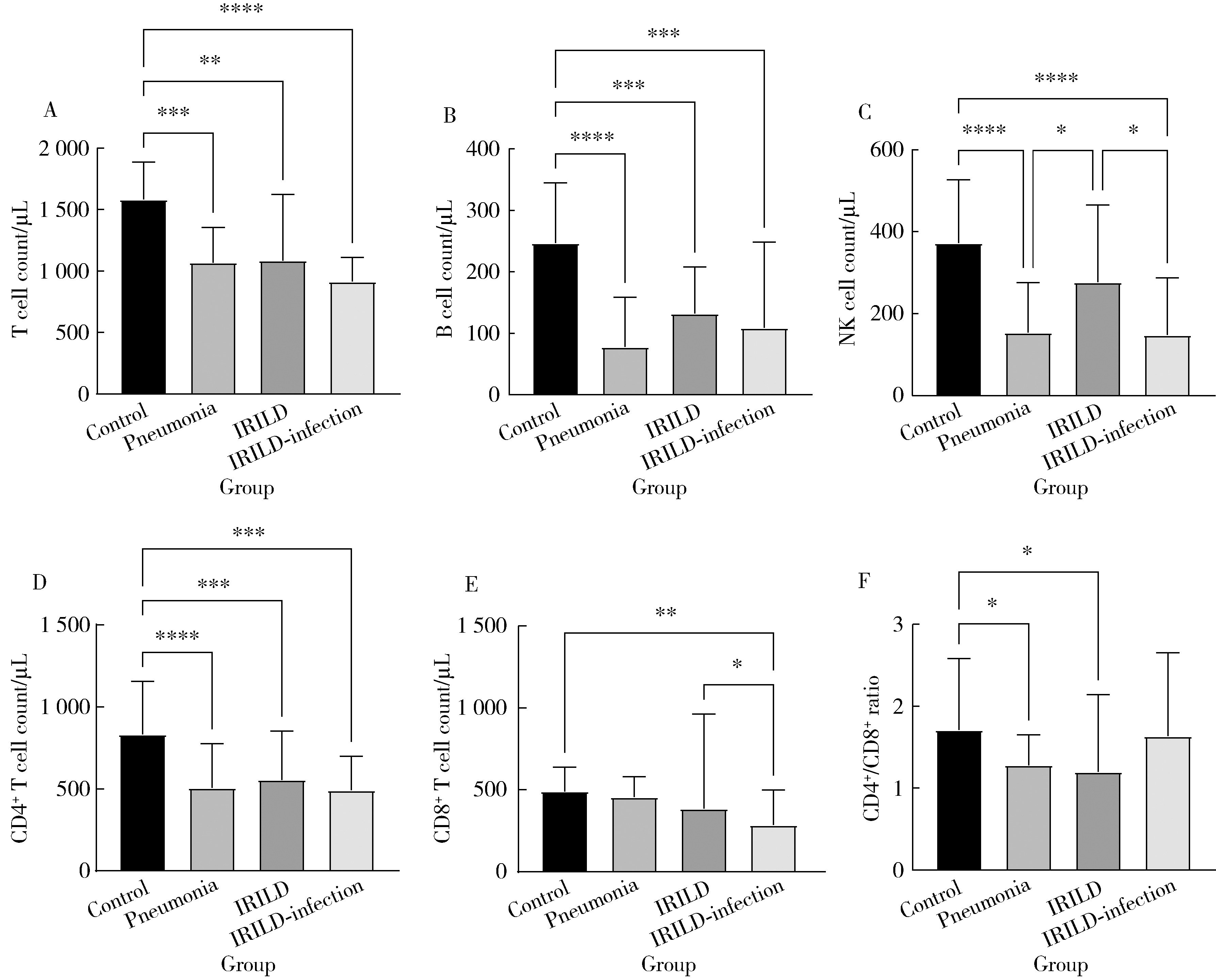
Objective: To delineate differences in lymphocyte subset expression between patients with infectious pneumonia and immune-related interstitial lung disease (IRILD), to assess the immune status across distinct pneumonia types, and to provide novel laboratory markers through immunological profiling to effectively differentiate pneumonias. Methods: A total of 78 patients sequentially enrolled from Peking University People' s Hospital between January 2023 and March 2024 were stratified into three groups: 27 with infectious pneumonia, 27 with isolated immune-related interstitial lung disease (IRILD), and 24 with IRILD complicated by infection. Fifty age-matched healthy individuals undergoing routine physical examinations during the same period served as controls. Peripheral lymphocyte subsets were quantified in all subjects by multiparametric flow cytometry. Results: There was no statistically significant difference in age between the pneumonia patients and the healthy control group in this study (P>0.05). Analysis of laboratory parameters revealed that compared with the IRILD group, the infectious pneumonia group demonstrated significantly elevated levels of neutrophils, C-reactive protein, procalcitonin (PCT), erythrocyte sedimentation rate (ESR), D-dimer, and fibrinogen (P < 0.05), while the IRILD with superimposed infection group exhibited significantly increased levels of PCT, ESR, and immunoglobulin G (P < 0.05). At the lymphocyte subset level, compared with the control group, the infectious pneumonia group exhibited significantly decreased counts of T cells, B cells, natural killer (NK) cells, CD4+T cells, and the CD4+/CD8+ ratio (P < 0.05). Similarly, compared with the control group, the IRILD group showed significantly reduced counts of T cells, B cells, CD4+T cells, and the CD4+/CD8+ ratio (P < 0.05). Furthermore, compared with the control group, the IRILD-with-infection group demonstrated significantly lower counts of T cells, B cells, NK cells, CD4+T cells, and CD8+T cells (P < 0.05). Compared with the IRILD group, the infectious pneumonia group had a significantly lower NK cell count (P < 0.05). Additionally, compared with the IRILD group, the IRILD-with-infection group displayed significantly reduced counts of NK cells and CD8+T cells (P < 0.05). Conclusion: The study revealed significant variations in lymphocyte subset profiles among the distinct pneumonia groups, providing novel insights with potential diagnostic value for differentiating between pneumonia types.

Key words: Infectious pneumonia, Immune-related interstitial lung disease, Lymphocyte subpopulations

CLC Number: 

  • R563

Table 1

Comparison of baseline data of patients"

Items Control (n=50) Infectious pneumonia (n=27) IRILD (n=27) IRILD with infection (n=24) F/χ2 P
Male 17 (34.0) 19 (70.4) 8 (29.6) 9 (37.5) χ2=11.82 P<0.05
Age/years 55.3±9.4 60.3±16.9 60.5±13.9 60.0±12.8 F=1.50 P>0.05
Infection type χ2=2.06 P>0.05
  Virus 10 (37.0) 6 (25.0)
  Bacteria 14 (51.9) 17 (70.8)
  Bacteria + virus 2 (7.4)
  Fungus 1 (3.7) 1 (4.2)
IRILD etiology χ2=5.56 P>0.05
  IIM 12 (44.4) 12 (50.0)
  RA 2 (7.4) 3 (12.5)
  SS 2 (7.4) 3 (12.5)
  SSc 2 (8.3)
  AAV 1 (4.2)
  IPAF 11 (40.8) 3 (12.5)

Table 2

Comparison of clinical characteristics among patient groups"

Characteristics Infectious pneumonia group(n=27) IRILD group(n=27) IRILD with infection group(n=24) F/x2/H P value
Common symptoms
  Fever 24 (88.9) 2 (7.4)a 13 (54.2)a,b χ2=36.09 P<0.001
  Cough 18 (66.7) 8 (29.6)a,c 19 (79.2) χ2=14.14 P<0.001
  Dyspnea 5 (18.5) 3 (11.1) 7 (29.2) χ2=2.59 0.321#
Co-existing complications
  Other 11 (40.7) 17 (63.0) 14 (58.3) χ2=2.96 0.222
  Hypertension 14 (51.9) 8 (29.6) 6 (25.0) χ2=4.69 0.101
  Diabetes 11 (40.7) 6 (22.2) 4 (16.7) χ2=4.96 0.20#
  CVD 2 (7.4) 2 (7.4) 4 (16.7) χ2=1.45 0.577#
Biochemical indexes
  WBC/(×109/L) 8.73 (5.61, 10.75) 7.80 (6.39, 8.30) 7.09 (5.15, 9.63) H=3.59 0.166
  LYM/(×109/L) 1.32±0.77 1.73±0.91 1.28±0.64 F=2.61 0.080
  NEU/(×109/L) 6.72 (4.42, 8.30)b 4.85 (3.80, 5.58) 5.17 (3.68, 7.27) H=6.57 0.038
  HB/(g/L) 110.40±21.78 129.89±16.90a 122.25±16.24a F=7.55 0.001
  PLT/(×109/L) 234.48±127.90 230.89±76.54 262.38±101.67 F=0.68 0.509
  ALT/(U/L) 22.00 (12.00, 36.00) 18.00 (13.00, 27.00) 15.00 (11.25, 49.75) H=0.38 0.828
  AST/(U/L) 21.00 (15.00, 28.00) 21.00 (16.00, 24.00) 26.00 (18.00, 37.75) H=2.13 0.346
  Scr/(μmol/L) 77.00 (60.00, 138.96) 65.00 (55.00, 79.00) 72.00 (56.25, 83.00) H=3.46 0.177
  CRP/(mg/L) 55.40 (14.20, 91.80) 1.10 (0.50, 3.90)a 5.90 (1.30, 24.70)a H=28.95 P<0.001
  PCT/(μg/L) 0.15 (0.10, 0.61)b 0.04 (0.03, 0.07) 0.20 (0.06, 0.52)b H=21.42 P<0.001
  ESR/(mm/h) 47.32 (39.00, 53.00)b 13.00 (7.00, 18.00) 33.50 (11.00, 70.00)b H=28.95 P<0.001
  D-dimer/(μg/L) 477.00 (203.00, 1 146.00)b 112.00 (75.00, 322.80) 254.00 (92.75, 496.25) H=14.67 P<0.001
  FIB/(mg/dL) 417.50±105.09 330.58±54.89a 377.33±115.00 F=5.72 0.005
  IgG/(g/L) 9.40±3.66c 11.49±3.66c 15.81±4.47 F=17.37 P<0.001
  IgA/(g/L) 2.00 (1.48, 2.26) 2.37 (1.63, 2.79) 2.65 (1.94, 3.36) H=5.79 0.055
  IgM/(g/L) 0.91 (0.43, 1.07) 1.05 (0.67, 1.52) 1.14 (0.77, 2.07) H=5.34 0.069
  C3/(g/L) 1.29±0.29c 1.34±0.18c 1.14±0.29 F=3.73 0.028
  C4/(g/L) 0.38 (0.36, 0.41)c 0.34 (0.27, 0.41) 0.26 (1.94, 3.36) H=11.18 0.004
Initial treatment
  GC therapy 0 (0) 23 (85.2)a 21 (87.5)a χ2=61.00 P<0.001#
  csDMARDs 0 (0) 23 (85.2)a 22 (91.7)a χ2=64.43 P<0.001#
  tDMARDs 0 (0) 1 (3.7) 5 (20.8)a χ2=7.02 0.012#

Figure 1

Comparative expression levels of lymphocyte subsets A, T lymphocyte count comparison; B, B lymphocyte count comparison; C, NK count comparison; D, CD4+ cell count comparison; E, CD8+ cell count comparison; F, CD4/CD8 ratio comparison. Control, health control group; Pneumonia, infectious pneumonia group; IRILD, immune-related interstitial lung disease group; IRILD-infection, immune-related interstitial lung disease with concurrent infection group.* P < 0.05, * * P < 0.01, * * * P < 0.001, * * * * P < 0.000 1."

1
Gopallawa I , Dehinwal R , Bhatia V , et al. A four-part guide to lung immunology: Invasion, inflammation, immunity, and intervention[J]. Front Immunol, 2023, 14, 1119564.

doi: 10.3389/fimmu.2023.1119564
2
Lletí MS , Cabañero Navalón MD , Pitarch MT , et al. Etiology, diagnosis, and management of pneumonia in immunosuppressed patients[J]. Rev Esp Quimioter, 2022, 35 (Suppl 1): 89- 96.
3
Sverzellati N , Lynch DA , Hansell DM , et al. American thoracic society-European respiratory society classification of the idiopathic interstitial pneumonias: Advances in knowledge since 2002[J]. Radiographics, 2015, 35 (7): 1849- 1871.

doi: 10.1148/rg.2015140334
4
Spagnolo P , Cordier JF , Cottin V . Connective tissue diseases, multimorbidity and the ageing lung[J]. Eur Respir J, 2016, 47 (5): 1535- 1558.

doi: 10.1183/13993003.00829-2015
5
葛均波, 徐永健, 王辰. 内科学[M]. 9版. 北京: 人民卫生出版社, 2018: 41- 44.
6
中华医学会健康管理学分会. TBNK淋巴细胞检测在健康管理中的应用专家共识[J]. 中华健康管理学杂志, 2023, 17 (2): 85- 95.
7
Wang J , Pei L , Zhao T , et al. CD4+ T cells related to disease severity in elderly and frailty community-acquired pneumonia patients: A retrospective cohort study[J]. Immun Inflamm Dis, 2023, 11 (9): e1009.

doi: 10.1002/iid3.1009
8
Qin L , Duan X , Dong JZ , et al. The unreversible reduced but persistent activated NK and CD8+ T cells in severe/critical COVID-19 during omicron pandemic in China[J]. Emerg Microbes Infect, 2023, 12 (1): 2208679.

doi: 10.1080/22221751.2023.2208679
9
Doughty L . Adaptive immune function in critical illness[J]. Curr Opin Pediatr, 2016, 28 (3): 274- 280.

doi: 10.1097/MOP.0000000000000357
10
Finfer S , Venkatesh B , Hotchkiss RS , et al. Lymphopenia in sepsis: An acquired immunodeficiency[J]. Immunol Cell Biol, 2023, 101 (6): 535- 544.

doi: 10.1111/imcb.12611
11
Shi L , Wang J , Guo HX , et al. Circulating Th2 cell reduction and Th1/Th2 imbalance are correlated with primary Sjögren ' s syndrome-associated interstitial lung disease[J]. Arthritis Res Ther, 2022, 24 (1): 121.

doi: 10.1186/s13075-022-02811-z
12
Cheng L , Li Y , Luo Y , et al. Decreased Th1 cells and Increased Th2 cells in peripheral blood are associated with Idiopathic Inflammatory myopathies patients with Interstitial lung disease[J]. Inflammation, 2023, 46 (1): 468- 479.

doi: 10.1007/s10753-022-01747-5
13
Feng M , Guo H , Zhang C , et al. Absolute reduction of regulatory T cells and regulatory effect of short-term and low-dose IL-2 in polymyositis or dermatomyositis[J]. Int Immunopharmacol, 2019, 77, 105912.

doi: 10.1016/j.intimp.2019.105912
14
Kotsianidis I , Nakou E , Bouchliou I , et al. Global impairment of CD4+CD25+FOXP3+ regulatory T cells in idiopathic pulmonary fibrosis[J]. Am J Respir Crit Care Med, 2009, 179 (12): 1121- 1130.

doi: 10.1164/rccm.200812-1936OC
15
Moyé S , Bormann T , Maus R , et al. Regulatory T cells limit pneumococcus-induced exacerbation of lung fibrosis in mice[J]. J Immunol, 2020, 204 (9): 2429- 2438.

doi: 10.4049/jimmunol.1900980
16
左艳华, 刘靓, 许化恒, 等. 结缔组织病相关性间质性肺炎患者涎液化糖链抗原与T细胞亚群水平变化及其临床意义[J]. 临床军医杂志, 2021, 49 (3): 336- 337.
17
张晶晶, 陈智勇, 王红, 等. 特发性炎性肌病间质性肺炎患者并发肺部感染的临床特征[J]. 中华风湿病学杂志, 2020, 24 (4): 253- 257.
18
耿陶然, 韩扬, 邱志峰, 等. 重症流行性感冒患者T淋巴细胞与预后研究[J]. 中华内科杂志, 2020, 59 (3): 200- 206.
19
Deng Y , Ou YY , Mo CJ , et al. Characteristics and clustering analysis of peripheral blood lymphocyte subsets in children with systemic lupus erythematosus complicated with clinical infection[J]. Clin Rheumatol, 2023, 42 (12): 3299- 3309.

doi: 10.1007/s10067-023-06716-3
20
Luzina IG , Todd NW , Iacono AT , et al. Roles of T lymphocytes in pulmonary fibrosis[J]. J Leukoc Biol, 2008, 83 (2): 237- 244.
21
Qin L , Wang WZ , Liu HR , et al. CD4+ and CD8+ T lymphocytes in lung tissue of NSIP: Correlation with T lymphocytes in BALF[J]. Respir Med, 2013, 107 (1): 120- 127.

doi: 10.1016/j.rmed.2012.09.021
[1] Jie ZHAO, Chun FU, Xiujuan ZHAO, Haiyan XUE, Shu LI, Zhenzhou WANG, Fengxue ZHU. Risk factors for ventilator-associated pneumonia in patients with chest trauma in intensive care unit [J]. Journal of Peking University (Health Sciences), 2026, 58(2): 351-358.
[2] Yunling GENG, Chao LIU, Ping YANG, Jiajia ZHENG, Ning SHEN, Yipeng DU. Clinical features and virulence gene distribution of Klebsiella pneumoniae multi-site infection in patients with hospital-acquired pneumonia [J]. Journal of Peking University (Health Sciences), 2026, 58(1): 201-207.
[3] Yujing ZHU, Lei WANG, Chengyin LYU, Wenfeng TAN, Miaojia ZHANG. Analysis of clinical features of ruccrent interstitial lung disease in patients with anti-EJ positive antisynthetase syndrome [J]. Journal of Peking University (Health Sciences), 2024, 56(6): 980-986.
[4] Bingle LI, Lingyan ZHU, Yongfu WANG, Li BAI. Mechanism of melatonin regulating the expression level of rhythm genes to alleviate interstitial pulmonary fibrosis [J]. Journal of Peking University (Health Sciences), 2024, 56(6): 963-971.
[5] Rui YAN, Dan KE, Yan ZHANG, Li LI, Huanran SU, Wei CHEN, Mingxia SUN, Xiaomin LIU, Liang LUO. Diagnostic significance of serum chemokine CXCL-10 and Krebs von den lungen-6 level in patients with rheumatoid arthritis associated interstitial lung disease [J]. Journal of Peking University (Health Sciences), 2024, 56(6): 956-962.
[6] Jiajun LIU, Guokang LIU, Yuhu ZHU. Immune-related severe pneumonia: A case report [J]. Journal of Peking University (Health Sciences), 2024, 56(5): 932-937.
[7] Shan HE,Xin CHEN,Qi CHENG,Lingjiang ZHU,Peiyu ZHANG,Shuting TONG,Jing XUE,Yan DU. Tofacitinib inhibits the transformation of lung fibroblasts into myofibroblasts through JAK/STAT3 pathway [J]. Journal of Peking University (Health Sciences), 2024, 56(3): 505-511.
[8] Xiaoqian SI,Xiujuan ZHAO,Fengxue ZHU,Tianbing WANG. Risk factors for acute respiratory distress syndrome in patients with traumatic hemorrhagic shock [J]. Journal of Peking University (Health Sciences), 2024, 56(2): 307-312.
[9] Zi-kai WANG,Jia-li MO,Meng ZHANG,Ji-ping LIAO. Epidemiology and hospitalization costs analysis of female inpatients with acute exacerbation of chronic obstructive pulmonary disease in Beijing from 2013 to 2020 [J]. Journal of Peking University (Health Sciences), 2023, 55(6): 1074-1081.
[10] LI Jia,XU Yu,WANG You-ya,GAO Zhan-cheng. Clinical characteristics of influenza pneumonia in the elderly and relationship between D-dimer and disease severity [J]. Journal of Peking University (Health Sciences), 2022, 54(1): 153-160.
[11] Fang BAO,Wei-li SHI,Jing HU,Di ZHANG,Dong-han GAO,Yun-xia XIA,Hong-mei JING,Xiao-yan KE,Qing-gang GE,Ning SHEN. Analysis of the correlation between lymphocyte subsets and severity of corona virus disease 19 [J]. Journal of Peking University (Health Sciences), 2020, 52(6): 1075-1081.
[12] Xiao-ning YUAN,Qing-yang MENG,Ning SHEN,Yu-xuan LI,Chao LIANG,Man CUI,Qing-gang GE,Xiao-guang LI,Kun TAN,Qian CHEN,Jing WANG,Xiao-yong ZENG. Detection and evaluation of SARS-CoV-2 nucleic acid contamination in corona virus disease 19 ward surroundings and the surface of medical staff’s protective equipment [J]. Journal of Peking University (Health Sciences), 2020, 52(5): 803-808.
[13] Qiu WANG,Jin-yu GUO,Hong SUN,Ling WANG,Ju-su YING,Hui-xin LIU. Investigation of protective exposure risk events in nurses against corona virus disease 2019 in Wuhan [J]. Journal of Peking University (Health Sciences), 2020, 52(4): 711-714.
[14] Qiu-yu LI,Qin CHENG,Zhi-ling ZHAO,Ni-ni DAI,Lin ZENG,Lan ZHU,Wei GUO,Chao LI,Jun-hong WANG,Shu LI,Qing-gang GE,Ning SHEN. Severe acute respiratory syndrome coronavirus 2 infection in renal transplant recipients: A case report [J]. Journal of Peking University (Health Sciences), 2020, 52(4): 780-784.
[15] Hang YANG,Lin-cheng YANG,Rui-tao ZHANG,Yun-peng LING,Qing-gang GE. Risks factors for death among COVID-19 patients combined with hypertension, coronary heart disease or diabetes [J]. Journal of Peking University (Health Sciences), 2020, 52(3): 420-424.
Viewed
Full text


Abstract

Cited

  Shared   
  Discussed   
No Suggested Reading articles found!