北京大学学报(医学版) ›› 2025, Vol. 57 ›› Issue (2): 277-283. doi: 10.19723/j.issn.1671-167X.2025.02.009
孤独症儿童血浆中缬氨酸水平变化及其与发育商的关系
徐新杰1, 蔡小娥2, 孟凡超3, 龙波1, 尤欣4, 张嵘5,*( )
)
- 1. 中国医学科学院/北京协和医学院/北京协和医院医学科学研究中心,北京 100730
2. 北京市海淀医院康复医学科,北京 100080
3. 首都医科大学附属北京安定医院,国家精神心理疾病临床医学研究中心,精神疾病诊断与治疗北京市重点实验室,北京 100088
4. 中国医学科学院北京协和医学院北京协和医院免疫内科,北京 100730
5. 北京大学神经科学研究所,北京大学基础医学院神经生物学系,神经科学教育部重点实验室,卫生部神经科学重点实验室,北京大学医学部孤独症研究中心,北京 100191
Change of plasma level of valine and its relationship with developmental quotient in children with autism
Xinjie XU1, Xiaoe CAI2, Fanchao MENG3, Bo LONG1, Xin YOU4, Rong ZHANG5,*()
- 1. Medical Science Research Center, Peking Union Medical College Hospital, Chinese Academy of Medical Sciences & Peking Union Medical College, Beijing 100730, China
2. Department of Rehabilitation Medicine, Beijing Haidian Hospital, Beijing 100080, China
3. The National Clinical Research Center for Mental Disorders & Beijing Key Laboratory of Mental Disorders, Beijing Anding Hospital, Capital Medical University, Beijing 100088, China
4. Department of Rheumatology and Clinical Immunology, Peking Union Medical College Hospital, Chinese Academy of Medical Sciences & Peking Union Medical College, Beijing 100730, China
5. Neuroscience Research Institute, Peking University; Department of Neurobiology, Peking University School of Basic Medical Sciences; Key Laboratory for Neuroscience, Ministry of Education/National Health and Family Planning Commission; Autism Research Center of Peking University Health Science Center, Beijing 100191, China
摘要:
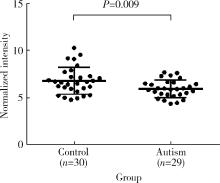
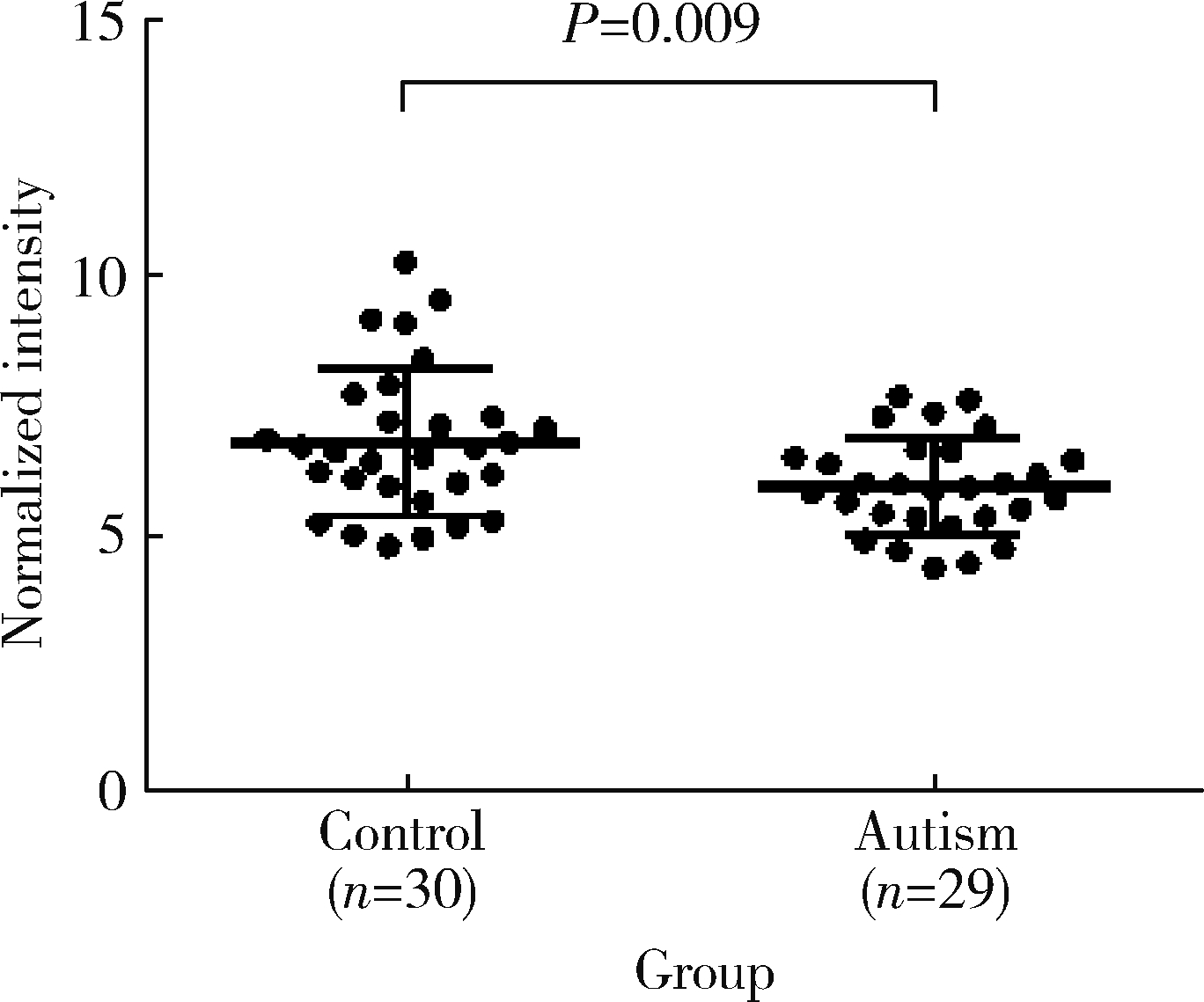
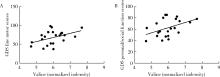
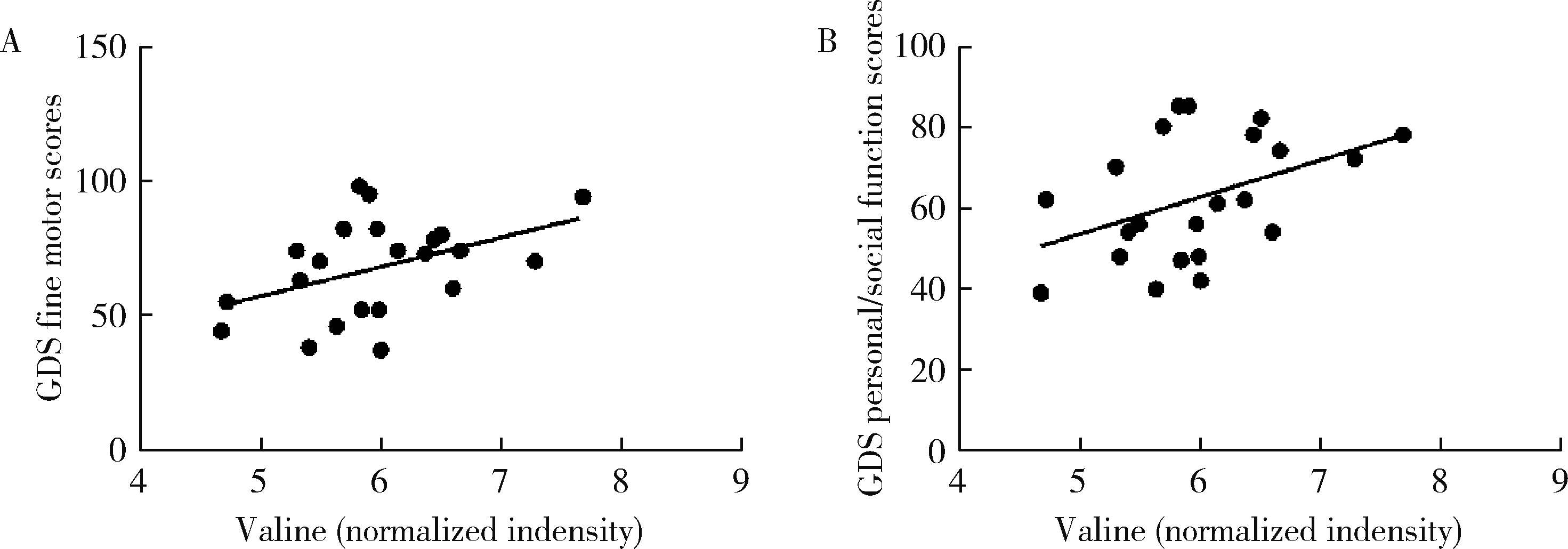
目的: 比较孤独症儿童与健康儿童血浆中缬氨酸水平的差异, 并探究孤独症儿童血浆缬氨酸水平与其发育商评分的相关性。方法: 共招募29例孤独症儿童作为病例组, 同期招募30例同年龄段的正常儿童作为对照组。采用儿童孤独症评定量表(childhood autism rating scale, CARS)对孤独症儿童的核心症状及其严重程度进行评估, 采用Gesell发育量表(Gesell developmental schedules, GDS)评估儿童发育商, 采用高效液相色谱-串联质谱法测定血浆缬氨酸水平, 并比较两组间差异, 分析病例组儿童血浆缬氨酸水平与其发育商评分间的相关性。结果: 与对照组相比, 孤独症组血浆缬氨酸水平显著偏低, 差异有统计学意义(P<0.05)。在GDS量表因子得分方面, 孤独症组儿童在适应性、大运动、精细运动、语言、个人-社交等方面的得分均显著低于对照组儿童, 差异均有统计学意义(P<0.000 1)。孤独症组儿童血浆缬氨酸水平与GDS量表中的精细运动评分(r=0.441, P<0.05)和个人-社交评分(r=0.437, P<0.05)均呈显著正相关, 但与适应性、大运动和语言方面的评分无显著相关(P>0.05)。根据CARS量表评分标准, 将孤独症组儿童根据病情严重程度分为轻中度和重度两个亚组, 在亚组之间进行比较发现, 重度孤独症儿童在GDS量表适应性、精细运动、语言以及个人-社交方面的评分均显著低于轻中度孤独症儿童(P<0.05), 而两个亚组之间在GDS量表大运动评分及血浆缬氨酸水平方面差异均无统计学意义(P>0.05)。结论: 孤独症儿童血浆中缬氨酸水平偏低, 且与其精细运动和个人-社交功能之间存在一定关联。
中图分类号:
- R749.94
| 1 | González MC , Vásquez M , Hernández-Chávez M . Autism spectrum disorder: Clinical diagnosis and ADOS test[J]. Rev Chil Pediatr, 2019, 90 (5): 485- 491. |
| 2 |
Maenner MJ , Shaw KA , Baio J , et al. Prevalence of autism spectrum disorder among children aged 8 years: Autism and Developmental Disabilities Monitoring Network, 11 Sites, United States, 2016[J]. MMWR Surveill Summ, 2020, 69 (4): 1- 12.
doi: 10.15585/mmwr.ss6904a1 |
| 3 |
Zhou H , Xu X , Yan W , et al. Prevalence of autism spectrum disorder in China: A nationwide multi-center population-based study among children aged 6 to 12 years[J]. Neurosci Bull, 2020, 36 (9): 961- 971.
doi: 10.1007/s12264-020-00530-6 |
| 4 |
樊越波, 揭晓锋, 邹小兵. 孤独症患病率回顾[J]. 中国儿童保健杂志, 2008, 16 (4): 439- 440.
doi: 10.3969/j.issn.1008-6579.2008.04.029 |
| 5 |
Croen LA , Zerbo O , Qian Y , et al. The health status of adults on the autism spectrum[J]. Autism, 2015, 19 (7): 814- 823.
doi: 10.1177/1362361315577517 |
| 6 | 赵刚, 韦明, 鄂颖梅, 等. 孤独症谱系障碍儿童饮食行为与家长喂养行为的相关研究[J]. 沈阳医学院学报, 2020, 22 (5): 428- 432. |
| 7 | Ghanizadeh A . Increased glutamate and homocysteine and decreased glutamine levels in autism: A review and strategies for future studies of amino acids in autism[J]. Dis Markers, 2013, 35 (5): 281- 286. |
| 8 | National Center for Biotechnology Information (2024). PubChem compound summary for CID 6287, valine[EB/OL]. [2021-03-08] https://pubchem.ncbi.nlm.nih.gov/compound/Valine. |
| 9 |
Maynard TM , Manzini MC . Balancing act: Maintaining amino acid levels in the autistic brain[J]. Neuron, 2017, 93 (3): 476- 479.
doi: 10.1016/j.neuron.2017.01.015 |
| 10 |
Tǎrlungeanu DC , Deliu E , Dotter CP , et al. Impaired amino acid transport at the blood brain barrier is a cause of autism spectrum disorder[J]. Cell, 2016, 167 (6): 1481- 1494.e18.
doi: 10.1016/j.cell.2016.11.013 |
| 11 |
Smith AM , King JJ , West PR , et al. Amino acid dysregulation metabotypes: Potential biomarkers for diagnosis and individualized treatment for subtypes of autism spectrum disorder[J]. Biol Psychiatry, 2019, 85 (4): 345- 354.
doi: 10.1016/j.biopsych.2018.08.016 |
| 12 |
Sperringer JE , Addington A , Hutson SM . Branched-chain amino acids and brain metabolism[J]. Neurochem Res, 2017, 42 (6): 1697- 1709.
doi: 10.1007/s11064-017-2261-5 |
| 13 | 王强. Gesell发育量表对2岁以内孤独症谱系障碍(ASD)患儿的应用效果观察[J]. 世界最新医学信息文摘(连续型电子期刊), 2020, 20 (33): 61- 62. |
| 14 |
Larsson SC , Markus HS . Branched-chain amino acids and Alzheimer's disease: A Mendelian randomization analysis[J]. Sci Rep, 2017, 7 (1): 13604.
doi: 10.1038/s41598-017-12931-1 |
| 15 |
Bjerkenstedt L , Edman G , Hagenfeldt L , et al. Plasma amino acids in relation to cerebrospinal fluid monoamine metabolites in schizophrenic patients and healthy controls[J]. Br J Psychiatry, 1985, 147, 276- 282.
doi: 10.1192/bjp.147.3.276 |
| 16 | Tu WJ , Chen H , He J . Application of LC-MS/MS analysis of plasma amino acids profiles in children with autism[J]. J Clin Biochem Nutr, 2012, 51 (3): 248- 249. |
| 17 |
Arnold GL , Hyman SL , Mooney RA , et al. Plasma amino acids profiles in children with autism: Potential risk of nutritional deficiencies[J]. J Autism Dev Disord, 2003, 33 (4): 449- 454.
doi: 10.1023/A:1025071014191 |
| 18 |
Witters P , Debbold E , Crivelly K , et al. Autism in patients with propionic academia[J]. Mol Genet Metab, 2016, 119 (4): 317- 321.
doi: 10.1016/j.ymgme.2016.10.009 |
| 19 | Bala KA , Dǒgan M , Mutluer T , et al. Plasma amino acid profile in autism spectrum disorder (ASD)[J]. Eur Rev Med Pharmacol Sci, 2016, 20 (5): 923- 929. |
| 20 |
Zou M , Li D , Wang L , et al. Identification of amino acid dys-regulation as a potential biomarker for autism spectrum disorder in China[J]. Neurotox Res, 2020, 38 (4): 992- 1000.
doi: 10.1007/s12640-020-00242-9 |
| 21 |
May T , Adesina I , McGillivray J , et al. Sex differences in neurodevelopmental disorders[J]. Curr Opin Neurol, 2019, 32 (4): 622- 626.
doi: 10.1097/WCO.0000000000000714 |
| 22 |
Lavelle A , Sokol H . Gut microbiota-derived metabolites as key actors in inflammatory bowel disease[J]. Nat Rev Gastroenterol Hepatol, 2020, 17 (4): 223- 237.
doi: 10.1038/s41575-019-0258-z |
| 23 |
Lussu M , Noto A , Masili A , et al. The urinary (1) H-NMR metabolomics profile of an Italian autistic children population and their unaffected siblings[J]. Autism Res, 2017, 10 (6): 1058- 1066.
doi: 10.1002/aur.1748 |
| 24 |
Li C , Shen K , Chu L , et al. Decreased levels of urinary free amino acids in children with autism spectrum disorder[J]. J Clin Neurosci, 2018, 54, 45- 49.
doi: 10.1016/j.jocn.2018.05.001 |
| 25 |
Evans C , Dunstan RH , Rothkirch T , et al. Altered amino acid excretion in children with autism[J]. Nutr Neurosci, 2008, 11 (1): 9- 17.
doi: 10.1179/147683008X301360 |
| 26 |
De Angelis M , Piccolo M , Vannini L , et al. Fecal microbiota and metabolome of children with autism and pervasive developmental disorder not otherwise specified[J]. PLoS One, 2013, 8 (10): e76993.
doi: 10.1371/journal.pone.0076993 |
| 27 |
Carunchio I , Curcio L , Pieri M , et al. Increased levels of p70S6 phosphorylation in the G93A mouse model of amyotrophic lateral sclerosis and in valine-exposed cortical neurons in culture[J]. Exp Neurol, 2010, 226 (1): 218- 230.
doi: 10.1016/j.expneurol.2010.08.033 |
| 28 |
Nave KA , Werner HB . Myelination of the nervous system: Mechanisms and functions[J]. Annu Rev Cell Dev Biol, 2014, 30, 503- 533.
doi: 10.1146/annurev-cellbio-100913-013101 |
| 29 |
Kakazu E , Kanno N , Ueno Y , et al. Extracellular branched-chain amino acids, especially valine, regulate maturation and function of monocyte-derived dendritic cells[J]. J Immunol, 2007, 179 (10): 7137- 7146.
doi: 10.4049/jimmunol.179.10.7137 |
| 30 | Shen L , Feng C , Zhang K , et al. Proteomics study of peripheral blood mononuclear cells (PBMCs) in autistic children[J]. Front Cell Neurosci, 2019, 13, 105. |
| 31 | Lungba RM , Khan S , Ajibawo-Aganbi U , et al. The role of the gut microbiota and the immune system in the development of autism[J]. Cureus, 2020, 12 (10): e11226. |
| 32 |
Meltzer A , Van de Water J . The role of the immune system in autism spectrum disorder[J]. Neuropsychopharmacology, 2017, 42 (1): 284- 298.
doi: 10.1038/npp.2016.158 |
| [1] | 赵亚楠,范慧芸,王翔宇,罗雅楠,张嵘,郑晓瑛. 孤独症患者过早死亡风险及死亡原因[J]. 北京大学学报(医学版), 2023, 55(2): 375-383. |
| [2] | 陆林,刘晓星,袁凯. 中国脑科学计划进展[J]. 北京大学学报(医学版), 2022, 54(5): 791-795. |
| [3] | 焦翠,王俭妹,况海霞,武志红,柳涛. CACNA1H基因敲除对小鼠孤独症样行为及海马神经元形态学的影响[J]. 北京大学学报(医学版), 2022, 54(2): 209-216. |
| [4] | 石慧峰, 张敬旭, 张嵘, 王晓莉. 中国0~6岁儿童孤独症谱系障碍患病率的meta分析[J]. 北京大学学报(医学版), 2017, 49(5): 798-806. |
| [5] | 秦炯, 韩颖. 儿童神经科临床应关注精神行为问题[J]. 北京大学学报(医学版), 2013, 45(2): 174-. |
|
||
