北京大学学报(医学版) ›› 2026, Vol. 58 ›› Issue (1): 169-174. doi: 10.19723/j.issn.1671-167X.2026.01.022

• 论著 • 上一篇    下一篇

脂肪肌肉比率与卵巢良性肿瘤风险的关联性

李宏杨1,2, 黄涛1, 王琳琳1,2,*()   

  1. 1. 北京大学公共卫生学院流行病与卫生统计学系, 北京 100191
    2. 北京大学生育健康研究所, 国家卫生健康委员会生育健康重点实验室, 北京 100191
  • 收稿日期:2023-05-23 出版日期:2026-02-18 发布日期:2024-02-06
  • 通讯作者: 王琳琳

Total and regional fat-to-muscle mass ratio and risk of incident benign ovarian neoplasm

Hongyang LI1,2, Tao HUANG1, Linlin WANG1,2,*()   

  1. 1. Department of Epidemiology and Biostatistics, Peking University School of Public Health, Beijing 100191, China
    2. Institute of Reproductive and Child Health, Peking University; National Health Commission Key Laboratory of Reproductive Health, Beijing 100191, China
  • Received:2023-05-23 Online:2026-02-18 Published:2024-02-06
  • Contact: Linlin WANG

RICH HTML


摘要:

目的: 探讨全身、手臂、腿部及躯干脂肪肌肉比率(fat-to-muscle mass ratio,FMR)与卵巢良性肿瘤风险的关联性。方法: 使用英国生物样本库(United Kingdom biobank,UKB)前瞻性队列研究的数据,在卵巢良性肿瘤风险关联性研究中纳入255 412例研究对象。采用Cox比例风险模型分别评估全身、手臂、腿部及躯干FMR与卵巢良性肿瘤风险的关联性。根据体重指数(body mass index,BMI)进行先验分层分析,评估全身、手臂、腿部及躯干FMR分别在BMI<25 kg/m2和BMI≥25 kg/m2人群中与卵巢良性肿瘤风险的关联性。采用限制性立方图进一步探讨FMR与卵巢良性肿瘤风险关联的变化趋势,最后根据研究对象的年龄(<50岁、50~59岁、≥60岁)进行亚组分析,探究在不同年龄组FMR与卵巢良性肿瘤风险关联。结果: 中位随访时间为8.77年,共追踪到卵巢良性肿瘤1 643例。在调整人口学因素、生殖因素、遗传因素、生活方式和激素相关因素后,全身、手臂、腿部和躯干FMR与卵巢良性肿瘤的发病风险均呈显著正相关,且高于BMI与卵巢良性肿瘤的发病风险,其中全身FMR与卵巢良性肿瘤风险关联性最强(HR:2.16; 95%CI:1.67~2.79)。根据BMI分层分析FMR与卵巢良性肿瘤风险显示,相比BM I≥25 kg/m2人群,BMI<25 kg/m2人群的全身、手臂、腿部和躯干FMR与卵巢良性肿瘤风险的关联更强(Pinteraction<0.05)。限制性立方图显示全身、手臂、躯干FMR与卵巢良性肿瘤风险关联在BMI<25 kg/m2和BMI≥25 kg/m2人群间整体呈相反趋势。亚组分析可见全身、腿部FMR与卵巢良性肿瘤风险关联随着年龄组增长而降低(P<0.05),其中<50岁年龄组人群的腿部FMR与卵巢良性肿瘤关联性最强(HR:2.38; 95%CI:1.39~4.08)。结论: FMR升高会增加卵巢良性肿瘤发病风险,其关联性在BMI<25 kg/m2人群和40~50岁女性中更强。

关键词: 脂肪肌肉比率, 卵巢良性肿瘤, 体重指数

Abstract:

Objective: To investigate the association between fat-to-muscle mass ratio (FMR) of whole body, arm, leg and trunk and the risk of benign ovarian neoplasm. Methods: A total of 255 412 participants from the prospective cohort study United Kingdom biobank (UKB) were enrolled in the risk-related study of benign ovarian neoplasm. Cox proportional hazard model was used to evaluate the correlation between total and regional FMR and the risk of benign ovarian neoplasm. A priori stratified analysis was performed according to the body mass index (BMI) category to evaluate the correlation between FMR of whole body, arm, leg and trunk and the risk of benign ovarian neoplasm in people with BMI < 25 kg/m2and BMI≥25 kg/m2, respectively. The restricted cubic plot was used to further explore the curve of FMR associated with the risk of benign ovarian neoplasm. Finally, subgroup analysis was performed on the age of the subjects (< 50 years, 50-59 years, ≥60 years) to explore the association between FMR and the risk of benign ovarian neoplasm at different ages. Results: During a median 8.77 years of follow-up, we recruited 1 643 cases of benign ovarian neoplasms. After adjusting for demographic, reproductive, genetic, lifestyle, and hormone-related factors, total, arm, leg and trunk FMR were significantly positively correlated with the risk of benign ovarian neoplasm and higher than BMI with the risk of benign ovarian neoplasm, among which the whole body FMR had the strongest correlation with the risk of benign ovarian neoplasm (HR: 2.16; 95%CI: 1.67-2.79). Stratified analysis of FMR and the risk of benign ovarian neoplasm based on BMI showed that compared with people with BMI≥25 kg/m2, people with BMI < 25 kg/m2 had a stronger association between whole body, arm, leg and trunk FMR and the risk of benign ovarian neoplasm (Pinteraction < 0.05). The restricted cubic plot showed that the association between FMR of the whole body, arm and trunk and the risk of benign ovarian neoplasm had an opposite trend between normal weight and overweight/obese people. Subgroup analysis showed that the association between the whole body and leg FMR and the risk of benign ovarian neoplasm decreased with age (P < 0.05). Among them, leg FMR was associated with benign ovarian neoplasm in people younger than 50 years (HR: 2.38; 95%CI: 1.39-4.08). Conclusion: There is a positive correlation between the total, arm, trunk FMR and the risk of benign ovarian neoplasm, and the correlation is stronger in people with BMI < 25 kg/m2 and women aged 40-50 years.

Key words: Fat-to-muscle mass ratio, Benign ovarian neoplasm, Body mass index

中图分类号: 

  • R181.3

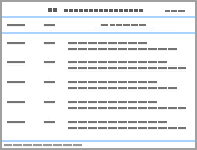
表1

研究对象的基线特征"

Characteristics Total (n=255 412) Diagnosed as benign ovarianneoplasm (n=1 643) Undiagnosed as benign ovarian neoplasm (n=253 769) P value
Age/years,$\bar x \pm s$ 56.34±7.98 55.81±7.98 56.35±7.98 0.006
Caucasian,n (%) 210 139 (82.27) 1 338 (81.44) 208 801 (82.28) 0.373
University or college degree,n (%) 80 797 (31.63) 479 (29.15) 80 318 (31.65) 0.030
Townsend deprivation index,$\bar x \pm s$ -1.37±3.01 -1.09±3.15 -1.38±3.01 <0.001
Menopause,n (%) 155 348 (60.82) 930 (56.60) 154 418 (60.85) <0.001
Age of menarche/years,$\bar x \pm s$ 12.96±1.59 12.92±1.63 12.97±1.59 0.203
Gave birth,n (%) 207 660 (81.30) 1 320 (80.34) 206 340 (81.31) 0.313
Ever had stillbirth, spontaneous miscarriage or termination,n (%) 83 148 (32.55) 546 (33.23) 82 602 (32.55) 0.554
Family history,n (%) 28 259 (11.06) 217 (13.21) 28 041 (11.05) 0.005
Smoking status,n (%)
  Never 152 127 (59.56) 931 (56.67) 151 196 (59.58) 0.004
  Previous 80 678 (31.59) 538 (32.74) 80 140 (31.58)
  Current 22 582 (8.85) 174 (10.59) 22 408 (8.83)
Drinking status,n (%)
  Never 14 201 (5.57) 91 (5.54) 14 110 (5.56) 0.355
  Previous 9 163 (3.59) 78 (4.75) 9 085 (3.58)
  Current 232 023 (90.84) 1 474 (89.71) 230 549 (90.85)
Physical activity at goal,n (%) 65 503 (25.65) 386 (23.49) 65 117 (25.66) 0.045
Healthy diet,n (%) 76 905 (30.11) 470 (28.61) 76 435 (30.12) 0.182
Used HRT,n (%) 97 369 (38.12) 734 (44.67) 96 635 (38.08) <0.001
Ever taken oral contraceptive pill,n (%) 207 842 (81.38) 1 376 (83.75) 206 466 (81.36) 0.013
BMI/(kg/m2),$\bar x \pm s$ 27.07±5.17 27.90±5.40 27.05±5.16 <0.001
FMR of total,$\bar x \pm s$ 0.63±0.19 0.66±0.19 0.63±0.19 <0.001
FMR of arm,$\bar x \pm s$ 0.65±0.26 0.69±0.27 0.65±0.26 <0.001
FMR of leg,$\bar x \pm s$ 0.73±0.17 0.76±0.17 0.73±0.17 <0.001
FMR of trunk,$\bar x \pm s$ 0.56±0.20 0.59±0.19 0.56±0.20 <0.001

表2

全身、手臂、腿部和躯干的FMR和BMI与卵巢良性肿瘤的多变量调整"

Characteristics Model 1 HR (95%CI) Model 2 HR (95%CI) Model 3 HR (95%CI)
FMR of total 2.16 (1.67-2.79) 2.10 (1.62-2.72) 1.46 (0.85-2.51)
FMR of arm 1.68 (1.41-2.00) 1.67 (1.40-1.99) 1.27 (0.65-2.47)
FMR of leg 2.17 (1.64-2.88) 2.09 (1.57-2.79) 0.89 (0.42-1.84)
FMR of trunk 1.53 (1.34-1.73) 1.53 (1.34-1.75) 1.25 (0.95-1.66)
BMI 1.03 (1.02-1.04) 1.03 (1.02-1.04)

表3

正常体质量和超重/肥胖人群FMR与卵巢良性肿瘤的多变量调整"

Characteristics Normal weight HR (95%CI) Overweight/obese HR (95%CI) Pinteraction
FMR of total 2.47 (1.08-5.65) 1.66 (1.14-2.42) 0.007
FMR of arm 2.52 (1.16-5.48) 1.43 (1.12-1.82) 0.023
FMR of leg 2.17 (0.84-5.60) 1.57 (1.02-2.39) 0.016
FMR of trunk 1.69 (1.07-2.69) 1.34 (1.06-1.70) 0.003

表4

不同年龄组人群FMR与卵巢良性肿瘤风险的Cox分析"

Characteristics HR (95%CI) Pinteraction
FMR of total
  <50 years old 2.30 (1.42-3.73) 0.043
  50-59 years old 2.14 (1.39-3.30)
  ≥60 years old 1.71 (1.11-2.64)
FMR of arm
  <50 years old 1.67 (1.21-2.30) 0.154
  50-59 years old 1.68 (1.25-2.25)
  ≥60 years old 1.54 (1.14-2.09)
FMR of leg
  <50 years old 2.38 (1.39-4.08) 0.028
  50-59 years old 2.24 (1.39-3.61)
  ≥60 years old 1.56 (0.97-2.52)
FMR of trunk
  <50 years old 1.80 (1.32-2.45) 0.125
  50-59 years old 1.45 (1.18-1.77)
  ≥60 years old 1.48 (1.08-2.03)
1
Yoneda A , Lendorf ME , Couchman JR , et al. Breast and ovarian cancers: A survey and possible roles for the cell surface heparan sulfate proteoglycans[J]. J Histochem Cytochem, 2012, 60 (1): 9- 21.

doi: 10.1369/0022155411428469
2
张楠, 狄文. 卵巢良性肿瘤手术中的无瘤防御[J]. 中国实用妇科与产科杂志, 2023, 39 (1): 25- 27.
3
刘宗超, 李哲轩, 张阳, 等. 2020全球癌症统计报告解读[J]. 肿瘤综合治疗电子杂志, 2021, 7 (2): 1- 13.
4
Renehan AG , Zwahlen M , Egger M . Adiposity and cancer risk: New mechanistic insights from epidemiology[J]. Nat Rev Cancer, 2015, 15 (8): 484- 498.

doi: 10.1038/nrc3967
5
Kyrgiou M , Kalliala I , Markozannes G , et al. Adiposity and can-cer at major anatomical sites: Umbrella review of the literature[J]. BMJ, 2017, 356, j477.
6
Stefan N , Schick F , Häring HU . Causes, characteristics, and consequences of metabolically unhealthy normal weight in humans[J]. Cell Metab, 2017, 26 (2): 292- 300.

doi: 10.1016/j.cmet.2017.07.008
7
Rubin R . Postmenopausal women with a "normal" BMI might be overweight or even obese[J]. JAMA, 2018, 319 (12): 1185- 1187.

doi: 10.1001/jama.2018.0423
8
Seo YG , Song HJ , Song YR . Fat-to-muscle ratio as a predictor of insulin resistance and metabolic syndrome in Korean adults[J]. J Cachexia Sarcopenia Muscle, 2020, 11 (3): 710- 725.

doi: 10.1002/jcsm.12548
9
Cho AR , Lee JH , Kwon YJ . Fat-to-muscle ratios and the non-achievement of LDL cholesterol targets: analysis of the Korean genome and epidemiology study[J]. Cardiovasc Dev Dis, 2021, 8 (8): 96.
10
Sudlow C , Gallacher J , Allen N , et al. UK biobank: An open access resource for identifying the causes of a wide range of complex diseases of middle and old age[J]. PLoS Med, 2015, 12 (3): e1001779.

doi: 10.1371/journal.pmed.1001779
11
Wang N , Sun Y , Zhang H , et al. Total and regional fat-to-muscle mass ratio measured by bioelectrical impedance and risk of incident type 2 diabetes[J]. J Cachexia Sarcopenia Muscle, 2021, 12 (6): 2154- 2162.

doi: 10.1002/jcsm.12822
12
张彭燕, 刘振球, 樊虹, 等. 限制性立方样条Cox比例风险模型在肿瘤预后分析中的应用[J]. 复旦学报(医学版), 2023, 50 (2): 280- 285.
13
Bacon JL . The menopausal transition[J]. Obstet Gynecol Clin N Am, 2017, 44 (2): 285- 296.

doi: 10.1016/j.ogc.2017.02.008
14
Gava G , Orsili I , Alvisi S , et al. Cognition, mood and sleep in menopausal transition: The role of menopause hormone therapy[J]. Medicina (Kaunas), 2019, 55 (10): 668.
15
Booth A , Magnuson A , Fouts J , et al. Adipose tissue, obesity and adipokines: Role in cancer promotion[J]. Horm Mol Biol Clin Investig, 2015, 21 (1): 57- 74.

doi: 10.1515/hmbci-2014-0037
16
Díaz BB , González DA , Gannar F , et al. Myokines, physical activity, insulin resistance and autoimmune diseases[J]. Immunol Lett, 2018, 203, 1- 5.
17
Li F , Li Y , Duan Y , et al. Myokines and adipokines: Involvement in the crosstalk between skeletal muscle and adipose tissue[J]. Cytokine Growth Factor Rev, 2017, 33, 73- 82.
18
Zhang Y , Huang X , Yu X , et al. Hematological and biochemical markers influencing breast cancer risk and mortality: Prospective cohort study in the UK biobank by multi-state models[J]. Breast (Edinburgh, Scotland), 2024, 73, 103603.

doi: 10.1016/j.breast.2023.103603
19
Ramírez-Vélez R , Carrillo HA , Correa-Bautista JE , et al. Fat-to-muscle ratio: A new anthropometric indicator as a screening tool for metabolic syndrome in young Colombian people[J]. Nutrients, 2018, 10 (8): 1027.

doi: 10.3390/nu10081027
20
Osaka T , Hashimoto Y , Okamura T , et al. Reduction of fat to muscle mass ratio is associated with improvement of liver stiffness in diabetic patients with non-alcoholic fatty liver disease[J]. J Clin Med, 2019, 8 (12): 2175.

doi: 10.3390/jcm8122175
21
Eun Y , Lee SN , Song SW , et al. Fat-to-muscle ratio: A new indicator for coronary artery disease in healthy adults[J]. Int J Med Sci, 2021, 18 (16): 3738- 3743.

doi: 10.7150/ijms.62871
22
Ham S , Choi JH , Shin SG , et al. High visceral fat-to-muscle ratio is an independent factor that predicts worse overall survival in patients with primary epithelial ovarian, fallopian tube, and peritoneal cancer[J]. Ovarian Res, 2023, 16 (1): 19.

doi: 10.1186/s13048-023-01098-1
23
Kim SI , Kim TM , Lee M , et al. Impact of CT-determined sarcopenia and body composition on survival outcome in patients with advanced-stage high-grade serous ovarian carcinoma[J]. Cancers (Basel), 2020, 12 (3): 559.

doi: 10.3390/cancers12030559
24
Ronco AL , Boeing H , de Stefani E , et al. A case-control study on fat-to-muscle ratio and risk of breast cancer[J]. Nutr Cancer, 2009, 61 (4): 466- 474.

doi: 10.1080/01635580902725995
[1] 王坤, 王淮蓉, 于欢, 杨若彤, 郑柳燕, 吴婧娴, 秦雪英, 吴涛, 陈大方, 武轶群, 胡永华. 基于肥胖基因多效性识别缺血性脑卒中遗传风险位点的同胞对研究[J]. 北京大学学报(医学版), 2025, 57(3): 448-455.
[2] 李卫民,祖菲娅·吐尔地. 维吾尔族、哈萨克族和汉族大学生体重指数与体能指数的关系[J]. 北京大学学报(医学版), 2024, 56(3): 411-417.
[3] 张警丰,金银姬,魏慧,姚中强,赵金霞. 体重指数与类风湿关节炎临床特征的相关性分析[J]. 北京大学学报(医学版), 2023, 55(6): 993-999.
[4] 史欣然,安美静,陈天娇,马军. 饮奶行为在家庭社会经济状况与儿童青少年体重指数间的中介作用[J]. 北京大学学报(医学版), 2021, 53(2): 308-313.
[5] 王义, 贺利军, 周哲, 赵文峰, 那彦群. 30~50岁男性前列腺体积与体重指数、血压、血脂及血糖的相关性分析 [J]. 北京大学学报(医学版), 2011, 43(3): 460-462.
[6] 张静, 丁士刚, 杨雪玲, 王晔, 张贺军. 胃黏膜病理学改变、体重指数与血清ghrelin和瘦素关系的研究[J]. 北京大学学报(医学版), 2010, 42(5): 543-546.
[7] 季成叶, 孙军玲. 中国学生超重、肥胖流行现状与15年流行趋势[J]. 北京大学学报(医学版), 2004, 36(2): 194-197.
Viewed
Full text


Abstract

Cited

  Shared   
  Discussed   
No Suggested Reading articles found!