北京大学学报(医学版) ›› 2025, Vol. 57 ›› Issue (6): 1145-1152. doi: 10.19723/j.issn.1671-167X.2025.06.019

• 论著 • 上一篇    下一篇

基于健康行动过程取向模型分析2型糖尿病患者膳食模式及血糖控制的影响因素

闵鹤葳1, 吴一波1, 史宇晖1, 李明子2, 孙昕霙1,*()   

  1. 1. 北京大学公共卫生学院社会医学与健康教育学系, 北京 100191
    2. 北京大学护理学院, 北京 100191
  • 收稿日期:2024-02-18 出版日期:2025-12-18 发布日期:2025-09-16
  • 通讯作者: 孙昕霙
  • 基金资助:
    国家自然科学基金(72174008)

Analyzing the influential factors of dietary patterns and blood glucose control in type 2 diabetes patients based on the model of health action process approach model

Hewei MIN1, Yibo WU1, Yuhui SHI1, Mingzi LI2, Xinying SUN1,*()   

  1. 1. Department of Social Medicine and Health Education, Peking University School of Public Health, Beijing 100191, China
    2. Peking University School of Nursing, Beijing 100191, China
  • Received:2024-02-18 Online:2025-12-18 Published:2025-09-16
  • Contact: Xinying SUN
  • Supported by:
    the National Natural Science Foundation of China(72174008)

RICH HTML


摘要:

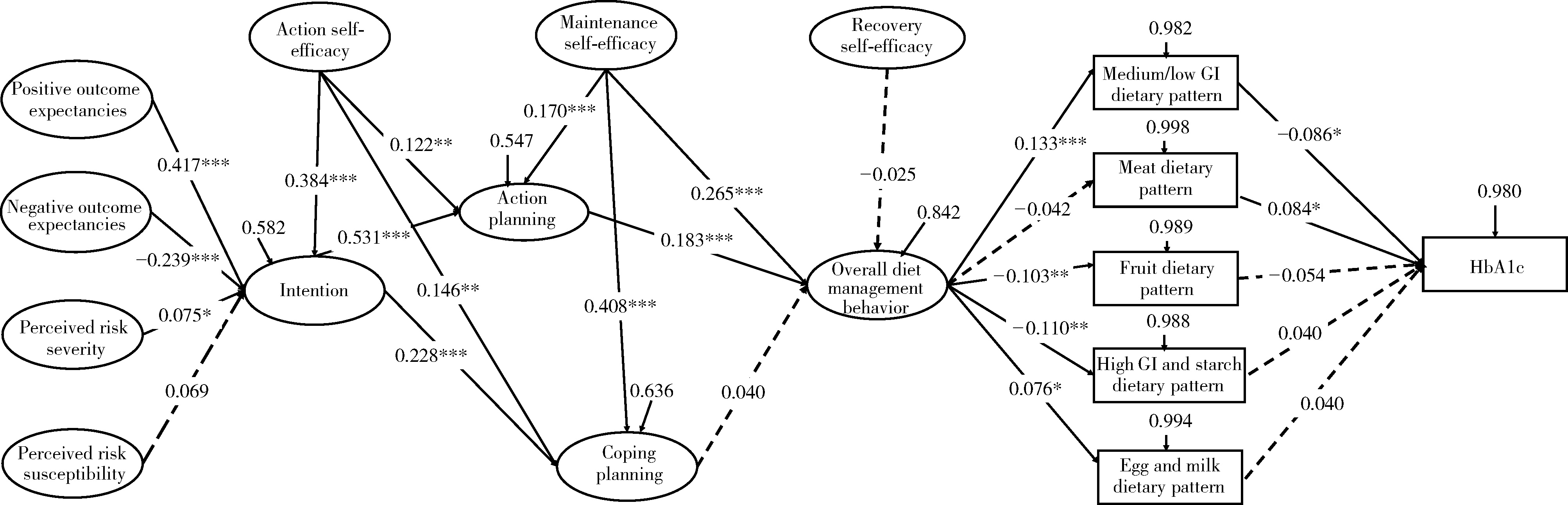
目的: 基于健康行动过程取向(health action process approach, HAPA)模型探究2型糖尿病患者膳食模式和血糖控制的影响因素。方法: 选取山东省东营市东城医院下属的11个社区卫生中心内的2型糖尿病患者作为研究对象,通过静脉抽血检测患者的糖化血红蛋白(glycosylated hemoglobin, HbA1c)水平,采用一般资料调查表、膳食频率调查问卷、2型糖尿病自我管理量表、HAPA量表收集信息。通过因子分析将患者的膳食模式划分为不同类型,通过结构方程模型分析HAPA模型各维度对于患者膳食模式和血糖控制的影响。结果: 共纳入819例2型糖尿病患者,总体HbA1c水平为7.1%±1.1%。研究对象的总体饮食管理得分为5.0 (1.0, 7.0),具体日常饮食被划分为中低血糖生成指数(glycemic index,GI)膳食模式、肉类膳食模式、水果膳食模式、高GI/淀粉类膳食模式、蛋奶类膳食模式。结构方程模型结果显示,积极结果预期(β=0.417,P<0.001)、消极结果预期(β=-0.239,P<0.001)和感知风险严重性(β=0.075,P=0.036)影响饮食管理行为意向;饮食管理行为意向影响行动计划(β=0.531,P<0.001)和应对计划(β=0.228,P<0.001);行动计划影响总体饮食管理行为(β=0.183,P<0.001);总体饮食管理行为影响中低GI膳食模式(β=0.133,P<0.001)、水果膳食模式(β=-0.103,P=0.003)、高GI/淀粉类膳食模式(β=-0.110,P=0.002)和蛋奶类膳食模式(β=0.076,P=0.031);中低GI膳食模式(β=-0.086,P=0.013)、肉类膳食模式(β=0.084,P=0.015)影响HbA1c水平。此外,行动自我效能可以影响行为意向(β=0.384,P<0.001)、行动计划(β=0.122,P=0.006)和应对计划(β=0.146,P=0.001)。维持自我效能可以影响行动计划(β=0.170,P<0.001)、应对计划(β=0.408,P<0.001)和总体饮食管理行为(β=0.265,P<0.001)。结论: 纳入的2型糖尿病患者的膳食模式存在差异,且每周饮食管理的水平欠佳,〖JP+2〗HAPA模型对于2型糖尿病患者的膳食模式和血糖控制水平具有较好的解释作用,因此,今后可基于HAPA模型制定针对性的饮食干预,提高患者的总体饮食管理水平,促进患者养成低GI的健康膳食模式,从而改善血糖水平,提高生活质量。

关键词: 2型糖尿病, 健康行动过程取向模型, 膳食模式

Abstract:

Objective: To explore the factors influencing dietary patterns and blood glucose control in patients with type 2 diabetes based on the health action process approach (HAPA) model. Methods: Patients with type 2 diabetes were selected in 11 community health centers affiliated to Dongcheng Hospital of Dongying City, Shandong Province. The glycosylated hemoglobin (HbA1c) level was detected by venous blood collection, and general data questionnaire, food frequency questionnaire, the Summary of Diabetes Self-Care Activities measure and HAPA scale were used to collect information. The dietary patterns of the patients were divided into different types by factor analysis. The effects of various dimensions of HAPA model on dietary patterns and blood glucose control of the type 2 diabetes patients were analyzed by structural equation model. Results: A total of 819 patients with type 2 diabetes were enrolled in the study, and the overall HbA1c level was 7.1%±1.1%. The overall diet management scores of the study subjects were 5.0 (1.0, 7.0), and the specific daily diets were divided into medium/low glycemic index (GI) dietary pattern, meat dietary pattern, fruit dietary pattern, high GI and starch dietary patterns, and egg and milk dietary pattern. Structural equation model results showed that positive outcome expectancies (β=0.417, P < 0.001), negative outcome expectancies (β=-0.239, P < 0.001) and perceived risk severity (β=0.075, P=0.036) affected dietary management behavior intention. Beha-vioral intention of diet management affected action planning (β=0.531, P < 0.001) and coping planning (β=0.228, P < 0.001). Action planning influenced overall diet management behavior (β=0.183, P < 0.001). The overall diet management behavior affected medium/low GI dietary pattern (β=0.133, P < 0.001), fruit dietary pattern (β=-0.103, P=0.003), high GI and starch dietary pattern (β=-0.110, P=0.002) and egg and milk dietary pattern (β=0.076, P=0.031). Medium/low GI dietary pattern (β=-0.086, P=0.013) and meat dietary pattern (β=0.084, P=0.015) affected the level of HbA1c. In addition, action self-efficacy can affect behavior intention (β=0.384, P < 0.001), action planning (β=0.122, P=0.006) and coping planning (β=0.146, P=0.001). Maintenance self-efficacy affected action planning (β=0.170, P < 0.001), coping planning (β=0.408, P < 0.001), and overall diet management behavior (β=0.265, P < 0.001). Conclusion: There were differences in dietary patterns among the participants with type 2 diabetes, and the weekly diet management behavior was not good enough of the patients with type 2 diabetes, because HAPA model could explain the dietary patterns and blood glucose control level of type 2 diabetes patients. In the future, targeted dietary interventions can be developed based on the HAPA model to improve the overall diet management level of patients and promote patients to develop a healthy diet pattern with low GI, thus controlling blood sugar level and improving quality of life.

Key words: Type 2 diabetes, Health action process approach model, Dietary pattern

中图分类号: 

  • R193.3

表1

HAPA量表的维度、定义及Cronbach’ s α系数"

Dimension Number Definition Sample question Cronbach’s α

Perceived risk susceptibility
3 Awareness of the probability of the occurrence of T2DM-related risk My blood sugar levels are likely to rise 0.918
Perceived risk severity 2 Awareness of the severity of T2DM-related risk The aggravation of diabetes will affect my normal life and work 0.883
Positive outcome expectancies 3 Expectation of potential positive outcomes of diet management Adopting a diabetic diet can make me feel better 0.801
Negative outcome expectancies 3 Expectation of potential negative outcomes of diet management I waste more energy following a diabetic diet 0.706
Intention 3 Willingness to engage in diet management I will learn about diabetes diet 0.769
Action planning 4 Planning for when, where, and how to engage in diet management I know when to eat healthy 0.892
Coping planning 3 Planning for management to address obstacles that may disrupt diet management I already know what to do if something happens that interferes with my eating plan 0.942
Action self-efficacy 3 Confidence in carrying out diet management While it took some time to adjust to the new way of eating, I remained confident in sticking to my diet plan 0.620
Maintenance self-efficacy 5 Confidence in addressing obstacles that may disrupt diet management Even when I’m out, I’m confident I’ll stick to my eating plan 0.923
Recovery self-efficacy 3 Confidence in overcoming setbacks and resuming diet management after failure I have confidence in sticking to my eating plan when I encounter difficulties (like not having time to buy or cook the right foods) 0.850

表2

2型糖尿病患者的基本特征"

Items Population (n = 819)
Age/years, ${\bar x}$±s 64.7±8.2
Gender, n (%)
  Male 444 (54.2)
  Female 375 (45.8)
Nation, n (%)
  Han 813 (99.3)
  Minority 6 (0.7)
Residence, n (%)
  Urban 615 (75.1)
  Rural 204 (24.9)
Education level, n (%)
  Junior high school or lower 382 (46.6)
  Senior high school or technical secondary school 265 (32.4)
  Junior college or higher 172 (21.0)
Marital status, n (%)
  Unmarried 5 (0.6)
  Married 745 (91.0)
  Divorced or bereft of one’s spouse 69 (8.4)
Average household monthly income/yuan, n (%)
  ≤1 000 85 (10.4)
  >1 000-≤3 000 185 (22.6)
  >3 000-≤5 000 282 (34.4)
  >5 000 267 (32.6)
HbA1c/%, ${\bar x}$±s 7.1±1.1

表3

2型糖尿病患者的膳食模式及主要食物因子载荷"

Component Medium/low GI pattern Meat pattern Fruit pattern High GI and starchy pattern Egg and milk pattern
Low/medium GI staple food 0.682
High GI staple food 0.276 0.351 0.433 -0.246
Tubers products 0.292 0.719
Starchy vegetables 0.694 0.277
Green vegetables 0.636 0.211 -0.281
Low/medium GI fruits 0.225 0.755
High GI fruits 0.782
Red meat 0.758
White meat 0.719
Processed meat 0.645
Eggs 0.707
Milk products 0.727
Teas 0.491

表4

2型糖尿病患者的HAPA得分情况"

Dimension Total score Actual score, M (P25, P75)
Perceived risk susceptibility 15 9.0 (6.0, 11.0)
Perceived risk severity 10 6.0 (4.0, 8.0)
Positive outcome expectancies 15 12.0 (10.0, 13.0)
Negative outcome expectancies 15 10.0 (8.0, 12.0)
Intention 15 12.0 (10.0, 13.0)
Action planning 20 16.0 (12.0, 16.0)
Coping planning 15 12.0 (9.0, 13.0)
Action self-efficacy 15 10.0 (8.0, 12.0)
Maintenance self-efficacy 25 18.0 (14.0, 20.0)
Recovery self-efficacy 15 9.0 (7.0, 11.0)

图1

HAPA影响膳食模式和HbA1c水平的结构方程模型 *P<0.05, * *P<0.01, * * * P<0.001; GI, glycemic index; HbA1c, glycosylated hemoglobin; HAPA, health action process approach."

1
International diabetes federation . IDF diabetes atlas[M]. 10th ed Belgium: International Diabetes Federation, 2021: 36.
2
Dudzik JM , Senkus KE , Evert AB , et al. The effectiveness of medical nutrition therapy provided by a dietitian in adults with prediabetes: A systematic review and meta-analysis[J]. Am J Clin Nutr, 2023, 118 (5): 892- 910.

doi: 10.1016/j.ajcnut.2023.08.022
3
Schwarzer R, Sniehotta FF, Lippke S, et al. On the assessment and analysis of variables in the health action process approach conducting an investigation[EB/OL]. (2013-11-01)[2024-05-20]. https://citeseerx.ist.psu.edu/viewdoc/download;jsessionid=3FFB18BA8EEC17A6CFA2C9065A98F60Fdoi=10.1.1.388.1394&rep=rep1&type=pdf.
4
Parkinson J , Hannan T , McDonald N , et al. Health action process approach: Promoting physical activity, and fruit and vegetable intake among Australian adults[J]. Health Promot Int, 2023, 38 (4): daad095.

doi: 10.1093/heapro/daad095
5
Lin CY , Scheerman JFM , Yaseri M , et al. A cluster randomised controlled trial of an intervention based on the Health Action Process Approach for increasing fruit and vegetable consumption in Iranian adolescents[J]. Psychol Health, 2017, 32 (12): 1449- 1468.
6
Pinidiyapathirage J , Jayasuriya R , Cheung NW , et al. Self-efficacy and planning strategies can improve physical activity levels in women with a recent history of gestational diabetes mellitus[J]. Psychol Health, 2018, 33 (8): 1062- 1077.

doi: 10.1080/08870446.2018.1458983
7
Poppe L , De Bourdeaudhuij I , Verloigne M , et al. Efficacy of a self-regulation-based electronic and mobile health intervention targeting an active lifestyle in adults having type 2 diabetes and in adults aged 50 years or older: Two randomized controlled trials[J]. J Med Internet Res, 2019, 21 (8): e13363.

doi: 10.2196/13363
8
Rollo S , Prapavessis H . Sedentary behaviour and diabetes information as a source of motivation to reduce daily sitting time in office workers: A pilot randomised controlled trial[J]. Appl Psychol Health Well Being, 2020, 12 (2): 449- 470.

doi: 10.1111/aphw.12190
9
Almutairi N , Hosseinzadeh H , Gopaldasani V . The effectiveness of patient activation intervention on type 2 diabetes mellitus glycemic control and self-management behaviors: A systematic review of RCTs[J]. Prim Care Diabetes, 2020, 14 (1): 12- 20.

doi: 10.1016/j.pcd.2019.08.009
10
陈雪莹. 社区2型糖尿病患者饮食教具干预的效果评价研究[D]. 北京: 北京大学, 2021.
11
Toobert DJ , Hampson SE , Glasgow RE . The summary of diabetes self-care activities measure: Results from 7 studies and a revised scale[J]. Diabetes Care, 2000, 23 (7): 943- 950.

doi: 10.2337/diacare.23.7.943
12
Ajzen I . The theory of planned behavior[J]. Organ Behav Hum Decis Process, 1991, 50 (2): 179- 211.

doi: 10.1016/0749-5978(91)90020-T
13
Schwarzer R , Renner B . Social-cognitive predictors of health behavior: Action self-efficacy and coping self-efficacy[J]. Health Psychol, 2000, 19 (5): 487- 495.

doi: 10.1037/0278-6133.19.5.487
14
温鑫. 基于HAPA理论慢性肾病健康饮食认知信念问卷的编制及应用研究[D]. 长春: 吉林大学, 2020.
15
Feng Y , Zhao Y , Mao L , et al. The effectiveness of an eHealth family-based intervention program in patients with uncontrolled type 2 diabetes mellitus (T2DM) in the community via WeChat: Randomized controlled trial[J]. JMIR Mhealth Uhealth, 2023, 11, e40420.

doi: 10.2196/40420
16
Zhang N , Du SM , Ma GS . Current lifestyle factors that increase risk of T2DM in China[J]. Eur J Clin Nutr, 2017, 71 (7): 832- 838.

doi: 10.1038/ejcn.2017.41
17
王雨, 李桂丽, 李颖. 糖尿病患者的膳食模式与伴发心脑血管疾病的关系研究[J]. 营养学报, 2021, 43 (2): 144- 149.
18
Li Y , Wang DD , Ley SH , et al. Potential impact of time trend of life-style factors on cardiovascular disease burden in China[J]. J Am Coll Cardiol, 2016, 68 (8): 818- 833.

doi: 10.1016/j.jacc.2016.06.011
19
Li M , Cui Z , Meng S , et al. Associations between dietary glycemic index and glycemic load values and cardiometabolic risk factors in adults: Findings from the China health and nutrition survey[J]. Nutrients, 2020, 13 (1): 116.

doi: 10.3390/nu13010116
20
Shu L , Shen XM , Li C , et al. Dietary patterns are associated with type 2 diabetes mellitus among middle-aged adults in Zhejiang Province, China[J]. Nutr J, 2017, 16 (1): 81.

doi: 10.1186/s12937-017-0303-0
21
Ye Y , Zhuo S , Lu W , et al. A diet rich in fruit and whole grains is associated with a low risk of type 2 diabetes mellitus: Findings from a case-control study in South China[J]. Public Health Nutr, 2022, 25 (6): 1492- 1503.

doi: 10.1017/S1368980020004930
22
Schwingshackl L , Hoffmann G , Lampousi AM , et al. Food groups and risk of type 2 diabetes mellitus: A systematic review and meta-analysis of prospective studies[J]. Eur J Epidemiol, 2017, 32 (5): 363- 375.

doi: 10.1007/s10654-017-0246-y
23
Bergia RE , Giacco R , Hjorth T , et al. Differential glycemic effects of low- versus high-glycemic index Mediterranean-style eating patterns in adults at risk for type 2 diabetes: The MEDGI-carb randomized controlled trial[J]. Nutrients, 2022, 14 (3): 706.

doi: 10.3390/nu14030706
24
Chiavaroli L , Lee D , Ahmed A , et al. Effect of low glycaemic index or load dietary patterns on glycaemic control and cardiometabolic risk factors in diabetes: Systematic review and meta-analysis of randomised controlled trials[J]. BMJ, 2021, 374, n1651.
25
Ley SH , Hamdy O , Mohan V , et al. Prevention and management of type 2 diabetes: Dietary components and nutritional strategies[J]. Lancet, 2014, 383 (9933): 1999- 2007.

doi: 10.1016/S0140-6736(14)60613-9
26
Bergeron N , Chiu S , Williams PT , et al. Effects of red meat, white meat, and nonmeat protein sources on atherogenic lipoprotein measures in the context of low compared with high saturated fat intake: A randomized controlled trial[J]. Am J Clin Nutr, 2019, 110 (1): 24- 33.

doi: 10.1093/ajcn/nqz035
27
Rouhani MH , Salehi-Abargouei A , Surkan PJ , et al. Is there a relationship between red or processed meat intake and obesity? A systematic review and meta-analysis of observational studies[J]. Obes Rev, 2014, 15 (9): 740- 748.

doi: 10.1111/obr.12172
28
Shi W , Huang X , Schooling CM , et al. Red meat consumption, cardiovascular diseases, and diabetes: A systematic review and meta-analysis[J]. Eur Heart J, 2023, 44 (28): 2626- 2635.

doi: 10.1093/eurheartj/ehad336
29
Lippke S , Plotnikoff RC . Testing two principles of the Health Action Process Approach in individuals with type 2 diabetes[J]. Health Psychol, 2014, 33 (1): 77- 84.

doi: 10.1037/a0030182
30
Rohani H , Bidkhori M , Eslami AA , et al. Psychological factors of healthful diet promotion among diabetics: An application of health action process approach[J]. Electron Physician, 2018, 10 (4): 6647- 6654.

doi: 10.19082/6647
31
Zhou G , Gan Y , Knoll N , et al. Proactive coping moderates the dietary intention-planning-behavior path[J]. Appetite, 2013, 70, 127- 133.

doi: 10.1016/j.appet.2013.06.097
32
Steca P , Pancani L , Greco A , et al. Changes in dietary behavior among coronary and hypertensive patients: A longitudinal investigation using the health action process approach[J]. Appl Psychol Health Well Being, 2015, 7 (3): 316- 339.

doi: 10.1111/aphw.12050
33
Fleig L , Ngo J , Roman B , et al. Beyond single behaviour theory: Adding cross-behaviour cognitions to the health action process approach[J]. Br J Health Psychol, 2015, 20 (4): 824- 841.

doi: 10.1111/bjhp.12144
34
曹佃省, 谢光荣. 从行为意向到健康行为: 健康行为程式模型(HAPA)概述[J]. 中国临床心理学杂志, 2010, 18 (6): 809- 812.
35
张持晨, 郑晓, 赵慧宁, 等. 基于健康行为过程取向的大学生膳食行为干预[J]. 卫生研究, 2017, 46 (5): 755- 760.
36
张向京, 岳建华, 林锐. 健康行为HAPA模型为指导提高老年高血压患者自我效能、心理健康和服药依从性的影响[J]. 中国健康心理学杂志, 2021, 29 (8): 1199- 1204.
37
Ranjbaran S , Shojaeizadeh D , Dehdari T , et al. The effectiveness of an intervention designed based on health action process approach on diet and medication adherence among patients with type 2 diabetes: A randomized controlled trial[J]. Diabetol Metab Syndr, 2022, 14 (1): 3.

doi: 10.1186/s13098-021-00773-x
38
Daryabeygi-Khotbehsara R , White KM , Djafarian K , et al. Short-term effectiveness of a theory-based intervention to promote diabetes management behaviours among adults with type 2 diabetes in Iran: A randomised control trial[J]. Int J Clin Pract, 2021, 75 (5): e13994.
39
赵静, 赵秋利, 王丽敏, 等. 2型糖尿病患者饮食行为改变特征的研究[J]. 中华护理杂志, 2018, 53 (2): 139- 143.
40
郭怡, 孙信, 黎泽明, 等. 基于健康行动过程取向理论模型分析2型糖尿病患者锻炼行为现状[J]. 中华疾病控制杂志, 2022, 26 (1): 56-60, 98.
41
朱金凤, 蔡卫新, 陶子荣, 等. 中青年出血性脑卒中患者康复运动依从性现状及其影响因素分析[J]. 中华护理杂志, 2023, 58 (5): 580- 586.
42
Ranjbaran S , Shojaeizadeh D , Dehdari T , et al. Using health action process approach to determine diet adherence among patients with Type 2 diabetes[J]. J Educ Health Promot, 2020, 9, 170.

doi: 10.4103/jehp.jehp_175_20
[1] 鲍雷,蔡夏夏,张明远,任磊磊. 维生素D3对2型糖尿病小鼠轻度认知障碍的改善作用及机制研究[J]. 北京大学学报(医学版), 2023, 55(4): 587-592.
[2] 于欢,杨若彤,王斯悦,吴俊慧,王梦莹,秦雪英,吴涛,陈大方,武轶群,胡永华. 2型糖尿病患者使用二甲双胍与缺血性脑卒中发病风险的队列研究[J]. 北京大学学报(医学版), 2023, 55(3): 456-464.
[3] 张晓悦,林雨欣,蒋莹,张蓝超,董芒艳,池海谊,董浩宇,马利军,李智婧,常春. 自我效能在2型糖尿病患者自我管理能力和自我管理行为间的中介效应[J]. 北京大学学报(医学版), 2023, 55(3): 450-455.
[4] 陈平,黎泽明,郭怡,孙昕霙,Edwin B.FISHER. 基于大五人格理论应用潜在剖面分析探究2型糖尿病患者的用药依从性[J]. 北京大学学报(医学版), 2021, 53(3): 530-535.
[5] 黎泽明,高敏,陈雪莹,孙昕霙. 2型糖尿病患者大五人格特征与自我管理态度的相关性[J]. 北京大学学报(医学版), 2020, 52(3): 506-513.
[6] 谢江,李菲. 睡眠重叠综合征与糖尿病发病率的横断面调查研究[J]. 北京大学学报(医学版), 2019, 51(2): 252-255.
Viewed
Full text


Abstract

Cited

  Shared   
  Discussed   
No Suggested Reading articles found!