北京大学学报(医学版) ›› 2026, Vol. 58 ›› Issue (3): 490-495. doi: 10.19723/j.issn.1671-167X.2026.03.007

• 论著 • 上一篇    下一篇

2018—2023年江苏省0~3岁婴幼儿肠套叠发病的流行病学特征

王玉霖1,2, 郜鑫1,2, 刘志科1,2,*(), 詹思延1,2,3,4,*()   

  1. 1. 北京大学公共卫生学院流行病与卫生统计学系,北京 100191
    2. 重大疾病流行病学教育部重点实验室(北京大学),北京 100191
    3. 北京大学第三医院临床流行病学研究中心,北京 100191
    4. 北京大学人工智能研究院智慧公众健康研究中心,北京 100871
  • 收稿日期:2026-01-15 出版日期:2026-06-18 发布日期:2026-04-15
  • 通讯作者: 刘志科, 詹思延
  • 基金资助:
    盖茨基金会(INV-035024); 国家自然科学基金(82204175); 国家自然科学基金(72361127500); 国家自然科学基金(82330107)

Epidemiological characteristics of intussusception in children aged 0-3 years in Jiangsu Province from 2018 to 2023

Yulin WANG1,2, Xin GAO1,2, Zhike LIU1,2,*(), Siyan ZHAN1,2,3,4,*()   

  1. 1. Department of Epidemiology and Biostatistics, Peking University School of Public Health, Beijing 100191, China
    2. Key Laboratory of Epidemiology of Major Diseases (Peking University), Ministry of Education, Beijing 100191, China
    3. Research Center of Clinical Epidemiology, Peking University Third Hospital, Beijing 100191, China
    4. Center for Intelligent Public Health, Institute for Artificial Intelligence, Peking University, Beijing 100871, China
  • Received:2026-01-15 Online:2026-06-18 Published:2026-04-15
  • Contact: Zhike LIU, Siyan ZHAN
  • Supported by:
    the Gates Foundation(INV-035024); the National Natural Science Foundation of China(82204175); the National Natural Science Foundation of China(72361127500); the National Natural Science Foundation of China(82330107)

RICH HTML


摘要:

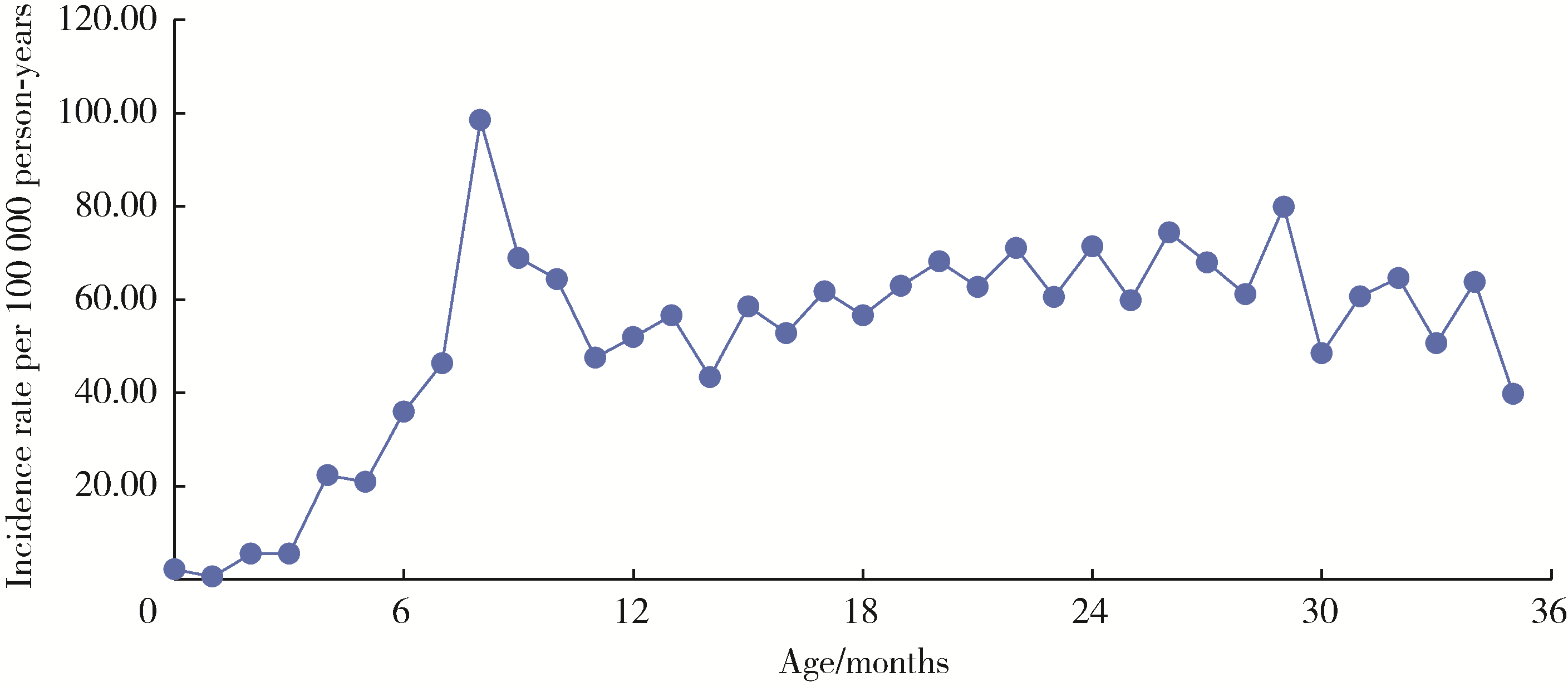
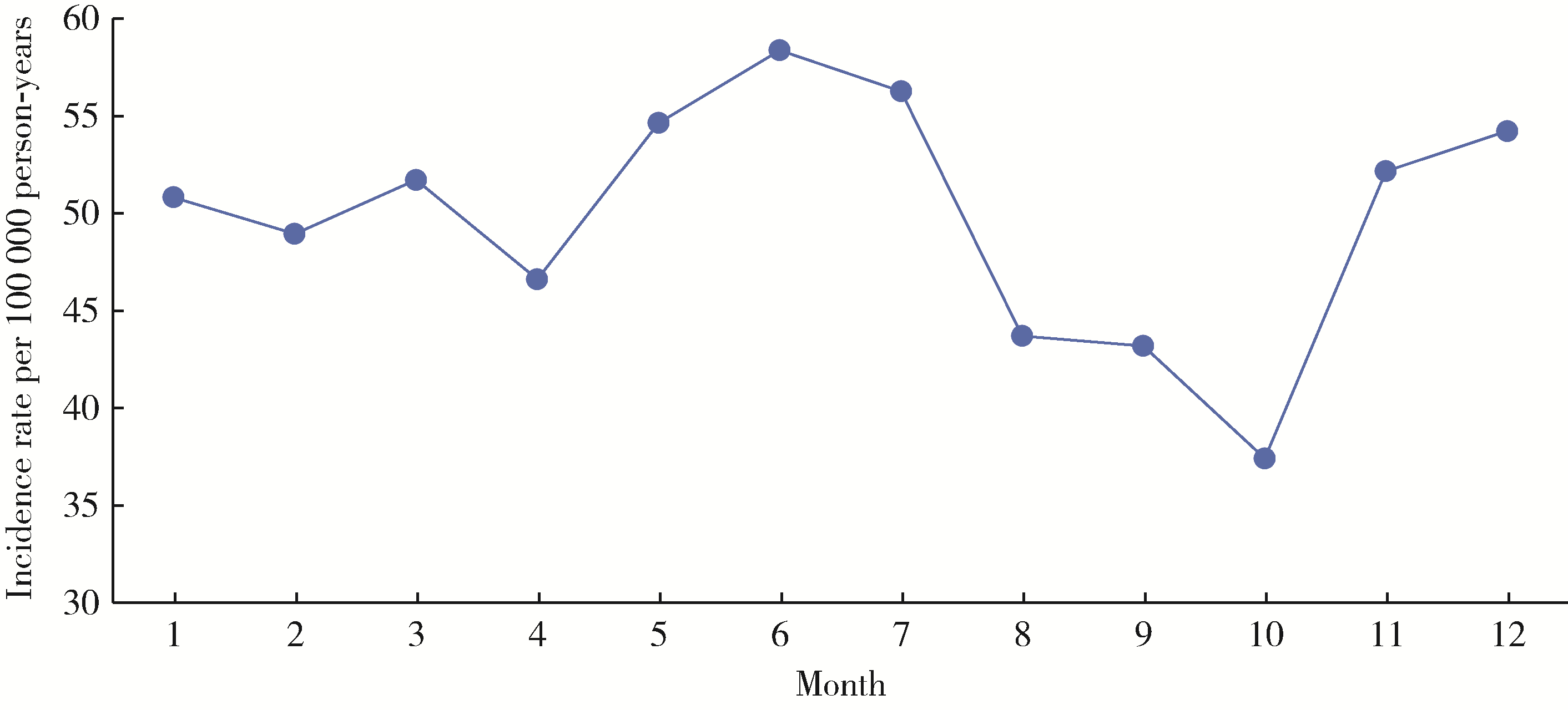
目的: 描述2018—2023年江苏省0~3岁常住儿童肠套叠的发病密度及其在不同年龄、性别和时间维度的分布特征,为该地区卫生行政部门制定0~3岁儿童肠套叠防治策略和措施提供科学依据。方法: 基于江苏省区域健康信息平台数据开展回顾性队列研究,纳入2018年1月1日至2023年12月31日出生且常住于江苏省的0~3岁儿童,通过正则表达式匹配算法,在信息平台中检索疾病和有关健康问题的国际统计分类(第10版)(International Statistical Classification of Diseases and Related Health Problems, 10 revision,ICD-10)编码“K56.1”及与“肠套叠”语义相关的关键词汇,识别疑似病例,定义研究期间首次发病者为新发病例。采用精确人时法计算随访人年,应用泊松(Poisson)分布估算总体及各亚组的发病密度及其95%置信区间(confidence interval,CI)。构建泊松回归模型,计算发病率比(incidence rate ratio,IRR),检验发病密度的月龄效应与季节性差异。结果: 构建了一个包含2 252 691名0~3岁儿童的出生队列,总随访5 316 389.55人年。研究期间共识别出2 650例0~3岁新发肠套叠病例,其中男童1 600例(60.4%),女童1 050例(39.6%)。总体发病密度为49.8 (95%CI: 47.9~51.7)/10万人年,男童发病密度为57.8 (95%CI: 54.9~60.6)/10万人年,女童为41.2 (95%CI: 38.7~43.7)/10万人年,男女比较差异有统计学意义;城乡间发病密度差异无统计学意义。发病存在季节性,高峰集中在夏季和冬季。发病密度随月龄变化呈单峰模式,在8月龄达到顶峰(98.5/10万人年),发病年龄的中位数为19.2个月[四分位距(interquartile range, IQR): 11.4~26.6个月]。结论: 基于江苏省区域健康信息平台的大数据回顾性队列研究,明确了2018—2023年本地0~3岁儿童肠套叠的流行病学特征。男童、8月龄至3岁的婴幼儿是肠套叠的高危人群,夏季和冬季为高发季节,此结果为卫生行政部门制定针对性的早期监测、预防和医疗资源调配策略提供了循证依据。

关键词: 肠套叠, 发病密度, 流行病学, 队列研究

Abstract:

Objective: To describe the incidence density of intussusception and its distribution characteristics across different ages, genders, and time periods among resident children aged 0-3 years in Jiangsu Province from 2018 to 2023, providing a scientific basis for health administrative departments in the region to formulate prevention and control strategies and measures for intussusception in children aged 0-3 years. Methods: A retrospective cohort study was conducted using data from the Jiangsu Regional Health Information Platform (RHIP). Resident children aged 0-3 years born between January 1, 2018, and December 31, 2023, were included. Suspected cases were identified by retrieving the International Statistical Classification of Diseases and Related Health Problems, 10 revision (ICD-10) code "K56.1" and semantically related keywords for "intussusception" from the original text using a regular expression matching algorithm. An incident case was defined as the first occurrence of the disease during the study period. Follow-up person-years were calculated using the exact person-time method. The Poisson distribution was applied to estimate the overall and subgroup incidence densities and their 95% confidence intervals (CI). Poisson regression models were constructed to calculate incidence rate ratio (IRR) and examine the effects of age (in months) and seasonal differences on incidence density. Results: A birth cohort comprising 2 252 691 children aged 0-3 years was established, accumulating a total follow-up of 5 316 389.55 person-years. During the study period, 2 650 incident cases of intussusception were identified, including 1 600 boys (60.4%) and 1 050 girls (39.6%). The overall incidence density was 49.8 (95%CI: 47.9-51.7) per 100 000 person-years. The incidence density was 57.8 (95%CI: 54.9-60.6) per 100 000 person-years for boys and 41.2 (95%CI: 38.7-43.7) per 100 000 person-years for girls, with a statistically significant difference between the sexes. Seasonal variations were observed, with peaks occurring in summer and winter. The incidence density exhibited a unimodal pattern, peaking at 8 months (98.5 per 100 000 person-years). The median age of onset was 19.2 months [interquartile range (IQR): 11.4-26.6 months]. Conclusion: This large retrospective cohort study based on the Jiangsu RHIP clarified the epidemiological characteristics of intussusception among local children aged 0-3 years from 2018 to 2023. Boys and children aged 8 months to 3 years were identified as high-risk populations for intussusception, with peak incidence occurring in summer and winter. These findings provide evidence-based support for health authorities to formulate targeted strategies for early surveillance, prevention, and healthcare resource allocation.

Key words: Intussusception, Incidence density, Epidemiology, Cohort study

中图分类号: 

  • R181.3

表1

研究队列的基线人口学特征"

Characteristic Total cohort (n=2 252 691) Cases (n=2 650) χ2 value P value
Gender, n (%) 71.99 <0.001
  Male 1 174 324 (52.13) 1 600 (60.38)
  Female 1 078 367 (47.87) 1 050 (39.62)
Residence, n (%) 7.87 0.005
  Urban 1 887 426 (83.78) 2 274 (85.81)
  Rural 365 265 (16.22) 376 (14.19)
Birth year, n (%)
  2018 409 210 (18.17) 332 (12.53)
  2019 434 083 (19.27) 573 (21.62)
  2020 410 813 (18.24) 690 (26.04)
  2021 358 774 (15.93) 672 (25.36)
  2022 344 582 (15.30) 327 (12.34)
  2023 295 229 (13.10) 56 (2.11)

表2

肠套叠发病密度的性别与城乡分布特征"

Characteristic Cases Person-years Incidence density(/100 000 person-years) IRR (95%CI) P value
Total 2 650 5 316 389.55 49.8 (47.9-51.7)
Gender 1.40 (1.30-1.52) <0.001
  Male 1 600 2 770 401.07 57.8 (54.9-60.6)
  Female 1 050 2 545 988.47 41.2 (38.7-43.7)
Residence 1.12 (1.00-1.25) 0.046
  Urban 2 274 4 487 101.09 50.7 (48.6-52.8)
  Rural 376 829 288.46 45.3 (40.8-49.9)

图1

江苏省婴幼儿肠套叠的月龄别发病密度(0~35个月)"

图2

江苏省婴幼儿肠套叠发病密度的月份分布"

1
Li Y , Zhou Q , Liu C , et al. Epidemiology, clinical characteristics, and treatment of children with acute intussusception: A case series[J]. BMC Pediatr, 2023, 23 (1): 143.

doi: 10.1186/s12887-023-03961-y
2
Bines JE , Kohl KS , Forster J , et al. Acute intussusception in infants and children as an adverse event following immunization: Case definition and guidelines of data collection, analysis, and presentation[J]. Vaccine, 2004, 22 (5/6): 569- 574.
3
Clark AD , Hasso-Agopsowicz M , Kraus MW , et al. Update on the global epidemiology of intussusception: A systematic review of incidence rates, age distributions and case-fatality ratios among children aged < 5 years, before the introduction of rotavirus vaccination[J]. Int J Epidemiol, 2019, 48 (4): 1316- 1326.

doi: 10.1093/ije/dyz028
4
郭宏溪, 杨俊, 卞红强, 等. 2016—2022年武汉儿童原发性肠套叠流行病学特征及变化趋势[J]. 陆军军医大学学报, 2023, 45 (19): 2085- 2091.
5
Green LA , Fryer GE Jr , Yawn BP , et al. The ecology of medical care revisited[J]. N Engl J Med, 2001, 344 (26): 2021- 2025.

doi: 10.1056/NEJM200106283442611
6
Pilkington M , Theivendram A , Brogly SB , et al. Rising incidence of childhood intussusception in Ontario: A population-based study from 1997-2016[J]. Am Surg, 2023, 89 (1): 129- 136.

doi: 10.1177/00031348211011139
7
Kramarz P , France EK , Destefano F , et al. Population-based study of rotavirus vaccination and intussusception[J]. Pediatr Infect Dis J, 2001, 20 (4): 410- 416.

doi: 10.1097/00006454-200104000-00008
8
Lei J , Wen D , Zhang X , et al. Enabling health reform through regional health information exchange: A model study from China[J]. J Healthc Eng, 2017, 2017, 1053403.
9
陆家发, 赵群, 唐凯, 等. 江苏省全民健康信息平台数据治理实践研究[J]. 中国卫生质量管理, 2023, 30 (8): 63- 67.
10
Liu Z , Li N , Liu G , et al. No increased risk of intussusception after pentavalent rotavirus vaccination in China: A retrospective birth cohort using electronic health records of Ningbo City[J]. Emerg Microbes Infect, 2023, 12 (2): 2270062.

doi: 10.1080/22221751.2023.2270062
11
Liu N , Yen C , Huang T , et al. Incidence and epidemiology of intussusception among children under 2 years of age in Chenzhou and Kaifeng, China, 2009-2013[J]. Vaccine, 2018, 36 (51): 7862- 7867.

doi: 10.1016/j.vaccine.2018.02.032
12
Zhang T , Cui L , Geng X , et al. Epidemiology study of pediatric primary intussusception aged ≤24 months in pre-rotavirus vaccine era of Jinan, China[J]. Vaccine, 2019, 37 (11): 1436- 1442.

doi: 10.1016/j.vaccine.2019.01.060
13
崔朋伟, 刘娜, 李静欣, 等. 苏州市2007—2013年2岁以下儿童住院肠套叠流行特征[J]. 中华流行病学杂志, 2016, 37 (3): 410- 414.
14
Van Trang N , Le Nguyen NT , Dao HT , et al. Incidence and epidemiology of intussusception among infants in Ho Chi Minh City, Vietnam[J]. J Pediatr, 2014, 164 (2): 366- 371.

doi: 10.1016/j.jpeds.2013.10.006
15
Takeuchi M , Osamura T , Yasunaga H , et al. Intussusception among Japanese children: An epidemiologic study using an administrative database[J]. BMC Pediatr, 2012, 12, 36.

doi: 10.1186/1471-2431-12-36
16
Fotso Kamdem A , Vidal C , Pazart L , et al. Incidence of acute intussusception among infants in eastern France: Results of the EPIstudy trial[J]. Eur J Pediatr, 2017, 176 (3): 301- 309.

doi: 10.1007/s00431-016-2838-z
17
Jenke AC , Klaassen-Mielke R , Zilbauer M , et al. Intussusception: Incidence and treatment-insights from the nationwide German surveillance[J]. J Pediatr Gastroenterol Nutr, 2011, 52 (4): 446- 451.

doi: 10.1097/MPG.0b013e31820e1bec
18
Gadroen K , Kemmeren JM , Bruijning-Verhagen PC , et al. Baseline incidence of intussusception in early childhood before rotavirus vaccine introduction, the Netherlands, January 2008 to December 2012[J]. Euro Surveill, 2017, 22 (25): 30556.
19
Jiang J , Jiang B , Parashar U , et al. Childhood intussusception: A literature review[J]. PLoS One, 2013, 8 (7): e68482.

doi: 10.1371/journal.pone.0068482
20
Johnson B , Gargiullo P , Murphy TV , et al. Sociodemographic and dietary risk factors for natural infant intussusception in the United States[J]. J Pediatr Gastroenterol Nutr, 2010, 51 (4): 458- 463.

doi: 10.1097/MPG.0b013e3181d3273f
21
World Health Organization. Acute intussusception in infants and children: Incidence, clinical representation and management: A global perspective[R]. Geneva: World Health Organization, 2002.
22
Chang CY , Chen YY , Lin CH , et al. Recurrence of pediatric intussusception: A nationwide population-based descriptive study in Taiwan[J]. Medicine, 2023, 102 (35): e34727.

doi: 10.1097/MD.0000000000034727
23
Hwang S , Kim J , Jung JY , et al. The epidemiology of childhood intussusception in South Korea: An observational study[J]. PLoS One, 2019, 14 (12): e0219286.

doi: 10.1371/journal.pone.0219286
24
Trotta F , Da Cas R , Bella A , et al. Intussusception hospitalizations incidence in the pediatric population in Italy: A nationwide cross-sectional study[J]. Ital J Pediatr, 2016, 42 (1): 89.

doi: 10.1186/s13052-016-0298-8
25
Panzera F , Di Venere B , Rizzi M , et al. Bowel intussusception in adult: Prevalence, diagnostic tools and therapy[J]. World J Methodol, 2021, 11 (3): 81- 87.

doi: 10.5662/wjm.v11.i3.81
26
国家统计局. 中国统计年鉴2024[M]. 北京: 中国统计出版社, 2024.
27
Althubaiti A . Information bias in health research: Definition, pitfalls, and adjustment methods[J]. J Multidiscip Healthc, 2016, 9, 211- 217.
28
Liang J , Zheng X , Chen Z , et al. The experience and challenges of healthcare-reform-driven medical consortia and Regional Health Information Technologies in China: A longitudinal study[J]. Int J Med Inform, 2019, 131, 103954.

doi: 10.1016/j.ijmedinf.2019.103954
29
Li C , Xu X , Zhou G , et al. Implementation of national health informatization in China: Survey about the status quo[J]. JMIR Med Inform, 2019, 7 (1): e12238.
30
江苏省统计局. 江苏统计年鉴2024[M]. 南京: 江苏省统计局, 2024.
31
Burnett E , Kabir F , van Trang N , et al. Infectious etiologies of intussusception among children <2 years old in 4 Asian countries[J]. J Infect Dis, 2020, 221 (9): 1499- 1505.
[1] 徐慧颖, 何兴侯, 黄薇, 张彬, 李梦瑶, 刘家辉, 方言, 赵二璐, 魏相睿, 马旭, 杨英. 中国育龄女性围孕期冷热暴露与先天性心脏病发病风险的关联[J]. 北京大学学报(医学版), 2026, 58(3): 503-512.
[2] 陆梦溪, 王炳翰, 康佳丽, 刘秋萍, 周逸帆, 孙烨祥, 沈鹏, 林鸿波, 唐迅, 高培. 生物学年龄在社区人群队列中预测心血管病风险的应用[J]. 北京大学学报(医学版), 2026, 58(3): 543-550.
[3] 潘子晨, 陈凯, 侯钰坤, 杨博涵, 张继新, 马永蔌, 田孝东, 杨尹默. 胰腺腺鳞癌临床病理特征与分子机制研究进展[J]. 北京大学学报(医学版), 2026, 58(2): 431-435.
[4] 范梦, 王梦莹, 王斯悦, 彭和香, 王雪珩, 郭煌达, 侯天姣, 秦雪英, 陈大方, 胡永华, 李劲, 武轶群, 吴涛. 动脉硬化相关指标与死亡风险的前瞻性队列研究[J]. 北京大学学报(医学版), 2025, 57(6): 1153-1159.
[5] 黄俊捷, 刘肇瑞, 张婷婷, 黄悦勤. 中国精神卫生调查的跨世纪历程[J]. 北京大学学报(医学版), 2025, 57(5): 868-874.
[6] 陆梦溪, 刘秋萍, 周恬静, 刘晓非, 孙烨祥, 沈鹏, 林鸿波, 唐迅, 高培. 基于社区人群队列的甘油三酯-葡萄糖指数与心血管病发病和死亡的关联[J]. 北京大学学报(医学版), 2025, 57(3): 430-435.
[7] 杨子铭, 李淑雅, 李肖彤, 沈鹏, 孙烨祥, 林鸿波, 江志琴, 詹思延, 刘志科. 2015—2024年宁波市鄞州区肺炎人群呼吸道病原体分布特点[J]. 北京大学学报(医学版), 2025, 57(3): 496-506.
[8] 陈欣, 杨君婷, 郭金鑫, 李淑雅, 刘志科, 朱颖靓, 李奉娟, 詹思延, 郭娟娟. 2022—2024年青岛市10~59岁女性自身免疫性甲状腺病的患病率特征[J]. 北京大学学报(医学版), 2025, 57(3): 507-513.
[9] 刘光旭, 张良, 赵厚宇, 邓思危, 杨君婷, 李宁, 马瑞, 何艳, 许国章, 刘志科, 詹思延. 2015—2021年宁波市6岁以下儿童热性惊厥的流行病学特征[J]. 北京大学学报(医学版), 2025, 57(3): 584-591.
[10] 刘晓强,周寅. 牙种植同期植骨术围术期高血压的相关危险因素[J]. 北京大学学报(医学版), 2024, 56(1): 93-98.
[11] 王子恺,莫佳丽,张蒙,廖纪萍. 2013—2020年北京市慢性阻塞性肺疾病急性加重女性住院患者的流行病学和住院费用分析[J]. 北京大学学报(医学版), 2023, 55(6): 1074-1081.
[12] 于欢,杨若彤,王斯悦,吴俊慧,王梦莹,秦雪英,吴涛,陈大方,武轶群,胡永华. 2型糖尿病患者使用二甲双胍与缺血性脑卒中发病风险的队列研究[J]. 北京大学学报(医学版), 2023, 55(3): 456-464.
[13] 王哲,孙伟,杨雪,宋颖,姬爱平,白洁. 口腔急诊颌面部感染患者临床分析[J]. 北京大学学报(医学版), 2023, 55(3): 543-547.
[14] 马涛,李艳辉,陈曼曼,马莹,高迪,陈力,马奇,张奕,刘婕妤,王鑫鑫,董彦会,马军. 青春期启动提前与儿童肥胖类型的关联研究: 基于横断面调查和队列调查[J]. 北京大学学报(医学版), 2022, 54(5): 961-970.
[15] 贺冰洁,刘志科,沈鹏,孙烨祥,陈彬,詹思延,林鸿波. 2011—2020年宁波市鄞州区炎症性肠病发病的流行病学研究[J]. 北京大学学报(医学版), 2022, 54(3): 511-519.
Viewed
Full text


Abstract

Cited

  Shared   
  Discussed   
No Suggested Reading articles found!