北京大学学报(医学版) ›› 2019, Vol. 51 ›› Issue (1): 53-58. doi: 10.19723/j.issn.1671-167X.2019.01.010
多模态影像融合技术与颅底-颞下区肿瘤的诊断和治疗
杨榕,李庆祥,毛驰,彭歆,王洋,郭玉兴( ),郭传瑸()
- 北京大学口腔医学院·口腔医院,口腔颌面外科 国家口腔疾病临床医学研究中心 口腔数字化医疗技术和材料国家工程实验室 口腔数字医学北京市重点实验室,北京 100081
Multimodal image fusion technology for diagnosis and treatment of the skull base-infratemporal tumors
Rong YANG,Qing-xiang LI,Chi MAO,Xin PENG,Yang WANG,Yu-xing GUO(),Chuan-bin GUO()
- Department of Oral and Maxillofacial Surgery, Peking University School and Hospital of Stomatology & National Clinical Research Center for Oral Diseases & National Engineering Laboratory for Digital and Material Technology of Stomatology & Beijing Key Laboratory of Digital Stomatology, Beijing 100081, China
摘要:
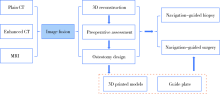
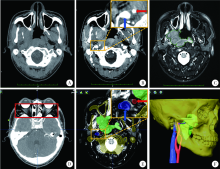
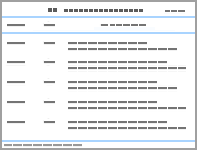
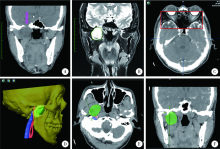
目的:评价多模态影像融合技术联合计算机辅助设计在颅底-颞下区肿瘤诊断和治疗中的应用及效果。方法:选择2011年2月至2018年9月于北京大学口腔医院诊治的颅底-颞下区肿瘤患者资料进行回顾性分析,共入选病例17例,术前所有患者进行平扫CT、增强CT及MRI影像扫描。在导航软件中将平扫CT、增强CT及MRI影像融合后,三维重建肿瘤、血管及颅颌面骨,计算机辅助设计手术方案,并联合导航引导下穿刺活检或手术,术后定期随访,分析患者资料,评价应用效果。结果:17例病例均取得满意的多模态影像融合,在同一帧图像上精确显示通过不同图像描记的病变、颅颌面骨及重要血管。联合计算机辅助三维重建及导航引导穿刺或手术设计,进行术前评估及手术方案设计,取得了良好的应用效果,尤其对肿瘤体积较小、复发及边界不清的病例效果显著。4例利用融合图像进行术前诊断与评估后行手术探查(无术中导航引导,其中3例手术切除,1例仅取活检), 3例行导航引导穿刺活检,12例行导航引导手术切除(其中2例先行导航穿刺活检)。所有患者均成功实施穿刺或手术,1例脑膜瘤复发患者术中出现脑脊液漏,1例腮腺深叶肿瘤患者术后面瘫,穿刺活检病理诊断阳性率为100%(3/3)。手术切除的15例经术中导航检查及术后影像验证显示完全切除14例,次全切除1例,术后随访3~94个月(中位随访时间9个月)。结论:充分利用多模态影像优势,准确分析肿瘤、血管及颅颌面骨的三维空间位置关系,有助于颅底-颞下区肿瘤的术前规划,联合导航技术可进一步提高穿刺活检及手术治疗的精准性和安全性。
中图分类号:
- R78



| [1] |
Choudhri AF, Parmar HA, Morales RE , et al. Lesions of the skull base: imaging for diagnosis and treatment[J]. Otolaryngol Clin North Am, 2012,45(6):1385-1404.
doi: 10.1007/978-3-642-35579-0_20 |
| [2] | 魏宏权 . 咽旁隙和颞下窝肿瘤的外科治疗进展[J]. 中国耳鼻咽喉颅底外科杂志, 2018,24(2):91-96, 102. |
| [3] |
郭玉兴, 彭歆, 刘筱菁 , 等. 导航技术在颅底-颞下区肿瘤手术中的应用[J]. 中华口腔医学杂志, 2013,48(11):645-647.
doi: 10.3760/cma.j.issn.1002-0098.2013.11.002 |
| [4] |
郭传瑸, 郭玉兴 . 外科导航技术引导的颅底肿瘤穿刺活检[J]. 中国实用口腔科杂志, 2014,7(6):321-324.
doi: 10.7504/kq.2014.06.001 |
| [5] |
Guo R, Guo YX, Feng Z , et al. Application of a computer-aided navigation technique in surgery for recurrent malignant infratemporal fossa tumors[J]. J Craniofac Surg, 2015,26(2):e126-132.
doi: 10.1097/SCS.0000000000001350 pmid: 25710743 |
| [6] |
Leong JL, Batra PS, Citardi MJ . CT-MR image fusion for the management of skull base lesions[J]. Otolaryngol Head Neck Surg, 2006,134(5):868-876.
doi: 10.1016/j.otohns.2005.11.015 pmid: 16647550 |
| [7] |
Guo Y, Guo C . Maxillary-fronto-temporal approach for removal of recurrent malignant infratemporal fossa tumors: Anatomical and clinical study[J]. J Craniomaxillofac Surg, 2014,42(3):206-212.
doi: 10.1016/j.jcms.2013.05.001 pmid: 23932542 |
| [8] |
Yacoub A, Anschuetz L, Schneider D , et al. Minimally invasive lateral endoscopic multiport approach to the infratemporal fossa: a cadaveric study[J]. World Neurosurg, 2018,112:e489-e496.
doi: 10.1016/j.wneu.2018.01.065 pmid: 29391297 |
| [9] | 李成才, 姚国杰, 杜威 , 等. 多模态影像融合在颅底肿瘤的诊断、治疗中的应用价值[J]. 中国临床神经外科杂志, 2018,23(3):145-148. |
| [10] |
O'Neill BE, Hochhalter CB, Carr C , et al.Advances in neuro-oncology imaging techniques[J]. Ochsner J, 2018,18(3):236-241.
doi: 10.31486/toj.17.0062 |
| [11] |
赵岩, 孙健, 杨学军 . 多模态影像融合技术在神经外科的应用及进展[J]. 中国现代神经疾病杂志, 2012,12(6):645-650.
doi: 10.3969/j.issn.1672-6731.2012.06.004 |
| [12] |
顾恒乐, 聂生东 . 多模医学图像配准和融合方法及其临床应用进展[J]. 中华放射肿瘤学杂志, 2016,25(8):902-906.
doi: 10.3760/cma.j.issn.1004-4221.2016.08.024 |
| [13] |
Inoue HK, Nakajima A, Sato H , et al. Image fusion for radiosurgery, neurosurgery and hypofractionated radiotherapy[J]. Cureus, 2015,7(3):e252.
doi: 10.7759/cureus.252 pmid: 26180676 |
| [14] |
Nemec SF, Donat MA, Mehrain S , et al. Ct-mr image data fusion for computer assisted navigated neurosurgery of temporal bone tumors[J]. Eur J Radiol, 2007,62(2):192-198.
doi: 10.1016/j.ejrad.2006.11.029 pmid: 17229539 |
| [15] |
Zhang SX, Han PH, Zhang GQ , et al. Comparison of spect/ct, mri and ct in diagnosis of skull base bone invasion in nasopharyngeal carcinoma[J]. Biomed Mater Eng, 2014,24(1):1117-1124.
doi: 10.3233/BME-130911 pmid: 24092081 |
| [16] |
Guo YX, Sun ZP, Liu XJ , et al. Surgical safety distances in the infratemporal fossa: three-dimensional measurement study[J]. Int J Oral Maxillofac Surg, 2015,44(5):555-561.
doi: 10.1016/j.ijom.2014.06.004 pmid: 25441861 |
| [17] |
吴东东, 卜博, 陈晓雷 , 等. 融合MRI与CT图像的多模态神经导航技术在颅底显微外科手术中的应用[J]. 解放军医学院学报, 2015, ( 5):411-414.
doi: 10.3969/j.issn.2095-5227.2015.05.002 |
| [18] |
Hayashi N, Kurimoto M, Hirashima Y , et al. Efficacy of navigation in skull base surgery using composite computer graphics of magnetic resonance and computed tomography images[J]. Neurol Med Chir (Tokyo), 2001,41(7):335.
doi: 10.2176/nmc.41.335 pmid: 11487996 |
| [1] | 季加孚, 韦静涛, 季科, 步召德. 胃癌诊疗的瓶颈与破局:迈向精准化与智能化融合的新纪元[J]. 北京大学学报(医学版), 2026, 58(2): 231-238. |
| [2] | 高加勒, 张忠涛. 局部进展期直肠癌精准治疗现状与展望[J]. 北京大学学报(医学版), 2026, 58(2): 247-250. |
| [3] | 王海, 江一舟. 靶向血管治疗在乳腺癌精准治疗中的分子机制与临床应用[J]. 北京大学学报(医学版), 2026, 58(2): 251-256. |
| [4] | 罗必显, 刘洪铭, 谢伟勋, 龚渭华. 产甲胎蛋白胃癌的新临床特征和前沿科学问题[J]. 北京大学学报(医学版), 2026, 58(2): 257-265. |
| [5] | 杜文, 章文博, 于尧, 刘硕, 苏惠裕, 胡耒豪, 唐祖南, 吴彬彰, 陈震, 李家琦, 王昊, 彭歆. 口腔颌面部肿瘤"数智化外科"诊疗流程探索与临床应用[J]. 北京大学学报(医学版), 2026, 58(2): 278-284. |
| [6] | 王楠楠, 袁大晋, 朱昱冰, 丁磊. 结直肠癌根治术后肝转移风险多中心列线图预测模型的构建与验证[J]. 北京大学学报(医学版), 2026, 58(2): 290-300. |
| [7] | 刘友东, 吕亚军, 陈杰, 臧明德, 潘宏达, 刘晓文, 陆俊, 刘凤林. 全腹腔镜保留贲门胃底胃次全切除术治疗中上部胃癌的疗效及安全性[J]. 北京大学学报(医学版), 2026, 58(2): 301-306. |
| [8] | 李嘉临, 陈力侨, 唐家天, 吴艳, 王安强. 胃肝样腺癌转化治疗1例[J]. 北京大学学报(医学版), 2026, 58(2): 399-404. |
| [9] | 李斌, 梁寒. 机器人胃癌根治术:研究进展与实践挑战[J]. 北京大学学报(医学版), 2026, 58(2): 416-422. |
| [10] | 董海峰, 陈恒星, 张常华. 恶性肿瘤中蛋白质乳酸化修饰的研究进展[J]. 北京大学学报(医学版), 2026, 58(2): 423-430. |
| [11] | 李宏杨, 黄涛, 王琳琳. 脂肪肌肉比率与卵巢良性肿瘤风险的关联性[J]. 北京大学学报(医学版), 2026, 58(1): 169-174. |
| [12] | 高若凡, 马天宇, 王润楷, 殷雨辰, 李芮迪, 王丹丹, 夏斌. 细胞膜囊泡递送靶向肿瘤坏死因子-α的小干扰RNA对牙髓干细胞的抗炎作用[J]. 北京大学学报(医学版), 2026, 58(1): 22-29. |
| [13] | 刘艳华, 陆敏, 赵旭阳, 张宽根, 武睿, 梅放, 戴志豪, 由江峰, 裴斐. 肿瘤转移抑制基因LASS2去磷酸化对液泡型ATP酶活性及前列腺癌侵袭性的影响[J]. 北京大学学报(医学版), 2025, 57(6): 1113-1123. |
| [14] | 杨小勇, 张帆, 马潞林, 刘承. 前列腺导管腺癌临床特征及腺外侵犯的影响因素[J]. 北京大学学报(医学版), 2025, 57(5): 956-960. |
| [15] | 陈定一, 杜浩鑫, 张逸晨, 王闫飞, 刘巍, 焦园园, 史录文, 管晓东, 卢新璞. 姑息治疗对晚期癌症患者药物使用和医疗资源利用的影响[J]. 北京大学学报(医学版), 2025, 57(5): 996-1001. |
|
||
