北京大学学报(医学版) ›› 2019, Vol. 51 ›› Issue (3): 445-450. doi: 10.19723/j.issn.1671-167X.2019.03.011
成红细胞样Ter细胞在胶原诱导性关节炎发病中的作用
王平1,宋婧1,方翔宇1,李鑫1,刘栩1,贾园1,栗占国1,2,胡凡磊1△( )
)
- 1. 北京大学人民医院风湿免疫科,风湿病机制及免疫诊断北京市重点实验室, 北京 100044
2. 北京大学药学院天然药物及仿生药物国家重点实验室, 北京 100191
Role of erythroblast-like Ter cells in the pathogenesis of collagen-induced arthritis
Ping WANG1,Jing SONG1,Xiang-yu FANG1,Xin LI1,Xu LIU1,Yuan JIA1,Zhan-guo LI1,2,Fan-lei HU1△()
- 1. Department of Rheumatology and Immunology, Peking University People’s Hospital & Beijing Key Laboratory for Rheumatism Mechanism and Immune Diagnosis, Beijing 100044, China;
2. State Key Laboratory of Natural and Biomime-tic Drugs, Peking University School of Pharmaceutical Sciences, Beijing 100191, China
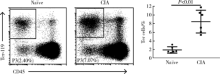
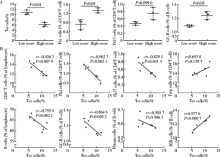
摘要: 目的 通过检测Ter细胞在不同发病阶段胶原诱导性关节炎(collagen-induced arthritis,CIA)小鼠脾脏中的数量变化及高峰期CIA小鼠脾脏Ter细胞与关节评分和T、B细胞亚群比例的相关性,探讨Ter细胞在CIA发生和发展中的作用,从而进一步深入理解类风湿关节炎的发病机制。方法 6~8周的DBA/1小鼠进行CIA模型的诱导,二次免疫后开始对CIA小鼠进行关节评分。根据发病时间和关节评分将CIA分为发病早期、高峰期、晚期三个阶段。发病高峰期小鼠根据最终关节评分再分为高评分组(>8分)和低评分组(≤8分),流式细胞术检测na?ve小鼠和各个阶段CIA小鼠脾脏中Ter细胞比例及发病高峰期CIA小鼠脾脏T、B 细胞亚群比例,并进行关联分析。结果 发病高峰期CIA小鼠脾脏Ter细胞比例较na?ve小鼠明显升高(8.522%±2.645% vs. 1.937%±0.725%,P<0.01), 高评分组小鼠脾脏Ter细胞比例明显低于低评分组(6.217%±0.841% vs. 10.827%±0.917%,P<0.01)。高评分组小鼠脾脏Th1细胞比例明显高于低评分组(1.337%±0.110% vs. 0.727%±0.223%,P<0.05),高评分组小鼠脾脏Th17细胞比例高于低评分组(0.750%±0.171% vs. 0.477%±0.051%,P=0.099),高评分组小鼠脾脏生发中心B(germinal center B,GC-B)细胞比例明显高于低评分组(1.243%±0.057% vs. 1.097%±0.015%,P<0.05)。相关性分析结果显示,发病高峰期CIA小鼠脾脏Ter细胞比例与CD4 +T、Th1、Th17、GC-B细胞比例均呈强负相关,与B10细胞比例呈强正相关,相关性均有统计学意义,提示这群细胞在CIA中可能具有保护作用。动态变化研究显示,随着疾病进展,发病晚期CIA小鼠脾脏Ter细胞比例较高峰期明显降低(0.917%±0.588% vs. 8.522%±2.645%,P<0.001), 进一步提示这群细胞在关节炎中的保护作用。 结论 Ter细胞在发病高峰期CIA小鼠脾脏中明显增加,与小鼠关节评分及致病性免疫细胞比例呈负相关,与保护性免疫细胞比例呈正相关,发病晚期CIA小鼠Ter细胞比例明显降低,提示Ter细胞可能作为一种保护性细胞参与类风湿关节炎的发生和发展,但其具体作用及机制仍需后续进一步的体内及体外实验验证。
中图分类号:
- R593.22




| [1] |
Smolen JS, Aletaha D, Barton A , et al. Rheumatoid arthritis[J]. Nat Rev Dis Primers, 2018,4:18001.
doi: 10.1038/nrdp.2018.1 |
| [2] |
McInnes IB, Schett G . The pathogenesis of rheumatoid arthritis[J]. N Engl J Med, 2011,365(23):2205-2219.
doi: 10.1056/NEJMra1004965 |
| [3] | Gol-Ara M, Jadidi-Niaragh F, Sadria R , et al. The role of diffe-rent subsets of regulatory T cells in immunopathogenesis of rheumatoid arthritis[J]. Arthritis, 2012,2012:805875. |
| [4] |
Kerkman PF , Rombouts Y, van der Voort EI, et al. Circulating plasmablasts/plasmacells as a source of anticitrullinated protein antibodies in patients with rheumatoid arthritis[J]. Ann Rheum Dis, 2013,72(7):1259-1263.
doi: 10.1136/annrheumdis-2012-202893 |
| [5] |
Xu LL, Liu X, Liu HJ , et al. Impairment of granzyme B-pro-ducing regulatory B cells correlates with exacerbated rheumatoid arthritis[J]. Front Immunol, 2017,8:768.
doi: 10.3389/fimmu.2017.00768 |
| [6] |
Guo CQ, Hu FL, Yi HF , et al. Myeloid-derived suppressor cells have a proinflammatory role in the pathogenesis of autoimmune arthritis[J]. Ann Rheum Dis, 2016,75(1):278-285.
doi: 10.1136/annrheumdis-2014-205508 |
| [7] |
Han YM, Liu QY, Hou J , et al. Tumor-induced generation of splenic erythroblast-like Ter-cells promotes tumor progression[J]. Cell, 2018,173(3):634-648.
doi: 10.1016/j.cell.2018.02.061 |
| [8] |
Bessis N, Decker P, Assier E , et al. Arthritis models: usefulness and interpretation[J]. Semin Immunopathol, 2017,39(4):469-486.
doi: 10.1007/s00281-017-0622-4 |
| [9] |
Gizinski AM, Fox DA . T cell subsets and their role in the pathogenesis of rheumatic disease[J]. Curr Opin Rheumatol, 2014,26(2):204-210.
doi: 10.1097/BOR.0000000000000036 |
| [10] |
Dahdah A, Habir K, Nandakumar KS , et al. Germinal center B cells are essential for collagen-induced arthritis[J]. Arthritis Rheumatol, 2018,70(2):193-203.
doi: 10.1002/art.40354 |
| [11] |
Daien CI, Gailhac S, Mura T , et al. Regulatory B10 cells are decreased in patients with rheumatoid arthritis and inversely correlated with disease activity[J]. Arthritis Rheumatol, 2014,66(8):2037-2046.
doi: 10.1002/art.v66.8 |
| [12] |
Song ZQ, Yang F, Du H , et al. Role of artemin in non-small cell lung cancer[J]. Thorac Cancer, 2018,9(5):555-562.
doi: 10.1111/tca.2018.9.issue-5 |
| [13] |
Wang J, Wang H, Cai J , et al. Artemin regulates CXCR4 expression to induce migration and invasion in pancreatic cancer cells through activation of NF-κB signaling[J]. Exp Cell Res, 2018,365(1):12-23.
doi: 10.1016/j.yexcr.2018.02.008 |
| [14] |
Gao L, Bo HJ, Wang Y , et al. Neurotrophic factor artemin promotes invasiveness and neurotrophic function of pancreatic adenocarcinoma in vivo and in vitro[J]. Pancreas, 2015,44(1):134-143.
doi: 10.1097/MPA.0000000000000223 |
| [1] | 魏慧, 张警丰, 姚中强, 赵金霞. 类风湿关节炎合并慢性病贫血患者的临床特征及相关因素[J]. 北京大学学报(医学版), 2026, 58(2): 307-312. |
| [2] | 温倩颖, 张丽卿, 秦安霖, 李小峰. 无症状高尿酸血症患者小肠细菌过度生长及炎症细胞因子表达水平[J]. 北京大学学报(医学版), 2026, 58(2): 313-318. |
| [3] | 吴滔, 林建子, 朱亚锋, 马剑达, 贾霈雯, 杨莉娟, 潘婕, 邹耀威, 杨迎, 卢烨, 戴冽. 血清蛋白质谱筛选及验证类风湿关节炎患者肌肉量减少的生物标志物[J]. 北京大学学报(医学版), 2025, 57(6): 1024-1031. |
| [4] | 高雅静, 李正芳, 马梦思, 武丽君. SII和SIRI对白塞病葡萄膜炎的风险预测及疾病活动度和预后的评估[J]. 北京大学学报(医学版), 2025, 57(6): 1067-1073. |
| [5] | 王翠萍, 陈哲, 程永静. 超微血流成像评估与膝骨关节炎临床症状的关联研究[J]. 北京大学学报(医学版), 2025, 57(6): 1096-1100. |
| [6] | 董琪, 何菁, 贾园, 姚海红, 张霞. 模拟复发性多软骨炎的VEXAS综合征1例[J]. 北京大学学报(医学版), 2025, 57(6): 1180-1183. |
| [7] | 吕雪冰, 俞烜华, 张伟桢, 刘昌泉, 林互涵, 曾珊婷, 黄惠娟, 吴月萍. 类风湿关节炎合并坏死性筋膜炎1例[J]. 北京大学学报(医学版), 2025, 57(6): 1198-1202. |
| [8] | 丁艳, 王丽芳, 李超然, 卢哲敏, 石连杰. 利妥昔单抗成功治疗类风湿关节炎合并IgG4相关性疾病1例[J]. 北京大学学报(医学版), 2025, 57(6): 1203-1207. |
| [9] | 杨菊, 徐婧, 戴菊华, 石连杰. Lumican蛋白在类风湿关节炎患者血清中的表达及其与疾病和免疫活动的相关性[J]. 北京大学学报(医学版), 2025, 57(5): 911-918. |
| [10] | 冯亮华, 洪丽荣, 陈雨佳, 蔡学明. 泛素特异性蛋白酶35对类风湿关节炎成纤维样滑膜细胞铁死亡的作用及机制[J]. 北京大学学报(医学版), 2025, 57(5): 919-925. |
| [11] | 包振英, 王雅杰. 炎症指标和细胞因子联合检测在慢性牙周炎中的应用[J]. 北京大学学报(医学版), 2025, 57(4): 772-778. |
| [12] | 贾霈雯, 杨迎, 邹耀威, 欧阳志明, 林建子, 马剑达, 杨葵敏, 戴冽. 类风湿关节炎患者低肌肉量综合征的临床特征及其对躯体功能的影响[J]. 北京大学学报(医学版), 2024, 56(6): 1009-1016. |
| [13] | 马豆豆, 卢哲敏, 郭倩, 朱莎, 古今, 丁艳, 石连杰. 小剂量利妥昔单抗成功治疗类风湿关节炎合并重症肌无力1例[J]. 北京大学学报(医学版), 2024, 56(6): 1110-1114. |
| [14] | 蔡文心, 杨琼英, 韩丹, 陈哲, 程永静. 红外热成像检查在风湿病中的应用及展望[J]. 北京大学学报(医学版), 2024, 56(6): 1132-1136. |
| [15] | 闫蕊, 柯丹, 张妍, 李丽, 苏焕然, 陈伟, 孙明霞, 刘晓敏, 罗靓. 血清趋化因子CXCL-10和涎液化糖链抗原6水平在类风湿关节炎合并肺间质病变患者中的诊断和病情评估价值[J]. 北京大学学报(医学版), 2024, 56(6): 956-962. |
|
||
