北京大学学报(医学版) ›› 2025, Vol. 57 ›› Issue (3): 507-513. doi: 10.19723/j.issn.1671-167X.2025.03.014

• 论著 • 上一篇    下一篇

2022—2024年青岛市10~59岁女性自身免疫性甲状腺病的患病率特征

陈欣1,2, 杨君婷1,2, 郭金鑫1,2, 李淑雅1,2, 刘志科1,2, 朱颖靓3, 李奉娟3, 詹思延1,2,4,5,*(), 郭娟娟6,*()   

  1. 1. 北京大学公共卫生学院流行病与卫生统计学系, 北京 100191
    2. 重大疾病流行病学教育部重点实验室(北京大学), 北京 100191
    3. 青岛市疾病预防控制中心, 山东青岛 266033
    4. 北京大学第三医院临床流行病学研究中心, 北京 100191
    5. 北京大学人工智能研究院智慧公众健康研究中心, 北京 100871
    6. 青岛市第三人民医院, 山东青岛 266041
  • 收稿日期:2025-02-09 出版日期:2025-06-18 发布日期:2025-06-13
  • 通讯作者: 詹思延, 郭娟娟
  • 基金资助:
    国家自然科学基金(82330107); 国家自然科学基金(72361127500)

Prevalence characteristics of autoimmune thyroid disease in women aged 10-59 years in Qingdao City from 2022 to 2024

Xin CHEN1,2, Junting YANG1,2, Jinxin GUO1,2, Shuya LI1,2, Zhike LIU1,2, Yingliang ZHU3, Fengjuan LI3, Siyan ZHAN1,2,4,5,*(), Juanjuan GUO6,*()   

  1. 1. Department of Epidemiology and Biostatistics, Peking University School of Public Health, Beijing 100191, China
    2. Key Laboratory of Epidemiology of Major Diseases (Peking University), Ministry of Education, Beijing 100191, China
    3. Qingdao Center for Disease Control and Prevention, Qingdao 266033, Shandong, China
    4. Research Center of Clinical Epidemiology, Peking University Third Hospital, Beijing 100191, China
    5. Center for Intelligent Public Health, Institute for Artificial Intelligence, Peking University, Beijing 100871, China
    6. Qingdao Third People' s Hospital, Qingdao 266041, Shandong, China
  • Received:2025-02-09 Online:2025-06-18 Published:2025-06-13
  • Contact: Siyan ZHAN, Juanjuan GUO
  • Supported by:
    the National Natural Science Foundation of China(82330107); the National Natural Science Foundation of China(72361127500)

RICH HTML


摘要:

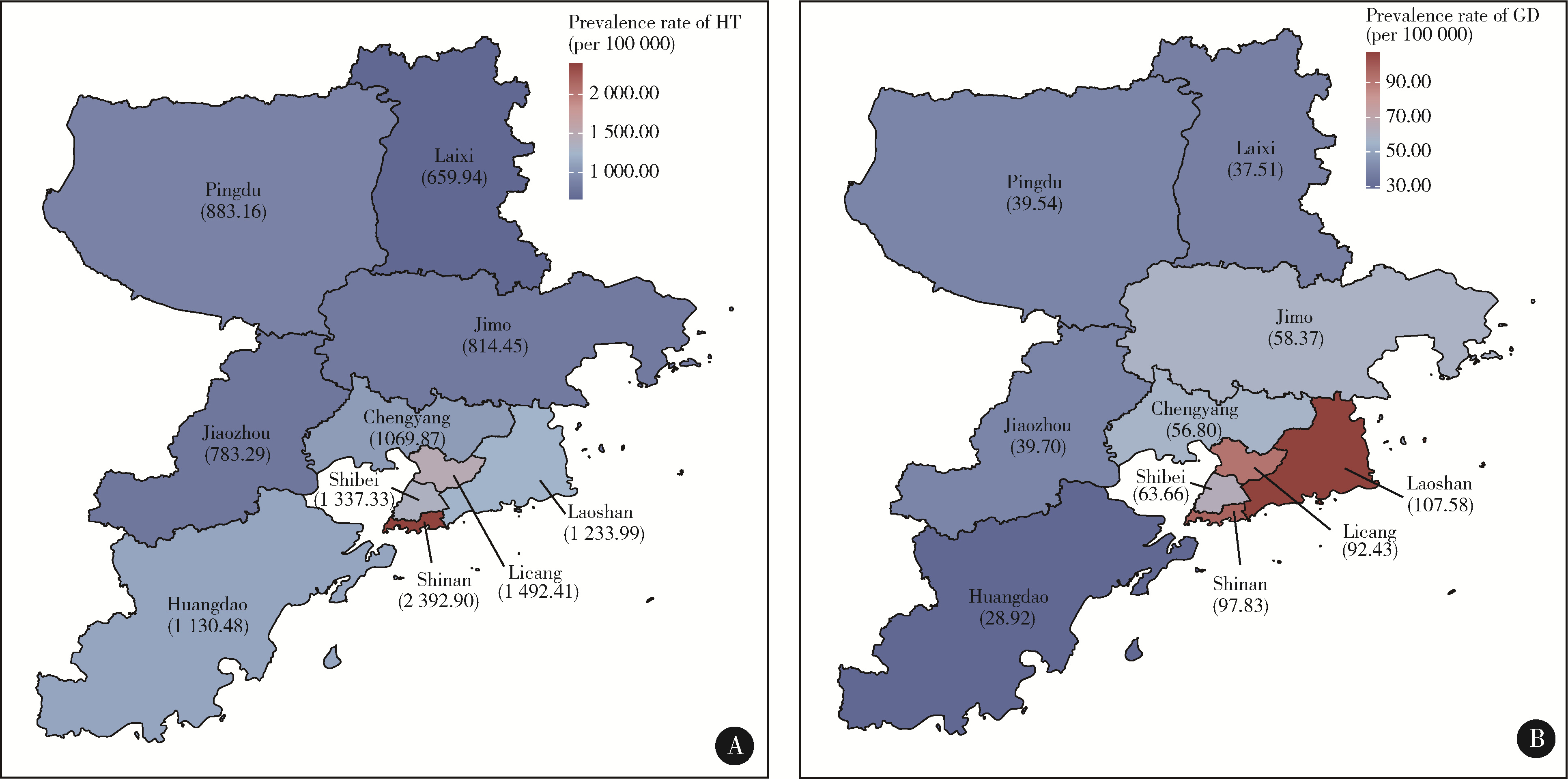
目的: 分析2022—2024年青岛市10~59岁女性桥本甲状腺炎(Hashimoto thyroiditis,HT)和格雷夫斯病(Graves disease,GD)两种自身免疫性甲状腺病的患病特征,为制定针对性的防治措施提供科学依据。方法: 采用横断面研究设计,基于青岛市全民健康信息平台数据,纳入2022—2024年确诊的HT和GD病例,结合第七次人口普查数据,计算HT和GD的三年患病率和年度患病率,采用Cochran-Armitage趋势检验分析年度患病率的时间趋势。分析不同的年龄组和地区HT和GD三年患病率的分布特征,并采用卡方检验比较组间差异。结果: 2022—2024年,青岛市10~59岁女性的HT患病总数为40 362例,在不同年龄组中30~34岁HT患者构成比最高(19.83%),在各区县中黄岛区HT患者构成比最高(17.72%)。HT三年患病率为1 206.53/10万,2022—2024年HT的年度患病率显著上升(P < 0.001),由2022年的385.32/10万增长至2024年的1 206.32/10万。HT三年患病率在年龄分布上差异存在统计学意义(P < 0.001),25~29岁(2 354.44/10万)和35~39岁(2 022.20/10万)高于其他年龄组,呈双峰分布; HT三年患病率在地区分布上差异也存在统计学意义(P < 0.001),市南区最高(2 392.90/10万),其次为李沧区(1 492.41/10万),莱西市最低(659.94/10万)。GD患病总数为2 095例,在不同年龄组中35~39岁GD患者构成比最高(15.42%),在各区县中即墨区GD患者构成比最高(12.27%)。GD三年患病率为62.63/10万,2022—2024年GD年度患病率呈上升趋势(P < 0.001),由2022年的20.33/10万增长至2024年的62.63/10万。GD的年龄别三年患病率差异存在统计学意义(P < 0.001),25~29岁年龄组的GD三年患病率达到最大值(98.90/10万),其次是35~39岁(85.21/10万),而10~14岁最低(14.43/10万); GD三年患病率在地区分布上差异也存在统计学意义(P < 0.001),其中崂山区最高(107.58 /10万),其次是市南区(97.83 /10万),黄岛区最低(28.92/10万)。结论: 2022—2024年青岛市10~59岁女性HT和GD三年患病率水平较低,但年度患病率呈上升趋势,25~39岁女性的HT和GD三年患病率均高于其他年龄组,需要加强该年龄段人群的筛查和监测。

关键词: 桥本甲状腺炎, 格雷夫斯病, 患病率, 女性, 流行病学

Abstract:

Objective: To analyze the characteristics of Hashimoto thyroiditis (HT) and Graves disease (GD), two autoimmune thyroid diseases aged 10-59 in Qingdao City from 2022 to 2024, and to provide scientific basis for making targeted prevention and treatment measures. Methods: A cross-sectional study design was adopted, based on the data of the Regional Health Information Platform in Qingdao, the confirmed cases of HT and GD from 2022 to 2024 were included, and combined with the data of the seventh population census, the three-year and annual prevalence rates of HT and GD were calculated, and the time trend of annual prevalence was analyzed by Cochran-Armitage trend test. The distribution characte-ristics of HT and GD prevalence in different age groups and regions were analyzed, and Chi-square test was used to compare the differences between the groups. Results: The total number of HT patients among women aged 10-59 in Qingdao City from 2022 to 2024 was 40 362. The proportion of HT patients in 30- 34 years old was the highest (19.83%). The proportion of HT patients in Huangdao District was the highest (17.72%). The three-year prevalence of HT was 1 206.53/100 000. In 2022-2024, the annual prevalence of HT increased significantly (P < 0.001), from 385.32/100 000 in 2022 to 1 206.32/ 100 000 in 2024. The three-year prevalence of HT was significantly different in age distribution (P < 0.001). The three-year prevalence of HT in 25-29 years (2 354.44/100 000) and 35-39 years (2 022.20/100 000) was higher than that in other age groups, showing a bimodal distribution. There were significant differences in the three-year prevalence of HT in different regions (P < 0.001), among which the three-year prevalence of HT in Shinan District was the highest (2 392.90/100 000), followed by Licang District (1 492.41/100 000), and Laixi City was the lowest (659.940/100 000). The total number of GD patients was 2 095, among which the proportion of GD patients in the 35-39 age group was the highest (15.42%), and the proportion of GD patients from Jimo District was the highest (12.27%). From 2022 to 2024, the three-year prevalence rate of GD was 62.63/100 000, and the annual prevalence rate of GD showed an increasing trend (P < 0.001), from 20.33/100 000 in 2022 to 62.63/100 000 in 2024. There were significant differences in the prevalence of GD by age (P < 0.001). The three-year prevalence of GD reached the highest value in the 25-29 age group (98.90/100 000), followed by the 35-39 age group (85.21/100 000), and the lowest in the 10-14 age group (14.43/100 000). In the regional distribution, there were significant differences in the 3-year prevalence of GD (P < 0.001). Laoshan District had the highest three-year prevalence of GD (107.58/100 000), followed by Shinan District (97.83/100 000) and Huangdao District (28.92/100 000). Conclusion: The three-year pre-valence of HT and GD in females aged 10-59 years in Qingdao City from 2022 to 2024 is low, but the annual prevalence is on the rise, and the three-year prevalence of HT and GD in females aged 25-39 years is higher than that in other age groups, so it is necessary to strengthen the screening and monitoring of this population.

Key words: Hashimoto thyroiditis, Graves disease, Prevalence, Female, Epidemiology

中图分类号: 

  • R181.32

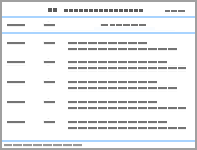
表1

2022—2024年青岛市10~59岁女性桥本甲状腺炎和格雷夫斯病患者的人口学特征"

Items HT (n=40 362) GD (n=2 095)
Age group/years, n(%)
  10-14 290 (0.72) 32 (1.53)
  15-19 632 (1.57) 90 (4.30)
  20-24 2 056 (5.09) 153 (7.30)
  25-29 6 298 (15.60) 259 (12.36)
  30-34 8 003 (19.83) 320 (15.27)
  35-39 7 543 (18.69) 323 (15.42)
  40-44 5 530 (13.70) 249 (11.89)
  45-49 3 508 (8.69) 211 (10.07)
  50-54 3 648 (9.04) 260 (12.41)
  55-59 2 854 (7.07) 198 (9.45)
Districts, n(%)
  Shinan District 3 840 (9.51) 157 (7.49)
  Shibei District 4 895 (12.13) 233 (11.12)
  Huangdao District 7 154 (17.72) 183 (8.74)
  Licang District 3 875 (9.60) 240 (11.46)
  Laoshan District 2 168 (5.37) 189 (9.02)
  Chengyang District 4 031 (9.99) 214 (10.21)
  Jimo District 3 586 (8.88) 257 (12.27)
  Jiaozhou City 2 565 (6.35) 130 (6.21)
  Pingdu City 3 328 (8.25) 149 (7.11)
  Laixi City 1 513 (3.75) 86 (4.11)
  Unknown 3 407 (8.44) 257 (12.27)
Insurance types, n(%)
  Basic medical insurance 26 257 (65.05) 1 219 (58.19)
  Supplementary medical insurance 142 (0.35) 7 (0.33)
  Special relief or grant 244 (0.60) 9 (0.43)
  All expenses paid 11 160 (27.65) 725 (34.61)
  Unknown 2 559 (6.34) 135 (6.44)

表2

2022—2024年青岛市10~59岁女性桥本甲状腺炎和格雷夫斯病患病率"

Items HT GD
n Prevalence rate (95%CI) (per 100 000) P value n Prevalence rate (95%CI) (per 100 000) P value
Three-year
(2022-2024) 40 362 1 206.53 (1 194.79, 1 218.36) 2 095 62.63 (59.97, 65.37)
Annual < 0.001 < 0.001
  2022 12 890 385.32 (378.69, 392.03) 680 20.33 (18.83, 21.91)
  2023 26 292 785.94 (776.47, 795.50) 1 405 42.00 (39.83, 44.25)
  2024 40 355 1 206.32 (1 194.58, 1 218.15) 2 095 62.63 (59.97, 65.37)

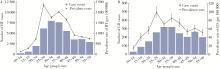
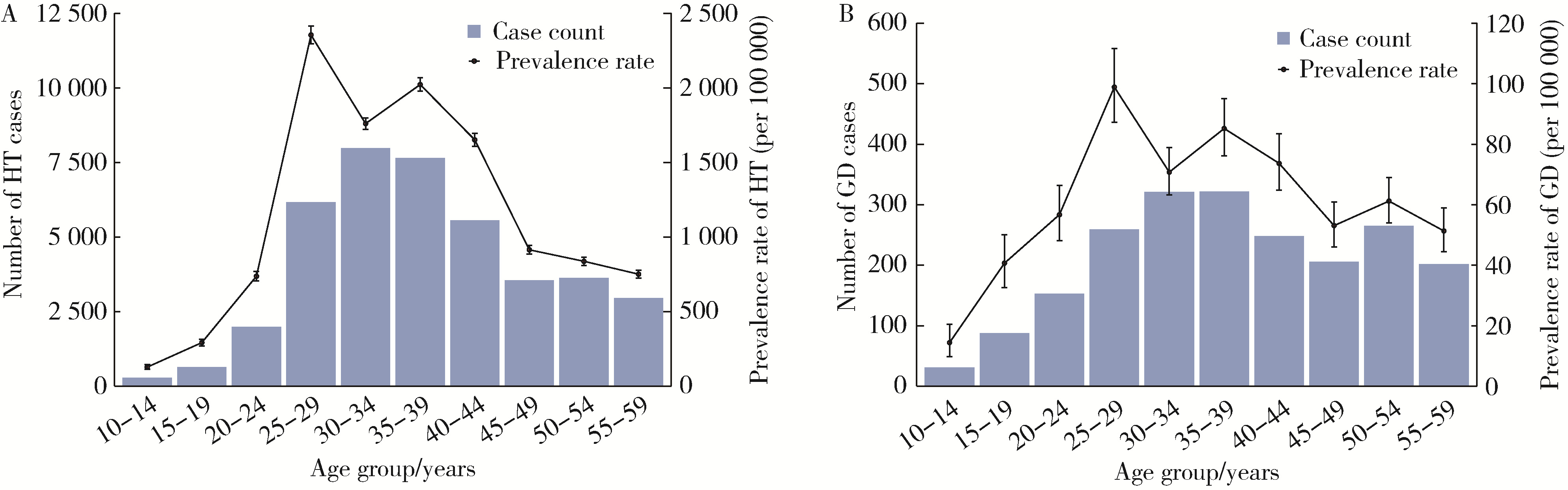
图1

2022—2024年青岛市10~59岁女性桥本甲状腺炎(A)和格雷夫斯病(B)患病率的年龄分布"

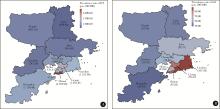
图2

2022—2024年青岛市10~59岁女性桥本甲状腺炎(A)和格雷夫斯病(B)患病率的地区分布示意图"

1
Anaya JM , Shoenfeld Y , Rojas-Villarraga A , et al. Autoimmunity: From bench to bedside[M]. Bogota, Colombia: El Rosario University Press, 2013.
2
中华医学会内分泌学分会, 《中国甲状腺疾病诊治指南》编写组. 中国甲状腺疾病诊治指南——甲状腺炎[J]. 中华内科杂志, 2008, 47 (9): 784- 788.
3
中华医学会内分泌学分会, 中国医师协会内分泌代谢科医师分会, 中华医学会核医学分会, 等. 中国甲状腺功能亢进症和其他原因所致甲状腺毒症诊治指南[J]. 中华内分泌代谢杂志, 2022, 38 (8): 700- 748.
4
Burch HB , Cooper DS . Management of Graves disease: A review[J]. JAMA, 2015, 314 (23): 2544- 2554.

doi: 10.1001/jama.2015.16535
5
Ragusa F , Fallahi P , Elia G , et al. Hashimotos ' thyroiditis: Epidemiology, pathogenesis, clinic and therapy[J]. Best Pract Res Clin Endocrinol Metab, 2019, 33 (6): 101367.

doi: 10.1016/j.beem.2019.101367
6
Conrad N , Misra S , Verbakel JY , et al. Incidence, prevalence, and co-occurrence of autoimmune disorders over time and by age, sex, and socioeconomic status: A population-based cohort study of 22 million individuals in the UK[J]. Lancet, 2023, 401 (10391): 1878- 1890.

doi: 10.1016/S0140-6736(23)00457-9
7
Petranović Ovčariček P , Görges R , Giovanella L . Autoimmune thyroid diseases[J]. Semin Nucl Med, 2024, 54 (2): 219- 236.

doi: 10.1053/j.semnuclmed.2023.11.002
8
Antonelli A , Ferrari SM , Corrado A , et al. Autoimmune thyroid disorders[J]. Autoimmun Rev, 2015, 14 (2): 174- 180.

doi: 10.1016/j.autrev.2014.10.016
9
Manji N , Carr-Smith JD , Boelaert K , et al. Influences of age, gender, smoking, and family history on autoimmune thyroid disease phenotype[J]. J Clin Endocrinol Metab, 2006, 91 (12): 4873- 4880.

doi: 10.1210/jc.2006-1402
10
青岛市统计局. 青岛市第七次全国人口普查公报[R/OL]. (2021-06-08) [2024-12-30]. http://qdtj.qingdao.gov.cn/tongjisj/tjsj_pcgb.
11
青岛市卫生健康委员会. 青岛市卫生健康委员会关于印发青岛市"十四五"区域卫生规划的通知[Z/OL]. (2023-02-21) [2024-12-30]. http://www.shandong.gov.cn/jpaas-jpo/ollicy-web-server/front/info/detail?iid=9803287f71ef4b56beb36b62926f09b0.
12
山东省统计局. 山东省2020年人口普查资料[R/OL]. (2023-05-21) [2024-12-30]. http://tjj.shandong.gov.cn/col/col322452/index.html.
13
王颜刚, 闫胜利, 王斐, 等. 山东沿海地区桥本甲状腺炎流行特点的调查[J]. 山东医药, 2003, 43 (34): 42- 43.
14
Mohamed-Ahmed O , Shang L , Wang L , et al. Incidence and prevalence of autoimmune diseases in China: A systematic review and meta-analysis of epidemiological studies[J]. Global epide-miology, 2024, 8, 100158.

doi: 10.1016/j.gloepi.2024.100158
15
Hu X , Chen Y , Shen Y , et al. Global prevalence and epidemiological trends of Hashimoto's thyroiditis in adults: A systematic review and meta-analysis[J]. Front Public Health, 2022, 10, 1020709.

doi: 10.3389/fpubh.2022.1020709
16
Wu G , Zou D , Cai H , et al. Ultrasonography in the diagnosis of Hashimoto's thyroiditis[J]. Front Biosci (Landmark Ed), 2016, 21 (5): 1006- 1012.

doi: 10.2741/4437
17
Wan S , Qu M , Wu H , et al. Autoimmune thyroid diseases after 25 years of universal salt iodisation: An epidemiological study of Chinese adults in areas with different water iodine levels[J]. Br J Nutr, 2020, 124 (8): 853- 864.

doi: 10.1017/S0007114520001786
18
Li Y , Teng D , Ba J , et al. Efficacy and safety of long-term universal salt iodization on thyroid disorders: Epidemiological evidence from 31 provinces of Mainland China[J]. Thyroid, 2020, 30 (4): 568- 579.

doi: 10.1089/thy.2019.0067
19
Caturegli P , De Remigis A , Rose NR . Hashimoto thyroiditis: Clinical and diagnostic criteria[J]. Autoimmun Rev, 2014, 13 (4/5): 391- 397.
20
杨祺, 唐兢, 吴雯雯, 等. 上海某社区成人自身免疫性甲状腺疾病患病率及影响因素分析[J]. 上海医药, 2020, 41 (14): 34- 36.
21
Gu F , Ding G , Lou X , et al. Incidence of thyroid diseases in Zhejiang Province, China, after 15 years of salt iodization[J]. J Trace Elem Med Biol, 2016, 36, 57- 64.

doi: 10.1016/j.jtemb.2016.04.003
22
Li J , Li Y , Shi X , et al. Prevalence and risk factors of hypothyroidism after universal salt iodisation: A large cross-sectional study from 31 provinces of China[J]. BMJ Open, 2023, 13 (2): e064613.

doi: 10.1136/bmjopen-2022-064613
23
Li Y , Shan Z , Teng W . The iodine status and prevalence of thyroid disorders among women of childbearing age in China: National cross-sectional Study[J]. Endocr Pract, 2021, 27 (10): 1028- 1033.

doi: 10.1016/j.eprac.2021.03.017
24
Menconi F , Marcocci C , Marinò M . Diagnosis and classification of Graves' disease[J]. Autoimmun Rev, 2014, 13 (4/5): 398- 402.
25
Lanzolla G , Marino M , Menconi F . Graves disease: Latest understanding of pathogenesis and treatment options[J]. Nat Rev Endocrinol, 2024, 20 (11): 647- 660.

doi: 10.1038/s41574-024-01016-5
26
Yang F , Shan Z , Teng X , et al. Chronic iodine excess does not increase the incidence of hyperthyroidism: A prospective community- based epidemiological survey in China[J]. Eur J Endocrinol, 2007, 156 (4): 403- 408.

doi: 10.1530/EJE-06-0651
[1] 王起, 柯涵炜, 丁泽华, 张维宇, 张晓鹏, 徐涛, 许克新. 耻骨后与经闭孔尿道中段悬吊术对术后最大尿流率及残余尿量的影响[J]. 北京大学学报(医学版), 2025, 57(4): 717-720.
[2] 杨子铭, 李淑雅, 李肖彤, 沈鹏, 孙烨祥, 林鸿波, 江志琴, 詹思延, 刘志科. 2015—2024年宁波市鄞州区肺炎人群呼吸道病原体分布特点[J]. 北京大学学报(医学版), 2025, 57(3): 496-506.
[3] 阿娜尔古丽·阿不都肉什提, 宋迎豪, 闫晓晋, 高永康, 刘波, 胡刚. 1990—2021年中国及全球增龄性听力损失的疾病负担与未来趋势预测[J]. 北京大学学报(医学版), 2025, 57(3): 545-553.
[4] 林芳汝, 唐志辉. 种植单冠修复后种植体周健康的相关分析[J]. 北京大学学报(医学版), 2025, 57(2): 347-353.
[5] 李雨清,王飚,乔鹏,王玮,关星. 经耻骨后尿道中段悬吊带术治疗女性复发性压力性尿失禁的中长期疗效[J]. 北京大学学报(医学版), 2024, 56(4): 600-604.
[6] 曾媛媛,谢云,陈道南,王瑞兰. 脓毒症患者发生正常甲状腺性病态综合征的相关因素[J]. 北京大学学报(医学版), 2024, 56(3): 526-532.
[7] 王子恺,莫佳丽,张蒙,廖纪萍. 2013—2020年北京市慢性阻塞性肺疾病急性加重女性住院患者的流行病学和住院费用分析[J]. 北京大学学报(医学版), 2023, 55(6): 1074-1081.
[8] 林咏惟,周雅琳,赵润茏,许雅君,刘燕萍. 孕早期女性铁营养状况及其影响因素分析[J]. 北京大学学报(医学版), 2023, 55(4): 600-605.
[9] 傅强,高冠英,徐雁,林卓华,孙由静,崔立刚. 无症状髋关节前上盂唇撕裂超声与磁共振检查的对比研究[J]. 北京大学学报(医学版), 2023, 55(4): 665-669.
[10] 姬学朝,刘珊,王万州,赵烨彤,李陆一,张文楼,沈国锋,邓芙蓉,郭新彪. 室内挥发性有机物与年轻女性夜间心率变异性关联的定组研究[J]. 北京大学学报(医学版), 2023, 55(3): 488-494.
[11] 王哲,孙伟,杨雪,宋颖,姬爱平,白洁. 口腔急诊颌面部感染患者临床分析[J]. 北京大学学报(医学版), 2023, 55(3): 543-547.
[12] 孙希雅,陈艺璐,曾琳,闫丽盈,乔杰,李蓉,智旭. 不孕女性维生素D水平与抗苗勒氏管激素的相关性及对妊娠结局的预测[J]. 北京大学学报(医学版), 2023, 55(1): 167-173.
[13] 方伟岗,田新霞,解云涛. 基因多态性对中国汉族女性乳腺癌遗传易感性的影响[J]. 北京大学学报(医学版), 2022, 54(5): 822-828.
[14] 姚晓莹,刘志科,李宁,马瑞,赵薛飞,张良,许国章,詹思延,方挺. 2015—2019年宁波市0~36月龄婴幼儿癫痫发病的流行病学研究[J]. 北京大学学报(医学版), 2021, 53(3): 485-490.
[15] 董彦会,陈曼曼,王丽萍,星一,宋逸,邹志勇,董彬,李中杰,马军. 中国6~22岁学生群体甲乙丙类传染病流行趋势[J]. 北京大学学报(医学版), 2021, 53(3): 498-505.
Viewed
Full text


Abstract

Cited

  Shared   
  Discussed   
No Suggested Reading articles found!