北京大学学报(医学版) ›› 2025, Vol. 57 ›› Issue (3): 496-506. doi: 10.19723/j.issn.1671-167X.2025.03.013

• 论著 • 上一篇    下一篇

2015—2024年宁波市鄞州区肺炎人群呼吸道病原体分布特点

杨子铭1,2, 李淑雅1,2, 李肖彤1,2, 沈鹏3, 孙烨祥3, 林鸿波3, 江志琴3, 詹思延1,2,4,5,*(), 刘志科1,2,*()   

  1. 1. 北京大学公共卫生学院流行病与卫生统计学系, 北京 100191
    2. 重大疾病流行病学教育部重点实验室(北京大学), 北京 100191
    3. 宁波市鄞州区疾病预防控制中心, 浙江宁波 315199
    4. 北京大学第三医院临床流行病学研究中心, 北京 100191
    5. 北京大学人工智能研究院智慧公众健康研究中心, 北京 100871
  • 收稿日期:2025-01-29 出版日期:2025-06-18 发布日期:2025-06-13
  • 通讯作者: 詹思延, 刘志科
  • 基金资助:
    国家自然科学基金(82330107); 国家自然科学基金(72361127500)

Distribution of respiratory pathogens in patients with pneumonia in Yinzhou, Ningbo, 2015-2024

Ziming YANG1,2, Shuya LI1,2, Xiaotong LI1,2, Peng SHEN3, Yexiang SUN3, Hongbo LIN3, Zhiqin JIANG3, Siyan ZHAN1,2,4,5,*(), Zhike LIU1,2,*()   

  1. 1. Department of Epidemiology and Biostatistics, Peking University School of Public Health, Beijing 100191, China
    2. Key Laboratory of Epidemiology of Major Diseases (Peking University), Ministry of Education, Beijing 100191, China
    3. Yinzhou District Center for Disease Control and Prevention of Ningbo, Ningbo 315199, Zhejiang, China
    4. Research Center of Clinical Epidemiology, Peking University Third Hospital, Beijing 100191, China
    5. Center for Intelligent Public Health, Institute for Artificial Intelligence, Peking University, Beijing 100871, China
  • Received:2025-01-29 Online:2025-06-18 Published:2025-06-13
  • Contact: Siyan ZHAN, Zhike LIU
  • Supported by:
    the National Natural Science Foundation of China(82330107); the National Natural Science Foundation of China(72361127500)

RICH HTML


摘要:

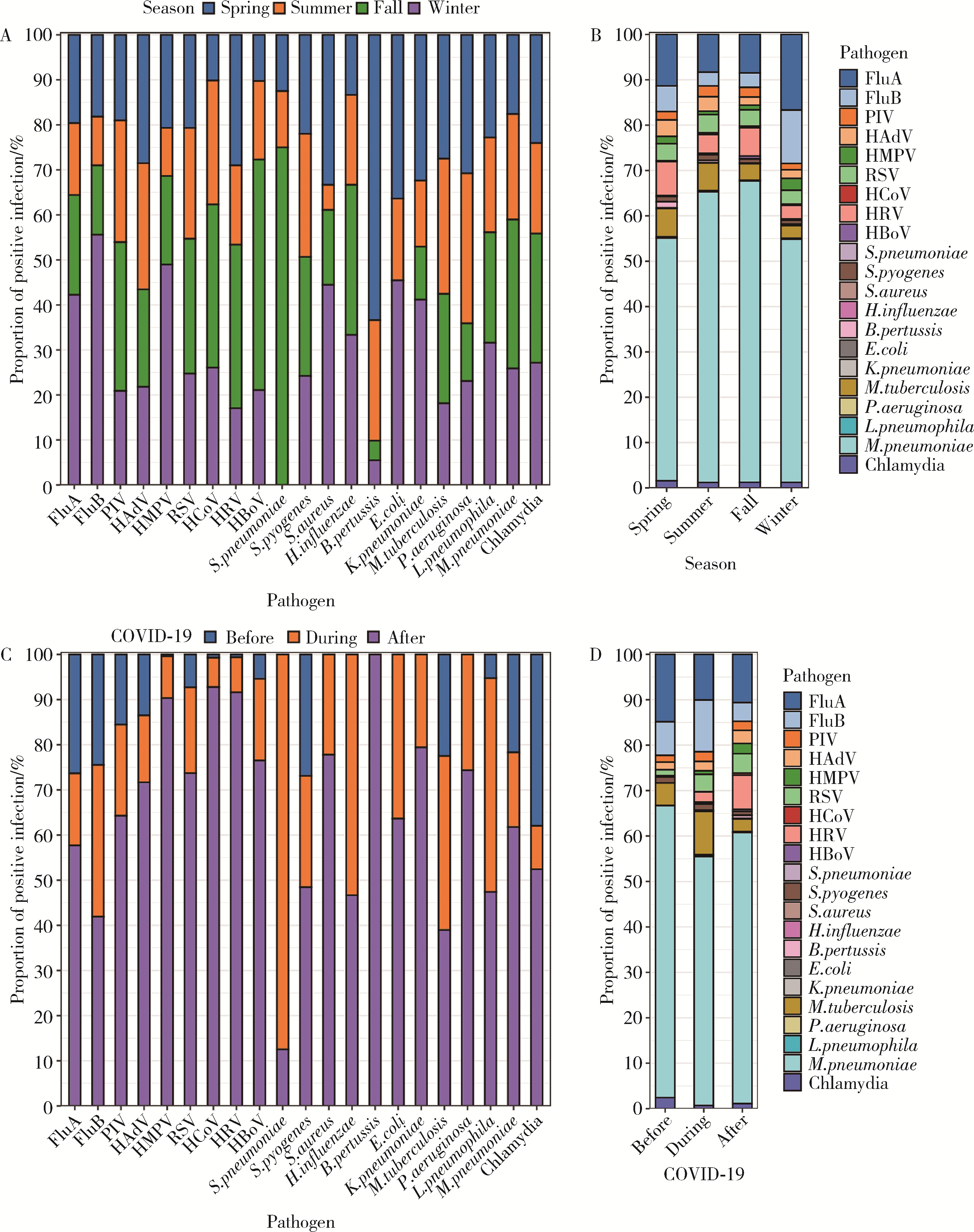
目的: 描述2015年1月1日至2024年12月21日期间宁波市鄞州区肺炎患者22种常见呼吸道病原体的流行特征。方法: 收集2015年1月1日至2024年12月21日期间鄞州区域健康信息平台中被诊断为肺炎或肺部感染的患者22种常见呼吸道病原体检验数据,计算阳性率、阳性人次和构成比,并从年度、性别、年龄组、季节、新型冠状病毒感染时期等亚组分别描述其流行特征。结果: 共纳入77 531例肺炎患者,进行呼吸道病原体检验492 696人次。鄞州区肺炎患者呼吸道病原体检验和阳性人次呈上升趋势。34.63%肺炎患者检出至少1种病原体阳性,病原体未检出率由2015年的79.44%下降至2024年的58.38%。总体病原体阳性率为9.12%,新型冠状病毒感染期间阳性率有所下降,新型冠状病毒感染后尚未回升至新型冠状病毒感染前水平。6~17岁儿童阳性率最高(13.99%),60岁以上老年人最低(4.16%)。病原体阳性人次前3位为肺炎支原体、甲型流感病毒和乙型流感病毒;病原体检验阳性率前3位为肺炎支原体(25.26%)、鼻病毒(12.02%)和百日咳鲍特菌(11.66%)。男性病原谱构成比与女性基本相似,仅表现出更高的结核分枝杆菌感染和略低的肺炎支原体感染(P < 0.001)。肺炎支原体、呼吸道合胞病毒和鼻病毒感染更多见于儿童,而流感病毒、结核分枝杆菌和溶血性链球菌则更多见于成人和老年人(P < 0.001)。流感病毒和偏肺病毒多发于冬季,鼻病毒和百日咳鲍特菌多发于春季,肺炎支原体则相对多发于秋季(P < 0.001)。新型冠状病毒感染后肺炎患者的鼻病毒、呼吸道合胞病毒、偏肺病毒感染构成比明显升高,分别达到7.53%、4.26%、2.25%,而乙型流感病毒和结核分枝杆菌感染构成比则分别降低至4.14%和2.80%(P < 0.001)。结论: 近十年间鄞州区肺炎人群呼吸道病原体感染规模明显扩大,并存在年度、性别、年龄、季节上的分布差异;新型冠状病毒感染后肺炎患者的呼吸道病原谱具有多样化趋势。

关键词: 肺炎, 病原体, 流行病学特征, 公共卫生监测

Abstract:

Objective: To describe the epidemiological characteristics of 22 common respiratory pathogens in patients with pneumonia in Yinzhou, Ningbo, from January 1, 2015 to December 21, 2024. Methods: The test data of 22 common respiratory pathogens in patients diagnosed with pneumonia or lung infection in the Yinzhou Regional Health Information Platform from January 1, 2015 to December 21, 2024 were collected. The positive cases, positive rates, and positive proportions were calculated. The epidemiological characteristics were described by the year, sex, age group, season, and coronavirus disease 2019 (COVID-19) pandemic period. Results: A total of 77 531 pneumonia patients were included, with 492 696 respiratory pathogen tests performed. The number of respiratory pathogen tests and positive cases of pneumonia patients in Yinzhou showed an upward trend. In the study, 34.63% of the pneumonia patients tested positive for at least one pathogen, and the pathogen non-detection rate decreased from 79.44% in 2015 to 58.38% in 2024. The overall pathogen positive rate was 9.12%, which decreased during the COVID-19 pandemic and had not returned to the historical level after the COVID-19 pande- mic. The positive rate was highest in children aged 6-17 years (13.99%), and lowest in the elderly over 60 years (4.16%). The top 3 highest number of positive cases was Mycoplasma pneumoniae, influenza A virus, and influenza B virus; the top 3 highest positive rates of pathogen tests were Mycoplasma pneumoniae (25.26%), rhinovirus (12.02%), and Bordetella pertussis (11.66%). The pathogen spectrum proportion in men was similar to that in women, only showing a higher ratio of Mycobacterium tuberculosis and a slightly lower ratio of Mycoplasma pneumoniae (P < 0.001). Mycoplasma pneumoniae, respiratory syncytial virus, and rhinovirus infections were more common in children, while influenza virus, Mycobacterium tuberculosis, and Streptococcus pyogenes infections were more common in adults and the elderly (P < 0.001). Influenza virus and human metapneumovirus infections were more common in winter, rhinovirus and Bordetella pertussis infections were more common in spring, and Mycoplasma pneumoniae infections were relatively more common in fall (P < 0.001). After the COVID-19 pandemic, the proportions of rhinovirus, respiratory syncytial virus, and human metapneumovirus infections in the pneumonia patients increased signi-ficantly, reaching 7.53%, 4.26%, and 2.25%, respectively, while the proportions of influenza B virus and Mycobacterium tuberculosis infections decreased to 4.14% and 2.80%, respectively (P < 0.001). Conclusion: In the past decade, the scale of respiratory pathogen infection in the pneumonia population in Yinzhou had expanded significantly, and there were differences in distribution by the year, gender, age group, and season. The respiratory pathogen spectrum in pneumonia patients after the COVID-19 pandemic had a trend of diversification.

Key words: Pneumonia, Pathogens, Epidemiological characteristics, Public health surveillance

中图分类号: 

  • R184

表1

研究对象基本特征"

Characteristics Test person-time Positive person-time Positive rate/% (95%CI) P
Gender < 0.001
  Man 260 029 22 724 8.74 (8.63, 8.85)
  Woman 232 667 22 228 9.55 (9.43, 9.67)
Ethnicitya 0.556
  Han 369 705 34 236 9.26 (9.17, 9.35)
  Minorities 587 59 10.05 (7.74, 12.77)
Age group/years < 0.001
  0-5 169 798 17 027 10.03 (9.89, 10.17)
  6-17 121 281 16 970 13.99 (13.80, 14.19)
  18-44 46 609 3 958 8.49 (8.24, 8.75)
  45-59 39 278 2 187 5.57 (5.34, 5.80)
  ≥60 115 730 4 810 4.16 (4.04, 4.27)
Year < 0.001
  2015 1 075 108 10.05 (8.31, 12.00)
  2016 2 665 386 14.48 (13.17, 15.88)
  2017 10 196 1 213 11.90 (11.27, 12.54)
  2018 20 592 2 141 10.40 (9.98, 10.82)
  2019 42 968 5 220 12.15 (11.84, 12.46)
  2020 24 528 2 203 8.98 (8.63, 9.35)
  2021 36 231 2 477 6.84 (6.58, 7.10)
  2022 43 548 3 426 7.87 (7.62, 8.12)
  2023 140 618 13 422 9.55 (9.39, 9.70)
  2024 170 275 14 356 8.43 (8.30, 8.56)
Season < 0.001
  Spring 107 354 8 829 8.22 (8.06, 8.39)
  Summer 107 801 9 810 9.10 (8.93, 9.27)
  Fall 136 109 13 367 9.82 (9.66, 9.98)
  Winter 141 432 12 946 9.15 (9.00, 9.30)
COVID-19 period < 0.001
  Before 77 496 9 068 11.70 (11.48, 11.93)
  During 104 307 8 106 7.77 (7.61, 7.94)
  After 310 893 27 778 8.93 (8.83, 9.04)
Total 492 696 44 952 9.12 (9.04, 9.20)

表2

各病原体的检验人次及阳性率"

Pathogen Test person-time Positive person-time Positive rate/% (95%CI)
Influenza A virus 76 849 5 111 6.65 (6.48, 6.83)
Influenza B virus 44 721 2 745 6.14 (5.92, 6.36)
Parainfluenza virus 21 528 862 4.00 (3.75, 4.27)
Human adenovirus 39 065 1 119 2.86 (2.70, 3.03)
Human metapneumovirus 12 871 692 5.38 (4.99, 5.78)
Respiratory syncytial virus 36 461 1 605 4.40 (4.19, 4.62)
Human coronavirus 12 911 138 1.07 (0.90, 1.26)
Human rhinovirus 18 996 2 283 12.02 (11.56, 12.49)
Human bocavirus 12 921 166 1.28 (1.10, 1.49)
Streptococcus pneumoniae 331 8 2.42 (1.05, 4.71)
Streptococcus pyogenes 11 972 446 3.73 (3.39, 4.08)
Staphylococcus aureus 503 18 3.58 (2.13, 5.60)
Haemophilus influenzae 28 105 15 0.05 (0.03, 0.09)
Bordetella pertussis 1 570 183 11.66 (10.11, 13.35)
Escherichia coli 522 11 2.11 (1.06, 3.74)
Klebsiella pneumoniae 1 710 34 1.99 (1.38, 2.77)
Mycobacterium tuberculosis 23 226 1 995 8.59 (8.23, 8.96)
Pseudomonas aeruginosa 1 428 39 2.73 (1.95, 3.71)
Legionella pneumophila 6 157 57 0.93 (0.70, 1.20)
Mycoplasma pneumoniae 106 260 26 843 25.26 (25.00, 25.52)
Chlamydia 32 847 582 1.77 (1.63, 1.92)
Rickettsia 1 742 0 0.00 (0.00, 0.21)
Virus total 276 323 14 721 5.33 (5.24, 5.41)
Bacterium totala 75 524 2 806 3.72 (3.58, 3.85)

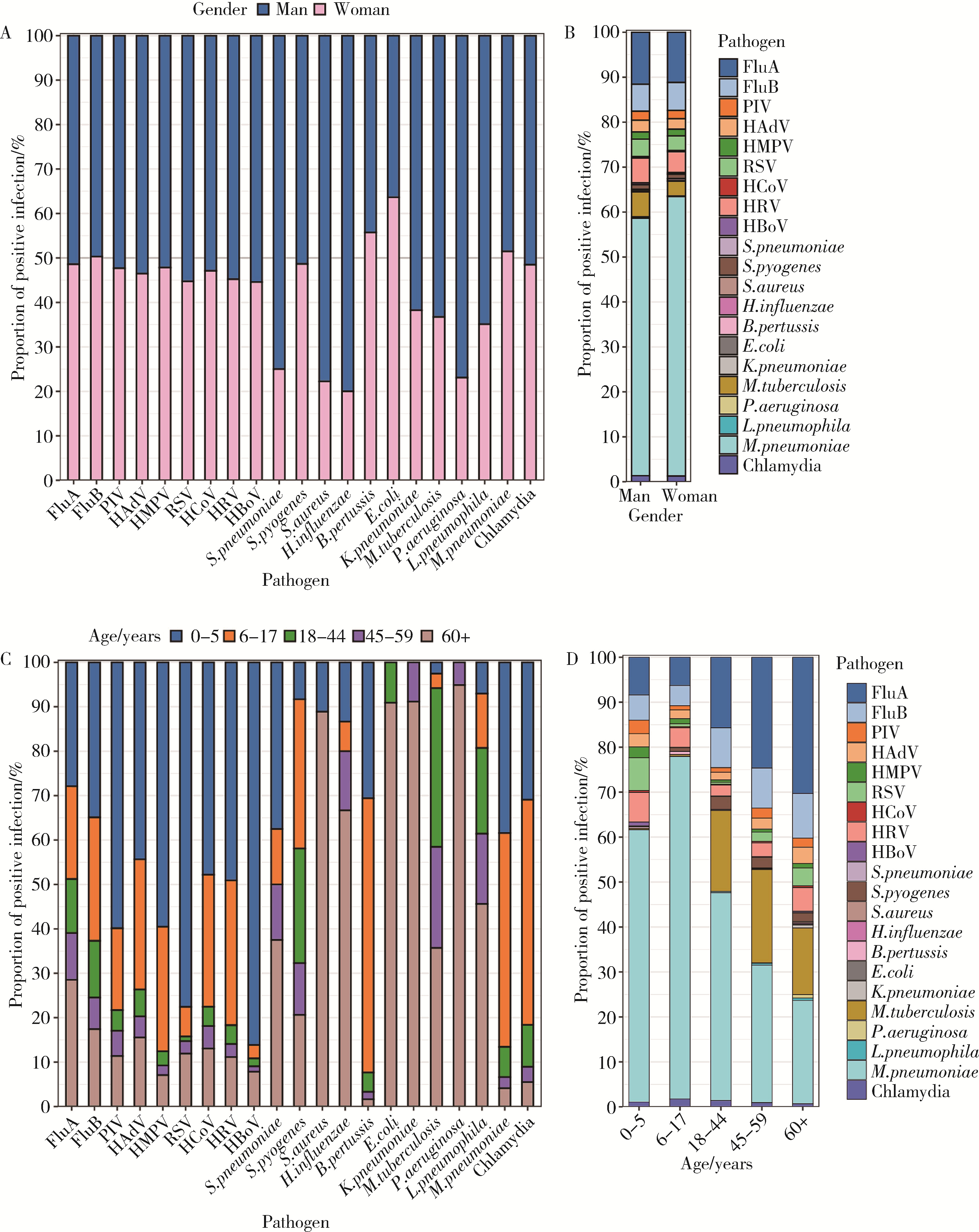
图1

呼吸道病原体的性别和年龄分布"

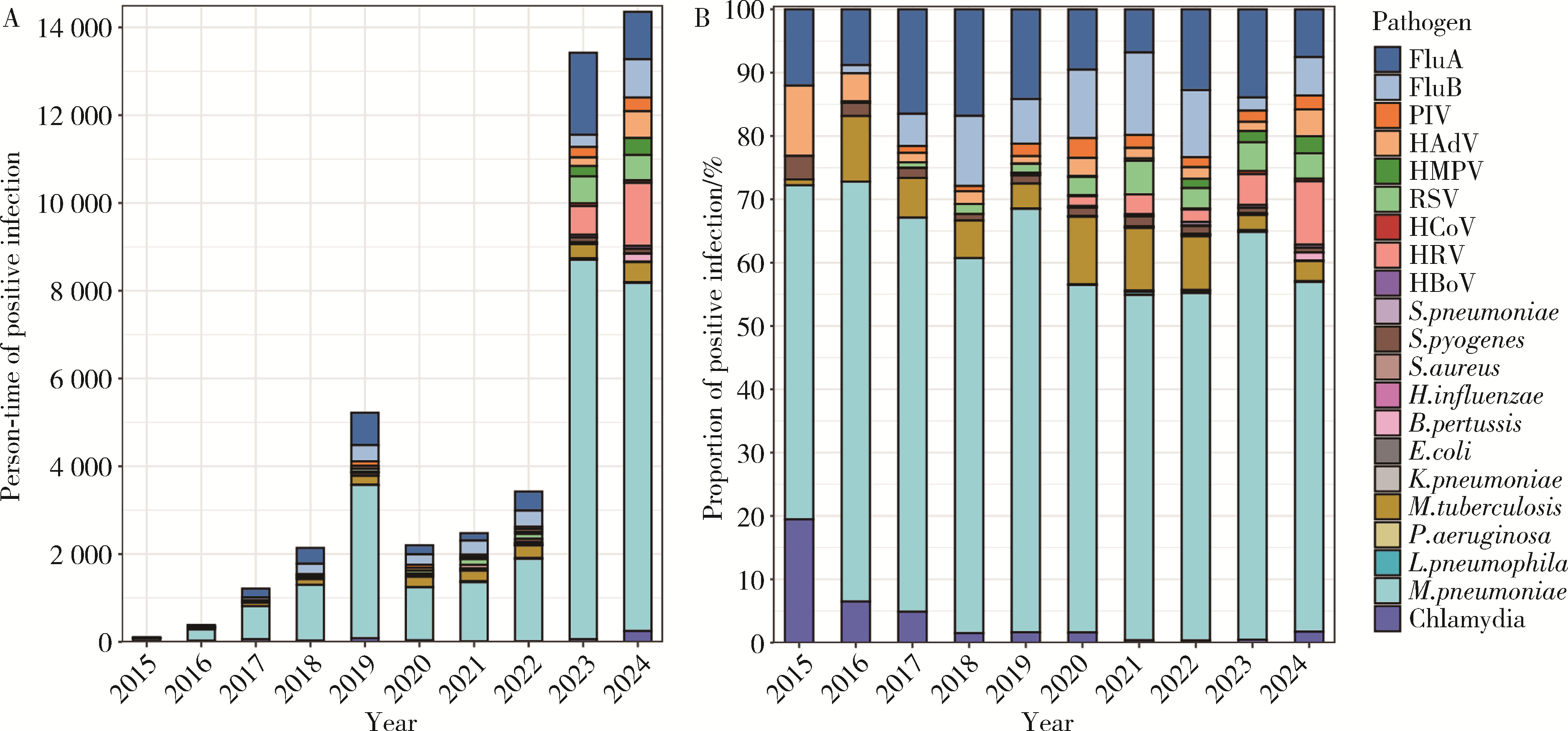
图2

2015—2024年呼吸道病原体的流行特征趋势"

图3

呼吸道病原体的季节和新型冠状病毒感染时期分布"

1
GBD 2021 Lower Respiratory Infections and Antimicrobial Resis-tance Collaborators . Global, regional, and national incidence and mortality burden of non-COVID-19 lower respiratory infections and aetiologies, 1990-2021: A systematic analysis from the Global Burden of Disease Study 2021[J]. Lancet Infect Dis, 2024, 24 (9): 974- 1002.

doi: 10.1016/S1473-3099(24)00176-2
2
邹林, 高翔, 张冲, 等. 2020—2022年北京市通州区呼吸道感染患者呼吸道病原体流行特征分析[J]. 疾病监测, 2023, 38 (7): 799- 805.
3
杨霖昀, 唐国英, 郑小萍, 等. 2019—2022年重庆开州区儿童呼吸道感染病原体流行特征[J]. 公共卫生与预防医学, 2024, 35 (3): 137- 140.
4
杨雪, 吴重阳, 熊丽, 等. 非药物干预措施对成人感染呼吸道病原体流行特征的影响[J]. 国际检验医学杂志, 2024, 45 (12): 1425- 1430.
5
Liu G , Liu Z , Zhao H , et al. The effectiveness of influenza vaccine among elderly Chinese: A regression discontinuity design based on Yinzhou regional health information platform[J]. Hum Vaccin Immunother, 2022, 18 (6): 2115751.

doi: 10.1080/21645515.2022.2115751
6
严梦瑶. 苏州地区住院儿童下呼吸道感染病原学流行特征以及与气候因素、大气污染物相关性研究[D]. 苏州: 苏州大学, 2022.
7
国家卫生健康委员会. 2020年第1号[EB/OL]. (2020-01-20) [2025-01-01]. http://www.nhc.gov.cn/xcs/zhengcwj/202001/44a3b8245e8049d2837a4f27529cd386.shtml.
8
国家卫生健康委员会. 2022年第7号[EB/OL]. (2022-12-26) [2025-01-01]. http://www.nhc.gov.cn/xcs/zhengcwj/202212/6630916374874368b9fea6c2253289e1.shtml.
9
张静, 王蕊, 任心慈, 等. "提高抗菌药物治疗前病原学送检率"专项行动三年改进效果追踪评价[J]. 中国感染控制杂志, 2024, 23 (11): 1430- 1437.
10
褚衍茹, 雷松, 劳旭影, 等. 2023—2024年宁波市冬春季急性呼吸道感染病例多病原流行特征分析[J]. 现代实用医学, 2024, 36 (9): 1162- 1165.
11
国家呼吸系统疾病临床医学研究中心, 国家儿童医学中心, 中华医学会儿科学分会呼吸学组, 等. 中国儿童肺炎链球菌性疾病诊断、治疗和预防专家共识[J]. 中华实用儿科临床杂志, 2020, 35 (7): 485- 505.
12
Li Z , Zhang H , Ren L , et al. Etiological and epidemiological features of acute respiratory infections in China[J]. Nat Commun, 2021, 12 (1): 5026.

doi: 10.1038/s41467-021-25120-6
13
汪海霞, 张学东, 张舒林, 等. 2011—2023年南阳市临床检测呼吸道病原体流行趋势及新冠疫情防控的影响[J]. 中华医院感染学杂志, 2024, 34 (11): 1672- 1678.
14
曹艳, 陈雨, 伊洁, 等. 北京地区2023—2024年秋冬季急性呼吸道感染疾病的病原体流行情况分析: 以北京协和医院5556例患者为例[J/OL]. 协和医学杂志, 2024, 12 (2024-12-09)[2025-01-05]. https://link.cnki.net/urlid/11.5882.r.20241209.1043.002.
15
Cherry JD . Epidemic pertussis in 2012: The resurgence of a vaccine-preventable disease[J]. N Engl J Med, 2012, 367 (9): 785- 787.

doi: 10.1056/NEJMp1209051
16
常子维, 唐海龙, 张娟, 等. 2011—2021年某院儿科住院呼吸道感染患儿病原体检测结果报告[J]. 中华医院感染学杂志, 2024, 34 (22): 3467- 3471.
17
World Health Organization. Global tuberculosis report 2024 [EB/OL]. (2024-10-29) [2025-01-01]. https://www.who.int/teams/global-tuberculosis-programme/tb-reports/global-tuberculosis-report-2024.
18
刘淑琼, 谢乐云, 曾赛珍, 等. 2013—2021年湖南地区社区获得性肺炎住院儿童肺炎支原体感染流行病学分析[J]. 中华微生物学和免疫学杂志, 2023, 43 (6): 432- 441.
19
张新星, 季伟, 顾文婧, 等. 2005年至2014年苏州地区儿童呼吸道肺炎支原体感染流行病学分析[J]. 中华传染病杂志, 2015, 33 (10): 594- 598.
20
毛碧波, 陈黛娜, 卢文波, 等. 2019—2023年宁波市0~17岁住院患儿肺炎支原体感染及耐药基因突变流行特征分析[J]. 中华预防医学杂志, 2024, 58 (7): 1035- 1040.
21
刘燕, 方巧云, 曾健君, 等. 2013—2017年惠州市重症社区获得性肺炎病例甲型流感/禽流感监测结果分析[J]. 实用预防医学, 2018, 25 (8): 922- 925.
22
权雅文, 李刚. 衰老与免疫的研究进展[J]. 中国临床保健杂志, 2022, 25 (4): 455- 459.
23
苏伟, 张复春. 甲型流感研究进展[J]. 新发传染病电子杂志, 2018, 3 (3): 182- 187.
24
Huang QS , Wood T , Jelley L , et al. Impact of the COVID-19 nonpharmaceutical interventions on influenza and other respiratory viral infections in New Zealand[J]. Nat Commun, 2021, 12 (1): 1001.

doi: 10.1038/s41467-021-21157-9
25
Chow EJ , Uyeki TM , Chu HY . The effects of the COVID-19 pandemic on community respiratory virus activity[J]. Nat Rev Microbiol, 2023, 21 (3): 195- 210.
26
Cohen R , Ashman M , Taha MK , et al. Pediatric Infectious Disease Group (GPIP) position paper on the immune debt of the COVID-19 pandemic in childhood, how can we fill the immunity gap?[J]. Infect Dis Now, 2021, 51 (5): 418- 423.

doi: 10.1016/j.idnow.2021.05.004
27
韩鹏, 郑跃杰, 杨永弘, 等. 儿童新型冠状病毒流行期间的免疫债及其影响[J]. 中华实用儿科临床杂志, 2023, 38 (1): 4- 9.
28
曾艺, 孙艺, 杨泽璇, 等. 上海市大学生新冠肺炎疫情不同阶段知信行变化情况[J]. 中国学校卫生, 2022, 43 (11): 1655- 1658.
29
邹晓辉, 曹彬. 呼吸道感染病原学诊断年度进展2021[J]. 中华结核和呼吸杂志, 2022, 45 (1): 78- 82.
30
全旭. 新冠疫情下苏州地区下呼吸道感染住院儿童病原谱及合胞病毒感染临床特征的变化[D]. 苏州: 苏州大学, 2023.
31
马稹. 新冠疫情对住院社区获得性肺炎患儿常见呼吸道病毒流行趋势的影响[D]. 吉林: 吉林大学, 2023.
32
徐爱强, 冯录召, 谢正德. 我国婴幼儿呼吸道合胞病毒感染被动免疫预防专家共识[J]. 中国预防医学杂志, 2024, 25 (10): 1223- 1234.
33
张新燕, 马建中, 闫春娟. 2017—2022年天水市国家级某哨点医院流感监测结果分析[J]. 中国初级卫生保健, 2024, 38 (2): 70- 72.
34
麻粉莲, 郑丽舒. 人偏肺病毒感染研究进展[J]. 病毒学报, 2024, 40 (1): 133- 139.
35
刘洋, 游贤路, 韩真明. 重庆市百日咳流行病学特征及影响因素分析[J]. 现代预防医学, 2021, 48 (8): 1372- 1374.
[1] 刘家骏, 刘国康, 朱玉虎. 免疫相关性重症肺炎1例[J]. 北京大学学报(医学版), 2024, 56(5): 932-937.
[2] 朱金荣,赵亚娜,黄巍,赵微微,王悦,王松,苏春燕. 感染新型冠状病毒的血液透析患者的临床特征[J]. 北京大学学报(医学版), 2024, 56(2): 267-272.
[3] 李建斌,吕梦娜,池强,彭一琳,刘鹏程,吴锐. 干燥综合征患者发生重症新型冠状病毒肺炎的早期预测[J]. 北京大学学报(医学版), 2023, 55(6): 1007-1012.
[4] 赖金惠,王起,姬家祥,王明瑞,唐鑫伟,许克新,徐涛,胡浩. 新型冠状病毒肺炎疫情期间延迟拔除输尿管支架对泌尿系结石术后患者生活质量和心理状态的影响[J]. 北京大学学报(医学版), 2023, 55(5): 857-864.
[5] 曹乐清,周婧睿,陈育红,陈欢,韩伟,陈瑶,张圆圆,闫晨华,程翼飞,莫晓冬,付海霞,韩婷婷,吕萌,孔军,孙于谦,王昱,许兰平,张晓辉,黄晓军. 异基因造血干细胞移植后晚发重症肺炎患者治疗与预后转归的关系[J]. 北京大学学报(医学版), 2022, 54(5): 1013-1020.
[6] 康志宇,王磊磊,韩永正,郭向阳. 北京冬季奥林匹克运动会运动员手术的麻醉管理[J]. 北京大学学报(医学版), 2022, 54(4): 770-773.
[7] 陈明隆,刘笑晗,郭静. 新型冠状病毒肺炎疫情下儿童父母社会支持与养育倦怠的关系[J]. 北京大学学报(医学版), 2022, 54(3): 520-525.
[8] 钱婧,魏友加,程毅菁,张奕,彭博,朱春梅. 儿童坏死性肺炎临床特征及危险因素分析[J]. 北京大学学报(医学版), 2022, 54(3): 541-547.
[9] 李佳,徐钰,王优雅,高占成. 老年流感肺炎的临床特征及D-二聚体与疾病严重程度的相关性[J]. 北京大学学报(医学版), 2022, 54(1): 153-160.
[10] 苏俊琪,宋扬,谢尚. 口腔鳞状细胞癌患者修复重建术后感染的病原学特征及感染风险预测模型的构建[J]. 北京大学学报(医学版), 2022, 54(1): 68-76.
[11] 王飞,朱翔,贺蓓,朱红,沈宁. 自发缓解的滤泡性细支气管炎伴非特异性间质性肺炎1例报道并文献复习[J]. 北京大学学报(医学版), 2021, 53(6): 1196-1200.
[12] 黄冰, 王洪源. 全球新型冠状病毒肺炎疫情发展趋势及严重程度[J]. 北京大学学报(医学版), 2021, 53(3): 536-542.
[13] 杨群智,张舸,费雅楠,付爽,闫冰. 沙利度胺治疗原发性干燥综合征合并轻中度非特异性间质性肺炎疗效观察[J]. 北京大学学报(医学版), 2021, 53(2): 413-416.
[14] 包芳,史尉利,胡静,张娣,高东晗,夏云霞,景红梅,克晓燕,葛庆岗,沈宁. 新型冠状病毒肺炎淋巴细胞亚群与严重程度的相关分析[J]. 北京大学学报(医学版), 2020, 52(6): 1075-1081.
[15] 袁晓宁,孟庆阳,沈宁,李宇轩,梁超,崔曼,葛庆岗,李晓光,谭昆,陈茜,王晶,曾晓勇. 新型冠状病毒肺炎病区环境及医务人员防护设备表面SARS-CoV-2核酸污染的检测与评价[J]. 北京大学学报(医学版), 2020, 52(5): 803-808.
Viewed
Full text


Abstract

Cited

  Shared   
  Discussed   
No Suggested Reading articles found!