北京大学学报(医学版) ›› 2025, Vol. 57 ›› Issue (3): 522-528. doi: 10.19723/j.issn.1671-167X.2025.03.016

• 论著 • 上一篇    下一篇

2型糖尿病患者使用E-health管理疾病意愿与影响机制

陈子砚, 张晓悦, 顾亦梧, 常春*()   

  1. 北京大学公共卫生学院社会医学与健康教育学系, 北京 100191
  • 收稿日期:2025-02-07 出版日期:2025-06-18 发布日期:2025-06-13
  • 通讯作者: 常春
  • 基金资助:
    北京大学医学部大健康国际研究院项目(48014Y1021)

Type 2 diabetes patients use E-health to manage disease willingness and influence mechanisms

Ziyan CHEN, Xiaoyue ZHANG, Yiwu GU, Chun CHANG*()   

  1. Department of Social Medicine and Health Education, Peking University School of Public Health, Beijing 100191, China
  • Received:2025-02-07 Online:2025-06-18 Published:2025-06-13
  • Contact: Chun CHANG
  • Supported by:
    the International Institute of Population Health, Peking University Health Science Center(48014Y1021)

RICH HTML


摘要:

目的: 探讨2型糖尿病患者对于E-health技术,如应用程序(application, APP)或微信小程序的使用意愿及其影响因素,分析具体的作用机制。方法: 使用扩展的技术接受模型为理论依据,于2024年11—12月选取全国东中西部地区6省或直辖市的2型糖尿病患者559例进行横断面问卷调查,调查患者使用APP或微信小程序的意愿及影响因素,使用相关分析和结构方程模型分析患者的使用意愿影响因素,并探究影响机制。结果: 共调查559例患者,平均使用意愿得分为10.68分(总分15分),年龄与文化程度是使用意愿的影响因素,年龄较低、文化程度为高中/大专者使用意愿更强,差异有统计学意义(P < 0.05);Spearman相关性分析显示感知有用性、感知易用性、疾病感知、社会支持、自我效能、外部线索均与使用意愿正相关,感知障碍与使用意愿呈负相关,差异均有统计学意义(P < 0.05)。结构方程模型显示感知有用性(β=0.375, P < 0.001)、疾病感知(β=-0.240, P < 0.001)、自我效能(β=0.313, P=0.019)、社会支持(β=-0.336, P=0.042)、外部线索(β=0.609, P < 0.001)对于患者的使用意愿有直接影响。感知易用性以感知有用性为中介,对使用意愿有间接影响,总效应为0.374;自我效能通过疾病感知的部分中介效应影响使用意愿;外部线索通过感知有用性的部分中介效应影响使用意愿;感知障碍以感知有用性为中介影响使用意愿;以上差异均有统计学意义(P < 0.05),对使用意愿的影响总效应最高为外部线索(β=0.672)。结论: 2型糖尿病患者对于E-health技术如APP或微信小程序有较高的使用意愿,年龄较低、文化程度为高中/大专者使用意愿更强,患者感知有用性、自我效能、外部线索的增加有利于提升使用意愿,而高疾病感知与高社会支持者的使用意愿有所下降,感知易用性、自我效能等也可通过多重机制影响使用意愿。

关键词: 糖尿病, E-health, 使用意愿, 结构方程模型, 技术接受模型

Abstract:

Objective: To comprehensively investigate how the willingness of patients with type 2 diabetes mellitus to use E-health technologies, such as the application (APP) or Wechat mini-programs and the underlying influencing factors works for its mechanisms. Methods: Based on the extended technology acceptance model, a cross-sectional questionnaire survey was conducted among 559 patients with type 2 diabetes from six provinces or municipalities in the eastern, central, and western regions of China from November to December 2024. The survey aimed to investigate the patients' willingness to use APP or Wechat mini-programs and the influencing factors. Correlation analysis and structural equation modeling methods were used to analyze the influencing factors of patients ' willingness to use and to explore the mechanisms. Results: A total of 559 patients were surveyed, with an average willingness score of 10.68 (out of a total score of 15). Age and education level were found to be influencing factors of willingness to use, younger age and higher education (high school/college) were significantly associated with stronger willingness to use (P < 0.05). Spearman correlation analysis revealed that perceived usefulness, perceived ease of use, disease perception, social support, self-efficacy, and external cues were positively correlated with willingness to use, while perceived barriers were negatively correlated (all P < 0.05). Structural equation modeling demonstrated direct effects of perceived usefulness (β=0.375, P < 0.001), disease perception (β=-0.240, P < 0.001), self-efficacy (β=0.313, P=0.019), social support (β=-0.336, P=0.042), and external cues (β=0.609, P < 0.001) on willingness to use. Perceived ease of use indirectly influenced willingness through perceived usefulness (total effect=0.374). Self-efficacy affected usage intention partially mediated by disease perception, external cues influenced intention through perceived usefulness, and perceived barriers impacted intention via perceived usefulness, with external cues exhibiting the strongest total effect (β=0.672). All these effects were statistically significant (P < 0.05). Conclusion: Patients with type 2 diabetes mellitus have a high willingness to use E-health technologies like APP or Wechat mini-programs, particularly younger individuals and those with high school/college education. Increasing perceived usefulness, self-efficacy, and external promotion can enhance willingness to use. However, higher disease perception and higher social support are associated with decreased willingness to use. Perceived ease of use and self-efficacy can also affect willingness to use through multiple mechanisms.

Key words: Type 2 diabetes mellitus, E-health, Willingness to use, Structural equation model, Technology acceptance model

中图分类号: 

  • R193.3

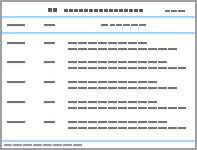
表1

患者社会人口学特征情况与APP或微信小程序使用意愿(n = 559)"

Variables Patients, n (%) Score, ${\bar x}$±s F/t P
Gender 1.775 0.077
  Male 244 (43.65) 10.87±2.23
  Female 315 (56.35) 10.53±2.30
Age/years 5.283 < 0.001***
  18- 60 (10.73) 11.53±2.09
  40- 81 (14.49) 11.11±2.07
  50- 132 (23.61) 10.42±2.13
  60- 173 (30.95) 10.75±2.39
  70- 113 (20.21) 10.11±2.31
Domicile -1.730 0.084
  Urban 311 (55.64) 10.53±2.23
  Rural 248 (44.36) 10.86±2.32
Area 1.154 0.283
  East 177 (31.66) 10.64±2.50
  Midland 217 (38.82) 10.53±2.35
  West 165 (29.52) 10.91±1.87
Education 4.843 0.028*
  Primary school and below 107 (19.14) 10.09±2.13
  Junior high school 187 (33.45) 10.67±2.28
  High school or technical school 130 (23.26) 11.00±2.36
  Junior college 54 (9.66) 10.94±2.41
  University and higher 81 (14.49) 10.75±2.11
Marital status 0.407 0.685
  Married 495 (88.55) 10.66±2.23
  Single/separated or divorced/widow 64 (11.45) 10.80±2.56
Income per month/yuan 0.180 0.671
  ≤1 499 146 (26.12) 10.75±2.45
  1 500-2 999 160 (28.62) 10.59±2.27
  3 000-5 999 160 (28.62) 10.49±2.15
  ≥6 000 93 (16.64) 10.82±2.20
Course of disease/years 3.627 < 0.001***
  ≤5 328 (58.68) 10.97±2.23
  >5 231 (41.32) 10.26±2.27
Complication 1.429 0.158
  Yes 50 (8.94) 10.26±2.15
  No 509 (91.06) 10.72±2.28
Diabetes comorbidities
  Yes 242 (43.29) 10.60±2.42 0.652 0.515
  No 317 (56.71) 10.73±2.15
Family history of diabetes
  Yes 210 (37.57) 10.83±2.38 -1.245 0.214
  No 349 (62.43) 10.58±2.20
Total 559 (100.00) 10.68±2.27

表2

APP或微信小程序的使用意愿及各影响因素得分"

Variables Items, n Score, ${\bar x}$±s
Perceived usefulness 7 28.23±5.91
Perceived ease of use 3 11.62±2.67
Disease perception 4 15.14±3.15
Perceived barrier 4 12.60±4.10
External clues 4 15.69±3.55
Social support 4 15.48±3.53
Self efficacy 3 11.59±2.67
Willingness to use 3 10.68±2.27

表3

APP或微信小程序的使用意愿及各影响因素得分Spearman相关性分析"

Variables Perceived usefulness Perceived ease of use Disease perception Perceived barrier External clues Social support Self efficacy Willingness to use
Perceived usefulness 1.000
Perceived ease of use 0.837*** 1.000
Disease perception 0.615*** 0.637*** 1.000
Perceived barrier 0.121** 0.091* 0.335*** 1.000
External clues 0.737*** 0.704*** 0.571*** 0.104* 1.000
Social support 0.701*** 0.648*** 0.549*** 0.142*** 0.868*** 1.000
Self efficacy 0.738*** 0.814*** 0.635*** 0.094* 0.772*** 0.726*** 1.000
Willingness to use 0.605*** 0.605*** 0.285*** -0.224*** 0.593*** 0.531*** 0.594*** 1.000

表4

结构方程模型的标准化参数估计"

Path Estimator 95%CI of estimator Z P
Perceived usefulness Willingness to use 0.375 0.250,0.500 5.865 < 0.001***
Perceived ease of use Willingness to use 0.108 -0.088,0.304 1.078 0.281
Disease perception Willingness to use -0.240 -0.364,-0.116 -3.792 < 0.001***
Self efficacy Willingness to use 0.313 0.051,0.575 2.338 0.019*
Perceived barrier Willingness to use -0.055 -0.114,0.004 -1.837 0.066
Social support Willingness to use -0.336 -0.661,-0.012 -2.032 0.042*
External clues Willingness to use 0.609 0.221,0.997 3.075 0.002**
Disease perception Perceived usefulness 0.057 -0.014,0.128 1.566 0.117
Perceived ease of use Perceived usefulness 0.708 0.632,0.784 18.245 < 0.001***
External clues Perceived usefulness 0.169 0.096,0.243 4.517 < 0.001***
Perceived barrier Perceived usefulness 0.044 0.001,0.088 2.004 0.045*
Self efficacy Perceived ease of use 0.910 0.885,0.935 71.419 < 0.001***
Perceived barrier Perceived ease of use -0.054 -0.105,-0.003 -2.081 0.037*
Self efficacy Disease perception 0.794 0.729,0.858 24.111 < 0.001***

表5

结构方程模型中的各效应"

Path Direct effect Total indirect effect Total effect
Perceived usefulness Willingness to use 0.375 0.375
Perceived ease of use Willingness to use 0.108 0.266 0.374
Disease perception Willingness to use -0.240 0.021 -0.219
Self efficacy Willingness to use 0.313 0.166 0.479
Perceived barrier Willingness to use -0.055 -0.004 -0.059
Social support Willingness to use -0.336 -0.336
External clues Willingness to use 0.609 0.063 0.672
1
中华医学会糖尿病学分会. 中国2型糖尿病防治指南(2020年版)[J]. 中华糖尿病杂志, 2021, 13 (4): 315- 409.
2
Magliano DJ , Boyko EJ , IDF diabetes atlas 10th edition scientific committee . IDF diabetes atlas[M]. Brussels: International Diabetes Federation, 2021: 34- 36.
3
嵇加佳, 刘林, 楼青青, 等. 2型糖尿病患者自我管理行为及血糖控制现状的研究[J]. 中华护理杂志, 2014, 49 (5): 617- 620.
4
Heidel A , Hagist C . Potential benefits and risks resulting from the introduction of health apps and wearables into the german statutory health care system: Scoping review[J]. JMIR Mhealth Uhealth, 2020, 8 (9): e16444.

doi: 10.2196/16444
5
赵亚珍, 王晓云. 移动健康技术在糖尿病病人自我管理中应用的研究进展[J]. 护理研究, 2023, 37 (13): 2395- 2398.
6
Gong E , Baptista S , Russell A , et al. My diabetes coach, a mobile app-based interactive conversational agent to support type 2 diabetes self-management: Randomized effectiveness-implementation trial[J]. J Med Internet Res, 2020, 22 (11): e20322.

doi: 10.2196/20322
7
Zhang X , Zhang L , Lin Y , et al. Effects of E-health-based interventions on glycemic control for patients with type 2 diabetes: A Bayesian network meta-analysis[J]. Front Endocrinol (Lausanne), 2023, 14, 1068254.

doi: 10.3389/fendo.2023.1068254
8
Eberle C , Stichling S . Clinical improvements by telemedicine interventions managing type 1 and type 2 diabetes: systematic meta-review[J]. J Med Internet Res, 2021, 23 (2): e23244.

doi: 10.2196/23244
9
Zhang Y , Li X , Luo S , et al. Use, perspectives, and attitudes regarding diabetes management mobile apps among diabetes patients and diabetologists in China: National web-based survey[J]. JMIR Mhealth Uhealth, 2019, 7 (2): e12658.

doi: 10.2196/12658
10
汪洋, 王觅也, 周有莲, 等. 我国互联网糖尿病健康信息资源的合理应用及挑战[J]. 中国全科医学, 2021, 24 (16): 2098- 2102.
11
Holmen H , Torbjørnsen A , Wahl AK , et al. A mobile health intervention for self-management and lifestyle change for persons with type 2 diabetes, Part 2: One-year results from the norwegian randomized controlled trial RENEWING HEALTH[J]. JMIR Mhealth Uhealth, 2014, 2 (4): e57.

doi: 10.2196/mhealth.3882
12
Zhang L , He X , Shen Y , et al. Effectiveness of smartphone APP-based interactive management on glycemic control in Chinese patients with poorly controlled diabetes: Randomized controlled trial[J]. J Med Internet Res, 2019, 21 (12): e15401.

doi: 10.2196/15401
13
王淇, 吴浩, 魏学娟, 等. 方庄社区卫生服务中心应用移动终端APP进行糖尿病管理的效果评价研究[J]. 中国全科医学, 2020, 23 (7): 844- 848.
14
万巧琴, 尚少梅, 来小彬, 等. 2型糖尿病患者自我管理行为量表的信、效度研究[J]. 中国实用护理杂志, 2008, 24 (7): 26- 27.
15
Breil B , Salewski C , Apolinário-Hagen J . Comparing the accep-tance of mobile hypertension apps for disease management among patients versus clinical use among physicians: Cross-sectional survey[J]. JMIR Cardio, 2022, 6 (1): e31617.
16
崔洪成. 移动健身App使用意愿研究: 基于技术准备度与技术接受模型(TRAM)[J]. 中国体育科技, 2022, 58 (6): 104- 113.
17
AlBar AM , Hoque MR . Patient Acceptance of E-health services in Saudi Arabia: An integrative perspective[J]. Telemed 1 E Health, 2019, 25 (9): 847- 852.
18
卫艳利, 曹晓强, 蔡雁, 等. 基于技术接受模型慢性病远程监护服务使用意愿的因素[J]. 中国全科医学, 2018, 21 (8): 958- 964.
[1] 毛雅晴, 陈震, 于尧, 章文博, 刘洋, 彭歆. 2型糖尿病对口腔鳞状细胞癌患者预后的影响[J]. 北京大学学报(医学版), 2024, 56(6): 1089-1096.
[2] 张培恒, 高莹, 吴红花, 张健, 张俊清. 暴发性1型糖尿病合并急性胰腺炎1例及文献回顾[J]. 北京大学学报(医学版), 2024, 56(5): 923-927.
[3] 马雨佳,卢燃藜,周泽宸,李晓怡,闫泽玉,武轶群,陈大方. 基于两样本孟德尔随机化的失眠与2型糖尿病关联研究[J]. 北京大学学报(医学版), 2024, 56(1): 174-178.
[4] 鲍雷,蔡夏夏,张明远,任磊磊. 维生素D3对2型糖尿病小鼠轻度认知障碍的改善作用及机制研究[J]. 北京大学学报(医学版), 2023, 55(4): 587-592.
[5] 张晓悦,林雨欣,蒋莹,张蓝超,董芒艳,池海谊,董浩宇,马利军,李智婧,常春. 自我效能在2型糖尿病患者自我管理能力和自我管理行为间的中介效应[J]. 北京大学学报(医学版), 2023, 55(3): 450-455.
[6] 于欢,杨若彤,王斯悦,吴俊慧,王梦莹,秦雪英,吴涛,陈大方,武轶群,胡永华. 2型糖尿病患者使用二甲双胍与缺血性脑卒中发病风险的队列研究[J]. 北京大学学报(医学版), 2023, 55(3): 456-464.
[7] 陈阳阳,周玉博,杨静,花语蒙,原鹏波,刘爱萍,魏瑗. 双胎妊娠孕期体质量对血清高敏C反应蛋白与妊娠期糖尿病关联的影响:一项队列研究[J]. 北京大学学报(医学版), 2022, 54(3): 427-433.
[8] 王佳敏,刘秋萍,张明露,巩超,刘舒丹,陈暐烨,沈鹏,林鸿波,高培,唐迅. 基于马尔可夫模型的社区人群糖尿病筛查预防心血管病的效果评价[J]. 北京大学学报(医学版), 2022, 54(3): 450-457.
[9] 吴俊慧,武轶群,吴瑶,王紫荆,吴涛,秦雪英,王梦莹,王小文,王伽婷,胡永华. 北京城镇职工2型糖尿病患者缺血性脑卒中发病率及主要危险因素[J]. 北京大学学报(医学版), 2022, 54(2): 249-254.
[10] 徐欣然,霍芃呈,和璐,孟焕新,朱筠轩,靳东思奇. 伴与不伴糖尿病的牙周炎患者牙周基础治疗的疗效比较及其与白细胞水平的相关分析[J]. 北京大学学报(医学版), 2022, 54(1): 48-53.
[11] 朱忆颖,闵赛南,俞光岩. 局部注射环孢素A对非肥胖糖尿病小鼠下颌下腺分泌功能及炎症的影响[J]. 北京大学学报(医学版), 2021, 53(4): 750-757.
[12] 尹雪倩, 张晓玄, 文婧, 刘思奇, 刘欣然, 周若宇, 王军波. 荞麦、燕麦、豌豆复配对糖尿病大鼠血糖的影响[J]. 北京大学学报(医学版), 2021, 53(3): 447-452.
[13] 郭洪萍,赵艾,薛勇,马良坤,张玉梅,王培玉. 孕期营养素摄入与妊娠期糖尿病孕妇血糖控制效果的相关性研究[J]. 北京大学学报(医学版), 2021, 53(3): 467-472.
[14] 吴俊慧,陈泓伯,武轶群,吴瑶,王紫荆,吴涛,王梦莹,王斯悦,王小文,王伽婷,于欢,胡永华. 2015—2017年北京市2型糖尿病患者骨关节炎患病的相关因素[J]. 北京大学学报(医学版), 2021, 53(3): 518-522.
[15] 樊理诗,高敏,Edwin B.FISHER,孙昕霙. 北京市通州区和顺义区747例2型糖尿病患者生存质量影响因素[J]. 北京大学学报(医学版), 2021, 53(3): 523-529.
Viewed
Full text


Abstract

Cited

  Shared   
  Discussed   
No Suggested Reading articles found!