北京大学学报(医学版) ›› 2025, Vol. 57 ›› Issue (3): 545-553. doi: 10.19723/j.issn.1671-167X.2025.03.019

• 论著 • 上一篇    下一篇

1990—2021年中国及全球增龄性听力损失的疾病负担与未来趋势预测

阿娜尔古丽·阿不都肉什提1, 宋迎豪1, 闫晓晋2, 高永康1, 刘波3,*(), 胡刚1,4,*()   

  1. 1. 新疆医科大学健康管理学院, 乌鲁木齐 830000
    2. 北京大学人口研究所, 北京 100871
    3. 新疆维吾尔自治区中医药管理局, 乌鲁木齐 830000
    4. 新疆医科大学第一附属医院健康管理中心, 乌鲁木齐 830000
  • 收稿日期:2025-01-03 出版日期:2025-06-18 发布日期:2025-06-13
  • 通讯作者: 刘波, 胡刚
  • 基金资助:
    新疆维吾尔自治区自然科学基金(2023D01C37)

Disease burden and future trend predictions of age-related hearing loss in China and worldwide from 1990 to 2021

Abudurexiti ANARGUL1, Yinghao SONG1, Xiaojin YAN2, Yongkang GAO1, Bo LIU3,*(), Gang HU1,4,*()   

  1. 1. College of Health Management, Xinjiang Medical University, Urumqi 830000, China
    2. Institute of Population Research, Peking University, Beijing 100871, China
    3. Administration of Traditional Chinese Medicine of Xinjiang Uygur Autonomous Region, Urumqi 830000, China
    4. Health Management Center, The First Affiliated Hospital of Xinjiang Medical University, Urumqi 830000, China
  • Received:2025-01-03 Online:2025-06-18 Published:2025-06-13
  • Contact: Bo LIU, Gang HU
  • Supported by:
    the Natural Science Foundation of Xinjiang Uygur Autonomous Region(2023D01C37)

RICH HTML


摘要:

目的: 描述1990—2021年中国及全球不同社会人口指数(socio-demographic index, SDI)地区增龄性听力损失的疾病负担变化趋势, 并预测2022—2036年增龄性听力损失的患病率及伤残损失寿命年(years lived with disability, YLD)率, 为防控增龄性听力损失疾病负担提供参考。方法: 利用2021年全球疾病负担(Global Burden of Disease 2021, GBD2021)数据, 选取增龄性听力损失的年龄标准化患病率(age-standardized prevalence rate, ASPR)和YLD为指标, 分不同SDI、不同性别描述1990—2021年中国及全球增龄性听力损失疾病负担的现状和长期变化趋势, 采用Joinpoint回归计算平均年度变化百分比(average annual percent change, AAPC)评估疾病负担的趋势变化, 利用分解分析探讨老龄化、人口增长和流行病学改变这三个因素对疾病负担改变的相对影响, 使用自回归移动平均(autoregressive integrated moving average, ARIMA)模型预测2022—2036年的ASPR和YLD率。结果: 2021年中国的增龄性听力损失患病率为82 162.49/10万(73 288.08/10万, 89 187.21/10万), 高于全球SDI水平的66 238.16/10万(59 982.54/10万, 72 669.82/10万)、高SDI地区的57 650.42/10万(52 059.12/10万, 63 889.02/10万)、中高SDI地区的69 115.59/10万(62 494.18/10万, 75 340.64/10万)、中SDI地区的72 365.56/10万(65 181.43/10万, 78 912.01/10万)、中低SDI地区的64 439.66/10万(58 368.22/10万, 71 468.27/10万)和低SDI地区的61 725.25/10万(55 749.18/10万, 68 477.67/10万)。中国增龄性听力损失的YLD率为2 762.98/10万[95%不确定性区间(uncertainty interval, UI): 1 855.28~3 880.68], 高于全球SDI水平的2 236.75/10万(95%UI: 1 511.56~3 155.88)、高SDI地区的1 805.79/10万(95%UI: 1 212.69~2 577.17)、中高SDI地区的2 316.58/10万(95%UI: 1 557.53~3 274.87)、中SDI地区的2 480.99/10万(95%UI: 1 678.17~3 489.24)、中低SDI地区的2 313.28/10万(95%UI: 1 578.35~3 271.50)和低SDI地区的2 383.55/10万(95%UI: 1 623.66~3 365.68)。1990—2021年, 中国增龄性听力损失的患病率及YLD率均呈上升趋势, 平均每年分别上升0.18%(95%CI: 0.16%~0.19%)和0.29%(95%CI: 0.27%~0.30%)。男性和女性增龄性听力损失的患病率上升速度相同, 男性AAPC为0.18%(95%CI: 0.17%~0.19%, P < 0.001), 女性AAPC为0.18%(95%CI: 0.16%~0.19%, P < 0.001)。男性增龄性听力损失的YLD率上升速度均高于女性, 男性为0.32%(95%CI: 0.27%~0.37%, P < 0.001), 女性为0.27%(95%CI: 0.26%~0.28%, P < 0.001)。分解分析发现, 人口增长是全球及不同SDI地区患病率和YLD率增加的主要影响因素, 而老龄化是中国患病率及YLD率增加的主要影响因素。ARIMA模型预测结果显示, 2022—2036年增龄性听力损失的患病率及YLD率均呈上升趋势, 2036年的患病率和YLD率预计达到89 723.99/10万和2 872.47/10万。结论: 我国60岁及以上人群增龄性听力损失的患病率和疾病负担位居全球首位, 1990—2021年间, 增龄性听力损失的患病率和YLD率呈持续上升趋势, 且始终高于全球各SDI地区, 预测未来15年中国及全球增龄性听力损失的疾病负担呈持续上升趋势。增龄性听力损失的患病率及疾病负担在男性老年人群中表现尤为显著, 对于这一特定人群的增龄性听力损失应给予高度重视, 积极采取早期干预措施。

关键词: 增龄性听力损失, 患病率, 伤残损失寿命年, 疾病负担

Abstract:

Objective: To describe the trend of changes in the disease burden of age-related hearing loss in China and globally from 1990 to 2021, to forecast the prevalence and years lived with disability (YLD) rates of age-related hearing loss from 2022 to 2036, and to provide a reference for the prevention and control of the disease burden associated with age-related hearing loss. Methods: Using the Global Burden of Disease 2021 (GBD2021) data, this study selected age-standardized prevalence rate (ASPR) and YLD as indicators. The disease burden and long-term trends of age-related hearing loss in China and globally from 1990 to 2021 were described by different socio-demographic index (SDI) and gender. Joinpoint regression was used to calculate the average annual percent change (AAPC) to assess the trend changes in the disease burden. Decomposition analysis was applied to explore the relative impacts of aging, population growth, and epidemiological changes on the variation in disease burden. An autoregressive integrated moving average (ARIMA) model was used to forecast the age-standardized pre-valence rate and YLD rates from 2022 to 2036. Results: The prevalence of age-related hearing loss in China in 2021 was 82 162.49 (73 288.08-89 187.21) per 100 000, higher than the global SDI level of 66 238.16 (59 982.54-72 669.82) per 100 000, the high SDI region ' s level of 57 650.42 (52 059.12-63 889.02) per 100 000, the upper-middle SDI region ' s level of 69 115.59 (62 494.18- 75 340.64) per 100 000, the middle SDI region ' s level of 72 365.56 (65 181.43-78 912.01) per 100 000, the lower-middle SDI region ' s level of 64 439.66 (58 368.22-71 468.27) per 100 000, and the low SDI region ' s level of 61 725.25 (55 749.18-68 477.67) per 100 000. The age- related hearing loss YLD rate in China was 2 762.98 [95% uncertainty interval (UI): 1 855.28-3 880.68] per 100 000, higher than the global SDI level of 2 236.75 (95%UI: 1 511.56-3 155.88) per 100 000, the high SDI region ' s level of 1 805.79 (95%UI: 1 212.69-2 577.17) per 100 000, the upper-middle SDI region ' s level of 2 316.58 (95%UI: 1 557.53-3 274.87) per 100 000, the middle SDI region ' s level of 2 480.99 (95%UI: 1 678.17-3 489.24) per 100 000, the lower-middle SDI region ' s level of 2 313.28 (95%UI: 1 578.35-3 271.50) per 100 000, and the low SDI region ' s level of 2 383.55 (95%UI: 1 623.66-3 365.68) per 100 000. From 1990 to 2021, both the prevalence and YLD rate of age-related hearing loss in China showed an increasing trend, rising by an average of 0.18% (95%CI: 0.16%-0.19%) and 0.29% (95%CI: 0.27%-0.30%) per year, respectively. The rates of increase in prevalence were the same for both men and women, with men showing a 0.18% increase (95%CI: 0.17%-0.19%, P < 0.001) and women showing a 0.18% increase (95%CI: 0.16%-0.19%, P < 0.001). However, the YLD rate increase was faster in men than in women, with men experiencing a 0.32% increase (95%CI: 0.27%-0.37%, P < 0.001) and women experiencing a 0.27% increase (95%CI: 0.26%-0.28%, P < 0.001). Decomposition analysis showed that population growth was the main factor driving the increase in prevalence and YLD rate globally and across different SDI regions. However, aging was the primary factor contributing to the increase in prevalence and YLD rate in China. ARIMA model predictions suggested that the prevalence and YLD rate of age-related hearing loss would continue to rise from 2022 to 2036, with the predicted prevalence and YLD rate in 2036 reaching 89 723.99 per 100 000 and 2 872.47 per 100 000, respectively. Conclusion: The prevalence and disease burden of age-related hearing loss in individuals aged 60 and above in China rank first globally. From 1990 to 2021, both the prevalence and YLD rate of age-related hearing loss have shown a continuous upward trend, consistently surpassing the levels observed in various SDI regions worldwide. The prevalence and disease burden of age-related hearing loss are particularly significant among elderly men. Moreover, projections indicate that the disease burden of age-related hearing loss will continue to rise over the next 15 years. Therefore, it is urgent to pay close attention to age-related hearing loss in this specific population, and early intervention measures are crucial to reduce the disease burden associated with age-related hearing loss.

Key words: Age-related hearing loss, Prevalence, Years of life lost due to disability, Disease burden

中图分类号: 

  • R195.4

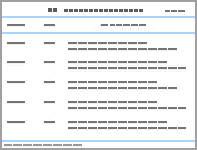
表1

2021年中国及全球不同SDI地区增龄性听力损失患病率和YLD率"

Items Prevalence (/100 000) (95%UI)
Total Male Female
Worldwide 66 238.16 (59 982.54, 72 669.82) 69 157.43 (62 608.42, 75 808.62) 63 650.49 (57 619.38, 69 924.12)
China 82 162.49 (73 288.08, 89 187.21) 83 239.67 (74 116.27, 90 367.20) 81 109.96 (72 320.34, 88 205.83)
High SDI 57 650.42 (52 059.12, 63 889.02) 62 629.90 (56 393.55, 69 611.13) 53 157.72 (48 076.72, 58 752.49)
Upper-middle SDI 69 115.59 (62 494.18, 75 340.64) 72 115.95 (65 119.49, 78 576.69) 66 629.62 (60 161.80, 72 700.20)
Middle SDI 72 365.56 (65 181.43, 78 912.01) 74 117.43 (66 896.74, 80 775.69) 70 764.28 (63 699.81, 77 225.86)
Lower-middle SDI 64 439.66 (58 368.22, 71 468.27) 66 760.33 (60 541.34, 73 990.02) 62 339.07 (56 372.16, 69 287.31)
Low SDI 61 725.25 (55 749.18, 68 477.67) 64391.41 (58 283.87, 71 048.12) 59 216.28 (53 338.05, 65 940.98)
Items YLD rate (/100 000) (95%UI)
Total Male Female
Worldwide 2 236.75 (1 511.56, 3 155.88) 2 340.52 (1 579.79, 3 313.09) 2 146.71 (1 452.03, 3 029.75)
China 2 762.98 (1 855.28, 3 880.68) 2 854.99 (1 910.45, 4 017.34) 2 675.33 (1 796.64, 3 751.90)
High SDI 1 805.79 (1 212.69, 2 577.17) 1 958.63 (1 308.65, 2 798.77) 1 671.24 (1 126.65, 2 381.55)
Upper-middle SDI 2 316.58 (1 557.53, 3 274.87) 2 440.79 (1 639.39, 3 448.78) 2 215.41 (1 491.18, 3 132.33)
Middle SDI 2 480.99 (1 678.17, 3 489.24) 2 559.40 (1 735.57, 3 607.99) 2 409.93 (1 630.03, 3 394.81)
Lower-middle SDI 2 313.28 (1 578.35, 3 271.50) 2 376.01 (1 622.71, 3 355.52) 2 257.96 (1 539.18, 3 194.87)
Low SDI 2 383.55 (1 623.66, 3 365.68) 2 429.69 (1 652.47, 3 414.24) 2 340.55 (1 595.58, 3 305.33)

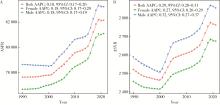
图1

1990—2021年中国增龄性听力损失的性别-年龄标准化患病率(A)及YLD率(B)"

图2

1990—2021年中国及全球不同SDI地区增龄性听力损失的地区-年龄标准化患病率(A)及YLD率(B)"

图3

1990—2021年中国及全球不同SDI地区增龄性听力损失的年龄标准化患病数(A)及YLDs(B)的分解分析"

图4

未来15年(2022—2036年)增龄性听力损失性别-年龄标准化患病率趋势预测"

图5

未来15年(2022—2036年)增龄性听力损失性别-年龄标准化YLD率趋势预测"

1
NIDCD. Age-related hearing loss [EB/OL]. (2018-11-25) [2023-03-17]. https://www.nidcd.nih.gov/health/age-related-hearing-loss.
2
Bowl MR , Dawson SJ . Age-related hearing loss[J]. Cold Spring Harb Perspect Med, 2019, 9 (8): a033217.

doi: 10.1101/cshperspect.a033217
3
Vaisbuch Y , Santa Maria PL . Age-related hearing loss: Innovations in hearing augmentation[J]. Otolaryngol Clin North Am, 2018, 51 (4): 705- 723.

doi: 10.1016/j.otc.2018.03.002
4
World Health Organization. World report on hearing [R]. Geneva: WHO, 2021.
5
World Health Organization. World report on hearing [R]. Geneva: WHO, 2024.
6
Li J , Zhao H , Huang B , et al. A survey on hearing acuity of centenarians in Hainan Province[J]. J Otol, 2018, 13 (4): 135- 137.

doi: 10.1016/j.joto.2018.11.008
7
Chang HP , Chou P . Presbycusis among older Chinese people in Taipei, Taiwan: A community-based study[J]. Int J Audiol, 2007, 46 (12): 738- 745.

doi: 10.1080/14992020701558529
8
国家卫健委发布2020年度国家老龄事业发展公报我国60岁以上老人2.6亿多人[EB/OL]. (2021-10-15) [2024-11-09]. https://baijiahao.baidu.com/s?id=1713692922453334407&wfr=spider&for=pc.
9
GBD 2019 Mental Disorders Collaborators . Global, regional, and national burden of 12 mental disorders in 204 countries and territories, 1990-2019: A systematic analysis for the Global Burden of Disease Study 2019[J]. Lancet Psychiatry, 2022, 9 (2): 137- 150.

doi: 10.1016/S2215-0366(21)00395-3
10
GBD 2019 Diseases and Injuries Collaborators . Global burden of 369 diseases and injuries in 204 countries and territories, 1990-2019: A systematic analysis for the Global Burden of Disease Study 2019[J]. Lancet, 2020, 396 (10258): 1204- 1222.

doi: 10.1016/S0140-6736(20)30925-9
11
GBD 2019 Hearing Loss Collaborators . Hearing loss prevalence and years lived with disability, 1990-2019: Findings from the Global Burden of Disease Study 2019[J]. Lancet, 2021, 397 (10278): 996- 1009.

doi: 10.1016/S0140-6736(21)00516-X
12
GBD 2016 Disease and Injury Incidence and Prevalence Collaborators . Global, regional, and national incidence, prevalence, and years lived with disability for 328 diseases and injuries for 195 countries, 1990-2016: A systematic analysis for the Global Burden of Disease Study 2016[J]. Lancet, 2017, 390 (10100): 1211- 1259.

doi: 10.1016/S0140-6736(17)32154-2
13
Kassebaum NJ , Arora M , Barber RM . Global, regional, and national disability-adjusted life-years (DALYs) for 315 diseases and injuries and healthy life expectancy (HALE), 1990-2015: A systematic analysis for the Global Burden of Disease Study 2015[J]. Lancet, 2016, 388 (10053): 1603- 1658.

doi: 10.1016/S0140-6736(16)31460-X
14
曾四清. Joinpoint回归模型及其在传染病流行趋势分析中的应用[J]. 中国卫生统计, 2019, 36 (5): 787- 791.
15
Kim HJ , Fay MP , Feuer EJ , et al. Permutation tests for Joinpoint regression with applications to cancer rates[J]. Stat Med, 2000, 19 (3): 335- 351.

doi: 10.1002/(SICI)1097-0258(20000215)19:3<335::AID-SIM336>3.0.CO;2-Z
16
Deng XX , Li H , Zhong YR , et al. Burden of liver cancer attribu-table to hepatitis B and alcohol globally, in China, and for five sociodemographic index regions from 1990 to 2021: A population-based study[J]. J Clin Transl Hepatol, 2025, 13 (1): 1- 14.
17
李欣欣, 柳安琪, 王丹, 等. 2020年中国工业企业接触噪声劳动者听力损失流行病学特征分析[J]. 中华疾病控制杂志, 2022, 26 (8): 882- 887.
18
Man J , Chen H , Zhang T , et al. Global, regional, and national burden of age-related hearing loss from 1990 to 2019[J]. Aging (Albany NY), 2021, 13 (24): 25944- 25959.
19
Stevens G , Flaxman S , Brunskill E , et al. Global and regional hearing impairment prevalence: An analysis of 42 studies in 29 countries[J]. Eur J Public Health, 2013, 23 (1): 146- 152.

doi: 10.1093/eurpub/ckr176
20
Orji A , Kamenov K , Dirac M , et al. Global and regional needs, unmet needs and access to hearing aids[J]. Int J Audiol, 2020, 59 (3): 166- 172.

doi: 10.1080/14992027.2020.1721577
21
Vollset SE , Goren E , Yuan CW , et al. Fertility, mortality, migration, and population scenarios for 195 countries and territories from 2017 to 2100: A forecasting analysis for the Global Burden of Disease Study[J]. Lancet, 2020, 396 (10258): 1285- 1306.

doi: 10.1016/S0140-6736(20)30677-2
22
乔晓春. 中国人口老龄化的过去、现在和未来[J]. 社会政策研究, 2024, 34 (1): 47- 63.
23
中华人民共和国中央人民政府. 第七次全国人口普查公报[EB/OL]. (2021-05-11) [2025-01-12]. https://www.gov.cn/guoqing/2021-05/13/content_5606149.htm.
24
徐杰茹, 陈磊, 王冕, 等. 1990—2019年中国女性卵巢癌发病趋势分析与预测[J]. 现代预防医学, 2021, 48 (19): 3457- 3460.
25
马一鸣, 丁勇. 我国2012—2021年4种肝炎流行趋势的时间序列分析和预测[J]. 南京医科大学学报(自然科学版), 2024, 44 (1): 72- 79.
26
王丽, 曹世义, 宋开发, 等. ARIMA模型在荆州市手足口病疫情预测中的应用[J]. 中国社会医学杂志, 2023, 40 (5): 623- 626.
27
陈雯, 刘艳, 宇传华. 1990—2019年中国归因于吸烟的膀胱癌疾病负担年龄-时期-队列分析及预测[J]. 中国卫生统计, 2023, 40 (5): 642- 645.
28
GBD 2019 Risk Factors Collaborators . Global burden of 87 risk factors in 204 countries and territories, 1990-2019: A systematic analysis for the Global Burden of Disease Study 2019[J]. Lancet, 2020, 396 (10258): 1223- 1249.
[1] 陈欣, 杨君婷, 郭金鑫, 李淑雅, 刘志科, 朱颖靓, 李奉娟, 詹思延, 郭娟娟. 2022—2024年青岛市10~59岁女性自身免疫性甲状腺病的患病率特征[J]. 北京大学学报(医学版), 2025, 57(3): 507-513.
[2] 林芳汝, 唐志辉. 种植单冠修复后种植体周健康的相关分析[J]. 北京大学学报(医学版), 2025, 57(2): 347-353.
[3] 曾媛媛,谢云,陈道南,王瑞兰. 脓毒症患者发生正常甲状腺性病态综合征的相关因素[J]. 北京大学学报(医学版), 2024, 56(3): 526-532.
[4] 傅强,高冠英,徐雁,林卓华,孙由静,崔立刚. 无症状髋关节前上盂唇撕裂超声与磁共振检查的对比研究[J]. 北京大学学报(医学版), 2023, 55(4): 665-669.
[5] 林咏惟,周雅琳,赵润茏,许雅君,刘燕萍. 孕早期女性铁营养状况及其影响因素分析[J]. 北京大学学报(医学版), 2023, 55(4): 600-605.
[6] 吴俊慧,陈泓伯,武轶群,吴瑶,王紫荆,吴涛,王梦莹,王斯悦,王小文,王伽婷,于欢,胡永华. 2015—2017年北京市2型糖尿病患者骨关节炎患病的相关因素[J]. 北京大学学报(医学版), 2021, 53(3): 518-522.
[7] 耿研,宋志博,张晓慧,邓雪蓉,王昱,张卓莉. 银屑病关节炎抑郁和焦虑患病情况及相关因素[J]. 北京大学学报(医学版), 2020, 52(6): 1048-1055.
[8] 邓思危,陈则亦,刘志科,王健,卓琳,高双庆,余家阔,詹思延. 基于城镇医保数据库骨关节伤病的流行病学研究[J]. 北京大学学报(医学版), 2020, 52(3): 527-534.
[9] 许璐,陈璐,樊东升,冯菁楠,刘立立,詹思延,王胜锋. 基于15省城镇医疗保险数据测算我国成人进行性肌萎缩患病率[J]. 北京大学学报(医学版), 2020, 52(3): 521-526.
[10] 石慧峰, 张敬旭, 张嵘, 王晓莉. 中国0~6岁儿童孤独症谱系障碍患病率的meta分析[J]. 北京大学学报(医学版), 2017, 49(5): 798-806.
[11] 郁静茹, 金蕾, 肖利华, 靳蕾. 北京通州区神经管缺陷患病率及其与监测时限的关系[J]. 北京大学学报(医学版), 2015, 47(6): 1042-1045.
[12] 李恒, 黄悦勤, 马亚婷, 刘肇瑞. 中国归因于非痴呆器质性精神障碍残疾的描述性流行病学研究[J]. 北京大学学报(医学版), 2014, 46(2): 247-253.
[13] 李春, 王秀茹*, 唐熠达, 安媛, 周云杉, 郭时伟, 张晓盈, 段天骄, 朱佳鑫, 李晓峰, 王莉枝, 王彩虹, 王永福, 杨荣, 王国春, 卢昕, 朱平. 全国多中心类风湿关节炎冠心病危险因素的现况调查[J]. 北京大学学报(医学版), 2012, 44(2): 176-181.
[14] 王巍, 曾祥龙, 刘武. 中国夏代人的牙周疾病状况分析[J]. 北京大学学报(医学版), 2007, 39(5): 511-514.
[15] 叶荣伟, 李松, 郑俊池, 洪世欣, 陈新, 王太梅, 任爱国, 王丽娜, 李竹. 中国30个县(市)1993~2000年神经管畸形在出生人群中的患病率及变动趋势分析[J]. 北京大学学报(医学版), 2002, 34(3): 204-209.
Viewed
Full text


Abstract

Cited

  Shared   
  Discussed   
No Suggested Reading articles found!