北京大学学报(医学版) ›› 2025, Vol. 57 ›› Issue (5): 941-946. doi: 10.19723/j.issn.1671-167X.2025.05.019

• 论著 • 上一篇    下一篇

儿童及青年漏斗胸患者Nuss术后发生脊柱侧弯的风险预测模型建立及验证

李博闻, 张强*(), 孙益鑫   

  1. 首都医科大学附属北京积水潭医院胸外科, 国家骨科医学中心, 北京 100035
  • 收稿日期:2024-06-16 出版日期:2025-10-18 发布日期:2025-09-04
  • 通讯作者: 张强

Establishment and validation of a risk prediction model for scoliosis after Nuss procedure in children and young adults with pectus excavatum

Bowen LI, Qiang ZHANG*(), Yixin SUN   

  1. Department of Thoracic Surgery, Beijing Jishuitan Hospital Affiliated to Capital Medical University, National Center for Orthopedics, Beijing 100035, China
  • Received:2024-06-16 Online:2025-10-18 Published:2025-09-04
  • Contact: Qiang ZHANG

RICH HTML


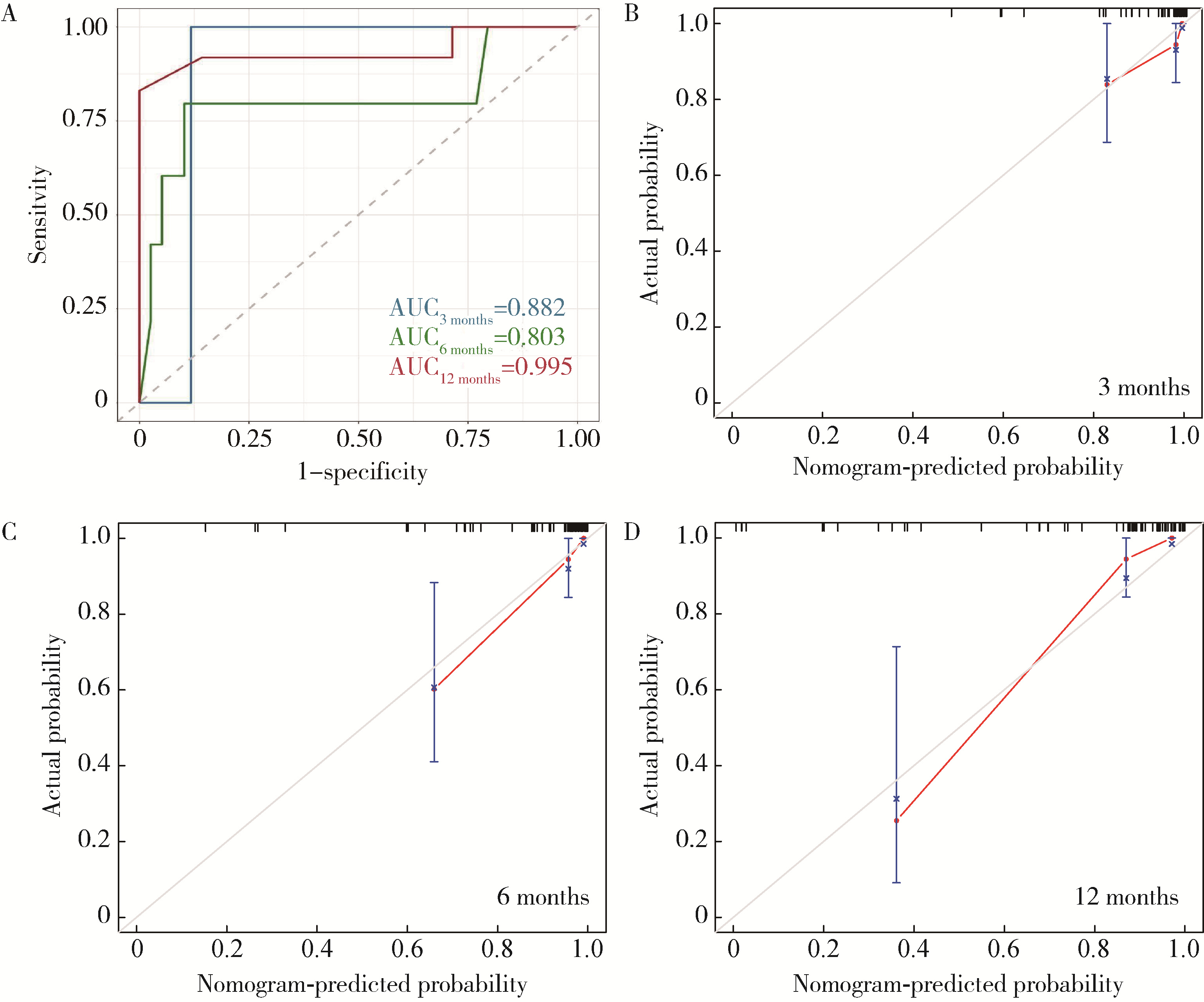
摘要: 目的: 明确儿童及青年漏斗胸患者接受Nuss术后发生脊柱侧弯的风险因素, 并建立相关预测模型。方法: 回顾性分析2018年1月至2023年2月于北京积水潭医院胸外科行Nuss手术治疗的漏斗胸患者, 收集患者的人口学资料(年龄、性别、身高、体重、体重指数)及超声心动图、胸部CT、脊柱全长X线、胸部正侧位X线检查结果, 同时收集Haller指数、不对称指数、胸骨扭转角(sternal torsion angle, STA)指数及Cobb角变化, 评估Nuss术后脊柱侧弯的发生风险。通过Cox回归分析明确影响漏斗胸患者Nuss术后脊柱侧弯的独立危险因素, 建立风险预测模型, 通过内部交叉验证明确模型的具体预测效能。结果: 符合纳入排除标准的患者共59例, 中位随访6.84个月, 随访结果显示术后Haller指数、STA指数、不对称指数均较术前显著改善, 术后3个月12例(20.3%)患者发生脊柱侧弯。Cox回归分析显示, 术前肺动脉高压和不对称指数是影响Nuss术后脊柱侧弯的独立影响因素。基于术前肺动脉高压、不对称指数绘制列线图建立预测模型, 整体预测模型的受试者工作特征(receiver operating characteristic, ROC)曲线下面积为0.995, 校准曲线显示模型预测值与实际值重合度良好。结论: Nuss手术临床疗效显著, 但术后脊柱侧弯并发症发生比例较高; 术前肺动脉高压和不对称指数高是影响Nuss术后脊柱侧弯的独立影响因素, 预测模型能够有效预测患者术后脊柱侧弯的发生概率。

关键词: 漏斗胸, Nuss手术, 脊柱侧弯, 危险因素, 列线图

Abstract: Objective: To identify the risk factors associated with the development of post-Nuss procedure scoliosis in pectus excavatum patients and to establish a relevant predictive model. Methods: A retro-spective review was conducted on pectus excavatum patients who underwent Nuss procedure in Department of Thoracic Surgery at Beijing Jishuitan Hospital between January 2018 and February 2023. We gathered the patient demographic information (including age, sex, height, weight, and body mass index) and diagnostic imaging results (echocardiogram, chest CT scan, full-spine radiography, and PA/lateral chest X-rays), and measurements of Haller index, asymmetry index, sternal torsion angle (STA) index, and Cobb angle changes. The risk of post-Nuss procedure scoliosis was assessed. Cox regression analysis was performed to identify independent risk factors for scoliosis development in the pectus excavatum patients. Based on the results of the Cox regression analysis, a risk prediction model was established, and its specific predictive performance was assessed through internal cross-validation. Results: A total of 59 pectus excavatum patients who underwent Nuss procedure were included after applying inclusion and exclusion criteria. The median follow-up duration was 6.84 months, and the follow-up results showed significant improvements in Haller index, STA index, and asymmetry index postoperatively. Twelve patients developed scoliosis 3 months after Nuss procedure, while 47 patients did not, the incidence of scoliosis was 20.3%. Cox regression analysis identified preoperative pulmonary artery hypertension and preoperative asymmetry index as independent risk factors for post-Nuss procedure scoliosis. A predictive model was constructed based on single-factor Cox regression analysis results, incorporating age, height, weight, body mass index, preoperative pulmonary artery hypertension, preoperative Haller index, STA index, asymmetry index, and Cobb angle. The receiver operating characteristic (ROC) curve was plotted, and the area under the curve (AUC) for the overall predictive model was calculated to be 0.995. A calibration curve demonstrated good alignment between predicted values and actual values. Conclusion: Nuss procedure achieved favorable clinical outcomes. However, postoperative scoliosis emerged as a significant complication with a high incidence rate. Pulmonary artery hypertension and asymmetry index were independent predictors of post-Nuss procedure scoliosis. The predictive model developed in this study demonstrated robust performance in estimating the risk of postoperative scoliosis.

Key words: Pectus excavatum, Nuss surgery, Scoliosis, Risk factors, Nomograms

中图分类号: 

  • R655

表1

漏斗胸患者Nuss术前基本情况(n=59)"

Characteristics Values
Age/years, ${\bar x}$±s 16.0±3.99
Gender, n(%)
  Male 52 (88.1)
  Female 7 (11.9)
Height/cm, ${\bar x}$±s 134±8.71
Weight/kg, ${\bar x}$±s 38.3±8.15
Body mass index/(kg/m2), ${\bar x}$±s 20.0±2.36
Mitral valve prolapse, n(%) 3 (5.08)
Mitral regurgitation, n(%) 6 (10.2)
Tricuspid regurgitation, n(%) 1 (1.69)
Pulmonary artery hypertension, n(%) 4 (6.78)

表2

漏斗胸患者Nuss手术前后影像学指标变化"

Radiographic parameters Before Nuss 3 months after Nuss P
Haller index, median (P25, P75) 3.20 (0.47, 5.35) 1.32 (0.18, 2.53) < 0.000 1
Sternal torsion angle index, median (P25, P75) 16.0 (5.75, 29.8) 11.8 (1.78, 21.6) < 0.000 1
Asymmetry index, median (P25, P75) 0.59 (0.33, 0.89) 0.32 (0.12, 0.48) < 0.000 1
Cobb angel, ${\bar x}$±s 7.16±2.45 8.86±3.20 0.001 6

表3

漏斗胸患者Nuss术后合并脊柱侧弯的单因素Cox回归分析"

Variable HR (95%CI) β SE P
Age 1.19 (1.05-1.36) 0.18 0.07 0.010
Gender 0.00 (0.00-Infinity) -18.20 6 900.00 1.000
Height 1.07 (1.01-1.14) 0.07 0.03 0.040
Weight 1.10 (1.02-1.19) 0.10 0.04 0.020
BMI 0.67 (0.49-0.90) -0.40 0.15 0.010
Mitral valve prolapse 4.75 (0.54-41.64) 1.56 1.11 0.160
Mitral regurgitation 1.54 (0.34-7.04) 0.43 0.78 0.580
Pulmonary artery hypertension 17.08 (4.66-62.62) 2.84 0.66 < 0.001
Haller index 0.25 (0.14-0.43) -1.40 0.29 < 0.001
STA index 0.68 (0.58-0.80) -0.39 0.08 < 0.001
Asymmetry index 0.00 (0.00-0.00) -19.70 4.30 < 0.001
Cobb angle 0.41 (0.28-0.61) -0.89 0.20 < 0.001

表4

漏斗胸患者Nuss术后脊柱侧弯的多因素Cox回归分析"

Variable HR (95%CI) β SE P
Age 1.19 (0.96-1.48) 0.176 0.110 0.111
Height 1.09 (0.94-1.25) 0.083 0.073 0.259
Weight 1.04 (0.87-1.25) 0.040 0.092 0.664
BMI 1.13 (0.61-2.08) 0.119 0.313 0.704
Pulmonary artery hypertension 20.80 (1.37-314.00) 3.030 1.390 0.029
Haller index 39.9 (0.19-8 380) 3.690 2.730 0.177
STA index 0.47 (0.06-3.55) -0.749 1.030 0.466
Asymmetry index 1.8×10-54 (3.6×10-96-9.1×10⁻¹³) -124.000 49.000 0.011
Cobb angle 54.4 (0.31-9 650) 4.000 2.640 0.131

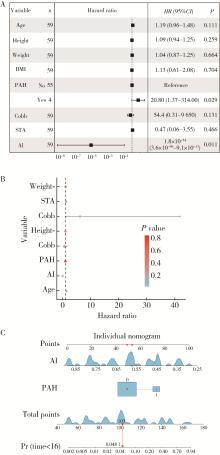
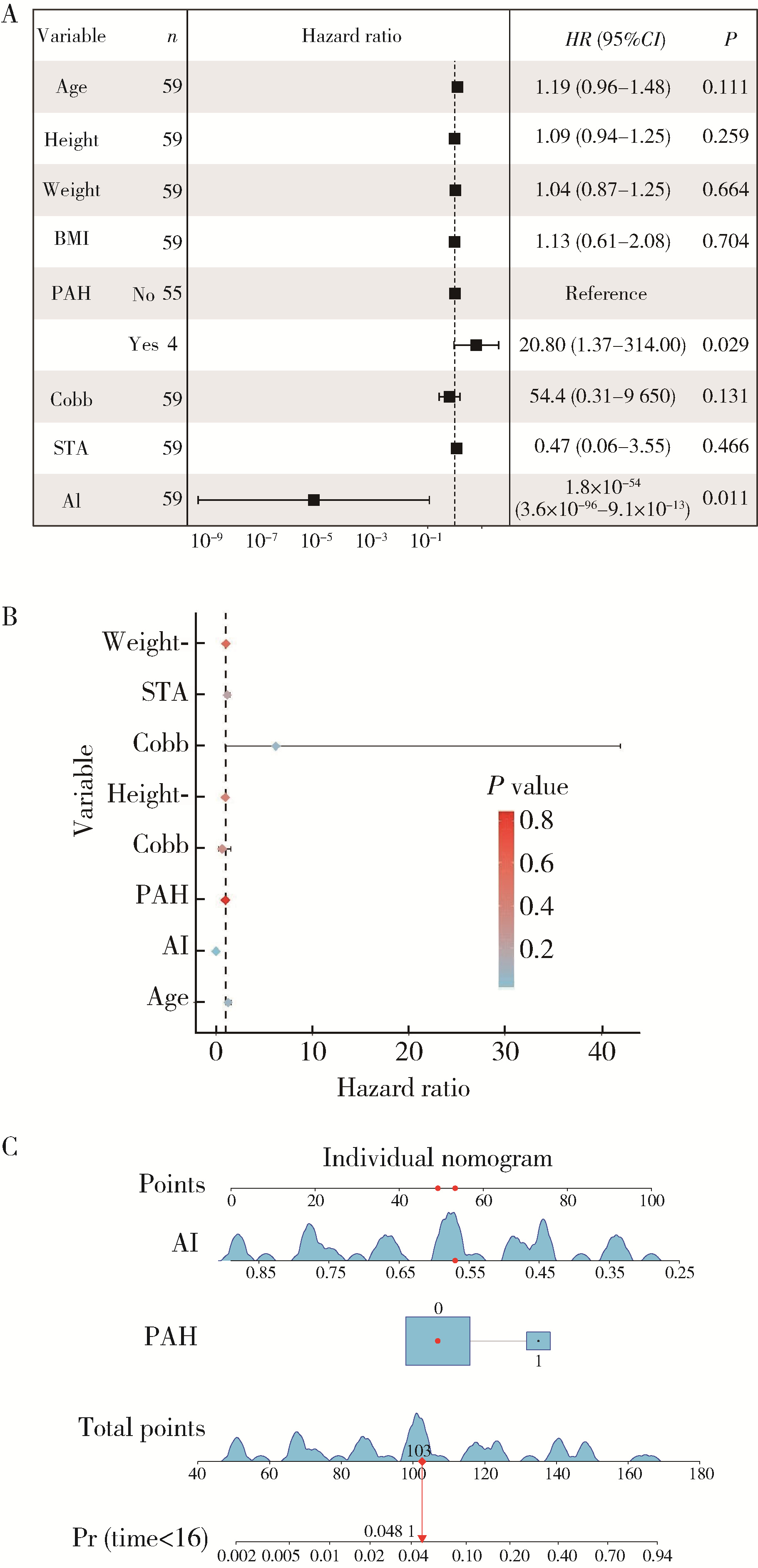
图1

漏斗胸Nuss术后合并脊柱侧弯患者风险预测模型的建立"

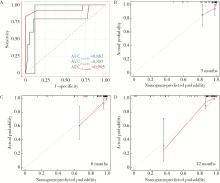
图2

漏斗胸Nuss术后合并脊柱侧弯患者风险预测模型的验证"

1
Scalise PN , Demehri FR . The management of pectus excavatum in pediatric patients: A narrative review[J]. Transl Pediatr, 2023, 12 (2): 208- 220.

doi: 10.21037/tp-22-361
2
Yoo G , Jeon HH , Rha EY , et al. The changes of distance between nipples following correction of women pectus excavatum[J]. Sci Rep, 2023, 12 (1): 20265.

doi: 10.1038/s41598-022-24768-4
3
Wang W , Long W , Liu Y , et al. Reoperation 10 years after Nuss procedure failed: Wung procedure combined with Wenlin procedure[J]. J Surg Case Rep, 2022, 2022 (12): rjac545.

doi: 10.1093/jscr/rjac545
4
Janssen N , Daemen JHT , Ashour O , et al. Nuss bar removal without straightening is a safe technique: A single center experience[J]. J Thorac Dis, 2022, 14 (9): 3335- 3342.

doi: 10.21037/jtd-22-725
5
Li H , Wang F , Ji G , et al. Modified Nuss procedure for the treatment of pectus excavatum: Experience of 259 patients[J]. Asian J Surg, 2023, 46 (2): 692- 697.

doi: 10.1016/j.asjsur.2022.06.080
6
Kuru P , Cakiroglu A , Er A , et al. Pectus excavatum and pectus carinatum: Associated conditions, family history, and postoperative patient satisfaction[J]. Korean J Thorac Cardiovasc Surg, 2016, 49 (1): 29- 34.

doi: 10.5090/kjtcs.2016.49.1.29
7
Araújo ME , Penha AD , Westphal FL , et al. Nuss procedure for pectus excavatum repair: Critical appraisal of the evidence[J]. Rev Col Bras Cir, 2014, 41 (6): 400- 405.

doi: 10.1590/0100-69912014006004
8
İşcanM, KılıçB, TurnaA, 等. The effect of minimally invasive pectus excavatum repair on thoracic scoliosis[J]. Eur J Cardiothorac Surg, 2020, ezaa328.
9
尚华, 张大, 杨林, 等. 漏斗胸Nuss矫形术对胸廓的影响及相关因素分析[J]. 中华小儿外科杂志, 2020, 41 (1): 42- 46.
10
梁林, 叶金铎, 王志芹, 等. Nuss手术矫正漏斗胸过程的数值模拟[J]. 生物医学工程与临床, 2011, 15 (4): 316- 321.
11
曹隽. 脊柱侧弯在漏斗胸矫正术中的形态改变及力学分析[D]. 北京: 首都医科大学, 2017.
12
Okuyama H , Tsukada R , Tazuke Y , et al. Thoracoscopic costal cartilage excision combined with the nuss procedure for patients with asymmetrical pectus excavatum[J]. J Laparoendosc Adv Surg Tech A, 2021, 31 (1): 95- 99.

doi: 10.1089/lap.2020.0312
13
Floccari LV , Sucato DJ , Ramo BA . Scoliosis progression after the nuss procedure for pectus excavatum: A case report[J]. Spine Deform, 2019, 7 (6): 1003- 1009.

doi: 10.1016/j.jspd.2019.01.009
14
Heydweiller AC , König TT , Yavuz ST , et al. Complications following metal bar removal after Nuss repair are rare in a duocentric retrospective evaluation[J]. Pediatr Surg Int, 2022, 38 (12): 1919- 1924.

doi: 10.1007/s00383-022-05250-8
15
Khairallah S , Chow OS , Mick SL . Combined minimally invasive repair of pectus excavatum and robotically assisted mitral valve repair: A case report and considerations[J]. J Card Surg, 2022, 37 (12): 5571- 5574.

doi: 10.1111/jocs.17070
16
Yi JH . Rastelli conduit change with the Nuss procedure for relieving compression of extracardiac conduit[J]. Eur J Cardiothorac Surg, 2022, 62 (5): ezac490.

doi: 10.1093/ejcts/ezac490
17
Park HJ , Park CB , Jeong JY . Bilateral tension pneumothoraxes in buffalo chest several months after Nuss procedure for pectus excavatum[J]. J Cardiothorac Surg, 2022, 17 (1): 314.

doi: 10.1186/s13019-022-02055-7
18
Chen HYM , Cheng WYR , Chan H , et al. Associated risk factors for patients undergoing a unique or double Nuss bar placement for pectus excavatum[J]. Asian Cardiovasc Thorac Ann, 2023, 31 (3): 221- 228.

doi: 10.1177/02184923221142165
19
Martin G , Canuet M , Rahli M , et al. Severe pre-capillary pulmonary hypertension associated with kyphoscoliosis: Description of 4 cases[J]. Respir Med Res, 2023, 84, 101034.
20
Li Q , Zeng F , Chen T , et al. Management of severe scoliosis with pulmonary arterial hypertension: A single-center retrospective case series study[J]. Geriatr Orthop Surg Rehabil, 2022, 13, 21514593221080279.

doi: 10.1177/21514593221080279
21
Sarwahi V , Borlack RE , Dworkin A , et al. Adolescent idiopathic scoliosis patients are at increased risk for pulmonary hypertension which reverses after scoliosis surgery[J]. Spine J, 2014, 14 (11): S153- S154.
22
Yang G , Deng X , Yang Y , et al. Simultaneous operative repair of pectus excavatum and concurrent congenital heart defects[J]. Interact Cardiovasc Thorac Surg, 2019, 28 (5): 783- 788.

doi: 10.1093/icvts/ivy294
23
曹隽, 张学军, 曾骐, 等. Nuss手术治疗漏斗胸患儿合并特发性脊柱侧弯的临床研究[J]. 临床小儿外科杂志, 2019, 18 (1): 13- 17.
24
Lotfi N , Chauhan GS , Gardner A , et al. The relationship between measures of spinal deformity and measures of thoracic trunk rotation[J]. J Spine Surg, 2020, 6 (3): 555- 561.

doi: 10.21037/jss-20-562
25
Li H , Jin X , Fan S , et al. Behavioural disorders in children with pectus excavatum in China: A retrospective cohort study with propensity score matching and risk prediction model[J]. Eur J Cardiothorac Surg, 2019, 56 (3): 596- 603.

doi: 10.1093/ejcts/ezz038
26
王丹, 沈明月. 胸腔镜下小儿漏斗胸矫形术后并发症风险预测模型的构建和验证[J]. 中国妇幼保健, 2022, 37 (1): 84- 86.
[1] 杨小勇, 张帆, 马潞林, 刘承. 前列腺导管腺癌临床特征及腺外侵犯的影响因素[J]. 北京大学学报(医学版), 2025, 57(5): 956-960.
[2] 刘伟, 郭稳, 过哲, 李春艳, 李云龙, 刘思奇, 张亮, 宋慧. 痛风患者放射学阴性骨侵蚀的相关危险因素[J]. 北京大学学报(医学版), 2025, 57(4): 735-739.
[3] 陆梦溪, 刘秋萍, 周恬静, 刘晓非, 孙烨祥, 沈鹏, 林鸿波, 唐迅, 高培. 基于社区人群队列的甘油三酯-葡萄糖指数与心血管病发病和死亡的关联[J]. 北京大学学报(医学版), 2025, 57(3): 430-435.
[4] 杨龙傲, 金旭, 黄文初, 何丽华, 陈娟. 视屏作业人员视疲劳及干眼的流行病学调查[J]. 北京大学学报(医学版), 2025, 57(3): 554-561.
[5] 郭华秋, 王哲, 杨雪, 白洁. 口腔急诊出血患者的临床特征与危险因素[J]. 北京大学学报(医学版), 2025, 57(1): 142-147.
[6] 邓敏婷, 王楠, 夏斌, 赵玉鸣, 朱俊霞. 儿童及青少年挫入恒前牙自行再萌出的相关影响因素[J]. 北京大学学报(医学版), 2025, 57(1): 148-153.
[7] 李钰锴, 王红彦, 罗靓, 李云, 李春. 抗磷脂抗体在白塞病合并血栓中的临床意义[J]. 北京大学学报(医学版), 2024, 56(6): 1036-1040.
[8] 田杨, 韩永正, 李娇, 王明亚, 曲音音, 房景超, 金辉, 李民, 王军, 徐懋, 王圣林, 郭向阳. 颈椎前路手术后硬膜外血肿的发生率和危险因素[J]. 北京大学学报(医学版), 2024, 56(6): 1058-1064.
[9] 王明瑞, 赖金惠, 姬家祥, 唐鑫伟, 胡浩浦, 王起, 许克新, 徐涛, 胡浩. 使用中文版威斯康星结石生活质量问卷预测肾结石患者生活质量降低的危险因素[J]. 北京大学学报(医学版), 2024, 56(6): 1069-1074.
[10] 刘园梅, 傅义程, 郝靖欣, 张福春, 刘慧琳. 老年髋部骨折患者住院期间发生术后心力衰竭的列线图预测模型的构建及验证[J]. 北京大学学报(医学版), 2024, 56(5): 874-883.
[11] 李志存, 吴天俣, 梁磊, 范宇, 孟一森, 张骞. 穿刺活检单针阳性前列腺癌术后病理升级的危险因素分析及列线图模型构建[J]. 北京大学学报(医学版), 2024, 56(5): 896-901.
[12] 颜野,李小龙,夏海缀,朱学华,张羽婷,张帆,刘可,刘承,马潞林. 前列腺癌根治术后远期膀胱过度活动症的危险因素[J]. 北京大学学报(医学版), 2024, 56(4): 589-593.
[13] 周泽臻,邓绍晖,颜野,张帆,郝一昌,葛力源,张洪宪,王国良,张树栋. 非转移性T3a肾细胞癌患者3年肿瘤特异性生存期预测[J]. 北京大学学报(医学版), 2024, 56(4): 673-679.
[14] 陈延,李况蒙,洪锴,张树栋,程建星,郑仲杰,唐文豪,赵连明,张海涛,姜辉,林浩成. 阴茎海绵体注射试验对阴茎血管功能影响的回顾性研究[J]. 北京大学学报(医学版), 2024, 56(4): 680-686.
[15] 庞博,郭桐君,陈曦,郭华棋,石嘉章,陈娟,王欣梅,李耀妍,单安琪,余恒意,黄婧,汤乃军,王艳,郭新彪,李国星,吴少伟. 天津与上海35岁以上人群氮氧化物个体暴露水平及其影响因素[J]. 北京大学学报(医学版), 2024, 56(4): 700-707.
Viewed
Full text


Abstract

Cited

  Shared   
  Discussed   
No Suggested Reading articles found!