北京大学学报(医学版) ›› 2026, Vol. 58 ›› Issue (4): 833-841. doi: 10.19723/j.issn.1671-167X.2026.04.021

• 论著 • 上一篇    下一篇

中国胃炎和十二指肠炎疾病负担的长期演变、效应解析与未来态势:基于GBD 2023的分析

王清华, 沈天天, 卢晓微, 廖聪聪, 许石伟, 李琰*()   

  1. 同济大学附属东方医院老年医学科,上海 200120
  • 收稿日期:2025-11-26 出版日期:2026-08-18 发布日期:2026-06-30
  • 通讯作者: 李琰

Long-term evolution, effect analysis and future trend of the burden of gastritis and duodenitis in China: An analysis based on GBD 2023

Qinghua WANG, Tiantian SHEN, Xiaowei LU, Congcong LIAO, Shiwei XU, Yan LI*()   

  1. Department of Geriatrics, Shanghai East Hospital, Tongji University, Shanghai 200120, China
  • Received:2025-11-26 Online:2026-08-18 Published:2026-06-30
  • Contact: Yan LI

RICH HTML


摘要:

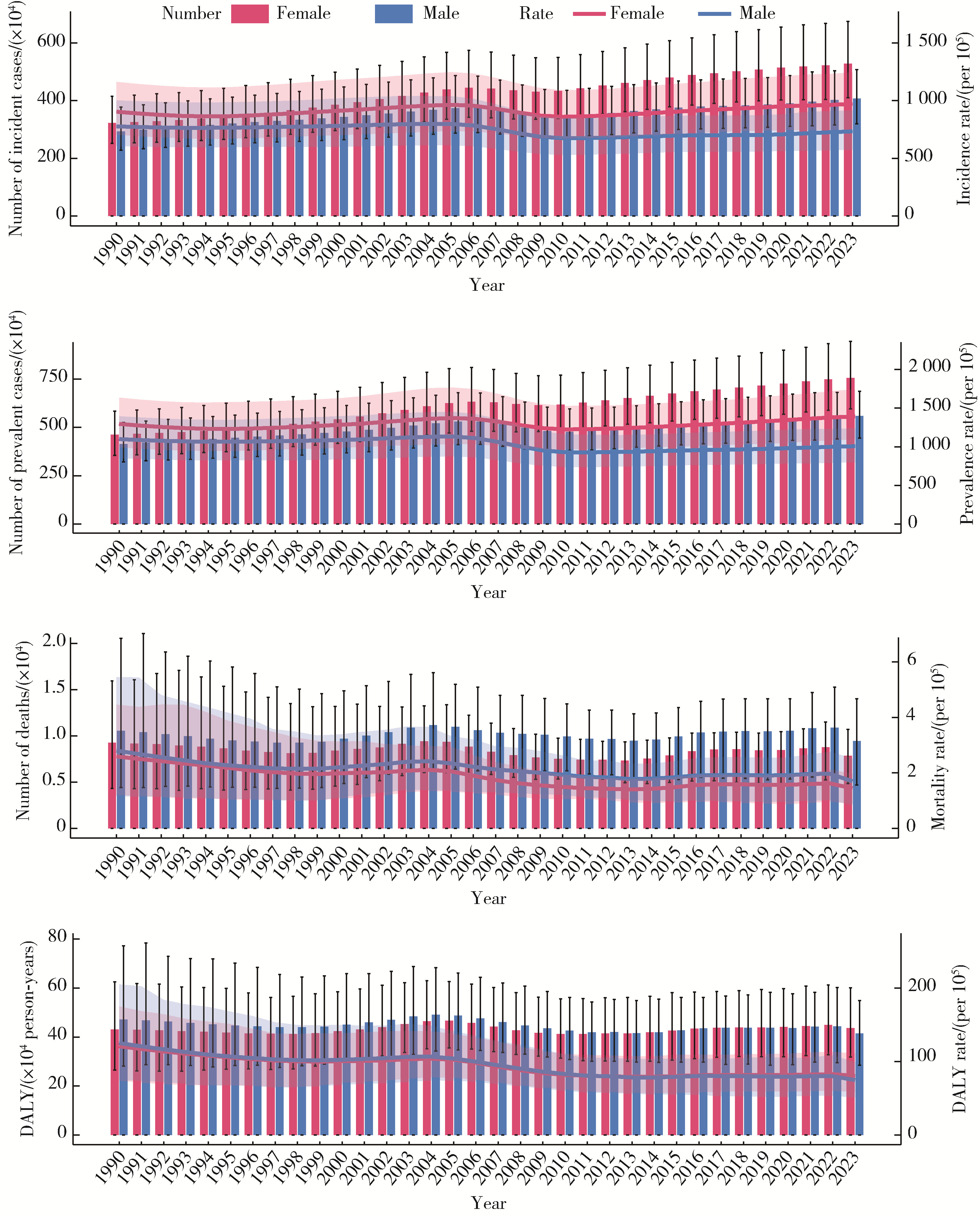
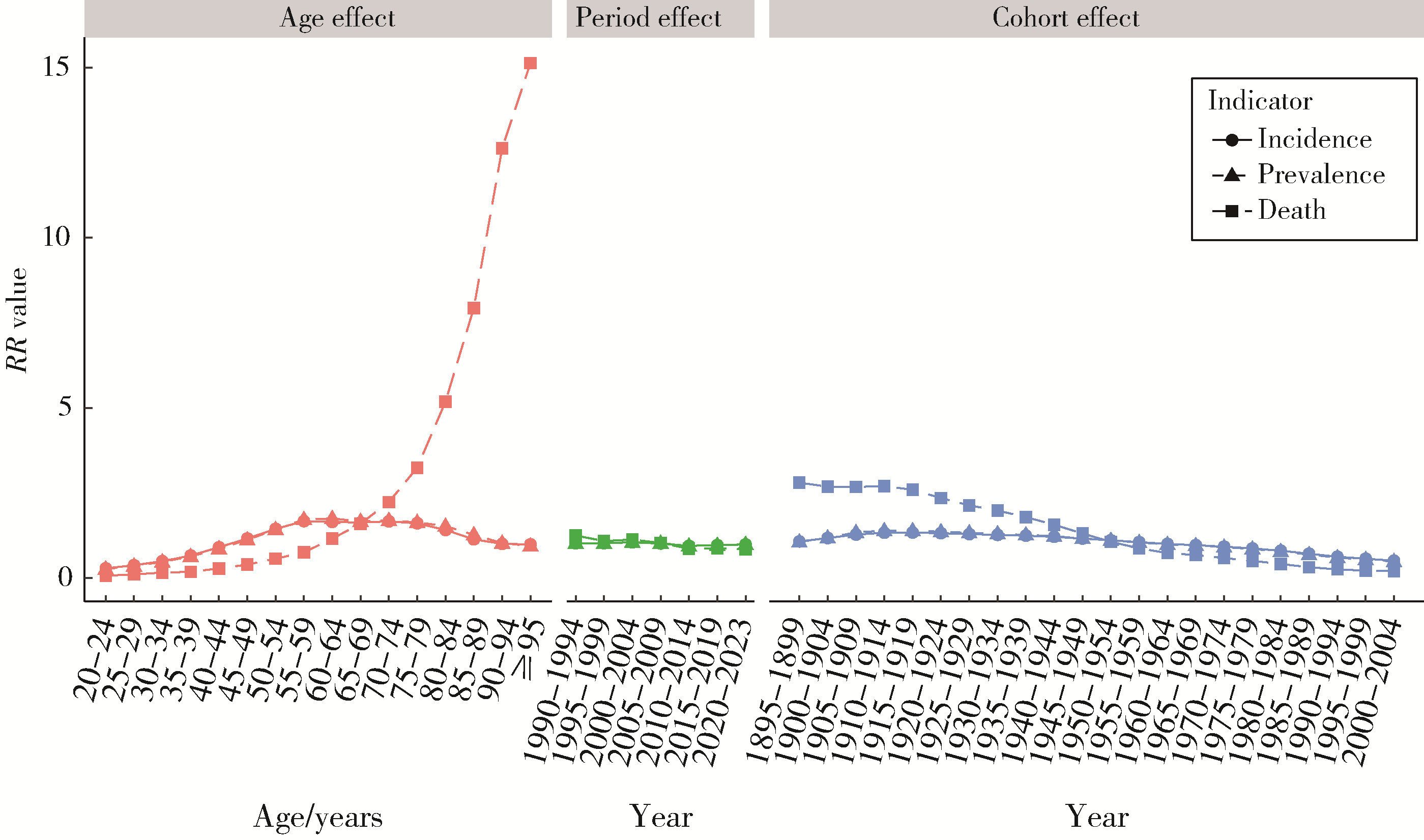
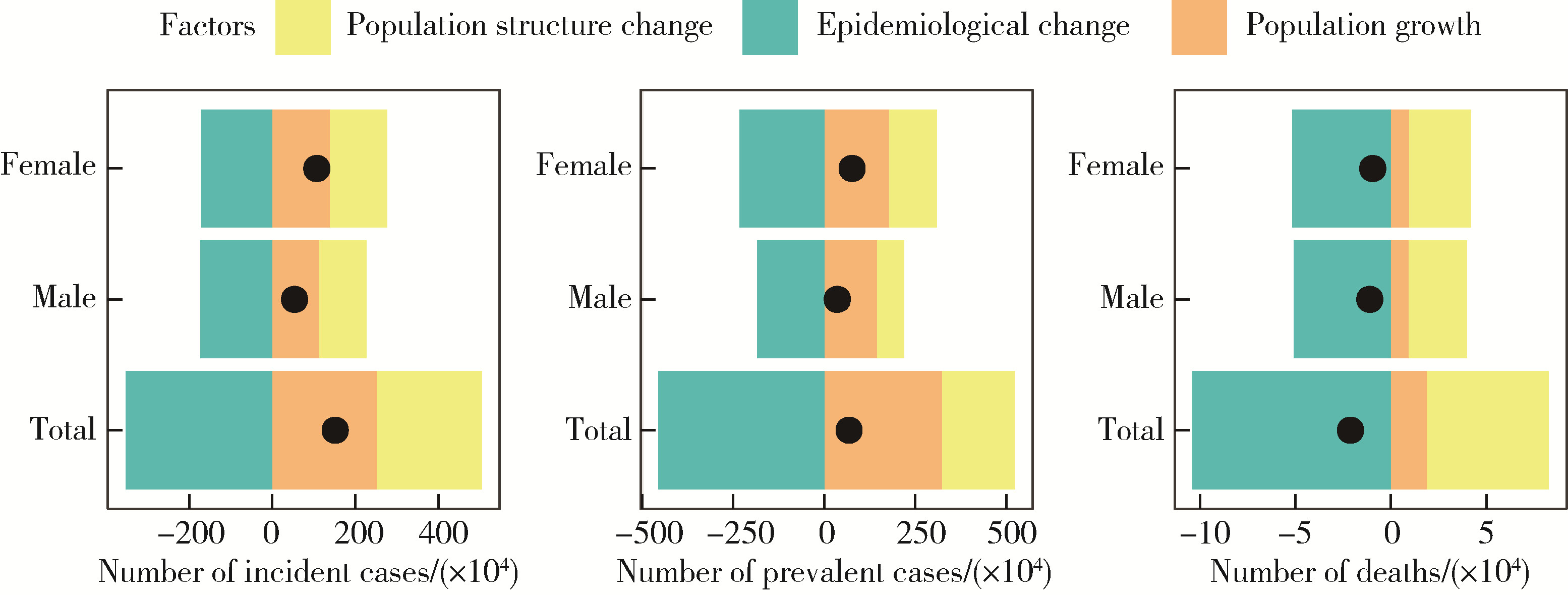
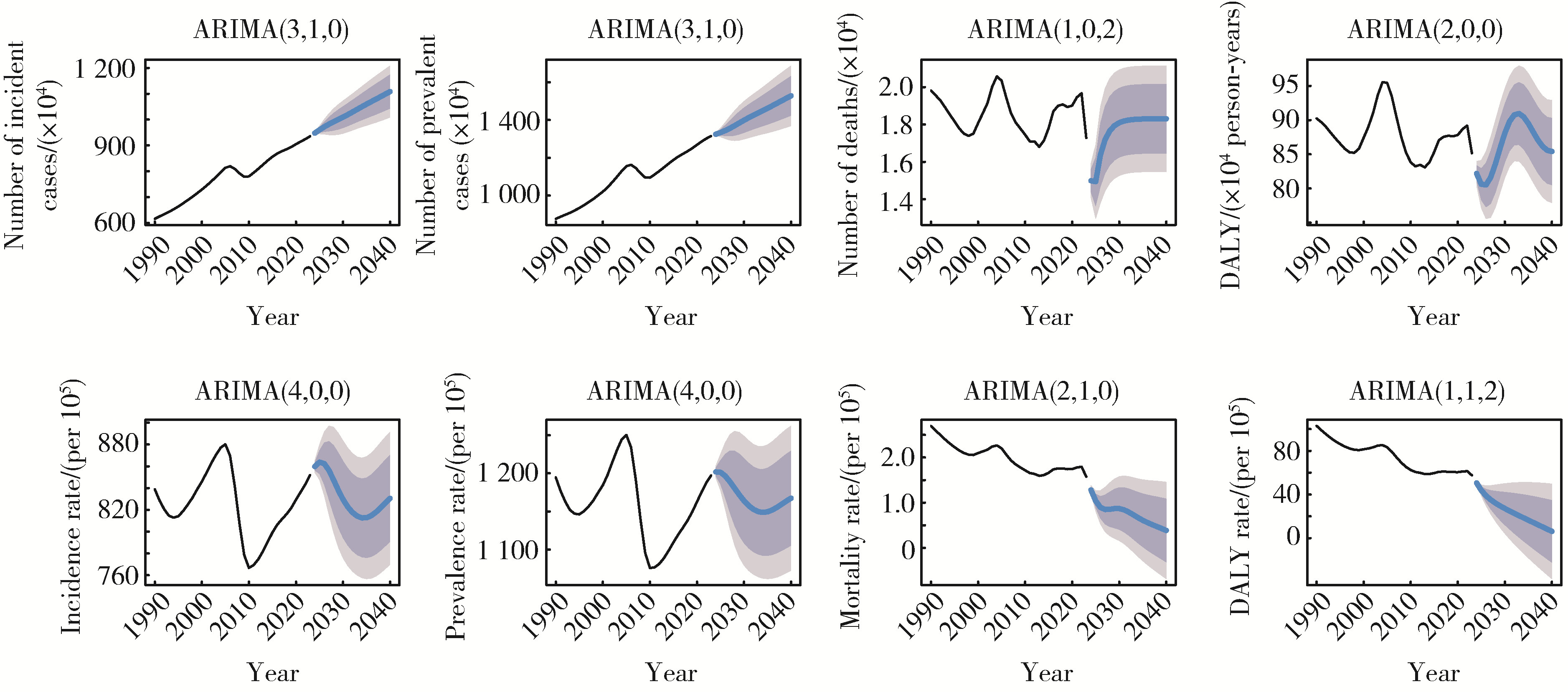
目的: 探究1990—2023年中国胃炎和十二指肠炎(gastritis and duodenitis,GD)的疾病负担演变趋势,明确其负担变化的驱动要素,预测2024—2040年疾病负担态势,为GD防控策略的制定提供数据依据。方法: 依托全球疾病负担研究2023的数据,运用Joinpoint回归模型剖析1990—2023年中国GD年龄标准化(简称标化)发病率、标化患病率、标化死亡率及标化伤残调整寿命年(disability-adjusted life year,DALY)率的平均年度百分比变化(ave-rage annual percent change,AAPC);通过年龄-时期-队列模型探究年龄、时期、队列三效应对发病、患病及死亡风险的作用;分辨人口结构变化、流行病学变化、人口增长三类因素对疾病负担的驱动效应;运用自回归积分滑动平均(autoregressive integrated moving average,ARIMA)模型展望未来疾病负担。结果: 1990—2023年,中国GD发病例数由615.88万上升至935.45万,患病例数由877.06万上升至1 314.59万,死亡例数由1.98万降至1.72万,DALY数由90.24万人年微降至85.16万人年;标化发病率、标化患病率、标化死亡率及标化DALY率的AAPC分别为-1.08%、-1.18%、-3.81%、-2.89%(均P<0.001)。Joinpoint回归分析表明,各标化率均呈分阶段下降趋势。年龄-时期-队列模型显示,发病与患病风险在55~59岁达峰,死亡风险随年龄升高显著上升;发病与患病风险时期效应先升后降,死亡风险时期效应持续下降;队列风险均呈下降趋势。分解研究表明,人口增长与结构变化促使发病数、患病数增加(发病数总体贡献占比分别为165.66%、167.00%),流行病学变化为其下降主因(发病数总体贡献占比-232.66%);流行病学变化是死亡数下降的核心因素(总体贡献占比490.07%)。ARIMA模型预测显示,至2040年发病数将升至1 108.61万例,患病数升至1 527.96万例,死亡率降至0.48/10万,DALY率降至26.18/10万。结论: 1990—2023年中国GD标化疾病负担明显缓解,人口因素与流行病学变化协同推动负担变化;未来发病与患病数将上升,但死亡与伤残负担持续降低,需结合年龄、队列特征及驱动因素制定精准防控策略。

关键词: 胃炎, 十二指肠炎, 全球疾病负担, 中国

Abstract:

Objective: To explore the evolutionary trends of the disease burden of gastritis and duodenitis (GD) in China from 1990 to 2023, to clarify the driving factors of changes in this burden, to predict the disease burden situation from 2024 to 2040, and to provide data support for formulating GD prevention and control strategies. Methods: Based on the Global Burden of Disease Study (GBD) 2023 data, the Joinpoint regression model was applied to analyze the annual average percentage change (AAPC) of age-standardized incidence rate, age-standardized prevalence rate, age-standardized mortality rate, and age-standardized disability-adjusted life years (DALY) rate of GD in China from 1990 to 2023. The age-period-cohort model was used to investigate the effects of age, period, and cohort on incidence, prevalence, and mortality risks. Three factors—population structure change, epidemiological change, and population growth—were identified to determine their driving effects on the disease burden. The auto-regressive integrated moving average (ARIMA) time series model was employed to forecast the future disease burden. Results: From 1990 to 2023, the number of GD incident cases in China increased from 6.158 8 million to 9.354 5 million, the number of prevalent cases rose from 8.770 6 million to 13.145 9 million, the number of deaths decreased from 19 800 to 17 200, and the number of DALY slightly declined from 902 400 person-years to 851 600 person-years. The AAPCs of age-standardized incidence rate, age-standardized prevalence rate, age-standardized mortality rate, and age-standardized DALY rate were -1.08%, -1.18%, -3.81%, and -2.89%, respectively (all P < 0.001). Joinpoint regression analysis showed that all age-standardized rates presented a phased downward trend. Age-period-cohort model analysis revealed that the incidence and prevalence risks peaked in the 55-59 years age group, while the mortality risk increased significantly with age. The period effect of incidence and prevalence risks first increased and then decreased, whereas the period effect of mortality risk showed a conti-nuous downward trend; the cohort risk exhibited a decreasing trend across all the groups. Decomposition analysis indicated that population growth and structural change promoted the increase in incident and prevalent cases (the overall contribution rates to the incident cases were 165.66% and 167.00%, respectively), while epidemiological change was the main factor driving their decrease (with an overall contribution rate of -232.66% to the incident cases). Additionally, epidemiological change was the core factor for the reduction in deaths (with an overall contribution rate of 490.07%). The ARIMA time series model predicted that by 2040, the number of incident cases would rise to 11.086 1 million, the number of prevalent cases to 15.279 6 million, the mortality rate to 0.48 per 100 000 population, and the DALY rate to 26.18 per 100 000 population. Conclusion: From 1990 to 2023, the age-standardized disease burden of GD in China was significantly alleviated, with population factors and epidemiological changes jointly driving the burden changes. Although the number of incident and prevalent cases will increase in the future, the mortality and disability burden will continue to decrease. It is necessary to formulate targeted prevention and control strategies based on age, cohort characteristics, and driving factors.

Key words: Gastritis, Duodenitis, Global burden of disease, China

中图分类号: 

  • R573

表1

1990年和2023年中国GD疾病负担对比"

Indicator 1990 2023
Total Male Female Total Male Female
Incidence
    Incident cases/(×104) 615.88(480.19-794.52) 292.77(228.67-377.46) 323.11(252.22-415.37) 935.45(729.09-1 182.95) 407.40(319.33-507.83) 528.04(410.28-675.16)
    Incidence rate/(per 105) 838.88(654.06-1 082.20) 777.12(606.96-1 001.89) 903.98(705.67-1 162.10) 851.98(664.03-1 077.39) 733.95(575.29-914.87) 972.65(755.74-1 243.63)
    Age-standardized incidence rate/(per 105) 700.22(551.64-874.14) 650.80(513.11-810.21) 750.13(592.28-940.96) 489.05(391.66-599.60) 437.47(349.09-529.29) 541.46(430.51-669.24)
Prevalence
    Prevalent cases/(×104) 877.06(674.68-1 108.67) 414.01(321.48-525.19) 463.05(355.15-584.33) 1 314.59(1 034.83-1 636.95) 559.05(445.26-687.11) 755.54(595.71-945.24)
    Prevalence rate/(per 105) 1 194.62(918.97-1 510.08) 1 098.90(853.32-1 394.02) 1 295.51(993.63-1 634.80) 1 197.28(942.49-1 490.87) 1 007.14(802.15-1 237.84) 1 391.69(1 097.30-1 741.12)
    Age-standardized prevalence rate/(per 105) 1 004.91(793.38-1 230.01) 929.54(738.53-1 142.69) 1 080.74(843.31-1 317.66) 678.98(544.78-821.73) 597.67(488.01-720.55) 761.24(606.68-923.71)
Death
    Number of deaths/(×104) 1.98(1.17-3.28) 1.05(0.44-2.05) 0.92(0.43-1.59) 1.72(1.03-2.31) 0.94(0.46-1.40) 0.78(0.48-1.06)
    Mortality rate/(per 105) 2.70(1.59-4.47) 2.80(1.17-5.45) 2.59(1.21-4.46) 1.57(0.94-2.11) 1.70(0.84-2.52) 1.45(0.89-1.97)
    Age-standardized mortality rate/(per 105) 3.02(1.78-5.02) 3.27(1.38-6.12) 2.73(1.28-4.74) 0.81(0.49-1.08) 0.96(0.48-1.38) 0.67(0.42-0.92)
DALY
    DALY/(×104 person-years) 90.24(61.53-134.31) 47.11(28.11-77.23) 43.13(26.52-62.51) 85.16(63.32-114.63) 41.49(28.44-54.89) 43.66(31.83-60.17)
    DALY rate/(per 105) 122.92(83.82-182.95) 125.05(74.62-205.01) 120.69(74.21-174.89) 77.56(57.67-104.41) 74.75(51.25-98.89) 80.44(58.65-110.83)
    Age-standardized DALY rate/(per 105) 118.19(81.26-173.20) 122.01(74.15-195.68) 113.87(71.70-163.06) 43.51(31.87-58.47) 43.58(29.97-57.48) 43.55(31.14-60.58)

图1

1990—2023年中国不同性别GD疾病负担变化"

表2

1990—2023年中国GD标化率的Joinpoint分析"

Items Trend stage Total Male Female
Year APC/% Year APC/% Year APC/%
Age-standardized incidence rate 1 1990-1995 -0.94*(-1.13 to -0.77) 1990-2005 -0.61*(-0.63 to -0.59) 1990-1994 -1.49*(-1.61 to -1.39)
2 1995-2005 -0.21*(-0.28 to -0.14) 2005-2010 -4.42*(-4.55 to -4.29) 1994-2003 0.04*(0.01 to 0.09)
3 2005-2010 -4.02*(-4.25 to -3.80) 2010-2015 -0.46*(-0.60 to -0.34) 2003-2006 -0.44*(-0.78 to -0.11)
4 2010-2023 -0.64*(-0.68 to -0.61) 2015-2020 -1.02*(-1.15 to -0.90) 2006-2009 -4.92*(-5.24 to -4.60)
5 2020-2023 -0.05 (-0.27 to 0.15) 2009-2012 -1.22*(-1.56 to -0.90)
6 2012-2015 -0.29 (-0.62 to 0.04)
7 2015-2023 -0.74*(-0.78 to -0.71)
Age-standardized prevalence rate 1 1990-1994 -1.29*(-1.49 to -1.11) 1990-2000 -0.82*(-0.89 to -0.77) 1990-1994 -1.56*(-1.76 to -1.37)
2 1994-2000 -0.49*(-0.63 to -0.36) 2000-2005 -0.01 (-0.24 to 0.23) 1994-2000 -0.28*(-0.43 to -0.15)
3 2000-2005 0.20*(0.02 to 0.40) 2005-2010 -5.18*(-5.40 to -4.97) 2000-2005 0.43*(0.24 to 0.64)
4 2005-2010 -4.54*(-4.73 to -4.37) 2010-2023 -0.70*(-0.74 to -0.67) 2005-2010 -3.98*(-4.17 to -3.79)
5 2010-2023 -0.69*(-0.72 to -0.66) 2010-2023 -0.69*(-0.73 to -0.66)
Age-standardized mortality rate 1 1990-1998 -4.29*(-4.52 to -4.08) 1990-1998 -4.00*(-4.63 to -3.38) 1990-1998 -4.19*(-5.18 to -3.20)
2 1998-2004 0.30 (-0.05 to 0.66) 1998-2004 0.26 (-0.70 to 1.25) 1998-2005 -0.72 (-1.86 to 0.42)
3 2004-2008 -7.44*(-7.97 to -6.92) 2004-2013 -5.81*(-6.16 to -5.48) 2005-2008 -10.34*(-14.72 to -5.74)
4 2008-2013 -5.75*(-6.06 to -5.44) 2013-2021 -1.81*(-2.26 to -1.37) 2008-2013 -5.82*(-7.12 to -4.51)
5 2013-2017 -1.03*(-1.66 to -0.41) 2021-2023 -9.09*(-12.64 to -5.40) 2013-2017 -0.44 (-2.74 to 1.90)
6 2017-2021 -3.34*(-4.02 to -2.66) 2017-2023 -5.04*(-5.87 to -4.21)
7 2021-2023 -7.97*(-9.35 to -6.57)
Age-standardized DALY rate 1 1990-1998 -3.13*(-3.44 to -2.84) 1990-1998 -3.40*(-3.64 to -3.16) 1990-1998 -2.94*(-3.14 to -2.74)
2 1998-2005 -0.86*(-1.27 to -0.46) 1998-2004 -0.44*(-0.85 to -0.03) 1998-2005 -0.84*(-1.08 to -0.60)
3 2005-2009 -6.68*(-7.61 to -5.75) 2004-2012 -5.42*(-5.61 to -5.25) 2005-2009 -6.80*(-7.41 to -6.20)
4 2009-2012 -4.24*(-6.15 to -2.30) 2012-2021 -1.96*(-2.13 to -1.80) 2009-2012 -4.01*(-5.36 to -2.65)
5 2012-2023 -2.22*(-2.38 to -2.07) 2021-2023 -4.35*(-5.88 to -2.80) 2012-2023 -2.18*(-2.29 to -2.08)

图2

1990—2023年中国GD发病、患病和死亡风险的年龄-时期-队列模型"

图3

1990—2023年中国GD疾病负担变化的分解分析"

图4

2024—2040年中国GD疾病负担预测"

1
Wang L , Jiang W , Li H . Global, regional, and national burden of gastritis and duodenitis from 1990 to 2021 with projections to 2050:A systematic analysis of the Global Burden of Disease Study 2021[J]. Int J Med Sci, 2025, 22 (11): 2570- 2582.

doi: 10.7150/ijms.109762
2
Zhao L , Zhang F , Kuang D , et al. Mediating effect of gastrointestinal symptoms on dietary behavior and quality of life in Chinese adults with chronic gastritis: A cross-sectional study[J]. Front Med (Lausanne), 2023, 10, 1178897.
3
Zhang Z , Chen S , Li S , et al. Association of Helicobacter pylori related chronic atrophic gastritis and gastric cancer risk: A literature review[J]. Front Med (Lausanne), 2025, 12, 1504749.
4
Lahner E , Conti L , Annibale B , et al. Current perspectives in atrophic gastritis[J]. Curr Gastroenterol Rep, 2020, 22 (8): 38.

doi: 10.1007/s11894-020-00775-1
5
Li J , Pan J , Xiao D , et al. Chronic atrophic gastritis and risk of incident upper gastrointestinal cancers: A systematic review and meta-analysis[J]. J Transl Med, 2024, 22 (1): 429.

doi: 10.1186/s12967-023-04736-w
6
秦建茹, 王峰. 慢性胃炎患者焦虑抑郁状况调查及危险因素[J]. 中国卫生工程学, 2022, 21 (6): 965- 967.
7
Zhang Z , Zhang X . Chronic atrophic gastritis in different ages in South China: A 10-year retrospective analysis[J]. BMC Gastro-enterol, 2023, 23 (1): 37.

doi: 10.1186/s12876-023-02662-1
8
王暖凤, 初海坤, 黄树民, 等. 慢性萎缩性胃炎患者临床流行病学分析[J]. 中国公共卫生, 2017, 33 (7): 1109- 1111.
9
赵丁慧. 延安市某三甲医院儿童胃镜检查结果特征分析[D]. 延安: 延安大学, 2024.
10
GBD results[EB/OL]. (2025-10-12)[2025-10-25]. https://vizhub.healthdata.org/gbd-results.
11
朱风尚, 朱国英, 陈利, 等. 建党100年来我国消化病学发展回顾之管见[J/OL]. 中华消化病与影像杂志(电子版), 2021, 11(4): 145-148. https://rs.yiigle.com/cmaid/1561940.
12
姜元喜, 陈莹, 许树长. 中国消化内镜质量控制现状、思考及未来[J]. 同济大学学报(医学版), 2020, 41 (6): 805- 810.
13
王昊成, 张振玉. 二联疗法根除幽门螺杆菌的昨天、今天和明天[J]. 胃肠病学和肝病学杂志, 2025, 34 (8): 1106- 1112.
14
Greuter T , Manser C , Pittet V , et al. Gender differences in inflammatory bowel disease[J]. Digestion, 2020, 101 (Suppl 1): 98- 104.
15
Lahner E , Dilaghi E , Cingolani S , et al. Gender-sex differences in autoimmune atrophic gastritis[J]. Transl Res, 2022, 248, 1- 10.
16
许诗涵, 周显祝, 杜奕奇, 等. 中国胃癌早筛早诊早治高质量发展的思考[J]. 中国实用内科杂志, 2025, 45 (5): 365- 372.
17
Zhu Z , Wang Q , Sun Q , et al. Improving access to medicines and beyond: The national volume-based procurement policy in China[J]. BMJ Glob Health, 2023, 8 (7): e011535.

doi: 10.1136/bmjgh-2022-011535
18
Idris M , Smiley A , Patel S , et al. Risk factors for mortality in emergently admitted patients with acute gastric ulcer: An analysis of 15, 538 patients in national inpatient sample, 2005-2014[J]. Int J Environ Res Public Health, 2022, 19 (23): 16263.

doi: 10.3390/ijerph192316263
19
Lin S , Gao T , Sun C , et al. Association of dietary patterns and endoscopic gastric mucosal atrophy in an adult Chinese population[J]. Sci Rep, 2019, 9 (1): 16567.

doi: 10.1038/s41598-019-52951-7
20
Piscione M , Mazzone M , Di Marcantonio MC , et al. Eradication of helicobacter pylori and gastric cancer: A controversial relationship[J]. Front Microbiol, 2021, 12, 630852.

doi: 10.3389/fmicb.2021.630852
21
Marshall B . Epidemiology of Helicobacter in Chinese families: A foundation for cost-effective eradication strategies?[J]. Gut, 2024, 73 (5): 870- 871.

doi: 10.1136/gutjnl-2023-329786
22
吴志国, 王先升, 杜敏, 等. 体检人群胃癌风险筛查结果分析及对策研究[J]. 智慧健康, 2024, 10 (9): 21- 24.
23
阳国兴, 杜光会, 张冲, 等. 健康教育在慢性胃炎护理干预中效果的随机对照试验[J]. 中国循证医学杂志, 2018, 18 (8): 812- 815.
24
Lupu A , Miron IC , Cernomaz AT , et al. Epidemiological characteristics of helicobacter pylori infection in children in northeast Romania[J]. Diagnostics (Basel), 2023, 13 (3): 408.

doi: 10.3390/diagnostics13030408
[1] 靖婷,江华,李婷,申倩倩,叶兰,曾银丹,梁文欣,冯罡,司徒文佑,张玉梅. 中国西部5城市中老年人血清25羟基维生素D与握力的相关性[J]. 北京大学学报(医学版), 2024, 56(3): 448-455.
[2] 王清波,傅虹桥. 中国卫生筹资转型的主要特征与历史沿革[J]. 北京大学学报(医学版), 2024, 56(3): 462-470.
[3] 闫晓晋,刘云飞,马宁,党佳佳,张京舒,钟盼亮,胡佩瑾,宋逸,马军. 《中国儿童发展纲要(2011-2020年)》实施期间中小学生营养不良率变化及其政策效应分析[J]. 北京大学学报(医学版), 2023, 55(4): 593-599.
[4] 王婷,李乔晟,刘皓冉,简伟研. 人格特征、城乡差异与抑郁症状变化的关系[J]. 北京大学学报(医学版), 2023, 55(3): 385-391.
[5] 邓佳慧,黄筱琳,刘晓星,孙杰,陆林. 中国睡眠医学的过去、现在和未来[J]. 北京大学学报(医学版), 2023, 55(3): 567-封三.
[6] 曹瑞洁,姚中强,焦朋清,崔立刚. 不同分类标准对中国大动脉炎的诊断效能比较[J]. 北京大学学报(医学版), 2022, 54(6): 1128-1133.
[7] 梁喆,范芳芳,张岩,秦献辉,李建平,霍勇. 中国高血压人群中H型高血压的比率和特征及与美国人群的比较[J]. 北京大学学报(医学版), 2022, 54(5): 1028-1037.
[8] 陆林,刘晓星,袁凯. 中国脑科学计划进展[J]. 北京大学学报(医学版), 2022, 54(5): 791-795.
[9] 方伟岗,田新霞,解云涛. 基因多态性对中国汉族女性乳腺癌遗传易感性的影响[J]. 北京大学学报(医学版), 2022, 54(5): 822-828.
[10] 刘小璇,段晓慧,张朔,孙阿萍,张英爽,樊东升. 中国人群遗传性周围神经病的致病基因分布[J]. 北京大学学报(医学版), 2022, 54(5): 874-883.
[11] 张力,龚继芳,潘宏铭,白玉贤,刘天舒,程颖,陈亚池,黄佳莹,许婷婷,葛飞娇,许婉玲,施佳,胡夕春,沈琳. 阿替利珠单抗治疗中国晚期实体瘤患者的开放标签Ⅰ期临床试验[J]. 北京大学学报(医学版), 2022, 54(5): 971-980.
[12] 许颖,次仁央金. 高原红细胞增多症与消化性溃疡出血的关系[J]. 北京大学学报(医学版), 2022, 54(1): 161-165.
[13] 敖英芳. 我国运动医学发展与北京冬奥会和健康中国建设[J]. 北京大学学报(医学版), 2021, 53(5): 823-827.
[14] 郭应禄. 夯实人才培养,实现我国泌尿外科奋斗目标[J]. 北京大学学报(医学版), 2021, 53(4): 633-634.
[15] 王志成,郭岩. 中国社区社会经济地位和成人自评健康的关联研究[J]. 北京大学学报(医学版), 2021, 53(2): 314-319.
Viewed
Full text


Abstract

Cited

  Shared   
  Discussed   
No Suggested Reading articles found!