北京大学学报(医学版) ›› 2025, Vol. 57 ›› Issue (6): 1067-1073. doi: 10.19723/j.issn.1671-167X.2025.06.008

• 论著 • 上一篇    下一篇

SII和SIRI对白塞病葡萄膜炎的风险预测及疾病活动度和预后的评估

高雅静1,2,3, 李正芳1,3, 马梦思1,2,3, 武丽君1,3,*()   

  1. 1. 新疆维吾尔自治区人民医院风湿免疫科,乌鲁木齐 830000
    2. 新疆医科大学,乌鲁木齐 830000
    3. 新疆类风湿关节炎临床医学研究中心,乌鲁木齐 830000
  • 收稿日期:2025-08-12 出版日期:2025-12-18 发布日期:2025-10-30
  • 通讯作者: 武丽君
  • 基金资助:
    新疆常见自身免疫病诊断评估关键技术研发及应用项目(2022B03002-1)

Role of the SII and SIRI in risk prediction, disease activity assessment, and prog-nostic evaluation of Behçet disease uveitis

Yajing GAO1,2,3, Zhengfang LI1,3, Mengsi MA1,2,3, Lijun WU1,3,*()   

  1. 1. Department of Rheumatology and Immunology, People's Hospital of Xinjiang Uygur Autonomous Region, Uygur 830000, China
    2. Xinjiang Medical University, Uygur 830000, China
    3. Xinjiang Clinical Research Center for Rheumatoid Arthritis, Uygur 830000, China
  • Received:2025-08-12 Online:2025-12-18 Published:2025-10-30
  • Contact: Lijun WU
  • Supported by:
    the Key Research and Development Project of Xinjiang Uygur Autonomous Region(2022B03002-1)

RICH HTML


摘要:

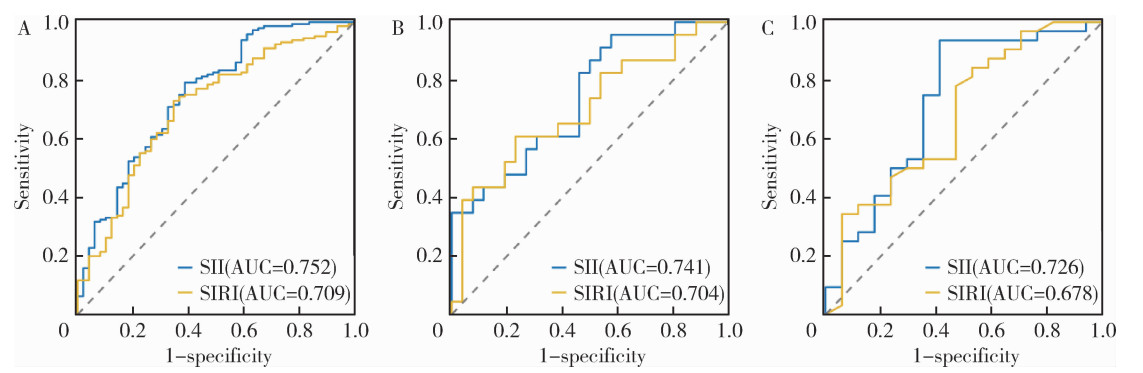
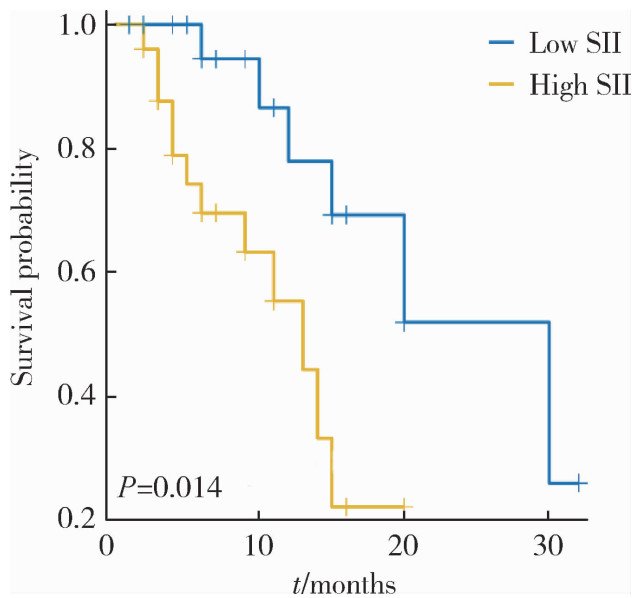
目的: 探讨全身免疫炎症指数(systemic immune inflammation index,SII)和全身炎症反应指数(systemic inflammatory response index,SIRI)与白塞病葡萄膜炎(Behçet disease uveitis, BU)的相关性,及其在BU患者疾病活动度及临床预后评估中的预测价值。方法: 回顾性纳入194例白塞病(Behçet disease, BD)患者和122例健康志愿者,按BD疾病活动与否分为疾病活动期(90例)和疾病稳定期(104例),按是否发生葡萄膜炎分为BU组(49例)与非BU组(145例),BU组按葡萄膜炎是否活动分为炎症活动期BU组(26例)与炎症稳定期BU组(23例)。基于常规血液检验指标(血小板、中性粒细胞、淋巴细胞、单核细胞计数)计算SII和SIRI。采用Spearman相关性分析评估SII和SIRI与BU发病风险、疾病活动及炎症标志物的相关性;通过受试者工作特征(receiver operating characteristic, ROC)曲线分析确定SII和SIRI预测BU发病风险及疾病活动的最佳阈值与预测效能。结果: BD疾病活动期的SII和SIRI水平均高于BD疾病稳定期(P < 0.05);有葡萄膜炎或血管受累BD患者的SII和SIRI水平高于有其他临床表现的患者(P < 0.05)。BU组患者的SII与SIRI水平均显著高于非BU组及健康对照组(P < 0.001),其中炎症活动期BU组的SII与SIRI高于炎症稳定期BU组(P=0.004)。Spearman相关性分析显示,SII与BD疾病活动(ρ=0.303,P < 0.001)呈正相关,SIRI与BD疾病活动无相关性(ρ=0.049,P=0.500);SII与BU发病风险(ρ=0.442, P < 0.001)、炎症活动(ρ=0.392, P=0.005)、炎症标志物C反应蛋白(ρ=0.272, P < 0.001)、红细胞沉降率(ρ=0.285, P < 0.001)呈正相关;SIRI仅与BU发病风险呈正相关(ρ=0.301, P=0.006)。Logistic回归分析显示,高SII是BU发病风险的独立危险因素(OR=1.003,95%CI:1.001~1.004,P<0.001)。ROC曲线分析表明,SII预测BU发病风险的阈值为711.800 [ROC曲线下的面积(area under curve, AUC)= 0.752],预测BU炎症活动的阈值为1 622.300(AUC=0.741),预测BU预后不良的阈值为1 634.200(AUC=0.726);SIRI预测BU发病风险的阈值为1.260(AUC=0.709),预测BU炎症活动的阈值为1.390(AUC=0.704),预测BU预后不良的阈值为2.790(AUC=0.678)。Kaplan-Meier曲线分析发现高SII水平是预后不良事件的独立预测因素(HR=3.440, 95%CI: 1.040~11.410, P=0.043)。结论: SII和SIRI可作为BD合并BU患者风险预测、疾病活动度及预后评估的潜在临床指标,为临床早期识别高风险BU患者及干预决策提供了依据。

关键词: 白塞病葡萄膜炎, 全身免疫炎症指数, 全身炎症反应指数, 预后评估

Abstract:

Objective: To evaluate the association of systemic immune-inflammation index (SII) and systemic inflammatory response index (SIRI) with Behçet disease uveitis (BU), and to assess their predictive value for inflammatory activity and clinical prognosis in BU patients. Methods: There were 194 patients diagnosed with Behçet disease (BD) and 122 healthy controls. The BD patients were classified into two subgroups based on disease activity: An active phase cohort (n=90) and a stable phase cohort (n=104). Furthermore, the patients were categorized according to the presence or absence of uveitis into two cohorts: BU (n=49) and non-BU (n=145). Among the BU cohort, 26 patients were in the active inflammatory stage, while 23 patients were in the quiescent inflammatory stage. SII and SIRI were calculated using routine blood parameters, including platelet, neutrophil, lymphocyte, and monocyte counts. Spearman correlation analysis was performed to assess the associations of SII and SIRI with BU onset, inflammatory activity, and inflammatory markers. Receiver operating characteristic (ROC) curve analysis was conducted to determine the optimal thresholds and predictive accuracy of SII and SIRI for BU onset and inflammatory activity. Results: SII and SIRI levels were significantly elevated in BD patients with ocular and vascular manifestations compared to those with stable disease (P < 0.05). No significant differences were observed in SII or SIRI levels among the patients with other clinical manifestations of BD. In the patients with BU, both SII and SIRI were significantly higher than in the non-BU and healthy control the groups (P < 0.001). Moreover, SII and SIRI levels were higher during the active inflamma-tory stage than in the inactive stage of BU (P=0.004). Spearman correlation analysis revealed that SII was positively associated with BD disease activity (ρ=0.303, P < 0.001), BU onset (ρ=0.442, P < 0.001), inflammatory activity (ρ=0.392, P=0.005), C-reactive protein (CRP, ρ=0.272, P < 0.001), and erythrocyte sedimentation rate (ESR, ρ=0.285, P < 0.001). SIRI was only positively correlated with BU onset (ρ=0.301, P=0.006). Logistic regression analysis demonstrated that eleva-ted SII was an independent risk factor for BU onset (OR=1.003, 95% CI: 1.001-1.004, P < 0.001). ROC curve analysis indicated that the optimal thresholds for SII were 711.800 [area under curve (AUC)=0.752] for predicting BU onset, 1 622.300 (AUC=0.741) for predicting inflammatory activity, and 1 634.200 (AUC=0.726) for predicting poor prognosis. The corresponding thresholds for SIRI were 1.260 (AUC=0.709), 1.390 (AUC=0.704), and 2.790 (AUC=0.678), respectively. Kaplan-Meier analysis indicated that elevated SII independently predicted adverse prognostic events (HR=3.440, 95%CI: 1.040-11.410, P=0.043). Conclusion: SII and SIRI may serve as potential clinical indicators for predicting inflammatory activity and prognosis in BD patients with uveitis. SII, in particular, demonstrates superior predictive performance for BU onset and disease activity, providing a basis for early identification of high-risk patients and clinical decision-making.

Key words: Behçet disease uveitis, Systemic immune inflammation index, Systemic inflammatory response index, Prognostic assessment

中图分类号: 

  • R593.22

表1

BD患者的基线临床特征"

Items BD (n=194)
Age/years 37.5 (30, 48)
BD disease course/years 5 (1, 10)
WBC/ (×109/L) 6.83 (5.05, 8.45)
RBC/ (×1012/L) 4.54 (4.16, 4.99)
PLT/ (×109/L) 245 (211.25, 308.00)
NEUT/ (×109/L) 4.05 (2.81, 5.58)
LYMPH/ (×109/L) 1.84 (1.38, 2.35)
MONO/ (×109/L) 0.46 (0.34, 0.63)
CRP/ (mg/L) 2.55 (1.20, 8.54)
ESR/ (mm/h) 17 (10, 30)
SII 510.55 (337.16, 849.29)
SIRI 0.98 (0.59, 1.79)

表2

BD疾病活动期与稳定期患者的实验室炎症指标比较"

Items Active BD (n=90) Stable BD (n=104) P value
WBC/ (×109/L) 7.57 (5.54, 9.75) 6.45 (4.93, 7.76) 0.002
PLT/ (×109/L) 251.50 (213.00, 325.25) 241.00 (210.00, 293.75) 0.269
NEUT/ (×109/L) 4.98 (3.17, 6.65) 3.58 (2.66, 4.73) < 0.001
LYMPH/ (×109/L) 1.74 (1.28, 2.39) 1.92 (1.53, 2.42) 0.078
MONO/ (×109/L) 0.51 (0.37, 0.66) 0.45 (0.33, 0.62) 0.193
CRP/ (mg/L) 4.08 (1.30, 18.46) 2.50 (1.20, 5.25) 0.017
ESR/ (mm/h) 21.50 (10.75, 45.50) 15.50 (8.25, 24.00) 0.001
SII 638.36 (367.84, 1 375.35) 469.78 (227.87, 680.42) 0.001
SIRI 1.19 (0.70, 2.58) 0.82 (0.53, 1.30) 0.002

表3

比较不同临床表现BD患者的SII和SIRI水平"

Manifestations Cases, n(%) SII,M(P25P75) P value SIRI, M(P25P75) P value
Oral aphthae 0.772 0.894
    Yes 192 (98.96) 510.55 (335.94, 858.82) 0.98 (0.59, 1.79)
    No 2 (1.04) 487.93 (335.75, 487.93) 1.24 (0.69, 1.24)
Genital aphthae 0.499 0.525
    Yes 153 (78.87) 508.22 (331.06, 808.88) 1.03 (0.60, 1.70)
    No 41 (21.13) 524.90 (351.78, 1 259.78)) 0.81 (0.51, 1.93)
Dermal 0.575 0.710
    Yes 81 (41.75) 504.20 (326.68, 724.67) 0.99 (0.57, 1.66)
    No 113 (58.25) 524.90 (341.59, 890.59) 0.97 (0.59, 1.81)
Uveitis < 0.001 < 0.001
    Yes 49 (25.26) 823.73 (498.34, 1 622.28) 1.61 (0.94, 2.90)
    No 145 (74.74) 453.16 (296.94, 684.78) 0.82 (0.54, 1.38)
Gastrointestinal 0.110 0.640
    Yes 25 (12.89) 704.76 (351.36, 1 441.90) 1.15 (0.57, 2.07)
    No 169 (87.11) 504.20 (332.88, 791.37) 0.97 (0.59, 1.71)
Vascular 0.040 0.038
    Yes 22 (11.34) 1 107.40 (422.73, 1 457.9) 1.56 (0.73, 1.72)
    No 172 (88.66) 671.45 (328.92, 772.03) 0.98 (0.57, 1.63)
Cardiovascular 0.363 0.340
    Yes 4 (2.06) 1 086.72 (349.43, 1 369.11) 1.93 (0.74, 2.72)
    No 190 (79.94) 506.85 (335.34, 813.91) 0.97 (0.59, 1.70)
Nervous system 0.435 0.856
    Yes 15 (7.73) 504.20 (335.75, 887.92) 1.07 (0.37, 2.55)
    No 179 (92.27) 512.89 (248.41, 707.32) 0.97 (0.60, 1.72)

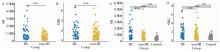
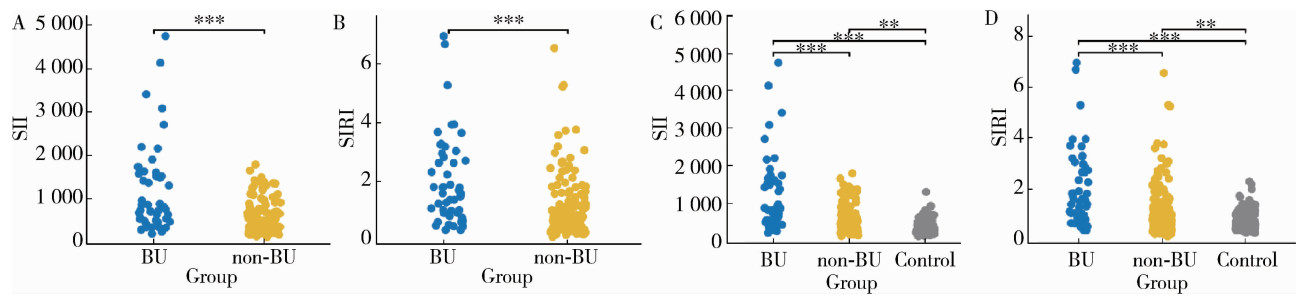
图1

BU组、非BU组及健康对照组的SII和SIRI分布水平"

表4

BU发病风险的多因素二元Logistic回归分析"

Items β SE t P OR OR 95%CI
SII 0.003 0.001 19.702 < 0.001 1.003 1.001-1.004
SIRI 0.041 0.141 0.083 0.773 0.960 0.729-1.265

表5

活动期与稳定期BU患者的实验室炎症指标比较"

Items Active BU (n=26) Stable BU (n=23) P value
WBC/ (×109/L) 9.36 (7.32, 11.49) 6.74 (5.08, 9.71) 0.002
PLT/ (×109/L) 308.50 (232.00, 366.00) 258.00 (213.00, 304.00) 0.113
NEUT/ (×109/L) 6.85 (4.81, 8.95) 4.39 (3.05, 5.74) 0.001
LYMPH/ (×109/L) 1.51 (1.06, 2.50) 1.54 (1.31, 2.09) 0.113
MONO/ (×109/L) 0.56 (0.40, 0.69) 0.51 (0.36, 0.75) 0.440
CRP/ (mg/L) 2.53 (1.18, 7.82) 2.50 (1.00, 6.56) 0.920
ESR/ (mm/h) 19.00 (11.00, 38.75) 18.00 (9.00, 33.00) 0.865
SII 1 471.74 (639.23, 1 970.36) 683.47 (347.29, 1 309.66) 0.004
SIRI 1.86 (1.36, 3.21) 1.11 (0.64, 2.26) 0.015

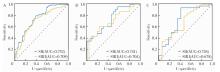
图2

SII和SIRI预测BU的ROC曲线"

图3

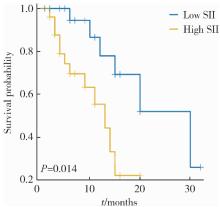
不同SII组BU患者Kaplan-Meier曲线"

1
Izzedine H , Jhaveri KD . Behçet's syndrome[J]. N Engl J Med, 2024, 390 (18): 1731.
2
Su G , Zhong Z , Zhou Q , et al. Identification of novel risk loci for Behçet' s disease-related uveitis in a Chinese population in a genome-wide association study[J]. Arthritis Rheumatol, 2022, 74 (4): 671- 681.

doi: 10.1002/art.41998
3
Li C , Li L , Wu X , et al. Clinical manifestations of Behçet' s disease in a large cohort of Chinese patients: Gender- and age-related differences[J]. Clin Rheumatol, 2020, 39 (11): 3449- 3454.

doi: 10.1007/s10067-020-05026-2
4
Zhong Z , Su G , Yang P . Risk factors, clinical features and treatment of Behçet's disease uveitis[J]. Prog Retin Eye Res, 2023, 97, 101216.

doi: 10.1016/j.preteyeres.2023.101216
5
Islam MM , Satici MO , Eroglu SE . Unraveling the clinical significance and prognostic value of the neutrophil-to-lymphocyte ratio, platelet-to-lymphocyte ratio, systemic immune-inflammation index, systemic inflammation response index, and delta neutrophil index: An extensive literature review[J]. Turk J Emerg Med, 2024, 24 (1): 8- 19.

doi: 10.4103/tjem.tjem_198_23
6
Yang CH , Wang XY , Zhang YH , et al. SIRI and SII as potential biomarkers of disease activity and lupus nephritis in systemic lupus erythematosus[J]. Front Immunol, 2025, 16, 1530534.

doi: 10.3389/fimmu.2025.1530534
7
Lu Z , Xie Z , Shen K , et al. Association of dietary inflammatory index with immune-inflammatory biomarkers in rheumatoid arthritis patients: Results from NHANES 1999-2018[J]. Front Nutr, 2024, 11, 1353964.

doi: 10.3389/fnut.2024.1353964
8
Davatchi F , Assaad-Khalil S , Calamia KT , et al. The Inter-national Criteria for Behçet' s Disease (ICBD): A collaborative study of 27 countries on the sensitivity and specificity of the new criteria[J]. Acad Dermatol Venereol, 2014, 28 (3): 338- 347.

doi: 10.1111/jdv.12107
9
Bhakta BB , Brennan P , James TE , et al. Behçet' s disease: Evaluation of a new instrument to measure clinical activity[J]. Rheumatology, 1999, 38 (8): 728- 733.

doi: 10.1093/rheumatology/38.8.728
10
Keino H . Evaluation of disease activity in uveoretinitis associated with Behçet's disease[J]. Immunol Med, 2021, 44 (2): 86- 97.

doi: 10.1080/25785826.2020.1800244
11
Koru L , Esen F , Turkyilmaz O , et al. Clinical characteristics of pediatric noninfectious uveitis and risk factors for severe disease: A single-center study[J]. Clin Rheumatol, 2024, 43 (9): 2933- 2942.
12
Wu Y , Ning K , Huang Z , et al. NETs-CD44-IL-17A feedback loop drives Th17-mediated inflammation in Behçet' s uveitis[J]. Adv Sci, 2025, 12 (16): 2411524.

doi: 10.1002/advs.202411524
13
Le Joncour A , Cacoub P , Boulaftali Y , et al. Neutrophil, NETs and Behçet' s disease: A review[J]. Clin Immunol, 2023, 250, 109318.
14
Dinkla S , van Cranenbroek B , van der Heijden WA , et al. Platelet microparticles inhibit IL-17 production by regulatory T cells through P-selectin[J]. Blood, 2016, 127 (16): 1976- 1986.
15
Citirik M , Ozdal PC , Keles A , et al. Platelet activation in ocular Behçet's patients with posterior segment involvement[J]. Middle East Afr J Ophthalmol, 2022, 28 (4): 203- 207.
16
Shadmanfar S , Masoumi M , Davatchi F , et al. Correlation of clinical signs and symptoms of Behçet's disease with platelet-to-lymphocyte ratio (PLR) and neutrophil-to-lymphocyte ratio (NLR)[J]. Immunol Res, 2021, 69 (4): 363- 371.

doi: 10.1007/s12026-021-09194-4
[1] 吴滔, 林建子, 朱亚锋, 马剑达, 贾霈雯, 杨莉娟, 潘婕, 邹耀威, 杨迎, 卢烨, 戴冽. 血清蛋白质谱筛选及验证类风湿关节炎患者肌肉量减少的生物标志物[J]. 北京大学学报(医学版), 2025, 57(6): 1024-1031.
[2] 吕雪冰, 俞烜华, 张伟桢, 刘昌泉, 林互涵, 曾珊婷, 黄惠娟, 吴月萍. 类风湿关节炎合并坏死性筋膜炎1例[J]. 北京大学学报(医学版), 2025, 57(6): 1198-1202.
[3] 杨菊, 徐婧, 戴菊华, 石连杰. Lumican蛋白在类风湿关节炎患者血清中的表达及其与疾病和免疫活动的相关性[J]. 北京大学学报(医学版), 2025, 57(5): 911-918.
[4] 冯亮华, 洪丽荣, 陈雨佳, 蔡学明. 泛素特异性蛋白酶35对类风湿关节炎成纤维样滑膜细胞铁死亡的作用及机制[J]. 北京大学学报(医学版), 2025, 57(5): 919-925.
[5] 韩艺钧, 陈小莉, 李常虹, 赵金霞. 甲氨蝶呤在类风湿关节炎患者中的应用现状[J]. 北京大学学报(医学版), 2024, 56(6): 994-1000.
[6] 贾霈雯, 杨迎, 邹耀威, 欧阳志明, 林建子, 马剑达, 杨葵敏, 戴冽. 类风湿关节炎患者低肌肉量综合征的临床特征及其对躯体功能的影响[J]. 北京大学学报(医学版), 2024, 56(6): 1009-1016.
[7] 马豆豆, 卢哲敏, 郭倩, 朱莎, 古今, 丁艳, 石连杰. 小剂量利妥昔单抗成功治疗类风湿关节炎合并重症肌无力1例[J]. 北京大学学报(医学版), 2024, 56(6): 1110-1114.
[8] 闫蕊, 柯丹, 张妍, 李丽, 苏焕然, 陈伟, 孙明霞, 刘晓敏, 罗靓. 血清趋化因子CXCL-10和涎液化糖链抗原6水平在类风湿关节炎合并肺间质病变患者中的诊断和病情评估价值[J]. 北京大学学报(医学版), 2024, 56(6): 956-962.
[9] 李正芳,罗采南,武丽君,吴雪,孟新艳,陈晓梅,石亚妹,钟岩. 抗氨基甲酰化蛋白抗体在诊断类风湿关节炎中的应用价值[J]. 北京大学学报(医学版), 2024, 56(4): 729-734.
[10] 黄会娜,赵静,赵祥格,白自然,李霞,王冠. 乳酸对类风湿关节炎患者外周血CD4+T细胞亚群的调控作用[J]. 北京大学学报(医学版), 2024, 56(3): 519-525.
[11] 汤晓菲,李永红,丁秋玲,孙卓,张阳,王育梅,田美伊,刘坚. 类风湿关节炎患者下肢深静脉血栓发病率及危险因素[J]. 北京大学学报(医学版), 2024, 56(2): 279-283.
[12] 邹雪,白小娟,张丽卿. 艾拉莫德联合托法替布治疗难治性中重度类风湿关节炎的疗效[J]. 北京大学学报(医学版), 2023, 55(6): 1013-1021.
[13] 金银姬,孙琳,赵金霞,刘湘源. 血清IgA型抗鼠科肉瘤病毒癌基因同源物B1抗体在类风湿关节炎中的意义[J]. 北京大学学报(医学版), 2023, 55(4): 631-635.
[14] 蔡文心,李仕成,刘一鸣,梁如玉,李静,郭建萍,胡凡磊,孙晓麟,李春,刘栩,叶华,邓立宗,李茹,栗占国. 类风湿关节炎临床分层及其特征的横断面研究[J]. 北京大学学报(医学版), 2022, 54(6): 1068-1073.
[15] 程昉,杨邵英,房星星,王璇,赵福涛. CCL28-CCR10通路在类风湿关节炎单核细胞迁移中的作用[J]. 北京大学学报(医学版), 2022, 54(6): 1074-1078.
Viewed
Full text


Abstract

Cited

  Shared   
  Discussed   
No Suggested Reading articles found!