北京大学学报(医学版) ›› 2025, Vol. 57 ›› Issue (6): 1203-1207. doi: 10.19723/j.issn.1671-167X.2025.06.029

• 病例报告 • 上一篇    下一篇

利妥昔单抗成功治疗类风湿关节炎合并IgG4相关性疾病1例

丁艳, 王丽芳, 李超然, 卢哲敏, 石连杰*()   

  1. 北京大学首钢医院风湿免疫科, 北京 100144
  • 收稿日期:2025-08-15 出版日期:2025-10-20 发布日期:2025-10-20
  • 通讯作者: 石连杰

Rheumatoid arthritis combined with IgG4-related disease successfully treated with rituximab: A case report

Yan DING, Lifang WANG, Chaoran LI, Zhemin LU, Lianjie SHI*()   

  1. Department of Rheumatology and Immunology, Peking University Shougang Hospital, Beijing 100144, China
  • Received:2025-08-15 Online:2025-10-20 Published:2025-10-20
  • Contact: Lianjie SHI

RICH HTML


摘要:

类风湿关节炎是一种以慢性对称性关节炎为主要表现的自身免疫性疾病, 合并嗜酸性粒细胞增高的类风湿关节炎有其自身特征, 但也应警惕合并免疫球蛋白(immunoglobulin, Ig)G4相关性疾病的可能。本文报道1例以多关节肿痛伴晨僵为主要表现的患者, 抗角蛋白抗体、抗环瓜氨酸肽抗体、抗核周因子抗体及类风湿因子阳性, 红细胞沉降率明显升高, 明确诊断类风湿关节炎。该患者病程中逐渐出现外周血嗜酸性粒细胞升高, 使用来氟米特、雷公藤多苷等药物治疗效果欠佳。调整为甲氨蝶呤及托珠单抗治疗后, 患者关节症状明显好转, 但外周血嗜酸性粒细胞升高无明显改善。病程中患者出现淋巴结及腮腺肿大, 淋巴结超声提示左侧锁骨上低回声结节, 双侧腋下、右侧腹股沟区异常淋巴结, 双侧颈部、左侧腹股沟区淋巴结可见。腮腺超声提示双侧腮腺内低回声结节, 腮腺导管增宽, 骨髓穿刺活检未见明显异常, 淋巴结病理活检提示有IgG4+细胞浸润, 进一步完善血清IgG4, 发现血清IgG4升高。最终诊断为类风湿关节炎合并IgG4相关性疾病可能, 调整治疗为甲氨蝶呤联合利妥昔单抗治疗, 患者关节肿痛明显好转, C反应蛋白逐渐恢复正常, 嗜酸性粒细胞明显下降, 病情缓解。因此, 对于合并嗜酸性粒细胞增多的类风湿关节炎应警惕IgG4相关性疾病的可能, 采用利妥昔单抗为临床治疗提供了新思路。

关键词: 类风湿关节炎, IgG4相关性疾病, 嗜酸性粒细胞增多, 利妥昔单抗

Abstract:

Rheumatoid arthritis is an autoimmune disease primarily characterized by chronic symmetric arthritis. While rheumatoid arthritis with elevated eosinophils exhibits distinct clinical features, the potential coexistence of immunoglobulin (Ig)G4-related disease warrants clinical vigilance. This article reports a case of a patient presenting with polyarticular swelling and pain accompanied by morning stiffness. Positive tests for anti-keratin antibody, anti-cyclic citrullinated peptide antibody, anti-perinuclear factor, and rheumatoid factor were observed with a significantly elevated erythrocyte sedimentation rate, leading to a definitive diagnosis of rheumatoid arthritis. The patient also exhibited elevated peripheral blood eosinophils and showed poor response to treatments, such as leflunomide and tripterygium glycosides. After switching to methotrexate and tocilizumab, the patient's joint symptoms improved significantly, but peripheral blood eosinophilia showed no notable improvement. During the course of the disease, the patient developed lymphadenopathy and parotid gland enlargement. Lymph node ultrasound revealed a hypoechoic nodule in the left supraclavicular area, abnormal lymph nodes in both axillae and the right inguinal region, and visible lymph nodes in the bilateral cervical and left inguinal areas. Parotid ultrasound indicated hypoechoic nodules within both parotid glands and widening of the parotid ducts. Further bone marrow aspiration biopsy showed no significant abnormalities, while lymph node pathological biopsy suggested infiltration of IgG4-positive cells. Subsequent serum IgG4 testing revealed elevated level of IgG4. The patient was ultimately considered likely to have rheumatoid arthritis complicated with IgG4-related disease. Treatment was adjusted to regular infusions of rituximab (500 mg every six months), resulting in significant improvement of joint swelling and pain, as well as marked reductions in C-reactive protein and eosinophil levels, achieving disease remission. Through case analysis and literature review, this article discusses the diagnosis and treatment of rheumatoid arthritis patients with elevated eosinophils. For patients with rheumatoid arthritis with elevated eosinophils, it is necessary to be vigilant of the possibility of concurrent IgG4-related diseases. The use of rituximab provides novel perspectives for clinical treatment strategies.

Key words: Rheumatoid arthritis, IgG4-related disease, Eosinophilia, Rituximab

中图分类号: 

  • R593.2

图1

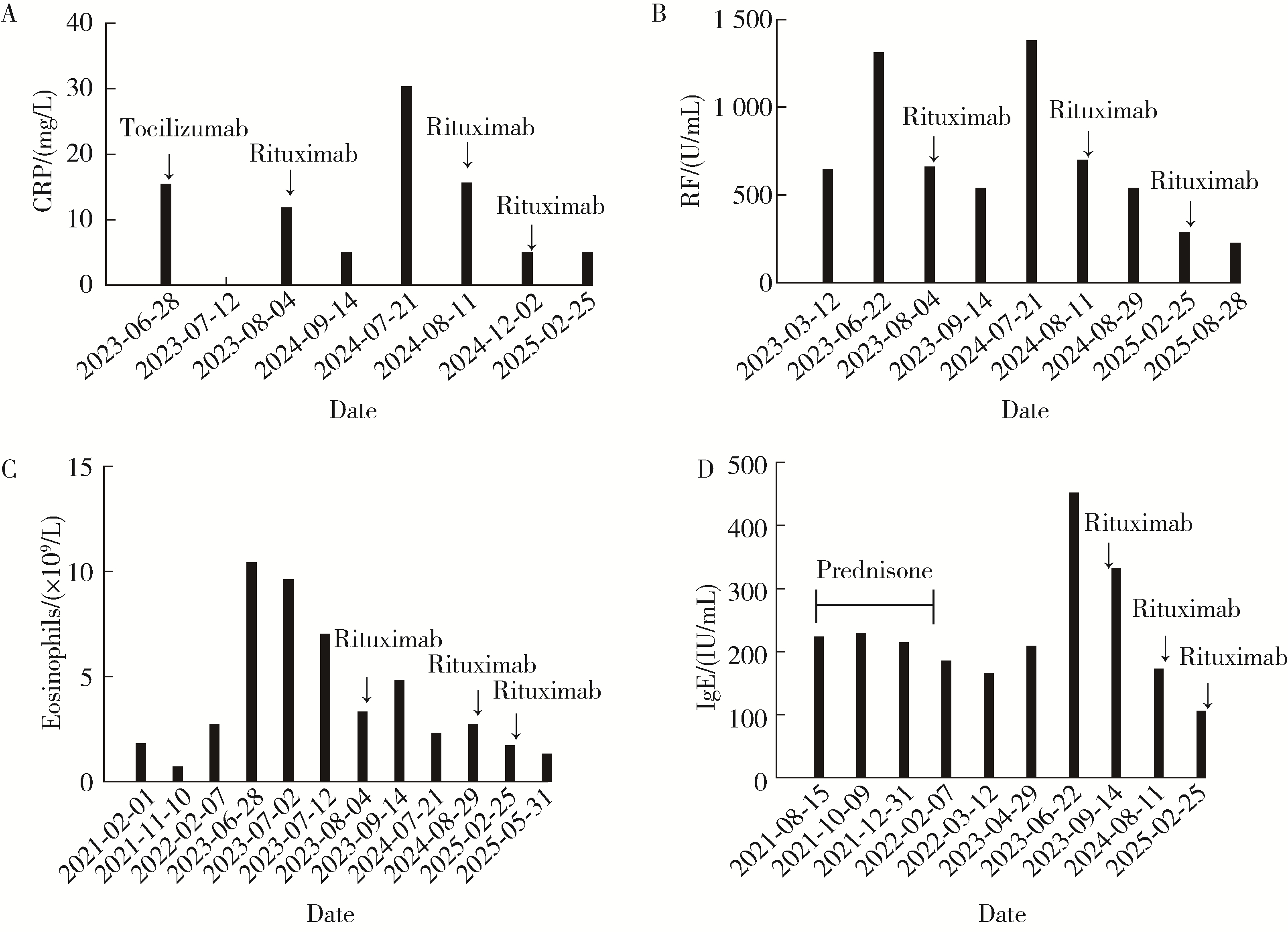
利妥昔单抗治疗后C反应蛋白、类风湿因子、嗜酸性粒细胞数及血清IgE变化"

1
Wallace ZS , Naden RP , Chari S , et al. The 2019 American College of Rheumatology/European League against Rheumatism classification criteria for IgG4-related disease[J]. Arthritis Rheumatol, 2020, 72 (1): 7- 19.

doi: 10.1002/art.41120
2
Emmanuel D , Parija SC , Jain A , et al. Persistent eosinophilia in rheumatoid arthritis: A prospective observational study[J]. Rheumatol Int, 2019, 39 (2): 245- 253.

doi: 10.1007/s00296-018-4191-1
3
Guellec D , Milin M , Cornec D , et al. Eosinophilia predicts poor clinical outcomes in recent-onset arthritis: Results from the ESPOIR cohort[J]. RMD Open, 2015, 1 (1): e000070.

doi: 10.1136/rmdopen-2015-000070
4
Chen Z , Bozec A , Ramming A , et al. Anti-inflammatory and immune-regulatory cytokines in rheumatoid arthritis[J]. Nat Rev Rheumatol, 2019, 15 (1): 9- 17.

doi: 10.1038/s41584-018-0109-2
5
Brito-Zerón P , Bosch X , Ramos-Casals M , et al. IgG4-related disease: Advances in the diagnosis and treatment[J]. Best Pract Res Clin Rheumatol, 2016, 30 (2): 261- 278.

doi: 10.1016/j.berh.2016.07.003
6
Zhang X , Zhang P , Li J , et al. Different clinical patterns of IgG4-RD patients with and without eosinophilia[J]. Sci Rep, 2019, 9 (1): 16483.

doi: 10.1038/s41598-019-52847-6
7
Engelmann R , Brandt J , Eggert M , et al. IgG1 and IgG4 are the predominant subclasses among auto-antibodies against two citrullinated antigens in RA[J]. Rheumatology, 2008, 47 (10): 1489- 1492.

doi: 10.1093/rheumatology/ken336
8
Carbone G , Wilson A , Diehl SA , et al. Interleukin-6 receptor blockade selectively reduces IL-21 production by CD4 T cells and IgG4 autoantibodies in rheumatoid arthritis[J]. Int J Biol Sci, 2013, 9 (3): 279- 288.

doi: 10.7150/ijbs.5996
9
Stavnezer J . Immunoglobulin class switching[J]. Curr Opin Immunol, 1996, 8 (2): 199- 205.

doi: 10.1016/S0952-7915(96)80058-6
10
Magalhães R , Stiehl P , Morawietz L , et al. Morphological and molecular pathology of the B cell response in synovitis of rheumatoid arthritis[J]. Virchows Arch, 2002, 441 (5): 415- 427.

doi: 10.1007/s00428-002-0702-1
11
Ming B , Zhong J , Dong L . Role of eosinophilia in IgG4-related disease[J]. Clin Exp Rheumatol, 2022, 40 (5): 1038- 1044.
12
Moriyama M , Nakamura S . Th1/Th2 immune balance and other T helper subsets in IgG4-related disease[J]. Curr Top Microbiol Immunol, 2017, 401, 75- 83.
13
Shiokawa M , Kodama Y , Kuriyama K , et al. Pathogenicity of IgG in patients with IgG4-related disease[J]. Gut, 2016, 65 (8): 1322- 1332.

doi: 10.1136/gutjnl-2015-310336
14
Martín-Nares E , Delgado-de la Mora J , Martínez-Benítez B , et al. Aortitis in rheumatoid arthritis: Think on overlapping IgG4-related disease: Scleritis and aortitis in early rheumatoid arthritis[J]. J Clin Rheumatol, 2021, 27 (Suppl 8): S863.
15
Chen LF , Mo YQ , Ma JD , et al. Elevated serum IgG4 defines specific clinical phenotype of rheumatoid arthritis[J]. Mediators Inflamm, 2014, 2014, 635293.
16
Tavakolpour S , Alesaeidi S , Darvishi M , et al. A comprehensive review of rituximab therapy in rheumatoid arthritis patients[J]. Clin Rheumatol, 2019, 38 (11): 2977- 2994.

doi: 10.1007/s10067-019-04699-8
17
Takanashi S , Kondo Y , Saito S , et al. Effectiveness and safety of rituximab in special types of rheumatoid arthritis[J]. Int J Rheum Dis, 2023, 26 (11): 2240- 2247.

doi: 10.1111/1756-185X.14920
18
Pugashetti JV , Lee JS . Overview of rheumatoid arthritis-associated interstitial lung disease and its treatment[J]. Semin Respir Crit Care Med, 2024, 45 (3): 329- 341.

doi: 10.1055/s-0044-1782218
19
Carruthers MN , Topazian MD , Khosroshahi A , et al. Rituximab for IgG4-related disease: A prospective, open-label trial[J]. Ann Rheum Dis, 2015, 74 (6): 1171- 1177.

doi: 10.1136/annrheumdis-2014-206605
20
张文, 董凌莉, 朱剑, 等. IgG 4相关性疾病诊治中国专家共识[J]. 中华内科杂志, 2021, 60 (3): 192- 206.
21
Campochiaro C , Della-Torre E , Lanzillotta M , et al. Long-term efficacy of maintenance therapy with Rituximab for IgG4-related disease[J]. Eur J Intern Med, 2020, 74, 92- 98.

doi: 10.1016/j.ejim.2019.12.029
[1] 吴滔, 林建子, 朱亚锋, 马剑达, 贾霈雯, 杨莉娟, 潘婕, 邹耀威, 杨迎, 卢烨, 戴冽. 血清蛋白质谱筛选及验证类风湿关节炎患者肌肉量减少的生物标志物[J]. 北京大学学报(医学版), 2025, 57(6): 1024-1031.
[2] 赵亚云, 倪梦凡, 李雪, 王蓓, 程功, 何菁, 金月波. 利妥昔单抗治疗原发性干燥综合征肾损害的临床疗效和安全性[J]. 北京大学学报(医学版), 2025, 57(6): 1051-1060.
[3] 杨菊, 徐婧, 戴菊华, 石连杰. Lumican蛋白在类风湿关节炎患者血清中的表达及其与疾病和免疫活动的相关性[J]. 北京大学学报(医学版), 2025, 57(5): 911-918.
[4] 冯亮华, 洪丽荣, 陈雨佳, 蔡学明. 泛素特异性蛋白酶35对类风湿关节炎成纤维样滑膜细胞铁死亡的作用及机制[J]. 北京大学学报(医学版), 2025, 57(5): 919-925.
[5] 贾霈雯, 杨迎, 邹耀威, 欧阳志明, 林建子, 马剑达, 杨葵敏, 戴冽. 类风湿关节炎患者低肌肉量综合征的临床特征及其对躯体功能的影响[J]. 北京大学学报(医学版), 2024, 56(6): 1009-1016.
[6] 马豆豆, 卢哲敏, 郭倩, 朱莎, 古今, 丁艳, 石连杰. 小剂量利妥昔单抗成功治疗类风湿关节炎合并重症肌无力1例[J]. 北京大学学报(医学版), 2024, 56(6): 1110-1114.
[7] 闫蕊, 柯丹, 张妍, 李丽, 苏焕然, 陈伟, 孙明霞, 刘晓敏, 罗靓. 血清趋化因子CXCL-10和涎液化糖链抗原6水平在类风湿关节炎合并肺间质病变患者中的诊断和病情评估价值[J]. 北京大学学报(医学版), 2024, 56(6): 956-962.
[8] 赵亮, 史成龙, 马柯, 赵静, 王潇, 邢晓燕, 莫万星, 练益瑞, 高超, 李玉慧. 抗合成酶综合征重叠类风湿关节炎患者的免疫学特征[J]. 北京大学学报(医学版), 2024, 56(6): 972-979.
[9] 韩艺钧, 陈小莉, 李常虹, 赵金霞. 甲氨蝶呤在类风湿关节炎患者中的应用现状[J]. 北京大学学报(医学版), 2024, 56(6): 994-1000.
[10] 刘东武, 陈杰, 高明利, 于静. 类风湿关节炎伴发淋巴结Castleman样病理改变1例[J]. 北京大学学报(医学版), 2024, 56(5): 928-931.
[11] 黄会娜,赵静,赵祥格,白自然,李霞,王冠. 乳酸对类风湿关节炎患者外周血CD4+T细胞亚群的调控作用[J]. 北京大学学报(医学版), 2024, 56(3): 519-525.
[12] 汤晓菲,李永红,丁秋玲,孙卓,张阳,王育梅,田美伊,刘坚. 类风湿关节炎患者下肢深静脉血栓发病率及危险因素[J]. 北京大学学报(医学版), 2024, 56(2): 279-283.
[13] 邹雪,白小娟,张丽卿. 艾拉莫德联合托法替布治疗难治性中重度类风湿关节炎的疗效[J]. 北京大学学报(医学版), 2023, 55(6): 1013-1021.
[14] 冯璐,翟佳羽,赵金霞. IgG4相关性疾病患者就诊情况及其临床特征[J]. 北京大学学报(医学版), 2023, 55(6): 1028-1032.
[15] 吴洁,张雯,梁舒,秦艺璐,范文强. 妊娠期原发性干燥综合征合并视神经脊髓炎谱系疾病危重症1例[J]. 北京大学学报(医学版), 2023, 55(6): 1118-1124.
Viewed
Full text


Abstract

Cited

  Shared   
  Discussed   
No Suggested Reading articles found!