北京大学学报(医学版) ›› 2025, Vol. 57 ›› Issue (2): 317-322. doi: 10.19723/j.issn.1671-167X.2025.02.015

• 论著 • 上一篇    下一篇

腰椎间盘突出患者腰椎融合术后恐动症现状及其影响因素

陈炼炼, 蔡张滢, 叶琳娜, 李洁*()   

  1. 温州医科大学附属第二医院脊柱外科,浙江温州 325027
  • 收稿日期:2024-01-16 出版日期:2025-04-18 发布日期:2025-04-12
  • 通讯作者: 李洁 E-mail:jianjian20002@163.com
  • 基金资助:
    温州市基础性科研项目(Y20220518)

Current status and influencing factors of kinesiophobia in patients with lumbar disc herniation after lumbar fusion surgery

Lianlian CHEN, Zhangying CAI, Linna YE, Jie LI*()   

  1. Department of Spinal Surgery, the 2nd Affiliated Hospital of Wenzhou Medical University, Wenzhou 325027, Zhejiang, China
  • Received:2024-01-16 Online:2025-04-18 Published:2025-04-12
  • Contact: Jie LI E-mail:jianjian20002@163.com
  • Supported by:
    the Basic Scientific Research Project of Wenzhou City in 2022(Y20220518)

RICH HTML


摘要:

目的: 调查腰椎间盘突出(lumbar disc herniation, LDH)患者腰椎融合术后恐动症现状, 分析LDH患者腰椎融合术后恐动症的影响因素。方法: 选择2021年1月至2022年12月在温州医科大学附属第二医院行腰椎融合术且术后第1天有效填写恐动症评分表(tampa scale for kinesiophobia, TSK)等调查问卷的489例LDH患者的病例资料, 进行回顾性分析, 采用恐动症评分表(tampa scale for kinesiophobia, TSK)调查LDH患者腰椎融合术后恐动症发生情况, 根据LDH患者腰椎融合术后是否存在恐动症分为恐动组(n=221)与非恐动组(n=268), 收集两组患者一般资料, 并运用Logistic回归分析LDH患者腰椎融合术后恐动症的危险因素。结果: 489例LDH患者221例(45.19%)存在腰椎融合术后恐动症, 其中男性(95%CI: 3.289~10.586, P<0.001)、文化程度本科以下(95%CI: 6.533~45.162, P<0.001)、重度疼痛(95%CI: 10.348~72.025, P<0.001)、中度疼痛(95%CI: 6.247~37.787, P<0.001)、低自我效能感(95%CI: 4.238~15.095, P<0.001)、中自我效能感(95%CI: 2.804~8.643, P<0.001)是LDH患者腰椎融合术后恐动症的影响因素(P<0.05)。结论: LDH患者腰椎融合术后恐动症发生率较高, 其影响因素包括性别、文化程度、疼痛程度、自我效能感。

关键词: 恐动症, 腰椎间盘突出, 腰椎融合术, 现状, 影响因素

Abstract:

Objective: To investigate the current status of kinesiophobia after lumbar fusion surgery in patients with lumbar disc herniation (LDH) and to analyze its influencing factors. Methods: A total of 489 LDH patients who underwent lumbar fusion surgery in our hospital from January 2021 to December 2022 and effectively filled out the tampa scale for kinesiophobia (TSK) and other questionnaires on the first day after surgery were collected as the study subjects, the current status of kinesiophobia in LDH patients after lumbar fusion surgery were investigated using the TSK. The LDH patients were grouped into a kinesiophobia group (n=221) and a non kinesiophobia group (n=268) based on whether there was kinesiophobia after lumbar fusion surgery. The self-designed general data questionnaires were used to collect data, and Logistic regression was applied to analyze independent risk factors for kinesiophobia after lumbar fusion surgery in the LDH patients. Results: In the study, 221 out of the 489 LDH patients (45.19%) had kinesiophobia after lumbar fusion surgery. Univariate analysis showed that there were statistically significant differences between the phobic group and the non phobic group in terms of gender, education level, course of disease, whether there was hypoproteinemia, pain level, self-efficacy, social support, whether there was anxiety, and whether there was depression (P < 0.05). There were no statistically significant differences in terms of age, body mass index, monthly family income, marital status, residence, medical expense payment form, whether there was hypertension, whether there was diabetes, whether there was cardiovascular and cerebrovascular disease, whether there was respiratory disease, whether there was surgery experience, whether there was anemia, work conditions, and responsibility segments (P>0.05). Male (95%CI: 3.289-10.586, P < 0.001), education level below undergraduate level (95%CI: 6.533-45.162, P < 0.001), severe pain (95%CI: 10.348-72.025, P < 0.001), moderate pain (95%CI: 6.247-37.787, P < 0.001), low self-efficacy (95%CI: 4.238-15.095, P < 0.001), and medium self-efficacy (95%CI: 2.804-8.643, P < 0.001) were influencing factors for kinesiophobia after lumbar fusion surgery in the patients with LDH (P < 0.05). Conclusion: The incidence of kinesiophobia after lumbar fusion surgery in patients with LDH is high, and its influencing factors include gender, education level, pain level, and self-efficacy.

Key words: Kinesiophobia, Lumbar disc herniation, Lumbar fusion surgery, Present situation, Influence factor

中图分类号: 

  • R687.3

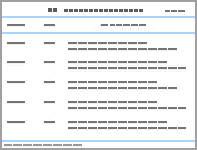
表1

LDH患者腰椎融合术后恐动症的单因素分析"

General information Number of survey participants Anxiety disorder, n(%) χ2 P
Gender 26.859 <0.001
  Male 363 189 (52.07)
  Female 126 32 (25.40)
Age/years 0.891 0.828
  18-<30 5 2 (40.00)
  30-<45 30 12 (40.00)
  45-<60 146 70 (47.95)
  ≥60 308 137 (44.48)
Body mass index/(kg/m2) 0.975 0.807
  Thin(<18.5) 46 23 (50.00)
  Normal weight(18.5-<24.0) 319 140 (43.89)
  Overweight(24.0-<28.0) 114 54 (47.37)
  Obesity(≥28.0) 10 4 (40.00)
Degree of education 65.323 <0.001
  Undergraduate or below 390 212 (54.36)
  Bachelor degree or above 99 9 (9.09)
Monthly household income/yuan 2.372 0.305
  <2 000 113 54 (47.79)
  2 000-<4 000 277 129 (46.57)
  ≥4 000 99 38 (38.38)
Marital status 1.253 0.740
  Unmarried 22 12 (54.55)
  Married 424 188 (44.34)
  Divorce 36 18 (50.00)
  Bereave 7 3 (42.86)
Place of residence 0.608 0.436
  Rural area 305 142 (46.56)
  Town center 184 79 (42.93)
Payment form of medical expenses 2.001 0.572
  Medical insurance 171 79 (46.20)
  Cooperative medical care 225 106 (47.11)
  Commercial insurance 24 9 (37.50)
  Self funded 69 27 (39.13)
Course of disease/years 21.665 <0.001
  <1 51 16 (31.37)
  1-<5 225 84 (37.33)
  5-<10 94 56 (59.57)
  ≥10 119 65 (54.62)
Hypertension 1.214 0.271
  Yes 160 78 (48.75)
  No 329 143 (43.47)
Diabetes 0.842 0.359
  Yes 108 53 (49.07)
  No 381 168 (44.09)
Cerebrovascular disease 2.898 0.089
  Yes 86 46 (53.49)
  No 403 175 (43.42)
Respiratory disease 0.595 0.441
  Yes 155 74 (47.74)
  No 334 147 (44.01)
Surgical experience 0.696 0.404
  Yes 108 45 (41.67)
  No 381 176 (46.19)
Anemia 0.964 0.326
  Yes 157 76 (48.41)
  No 332 145 (43.67)
Hypoproteinemia 15.684 <0.001
  Yes 134 80 (59.70)
  No 355 141 (39.72)
Pain level 59.148 <0.001
  Mild 84 7 (8.33)
  Moderate 274 136 (49.64)
  Severe 131 78 (59.54)
Efficacy 41.043 <0.001
  Low 133 79 (59.40)
  Medium 183 97 (53.01)
  High 173 45 (26.01)
Social support 29.552 <0.001
  Low 142 90 (63.38)
  Medium 186 78 (41.94)
  High 161 53 (32.92)
Anxiety 11.746 0.001
  Yes 198 108 (54.55)
  No 291 113 (38.83)
Depressed 10.850 0.001
  Yes 206 111 (53.88)
  No 283 110 (38.87)
Work situation 2.056 0.358
  Unemployed 59 23 (38.98)
  Retire 103 43 (41.75)
  Be on the job 327 155 (47.40)
Responsibility section 0.896 0.639
  L3-L4 51 21 (41.18)
  L4-L5 236 104 (44.07)
  L5-S1 202 96 (47.52)

表2

LDH患者腰椎融合术后恐动症的多因素分析"

Factor β S.E. Wald P OR 95% confidence interval
Lower limit Upper limit
Gender (Male) 1.775 0.298 35.441 <0.001 5.901 3.289 10.586
Degree of education (Undergraduate or below) 2.844 0.493 33.236 <0.001 17.176 6.533 45.162
Pain level
  Severe 3.307 0.495 44.639 <0.001 27.301 10.348 72.025
  Moderate 2.732 0.459 35.400 <0.001 15.363 6.247 37.787
Efficacy
  Low 2.079 0.324 41.165 <0.001 7.998 4.238 15.095
  Medium 1.594 0.287 30.796 <0.001 4.922 2.804 8.643
  Constant -7.910 0.764 107.201 <0.001 <0.001
1 中国康复医学会脊柱脊髓专业委员会基础研究与转化学组. 腰椎间盘突出症诊治与康复管理指南[J]. 中华外科杂志, 2022, 60 (5): 401- 408.
doi: 10.3760/cma.j.cn112139-20211122-00548
2 郭卓涛, 张凯, 查国春, 等. 腰椎融合对全髋关节置换后中期疗效影响的匹配对照试验[J]. 中国组织工程研究, 2023, 27 (36): 5801- 5805.
doi: 10.12307/2023.774
3 靳鑫杰, 陆向东, 赵轶波, 等. 内镜下经椎间孔腰椎椎间融合治疗腰椎退行性疾病: 减压融合与保存脊柱后方的解剖结构[J]. 中国组织工程研究, 2023, 27 (27): 4401- 4407.
doi: 10.12307/2023.629
4 梁秋婷, 杨丽, 周溢, 等. PICC置管肿瘤患者恐动症现状及影响因素分析[J]. 护理学杂志, 2023, 38 (6): 59- 62.
5 谭明杨, 李红玉. 老年慢性疼痛患者恐动症现状及影响因素分析[J]. 当代护士, 2023, 30 (6): 127- 130.
6 王晔, 吴萍. 膝骨关节炎患者关节镜术后恐动行为现状及与社会支持、心理弹性的关系调查研究[J]. 现代预防医学, 2023, 50 (3): 540-544, 555.
7 凡丹, 周薇, 杨彬, 等. 全髋关节置换术后恐动症影响因素及干预措施研究进展[J]. 护理实践与研究, 2022, 19 (23): 3534- 3538.
8 中华医学会骨科学分会脊柱外科学组, 中华医学会骨科学分会骨科康复学组. 腰椎间盘突出症诊疗指南[J]. 中华骨科杂志, 2020, 40 (8): 477- 487.
9 胡文. 简体中文版TSK和FABQ量表的文化调适及其在退行性腰腿痛中的应用研究[D]. 上海: 第二军医大学, 2012.
10 严广斌. NRS疼痛数字评价量表numerical rating scale[J]. 中华关节外科杂志(电子版), 2014, 8 (3): 410- 410.
11 Lorig KR , Sobel DS , Ritter PL , et al. Effect of a self-management program on patients with chronic disease[J]. Eff Clin Pract, 2001, 4 (6): 256- 262.
12 肖水源. 《社会支持评定量表》的理论基础与研究应用[J]. 临床精神医学杂志, 1994, 4 (2): 98- 100.
13 孙振晓, 刘化学, 焦林瑛, 等. 医院焦虑抑郁量表的信度及效度研究[J]. 中华临床医师杂志(电子版), 2017, 11 (2): 198- 201.
14 安玉兰, 孙晴, 郭鑫, 等. 胸腰椎骨折术后患者恐动症成因的调查及影响因素分析[J]. 中国卫生统计, 2021, 38 (4): 581- 584.
15 袁伟, 高升, 俞军卫, 等. 腰椎间盘突出症患者心理弹性和社会支持水平对术后恐动症发生情况的影响[J]. 颈腰痛杂志, 2023, 44 (6): 1011- 1015.
16 王萍丽, 刘彩彦, 付文丽, 等. 腰椎间盘突出症患者微创手术治疗后并发恐动症的相关因素筛选及护理对策分析[J]. 山西医药杂志, 2020, 49 (20): 2738- 2740.
17 Kluszczyńska M , Młynarska A , Mikulakova W . Influence of frailty syndrome on kinesiophobia according to the gender of patients after coronary artery bypass surgery[J]. Healthcare (Basel), 2021, 9 (6): 730- 738.
18 韩胜柏, 邵刚, 姚奎, 等. 慢性疼痛患者恐动症现状及影响因素分析[J]. 华南预防医学, 2023, 49 (3): 349-351, 357.
19 郜鑫, 吴菁, 吴红. 骨科术后患者恐动症与疼痛灾难化、情绪状态的相关性研究[J]. 华南国防医学杂志, 2021, 35 (8): 584- 588.
20 杜彩凤, 李华. 认知行为疗法对深Ⅱ度烧伤患者心理状态、疼痛及并发症的影响[J]. 中国健康心理学杂志, 2021, 29 (7): 978- 983.
21 邓晓园, 王国蓉, 张甜, 等. 手术患者恐动症影响因素的Meta分析[J]. 中国疗养医学, 2023, 32 (6): 583- 586.
22 历广招, 赵旭, 王丽媛, 等. 膝骨关节炎患者恐动行为现状及影响因素分析[J]. 中国实用护理杂志, 2020, 36 (18): 1372- 1377.
23 季长高, 梁媛, 贾国红, 等. 高龄股骨颈骨折患者自我效能在术后疼痛与恐动间的中介效应研究[J]. 现代临床护理, 2023, 22 (10): 35- 41.
[1] 王敏, 李倩. 青少年抑郁症患者心理弹性影响因素的路径分析[J]. 北京大学学报(医学版), 2024, 56(5): 809-814.
[2] 曾媛媛,谢云,陈道南,王瑞兰. 脓毒症患者发生正常甲状腺性病态综合征的相关因素[J]. 北京大学学报(医学版), 2024, 56(3): 526-532.
[3] 沈鹤军,侍崇艳,郑清,黄玉,景涛. 我国高中生静坐时长与健康素养现状及其影响因素调查[J]. 北京大学学报(医学版), 2024, 56(2): 239-246.
[4] 刘笑晗,杨帆,王昕迪,黄宁,程陶朱,郭静. 中国流动人口自评健康状况影响因素及公平性[J]. 北京大学学报(医学版), 2024, 56(2): 223-229.
[5] 安思兰,郑群怡,王锴,高姗. 全膝关节置换术后患者早期疼痛的特点及其影响因素[J]. 北京大学学报(医学版), 2024, 56(1): 167-173.
[6] 越雷,王月田,白纯碧,陈浩,付豪永,于峥嵘,李淳德,孙浩林. 内镜治疗中青年双节段腰椎间盘突出症患者的手术策略[J]. 北京大学学报(医学版), 2021, 53(4): 734-739.
[7] 张艺潇,冯文. 决策树在贫困农村老人就诊影响因素中的应用[J]. 北京大学学报(医学版), 2018, 50(3): 450-456.
[8] 景日泽,章湖洋,徐婷婷,张鲁豫,方海. 北京市三级公立医院效率及其影响因素[J]. 北京大学学报(医学版), 2018, 50(3): 408-415.
[9] 赵雨薇,吴明. 北京市不同居住时间的农村流动人口门诊服务利用状况及其影响因素[J]. 北京大学学报(医学版), 2017, 49(3): 476-482.
[10] 吴士艳,张旭熙,杨帅帅,孙凯歌,贾卫兰,邵春欣,吴芹,宣小伟,刘永昌,刘思佳,孙昕霙. 北京市某近郊区居民身体活动情况及其影响因素[J]. 北京大学学报(医学版), 2016, 48(3): 483-490.
Viewed
Full text


Abstract

Cited

  Shared   
  Discussed   
No Suggested Reading articles found!