北京大学学报(医学版) ›› 2025, Vol. 57 ›› Issue (6): 1051-1060. doi: 10.19723/j.issn.1671-167X.2025.06.006

• 论著 • 上一篇    下一篇

利妥昔单抗治疗原发性干燥综合征肾损害的临床疗效和安全性

赵亚云1,2,*, 倪梦凡3,*, 李雪1, 王蓓1,4, 程功1, 何菁1, 金月波1,*()   

  1. 1. 北京大学人民医院风湿免疫科,北京 100044
    2. 河北省中医院风湿病科,石家庄 050000
    3. 北京大学人民医院肾内科,北京 100044
    4. 贵州省黔东南州人民医院风湿免疫科,贵州凯里 556000
  • 收稿日期:2025-08-18 出版日期:2025-12-18 发布日期:2025-10-30
  • 通讯作者: 金月波
  • 作者简介:

    * These authors contributed equally to this work

  • 基金资助:
    国家重点研发计划(2022YFE0131700); 北京大学人民医院研究与发展基金(RDZH2022-03); 北京大学人民医院研究与发展基金(RDY2021-26); 河北省政府资助临床医学优秀人才项目(ZF2025306); 河北省中医药管理局科研计划项目(2021039)

Clinical efficacy and safety of rituximab in treating renal injury in primary Sjögren syndrome

Yayun ZHAO1,2, Mengfan NI3, Xue LI1, Bei WANG1,4, Gong CHENG1, Jing HE1, Yuebo JIN1,*()   

  1. 1. Department of Rheumatology and Immunology, Peking University People' s Hospital, Beijing 100044, China
    2. Department of Rheumatology, Hebei Provincial Hospital of Chinese Medicine, Shijiazhuang 050000, China
    3. Department of Nephrology, Peking University People' s Hospital, Beijing 100044, China
    4. Department of Rheumatology and Immunology, Qiandongnan People' s Hospital, Kaili 556000, Guizhou, China
  • Received:2025-08-18 Online:2025-12-18 Published:2025-10-30
  • Contact: Yuebo JIN
  • Supported by:
    the National Key Research and Development Program(2022YFE0131700); the Research and Development Fund of Peking University People' s Hospital(RDZH2022-03); the Research and Development Fund of Peking University People' s Hospital(RDY2021-26); the Project for the Clinical Excellent Person Funded by the Hebei Provincial Government(ZF2025306); the Scientific Research Project of the Administration of Traditional Chinese Medicine of Hebei Province(2021039)

RICH HTML


摘要:

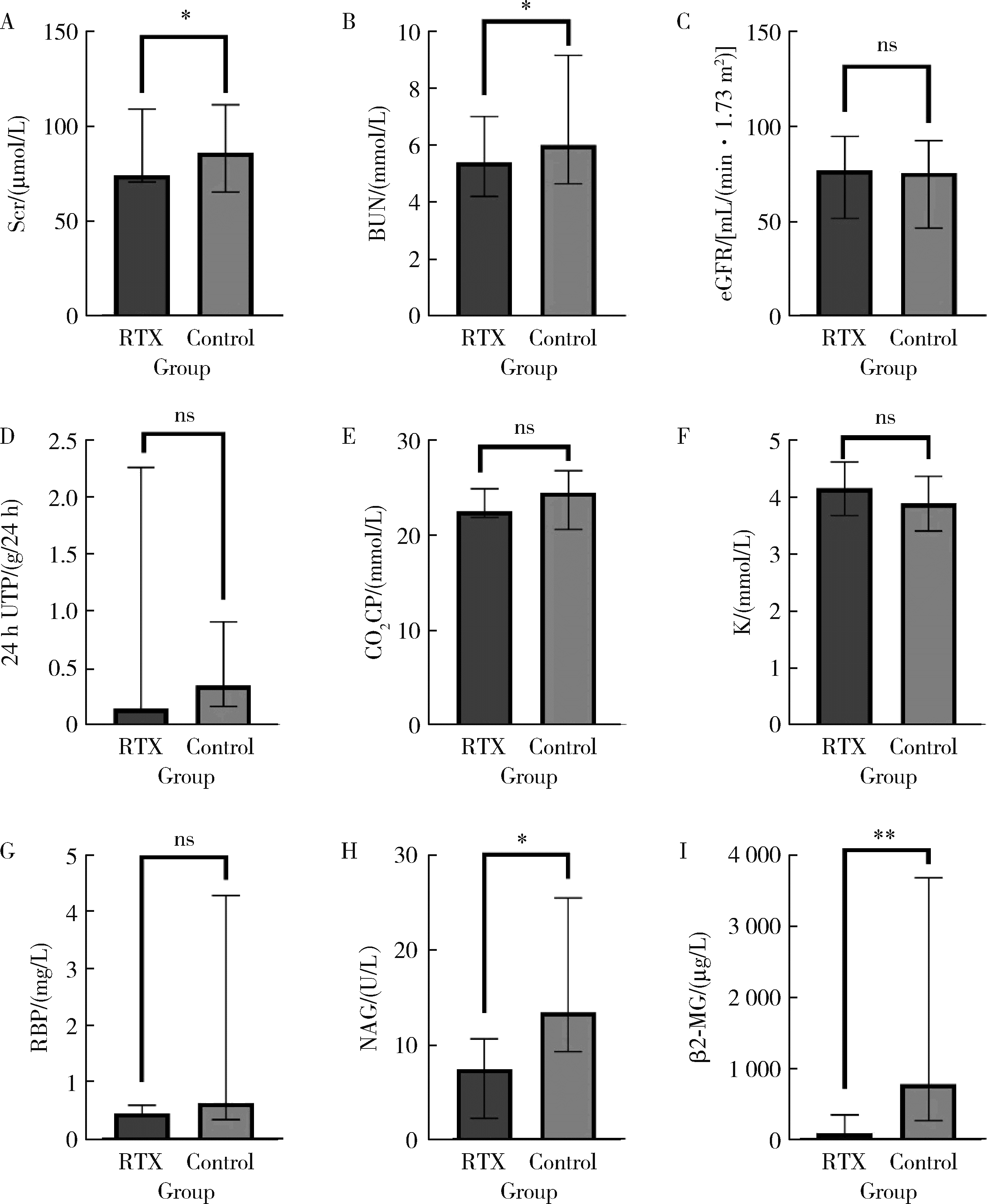
目的: 肾损害是原发性干燥综合征(primary Sjögren syndrome,pSS)常见的腺体外损伤之一,总体预后不良,但早期免疫治疗有助于减轻肾损伤,改善远期肾功能。越来越多的证据表明,利妥昔单抗(rituximab,RTX)治疗干燥综合征的系统损害有效。本研究通过回顾性分析,探索RTX治疗pSS肾损害的临床疗效和安全性。方法: 检索北京大学人民医院临床大数据应用平台,连续纳入2013年7月至2025年1月在北京大学人民医院风湿免疫科和肾内科就诊,且应用RTX治疗的pSS继发肾损害的患者17例,匹配同期年龄、性别、基线病情相当的,应用传统免疫抑制药物治疗的患者34例,收集所有患者的临床及实验室数据,RTX组患者接受糖皮质激素联合RTX治疗,对照组患者接受糖皮质激素联合传统免疫抑制药物进行治疗,分析治疗6个月后的病情变化,对两组患者治疗前后的一般实验室检查结果、肾损害指标、免疫学指标等进行比较。结果: 治疗6个月后,肾损害指标方面,RTX组患者尿N-乙酰β-D氨基葡萄糖苷酶、尿β2微球蛋白、肌酐、尿素氮均显著低于对照组( P < 0.01、P < 0.05),24小时尿蛋白水平、尿视黄醇结合蛋白水平低于对照组,血钾高于对照组;免疫学指标方面,RTX组免疫球蛋白G (immunoglobulin G, IgG)、类风湿因子(rheumatoid factor, RF)水平明显低于对照组( P < 0.05),补体C3、C4明显高于对照组( P < 0.05);RTX组的欧洲抗风湿病联盟干燥综合征疾病活动指数(European League Against Rheumatism Sjögren syndrome disease activity index,ESSDAI)总分和肾脏评分均明显低于对照组,差异有统计学意义( P < 0.05)。分析两组患者治疗6个月时的激素减量情况,RTX组的泼尼松减至小剂量(0~5 mg,每日1次)的患者比例高于对照组(64.71% vs. 32.35%,P=0.038)。比较两组患者半年内的感染发生率,RTX组为1/17例,对照组为3/34例,两组均未见严重的不良反应。结论: RTX可通过靶向清除致病性B细胞,有效治疗pSS患者的肾小管间质以及肾小球损害,改善肾脏代谢及酸碱平衡功能,其治疗效果可能优于传统免疫抑制药物,有助于激素减量,且患者的依从性、安全性良好,具有较好的临床应用前景。

关键词: 利妥昔单抗, 干燥综合征, 肾损害, 免疫抑制剂

Abstract:

Objective: Renal involvement is a common extra-glandular lesion in primary Sjögren syndrome (pSS), generally associated with poor prognosis. Early immunotherapy might alleviate renal injury and improve long-term renal function. Growing evidence suggests that rituximab (RTX) is effective for systemic manifestations in pSS. In this retrospective study, we preliminarily investigated the efficacy of RTX on renal involvement in pSS. Methods: Clinical and laboratory data from the clinical large-scale data application platform of peking University People' s Hospital were collected. From July 2013 to January 2025, 17 patients with secondary renal damage due to pSS who were treated with RTX in the Department of Rheumatology and Immunology and the Department of Nephrology of Peking University People' s Hospital were consecutively included. During the same period, 34 patients treated with conventional immunosuppressive drugs were matched for age, gender, and baseline disease conditions. The RTX group received glucocorticoid therapy along with RTX, while the control group received glucocorticoid therapy along with immunosuppressive drugs for 6 months. We evaluated the effect of different treatments by comparing general laboratory parameters, renal injury index, and immunological features before and after treatment in the two groups. Results: After 6 months, renal function indices showed significant reductions in levels of the urinary N-acetyl-β-glucosaminidase (NAG), beta2-microglobulin (β2-MG), creatinine, and urea nitrogen in the RTX group ( P < 0.01, P < 0.05). It was shown that the levels of 24 h urinary total protein (24h UTP), urinary retinol-binding protein in the RTX group were lower, while the serum potassium in the RTX group were higher than those in the control group, all with no significant difference (P>0.05). Regarding immunological features, the RTX group had significantly lower levels of immunoglobulin G (IgG, P < 0.05) and rheumatoid factor (RF, P < 0.05), and higher levels of complement 3 (C3) and complement 4 (C4) compared with the control group ( P < 0.05). The total European League Against Rheumatism Sjögren syndrome disease activity index (ESSDAI) score and renal score in the RTX group were significantly lower than those in the control group, with statistically significant differences ( P < 0.05). Furthermore, after the 6-month treatment, a higher proportion of patients in the RTX group were able to taper their prednisone dose to lower levels (0-5 mg, quaque die) compared with the control group (64.71% vs. 32.35%, P=0.038). In addition to these positive outcomes, the incidence of infection was 1/17 in the RTX group and 3/34 in the control group. No serious adverse events were observed during the trial. Conclusion: Through targeted depletion of pathogenic B cells, RTX had the potential to ameliorate glomerular and tubulointerstitial damage, as well as modulate renal excretion and acid-base equilibrium in pSS patients. It was suggested that RTX might be superior to traditional immunosuppressive drugs, and helpful in glucocorticoid tapering. Meanwhile, medication adherence was guaranteed with a favorable safety profile. Thus, RTX is considered to be a promising option in clinical practice.

Key words: Rituximab, Sjögren syndrome, Renal injury, Immunosuppressive agents

中图分类号: 

  • R593.2

表1

RTX组和对照组基线一般情况比较"

Items RTX group (n=17) Control group (n=34) P value
Demographic data
  Male/Female 1/16 2/32 >0.999
  Age of onset/years, $\bar x \pm s$ 38.35±14.81 40.97±12.37 0.508
  Course of disease/years, $\bar x \pm s$ 12.86±10.82 11.24±10.33 0.604
Symptom, n (%)
  Dry mouth 16 (94.12) 32 (94.12) >0.999
  Ocular dryness 17 (100.00) 33 (97.06) >0.999
  Edema 6 (35.29) 7 (20.59) 0.315
  Increased nocturia 3 (17.65) 9 (26.47) 0.728
Antibody, n (%)
  Anti-SSA60 antibodies 14 (82.35) 29 (85.29) >0.999
  Anti-Ro52 antibodies 16 (94.12) 26 (76.47) 0.241
  Anti-SSB antibodies 4 (23.53) 18 (52.94) 0.072
System involvement, n (%)
  Respiratory system 4 (23.53) 12 (35.29) 0.527
  Hematologic system 10 (58.82) 14 (41.18) 0.255
  Peripheral nervous system 4 (23.53) 4 (11.76) 0.416
Previous medication, n (%)
  HCQ 14 (82.35) 24 (70.59) 0.568
  MMF 14 (82.35) 25 (73.53) 0.728
  CTX 6 (35.29) 14 (41.18) 0.767
  IGU 2 (11.76) 6 (17.65) 0.703
  AZA 1 (5.88) 1 (2.94) >0.999
  CsA 1 (5.88) 2 (5.88) >0.999
  TAC 2 (11.76) 7 (20.59) 0.699
  LEF 1 (5.88) 1 (2.94) >0.999
  Tofacitinib 0 (0) 4 (11.76) 0.284
Using prednisone, n (%) 12 (70.59) 27 (79.41) 0.503

表2

RTX组和对照组基线实验室指标的比较"

Items RTX group (n=17) Control group (n=34) P value
General laboratory parameter
  WBC/(×109/L) 5.36±2.73 5.78±2.10 0.544
  HGB/(g/L) 113.00±16.95 114.62±18.99 0.768
  PLT/(×109/L) 191.65±79.05 183.91±79.04 0.744
  CRP/(mg/L) 1.10 (0.50, 3.70) 1.00 (0.50, 2.70) 0.852
  ESR/(mm/h) 54.12±30.47 40.38±27.45 0.115
Renal injury index
  Scr/(μmol/L) 83.0 (64.0, 155.0) 76.0 (62.5, 96.5) 0.631
  BUN/(mmol/L) 6.00 (4.50, 10.95) 5.88 (4.40, 8.51) 0.920
  eGFR/[mL/(min·1.73 m2)] 73.00 (36.63, 102.14) 75.69 (49.95, 97.73) 0.910
  Serum potassium/(mmol/L) 3.80±0.57 3.77±0.57 0.845
  CO2CP/(mmol/L) 24.00 (21.70, 25.00) 23.65 (18.75, 27.80) 0.897
  24h UTP/(g/24 h) 0.30 (0.19, 4.53) 0.54 (0.21, 1.10) 0.933
  RBP/(mg/L) 3.17±3.34 3.04±3.84 0.916
  NAG/(U/L) 17.60±9.99 24.15±37.86 0.530
  β2-MG/(μg/L) 1 444.65 (325.08, 6 102.90) 1 091.00 (112.95, 7 170.25) 0.784
  Urine pH 6.50±0.77 6.61±0.77 0.647
  Bicarbonate/(mmol/L) 17.68±7.87 17.46±6.64 0.939
  Titratable acid/(mmol/L) 1.59 (0.55, 7.15) 6.00 (2.15, 10.46) 0.237
  Ammonium ion/(mmol/L) 18.99±10.49 30.01±14.78 0.065
Immunological features
  IgG/(g/L) 19.39±9.91 20.79±12.48 0.690
vC3/(g/L) 1.06±0.29 0.98±0.21 0.276
  C4/(g/L) 0.32±0.17 0.24±0.10 0.079
  RF/(IU/mL) 33.40 (17.90, 113.50) 67.65 (20.00, 173.75) 0.341
  γ-globulin/% 22.60 (18.30, 34.50) 26.15 (18.80, 30.50) 0.990
  Anti-α-fodrin/(RU/mL) 11.94 (6.46, 19.24) 8.61 (5.07, 17.00) 0.366

表3

RTX组和对照组治疗前后一般实验室指标比较"

Items Group Before treatment After treatment P value
WBC/(×109/L) RTX group 4.50 (3.79, 6.55) 4.60 (3.53, 5.85) 0.518
Control group 5.38 (4.18, 7.59) 5.74 (4.29, 7.99) 0.480
HGB/(g/L) RTX group 112.00 (101.00, 130.00) 126.00 (115.50, 131.50) 0.097
Control group 116.50 (101.25, 126.25) 122.00 (110.00, 131.00) 0.111
PLT/(×109/L) RTX group 164.00 (139.00, 247.00) 178.00 (144.00, 230.50) 0.552
Control group 195.00 (120.75, 237.50) 183.00 (150.00, 256.50) 0.340
CRP/(mg/L) RTX group 1.10 (0.50, 3.70) 0.55 (0.50, 1.75) 0.333
Control group 1.00 (0.50, 2.70) 1.37 (0.50, 3.38) 0.020
ESR/(mm/h) RTX group 68.00 (24.00, 80.00) 15.00 (6.75, 30.75) 0.002
Control group 28.50 (19.25, 60.00) 23.00 (9.50, 38.00) 0.059

图1

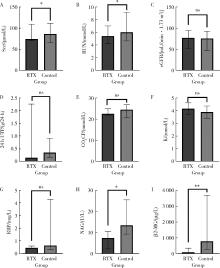
治疗后RTX组和对照组肾损伤指标的比较"

表4

RTX组和对照组治疗前后肾损害指标的比较"

Items Group Before treatment After treatment P value
Scr/(μmol/L) RTX group 83.00 (64.00, 155.00) 74.00 (70.50, 109.00) 0.049
Control group 76.00 (62.50, 96.50) 86.00 (65.25, 111.25) 0.112
BUN/(mmol/L) RTX group 6.00 (4.50, 10.95) 5.40 (4.20, 7.00) 0.011
Control group 5.88 (4.40, 8.51) 6.00 (4.65, 9.15) 0.859
eGFR/[mL/(min·1.73 m2)] RTX group 73.00 (36.63, 102.14) 76.71 (51.50, 94.86) 0.287
Control group 75.69 (49.95, 97.73) 75.35 (46.32, 92.56) 0.224
Serum potassium/(mmol/L) RTX group 3.80±0.57 4.15±0.47 0.005
Control group 3.77±0.57 3.89±0.48 0.137
CO2CP/(mmol/L) RTX group 24.00 (21.70, 25.00) 22.50 (21.90, 24.90) 0.687
Control group 23.65 (18.75, 27.80) 24.50 (20.60, 26.75) 0.586
24h UTP/(g/24 h) RTX group 0.30 (0.19, 4.53) 0.15 (0.14, 2.26) 0.333
Control group 0.54 (0.21, 1.10) 0.35 (0.17, 0.91) 0.055
RBP/(mg/L) RTX group 1.15 (0.74, 5.99) 0.46 (0.40, 0.60) 0.003
Control group 1.14 (0.32, 5.41) 0.64 (0.35, 4.31) 0.959
NAG/(U/L) RTX group 14.22 (10.53, 24.10) 7.45 (2.29, 10.65) 0.008
Control group 13.80 (7.25, 24.00) 13.45 (9.30, 25.50) 0.500
β2-MG/(μg/L) RTX group 1 444.65 (325.08, 6 102.90) 94.15 (10.88, 351.45) 0.002
Control group 1 091.00 (112.95, 7 170.25) 784.70 (267.20, 3 688.00) 0.918
Urine pH RTX group 6.44±0.81* 6.58±0.67 0.238
Control group 6.46±0.92* 6.63±0.92 0.465
Bicarbonate/(mmol/L) RTX group 18.46±9.20* 15.05±8.60 0.155
Control group 15.16±5.19* 11.64±4.46 0.359
Titratable acid/(mmol/L) RTX group 1.59 (0.55, 7.15) 2.00 (0.55, 6.15) 0.500
Control group 6.00 (2.15, 10.46) 5.50 (2.91, 11.65) 0.893
Ammonium ion/(mmol/L) RTX group 18.99 (8.36, 28.01) 17.44 (12.30, 26.91) 0.345
Control group 28.83 (17.69, 41.41) 17.37 (12.26, 28.33) 0.080

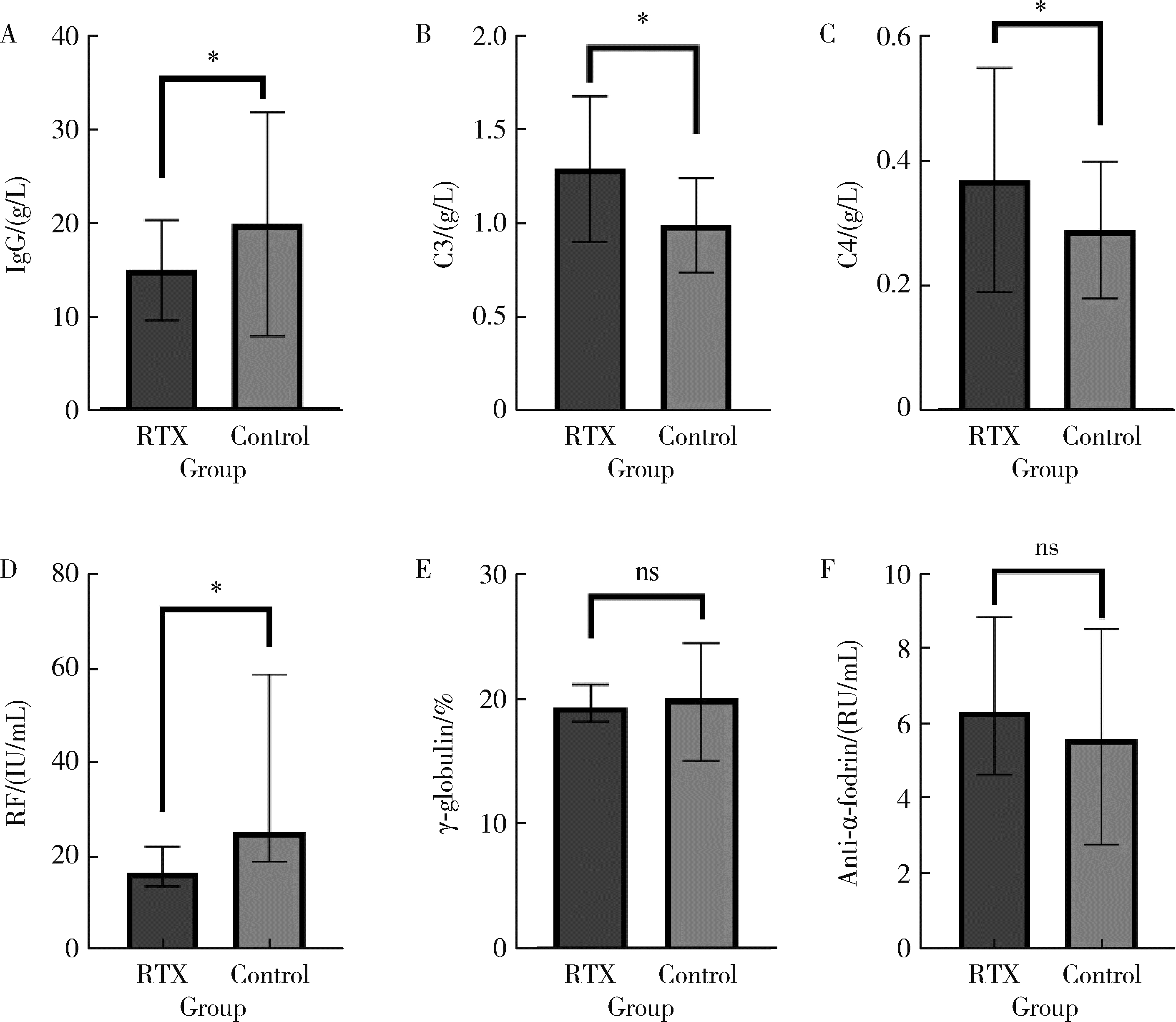
图2

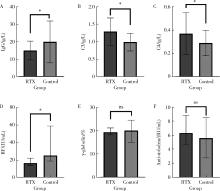
治疗后RTX组和对照组免疫指标的比较"

表5

RTX组和对照组治疗前后免疫指标比较"

Items Group Before treatment After treatment P value
IgG/(g/L) RTX group 20.98±9.45* 14.97±5.39 0.013
Control group 21.25±12.85* 19.91±11.99 0.081
C3/(g/L) RTX group 1.03±0.30* 1.29±0.39 0.047
Control group 0.98±0.21 0.99±0.25 0.086
C4/(g/L) RTX group 0.29±0.14* 0.37±0.18 0.024
Control group 0.23±0.09* 0.29±0.11 0.001
RF/(IU/mL) RTX group 33.40 (17.90, 113.50) 16.40 (13.50, 22.00) 0.034
Control group 67.65 (20.00, 173.75) 25.00 (18.80, 58.80) 0.012
γ-globulin/% RTX group 22.60 (18.30, 34.50) 19.35 (18.18, 21.20) 0.005
Control group 26.15 (18.80, 30.50) 20.00 (15.05, 24.50) 0.002
Anti-α-fodrin/(RU/mL) RTX group 11.94 (6.46, 19.24) 6.37 (4.68, 8.90) 0.017
Control group 8.61 (5.07, 17.00) 5.64 (2.81, 8.58) 0.063
1
Mariette X , Criswell LA . Primary Sjögren' s syndrome[J]. N Engl J Med, 2018, 378(10): 931- 939.

doi: 10.1056/NEJMcp1702514
2
Maripuri S , Grande JP , Osborn TG , et al. Renal involvement in primary Sjögren' s syndrome: A clinicopathologic study[J]. Clin J Am Soc Nephrol, 2009, 4(9): 1423- 1431.

doi: 10.2215/CJN.00980209
3
Goules AV , Tatouli IP , Moutsopoulos HM , et al. Clinically signi-ficant renal involvement in primary Sjögren' s syndrome: Clinical presentation and outcome[J]. Arthritis Rheum, 2013, 65(11): 2945- 2953.

doi: 10.1002/art.38100
4
Ramos-Casals M , Brito-Zerón P , Bombardieri S , et al. EULAR recommendations for the management of Sjögren' s syndrome with topical and systemic therapies[J]. Ann Rheum Dis, 2020, 79(1): 3- 18.

doi: 10.1136/annrheumdis-2019-216114
5
Carubbi F , Cipriani P , Marrelli A , et al. Efficacy and safety of rituximab treatment in early primary Sjögren' s syndrome: A prospective, multi-center, follow-up study[J]. Arthritis Res Ther, 2013, 15(5): R172.

doi: 10.1186/ar4359
6
Baldini C , Fulvio G , La Rocca G , et al. Update on the pathophysiology and treatment of primary Sjögren syndrome[J]. Nat Rev Rheumatol, 2024, 20(8): 473- 491.

doi: 10.1038/s41584-024-01135-3
7
Lin DF , Yan SM , Zhao Y , et al. Clinical and prognostic characteristics of 573 cases of primary Sjögren' s syndrome[J]. Chin Med J (Engl), 2010, 123(22): 3252- 3257.
8
Qiu DD , Li Z , Wang JJ , et al. The spectrum and prognosis of Sjögren' s syndrome with membranous nephropathy[J]. Clin Kidney J, 2024, 18(2): sfae384.
9
北京大学医学部肾脏病学系专家组. 利妥昔单抗在膜性肾病中应用的专家共识[J]. 中华内科杂志, 2022, 61(3): 282- 290.
10
Odler B , Tieu J , Artinger K , et al. The plethora of immunomodulatory drugs: Opportunities for immune-mediated kidney diseases[J]. Nephrol Dial Transplant, 2023, 38(Suppl 2): ii19- ii28.
11
Jasiek M , Karras A , Le Guern V , et al. A multicentre study of 95 biopsy-proven cases of renal disease in primary Sjögren' s syndrome[J]. Rheumatology (Oxford), 2017, 56(3): 362- 370.
12
Longhino S , Chatzis LG , Dal Pozzolo R , et al. Sjögren' s syndrome: One year in review 2023[J]. Clin Exp Rheumatol, 2023, 41(12): 2343- 2356.
13
Lee DSW , Rojas OL , Gommerman JL . B cell depletion therapies in autoimmune disease: Advances and mechanistic insights[J]. Nat Rev Drug Discov, 2021, 20(3): 179- 199.

doi: 10.1038/s41573-020-00092-2
14
Kuijpers TW , Bende RJ , Baars PA , et al. CD20 deficiency in humans results in impaired T cell-independent antibody responses[J]. J Clin Invest, 2010, 120(1): 214- 222.

doi: 10.1172/JCI40231
15
Devauchelle-Pensec V , Pennec Y , Morvan J , et al. Improvement of Sjögren' s syndrome after two infusions of rituximab (anti-CD20)[J]. Arthritis Rheum, 2007, 57(2): 310- 317.

doi: 10.1002/art.22536
16
Mekinian A , Ravaud P , Hatron PY , et al. Efficacy of rituximab in primary Sjögren' s syndrome with peripheral nervous system involvement: Results from the AIR registry[J]. Ann Rheum Dis, 2012, 71(1): 84- 87.

doi: 10.1136/annrheumdis-2011-200086
17
Devauchelle-Pensec V , Mariette X , Jousse-Joulin S , et al. Treatment of primary Sjögren syndrome with rituximab: A randomized trial[J]. Ann Intern Med, 2014, 160(4): 233- 242.

doi: 10.7326/M13-1085
18
Ring T , Kallenbach M , Praetorius J , et al. Successful treatment of a patient with primary Sjögren' s syndrome with Rituximab[J]. Clin Rheumatol, 2006, 25(6): 891- 894.

doi: 10.1007/s10067-005-0086-0
19
Carubbi F , Alunno A , Cipriani P , et al. Rituximab in primary Sjögren' s syndrome: A ten-year journey[J]. Lupus, 2014, 23(13): 1337- 1349.

doi: 10.1177/0961203314546023
20
中国初级卫生保健基金会风湿免疫学专业委员会. 干燥综合征超药品说明书用药中国临床实践指南(2023版)[J]. 中华医学杂志, 2023, 103(43): 3445- 3461.
21
中国初级卫生保健基金会风湿免疫学分会干燥综合征和IgG4相关性疾病专委会, 系统性红斑狼疮专委会. 利妥昔单抗治疗风湿免疫病中国专家共识(2024版)[J]. 中华风湿病学杂志, 2024, 28(8): 521- 537.
22
Chen YH , Wang XY , Jin X , et al. Rituximab therapy for primary Sjögren' s syndrome[J]. Front Pharmacol, 2021, 12, 731122.

doi: 10.3389/fphar.2021.731122
[1] 刘源, 石桂秀. 干燥综合征到干燥病的命名变迁[J]. 北京大学学报(医学版), 2025, 57(6): 1015-1017.
[2] 林文灏, 谢阳, 王芳晴, 王淑盈, 刘香君, 胡凡磊, 贾园. 基于B细胞单细胞转录组测序的干燥综合征分子分型[J]. 北京大学学报(医学版), 2025, 57(6): 1032-1041.
[3] 向钊, 杨莉, 杨静. 非靶向代谢组学揭示原发性干燥综合征血小板减少患者血清差异代谢物及代谢通路[J]. 北京大学学报(医学版), 2025, 57(6): 1042-1050.
[4] 丁艳, 王丽芳, 李超然, 卢哲敏, 石连杰. 利妥昔单抗成功治疗类风湿关节炎合并IgG4相关性疾病1例[J]. 北京大学学报(医学版), 2025, 57(6): 1203-1207.
[5] 朱丽秀, 陈仁利, 周素娟, 林烨, 汤一榕, 叶桢. 水通道蛋白5对干燥综合征大鼠TLR4/MyD88/NF-κB信号的影响[J]. 北京大学学报(医学版), 2025, 57(5): 875-883.
[6] 宁圆, 张晓盈, 李雪, 李原, 何菁, 金月波. 干燥综合征并发乳腺淋巴瘤1例[J]. 北京大学学报(医学版), 2025, 57(4): 808-811.
[7] 王紫薇, 李闵, 高慧, 邓芳. 链球菌感染与过敏性紫癜肾炎患儿肾损害的相关性[J]. 北京大学学报(医学版), 2025, 57(2): 284-290.
[8] 马豆豆, 卢哲敏, 郭倩, 朱莎, 古今, 丁艳, 石连杰. 小剂量利妥昔单抗成功治疗类风湿关节炎合并重症肌无力1例[J]. 北京大学学报(医学版), 2024, 56(6): 1110-1114.
[9] 杨玉淑, 齐晅, 丁萌, 王炜, 郭惠芳, 高丽霞. 抗唾液腺蛋白1抗体联合抗腮腺分泌蛋白抗体对干燥综合征的诊断价值[J]. 北京大学学报(医学版), 2024, 56(5): 845-852.
[10] 韩艺钧,李常虹,陈秀英,赵金霞. 抗SSB抗体阳性和阴性的原发性干燥综合征患者临床及免疫学特征的比较[J]. 北京大学学报(医学版), 2023, 55(6): 1000-1006.
[11] 李建斌,吕梦娜,池强,彭一琳,刘鹏程,吴锐. 干燥综合征患者发生重症新型冠状病毒肺炎的早期预测[J]. 北京大学学报(医学版), 2023, 55(6): 1007-1012.
[12] 孟彦宏,陈怡帆,周培茹. CENP-B抗体阳性的原发性干燥综合征患者的临床和免疫学特征[J]. 北京大学学报(医学版), 2023, 55(6): 1088-1096.
[13] 吴洁,张雯,梁舒,秦艺璐,范文强. 妊娠期原发性干燥综合征合并视神经脊髓炎谱系疾病危重症1例[J]. 北京大学学报(医学版), 2023, 55(6): 1118-1124.
[14] 王丽芳,石连杰,宁武,高乃姝,王宽婷. 干燥综合征合并冷凝集素病1例[J]. 北京大学学报(医学版), 2023, 55(6): 1130-1134.
[15] 邢海霞,王琳,乔迪,刘畅,潘洁. 干燥综合征口腔疾病的治疗特点[J]. 北京大学学报(医学版), 2023, 55(5): 929-933.
Viewed
Full text


Abstract

Cited

  Shared   
  Discussed   
No Suggested Reading articles found!