北京大学学报(医学版) ›› 2025, Vol. 57 ›› Issue (3): 473-480. doi: 10.19723/j.issn.1671-167X.2025.03.010

• 论著 • 上一篇    下一篇

母亲围受孕期服用叶酸营养素补充剂与围产儿死亡率的关系

刘畅1,2,3,4, 李炤1,2,3,4, 金蕾5, 刘春毅1,2,3,4, 王春静5,6, 张杰1,2,3,4, 靳蕾1,2,3,4,*()   

  1. 1. 北京大学公共卫生学院流行病与卫生统计学系, 北京 100191
    2. 北京大学生育健康研究所, 北京 100191
    3. 国家卫生健康委员会生育健康重点实验室, 北京 100191
    4. 北京大学女性生育力促进全国重点实验室, 北京 100191
    5. 北京市通州区妇幼保健院妇女保健科, 北京 101100
    6. 北京市通州区妇幼保健院产科, 北京 101100
  • 收稿日期:2025-02-06 出版日期:2025-06-18 发布日期:2025-06-13
  • 通讯作者: 靳蕾
  • 基金资助:
    国家重点研发计划(2021YFC2700700); 国家重点研发计划(2021YFC2700704)

Association between maternal periconceptional supplementation of folic acid or multiple micronutrients containing folic acid and perinatal mortality rate

Chang LIU1,2,3,4, Zhao LI1,2,3,4, Lei JIN5, Chunyi LIU1,2,3,4, Chunjing WANG5,6, Jie ZHANG1,2,3,4, Lei JIN1,2,3,4,*()   

  1. 1. Department of Epidemiology and Biostatistics, Peking University School of Public Health, Beijing 100191, China
    2. Institute of Reproductive and Child Health, Peking University, Beijing 100191, China
    3. National Health Commission Key Laboratory of Reproductive Health, Beijing 100191, China
    4. State Key Laboratory of Female Fertility Promotion, Peking University, Beijing 100191, China
    5. Department of Maternal Health Care, Tongzhou Maternal and Child Health Hospital of Beijing, Beijing 101100, China
    6. Department of Obstetrics, Tongzhou Maternal and Child Health Care Hospital of Beijing, Beijing 101100, China
  • Received:2025-02-06 Online:2025-06-18 Published:2025-06-13
  • Contact: Lei JIN
  • Supported by:
    the National Key Research and Development Program of China(2021YFC2700700); the National Key Research and Development Program of China(2021YFC2700704)

RICH HTML


摘要:

目的: 了解北京市通州地区围产儿死亡率情况,探索母亲围受孕期服用叶酸营养素补充剂与围产儿死亡率的关系。方法: 基于北京市通州区妇幼保健系统开展回顾性队列研究,收集2013年1月至2018年12月94 490例围产儿结局及其母亲围受孕期服用叶酸营养素补充剂的信息,应用泊松(Poisson)对数线性模型分析母亲围受孕期服用叶酸营养素补充剂情况与围产儿死亡率的关系。结果: 通州区围产儿死亡率为2.71‰。母亲围受孕期服用叶酸营养素补充剂组与未服用营养素补充剂组围产儿死亡率分别为2.63‰和3.43‰,差异无统计学意义[粗风险比(crude risk ratio,cRR)=0.77,95%CI:0.54~1.14]。调整母亲民族、年龄、文化程度、职业、户籍地、产次、胎数、孕周、是否应用辅助生殖技术、分娩年份和孕前体重指数潜在混杂因素后,母亲围受孕期服用叶酸营养素补充剂与围产儿死亡率的关联也未见统计学意义[调整风险比(adjusted risk ratio,aRR)=0.93,95% CI:0.77~1.13]。服用单纯叶酸组与服用含有叶酸的复合营养素组的围产儿死亡率分别为2.23‰和2.99‰,差异有统计学意义(cRR= 1.34,95%CI: 1.02~1.76),调整潜在混杂因素后,差异仍具有统计学意义(aRR=1.31, 95%CI: 1.06~1.62)。进一步分析叶酸营养补充剂开始服用时间和服用频率与围产儿死亡的关系,服用组开始服用的时间及服用频率(孕前或孕后及低频或高频)与未服用叶酸营养素补充剂组比较,无论是否调整混杂因素,围产儿死亡率差异均无统计学意义。结论: 北京市通州区围产儿死亡率低于全国平均水平,尚未发现母亲围受孕期服用叶酸营养素补充剂与围产儿死亡率间存在关联,围受孕期服用含叶酸的复合营养素与围产儿死亡的关系需要进一步研究。

关键词: 围受孕期, 营养补充剂, 叶酸, 围产儿, 死亡率

Abstract:

Objective: To describe the prevalence of perinatal death in Tongzhou District of Beijing, and to estimate the association between maternal periconceptional supplementation of folic acid or multiple micronutrients containing folic acid and perinatal mortality rate. Methods: A retrospective cohort study was conducted based on the maternal and child care system in Tongzhou District of Beijing. The subjects were 94 490 perinatal who were born during January 2013 to December 2018. The information on perinatal outcomes and maternal periconceptional supplementation of folic acid or multiple micronutrients containing folic acid were collected. The Poisson log-linear model was used to estimate the association between maternal periconceptional folic acid or multiple micronutrients supplementation and perinatal mortality rate. Results: The overall perinatal mortality rate was 2.71‰. The perinatal mortality rates for maternal nutrients supplementation containing folic acid and no supplementation during periconceptional period were 2.63‰ and 3.43‰, respectively, and the difference in rates was not statistically significant [crude risk ratio (cRR) = 0.77, 95%CI: 0.54-1.14]. After adjusting for potential confounding factors including ethnicity, age, education level, occupation, household registration, parity, numbers of fetuses, gestational age, pregnant with assisted reproductive technology, delivery year and pre-pregnancy body mass index, the rates remained not statistically significant [adjusted risk ratio (aRR) = 0.93, 95%CI: 0.77-1.13]. The perinatal mortality rates were 2.23‰ and 2.99‰ for pure folic acid and multi-nutrients supplements containing folic acid, respectively, and the difference in rates was statistically significant (cRR = 1.34, 95% CI: 1.02-1.76). The rates difference remained statistically significant after adjusting for potential confounders (aRR = 1.31, 95% CI: 1.06-1.62). Additionally, the perinatal mortality rates differences among the non-supplementation group and the supplementation group with variate timing of initiation (pre-conception or post-conception) or frequency of supplementation (low-frequency or high-frequency) were not statistically significant, regardless of adjusting for confounders. Conclusion: The overall perinatal mortality rate was lower than the national average level in Tongzhou District of Beijing. Maternal periconceptional supplementation of pure folic acid or micronutrients containing folic acid had no impact on perinatal mortality. The association between maternal periconceptional supplementation of multiple micronutrients containing folic acid and perinatal mortality rate need further research.

Key words: Periconceptional period, Micronutrients supplementation, Folic acid, Perinatal infant, Mortality rate

中图分类号: 

  • R17

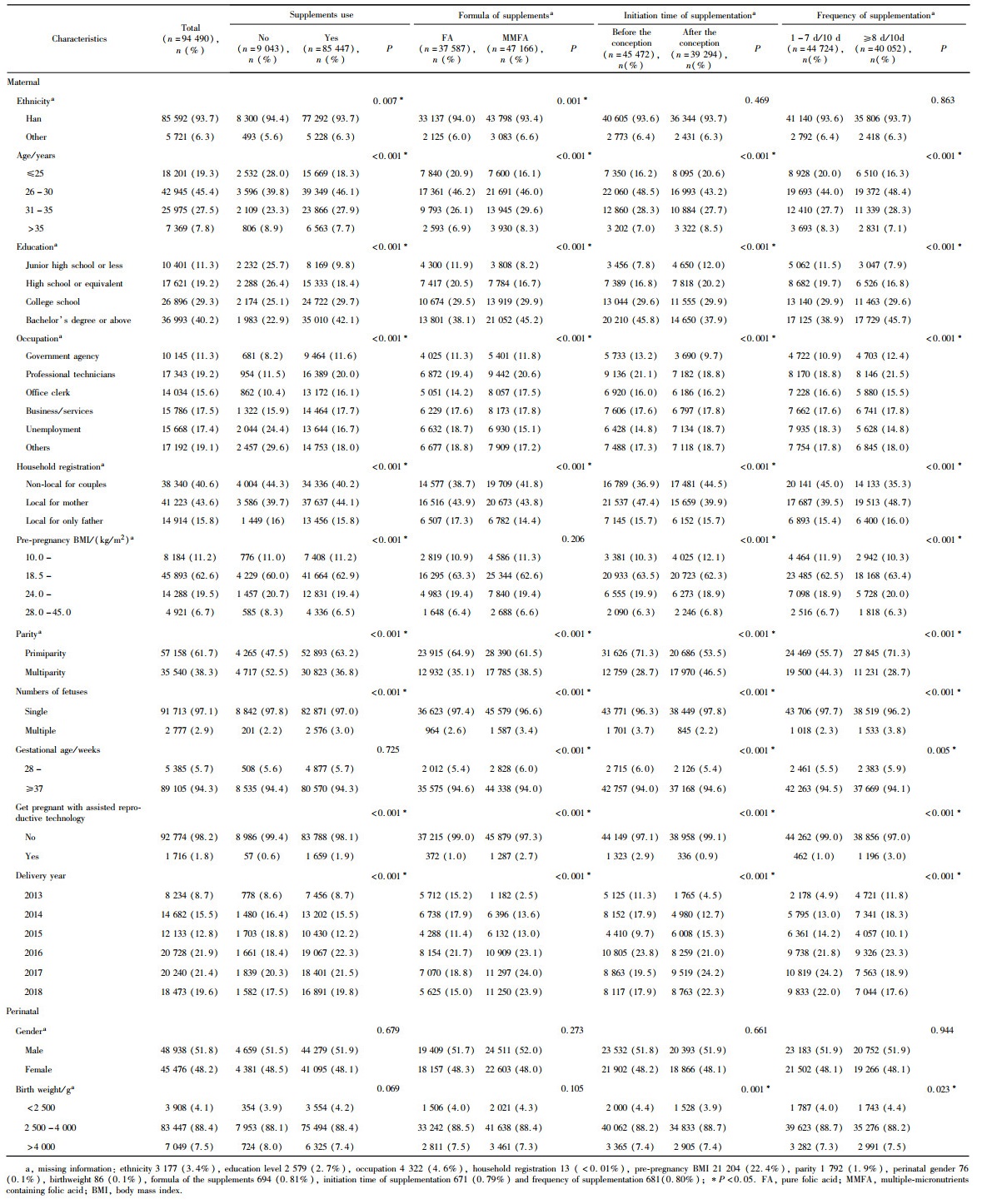
表1

叶酸营养素补充剂不同比对组研究对象基本特征"

表2

母亲围受孕期服用营养补充剂与围产儿死亡率关系"

n PM, n(‰) cRR (95%CI) aRR (95%CI)a aRR (95%CI)b
FA/MMFA supplementation
  No use 9 043 31 (3.43) 1 1 1
  Use 85 447 225 (2.63) 0.77 (0.54-1.14) 0.89 (0.75-1.05) 0.93 (0.77-1.13)
Formula of the supplements
  FA 37 587 84 (2.23) 1 1 1
  MMFA 47 166 141 (2.99) 1.34 (1.02-1.76) 1.29 (1.07-1.56) 1.31 (1.06-1.62)
Initiation time of supplementation
  No use 9 043 31 (3.43) 1 1 1
  Post-conception 39 294 112 (2.85) 0.83 (0.57-1.26) 0.94 (0.74-1.18) 0.95 (0.73-1.22)
  Pre-conception 45 472 113 (2.49) 0.72 (0.49-1.10) 0.87 (0.69-1.09) 0.89 (0.68-1.15)
Frequency of supplementation
  No use 9 043 31 (3.43) 1 1 1
  1-7 d/10 d 44 724 126 (2.82) 0.82 (0.56-1.24) 0.94 (0.75-1.17) 0.98 (0.77-1.25)
  ≥8 d/10 d 40 052 99 (2.47) 0.72 (0.49-1.10) 0.84 (0.66-1.07) 0.84 (0.63-1.11)

表3

围受孕期服用叶酸营养素补充剂与孕早期血浆Hcy浓度的关系"

Status of supplementation n Hcy/(μmol/L), M (P25, P75) P
FA/MMFA supplementation <0.001
  No use 1 427 6.5 (5.6, 7.7)
  Use 15 627 6.1 (5.3, 7.0)
Formula of the supplements <0.001
  FA 5 853 6.2 (5.4, 7.2)
  MMFA 9 757 6.0 (5.3, 6.9)
Initiation time of supplementation <0.001
  Pre-conception 7 500 6.0 (5.3, 6.9)
  Post-conception 8 124 6.2 (5.4, 7.2)
Frequency of supplementation <0.001
  1-7 d/10 d 8 889 6.2 (5.4, 7.2)
  ≥8 d/10 d 6 733 6.0 (5.3, 6.9)
1
World Health Organization. Levels and trends in child mortality: Report 2021[EB/OL]. (2021-12-12)[2024-06-15]. https://www.who.int/publications/m/item/levels-and-trends-in-child-mortality-report-2021.
2
World Health Organization. A neglected tragedy: The global burden of stillbirths[EB/OL]. (2020-11-30)[2024-06-10]. https://www.who.int/publications/m/item/a-neglected-tragedy-the-global-burden-of-stillbirths.
3
Fernández-Férez A , Ventura-Miranda MI , Camacho-ávila M , et al. Nursing interventions to facilitate the grieving process after perinatal death: A systematic review[J]. Int J Environ Res Public Health, 2021, 18 (11): 5587.

doi: 10.3390/ijerph18115587
4
Liu X , Liu X , An H , et al. Folic acid supplements and perinatal mortality in China[J]. Front Nutr, 2023, 10, 1281971.
5
Keats EC , Haider BA , Tam E , et al. Multiple-micronutrient supplementation for women during pregnancy[J]. Cochrane Database Syst Rev, 2019, 3 (3): CD004905.
6
Berry RJ , Li Z , Erickson JD , et al. Prevention of neural-tube defects with folic acid in China. China-U.S. collaborative project for neural tube defect prevention[J]. N Engl J Med, 1999, 341 (20): 1485- 1490.

doi: 10.1056/NEJM199911113412001
7
中华人民共和国国家卫生健康委员会. 卫生部关于印发《增补叶酸预防神经管缺陷项目管理方案》的通知[EB/OL]. (2009-06-29)[2025-04-10]. http://www.nhc.gov.cn/wjw/gfxwj/201304/02c3c3d51117464aa054c08de04b0468.shtml.
8
金蕾, 王程, 张杰, 等. 妇女围受孕期叶酸服用情况及其对胎儿神经管缺陷的预防效果[J]. 北京大学学报(医学版), 2020, 52 (4): 719- 725.
9
Wang D , Jin L , Zhang J , et al. Maternal periconceptional folic acid supplementation and risk for fetal congenital heart defects[J]. J Pediatr, 2022, 240, 72- 78.

doi: 10.1016/j.jpeds.2021.09.004
10
黄琬桐, 庞梓溪, 金蕾, 等. 母亲围受孕期服用叶酸与胎儿腹壁缺陷风险关系的研究[J]. 中国生育健康杂志, 2023, 34 (3): 201- 206.
11
Zhang J , Jin L , Wang D , et al. Maternal periconceptional folic acid supplements use and fetus risk for limb defects[J]. Paediatr Perinat Epidemiol, 2021, 35 (6): 645- 653.

doi: 10.1111/ppe.12775
12
Lin J , Wang C , Li S , et al. Periconceptional folic acid supplementation and newborn birth weights[J]. Front Pediatr, 2022, 10, 844404.

doi: 10.3389/fped.2022.844404
13
谢幸, 孔北华, 段涛. 妇产科学[M]. 9版 北京: 人民卫生出版社, 2018: 48.
14
赵星宇, 王广成, 单海峰, 等. 我国围产儿死亡率时空变化及预测研究[J]. 中国卫生统计, 2021, 38 (2): 177- 180.
15
Gakidou E , Cowling K , Lozano R , et al. Increased educational attainment and its effect on child mortality in 175 countries between 1970 and 2009: A systematic analysis[J]. Lancet, 2010, 376 (9745): 959- 974.

doi: 10.1016/S0140-6736(10)61257-3
16
魏佳慧, 林琪菲, 李向云, 等. 我国围产儿死亡率时空分布及预测分析[J]. 青岛大学学报(医学版), 2024, 60 (5): 689- 692.
17
Duffy K , Connolly S , Nolan A , et al. Perinatal mortality in Ireland: Inequalities by socio-economic group and country of birth[J]. Eur J Public Health, 2023, 33 (1): 20- 24.

doi: 10.1093/eurpub/ckac167
18
Lassi ZS , Salam RA , Haider BA , et al. Folic acid supplementation during pregnancy for maternal health and pregnancy outcomes[J]. Cochrane Database Syst Rev, 2013 (3): CD006896.
19
Charles DHM , Ness AR , Campbell D , et al. Folic acid supplements in pregnancy and birth outcome: Re-analysis of a large randomised controlled trial and update of Cochrane review[J]. Paediatr Perinat Epidemiol, 2005, 19 (2): 112- 124.
20
Liu JM , Mei Z , Ye R , et al. Micronutrient supplementation and pregnancy outcomes: Double-blind randomized controlled trial in China[J]. JAMA Intern Med, 2013, 173 (4): 276- 282.
21
Hunt JR . Teratogenicity of high vitamin A intake[J]. N Engl J Med, 1996, 334 (18): 1197.
22
Rayman MP , Barlis J , Evans RW , et al. Abnormal iron parameters in the pregnancy syndrome preeclampsia[J]. Am J Obstet Gynecol, 2002, 187 (2): 412- 418.
23
Miriuka SG , Langman LJ , Keren ES , et al. Effects of folic acid fortification and multivitamin therapy on homocysteine and vitamin b12 status in cardiac transplant recipients[J]. J Heart Lung Transplant, 2004, 23 (4): 405- 412.
[1] 王裕新, 曹茹, 黄婧, Pitakchon Ponsawansong, Benjawan Tawatsupa, 潘小川, Tippawan Prapamontol, 李国星. 不同表观温度水平下大气细颗粒物暴露对人群非意外死亡的影响[J]. 北京大学学报(医学版), 2024, 56(5): 820-827.
[2] 白银晓,刘春毅,张杰,孟文颖,金蕾,靳蕾. 妇女围受孕期服用叶酸或含叶酸的多种微量营养素补充剂与早产的关联性研究[J]. 北京大学学报(医学版), 2023, 55(3): 495-501.
[3] 赵亚楠,范慧芸,王翔宇,罗雅楠,张嵘,郑晓瑛. 孤独症患者过早死亡风险及死亡原因[J]. 北京大学学报(医学版), 2023, 55(2): 375-383.
[4] 邢云飞,刘春毅,孟文颖,张杰,焦明远,金蕾,靳蕾. 围受孕期服用微量营养增补剂与孕早期血清维生素E浓度的关系[J]. 北京大学学报(医学版), 2022, 54(3): 434-442.
[5] 刘云飞,党佳佳,钟盼亮,马宁,师嫡,宋逸. 1990—2019年中国5~24岁人群伤害死亡率分析[J]. 北京大学学报(医学版), 2022, 54(3): 498-504.
[6] 金蕾,王程,张杰,孟文颖,张佳煜,于锦慧,蔺桂银,佟明坤,靳蕾. 妇女围受孕期叶酸服用情况及其对胎儿神经管缺陷的预防效果[J]. 北京大学学报(医学版), 2020, 52(4): 719-725.
[7] 陈章健,韩硕,郑湃,周淑佩,贾光. 纳米二氧化钛与葡萄糖亚慢性联合经口暴露对幼年大鼠血清叶酸和维生素B12水平的影响[J]. 北京大学学报(医学版), 2020, 52(3): 451-456.
[8] 袁蒙蒙,王锰,刘俊义,张志丽. 基于4-氨基-5-甲酰基-8,10-二去氮杂四氢叶酸二乙酯侧链的水解反应条件优化[J]. 北京大学学报(医学版), 2017, 49(4): 714-718.
[9] 刘鑫,杜义青,李远新,王锰,张志丽,王孝伟,刘俊义,田超. N-[4-(2,4-二氨基吡啶并[3,2-d]嘧啶-6-甲氨基)-苯甲酰]-L-谷氨酸二乙酯的合成方法改进[J]. 北京大学学报(医学版), 2015, 47(5): 842-845.
[10] 任爱国. 叶酸预防神经管缺陷[J]. 北京大学学报(医学版), 2014, 46(3): 343-346.
[11] 王琳琳, 杨娜, 袁悦, 任爱国. 人叶酸受体自身抗体IgG酶联免疫吸附试验检测方法的建立及评价[J]. 北京大学学报(医学版), 2014, 46(3): 483-487.
[12] 王苹, 王红, 吴雅慧, 叶晓茜, 黄尚志, 石冰, 梁赓义, 曹卫华, 吴涛, Terri H. BEATY. 中国人群叶酸/同型半胱氨酸代谢基因多态性与非综合征型唇腭裂关联研究[J]. 北京大学学报(医学版), 2013, 45(03): 352-358.
[13] 骆大胜, 陈荔丽, 韦萍, 江震, 郭岩. 运用生命挽救工具预测降低广西农村孕产妇死亡率的干预措施健康效果的适用性[J]. 北京大学学报(医学版), 2013, 45(03): 427-431.
[14] 冯星淋, 杨青, 徐玲, 王燕, 郭岩 . 中国实现联合国千年发展目标5的进程和挑战(英文稿)[J]. 北京大学学报(医学版), 2011, 43(3): 391-396.
[15] 杨祖耀, 詹思延, 王波, 吕晓珍, 舒正, 何英剑, 邱宁, 杨慧英. 中国血流感染住院病死率的系统评价和meta分析[J]. 北京大学学报(医学版), 2010, 42(3): 304-307.
Viewed
Full text


Abstract

Cited

  Shared   
  Discussed   
No Suggested Reading articles found!