北京大学学报(医学版) ›› 2025, Vol. 57 ›› Issue (5): 956-960. doi: 10.19723/j.issn.1671-167X.2025.05.021

• 论著 • 上一篇    下一篇

前列腺导管腺癌临床特征及腺外侵犯的影响因素

杨小勇1,*, 张帆1,*, 马潞林1,*(), 刘承1,2,*()   

  1. 1. 北京大学第三医院泌尿外科, 北京 100191
    2. 上海交通大学医学院附属第一人民医院泌尿外科临床医学中心, 上海 200080
  • 收稿日期:2023-01-17 出版日期:2025-10-18 发布日期:2024-01-30
  • 通讯作者: 马潞林, 刘承
  • 作者简介:* These authors contributed equally to this work
  • 基金资助:
    国家自然科学基金(82070778)

Clinical characteristics and influencing factors of extraglandular invasion of prostatic ductal adenocarcinoma

Xiaoyong YANG1, Fan ZHANG1, Lulin MA1,*(), Cheng LIU1,2,*()   

  1. 1. Department of Urology, Peking University Third Hospital, Beijing 100191, China
    2. Department of Urology, Shanghai General Hospital, Shanghai Jiao Tong University School of Medicine, Shanghai 200080, China
  • Received:2023-01-17 Online:2025-10-18 Published:2024-01-30
  • Contact: Lulin MA, Cheng LIU
  • Supported by:
    the National Natural Science Foundation of China(82070778)

RICH HTML


摘要: 目的: 探索不同病理类型前列腺癌患者根治性前列腺切除术(radical prostatectomy, RP)围术期临床及病理特征差异, 分析可能影响前列腺导管腺癌腺外侵犯的影响因素。方法: 回顾性收集2011年12月至2021年4月北京大学第三医院收治的行RP且病理明确为前列腺癌患者的临床资料, 获取其基本临床特征及术后病理结果。根据病理结果将患者分为导管腺癌组(混有导管腺癌)及单纯腺泡腺癌组, 并进行1 ∶1倾向评分匹配, 比较两组患者临床特征差异, 并对导管腺癌组腺外侵犯的相关因素进行单因素及多因素分析。结果: 共获得764例前列腺癌患者信息, 其中术后病理明确混有导管腺癌成分者62例。倾向评分匹配前两组患者基线特征中既往有糖尿病史的比例差异有统计学意义(29.5% vs. 17.7%, P=0.027), 共有61例单纯腺泡腺癌患者和导管腺癌患者成功匹配, 匹配后基线特征在两组间差异无统计学意义(P>0.05)。对两组围术期临床及病理特征进行比较, 导管腺癌组国际泌尿病理协会(International Society of Urology Pathology, ISUP)分级(P=0.003)、pT分期(P=0.004)、腺外侵犯率(P=0.018)及脉管癌栓率(P=0.019)均明显高于单纯腺泡腺癌组。单因素分析显示, 前列腺特异性抗原(prostate-specific antigen, PSA)水平、前列腺体积、ISUP分级、精囊侵犯及神经侵犯可能是导管腺癌腺外侵犯的影响因素(P<0.10);二元Logistic回归分析表明, 神经侵犯是前列腺导管腺癌腺外侵犯的独立影响因素(OR=11.78, 95%CI: 1.97~70.56, P=0.007)。结论: 前列腺导管腺癌比单纯腺泡腺癌预后更差, 神经侵犯是前列腺导管腺癌腺外侵犯的独立影响因素。

关键词: 前列腺肿瘤, 导管腺癌, 肿瘤浸润, 前列腺癌切除术, 危险因素

Abstract: Objective: To explore the differences in perioperative clinical and pathological characteristics of patients with different pathological types of prostate cancer undergoing radical prostatectomy, and to analyze the influencing factors that may affect the extraglandular invasion of ductal adenocarcinoma of the prostate. Methods: Retrospective collection was made of the radical prostatectomy patients who were admitted to Peking University Third Hospital from December 2011 to April 2021. The patients were screened based on inclusion criteria to obtain basic clinical features and postoperative pathological results. According to the pathological results, the patients were divided into ductal adenocarcinoma group (mixed with ductal adenocarcinoma) and acinar adenocarcinoma group, and a 1 ∶1 propensity score matching was performed to compare the differences in clinical characteristics between the two groups. Univariate and multivariate analyses of the factors related to extraglandular invasion were performed in the matched ductal adenocarcinoma groups. Results: A total of 764 patients with prostate cancer were enrolled in this study, of which 62 patients were confirmed to have ductal adenocarcinoma components by postoperative pathology. There was a statistically significant difference in the proportion of the patients with a history of diabetes in baseline characteristics between the two groups before propensity score matching (29.5% vs. 17.7%, P=0.027). A total of 61 patients with simple acinar adenocarcinoma were successfully matched with the patients with ductal adenocarcinoma, and there was no statistically significant difference in baseline characteristics between the two groups after matching (P>0.05). The comparison of perioperative clinical and pathological features showed that International Society of Urology Pathology (ISUP) grade (P=0.003), pT stage (P=0.004), extraglandular invasion rate (P=0.018) and vascular thrombus rate (P=0.019) in ductal adenocarcinoma group were significantly higher than those in simple acinous adenocarcinoma group. Univariate analysis of the influence factors of extraglandular invasion showed that prostate-specific antigen (PSA) level, prostate volume, ISUP grade, seminal vesicle invasion and perineural invasion might be the influencing factors of extraglandular invasion (P < 0.10). Binary Logistic regression analysis showed that perineural invasion was an independent factor of extraglandular invasion (OR=11.78, 95%CI: 1.97-70.56, P=0.007). Conclusion: Prostatic ductal adenocarcinoma has a worse prognosis than simple acinar adenocarcinoma. Perineural invasion is the influencing factor of extraglandular invasion of ductal adenocarcinoma.

Key words: Prostatic neoplasms, Ductal adenocarcinoma, Neoplasm invasiveness, Prostatectomy, Risk factors

中图分类号: 

  • R737.25

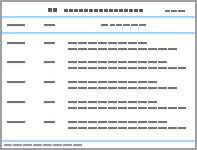
表1

倾向评分匹配后患者临床特征"

Items DAP (n=61) PAA (n=61) P value
Age/years, ${\bar x}$±s 69.39±6.66 68.85±7.54 0.675
BMI/(kg/m2), ${\bar x}$±s 25.13±2.94 24.98±3.17 0.783
Hypertension, n(%) 33 (54.1) 34 (55.7) 0.856
Diabetes, n(%) 18 (29.5) 17 (27.9) 0.841
History of malignancy, n(%) 2 (3.3) 1 (1.6) 0.641
History of prostatic operation, n(%) 3 (4.9) 2 (3.3) 0.641
PSA/(μg/L), M(Q1, Q3) 11.80 (6.18, 26.89) 10.22 (5.83, 19.51) 0.408
Prostate volume/mL, M(Q1, Q3) 40.00 (30.15, 52.65) 39.51 (26.36, 52.18) 0.519
ISUP grade, n(%) 0.003
  1 1 (1.6) 8 (13.1)
  2 7 (11.5) 18 (29.5)
  3 7 (11.5) 7 (11.5)
  4 16 (26.2) 13 (21.3)
  5 30 (49.2) 15 (24.6)
Positive margin, n(%) 26 (42.6) 24 (39.3) 0.713
Extraglandular invasion, n(%) 40 (65.6) 27 (44.3) 0.018
Seminal vesicle invasion, n(%) 13 (21.3) 8 (13.1) 0.230
Perineural invasion, n(%) 51 (83.6) 43 (70.5) 0.085
Vascular cancer thrombus, n(%) 16 (26.2) 6 (9.8) 0.019
pT, n(%) 0.004
  2 19 (31.1) 33 (54.1)
  3 37 (60.7) 28 (45.9)
  4 5 (8.2) 0
Surgical duration/min, M(Q1, Q3) 218 (185, 256) 221 (187, 251) 0.828
Blood loss/mL, M(Q1, Q3) 50 (50, 150) 50 (50, 175) 0.647

表2

前列腺导管腺癌腺外侵犯的单因素分析"

Items Extraglandular invasion P value
Positive (n=40) Negative (n=21)
Age/years, ${\bar x}$±s 69.10±6.64 69.95±6.82 0.639
BMI/(kg/m2),${\bar x}$±s 25.33±2.78 24.74±3.24 0.454
PSA/(μg/L), M (Q1, Q3) 15.08 (7.22, 36.64) 9.83 (4.77, 13.32) 0.054
Volume/mL, M (Q1, Q3) 36.95 (28.58, 47.15) 44.80 (34.10, 55.10) 0.074
ISUP, n(%) 0.017
  1 1 (2.5) 0
  2 2 (5.0) 5 (23.8)
  3 2 (5.0) 5 (23.8)
  4 12 (30.0) 4 (19.0)
  5 23 (57.5) 7 (33.3)
Positive margin, n(%) 16 (40.0) 10 (47.6) 0.568
Seminal vesicle invasion, n(%) 12 (30.0) 1 (4.8) 0.024
Perineural invasion, n(%) 38 (95.0) 13 (61.9) 0.002
Vascular cancer thrombus, n(%) 13 (32.5) 3 (14.3) 0.124
1
Mottet N, Cornford P, van den Bergh RCN, et al. EAU-EANM-ESTRO-ESUR-ISUP-SIOG guidelines on prostate cancer, 2023[EB/OL]. https://uroweb.org/guidelines/prostate-cancer.
2
Bell KJ , Del Mar C , Wright G , et al. Prevalence of incidental prostate cancer: A systematic review of autopsy studies[J]. Int J Cancer, 2015, 137 (7): 1749- 1757.

doi: 10.1002/ijc.29538
3
Vn S , Türk H , Koca O , et al. Factors determining biochemical recurrence in low-risk prostate cancer patients who underwent radical prostatectomy[J]. Turk J Urol, 2015, 41 (2): 61- 66.

doi: 10.5152/tud.2015.65624
4
Jang WS , Shin SJ , Yoon CY , et al. Prognostic significance of the proportion of ductal component in ductal adenocarcinoma of the prostate[J]. J Urol, 2017, 197 (4): 1048- 1053.

doi: 10.1016/j.juro.2016.11.104
5
Amin A . Prostate ductal adenocarcinoma[J]. Appl Immunohistochem Mol Morphol, 2018, 26 (7): 514- 521.

doi: 10.1097/PAI.0000000000000508
6
Liu TT , Wang YM , Zhou R , et al. The update of prostatic ductal adenocarcinoma[J]. Chin J Cancer Res, 2016, 28 (1): 50- 57.
7
Meeks JJ , Zhao LC , Cashy J , et al. Incidence and outcomes of ductal carcinoma of the prostate in the USA: Analysis of data from the Surveillance, Epidemiology, and End Results program[J]. BJU Int, 2012, 109 (6): 831- 834.

doi: 10.1111/j.1464-410X.2011.10520.x
8
Seipel AH , Delahunt B , Samaratunga H , et al. Ductal adeno-carcinoma of the prostate: Histogenesis, biology and clinicopathological features[J]. Pathology, 2016, 48 (5): 398- 405.

doi: 10.1016/j.pathol.2016.04.001
9
McKay RR , Ye HH , Xie WL , et al. Evaluation of intense androgen deprivation before prostatectomy: A randomized phase Ⅱ trial of enzalutamide and leuprolide with or without abiraterone[J]. J Clin Oncol, 2019, 37 (11): 923- 931.

doi: 10.1200/JCO.18.01777
10
Kurose H , Ueda K , Ogasawara N , et al. Impact of Gleason score of the tumor at the positive surgical margin as a prognostic factor[J]. Mol Clin Oncol, 2022, 16 (4): 82.

doi: 10.3892/mco.2022.2515
11
Sfoungaristos S , Perimenis P . Clinical and pathological parameters predicting extracapsular disease in patients undergoing a radical prostatectomy for clinically localized prostate cancer[J]. Prague Med Rep, 2012, 113 (1): 5- 15.

doi: 10.14712/23362936.2015.32
12
张帆, 黄毅, 陆敏, 等. 临床局限性前列腺癌根治性切除术后病理包膜侵犯的危险因素分析[J]. 临床泌尿外科杂志, 2012, 27 (12): 901- 903.
13
DeLancey JO , Wood DP Jr , He C , et al. Evidence of perineural invasion on prostate biopsy specimen and survival after radical prostatectomy[J]. Urology, 2013, 81 (2): 354- 357.

doi: 10.1016/j.urology.2012.09.034
14
Li H , Chang XF , Du YQ . Perineural invasion detected in prostate biopsy is a predictor of positive surgical margin of radical prostatectomy specimen: A meta-analysis[J]. Andrologia, 2022, 54 (5): e14395.
[1] 李博闻, 张强, 孙益鑫. 儿童及青年漏斗胸患者Nuss术后发生脊柱侧弯的风险预测模型建立及验证[J]. 北京大学学报(医学版), 2025, 57(5): 941-946.
[2] 宁家昕, 王浩然, 罗书航, 敬吉波, 王建业, 侯惠民, 刘明. 氧化应激相关基因与前列腺癌关系的多组学分析[J]. 北京大学学报(医学版), 2025, 57(4): 633-643.
[3] 王泽远, 于栓宝, 郑浩轲, 陶金, 范雅峰, 张雪培. 基于临床特征和多参数MRI的前列腺癌盆腔淋巴结转移的术前预测模型[J]. 北京大学学报(医学版), 2025, 57(4): 684-691.
[4] 刘伟, 郭稳, 过哲, 李春艳, 李云龙, 刘思奇, 张亮, 宋慧. 痛风患者放射学阴性骨侵蚀的相关危险因素[J]. 北京大学学报(医学版), 2025, 57(4): 735-739.
[5] 陆梦溪, 刘秋萍, 周恬静, 刘晓非, 孙烨祥, 沈鹏, 林鸿波, 唐迅, 高培. 基于社区人群队列的甘油三酯-葡萄糖指数与心血管病发病和死亡的关联[J]. 北京大学学报(医学版), 2025, 57(3): 430-435.
[6] 杨龙傲, 金旭, 黄文初, 何丽华, 陈娟. 视屏作业人员视疲劳及干眼的流行病学调查[J]. 北京大学学报(医学版), 2025, 57(3): 554-561.
[7] 郭华秋, 王哲, 杨雪, 白洁. 口腔急诊出血患者的临床特征与危险因素[J]. 北京大学学报(医学版), 2025, 57(1): 142-147.
[8] 邓敏婷, 王楠, 夏斌, 赵玉鸣, 朱俊霞. 儿童及青少年挫入恒前牙自行再萌出的相关影响因素[J]. 北京大学学报(医学版), 2025, 57(1): 148-153.
[9] 李钰锴, 王红彦, 罗靓, 李云, 李春. 抗磷脂抗体在白塞病合并血栓中的临床意义[J]. 北京大学学报(医学版), 2024, 56(6): 1036-1040.
[10] 田杨, 韩永正, 李娇, 王明亚, 曲音音, 房景超, 金辉, 李民, 王军, 徐懋, 王圣林, 郭向阳. 颈椎前路手术后硬膜外血肿的发生率和危险因素[J]. 北京大学学报(医学版), 2024, 56(6): 1058-1064.
[11] 王明瑞, 赖金惠, 姬家祥, 唐鑫伟, 胡浩浦, 王起, 许克新, 徐涛, 胡浩. 使用中文版威斯康星结石生活质量问卷预测肾结石患者生活质量降低的危险因素[J]. 北京大学学报(医学版), 2024, 56(6): 1069-1074.
[12] 李志存, 吴天俣, 梁磊, 范宇, 孟一森, 张骞. 穿刺活检单针阳性前列腺癌术后病理升级的危险因素分析及列线图模型构建[J]. 北京大学学报(医学版), 2024, 56(5): 896-901.
[13] 田宇轩,阮明健,刘毅,李德润,吴静云,沈棋,范宇,金杰. 双参数MRI改良PI-RADS评分4分和5分病灶的最大径对临床有意义前列腺癌的预测效果[J]. 北京大学学报(医学版), 2024, 56(4): 567-574.
[14] 姚凯烽,阮明健,李德润,田宇轩,陈宇珂,范宇,刘毅. 靶向穿刺联合区域系统穿刺对PI-RADS 4~5分患者的前列腺癌诊断效能[J]. 北京大学学报(医学版), 2024, 56(4): 575-581.
[15] 欧俊永,倪坤明,马潞林,王国良,颜野,杨斌,李庚午,宋昊东,陆敏,叶剑飞,张树栋. 肌层浸润性膀胱癌合并中高危前列腺癌患者的预后因素[J]. 北京大学学报(医学版), 2024, 56(4): 582-588.
Viewed
Full text


Abstract

Cited

  Shared   
  Discussed   
No Suggested Reading articles found!