北京大学学报(医学版) ›› 2026, Vol. 58 ›› Issue (4): 803-807. doi: 10.19723/j.issn.1671-167X.2026.04.017

• 论著 • 上一篇    下一篇

合并低级别成分对高级别非肌层浸润性膀胱癌预后的影响

姬家祥*, 赖金惠*, 王飞, 胡浩*()   

  1. 北京大学人民医院泌尿外科, 北京 100044
  • 收稿日期:2024-03-18 出版日期:2026-08-18 发布日期:2026-02-25
  • 通讯作者: 胡浩
  • 作者简介:

    * These authors contributed equally to this work

Impact of coexistent low-grade components on the prognosis of high-grade non-muscle invasive bladder cancer

Jiaxiang JI, Chinhui LAI, Fei WANG, Hao HU*()   

  1. Department of Urology, Peking University People's Hospital, Beijing 100044, China
  • Received:2024-03-18 Online:2026-08-18 Published:2026-02-25
  • Contact: Hao HU

RICH HTML


摘要:

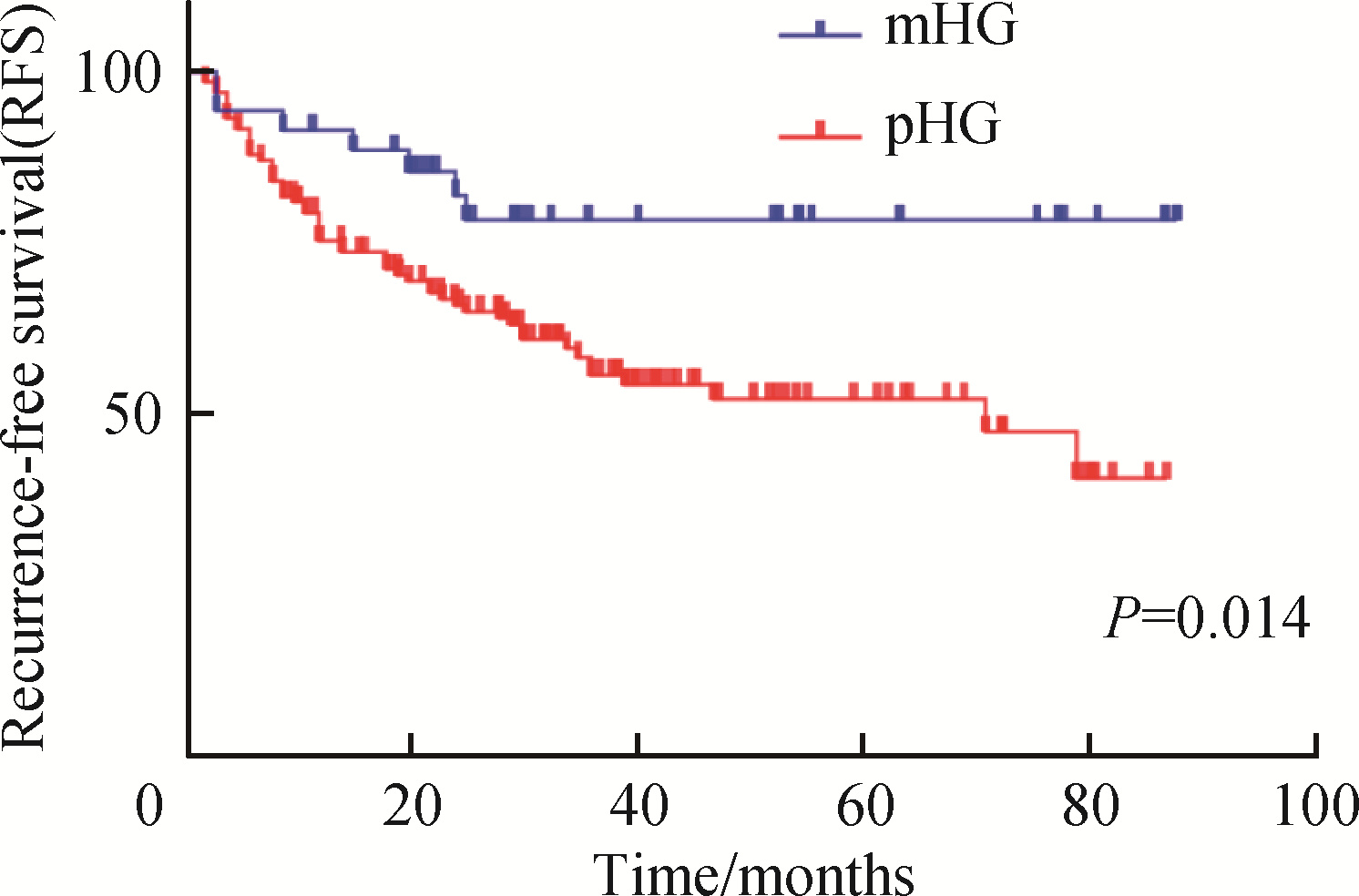
目的: 评估合并低级别成分对高级别单发原发性非肌层浸润性膀胱癌(non-muscle invasive bladder cancer, NMIBC)患者预后的影响。方法: 选择2015年1月至2019年12月在北京大学人民医院接受经尿道膀胱肿瘤切除手术(Transurethral resection of bladder tumor, TURBT)的原发性且单发的高级别NMIBC患者的病例资料进行回顾性分析。所有患者均于术后24 h内接受单次灌注化疗,并接受足量辅助灌注化疗。所有患者均严格依据随访计划接受随访。结果: 共纳入167名患者,35名患者为混合性高级别肿瘤(mixed high-grade, mHG,高级别肿瘤合并低级别成分),132名患者为单纯高级别肿瘤(pure high grade, pHG),中位随访时间为39.32(26.82, 61.37)个月,两组患者间的基线特征分布平衡。pHG组的5年无复发生存率(recurrence-free survival rate, RFSR)显著低于mHG组(50.5% vs. 80.0%,P=0.01)。多变量Cox回归分析显示,合并低级别成分是复发的独立保护因素(HR=0.42,P=0.02),其他影响因素包括T1分期(HR=2.09,P=0.01)。结论: 合并低级别成分是高级别单发原发性NMIBC患者的独立预后保护因素。

关键词: 非肌层浸润性膀胱癌, 高级别, 合并, 低级别, 预后

Abstract:

Objective: To evaluate the impact of coexisted low-grade components on the prognosis of patients with high-grade solitary primary non-muscle invasive bladder cancer (NMIBC). Methods: A retrospective analysis was conducted on patients diagnosed with primary, solitary, high-grade non-muscle invasive bladder cancer (NMIBC) who underwent transurethral resection of bladder tumor (TURBT) at Peking University People' s Hospital between January 2015 and December 2019. All patients received single-dose intravesical chemotherapy within 24 hours after TURBT. Only patients accetpting adequate adjuvant intravesical chemotherapy were included for further analysis. Adequate intravesical chemotherapy was defined as weekly instillation for 8 weeks and monthly instillation for at least 6 months. All patients were strictly followed up according to the preestablished schedule with cystoscopic surveillance. The primary endpoint was recurrence free survival. Kaplan-Meier curve was used to compare the recurrence free survival of mHG group and pHG group. Univariable and multivariable Cox regression was conducted to evaluate the risk factors for tumor recurrence. Patients with variant histology, concurrent upper tract urothelial carcinoma, and incomplete resection which required re-TURBT were excluded. Patients without single instillation postoperative were also eliminated from the final cohort. Results: A total of 167 patients were enrolled in the final cohort, with 35 patients having mixed high-grade tumors (mHG) and 132 patients having pure high-grade tumors (pHG). The median follow-up time was 39.32 (26.82, 61.37) months. Baseline characteristics were well balanced between the two groups with regard to age, gender, pathological characteristics and instillation doses. Compared with the mHG group, the 5-year recurrence-free survival rate (RFS) of the pHG group was significantly lower (80.0% vs. 50.5%, P=0.01). Multivariate Cox regression analysis further confirmed that the presence of mixed low-grade components was an independent protective factor for recurrence free survival (HR=0.42, P=0.02), and other risk factors included T1 stage (HR=2.09, P=0.01). while tumor size was not associated with recurrence free survival. Conclusion: Coexistence of low-grade component in pathological specimen was associated with lower recurrence rate in patients with primary, solitary high-grade non-muscle invasive bladder cancer. Thus, it should be considered as a favorable pathological feature in bladder cancer patients.

Key words: Non-muscle invasive bladder cancer (NMIBC), High-grade, Coexistence, Low-grade, Prognosis

中图分类号: 

  • R737.14

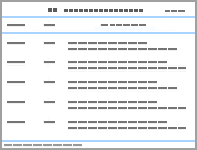
表1

患者的基线特征资料"

Variable mHG (n=35) pHG (n=132) P
Age/years 0.58
  ≤65 12 52
  >65 23 80
Gender 0.86
  Male 27 100
  Female 8 32
Smoking status 0.66
  Never 27 97
  Former/current 8 35
UTUC history 0.18
  Yes 0 8
  No 35 124
Hypertension 0.59
  No 20 82
  Yes 15 50
Diabetes mellitus 0.46
  No 30 106
  Yes 5 26
Tumor size/cm 0.34
  ≤3 32 126
  >3 3 6
Pathological stage 0.13
  Ta 32 112
  T1 3 20
Median instillation numbers 15 16 0.54
Recurrence 0.01
  No 28 76
  Yes 7 56

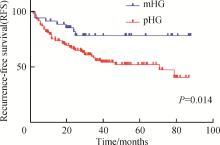
图1

两组患者无复发生存期RFS的Kaplan-Meier曲线"

表2

单因素和多因素Cox风险回归分析"

Variables Univariate Multivariate
HR P HR P
Age/years 0.10
  ≤65 Reference
  >65 0.65 (0.39, 1.09)
Gender 0.64
  Male reference
  Female 1.08 (0.78, 1.51)
Smoking status 0.51
  Never reference
  Former/current 0.81 (0.44, 1.49)
Hypertension 0.88
  No reference
  Yes 0.96 (0.56, 1.64)
Diabetes mellitus 0.64
  No reference
  Yes 0.84 (0.41, 1.73)
Tumor size/cm 0.58
  ≤3 reference
  >3 0.67 (0.16, 2.82)
Stage 0.02 0.01
  Ta reference reference
  T1 2.02 (1.07, 3.81) 2.09
Pathology 0.03 0.02
  mHG 0.52 (0.19, 0.94) 0.52
  pHG reference reference
UTUC history 0.59
  No reference
  Yes 1.32 (0.46, 1.75)
1
Richters A , Aben KKH , Kiemeney LALM . The global burden of urinary bladder cancer: An update[J]. World J Urol, 2020, 38 (8): 1895- 1904.

doi: 10.1007/s00345-019-02984-4
2
Kamat AM , Hahn NM , Efstathiou JA , et al. Bladder cancer[J]. Lancet, 2016, 388 (10061): 2796- 2810.

doi: 10.1016/S0140-6736(16)30512-8
3
Koti M , Robert Siemens D . A step closer to predicting progression after bacillus calmette-guérin immunotherapy in high-risk non-muscle-invasive bladder cancer[J]. Eur Urol, 2023, 84 (5): 447- 448.

doi: 10.1016/j.eururo.2023.06.017
4
Epstein JI , Amin MB , Reuter VR , et al. The World Health Organization/International Society of Urological Pathology Consensus Classification of Urothelial (transitional cell) Neoplasms of the Urinary Bladder[J]. Am J Surg Pathol, 1998, 22 (12): 1435- 1448.

doi: 10.1097/00000478-199812000-00001
5
Budson AE , Droller DBJ , Dodson CS , et al. Electrophysiological dissociation of picture versus word encoding: The distinctiveness heuristic as a retrieval orientation[J]. J Cogn Neurosci, 2005, 17 (8): 1181- 1193.

doi: 10.1162/0898929055002517
6
Tang Q , Zuo W , Wan C , et al. Comprehensive genomic profiling of upper tract urothelial carcinoma and urothelial carcinoma of the bladder identifies distinct molecular characterizations with potential implications for targeted therapy & immunotherapy[J]. Front Immunol, 2023, 13, 1097730.

doi: 10.3389/fimmu.2022.1097730
7
van Rhijn BWG , Mertens LS , Mayr R , et al. FGFR3 mutation status and FGFR3 expression in a large bladder cancer cohort treated by radical cystectomy: Implications for anti-FGFR3 treatment?[J]. Eur Urol, 2020, 78 (5): 682- 687.

doi: 10.1016/j.eururo.2020.07.002
8
Richter J , Jiang F , Gorog JP , et al. Marked genetic differences between stage pTa and stage pT1 papillary bladder cancer detected by comparative genomic hybridization[J]. Cancer Res, 1997, 57 (14): 2860- 2864.
9
Strandgaard T , Nordentoft I , Birkenkamp-Demtr der K , et al. Field cancerization is associated with tumor development, T-cell exhaustion, and clinical outcomes in bladder cancer[J]. Eur Urol, 2024, 85 (1): 82- 92.

doi: 10.1016/j.eururo.2023.07.014
10
Oliveira PA , Arantes-Rodrigues R , Vasconcelos-Nóbrega C . Animal models of urinary bladder cancer and their application to novel drug discovery[J]. Expert Opin Drug Discov, 2014, 9 (5): 485- 503.

doi: 10.1517/17460441.2014.902930
11
Bondaruk J , Jaksik R , Wang Z , et al. The origin of bladder cancer from mucosal field effects[J]. iScience, 2022, 25 (7): 104551.

doi: 10.1016/j.isci.2022.104551
12
Wu SC , Lin ZQ , Xu CW , et al. Multiple primary lung cancers[J]. Chest, 1987, 92 (5): 892- 896.

doi: 10.1378/chest.92.5.892
13
Shintani Y , Okami J , Ito H , et al. Clinical features and outcomes of patients with stage Ⅰ multiple primary lung cancers[J]. Cancer Sci, 2021, 112 (5): 1924- 1935.

doi: 10.1111/cas.14748
14
Romaszko AM , Doboszyńska A . Multiple primary lung cancer: A literature review[J]. Adv Clin Exp Med, 2018, 27 (5): 725- 730.

doi: 10.17219/acem/68631
15
Wang H , Hou J , Zhang G , et al. Clinical characteristics and prognostic analysis of multiple primary malignant neoplasms in patients with lung cancer[J]. Cancer Gene Ther, 2019, 26 (11/12): 419- 426.
[1] 杜志明, 张纬亮, 赵磊, 邱敏, 马潞林, 颜野, 贺慧颖, 谢睿扬, 张树栋. 5年以上长期生存肾透明细胞癌伴静脉瘤栓患者的临床病理特征及预后因素[J]. 北京大学学报(医学版), 2026, 58(4): 692-699.
[2] 赖世聪, 王焕瑞, 倪润峰, 胡浩浦, 王辰龙, 徐涛, 胡浩. 免分腿侧卧位与截石位对输尿管软镜碎石术中肾盂内压及预后的影响[J]. 北京大学学报(医学版), 2026, 58(4): 748-753.
[3] 董丽媛, 彭云, 宋宇轩, 李晓阳, 杜依青, 徐涛. 基于36基因标签的非肌层浸润性膀胱癌复发预测模型及中国队列验证[J]. 北京大学学报(医学版), 2026, 58(4): 794-802.
[4] 郑光玮, 彭云, 杜依青, 徐涛. 基于TCGA数据库的ERBB2在膀胱尿路上皮癌中的表达特征及临床意义[J]. 北京大学学报(医学版), 2026, 58(4): 818-826.
[5] 彭博, 刘芳芳, 杨伟, 徐瑞平, 陈蕾, 李保中, 王新家, 柯骥, 杨文蕾, 何煜, 刘震, 侯波林, 张利群, 林妙萍, 张立新, 张凡, 蔡奋, 许铧文, 刘萌飞, 刘英, 潘雅琪, 何忠虎, 柯杨. 围术期高血糖与食管切除术后食管鳞癌不良预后相关性[J]. 北京大学学报(医学版), 2026, 58(3): 567-574.
[6] 舒帆, 葛力源, 邓汉彰, 殷昊明, 欧俊永, 邓绍晖, 郝一昌, 陆敏, 张展奕, 段佩辰, 张树栋. 预后不良的肾细胞癌伴淋巴结转移的分子特征[J]. 北京大学学报(医学版), 2026, 58(3): 631-640.
[7] 张铃福, 陈明, 赵小宇, 王港, 崔龙, 凌晓锋, 王立新, 徐智, 郭丽梅, 侯纯升. 原发灶局限于胆囊壁内胆囊癌大体分型及其与预后和癌前病变的相关性[J]. 北京大学学报(医学版), 2026, 58(1): 184-189.
[8] 高雅静, 李正芳, 马梦思, 武丽君. SII和SIRI对白塞病葡萄膜炎的风险预测及疾病活动度和预后的评估[J]. 北京大学学报(医学版), 2025, 57(6): 1067-1073.
[9] 郭博达, 陆敏, 王国良, 张洪宪, 刘磊, 侯小飞, 赵磊, 田晓军, 张树栋. 肾透明细胞癌与非透明细胞癌伴静脉癌栓患者的临床病理特征及预后比较[J]. 北京大学学报(医学版), 2025, 57(4): 644-649.
[10] 李伟浩, 李晶, 张学民, 李伟, 李清乐, 张小明. 术中回收式自体输血对颈动脉体瘤切除术后肿瘤预后的影响[J]. 北京大学学报(医学版), 2025, 57(2): 272-276.
[11] 毛雅晴, 陈震, 于尧, 章文博, 刘洋, 彭歆. 2型糖尿病对口腔鳞状细胞癌患者预后的影响[J]. 北京大学学报(医学版), 2024, 56(6): 1089-1096.
[12] 欧俊永,倪坤明,马潞林,王国良,颜野,杨斌,李庚午,宋昊东,陆敏,叶剑飞,张树栋. 肌层浸润性膀胱癌合并中高危前列腺癌患者的预后因素[J]. 北京大学学报(医学版), 2024, 56(4): 582-588.
[13] 刘帅,刘磊,刘茁,张帆,马潞林,田晓军,侯小飞,王国良,赵磊,张树栋. 伴静脉癌栓的肾上腺皮质癌的临床治疗及预后[J]. 北京大学学报(医学版), 2024, 56(4): 624-630.
[14] 虞乐,邓绍晖,张帆,颜野,叶剑飞,张树栋. 具有低度恶性潜能的多房囊性肾肿瘤的临床病理特征及预后[J]. 北京大学学报(医学版), 2024, 56(4): 661-666.
[15] 周泽臻,邓绍晖,颜野,张帆,郝一昌,葛力源,张洪宪,王国良,张树栋. 非转移性T3a肾细胞癌患者3年肿瘤特异性生存期预测[J]. 北京大学学报(医学版), 2024, 56(4): 673-679.
Viewed
Full text


Abstract

Cited

  Shared   
  Discussed   
No Suggested Reading articles found!