北京大学学报(医学版) ›› 2026, Vol. 58 ›› Issue (1): 184-189. doi: 10.19723/j.issn.1671-167X.2026.01.024

• 论著 • 上一篇    下一篇

原发灶局限于胆囊壁内胆囊癌大体分型及其与预后和癌前病变的相关性

张铃福1,*, 陈明2,*, 赵小宇1, 王港1, 崔龙1, 凌晓锋1, 王立新1, 徐智1, 郭丽梅3,*(), 侯纯升1,*()   

  1. 1. 北京大学第三医院普通外科, 北京 100191
    2. 北京大学第三医院放射科, 北京 100191
    3. 北京大学第三医院病理科, 北京 100191
  • 收稿日期:2025-06-10 出版日期:2026-02-18 发布日期:2025-10-10
  • 通讯作者: 郭丽梅, 侯纯升
  • 作者简介:

    * These authors contributed equally to this work

Gross classification of gallbladder cancer with primary lesion limited to the gallbladder wall and its correlation with prognosis and precancerous lesions

Lingfu ZHANG1, Ming CHEN2, Xiaoyu ZHAO1, Gang WANG1, Long CUI1, Xiaofeng LING1, Lixin WANG1, Zhi XU1, Limei GUO3,*(), Chunsheng HOU1,*()   

  1. 1. Department of General Surgery, Peking University Third Hospital, Beijing 100191, China
    2. Department of Radiology, Peking University Third Hospital, Beijing 100191, China
    3. Department of Pathology, Peking University Third Hospital, Beijing 100191, China
  • Received:2025-06-10 Online:2026-02-18 Published:2025-10-10
  • Contact: Limei GUO, Chunsheng HOU

RICH HTML


摘要:

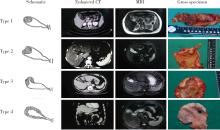
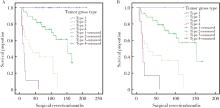
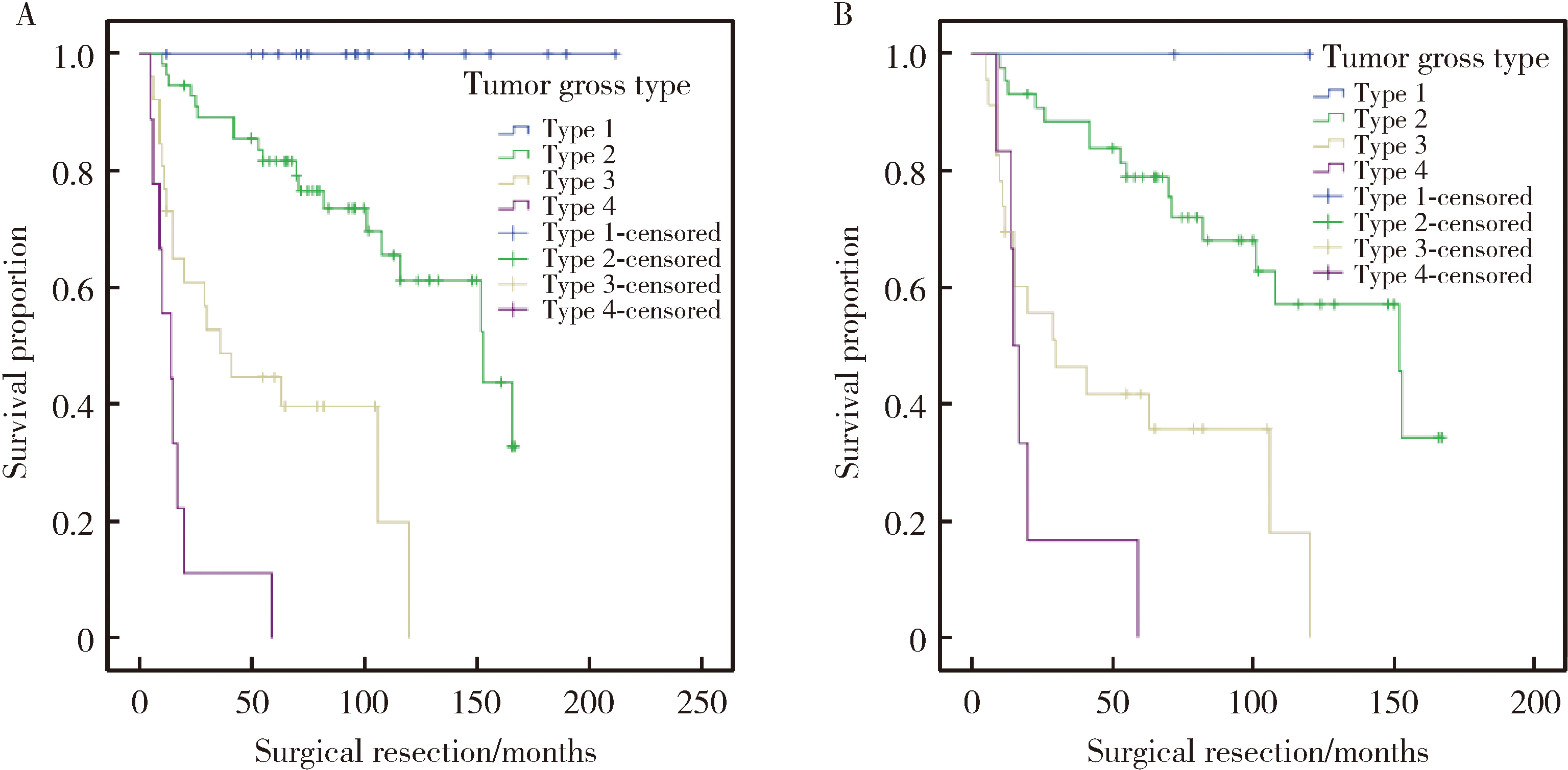
目的: 探讨原发灶局限于胆囊壁内胆囊癌的大体分型及其与预后和癌前病变相关性。方法: 回顾性纳入2006年1月至2020年12月北京大学第三医院收治的123例术前影像提示原发灶局限于胆囊壁内、且术后病理为腺癌患者。依据CT、MRI或大体标本分为如下4型:1型,局限性凸向腔内肿物,不伴肿物附着处胆囊壁增厚;2型,局限性凸向腔内肿物,伴肿物附着处胆囊壁增厚和/或增厚处浆膜皱褶;3型,局限于两个连续部分的胆囊壁环形增厚;4型,延续至两个以上连续部分的胆囊壁环形增厚。比较各分型之间的临床病理特征、癌前病变类型及生存情况。结果: 术前CT/MRI及术中大体标本均可以作为大体分型的依据,大体标本准确率最高。123例患者中13例无法分型,剩余110例完成大体分型。胆囊癌大体分型与T分期(P<0.001,rs=0.682)呈高强度相关,与淋巴结转移(P<0.001,rs=0.478)、组织分化程度(P<0.001,rs=0.484)、神经浸润(P<0.001,rs=0.490)以及脉管瘤栓(P<0.001,rs=0.334)等组织病理学参数呈中等强度相关,分型越高,不良组织病理学参数越多。另外,胆囊癌大体分型与患者手术治疗后残余病灶(P<0.001,rs=0.328)和术后复发(P<0.001,rs=0.619)呈中等强度和高等强度相关性。生存分析显示,分型越高,患者中位生存时间越短,1型96个月,2型73个月,3型30个月,4型14个月,P<0.001。多因素Cox回归表明胆囊癌大体分型是患者预后的独立影响因素(HR=3.609,95%CI:2.177~5.983,P<0.001)。在肿瘤生物学行为异质性最强的T2期患者中,胆囊癌大体分型同样与预后密切相关,中位生存时间分别为72个月、70个月、29个月和16个月, P<0.001。多因素Cox回归亦表明胆囊癌大体分型是患者预后的独立影响因素(HR=2.723,95%CI:1.566~4.736,P<0.001)。在肿瘤起源方面,胆囊癌大体分型与癌前病变类型显著相关:1型主要源自胆囊内乳头状肿瘤,3型与4型则多为高级别胆管上皮内瘤变或无癌前病变。肿瘤自然病程分析提示:1型进展缓慢,4型进展迅速,2型表现出较大异质性。结论: 原发灶局限于胆囊壁内胆囊癌大体分型与预后及癌前病变密切相关,可作为手术决策与分层管理的重要参考依据。

关键词: 胆囊癌, 大体分型, 癌前病变, 预后, 生物学异质性

Abstract:

Objective: To explore the gross classification of gallbladder cancer with primary lesion confined within the gallbladder wall, and its correlation with prognosis and precancerous lesions. Methods: A retrospective study was conducted on 123 patients who were admitted to Peking University Third Hospital from January 2006 to December 2020. These patients had preoperative imaging findings suggesting that the primary lesion was confined within the gallbladder wall and had postoperative pathology of adenocarcinoma. Based on CT, MRI, or gross specimens, they were divided into the following four types: Type 1, simple intraluminal lesion: Intraluminal lesions without focal thickening of the gallbladder wall; Type 2, complex intraluminal lesion: Intraluminal lesions associated with focal thickening of the gallbladder wall and/or outer surface dimpling at the tumor base; Type 3, focal wall thickening: Circumferential focal wall thickening with heterogeneous enhancement within 2 continuous parts of the gallbladder; Type 4, diffuse wall thickening: Circumferential diffuse wall thickening extending more than 2 continuous parts of the gallbladder with heterogeneous enhancement. The clinical pathological characteristics, types of precancerous lesions, and survival status were compared among the different types. Results: Both preoperative CT/MRI and intraoperative gross specimens could serve as the basis for gross classification, with gross specimens demonstrating the highest accuracy rate. Among the 123 patients, 13 could not be classified, while the remaining 110 underwent gross classification. The gross classification of gallbladder cancer was strongly or moderately correlated with histopathological parameters such as T-stage (P < 0.001, rs=0.682), lymph node metastasis (P < 0.001, rs=0.478), tissue differentiation degree (P < 0.001, rs=0.484), nerve infiltration (P < 0.001, rs=0.490), and vascular invasion (P < 0.001, rs=0.334). The higher the classification, the more adverse histopathological parameters were observed. Additionally, the gross classification of gallbladder cancer was moderately strongly and highly strongly correlated with residual lesions after surgical treatment (P < 0.001, rs=0.328) and postoperative recurrence (P < 0.001, rs=0.619) in the patients. Survival analysis revealed that the higher the classification, the shorter the median survival time of the patients (Type 1: 96 months, Type 2: 73 months, Type 3: 30 months, Type 4: 14 months, P < 0.001). Multivariate Cox regression indicated that the gross classification of gallbladder cancer was an independent prognostic factor (HR=3.609, 95%CI: 2.177-5.983, P < 0.001). In the patients with the most heterogeneous biological behavior in stage T2, the gross classification of gallbladder cancer was also closely associated with prognosis (median survival times were 72, 70, 29, and 16 months, respectively, P < 0.001). Multivariate Cox regression further demonstrated that the gross classification of gallbladder cancer was an independent prognostic factor (HR=2.723, 95%CI: 1.566-4.736, P < 0.001). In terms of tumor origin, the gross classification of gallbladder cancer was significantly correlated with the type of precancerous lesions: Type 1 mainly originated from intracholecystic papillary neoplasm of the gallbladder, while Types 3 and 4 were mostly high-grade biliary intraepithelial neoplasm or without precancerous lesions. Analysis of the natural history of the tumor suggested that Type 1 progressed slowly, Type 4 progressed rapidly, and Type 2 exhibited greater heterogeneity. Conclusion: The gallbladder cancer with primary lesion confined within the gallbladder wall is closely related to prognosis and precancerous lesions, and can serve as an important reference for surgical decision-making and stratified management.

Key words: Gallbladder cancer, Gross classification, Precancerous lesions, Prognosis, Biological heterogeneity

中图分类号: 

  • R735.8

图1

胆囊癌大体分型"

表1

胆囊癌不同大体分型患者的临床病理特征比较"

Parameters Type 1 (n=19) Type 2 (n=56) Type 3 (n=26) Type 4 (n=9) rs value P value
Baseline demographics
  Age/years, $\bar x \pm s$ 59.8±12.9 65.9±10.7 63.6±10.6 62.9±12.8 0.221
  Male/female, n 2/17 19/37 9/17 4/5 0.157
Clinicopathological characteristics
  Pancreaticobiliary maljunction, n 3 13 3 2 0.630
  Gallstone, n 6 19 9 5 0.628
  CA199 elevation*, n 4 10 5 4 0.089 0.371
  CEA elevation*, n 0 6 3 2 0.167 0.090
  T stage, n 0.682 <0.001
    Tis 12 2 0 0
    T1 5 10 0 0
    T2 2 44 23 6
    T3 0 0 3 3
  Lymph node metastasis, n (%) 0 (0) 12 (21) 15 (58) 5 (56) 0.478 <0.001
  Histology grade, n 0.484 <0.001
    Well 16 20 3 1
    Moderate 2 26 14 3
    Poor 1 10 9 5
  Neural invasion, n (%) 0 (0) 5 (9) 13 (50) 5 (56) 0.490 <0.001
  Lymphovascular invasion, n (%) 1 (5) 10 (18) 10 (19) 5 (56) 0.334 <0.001
  Residual disease, n (%) 0 (0) 3 (5) 6 (23) 3 (33) 0.328 <0.001
  Recurrence, n (%) 0 (0) 12 (21) 18 (69) 9 (100) 0.619 <0.001

图2

基于不同胆囊癌肿瘤大体分型的累积生存率比较"

表2

胆囊癌大体分型与癌前病变之间的相关性"

Gross classification and precancerous lesions Type 1 (n=19) Type 2 (n=56) Type 3 (n=26)* Type 4 (n=9)
ICPN 18 23 0 0
High-grade BilIN 1 26 12 2
No precancerous lesion 0 6 12 7

表3

基于胆囊癌大体分型的肿瘤自然病程"

Cases Tumor gross type Precancerous lesions Fist CT scan charateristics Interval of CTscan/months Second CT scan charateristics Operation date T stage
Case 1 Type 2 High-grade BilIN No polyps or localized thickening of the gallbladder wall 24 Intraluminal single polyp without focal thickening of the gallbladder wall 2010-11-5 Tis
Case 2 Type 3 ICPN Intraluminal single polyp without focal thickening of the gallbladder wall 12 Lesion diameter no change 2019-3-19 Tis
Case 3 Type 2 ICPN No polyps or localized thickening of the gallbladder wall 48 Intraluminal single polyp with focal thickening of the gallbladder wall 2013-7-18 T1b
Case 4 Type 2 ICPN No polyps or localized thickening of the gallbladder wall 12 Intraluminal single polyp with focal thickening of the gallbladder wall 2013-1-15 T2
Case 5 Type 4 No precancerous lesion No polyps or localized thickening of the gallbladder wall 9 Diffuse thickening of the gallbladder wall 2015-11-24 T3
1
Roa JC , García P , Kapoor VK , et al. Gallbladder cancer[J]. Nat Rev Dis Primers, 2022, 8, 69.

doi: 10.1038/s41572-022-00398-y
2
张铃福, 侯纯升, 徐智, 等. 腹腔镜胆囊切除术中或术后意外胆囊癌腹腔镜手术治疗: 单中心10年回顾性分析[J]. 中华外科杂志, 2019, 57 (4): 277- 281.
3
Zhang L , Hou C , Chen M , et al. Tumour radiological appearance evaluated by enhanced CT correlates with tumour progression and survival in curable gallbladder cancer[J]. Eur J Surg Oncol, 2020, 46 (11): 2099- 2105.

doi: 10.1016/j.ejso.2020.07.006
4
Mochidome N , Koga Y , Ohishi Y , et al. Prognostic implications of the coexisting precursor lesion types in invasive gallbladder cancer[J]. Hum Pathol, 2021, 114, 44- 53.

doi: 10.1016/j.humpath.2021.05.001
5
Nakanuma Y , Sugino T , Nomura Y , et al. Association of precursors with invasive adenocarcinoma of the gallbladder: A clinicopathological study[J]. Ann Diagn Pathol, 2022, 58, 151911.

doi: 10.1016/j.anndiagpath.2022.151911
6
Wakai T , Shirai Y , Yokoyama N , et al. Early gallbladder carcinoma does not warrant radical resection[J]. Br J Surg, 2001, 88 (5): 675- 678.

doi: 10.1046/j.1365-2168.2001.01749.x
7
张铃福, 侯纯升, 郭丽梅, 等. 术中冰冻或术后石蜡病理报告T1b期胆囊癌的外科治疗策略[J]. 北京大学学报(医学版), 2017, 49 (6): 1034- 1037.

doi: 10.3969/j.issn.1671-167X.2017.06.017
8
Kohya N , Kitahara K , Miyazaki K . Rational therapeutic strategy for T2 gallbladder carcinoma based on tumor spread[J]. World J Gastroenterol, 2010, 16 (28): 3567- 3572.

doi: 10.3748/wjg.v16.i28.3567
9
Okada KI , Kijima H , Imaizumi T , et al. Clinical significance of wall invasion pattern of subserosa-invasive gallbladder carcinoma[J]. Oncol Rep, 2012, 28 (5): 1531- 1536.

doi: 10.3892/or.2012.1971
10
Sung MK , Lee W , Lee JH , et al. Comparing survival rate and appropriate surgery methods according to tumor location in T2 gallbladder cancer[J]. Surg Oncol, 2022, 40, 101693.

doi: 10.1016/j.suronc.2021.101693
[1] 高雅静, 李正芳, 马梦思, 武丽君. SII和SIRI对白塞病葡萄膜炎的风险预测及疾病活动度和预后的评估[J]. 北京大学学报(医学版), 2025, 57(6): 1067-1073.
[2] 郭博达, 陆敏, 王国良, 张洪宪, 刘磊, 侯小飞, 赵磊, 田晓军, 张树栋. 肾透明细胞癌与非透明细胞癌伴静脉癌栓患者的临床病理特征及预后比较[J]. 北京大学学报(医学版), 2025, 57(4): 644-649.
[3] 李伟浩, 李晶, 张学民, 李伟, 李清乐, 张小明. 术中回收式自体输血对颈动脉体瘤切除术后肿瘤预后的影响[J]. 北京大学学报(医学版), 2025, 57(2): 272-276.
[4] 毛雅晴, 陈震, 于尧, 章文博, 刘洋, 彭歆. 2型糖尿病对口腔鳞状细胞癌患者预后的影响[J]. 北京大学学报(医学版), 2024, 56(6): 1089-1096.
[5] 欧俊永,倪坤明,马潞林,王国良,颜野,杨斌,李庚午,宋昊东,陆敏,叶剑飞,张树栋. 肌层浸润性膀胱癌合并中高危前列腺癌患者的预后因素[J]. 北京大学学报(医学版), 2024, 56(4): 582-588.
[6] 刘帅,刘磊,刘茁,张帆,马潞林,田晓军,侯小飞,王国良,赵磊,张树栋. 伴静脉癌栓的肾上腺皮质癌的临床治疗及预后[J]. 北京大学学报(医学版), 2024, 56(4): 624-630.
[7] 虞乐,邓绍晖,张帆,颜野,叶剑飞,张树栋. 具有低度恶性潜能的多房囊性肾肿瘤的临床病理特征及预后[J]. 北京大学学报(医学版), 2024, 56(4): 661-666.
[8] 周泽臻,邓绍晖,颜野,张帆,郝一昌,葛力源,张洪宪,王国良,张树栋. 非转移性T3a肾细胞癌患者3年肿瘤特异性生存期预测[J]. 北京大学学报(医学版), 2024, 56(4): 673-679.
[9] 方杨毅,李强,黄志高,陆敏,洪锴,张树栋. 睾丸鞘膜高分化乳头状间皮肿瘤1例[J]. 北京大学学报(医学版), 2024, 56(4): 741-744.
[10] 曾媛媛,谢云,陈道南,王瑞兰. 脓毒症患者发生正常甲状腺性病态综合征的相关因素[J]. 北京大学学报(医学版), 2024, 56(3): 526-532.
[11] 苏俊琪,王晓颖,孙志强. 舌鳞状细胞癌根治性切除术后患者预后预测列线图的构建与验证[J]. 北京大学学报(医学版), 2024, 56(1): 120-130.
[12] 李建斌,吕梦娜,池强,彭一琳,刘鹏程,吴锐. 干燥综合征患者发生重症新型冠状病毒肺炎的早期预测[J]. 北京大学学报(医学版), 2023, 55(6): 1007-1012.
[13] 刘欢锐,彭祥,李森林,苟欣. 基于HER-2相关基因构建风险模型用于膀胱癌生存预后评估[J]. 北京大学学报(医学版), 2023, 55(5): 793-801.
[14] 薛子璇,唐世英,邱敏,刘承,田晓军,陆敏,董靖晗,马潞林,张树栋. 青年肾肿瘤伴瘤栓的临床病理特征及预后分析[J]. 北京大学学报(医学版), 2023, 55(5): 802-811.
[15] 卢汉,张建运,杨榕,徐乐,李庆祥,郭玉兴,郭传瑸. 下颌牙龈鳞状细胞癌患者预后的影响因素[J]. 北京大学学报(医学版), 2023, 55(4): 702-707.
Viewed
Full text


Abstract

Cited

  Shared   
  Discussed   
No Suggested Reading articles found!