北京大学学报(医学版) ›› 2026, Vol. 58 ›› Issue (4): 855-859. doi: 10.19723/j.issn.1671-167X.2026.04.024

• 论著 • 上一篇    下一篇

改良热酸蚀处理对氧化锆机械性能及树脂粘接强度的影响

杨鑫1, 吴煜2, 吕品2,*()   

  1. 1. 北京大学口腔医学院·口腔医院门诊部,国家口腔医学中心,国家口腔疾病临床医学研究中心,口腔生物材料和数字诊疗装备国家工程研究中心,北京 100081
    2. 北京大学第三医院口腔科,北京 100191
  • 收稿日期:2025-10-10 出版日期:2026-08-18 发布日期:2026-05-19
  • 通讯作者: 吕品
  • 基金资助:
    北京大学第三医院交叉联合专项基金(BYSYJC2024029)

Effect of modified hot-etching treatment on the mechanical properties of zirconia and zirconia/resin bond strength

Xin YANG1, Yu WU2, Pin LV2,*()   

  1. 1. First Clinical Division, Peking University School and Hospital of Stomatology & National Center for Stomatology & National Clinical Research Center for Oral Diseases & National Engineering Research Center of Oral Biomaterials and Digital Medical Devices, Beijing 100081, China
    2. Department of Stomatology, Peking University Third Hospital, Beijing 100191, China
  • Received:2025-10-10 Online:2026-08-18 Published:2026-05-19
  • Contact: Pin LV
  • Supported by:
    the Peking University Third Hospital Fund for Interdisciplinary Research(BYSYJC2024029)

RICH HTML


摘要:

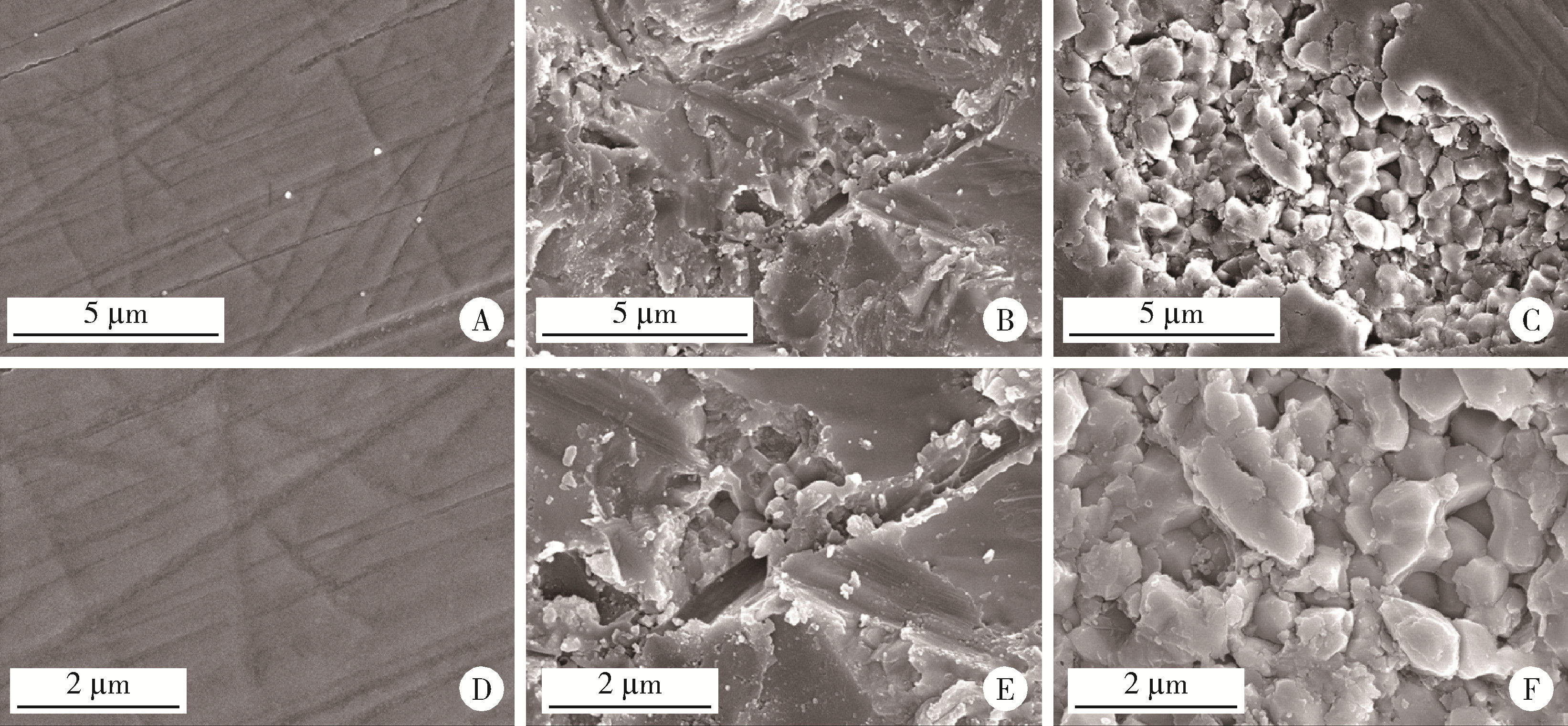
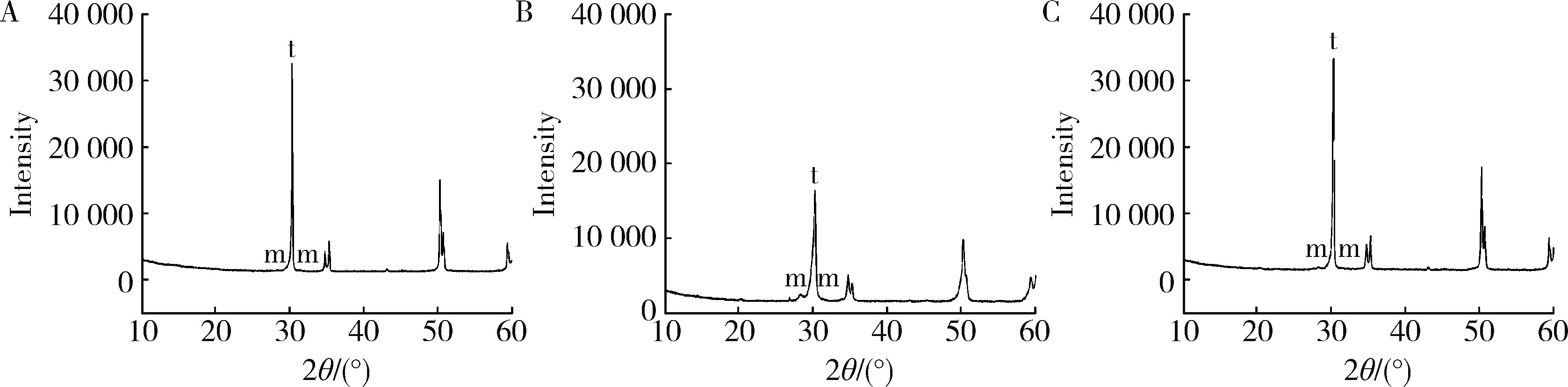
目的: 探索改良热酸蚀处理对氧化锆弯曲强度、表面晶相及树脂粘接强度的影响。方法: 将氧化锆试件根据表面处理方式分为空白组、喷砂组和改良热酸蚀组。使用扫描电子显微镜(scanning electron microscope,SEM)观察各组氧化锆表面形貌,使用X射线衍射仪(X-ray diffractometer,XRD)检测各组氧化锆试件表面各晶相比例,使用万能力学试验机测试各组氧化锆试件的挠曲强度。制作平整的牛牙釉质粘接平面,用树脂水门汀完成氧化锆试件粘接,半数粘接试件经过冷热循环疲劳5 000次,使用万能力学试验机检测各组即刻及温度疲劳后剪切粘接强度(shear bond strengths, SBS)。结果: SEM结果显示空白组氧化锆表面光滑,喷砂组可见不规则划痕,改良热酸蚀组呈蜂窝状酸蚀形貌。XRD结果显示单斜相比例,空白组为8.18%,喷砂组为28.34%,改良热酸蚀组为9.69%。挠曲强度喷砂组[(316.40±58.37) MPa]明显低于空白组[(415.30±47.64) MPa]和改良热酸蚀组[(398.77±47.94) MPa],差异具有统计学意义(P<0.01)。即刻SBS改良热酸蚀组[(53.77±8.36) MPa]高于空白组[(35.50±4.72) MPa]和喷砂组[(42.97±6.95) MPa],差异具有统计学意义(P<0.01);温度疲劳后SBS空白组[(21.65±4.01) MPa]低于改良热酸蚀组[(30.69±7.36) MPa]和喷砂组[(29.37±5.73) MPa], 差异具有统计学意义(P<0.01)。结论: 改良热酸蚀处理可以提高氧化锆即刻SBS,具有与喷砂类似抗温度疲劳性能,不会显著降低氧化锆的挠曲强度,未引起明显的表面晶相改变。

关键词: 改良热酸蚀, 氧化锆, 挠曲强度, 温度疲劳, 剪切粘接强度

Abstract:

Objective: To investigate the effect of modified hot-etching treatment on the flexural strength and surface crystalline phase proportions of zirconia and zirconia/resin bond strength. Methods: Zirconia specimens were divided into three groups according to different surface treatments, including blank group, sandblasting treatment group and modified hot-etching treatment group. A scanning electron microscope (SEM) was used to observe the surface morphology of the treated zirconia, an X-ray diffractometer (XRD) was employed to detect the surface crystalline phase proportions, and a universal mechanical testing machine was utilized to measure the three-point flexural strength of the zirconia specimens of different treatment groups. A bonding surface was prepared with bovine enamel, and the zirconia specimens were bonded using resin cement. Half of the bonded specimens underwent 5 000 cycles of thermal cycling fatigue test, and the immediate and fatigued shear bond strengths (SBS) were detected by using a universal mechanical testing machine. Results: SEM observations revealed that the surface of the control group was smooth, the surface of sandblasting treatment group exhibited irregular scratches, and the surface of modified hot-etching treatment group showed a honeycomb-like etched morphology. XRD results indicated that the monoclinic phase proportions were 8.18% for the control group, 28.34% for the sandblasting treatment group, and 9.69% for the modified hot-etching treatment group. The flexural strength of the sandblasting treatment group [(316.40±58.37) MPa] was significantly (P < 0.01) lower than that of the blank group [(415.30±47.64) MPa] and the modified hot-etching treatment group [(398.77±47.94) MPa]. The immediate SBS of the modified hot-etching treatment group [(53.77±8.36) MPa] was higher (P < 0.01) than that of blank group[(35.50±4.72) MPa] and sandblasting treatment group [(42.97±6.95) MPa]. After thermal cycling fatigue test, the fatigued SBS of the blank group [(21.65±4.01) MPa] was lower (P < 0.01) than that of the modified hot-etching treatment group [(30.69±7.36) MPa] and the sandblasting treatment group [(29.37±5.73) MPa]. Conclusion: The modified hot-etching treatment could enhance the immediate zirconia/resin SBS, exhibited similar resistance to thermal fatigue test with sandblasting treatment group, could not significantly reduce the flexural strength, and did not obviously alter the surface crystalline phase proportions.

Key words: Modified hot-etching treatment, Zirconia, Flexural strength, Thermal cycling fatigue, Shear bond strength

中图分类号: 

  • R783.1

图1

扫描电镜下各组氧化锆表面形貌"

图2

各组氧化锆试件XRD图谱"

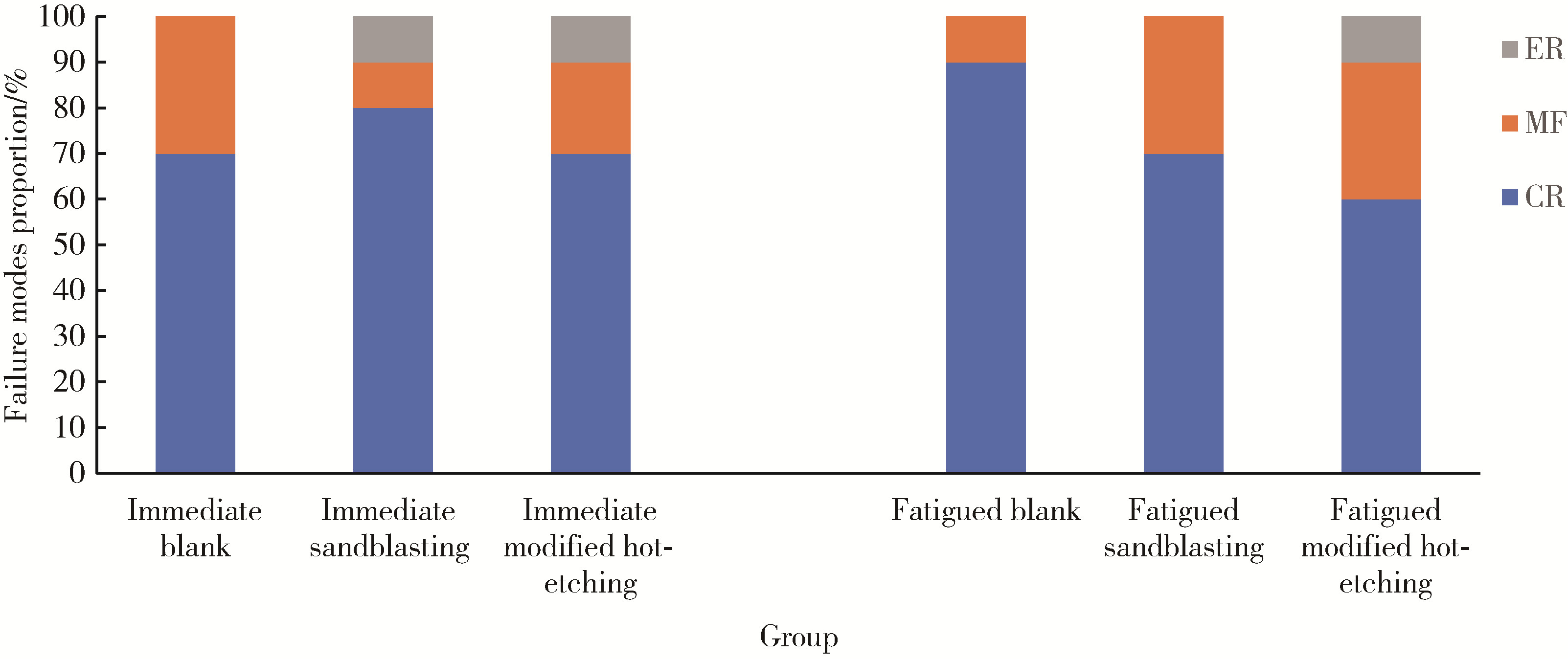
图3

各组氧化锆粘接试件断裂模式"

1
Zenthöfer A , Schwindling FS , Schmitt C , et al. Strength and reliability of zirconia fabricated by additive manufacturing tech-nology[J]. Dent Mater, 2022, 38 (10): 1565- 1574.

doi: 10.1016/j.dental.2022.07.004
2
Sulaiman TA , Suliman AA , Abdulmajeed AA , et al. Zirconia restoration types, properties, tooth preparation design, and bon-ding. A narrative review[J]. J Esthet Restor Dent, 2024, 36 (1): 78- 84.

doi: 10.1111/jerd.13151
3
Alammar A , Att W . Bonding durability between zirconia and different types of tooth or implant abutments: A systematic review. Part II: Outcomes of clinical studies[J]. Int J Pros-thodont, 2022, 25 (4): 512- 529.
4
Lupu IC , Tatarciuc MS , Vitalariu AM , et al. Bonding strategies for zirconia fixed restorations: A scoping review of surface treatments, cementation protocols, and long-term durability[J]. Biomimetics, 2025, 10 (9): 632.

doi: 10.3390/biomimetics10090632
5
Nishizawa Y , Komagata Y , Nagamatsu Y , et al. Chemical etching of CAD-CAM glass-ceramic-based materials using fluoride solutions for bonding pretreatment[J]. Dent Mater J, 2024, 43 (4): 504- 516.

doi: 10.4012/dmj.2023-333
6
Komine F , Furuchi M , Honda J , et al. Clinical performance of laminate veneers: A review of the literature[J]. J Prosthodont Res, 2024, 68 (3): 368- 379.

doi: 10.2186/jpr.JPR_D_23_00151
7
D'Alessandro C , Josic U , Mazzitelli C , et al. Is zirconia surface etching a viable alternative to airborne particle abrasion? A syste-matic review and meta-analysis of in vitro studies[J]. J Dent, 2024, 151, 105394.

doi: 10.1016/j.jdent.2024.105394
8
Sadid-Zadeh R , Strazzella A , Li R , et al. Effect of zirconia etching solution on the shear bond strength between zirconia and resin cement[J]. J Prosthet Dent, 2021, 126 (5): 693- 697.

doi: 10.1016/j.prosdent.2020.09.016
9
You GE , Lim MJ , Min KS , et al. Surface property changes observed in zirconia during etching with high-concentration hydrofluoric acid over various immersion times[J]. Dent Mater J, 2024, 43 (1): 52- 57.

doi: 10.4012/dmj.2023-091
10
Cadenaro M , Josic U , Maravić T , et al. Progress in dental adhesive materials[J]. J Dent Res, 2023, 102 (3): 254- 262.

doi: 10.1177/00220345221145673
11
Lima RBW , Silva AF , da Rosa WLO , et al. Bonding efficacy of universal resin adhesives to zirconia substrates: Systematic review and meta-analysis[J]. J Adhes Dent, 2023, 25, 51- 62.
12
Akar T , İçen G . Effect of dentin and zirconia surface treatments with laser irradiation versus sandblasting on the bonding ability of zirconia[J]. Photobiomodul Photomed Laser Surg, 2023, 41 (9): 501- 508.
13
Kim HK , Yoo KW , Kim SJ , et al. Phase transformations and subsurface changes in three dental zirconia grades after sandblasting with various Al2O3 particle sizes[J]. Materials, 2021, 14 (18): 5321.

doi: 10.3390/ma14185321
14
Jakovac M , Klaser T , Radatovic' B , et al. Impact of sandblasting on morphology, structure and conductivity of zirconia dental ceramics material[J]. Materials, 2021, 14 (11): 2834.

doi: 10.3390/ma14112834
15
Jin C , Wang J , Huang Y , et al. Effects of hydrofluoric acid concentration and etching time on the bond strength to ceramic-coated zirconia[J]. J Adhes Dent, 2022, 24, 125- 136.
16
魏萌, 朱红, 梁琢然, 等. 不同热酸蚀液对氧化锆粘接强度和抗折性能的影响[J]. 实用口腔医学杂志, 2022, 38 (4): 445- 449.
17
梁琢然, 张研楠, 魏萌, 等. 2种酸液热酸蚀对氧化锆表面形貌及粘接强度的影响[J]. 上海口腔医学, 2023, 32 (4): 369- 374.
18
Casucci A , Osorio E , Osorio R , et al. Influence of different surface treatments on surface zirconia frameworks[J]. J Dent, 2009, 37 (11): 891- 897.

doi: 10.1016/j.jdent.2009.06.013
19
Casucci A , Mazzitelli C , Monticelli F , et al. Morphological analysis of three zirconium oxide ceramics: Effect of surface treatments[J]. Dent Mater, 2010, 26 (8): 751- 760.

doi: 10.1016/j.dental.2010.03.020
20
El-Korashy DI , El-Refai DA . Mechanical properties and bonding potential of partially stabilized zirconia treated with different chemomechanical treatments[J]. J Adhes Dent, 2014, 16 (4): 365- 376.
21
Casucci A , Monticelli F , Goracci C , et al. Effect of surface pre-treatments on the zirconia ceramic: Resin cement microtensile bond strength[J]. Dent Mater, 2011, 27 (10): 1024- 1030.

doi: 10.1016/j.dental.2011.07.002
[1] 赵健霄, 丁茜, 李文锦, 马全诠, 兰一笑, 张磊, 韩建民. 多孔表面结构对立体光固化成型氧化锆疲劳强度的影响[J]. 北京大学学报(医学版), 2025, 57(6): 1165-1173.
[2] 钱锟, 刘亦洪. 基于直接法和间接法数字印模制作的高嵌体适合性评价的体外研究[J]. 北京大学学报(医学版), 2025, 57(3): 604-609.
[3] 丁茜,李文锦,孙丰博,谷景华,林元华,张磊. 表面处理对氧化钇和氧化镁稳定的氧化锆种植体晶相及断裂强度的影响[J]. 北京大学学报(医学版), 2023, 55(4): 721-728.
[4] 李伟伟,陈虎,王勇,孙玉春. 氧化锆陶瓷表面硅锂喷涂层的摩擦磨损性能[J]. 北京大学学报(医学版), 2023, 55(1): 94-100.
[5] 王铮,丁茜,高远,马全诠,张磊,葛兮源,孙玉春,谢秋菲. 氧化锆多孔表面显微形貌对成骨细胞增殖及分化的影响[J]. 北京大学学报(医学版), 2022, 54(1): 31-39.
[6] 李文锦,丁茜,原福松,孙丰博,郑剑桥,鲍蕊,张磊. 飞秒激光表面处理对氧化锆表面特征及弯曲强度的影响[J]. 北京大学学报(医学版), 2021, 53(4): 770-775.
[7] 杨欣,李榕,叶红强,陈虎,王勇,周永胜,孙玉春. 不同刃状边缘补偿角度的两种氧化锆全瓷冠断裂强度的评价[J]. 北京大学学报(医学版), 2021, 53(2): 402-405.
[8] 郑苗,詹凌璐,刘志强,李和平,谭建国. 不同等离子体处理氧化锆对人牙龈成纤维细胞黏附能力的影响[J]. 北京大学学报(医学版), 2019, 51(2): 315-320.
[9] 周团锋,王新知. 计算机辅助设计与制作的一体化氧化锆全瓷桩核5年临床观察[J]. 北京大学学报(医学版), 2018, 50(4): 680-684.
[10] 崔新悦,佟岱,王新知,沈志坚. 对比切削与胶态成型工艺制作的氧化锆陶瓷的透光性与遮色效果[J]. 北京大学学报(医学版), 2018, 50(1): 85-90.
[11] 廖宇,刘晓强,陈立,周建锋,谭建国. 不同表面处理方法对氧化锆与树脂水门汀粘接强度的影响[J]. 北京大学学报(医学版), 2018, 50(1): 53-57.
[12] 焦洋, 王继德, 邓久鹏. 不同表面处理对氧化锆晶相结构及性能的影响[J]. 北京大学学报(医学版), 2018, 50(1): 49-52.
[13] 周团锋, 张相皞, 王新知. 一体化计算机辅助设计与制作氧化锆桩核的三维有限元分析[J]. 北京大学学报(医学版), 2015, 47(1): 78-84.
[14] 吕品, 姜婷. 热酸蚀处理对氧化锆表面剪切粘接强度的影响[J]. 北京大学学报(医学版), 2014, 46(2): 302-305.
[15] 周团锋,张相皞,王新知. 计算机辅助设计与制作的一体化氧化锆全瓷桩核抗折力的体外对比实验[J]. 北京大学学报(医学版), 2014, 46(1): 81-85.
Viewed
Full text


Abstract

Cited

  Shared   
  Discussed   
No Suggested Reading articles found!