北京大学学报(医学版) ›› 2026, Vol. 58 ›› Issue (4): 827-832. doi: 10.19723/j.issn.1671-167X.2026.04.020

• 论著 • 上一篇    下一篇

热膨胀镍钛合金输尿管支架置入维持性治疗输尿管狭窄的疗效

陈国卫1, 谢遵珂1, 师磊1, 郭学敬1, 王俊欣1, 曹犇1, 胡浩2,*(), 晋连超1   

  1. 1. 北京老年医院泌尿外科,北京 100095
    2. 北京大学人民医院泌尿外科,北京 100044
  • 收稿日期:2026-02-28 出版日期:2026-08-18 发布日期:2026-05-19
  • 通讯作者: 胡浩

Efficacy of thermo-expandable nickel-titanium alloy ureteral stent placement as maintenance therapy for ureteral strictures

Guowei CHEN1, Zunke XIE1, Lei SHI1, Xuejing GUO1, Junxin WANG1, Ben CAO1, Hao HU2,*(), Lianchao JIN1   

  1. 1. Department of Urology, Beijing Geriatric Hospital, Beijing 100095, China
    2. Department of Urology, Peking University People's Hospital, Beijing 100044, China
  • Received:2026-02-28 Online:2026-08-18 Published:2026-05-19
  • Contact: Hao HU

RICH HTML


摘要:

目的: 评估热膨胀镍钛合金输尿管支架[梅莫凯斯(Memokath)-051型]维持性治疗输尿管狭窄的临床疗效及安全性。方法: 回顾性分析2024年1月至2025年4月北京老年医院收治的16例输尿管狭窄患者的临床资料,其中男性3例,女性13例,平均年龄(57.60±9.79)岁。病因分布:腹盆腔肿瘤放疗术后13例,腹膜后纤维化2例,输尿管肉芽肿1例。16例患者均为双J管留置失效后改行热膨胀镍钛合金输尿管支架置入,其中7例为双侧输尿管病变,共置入23侧输尿管支架。记录手术时间、并发症(采用Clavien-Dindo分级)、支架通畅率及输尿管支架症状问卷(ureteral stent symptom questionnaire, USSQ)评分,随访术后3、6、12个月的血肌酐及肾积水改善情况。结果: 23侧支架均成功置入(成功率100%),手术平均时长(51.52±9.55) min,术后12个月支架总体通畅率为82.61%(19/23)。早期并发症7例;长期并发症4例,包括支架移位1例、组织增生堵塞2例、结石堵塞1例;余5例无并发症发生。术后3个月血肌酐由术前186.80 (111.80, 244.93) μmol/L降至103.05 (96.20, 135.97) μmol/L(P < 0.01),肾积水宽度由3.20 (2.78, 3.40) cm降至2.05 (1.08, 2.20) cm (P < 0.01),术后6、12个月血肌酐及肾积水保持稳定。与术前留置双J管相比,USSQ中泌尿系统症状(34.75±2.34 vs. 23.75±3.26)、躯体疼痛(6.50±2.26 vs. 3.00±1.22)、健康状况及工作情况的评分均显著改善(均P < 0.001)。结论: 热膨胀镍钛合金输尿管支架(梅莫凯斯-051型)置入维持性治疗输尿管狭窄安全有效,相较于双J管,可改善肾功能及肾积水,提高患者生活质量,尤其适用于放疗后等病因导致的长段输尿管狭窄患者。

关键词: 输尿管狭窄, 输尿管支架, 热膨胀, 镍钛合金, 微创治疗

Abstract:

Objective: To evaluate the clinical efficacy and safety of thermo-expandable nickel-titanium alloy ureteral stents (Memokath-051) for maintenance therapy of ureteral strictures. Methods: A retrospective analysis was conducted on the clinical data of 16 patients with ureteral strictures admitted to Beijing Geriatric Hospital from January 2024 to April 2025. The cohort comprised 3 males and 13 females, with a mean age of (57.60±9.79) years. Etiologies included post-radiation stricture following abdominopelvic tumor radiotherapy in 13 patients, retroperitoneal fibrosis in 2, and ureteral granuloma in 1. All the 16 patients had experienced failure of previous indwelling double-J stent placement and subsequently underwent conversion to thermo-expandable nickel-titanium alloy ureteral stent insertion. Among the 16 patients, 7 had bilateral ureteral lesions, with a total of 23 ureteral units treated. Operative time, complications (graded according to the Clavien-Dindo classification), stent patency rate, and ureteral stent symptom questionnaire (USSQ) scores were recorded. Follow-up assessments of serum creatinine levels and hydronephrosis improvement were performed 3, 6, and 12 months postoperatively. Results: All 23 stents were successfully placed in the 16 patients (technical success rate, 100%), with a mean operative time of (51.52±9.55) min. The overall stent patency rate 12 months postoperatively was 82.61% (19/23). Early complications occurred in 7 patients. Long-term complications developed in 4 patients, including stent migration (n=1), tissue hyperplasia-induced obstruction (n=2), and stone-related obstruction (n=1); the remaining 5 patients had no complications. Three months postoperatively, serum creatinine decreased from the preoperative baseline of 186.80 (111.80, 244.93) μmol/L to 103.05 (96.20, 135.97) μmol/L (P < 0.01), and hydronephrosis width decreased from 3.20 (2.78, 3.40) cm to 2.05 (1.08, 2.20) cm (P < 0.01). Serum creatinine levels and hydronephrosis remained stable 6 and 12 months postoperatively. Compared with the previous indwelling period of double-J stents, USSQ scores showed significant improvements in urinary symptoms (34.75±2.34 vs. 23.75±3.26), bodily pain (6.50±2.26 vs. 3.00±1.22), general health status, and work performance (all P < 0.001). Conclusion: Placement of thermo-expandable nickel-titanium alloy ureteral stents (Memokath-051) as maintenance therapy for ureteral strictures is safe and effective. Compared with double-J stenting, it improves renal function and hydronephrosis, and enhances patient quality of life. This approach is particularly applicable to patients with long-segment ureteral strictures secondary to post-radiation etiologies.

Key words: Ureteral stricture, Ureteral stent, Thermal-expansion, Nitinol, Minimally invasive therapy

中图分类号: 

  • R693.2

表1

16例输尿管狭窄患者一般临床资料"

Case No. Gender Age/years Laterality Pathogenesis Double J stent duration/months
1 F 56 Bilateral Retroperitoneal fibrosis 24
2 F 46 Left Radiotherapy after cervical cancer surgery 15
3 F 55 Bilateral Radiotherapy after cervical cancer surgery 20
4 F 53 Left Immune-related ureteral granuloma 19
5 F 67 Bilateral Radiotherapy after cervical cancer surgery 3
6 F 52 Left Radiotherapy after cervical cancer surgery 20
7 F 71 Bilateral Radiotherapy after cervical cancer surgery 60
8 M 67 Left Radiotherapy after colon cancer surgery 12
9 M 65 Right Chemoradiation for ureteral carcinoma 4
10 F 30 Bilateral Radiotherapy after cervical cancer surgery 2
11 F 62 Bilateral Radiotherapy after cervical cancer surgery 36
12 F 63 Right Radiotherapy after cervical cancer surgery 19
13 F 61 Right Chemoradiotherapy after cervical cancer surgery 20
14 F 57 Bilateral Chemoradiotherapy after cervical cancer surgery 8
15 F 62 Right Radiotherapy after cervical cancer surgery 54
16 M 66 Left Retroperitoneal fibrosis 10

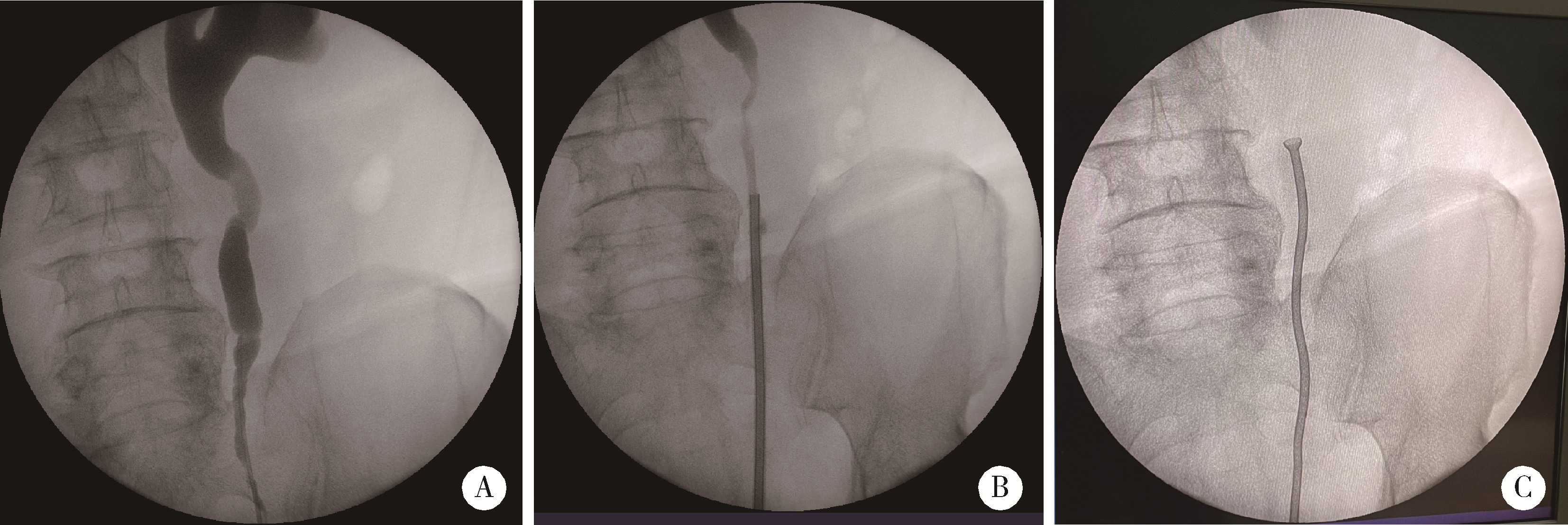
图1

梅莫凯斯-051型输尿管支架置入术操作步骤"

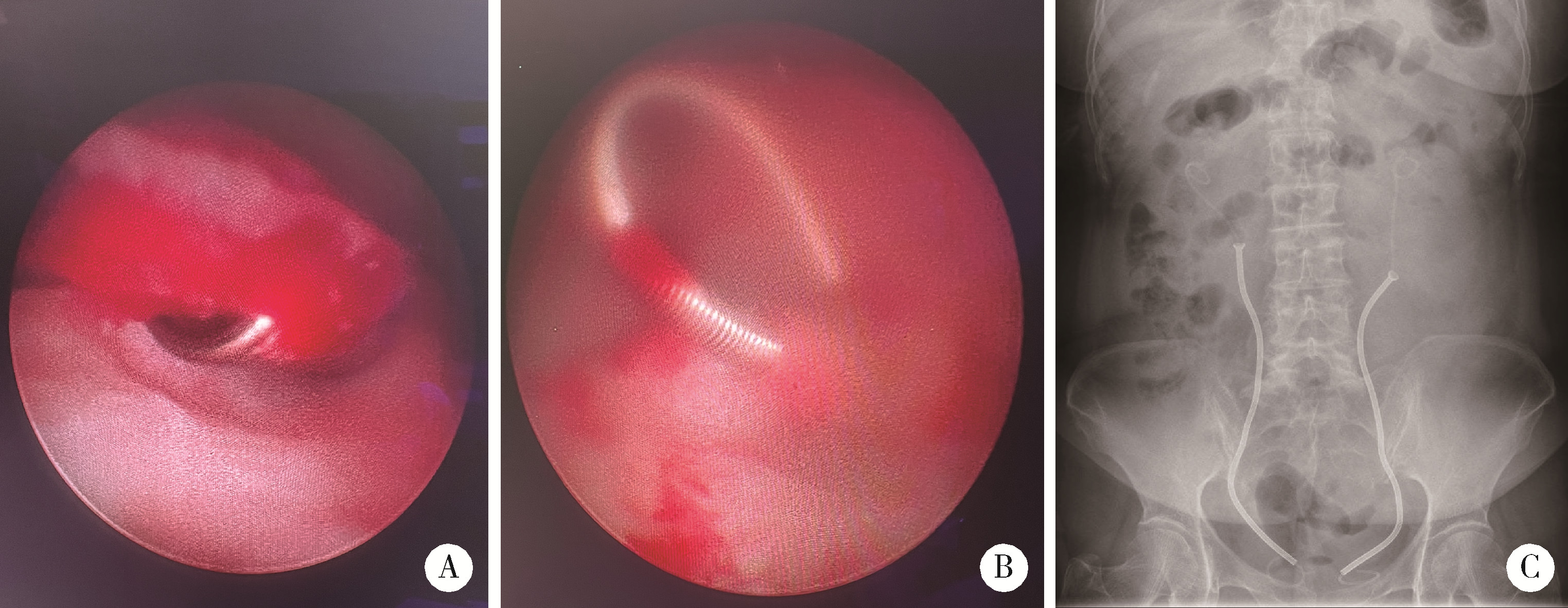
图2

梅莫凯斯-051型输尿管支架内血凝块堵塞后双J管置入术及术后肾-输尿管-膀胱平片"

表2

16例患者23侧梅莫凯斯-051型输尿管支架置入术后并发症"

Patients Stents Length/cm Complication Clavien-Dindo grade Management
1 1 15 Occlusion Double J stenting in lumen (2 weeks)
1 2 20 Occlusion Double J stenting in lumen (2 weeks)
2 3 25 None
3 4 15 Pain Analgesics
3 5 10 None
4 6 15 Migration Stent replacement
5 7 20 None
5 8 20 None
6 9 15 Stone obstruction Stent replacement
7 10 20 Tissue obstruction Stent replacement
8 11 10 Tissue obstruction Stent replacement
8 12 20 None
9 13 15 None
10 14 25 Fever Antibiotics
10 15 15 Fever Antibiotics
11 16 20 None
11 17 20 Pain Analgesics
12 18 25 None
13 19 25 None
14 20 15 Pain Analgesics
14 21 20 None
15 22 25 Pain Analgesics
16 23 25 Pain Analgesics

表3

术前及术后血肌酐、肾积水变化情况比较"

Items Preoperative 3 months postoperatively 6 months postoperatively 12 months postoperatively χ2 P
Scr/(μmol/L), M (P25, P75) 186.80 (111.80, 244.93) 103.05 (96.20, 135.97) 97.45 (87.18, 124.50) 105.90 (87.08, 126.45) 19.50 <0.01
Width of hydronephrosis/cm, M (P25, P75) 3.20 (2.78, 3.40) 2.05 (1.08, 2.20) 1.98 (1.08, 2.10) 1.69 (1.23, 2.30) 27.94 <0.01

表4

术前及术后USSQ评分比较"

USSQ domain Preoperative 3 months postoperatively t P
Urinary symptoms 34.75±2.34 23.75±3.26 11.10 <0.001
Physical pain 6.50±2.26 3.00±1.22 5.27 <0.001
General health status 14.19±1.52 9.37±2.09 7.24 <0.001
Work performance 9.06±1.18 4.44±1.09 10.58 <0.001
1
Caamiña L , Pietropaolo A , Prudhomme T , et al. Endourological management of ureteral stricture in patients with renal transplant: A systematic review of literature[J]. J Endourol, 2024, 38 (3): 290- 300.
2
Lee M , Lee Z , Houston N , et al. Robotic ureteral reconstruction for recurrent strictures after prior failed management[J]. BJUI Compass, 2023, 4 (3): 298- 304.

doi: 10.1002/bco2.224
3
王明瑞, 胡浩, 王起, 等. Allium覆膜金属输尿管支架长期留置治疗放疗后输尿管狭窄的有效性和安全性[J]. 中华泌尿外科杂志, 2020, 41 (12): 921- 926.
4
Forster LR , Watson L , Breeze CE , et al. The fate of ureteral memokath stent(s) in a high-volume referral center: An indepen-dent long-term outcomes review[J]. J Endourol, 2021, 35 (2): 180- 186.

doi: 10.1089/end.2020.0542
5
Zhong Q , Song T , Zeng J , et al. Initial experiment of self-expanding metal ureteral stent in recurrent ureteral stenosis after kidney transplantation[J]. Am J Transplant, 2021, 21 (5): 1983- 1984.

doi: 10.1111/ajt.16444
6
Buksh O , Jar A , Khogeer A , et al. Thermoexpandable Memokath stent: Usage and efficacy in ureteral and urethral strictures in Saudi Arabia[J]. Urol Ann, 2024, 16 (1): 98- 103.

doi: 10.4103/ua.ua_160_22
7
Su B , Hu W , Xiao B , et al. Long-term outcomes of allium ureteral stent as a treatment for ureteral obstruction[J]. Sci Rep, 2024, 14, 21958.

doi: 10.1038/s41598-024-73125-0
8
Vogt B , Dove-Rumé J . It is possible to reduce ureteral stent clogging and stent-related symptoms to soothe the pain of the patient: A case report[J]. Res Rep Urol, 2023, 15, 315- 319.
9
Khoo CC , Ho C , Palaniappan V , et al. Single-center experience with three metallic ureteral stents (AlliumURS, MemokathTM-051, and Resonance) for chronic ureteral obstruction[J]. J Endourol, 2021, 35 (12): 1829- 1837.

doi: 10.1089/end.2021.0208
10
Gao X , Di X , Chen G , et al. Metal ureteral stents for ureteral stricture: 2 years of experience with 246 cases[J]. Int J Surg, 2024, 110 (1): 66- 71.

doi: 10.1097/JS9.0000000000000841
11
Moretto S , Saita A , Scoffone CM , et al. Ureteral stricture rate after endoscopic treatments for urolithiasis and related risk factors: Systematic review and meta-analysis[J]. World J Urol, 2024, 42 (1): 234.

doi: 10.1007/s00345-024-04933-2
12
Yang K , Pang KH , Fan S , et al. Robotic ureteral reconstruction for benign ureteral strictures: A systematic review of surgical techniques, complications and outcomes[J]. BMC Urol, 2023, 23 (1): 160.

doi: 10.1186/s12894-023-01313-7
13
Heo JE , Kang SK , Lee J , et al. Outcomes of single-port robotic ureteral reconstruction using the da Vinci SP system[J]. Investig Clin Urol, 2023, 64 (4): 373.

doi: 10.4111/icu.20230005
14
Sugino T , Taguchi K , Hamamoto S , et al. Risk factors for failure of endoscopic management of stone-related ureteral strictures[J]. Urol J, 2021, 19 (2): 95- 100.
15
Bilotta A , Wiegand LR , Heinsimer KR . Ureteral reconstruction for complex strictures: A review of the current literature[J]. Int Urol Nephrol, 2021, 53 (11): 2211- 2219.

doi: 10.1007/s11255-021-02985-6
16
Hu H , Wang M , Tang X , et al. Allium ureteral stent for the treatment of malignant ureteral obstruction: A median term study[J]. Medicine, 2023, 102 (30): e34309.

doi: 10.1097/MD.0000000000034309
[1] 胡浩, 边小龙, 徐涛. 局段金属输尿管支架的临床应用进展、热点、争议与未来展望[J]. 北京大学学报(医学版), 2026, 58(4): 679-685.
[2] 黄万伟, 沙显燊, 张艺宝, 伍国豪, 骆峰, 陈智慧, 叶东明, 李学松, 赖彩永. 完全3D腹腔镜回肠代双侧输尿管联合膀胱扩大术修复放射治疗后双侧输尿管狭窄并膀胱挛缩[J]. 北京大学学报(医学版), 2025, 57(4): 789-795.
[3] 王焕瑞, 赖世聪, 胡浩浦, 丁泽华, 徐涛, 胡浩. 腹腔镜与输尿管软镜联合定位治疗复杂输尿管狭窄的疗效分析[J]. 北京大学学报(医学版), 2025, 57(4): 784-788.
[4] 余霄腾, 黄奕瑄, 李新飞, 陈昶甫, 赵方舟, 应鸿刚, 陶子豪, 张一鸣, 徐丽清, 李志华, 杨昆霖, 周利群, 李学松, 赵峥. 结石相关输尿管狭窄的上尿路修复手术技术与临床结局[J]. 北京大学学报(医学版), 2025, 57(4): 670-675.
[5] 王明瑞, 王起, 胡浩, 赖金惠, 唐鑫伟, 万春艳, 许克新, 徐涛. 覆膜金属输尿管支架治疗盆腔脂肪增多症所致肾积水的疗效[J]. 北京大学学报(医学版), 2024, 56(5): 919-922.
[6] 应沂岑,杜毅聪,李志华,张一鸣,李新飞,王冰,张鹏,朱宏建,周利群,杨昆霖,李学松. 机器人辅助腹腔镜下颊黏膜补片输尿管成形术治疗复杂输尿管狭窄[J]. 北京大学学报(医学版), 2024, 56(4): 640-645.
[7] 赖金惠,王起,姬家祥,王明瑞,唐鑫伟,许克新,徐涛,胡浩. 新型冠状病毒肺炎疫情期间延迟拔除输尿管支架对泌尿系结石术后患者生活质量和心理状态的影响[J]. 北京大学学报(医学版), 2023, 55(5): 857-864.
[8] 韩冠鹏,许洋洋,李志华,孟畅,朱宏建,杨昆霖,周利群,李学松. 造血干细胞移植后输尿管狭窄1例[J]. 北京大学学报(医学版), 2022, 54(4): 762-765.
[9] 张春龙,王明瑞,王起,许克新,徐涛,胡浩. 覆膜金属输尿管支架维持性治疗输尿管镜碎石术后难治性输尿管狭窄的远期疗效评价[J]. 北京大学学报(医学版), 2022, 54(4): 674-679.
[10] 黄炳伟,王杰,张鹏,李喆,毕泗成,王强,岳才博,杨昆霖,李学松,周利群. 吲哚菁绿在复杂上尿路修复手术中的应用[J]. 北京大学学报(医学版), 2020, 52(4): 651-656.
[11] 郝一昌,侯小飞,赵磊,肖春雷,刘茁,张帆,马潞林. 全腹腔镜移植输尿管膀胱再植术处理肾移植术后输尿管狭窄[J]. 北京大学学报(医学版), 2018, 50(4): 705-710.
Viewed
Full text


Abstract

Cited

  Shared   
  Discussed   
No Suggested Reading articles found!