北京大学学报(医学版) ›› 2025, Vol. 57 ›› Issue (4): 740-747. doi: 10.19723/j.issn.1671-167X.2025.04.018

• 论著 • 上一篇    下一篇

较大的肱骨大结节角和峰盂角与肩袖撕裂的相关性

蒋华1, 颜宇2, 李盼盼1, 陈康1, 马红兵1, 曾勇1, 唐新2, 崔国庆3,*()   

  1. 1. 成都市第二人民医院/成都医学院附属医院骨科, 成都 610017
    2. 四川大学华西医院骨科, 成都 610041
    3. 北京大学第三医院运动医学科, 北京 100191
  • 收稿日期:2024-09-29 出版日期:2025-08-18 发布日期:2025-08-02
  • 通讯作者: 崔国庆
  • 基金资助:
    成都市卫生健康委员会科研项目(2020090); 四川省中医药管理局科研专项(2024MS179)

Association of increased greater tubercle angle and critical shoulder angle with rotator cuff tears

Hua JIANG1, Yu YAN2, Panpan LI1, Kang CHEN1, Hongbing MA1, Yong ZENG1, Xin TANG2, Guoqing CUI3,*()   

  1. 1. Department of Orthopedics, Chengdu Second People ' s Hospital, Affiliated Hospital of Chengdu Medical College, Chengdu 610017, China
    2. Department of Orthopedics, West China Hospital, Sichuan University, Chengdu 610041, China
    3. Department of Sports Medicine, Peking University Third Hospital, Beijing 100191, China
  • Received:2024-09-29 Online:2025-08-18 Published:2025-08-02
  • Contact: Guoqing CUI
  • Supported by:
    the Project of Chengdu Health and Health Commission(2020090); the Special Fund of Sichuan Provincial Administration of Traditional Chinese Medicine(2024MS179)

RICH HTML


摘要:

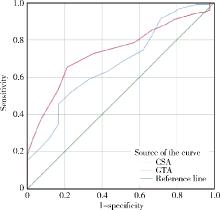
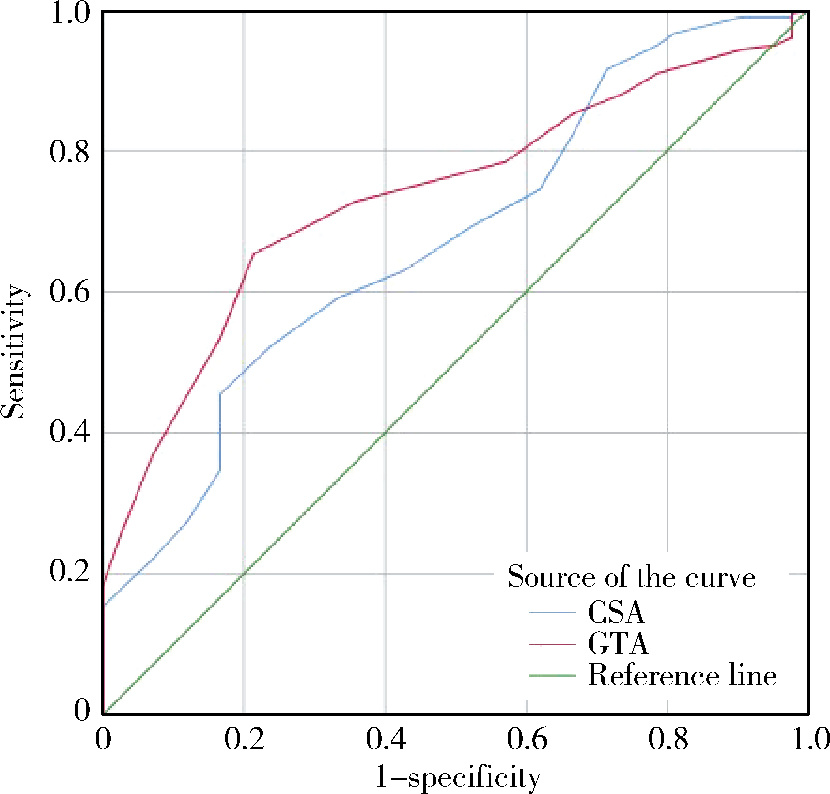
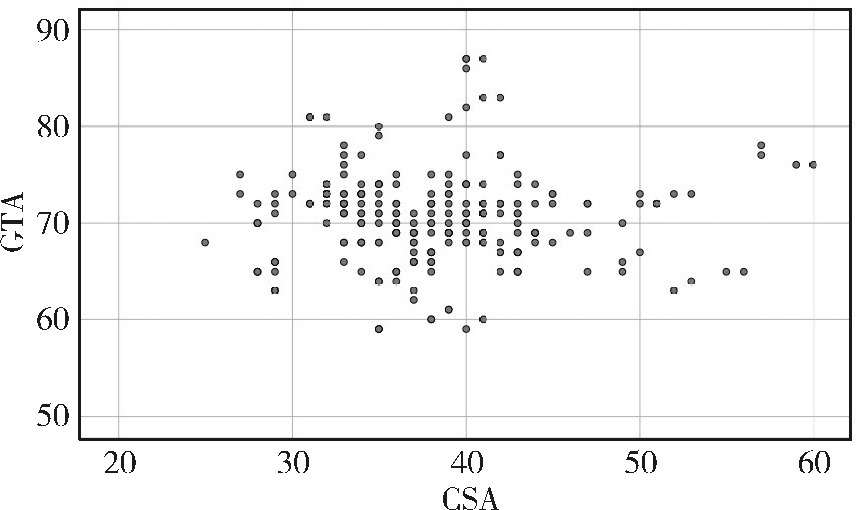
目的: 肱骨大结节角(greater tuberosity angle,GTA)和峰盂角(critical shoulder angle,CSA)通常作为影像学标记用于描述肱骨大结节和肩峰的形态,本研究分析肩袖撕裂患者GTA和CSA的变化趋势和风险阈值,并探讨肩袖撕裂的保护因素和危险因素。方法: 从2019年5月至2020年12月共回顾性纳入130例患者,根据南加州骨科研究所(Southern California Orthopaedic Institute,SCOI)的分类法,将患者分为4组:A组,正常对照组;B组,部分肩袖撕裂(关节侧)组;C组,部分肩袖撕裂(滑囊侧)组;D组,全层肩袖撕裂组。在单盲条件下,由同一组医生分别在手臂中立位的肩胛骨正位X线片上测量GTA和CSA,分析其对肩袖撕裂的诊断价值,同时对可能影响肩袖撕裂的因素进行相关性分析。结果: 根据受试者工作特征(receiver operating characteristic,ROC)曲线下面积(area under curve,AUC),在95%置信区间(confidence interval,CI)内,肩袖撕裂组(B、C、D组)的GTA和CSA分别为0.736和0.673,肩袖撕裂患者的GTA和CSA临界值(cut-off value)分别为70.5°和39.5°。与对照组相比,各肩袖撕裂组在身高、年龄、体重指数(body mass index,BMI)等方面差异均有统计学意义(P < 0.05),全层肩袖撕裂组(D组)患者的年龄更大(P < 0.05,临界值为56.5岁),比A、B组身高更低(P < 0.05,临界值为1.58 m)。散点图和回归分析显示,GTA与CSA之间不存在线性相关。与对照组相比,肩袖撕裂组在性别、优势肩和吸烟等方面差异无统计学意义(P>0.05)。结论: 较大的GTA(>70.5°)和CSA(>39.5°)可能对诊断肩袖撕裂具有较高的预测价值,相较而言,GTA的诊断价值更高;年龄>56.5岁、身高 < 1.58 m的患者更易发生全层肩袖撕裂;性别、优势肩、吸烟既不是危险因素,也不是保护因素。

关键词: 肩袖撕裂, 肱骨大结节角, 峰盂角, 肩撞击综合征

Abstract:

Objective: The greater tuberosity angle (GTA) and critical shoulder angle (CSA) are commonly referred to as radiographic markers which were used to described morphology of the greater tuberosity and acromion respectively. At present, most international studies focus on the correlation between the above two parameters and rotator cuff tears (RCTs), and their diagnostic value and risk assessment. This study attempts to find out the trend of GTA and CSA changes and risk threshold of RCTs, as well as the protective factors and risk factors. Methods: In this study, 130 individuals from May 2019 to December 2020 were recruited. According to Southern California Orthopedic Institute (SCOI) classification, the individuals were divided into four groups retrospectively: Group A, negative control group; Group B, partial tears (articular side); Group C, partial tears (bursal side); Group D, full-thickness tears. GTA and CSA were measured respectively on true anteroposterior position X-ray of shoulder with arm in neutral rotation and performed by the same trained technician team in single-blind. The correlations between RCTs and relevant factors were analyzed. Results: According to the area under the receiver operating characteristic curve (AUC), GTA and CSA of RCTs (Groups B, C and D) were 0.736 and 0.673 with 95% confidence interval (CI), the cut-off value of GTA and CSA of RCTs were 70.5° and 39.5° respectively. Comparing with the control group, RCTs groups had significant statistical differences in age and body mass index (BMI) (P < 0.05), especially the full-thickness RCTs (Group D), which was older than Groups A, B and C (P < 0.05, cut-off value: 56.5 years old) and shorter than Groups A and B (P < 0.05, cut-off value: 1.58 m). Analyzed from scatter plot and regression analysis, there was no linear correlation between GTA and CSA. There were no significant differences in gender, dominant shoulders and smoking between the RCTs groups and the control group (P>0.05). Conclusion: Larger GTA (>70.5°) and CSA (>39.5°) would be highly predictive in diagnosing RCTs without linear correlation, and GTA has a higher diagnostic value in contrast. Subacromial impingement and shoulder degeneration occurred before RCTs. Patients with age >56.5 years and height < 1.58 m were more likely to develop disease of full-thickness RCTs and no statistic differences in weight and BMI. Gender, dominant shoulder and smoking were neither risk factors nor protective factors.

Key words: Rotator cuff tears, Greater tuberosity angle, Critical shoulder angle, Shoulder impingement syndrome

中图分类号: 

  • R684

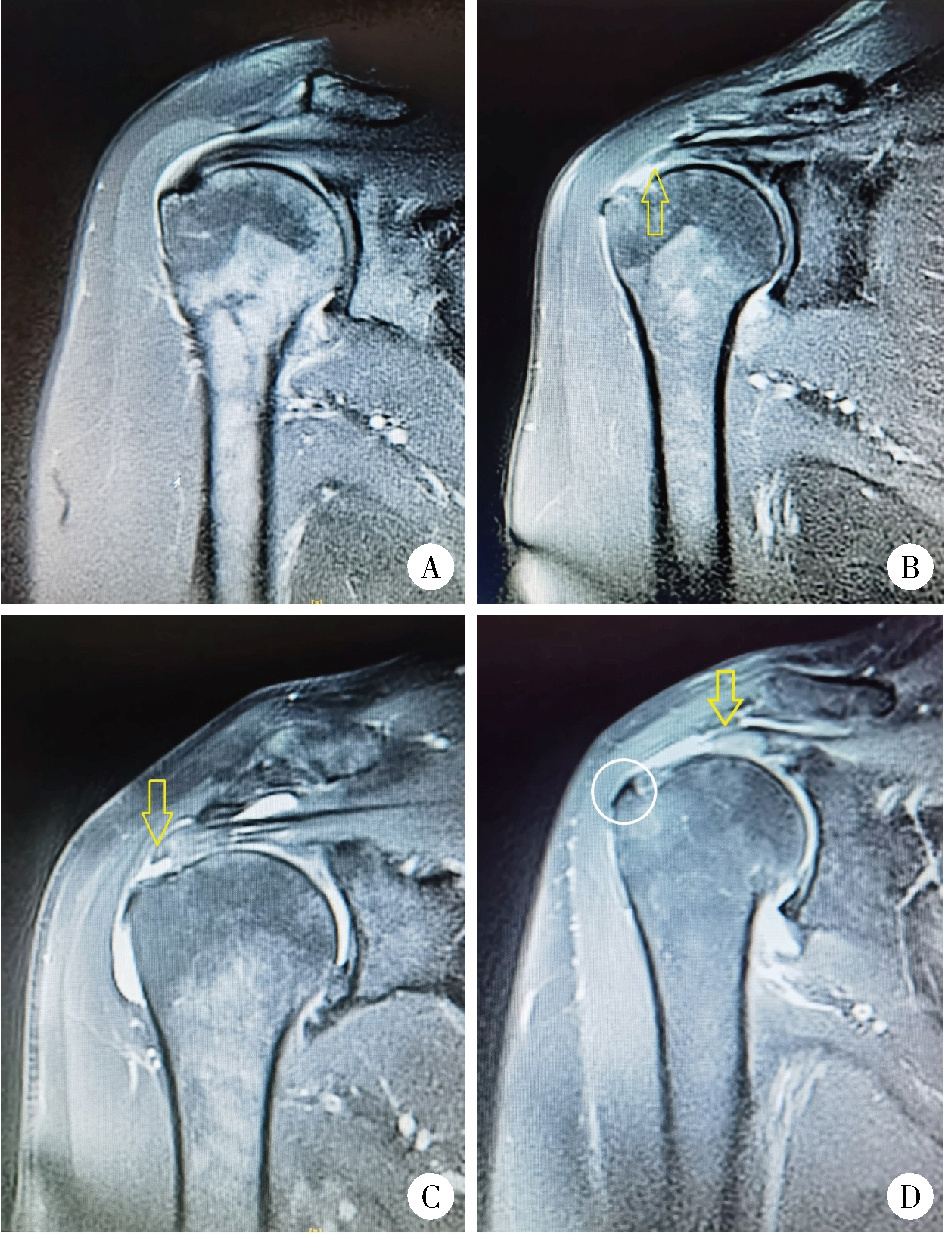
图1

各组肩袖撕裂患者的MRI影像"

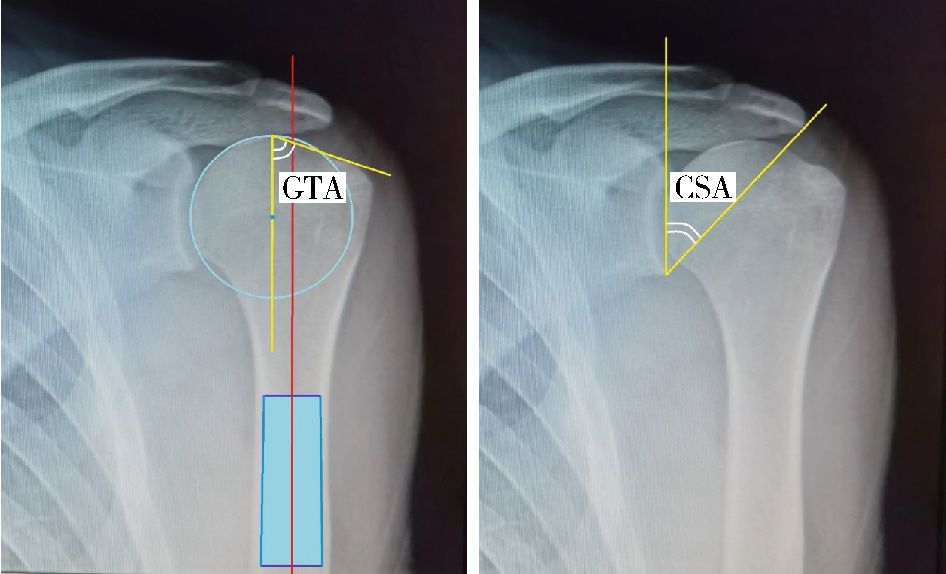
图2

GTA和CSA在肩胛骨正位X线片上的测量方法"

表1

放射学测量的可靠性检测"

Measurements ICC-1 ICC-2 ICC-3
CSA 0.988 0.988 0.897
GTA 0.977 0.990 0.921

图3

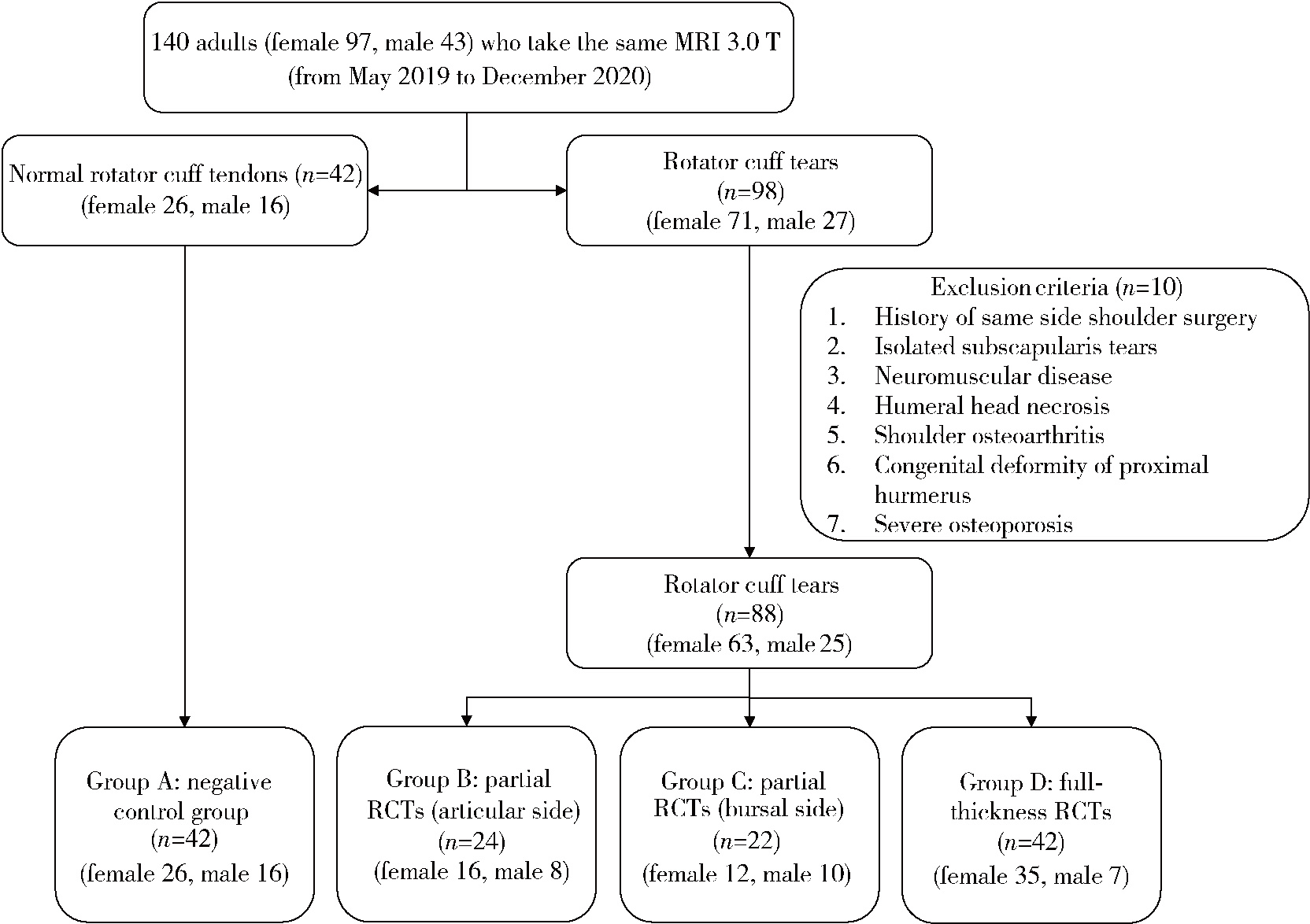
受试者入组流程图"

表2

各组人口学数据资料"

Items Group A Group B Group C Group D P value
Age/years, ${\bar x}$±s 27.76±7.30 54.00±14.89 51.27±8.41 64.24±10.01 <0.001
Weight/kg, ${\bar x}$±s 58.90±6.51 63.83±9.06 63.27±6.13 61.43±10.06 0.075
Height/m, ${\bar x}$±s 1.64±0.50 1.65±0.78 1.62±0.68 1.59±0.07 0.001
BMI/(kg/m2), ${\bar x}$±s 21.82±1.73 23.24±1.91 24.04±1.54 24.10±2.93 <0.001
Gender (male/female), n 16/26 8/16 10/12 7/35 0.067
Shoulder (left/right), n 16/26 8/16 12/10 18/24 0.487
Smoking (yes/no), n 6/36 2/22 2/20 2/40 0.511

表3

各组CSA和GTA的测量值"

Items Group A Group B Group C Group D
CSA, ${\bar x}$±s 35.33±4.69 38.56±4.83 40.23±5.72 39.18±7.18
GTA, ${\bar x}$±s 68.36±3.06 70.54±3.08 71.09±5.31 72.62±5.37

表4

CSA的组间多重比较(P value)"

Items Group A Group B Group C Group D
Group A - 0.028* 0.001** 0.002**
Group B 0.028* - 0.323 0.673
Group C 0.001** 0.323 - 0.485
Group D 0.002** 0.673 0.485 -

图4

ROC曲线下肩袖撕裂患者CSA和GTA的临界值分析"

表5

GTA的组间多重比较(P value)"

Items Group A Group B Group C Group D
Group A - 0.045* 0.015* <0.001**
Group B 0.045 - 0.660 0.057
Group C 0.015* 0.660 - 0.172
Group D <0.001** 0.057 0.172 -

图5

GTA和CSA的散点图"

图6

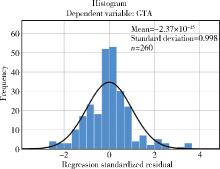
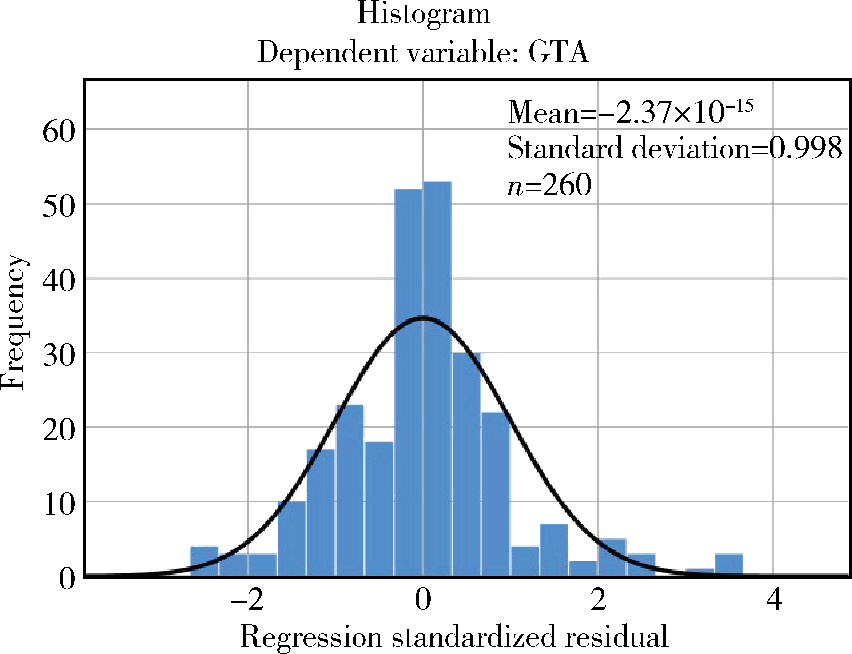
回归标准化残差(因变量:GTA)遵循标准正态分布(95%CI: -2, 2)"

表6

RCTs各组的优势比"

Items Group B Group C Group D
OR (95%CI) P value OR (95%CI) P value OR (95%CI) P value
Gender (male/female) 1.231 (0.430-3.527) 0.699 0.738 (0.260-2.100) 0.569 3.077 (1.106-8.558) 0.050
Shoulder (left/right) 1.231 (0.430-3.527) 0.699 0.513 (0.180-1.458) 0.208 0.821 (0.343-1.963) 0.657
Smoke (yes/no) 1.833 (0.340-9.895) 0.476 1.667 (0.307-9.042) 0.551 3.333 (0.632-17.574) 0.137
1
Neer CS . Anterior acromioplasty for the chronic impingement syndrome in the shoulder: A preliminary report[J]. J Bone Joint Surg Am, 1972, 54 (1): 41- 50.
2
Bigliani LU , D' Alessandro DF , Duralde XA , et al. Anterior acromioplasty for subacromial impingement in patients younger than 40 years of age[J]. Clin Orthop Relat Res, 1989 (246): 111- 116.
3
Cunningham G , Nicodeme-Paulin E , Smith MM , et al. The greater tuberosity angle: A new predictor for rotator cuff tear[J]. J Shoulder Elbow Surg, 2018, 27 (8): 1415- 1421.
4
Kocadal O , Tasdelen N , Yuksel K , et al. Volumetric evaluation of the subacromial space in shoulder impingement syndrome[J]. Orthop Traumatol Surg Res, 2022, 108 (2): 103- 110.
5
Bufe K , Müller KH , Retzlaff C , et al. Interobserver reliability of shoulder radiographic findings and correlation to MRI: A preliminary case series[J]. Arch Orthop Trauma Surg, 2024, 144 (8): 3313- 3322.
6
Bi AS , Morgan AM , O' Brien M , et al. Partial-thickness rotator cuff tears: Current concepts[J]. JBJS Rev, 2024, 12 (8): e24.00063.
7
王琦, 王会祥, 吴晓明. 峰盂角的定义及临床研究进展[J]. 中华骨科杂志, 2020, 40 (1): 55- 59.
8
陈俊, 楼珏翔, 申屠国建, 等. 肩关节峰盂角对肩袖撕裂修补术后再撕裂的影响[J]. 中国运动医学杂志, 2022, 41 (6): 423- 429.

doi: 10.3969/j.issn.1000-6710.2022.06.002
9
Moor BK , Bouaicha S , Rothenfluh DA , et al. Is there an association between the individual anatomy of the scapula and the deve-lopment of rotator cuff tears or osteoarthritis of the glenohumeral joint? A radiological study of the critical shoulder angle[J]. Bone Joint J, 2013, 95-B (7): 935- 941.
10
Bossuyt PM , Reitsma JB , Bruns DE , et al. STARD 2015:An updated list of essential items for reporting diagnostic accuracy studies[J]. BMJ, 2015, 351, h5527.
11
Seo J , Heo K , Kwon S , et al. Critical shoulder angle and greater tuberosity angle according to the partial thickness rotator cuff tear patterns[J]. Orthop Traumatol Surg Res, 2019, 105 (8): 1543- 1548.
12
Yoo JS , Heo K , Yang JH , et al. Greater tuberosity angle and critical shoulder angle according to the delamination patterns of rotator cuff tear[J]. J Orthop, 2019, 16 (5): 354- 358.
13
Schaaf JV , Weidinger L , Molleman L , et al. Test-retest reliability of reinforcement learning parameters[J]. Behav Res Methods, 2024, 56 (5): 4582- 4599.
14
Job TDW , Cross MR , Cronin JB . Comparison of shoulder rotation strength and test-retest reliability in 3 test positions with swimmers[J]. J Sport Rehabil, 2024, 11 (6): 1- 7.
15
Sutton P , Lund Ohlsson M , Röijezon U . Reduced shoulder proprioception due to fatigue after repeated handball throws and evaluation of test-retest reliability of a clinical shoulder joint position test[J]. Shoulder Elbow, 2024, 16 (1): 100- 109.
16
Othman R , Bajaber AM , Alhabshi AM , et al. Test-retest reliability of pain sensitivity measures in individuals with shoulder pain[J]. J Pain Res, 2024, 25 (17): 1917- 1927.
17
Bigliani LU , Levine WN . Subacromial impingement syndrome[J]. J Bone Joint Surg Am, 1997, 79 (12): 1854- 1868.
18
Akgün D , Gebauer H , Paksoy A , et al. Differences in osseous shoulder morphology, scapulothoracic orientation, and muscle volume in patients with constitutional static posterior shoulder instability (type C1) compared with healthy controls[J]. Am J Sports Med, 2024, 52 (5): 1299- 1307.
19
Dong W , Du K , Shi B , et al. Distribution and analysis of subacromial spurs and the relationship with acromial classification and angle in healthy individuals[J]. PLoS One, 2024, 19 (3): e0301066.
20
Abu El Kasem ST , Alaa FAA , Abd El-Raoof NA , et al. Efficacy of Mulligan thoracic sustained natural apophyseal glides on sub-acromial pain in patients with sub-acromial impingement syndrome: A single-blinded randomized controlled trial[J]. J Man Manip Ther, 2024, 32 (6): 584- 593.
21
Saengpetch N , Bamrungchaowkasem J , Chitrapazt N , et al. Predicting bursal-side supraspinatus tendon tears with the acromioclavicular angle[J]. Asia Pac J Sports Med Arthrosc Rehabil Technol, 2024, 27 (39): 15- 21.
22
Ellman H . Arthroscopic treatment of impingement of the shoulder[J]. Instr Course Lect, 1989, 38, 177- 185.
23
Gartsman GM , Blair ME , Jr. Noble PC , et al. Arthroscopic subacromial decompression: An anatomical study[J]. Am J Sports Med, 1988, 16 (1): 48- 50.
24
Lowry V , Lavigne P , Zidarov D , et al. A systematic review of clinical practice guidelines on the diagnosis and management of various shoulder disorders[J]. Arch Phys Med Rehabil, 2024, 105 (2): 411- 426.
25
Yang S , Pang L , Zhang C , et al. Lower reoperation rate and superior patient-reported outcome following arthroscopic rotator cuff repair with concomitant acromioplasty: An updated systematic review of randomized controlled trials[J]. Arthroscopy, 2025, 41 (5): 1618- 1634.
26
Zhao J , Huang H , Zeng L , et al. Acromioplasty combined with arthroscopic rotator cuff repair can reduce the risk of reoperation: A systematic review and meta-analysis[J]. Postgrad Med, 2024, 136 (6): 666- 677.
27
Maguire JA , Dhillon J , Scillia AJ , et al. Rotator cuff repair with or without acromioplasty: A systematic review of randomized controlled trials with outcomes based on acromial type[J]. Am J Sports Med, 2024, 52 (13): 3404- 3411.
28
Gatto L , Fernando A , Patel M , et al. Subacromial contact after acromioplasty in the rotator cuff deficient shoulder[J]. J Orthop Res, 2024, 42 (3): 588- 597.
29
Heydar AM , Kiyak G . Effect of arthroscopic acromioplasty on the isometric abduction strength[J]. Cureus, 2024, 16 (4): e59426.
30
Sayampanathan AA , Tan AHC . Editorial commentary: Long-term, clinical outcome of arthroscopic rotator cuff repair may be improved with concomitant acromioplasty in patients with a type Ⅲ acromion[J]. Arthroscopy, 2025, 41 (5): 1635- 1636.
31
Gutierrez-Naranjo JM , Salazar LM , Kanawade VA , et al. The greater tuberosity version angle: A novel method of acquiring humeral alignment during intramedullary nailing[J]. Bone Jt Open, 2024, 5 (10): 929- 936.
32
Castanheira A , Amaro P , Alonso R , et al. Influence of reestabli-shing greater tuberosity angle on patient outcomes following greater tuberosity fractures[J]. Eur J Orthop Surg Traumatol, 2024, 35 (1): 22- 26.
33
Klosterman EL , Tagliero AJ , Lenters TR , et al. The subcoracoid distance is correlated with pain and internal rotation after reverse shoulder arthroplasty[J]. JSES Int, 2024, 8 (3): 528- 534.
34
Açan AE , Hapa O , Gursan O , et al. The effect of arthroscopic coracoplasty on subscapularis strength in cases of subcoracoid impingement in the absence of subscapularis tear[J]. Medicine (Baltimore), 2024, 103 (3): e36947.
35
Gamiel A , Elkhawaga H , Badr M , et al. Multimodal physical therapy management of subcoracoid impingement: A case report with one-year follow-up and ultrasound measurement of coracohumeral distance[J]. Cureus, 2024, 16 (11): e73398.
36
Villatte G , van der Kruk E , Bhuta AI , et al. A biomechanical confirmation of the relationship between critical shoulder angle (CSA) and articular joint loading[J]. J Shoulder Elbow Surg, 2020, 29 (10): 1967- 1973.
37
Pandey V , Vijayan D , Tapashetti S , et al. Does scapular morphology affect the integrity of the rotator cuff?[J]. J Shoulder Elbow Surg, 2016, 25 (3): 413- 421.
38
Shinagawa K , Hatta T , Yamamoto N , et al. Critical shoulder angle in an East Asian population: Correlation to the incidence of rotator cuff tear and glenohumeral osteoarthritis[J]. J Shoulder Elbow Surg, 2018, 27 (9): 1602- 1606.
39
Moor BK , Wieser K , Slankamenac K , et al. Relationship of individual scapular anatomy and degenerative rotator cuff tears[J]. J Shoulder Elbow Surg, 2014, 23 (4): 536- 541.
40
Oladimeji AE , Amoo-Achampong K , Ode GE . Impact of critical shoulder angle in shoulder pathology: A current concepts review[J]. JSES Int, 2023, 8 (2): 287- 292.
41
Cerciello S , Mocini F , Proietti L , et al. Critical shoulder angle in patients with cuff tears[J]. Sports Med Arthrosc Rev, 2024, 32 (1): 38- 45.
[1] 安思兰,郑群怡,王锴,高姗. 全膝关节置换术后患者早期疼痛的特点及其影响因素[J]. 北京大学学报(医学版), 2024, 56(1): 167-173.
[2] 傅强,高冠英,徐雁,林卓华,孙由静,崔立刚. 无症状髋关节前上盂唇撕裂超声与磁共振检查的对比研究[J]. 北京大学学报(医学版), 2023, 55(4): 665-669.
[3] 吴浩,潘利平,刘恒,塔拉提百克·买买提居马,王洪彬,宁太国,曹永平. 胫骨假体的不同后倾角度对内侧间室单髁置换术后膝关节功能的影响[J]. 北京大学学报(医学版), 2021, 53(5): 877-882.
[4] 郑佳鹏,肖棋,邓辉云,吴清泉,翟文亮,林达生. 外侧半月板腘肌腱区损伤的关节镜下分型和处理[J]. 北京大学学报(医学版), 2021, 53(5): 891-895.
[5] 邵振兴,宋庆法,赵宇晴,崔国庆. 一种结合线袢固定的关节镜下“嵌入式”喙突移位术:手术技术及术后影像学分析[J]. 北京大学学报(医学版), 2021, 53(5): 896-901.
[6] 朱敬先,鲁胜楠,蒋艳芳,姜玲,王健全. 老年肩袖损伤手术患者术前肺功能的影响因素[J]. 北京大学学报(医学版), 2021, 53(5): 902-906.
[7] 刘中砥,许庭珉,党育,张殿英,付中国. 关节镜下改良outside-in穿刺缝合技术修复半月板撕裂的中期临床随访[J]. 北京大学学报(医学版), 2020, 52(5): 870-874.
[8] 江东,胡跃林,焦晨,郭秦炜,谢兴,陈临新,赵峰,皮彦斌. 慢性踝关节不稳合并后踝撞击同期手术中长期疗效及影响因素分析[J]. 北京大学学报(医学版), 2019, 51(3): 505-509.
[9] 张翠平,刘佩佩,傅强,高冠英,崔立刚,徐雁,王健全. 超声引导下髋关节药物注射在关节镜盂唇修复术后康复中的应用[J]. 北京大学学报(医学版), 2019, 51(2): 265-267.
[10] 吕明, 张金庆, 王兴山, 黄野, 李为, 张春雨. 直接前入路髋关节置换术及其早期临床疗效[J]. 北京大学学报(医学版), 2017, 49(2): 206-213.
[11] 李杨,李子剑,张克,田华,刘延青,蔡宏,李锋,赵旻暐. 膝髋关节置换术非计划性暂停手术的原因分析[J]. 北京大学学报(医学版), 2017, 49(2): 231-235.
[12] 张铁超,张志山,周方,田耘,姬洪全,郭琰,吕扬,杨钟玮,侯国进. 颈基底型股骨粗隆部骨折的诊断及治疗[J]. 北京大学学报(医学版), 2017, 49(2): 246-251.
[13] 于峥嵘,李淳德,朱赛楠,孙浩林,赵耀,漆龙涛. 经皮椎间孔入路内镜下神经根减压治疗腰椎管狭窄症的短期随访[J]. 北京大学学报(医学版), 2017, 49(2): 252-255.
[14] 李伟, 姜春岩, 王战伟, 肖德明. 关节腔内注射贝伐单抗治疗兔膝骨性关节炎[J]. 北京大学学报(医学版), 2016, 48(2): 203-209.
[15] 查晔军,蒋协远,公茂琪. 无手术史的陈旧性肘关节“三联征”的治疗[J]. 北京大学学报(医学版), 2016, 48(2): 224-229.
Viewed
Full text


Abstract

Cited

  Shared   
  Discussed   
No Suggested Reading articles found!