北京大学学报(医学版) ›› 2026, Vol. 58 ›› Issue (2): 351-358. doi: 10.19723/j.issn.1671-167X.2026.02.020

• 论著 • 上一篇    下一篇

胸部创伤患者在重症监护病房内发生呼吸机相关性肺炎的危险因素

赵杰, 付春, 赵秀娟, 薛海岩, 李纾, 王振洲, 朱凤雪*()   

  1. 北京大学人民医院重症医学科, 创伤救治中心, 北京 100044
  • 收稿日期:2024-02-22 出版日期:2026-04-18 发布日期:2025-09-24
  • 通讯作者: 朱凤雪
  • 基金资助:
    国家自然科学基金(81971808)

Risk factors for ventilator-associated pneumonia in patients with chest trauma in intensive care unit

Jie ZHAO, Chun FU, Xiujuan ZHAO, Haiyan XUE, Shu LI, Zhenzhou WANG, Fengxue ZHU*()   

  1. Department of Critical Care Medicine, Trauma Treatment Center, Peking University People's Hospital, Beijing 100044, China
  • Received:2024-02-22 Online:2026-04-18 Published:2025-09-24
  • Contact: Fengxue ZHU
  • Supported by:
    the National Natural Science Foundation of China(81971808)

RICH HTML


摘要:

目的: 探讨胸部创伤患者在重症监护病房(intensive care unit, ICU)内发生呼吸机相关性肺炎(ventilator-associated pneumonia,VAP)的危险因素。方法: 回顾性分析2019年6月至2023年6月收住北京大学人民医院外科ICU、入院24 h内进行气管插管且机械通气>48 h的124例成人创伤患者的临床资料。根据住院期间是否发生VAP分为VAP组(46例)和非VAP组(78例),采用Lasso回归分析进行筛选并采用Logistic进行多因素回归分析以确定胸部创伤患者在ICU内发生VAP的危险因素。结果: 多因素回归分析显示,损伤严重度评分(injury severity score,ISS)(OR=1.08,95%CI:1.02~1.14,P=0.007)和气管切开(OR=4.61,95%CI:1.74~13.11,P=0.003)是胸部创伤患者发生VAP的独立危险因素(P < 0.05)。早期VAP患者19例,晚期VAP患者27例。所有VAP病例中,最常见的病原体是肺炎克雷伯菌(Klebsiella pneumoniae),共18次(39.1%);早期VAP病例中肺炎克雷伯菌最多见(10次,52.6%),晚期VAP中铜绿假单胞菌(Pseudomonas aeruginosa)和鲍曼不动杆菌(Acinetobacter baumannii)的出现频率最高,均为10次(37.0%)。结论: 胸部创伤患者在ICU内是否发生VAP与多个因素有关,ISS评分高以及气管切开是胸部创伤患者发生VAP的独立危险因素。

关键词: 呼吸机相关性肺炎, 胸部损伤, 机械通气, 重症监护病房, 危险因素

Abstract:

Objective: To explore the risk factors associated with ventilator-associated pneumonia (VAP) in the patients with chest trauma in the intensive care unit (ICU). Methods: A retrospective analysis was conducted on the clinical data of 124 adult trauma patients admitted to the surgical ICU of Peking University People' s Hospital between June 2019 and June 2023. These patients underwent tra-cheal intubation within 24 hours of admission and received mechanical ventilation for more than 48 hours. Based on whether VAP occurred during hospitalization, the patients were divided into a VAP group (46 cases) and a non-VAP group (78 cases). Lasso regression analysis was employed for variable selection, followed by Logistic regression analysis to determine the risk factors for VAP in these patients with chest trauma in the ICU. Results: The multivariate regression analysis indicated that the injury severity score (ISS) (OR=1.08, 95%CI: 1.02-1.14, P=0.007) and tracheostomy (OR=4.61, 95%CI: 1.74-13.11, P=0.003) were independent risk factors for VAP in the patients with chest trauma (P < 0.05). Among all VAP cases, early-onset VAP was observed in 19 patients, while late-onset VAP was observed in 27 patients. The most common pathogen in all VAP cases was Klebsiella pneumoniae, identified in 18 cases (39.1%). In early-onset VAP, Klebsiella pneumoniae was the most frequently detected pathogen, found in 10 cases (52.6%). Conversely, in late-onset VAP, Pseudomonas aeruginosa and Acinetobacter baumannii were the most prevalent pathogens, each appearing in 10 cases (37.0%). Conclusion: The occurrence of VAP in the patients with chest trauma in the ICU was influenced by multiple factors. This study identified that a higher ISS and the presence of a tracheostomy were independent risk factors for VAP in these patients. These findings suggest that in clinical practice, special attention should be given to the chest trauma patients with high ISS scores, and the timing and necessity of tracheostomy should be carefully considered to reduce the incidence of VAP and improve patient outcomes. Furthermore, the study highlights the importance of early identification and appropriate management of the patients at higher risk for developing VAP. By recognizing the significance of these risk factors, healthcare providers can implement targeted interventions and preventive measures, such as optimizing ventilation strategies and enhancing infection control practices. Future research should further explore additional factors that may influence the occurrence of VAP and verify these findings to provide stronger evidence for the prevention and treatment of VAP. Additionally, multicenter studies with larger sample sizes are recommended to validate these results and develop comprehensive guidelines for managing the chest trauma patients in the ICU.

Key words: Ventilator-associated pneumonia, Thoracic injuries, Mechanical ventilation, Intensive care units, Risk factors

中图分类号: 

  • R563.1

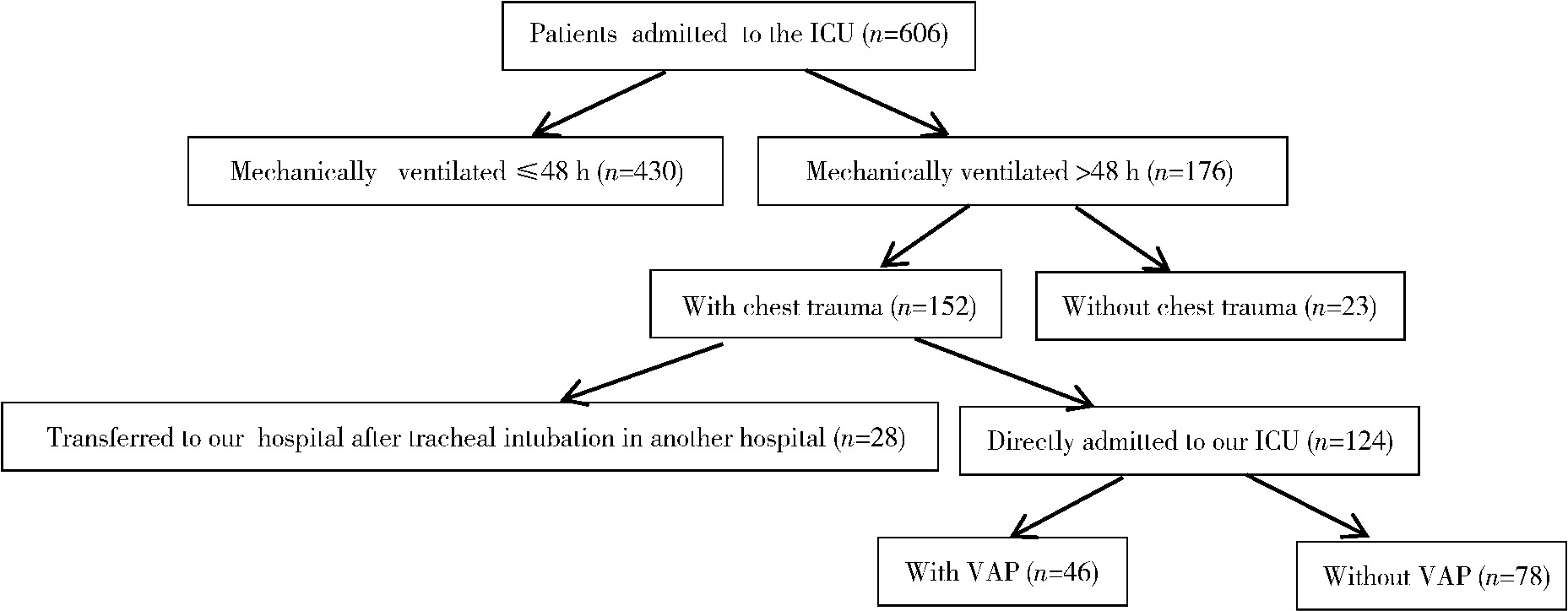
图1

患者入组流程图"

表1

患者的基线资料(n=124)"

Feature Non-VAP (n=78) VAP (n=46) P value
General information
  Age/years, M (P25, P75) 58 (46, 66) 54 (43, 64) 0.660
  Gender (male), n (%) 55 (70.5) 39 (84.8) 0.073
Medical history, n (%)
  Diabetes 7 (9.0) 5 (10.9) 0.760
  Hypertension 15 (19.2) 16 (34.8) 0.053
  Chronic kidney disease 1 (1.3) 1 (2.2) 0.999
  Hepatitis B 2 (2.6) 1 (2.2) 0.999
  Cerebrovascular disease 5 (6.4) 5 (10.9) 0.497
  Emphysema 5 (6.4) 1 (2.2) 0.411
  Coronary heart disease 1 (1.3) 3 (6.5) 0.144
  Smoking history 9 (11.5) 5 (10.9) 0.909
  Drinking history 6 (7.7) 4 (8.7) 0.999
Type of trauma, n (%) 0.854
  Traffic accident injury 50 (64.1) 32 (69.6)
  Fall injury 18 (23.1) 9 (19.6)
  Slip injury 6 (7.7) 2 (4.3)
  Crush injury 4 (5.1) 3 (6.5)
Overall trauma condition
  Shock, n (%) 26 (33.3) 20 (43.5) 0.259
  Head injury, n (%) 39 (50.0) 32 (69.6) 0.033
  Facial injury, n (%) 28 (35.9) 18 (39.1) 0.719
  Abdominal injury, n (%) 35 (44.9) 19 (41.3) 0.699
  Spinal injury, n (%) 32 (41.0) 23 (50.0) 0.331
  Pelvic injury, n (%) 38 (48.7) 25 (54.3) 0.545
  ISS score, M (P25, P75) 26 (19, 34) 29 (26, 34) 0.003
  GCS score, M (P25, P75) 14 (11, 15) 13 (7, 15) 0.022
Chest trauma condition
  Chest AIS score, ${\bar x}$±s 3.15±0.77 3.33±0.70 0.207
  Number of rib fractures, M (P25, P75) 5 (2, 10) 4 (2, 10) 0.801
  Clavicle fracture, n (%) 12 (15.4) 12 (26.1) 0.145
  Sternum fracture, n (%) 7 (9.0) 3 (6.5) 0.743
  Lung contusion, n (%) 53 (67.9) 33 (71.7) 0.658
  Pleural effusion, n (%) 49 (62.8) 31 (67.4) 0.607
  Pneumothorax, n (%) 29 (37.2) 20 (43.5) 0.488
Routine blood tests
  White blood cell count/(×109/L), M (P25, P75) 16.71 (12.58, 21.53) 18.41 (14.92, 22.57) 0.145
  Neutrophil percentage/%, M (P25, P75) 90.6 (88.6, 92.8) 90.2 (87.7, 92.1) 0.247
  Hemoglobin level/(g/L), ${\bar x}$±s 79.31±17.55 79.80±16.98 0.402
  Platelet count/(×109/L), M (P25, P75) 65 (47, 110) 75 (49, 120) 0.284
Blood product usage
  Red blood cells/U, M (P25, P75) 6 (1, 13) 8 (4, 14) 0.327
  Plasma/mL, M (P25, P75) 400 (0, 900) 400 (0, 1 050) 0.580
  Platelets/U, ${\bar x}$±s 0.51±1.36 0.43±0.91 0.703
Complications, n (%)
  VTE 4 (5.1) 2 (4.3) 0.999
  AKI 6 (7.7) 3 (6.5) 0.999
  ARDS 2 (2.6) 3 (6.5) 0.359
ICU procedures, n (%)
  CVC 48 (61.5) 30 (65.2) 0.682
  Thoracentesis 34 (43.6) 15 (32.6) 0.227
  Tracheostomy 8 (10.3) 18 (39.1) < 0.001
  Multiple intubations 2 (2.6) 4 (8.7) 0.193
Surgeries, n (%)
  Thoracic surgery 29 (37.2) 14 (30.4) 0.446
  Cranial surgery 13 (16.7) 8 (17.4) 0.917
  Pelvic surgery 17 (21.8) 12 (26.1) 0.585
  Spinal surgery 9 (11.5) 6 (13.0) 0.804
  Abdominal surgery 9 (11.5) 9 (19.6) 0.220
  Femoral surgery 11 (14.1) 4 (8.7) 0.372
Mechanical ventilation duration/h, ${\bar x}$±s 183±116 299±290 0.012
Outcomes
  ICU stay duration/d, ${\bar x}$±s 16±9 19±12 0.140
  Discharge outcome (mortality), n (%) 10 (12.8) 5 (10.9) 0.748

表2

VAP患者中的病原菌分布"

Pathogen Total VAP patients (n=46), n (%) Early-onset VAP (n=19), n (%) Late-onset VAP (n=27), n (%)
Pseudomonas aeruginosa 12 (26.1) 2 (10.5) 10 (37.0)
Acinetobacter baumannii 13 (28.3) 3 (15.8) 10 (37.0)
Klebsiella pneumoniae 18 (39.1) 10 (52.6) 8 (29.6)
Stenotrophomonas maltophilia 7 (15.2) 0 (0) 7 (25.9)
Escherichia coli 2 (4.3) 2 (10.5) 0 (0)
Candida albicans 2 (4.3) 0 (0) 2 (7.4)
Enterobacter cloacae 2 (4.3) 0 (0) 2 (7.4)

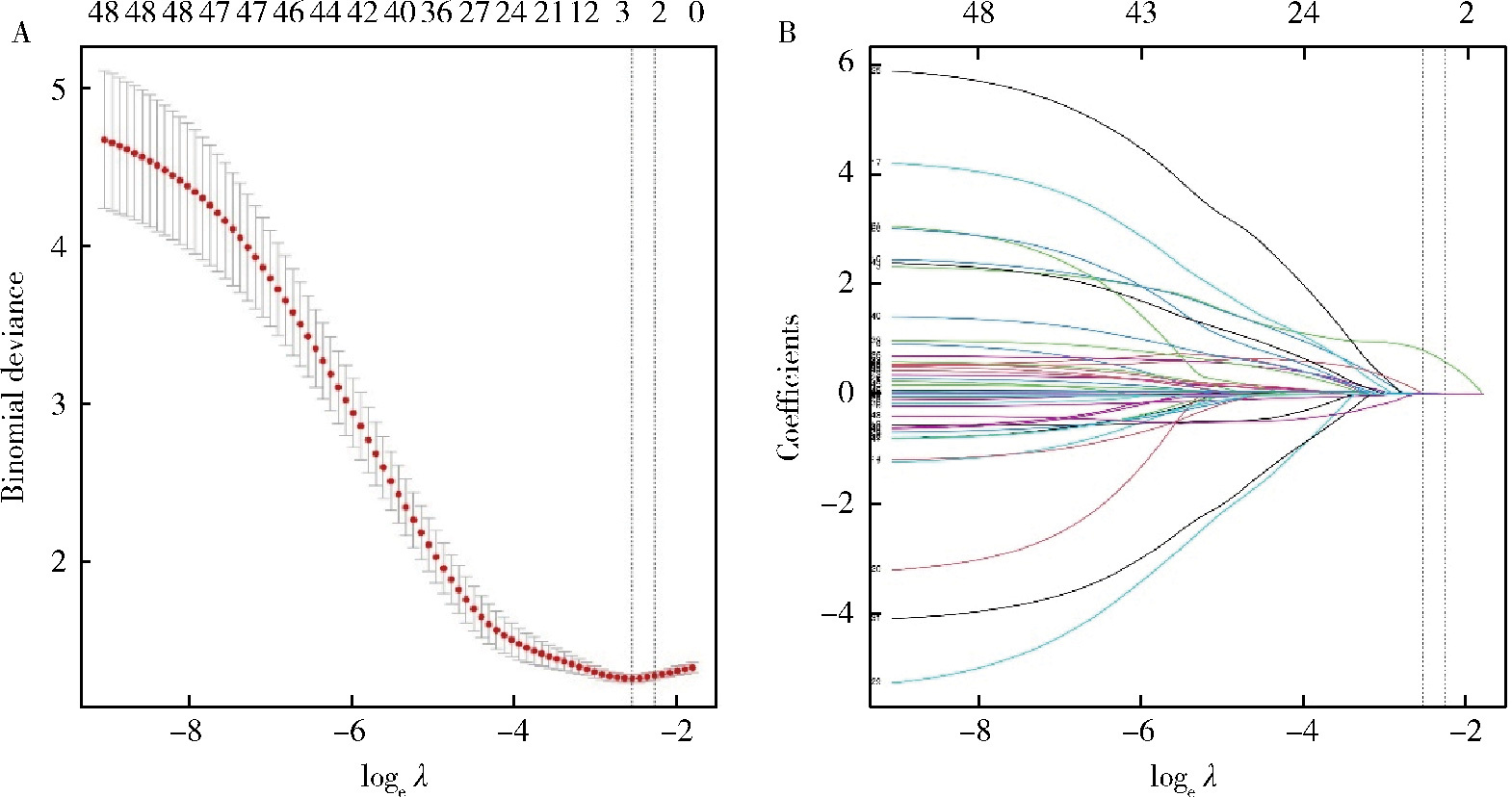
图2

Lasso回归系数惩罚图"

表3

Logistic回归模型多因素分析"

Predictor Estimate SE Z P Odds ratio Lower Upper
(Intercept) -2.773 0.783 -3.543 0.000 0.062 0.012 0.268
ISS score 0.067 0.026 2.550 0.011 1.069 1.017 1.128
Tracheostomy 1.608 0.499 3.224 0.001 4.995 1.928 13.904
1
中华医学会呼吸病学分会感染学组. 中国成人医院获得性肺炎与呼吸机相关性肺炎诊断和治疗指南(2018年版)[J]. 中华结核和呼吸杂志, 2018, 41 (4): 255- 280.
2
Bonell A , Azarrafiy R , Huong VTL , et al. A systematic review and meta-analysis of ventilator-associated pneumonia in adults in Asia: An analysis of national income level on incidence and etiology[J]. Clin Infect Dis, 2019, 68 (3): 511- 518.

doi: 10.1093/cid/ciy543
3
Johnstone J , Muscedere J , Dionne J , et al. Definitions, rates and associated mortality of ICU-acquired pneumonia: A multicenter cohort study[J]. J Crit Care, 2023, 75, 154284.

doi: 10.1016/j.jcrc.2023.154284
4
Papazian L , Klompas M , Luyt CE . Ventilator-associated pneumonia in adults: A narrative review[J]. Intensive Care Med, 2020, 46 (5): 888- 906.

doi: 10.1007/s00134-020-05980-0
5
Koulenti D , Arvaniti K , Judd M , et al. Ventilator-associated tracheobronchitis: To treat or not to treat?[J]. Antibiotics (Basel), 2020, 9 (2): 51.

doi: 10.3390/antibiotics9020051
6
Kalanuria AA , Ziai W , Mirski M . Ventilator-associated pneumonia in the ICU[J]. Crit Care, 2014, 18 (2): 208.

doi: 10.1186/cc13775
7
Hayashi Y , Morisawa K , Klompas M , et al. Toward improved surveillance: The impact of ventilator-associated complications on length of stay and antibiotic use in patients in intensive care units[J]. Clin Infect Dis, 2013, 56 (4): 471- 477.

doi: 10.1093/cid/cis926
8
Park DR . The microbiology of ventilator-associated pneumonia[J]. Respir Care, 2005, 50 (6): 742- 763.

doi: 10.4187/respcare.05500742
9
El-Saed A , Balkhy HH , Al-Dorzi HM , et al. Acinetobacter is the most common pathogen associated with late-onset and recurrent ventilator-associated pneumonia in an adult intensive care unit in Saudi Arabia[J]. Int J Infect Dis, 2013, 17 (9): e696- e701.

doi: 10.1016/j.ijid.2013.02.004
10
Chaudhary U , Ranjan N , Ranjan KP . Ventilator-associated pneumonia in a tertiary care intensive care unit: Analysis of incidence, risk factors and mortality[J]. Indian J Crit Care Med, 2014, 18 (4): 200- 204.

doi: 10.4103/0972-5229.130570
11
Charles MP , Easow JM , Joseph NM , et al. Aetiological agents of ventilator-associated pneumonia and its resistance pattern: A threat for treatment[J]. Australas Med J, 2013, 6 (9): 430- 434.

doi: 10.4066/AMJ.2013.1710
12
Craven DE , Steger KA . Ventilator-associated bacterial pneumo-nia: Challenges in diagnosis, treatment, and prevention[J]. New Horiz, 1998, 6 (Suppl 2): S30- S45.
13
Cook A , Norwood S , Berne J . Ventilator-associated pneumonia is more common and of less consequence in trauma patients compared with other critically ill patients[J]. J Trauma, 2010, 69 (5): 1083- 1091.
14
Younan D , Delozier SJ , Adamski J , et al. Factors predictive of ventilator-associated pneumonia in critically ill trauma patients[J]. World J Surg, 2020, 44 (4): 1121- 1125.

doi: 10.1007/s00268-019-05286-3
15
Patel N , Modi C , Singh S . Risk factors for ventilator associated pneumonia in patients with trauma and head injury in a tertiary care teaching hospital of rural Gujarat[J]. J Med Allied Sci, 2021, 11 (2): 137.

doi: 10.5455/jmas.42509
16
Darvishi-Khezri H , Alipour A , Emami Zeydi A , et al. Is type 2 diabetes mellitus in mechanically ventilated adult trauma patients potentially related to the occurrence of ventilator-associated pneumonia?[J]. J Res Med Sci, 2016, 21, 19.
17
Leone M , Delliaux S , Bourgoin A , et al. Risk factors for late-onset ventilator-associated pneumonia in trauma patients receiving selective digestive decontamination[J]. Intensive Care Med, 2005, 31 (1): 64- 70.

doi: 10.1007/s00134-004-2514-z
18
Jovanovic B , Milan Z , Markovic-Denic L , et al. Risk factors for ventilator-associated pneumonia in patients with severe traumatic brain injury in a Serbian trauma centre[J]. Int J Infect Dis, 2015, 38, 46- 51.

doi: 10.1016/j.ijid.2015.07.005
19
Mangram AJ , Sohn J , Zhou N , et al. Trauma-associated pneumonia: Time to redefine ventilator-associated pneumonia in trauma patients[J]. Am J Surg, 2015, 210 (6): 1056- 1061.

doi: 10.1016/j.amjsurg.2015.06.029
20
Park HO , Kang DH , Moon SH , et al. Risk factors for pneumonia in ventilated trauma patients with multiple rib fractures[J]. Korean J Thorac Cardiovasc Surg, 2017, 50 (5): 346- 354.

doi: 10.5090/kjtcs.2017.50.5.346
21
Arumugam SK , Mudali I , Strandvik G , et al. Risk factors for ventilator-associated pneumonia in trauma patients: A descriptive analysis[J]. World J Emerg Med, 2018, 9 (3): 203- 210.

doi: 10.5847/wjem.j.1920-8642.2018.03.007
22
Bochicchio GV , Napolitano L , Joshi M , et al. Blood product transfusion and ventilator-associated pneumonia in trauma patients[J]. Surg Infect (Larchmt), 2008, 9 (4): 415- 422.

doi: 10.1089/sur.2006.069
23
Robba C , Rebora P , Banzato E , et al. Incidence, risk factors, and effects on outcome of ventilator-associated pneumonia in patients with traumatic brain injury: Analysis of a large, multicenter, prospective, observational longitudinal study[J]. Chest, 2020, 158 (6): 2292- 2303.

doi: 10.1016/j.chest.2020.06.064
24
Li Y , Liu C , Xiao W , et al. Incidence, risk factors, and outcomes of ventilator-associated pneumonia in traumatic brain injury: A meta-analysis[J]. Neurocrit Care, 2020, 32 (1): 272- 285.

doi: 10.1007/s12028-019-00773-w
25
Li L , Yuan W , Zhang S , et al. Analysis of risk factors for pneumonia in 482 patients undergoing oral cancer surgery with tracheo-tomy[J]. J Oral Maxillofac Surg, 2016, 74 (2): 415- 419.

doi: 10.1016/j.joms.2015.08.018
26
Marra A , Vargas M , Buonanno P , et al. Early vs. late tracheostomy in patients with traumatic brain injury: Systematic review and meta-analysis[J]. J Clin Med, 2021, 10 (15): 3319.

doi: 10.3390/jcm10153319
27
Qiu Y , Yin Z , Wang Z , et al. Early versus late tracheostomy in stroke-related patients: A systematic review and meta-analysis[J]. J Clin Neurosci, 2023, 114, 48- 54.

doi: 10.1016/j.jocn.2023.06.004
28
Altinsoy S , Catalca S , Sayin MM , et al. The risk factors of ventilator associated pneumonia and relationship with type of tracheostomy[J]. Trends Anaesth Crit Care, 2020, 35, 38- 43.
29
Pawlik J , Tomaszek L , Mazurek H , et al. Risk factors and protective factors against ventilator-associated pneumonia: A single-center mixed prospective and retrospective cohort study[J]. J Pers Med, 2022, 12 (4): 597.

doi: 10.3390/jpm12040597
30
Ding C , Zhang Y , Yang Z , et al. Incidence, temporal trend and factors associated with ventilator-associated pneumonia in mainland China: A systematic review and meta-analysis[J]. BMC Infect Dis, 2017, 17 (1): 468.

doi: 10.1186/s12879-017-2566-7
31
Chaari A , Kssibi H , Zribi W , et al. Ventilator-associated pneumonia in trauma patients with open tracheotomy: Predictive factors and prognosis impact[J]. J Emerg Trauma Shock, 2013, 6 (4): 246- 251.

doi: 10.4103/0974-2700.120364
32
Gunalan A , Sistla S , Ramanathan V , et al. Early- vs late-onset ventilator-associated pneumonia in critically ill adults: Comparison of risk factors, outcome, and microbial profile[J]. Indian J Crit Care Med, 2023, 27 (6): 411- 415.

doi: 10.5005/jp-journals-10071-24465
33
Male PV , Kashyap MK , Bora RA , et al. Ventilator associated pneumonia (VAP) in an intensive care unit of a tertiary care hospital: Incidence, their microbial etiology, risk factors and role of multidrug resistant pathogens[J]. Indian J Appl Res, 2017, 7 (2): 214- 216.
[1] 魏慧, 张警丰, 姚中强, 赵金霞. 类风湿关节炎合并慢性病贫血患者的临床特征及相关因素[J]. 北京大学学报(医学版), 2026, 58(2): 307-312.
[2] 郭芷均, 俎明, 马超, 张贺军, 张静, 丁士刚. 同时性多发早期胃癌漏诊病灶的临床病理特征[J]. 北京大学学报(医学版), 2026, 58(2): 410-415.
[3] 李博闻, 张强, 孙益鑫. 儿童及青年漏斗胸患者Nuss术后发生脊柱侧弯的风险预测模型建立及验证[J]. 北京大学学报(医学版), 2025, 57(5): 941-946.
[4] 杨小勇, 张帆, 马潞林, 刘承. 前列腺导管腺癌临床特征及腺外侵犯的影响因素[J]. 北京大学学报(医学版), 2025, 57(5): 956-960.
[5] 刘伟, 郭稳, 过哲, 李春艳, 李云龙, 刘思奇, 张亮, 宋慧. 痛风患者放射学阴性骨侵蚀的相关危险因素[J]. 北京大学学报(医学版), 2025, 57(4): 735-739.
[6] 陆梦溪, 刘秋萍, 周恬静, 刘晓非, 孙烨祥, 沈鹏, 林鸿波, 唐迅, 高培. 基于社区人群队列的甘油三酯-葡萄糖指数与心血管病发病和死亡的关联[J]. 北京大学学报(医学版), 2025, 57(3): 430-435.
[7] 杨龙傲, 金旭, 黄文初, 何丽华, 陈娟. 视屏作业人员视疲劳及干眼的流行病学调查[J]. 北京大学学报(医学版), 2025, 57(3): 554-561.
[8] 郭华秋, 王哲, 杨雪, 白洁. 口腔急诊出血患者的临床特征与危险因素[J]. 北京大学学报(医学版), 2025, 57(1): 142-147.
[9] 邓敏婷, 王楠, 夏斌, 赵玉鸣, 朱俊霞. 儿童及青少年挫入恒前牙自行再萌出的相关影响因素[J]. 北京大学学报(医学版), 2025, 57(1): 148-153.
[10] 李钰锴, 王红彦, 罗靓, 李云, 李春. 抗磷脂抗体在白塞病合并血栓中的临床意义[J]. 北京大学学报(医学版), 2024, 56(6): 1036-1040.
[11] 田杨, 韩永正, 李娇, 王明亚, 曲音音, 房景超, 金辉, 李民, 王军, 徐懋, 王圣林, 郭向阳. 颈椎前路手术后硬膜外血肿的发生率和危险因素[J]. 北京大学学报(医学版), 2024, 56(6): 1058-1064.
[12] 王明瑞, 赖金惠, 姬家祥, 唐鑫伟, 胡浩浦, 王起, 许克新, 徐涛, 胡浩. 使用中文版威斯康星结石生活质量问卷预测肾结石患者生活质量降低的危险因素[J]. 北京大学学报(医学版), 2024, 56(6): 1069-1074.
[13] 李志存, 吴天俣, 梁磊, 范宇, 孟一森, 张骞. 穿刺活检单针阳性前列腺癌术后病理升级的危险因素分析及列线图模型构建[J]. 北京大学学报(医学版), 2024, 56(5): 896-901.
[14] 颜野,李小龙,夏海缀,朱学华,张羽婷,张帆,刘可,刘承,马潞林. 前列腺癌根治术后远期膀胱过度活动症的危险因素[J]. 北京大学学报(医学版), 2024, 56(4): 589-593.
[15] 陈延,李况蒙,洪锴,张树栋,程建星,郑仲杰,唐文豪,赵连明,张海涛,姜辉,林浩成. 阴茎海绵体注射试验对阴茎血管功能影响的回顾性研究[J]. 北京大学学报(医学版), 2024, 56(4): 680-686.
Viewed
Full text


Abstract

Cited

  Shared   
  Discussed   
No Suggested Reading articles found!