Journal of Peking University (Health Sciences) ›› 2025, Vol. 57 ›› Issue (4): 650-661. doi: 10.19723/j.issn.1671-167X.2025.04.004

Previous Articles     Next Articles

Clinicopathological features and survival analysis of TFE3-rearranged renal cell carcinoma with venous tumor thrombus

Zhanyi ZHANG1, Min LU2,3, Yuehao SUN1, Jinghan DONG1, Xiaofei HOU1, Chunlei XIAO1, Guoliang WANG1, Xiaojun TIAN1, Lulin MA1, Hongxian ZHANG1, Shudong ZHANG1,4,*()   

  1. 1. Department of Urology, Peking University Third Hospital, Beijing 100191, China
    2. Department of Pathology, Peking University Third Hospital, Beijing 100191, China
    3. Department of Pathology, Peking University School of Basic Medical Sciences, Beijing 100191, China
    4. Cancer Center, Peking University Third Hospital, Beijing 100191, China
  • Received:2025-02-28 Online:2025-08-18 Published:2025-08-02
  • Contact: Shudong ZHANG
  • Supported by:
    the National Natural Science Foundation of China(82273389); the Beijing Natural Science Foundation(7232212)

RICH HTML


Abstract:

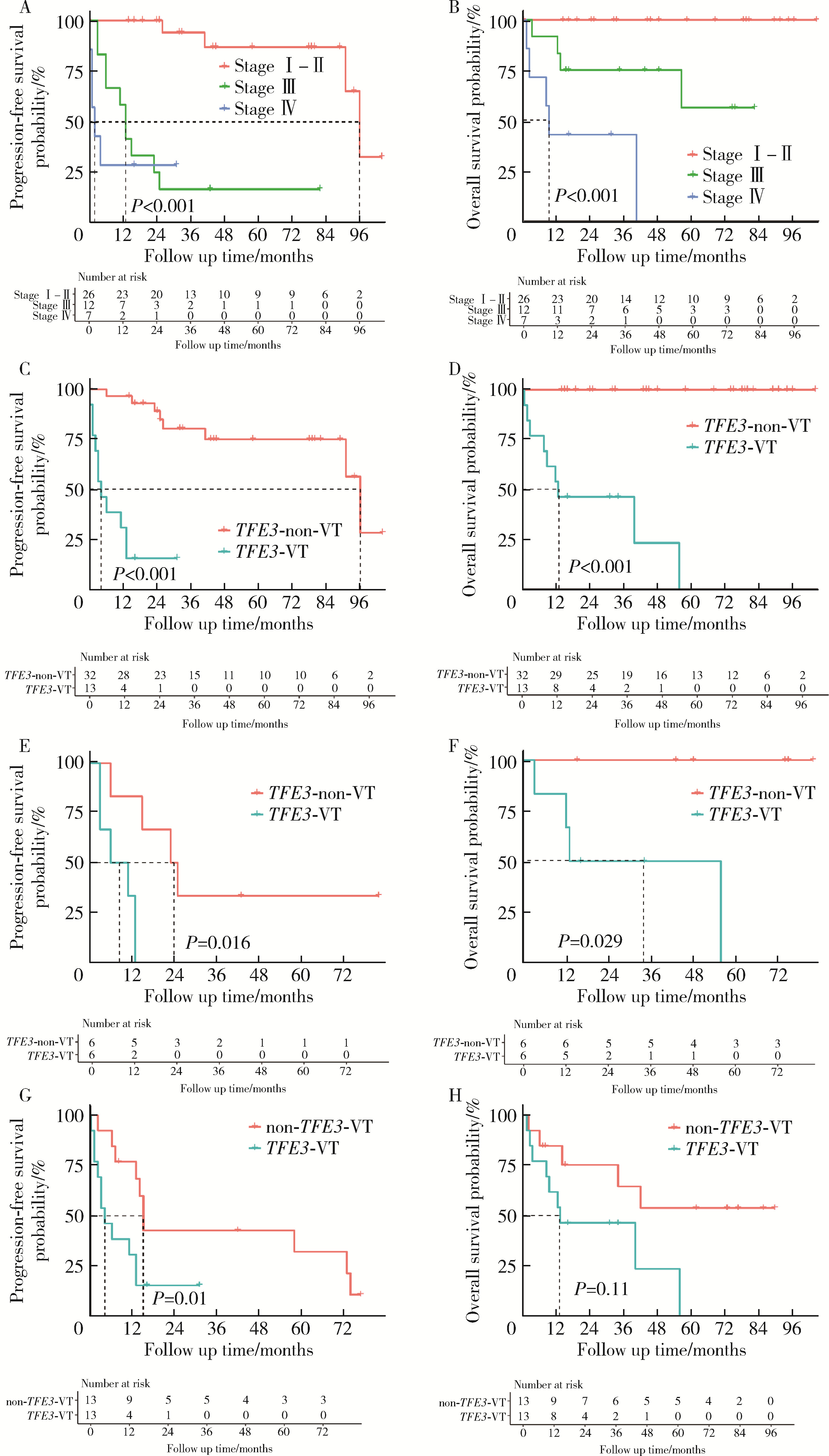
Objective: To review the clinicopathological features of TFE3-rearranged renal cell carcinoma (TFE3-RCC) with venous tumor thrombus (VT) (TFE3-VT), to explore treatment strategies and to prognostic characteristics, and to provide diagnostic and therapeutic references for TFE3-VT patients. Methods: Patients who underwent surgery at Department of Urology, Peking University Third Hospital from January 2013 to January 2024 were enrolled, including three cohorts: Pathologically confirmed TFE3-VT patients, TFE3-RCC patients without VT (TFE3-non-VT), and non-TFE3-rearranged renal cell carcinoma patients with VT (non-TFE3-VT). Clinical history, imaging data, pathological data, and follow-up records were collected. Primary and secondary endpoints were progression-free survival (PFS) and overall survival (OS), respectively. (1) Baseline characteristics were compared between the TFE3-VT and TFE3-non-VT patients. Normally distributed continuous variables were expressed as mean±SD and compared using Student's t-test; non-normally distributed variables were expressed as M (P25, P75) and analyzed with Mann-Whitney U test; categorical variables were described as frequency and percentage [n (%)] and compared by χ2 test or Fisher's exact test. (2) Clinical history, radiological presentations, surgical data, and histopathological features of the TFE3-VT patients were comprehensively characterized. (3) Survival analysis was performed for the TFE3-VT patients. Follow-up data of the TFE3-VT patients were described in detail, and their survival outcomes were compared with the TFE3-non-VT and non-TFE3-VT patients. When compared with the TFE3-non-VT counterparts, Kaplan-Meier method was used to generate PFS and OS curves among: (1) the TFE3-RCC patients across clinical stages Ⅰ-Ⅳ; (2) TFE3-VT versus TFE3-non-VT cohorts; (3) stage Ⅲ subgroups of the TFE3-VT and TFE3-non-VT patients. Intergroup survival differences were statistically evaluated using Log-rank tests. For comparisons with the non-TFE3-VT patients, a 1 : 1 propensity score matching (PSM) was implemented to balance baseline characteristics between the two cohorts. Post-matching Kaplan-Meier curves were generated to compare PFS and OS between the matched groups, with Log-rank tests employed to determine statistical significance of survival disparities. All statistical analyses were conducted with R software (v 4.2.3), and two-tailed P < 0.05 was considered statistically significant. Results: The study included 45 TFE3-RCC patients: 13 TFE3-VT and 32 TFE3-non-VT cases. Additionally, 523 non-TFE3-VT patients were enrolled. Among the 13 TFE3-VT patients, 9 were female (69.2%) and 4 male (30.8%), with a mean age of (37.9±14.4) years, mean BMI of (22.2 ± 3.5) kg/m2, median age-adjusted Charlson comorbidity index (aCCI) of 1.0 (0.0, 1.0), and preoperative creatinine level of (75.3±15.9) μmol/L; tumors were located in the left kidney in 7 patients (53.8%) and right kidney in 6 (46.2%); preoperative distant metastasis (M1 stage) was present in 6 patients (46.2%), while 7 (53.8%) showed no metastasis; VT distribution by Mayo level comprised 7 cases (53.8%) at level 0, 1 case each at levels Ⅰ and Ⅳ (7.7% respectively), and 2 cases each at levels Ⅱ and Ⅲ (15.4% respectively); surgical approaches comprised open surgery (n=2, 15.4%), laparoscopic surgery (n=6, 46.1%), and robot-assisted laparoscopic surgery (n=5, 38.5%); mean operative time was (273±79) min, and intraoperative blood loss was (722±570) mL; mean maximum tumor diameter was (10.8±2.4) cm. All the 13 patients underwent TFE3 protein immunohistochemistry (IHC) staining, with 7 confirmed by fluorescence in situ hybridization (FISH). Tumor recurrence or metastasis occurred in 11 patients (84.6%), and 9 (69.2%) patients died during follow-up. Median PFS was 4 months (1 year PFS rate: 31%), and median OS was 13 months (1 year OS rate: 54%). Survival analysis of 45 TFE3-RCC patients revealed statistically significant differences in PFS and OS across all the clinical stages (P < 0.001). The TFE3-VT patients exhibited significantly worse PFS and OS than the TFE3-non-VT patients (P < 0.001), with persistent significance in stage Ⅲ subgroup analysis (P < 0.05). After PSM, TFE3-VT patients showed significantly inferior PFS compared with non-TFE3-VT (P=0.01), though no significant difference was shown between the OS curves (P=0.11). Conclusion: TFE3-VT predominantly occurs in young females with frequent preoperative metastases. Strongly-positive staining of TFE3 protein in IHC staining and red-green split signals in FISH tests are reliable diagnostic markers. TFE3-VT patients exhibit inferior survival compared with TFE3-non-VT patients and earlier progression than non-TFE3-VT patients.

Key words: Renal cell carcinoma, TFE3 gene, Venous tumor thrombus, Immunohistochemical staining, Fluorescence in situ hybridization

CLC Number: 

  • R737.11

Table 1

Baseline characteristics of 45 TFE3 -RCC patients with or without VT"

Items TFE3-VT (n=13) TFE3-non-VT (n=32) P value
Age/years, ${\bar x}$±s 37.9 ±14.4 36.0 ±13.1 0.662
Gender, n (%) 0.638
  Male 4 (30.8) 14 (43.8)
  Female 9 (69.2) 18 (56.2)
BMI/(kg/m2), ${\bar x}$±s 22.2 ±3.5 24.8 ±3.4 0.023*
aCCI, M (P25, P75) 1.0 (0.0, 1.0) 0.0 (0.0, 1.0) 0.376
ASA level, n (%) 0.840
  1 7 (53.8) 20 (62.5)
  2 6 (46.2) 12 (37.5)
Cr/(μmoL/L), ${\bar x}$±s 75.3 ±15.9 75.6±16.6 0.953
Laterality, n (%) 0.924
  Left 7 (53.8) 15 (46.9)
  Right 6 (46.2) 17 (53.1)
Surgical approach, n (%) < 0.001*
  Laparoscopic 2 (15.4) 23 (71.9)
  Open 6 (46.1) 0 (0.0)
  Robotic 5 (38.5) 9 (28.1)
Operative time/min, M (P25, P75) 292.0 (194.0, 320.0) 138.0 (109.8, 167.8) < 0.001*
Blood loss/mL, M (P25, P75) 600.0 (300.0, 1 100.0) 40.0 (17.5, 100.0) < 0.001*
RBC transfusion/mL, M (P25, P75) 0.0 (0.0, 600.0) 0.0 (0.0, 0.0) < 0.001*
Clavien-Dindo level, n (%) 0.031*
  0-Ⅰ 9 (69.2) 31 (96.9)
  Ⅱ 4 (30.8) 1 (3.1)
Postoperative hospital stays/d, M (P25, P75) 9.0 (6.0, 14.0) 6.0 (5.0, 6.0) 0.009*
Tumor diameter/cm, M (P25, P75) 10.3 (9.6, 12.0) 4.4 (3.2, 6.5) < 0.001*
pT stage, n (%) < 0.001*
  pT1 0 (0.0) 23 (71.9)
  pT2 0 (0.0) 4 (12.5)
  pT3 11 (84.6) 5 (15.6)
  pT4 2 (15.4) 0 (0.0)
N1 stage, n (%) 5 (38.5) 3 (9.4) 0.060
M1 stage, n (%) 6 (46.2) 0 (0.0) < 0.001*
Clinical tumor stage, n (%) < 0.001*
  Stage Ⅰ 0 (0.0) 22 (68.8)
  Stage Ⅱ 0 (0.0) 4 (12.5)
  Stage Ⅲ 6 (46.2) 6 (18.8)
Stage Ⅳ 7 (53.8) 0 (0.0)
Nuclear grade, n (%) 0.003*
  Ⅰ-Ⅱ 0 (0.0) 17 (53.1)
  Ⅲ-Ⅳ 13 (100.0) 15 (46.9)
Sarcomatoid differentiation, n (%) 2 (15.4) 1 (3.1) 0.404

Table 2

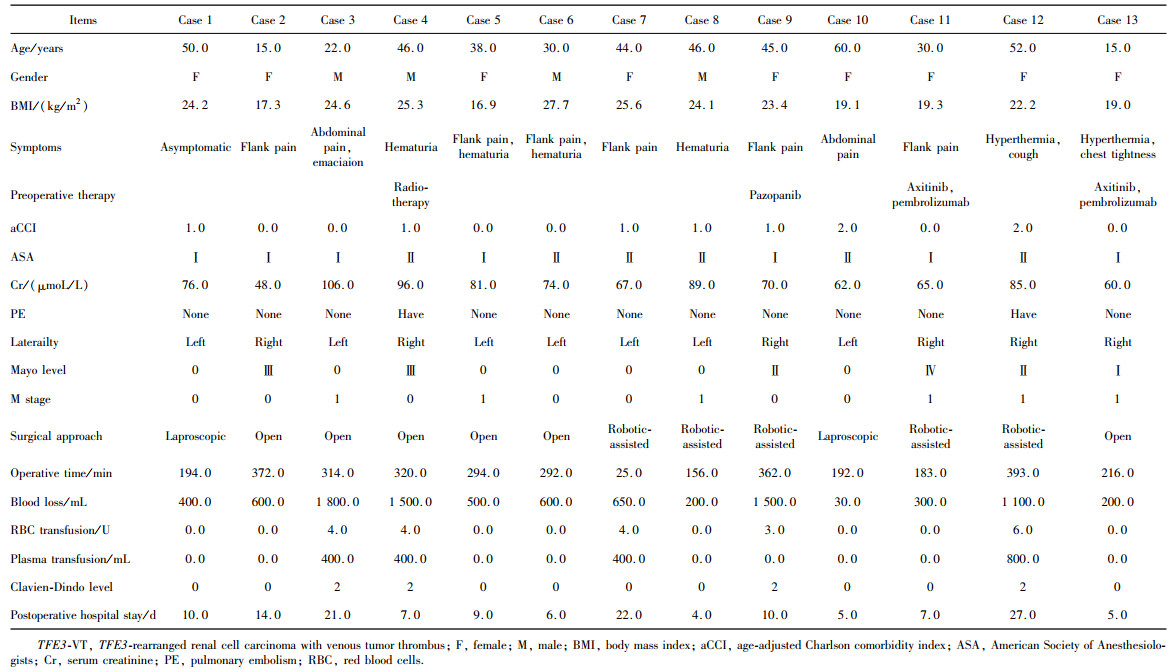
Clinical history, radiological tumor characteristics and surgical data of 13 TFE3-VT patients"

Figure 1

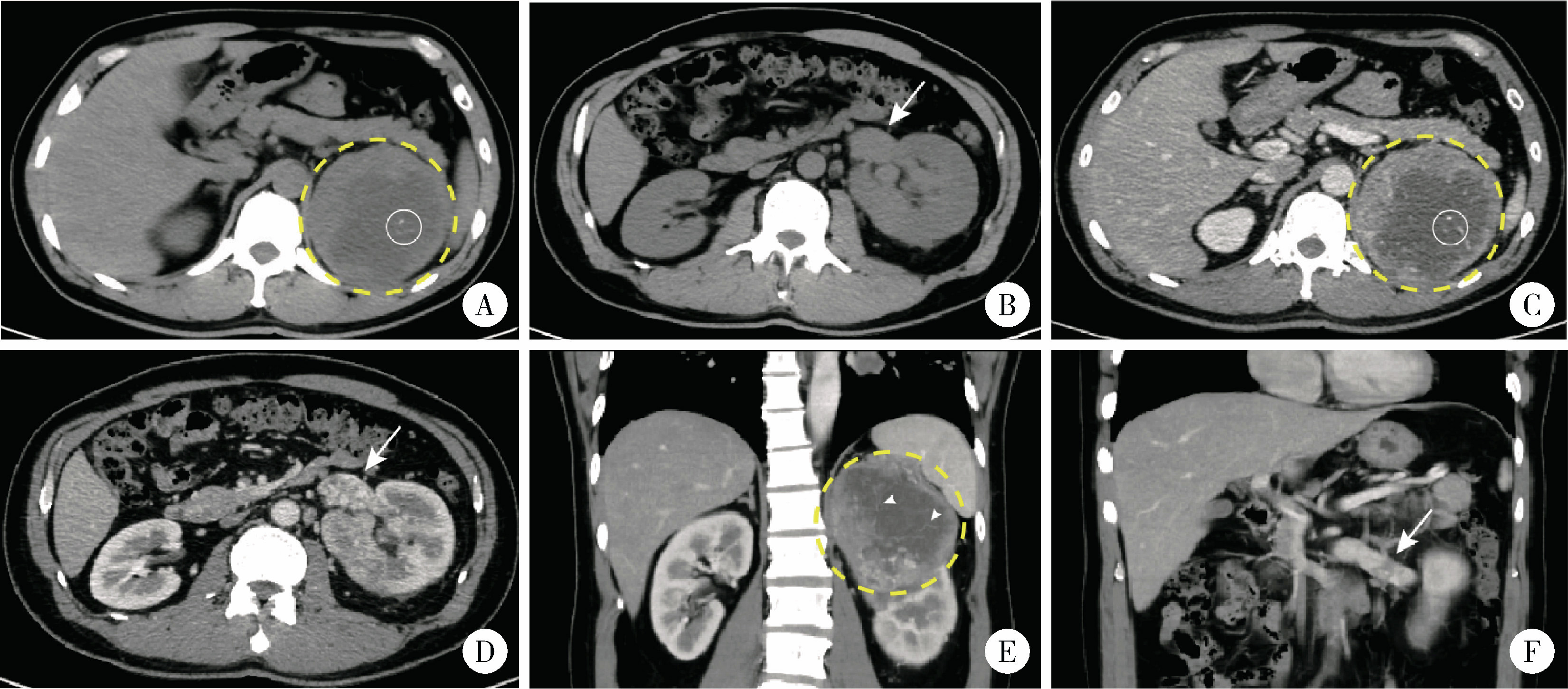
Contrast-enhanced CT images from a left-sided TFE3 -rearranged renal cell carcinoma patient combined with Mayo level 0 renal vein thrombus (case 8) A, B, 9.4×9.6×9.5 cm mass was identified in the upper pole of the left kidney, the margin of the mass was well-defined; on non-contrast CT scan, the mass (yellow circle with dashed line) demonstrated heterogeneous soft tissue density (50-70 HU) with patchy areas of low density (30-40 HU); central punctate calcifications were observed within the lesion (white circle with solid line); the left renal vein was dilated (white arrow, axial plane). C, D, on contrast-enhanced CT imaging (arterial phase), the solid components of the mass showed marked heterogeneous enhancement (80-120 HU), while the cystic areas within the lesion exhibited no obvious enhancement; tumor thrombus was identified within the renal vein (white arrow), measuring approximately 3.7 cm in length (axial plane). E, F, on contrast-enhanced CT imaging (arterial phase), multiple fine septations were visible within the cystic areas and demonstrated enhancement (white arrow head); the perirenal fascia was compressed, and the lesion was in close proximity to the left adrenal gland and spleen; the left renal vein exhibited a filling defect and indicated tumor thrombus (white arrow); no significantly enlarged lymph nodes were seen (coronal plane)."

Table 3

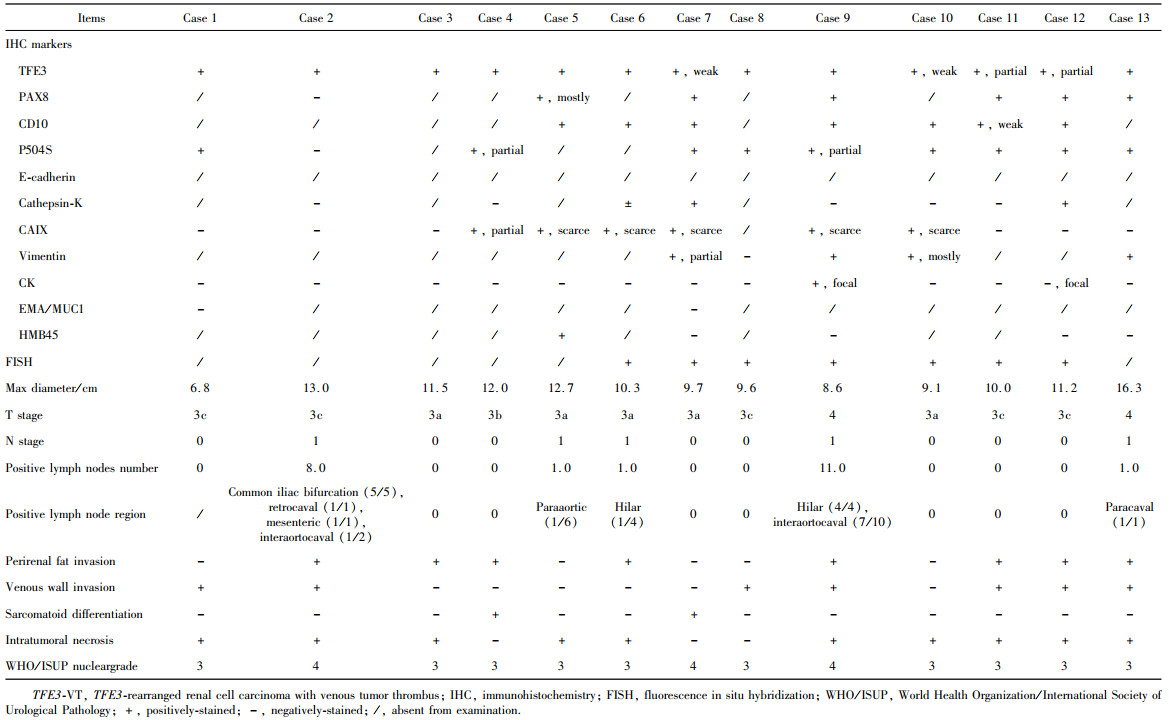
Histopathological features of 13 TFE3-VT patients"

Figure 2

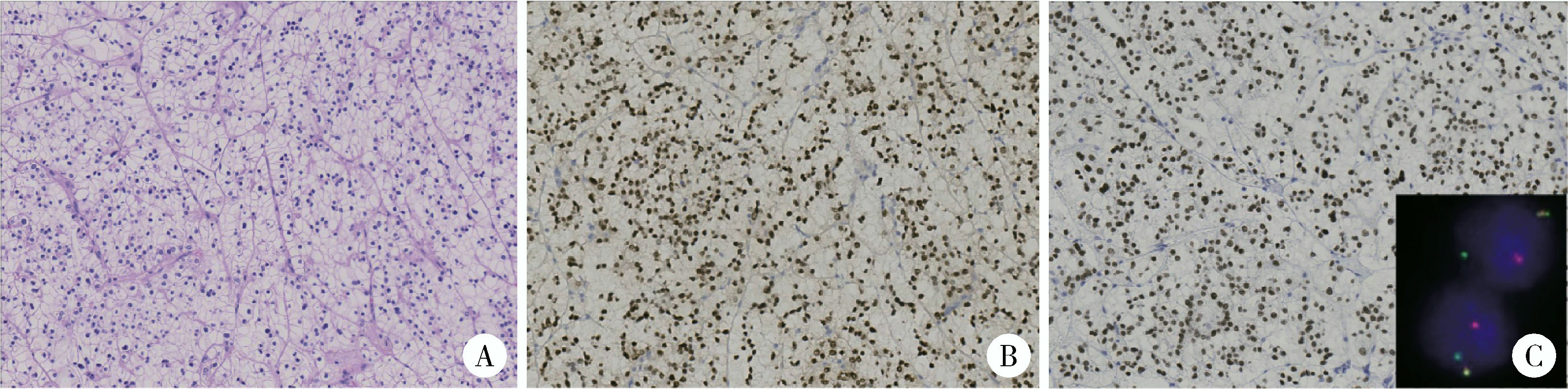
Pathological images from a left-sided TFE3-rearranged renal cell carcinoma patient with Mayo level Ⅱ inferior vena cava thrombus (case 9) A, Hematoxylin-Eosin staining (×200), tumor cells exhibit clear cytoplasm arranged in a sheet-like pattern; B, immunohistochemistry staining of PAX-8 (×200), staining of tumor cell nuclei was strongly positive for PAX-8; C, immunohistochemistry staining of TFE3 protein (×200), staining of tumor cell nuclei was strongly positive for TFE3, FISH-TFE3 showed red-green split signals (inset)."

Table 4

Postoperative therapy and survival outcomes of 13 TFE3 -VT patients"

Items Case 1 Case 2 Case 3 Case 4 Case 5 Case 6 Case 7
Postoperative therapy TKI TKI TKI None TKI TKI TKI, ICI
Type of TKI Sunitinib, axitinib Sunitinib Sunitinib None Pazopanib NA Sunitinib, axitinib, anlotinib
Type of ICI None None None None None None Triprolizumab, bevacizumab (peritoneal perfusion)
Death + + + + + - +
Death reason Cancer NA Cancer Cancer Cancer None Cancer
OS/months 56 3 9 12 8 16 13
Progression + + + + + + +
Sites of tumor relapse or metastasis Lung, liver NA Abdominal wall, surgical region Lung, liver Liver Lung, liver Liver, peritoneum, omentum, retroperitoneal region
PFS/months 13 3 4 3 1 11 6
Items Case 8 Case 9 Case 10 Case 11 Case 12 Case 13
Postoperative therapy TKI TKI TKI TKI, radiotherapy, ICI None TKI, ICI
Type of TKI Sunitinib, axitinib Pazopanib Pazopanib Sunitinib, axitinib None Axitinib
Type of ICI None None None Pembrolizumab None Pembrolizumab
Death + + - - + -
Death reason Cancer Cancer None None Cancer None
OS/months 40 1 34 31 2 16
Progression + + + - + -
Sites of tumor relapse or metastasis Lung Liver, adrenal gland, abdominal wall Surgical region, cervical and mediastinal lymph nodes, lung None NA None
PFS/months 1 0 13 31 2 16

Figure 3

Kaplan-Meier curves of TFE3 -VT, TFE3 -non-VT, and non- TFE3 -VT A, B, progression free survival and overall survival curves of TFE3-RCC patients with different clinical tumor stage (2017 American Joint Committee on Cancer 8th version); C, D, progression free survival and overall survival curves of TFE3-VT and TFE3-non-VT patients; E, F, progression free survi-val and overall survival curves of stage Ⅲ TFE3 -VT and TFE3 -non-VT patients.; G, H, progression free survival and overall survival curves of TFE3 -VT and non-TFE3 -VT patients after 1 ∶ 1 propensity score matching. TFE3 -RCC, TFE3 -rearranged renal cell carcinoma; TFE3 -VT, TFE3 -rearranged renal cell carcinoma with venous tumor thrombus; TFE3 -non-VT, TFE3-rearranged renal cell carcinoma patients without VT; non-TFE3 -VT, non-TFE3 -rearranged renal cell carcinoma patients with VT."

Table 5

Distribution of matching factors before and after propensity score matching (PSM)"

Items Before PSM SMD After PSM SMD
TFE3-VT (n=13) non-TFE3-VT (n=523) TFE3-VT (n=13) non-TFE3-VT (n=13)
Age/years, n (%) 1.432 < 0.001
  ≤45 8 (61.5) 60 (11.5) 8 (61.5) 8 (61.5)
  >45-65 5 (38.5) 312 (59.7) 5 (38.5) 5 (38.5)
  >65 0 (0.0) 151 (28.9) 0 (0.0) 0 (0.0)
Gender, n (%) 0.857 < 0.001
  Male 4 (30.8) 367 (70.2) 4 (30.8) 4 (30.8)
  Female 9 (69.2) 156 (29.8) 9 (69.2) 9 (69.2)
M1 stage, n (%) 7 (53.8) 144 (27.5) 0.556 7 (53.8) 7 (53.8) < 0.001
Neoadjuvant therapy, n (%) 4 (30.8) 66 (12.6) 0.451 4 (30.8) 4 (30.8) < 0.001
1
Cheng J , Han Z , Mehra R , et al. Computational analysis of pathological images enables a better diagnosis of TFE3 Xp11.2 translocation renal cell carcinoma[J]. Nat Commun, 2020, 11 (1): 1778.
2
He J , Chen X , Gan W , et al. Renal cell carcinoma associated with Xp11.2 translocation/TFE3 gene fusions: Clinical experience and literature review[J]. Future Oncol, 2015, 11 (24): 3243- 3252.
3
Komai Y , Fujiwara M , Fujii Y , et al. Adult Xp11 translocation renal cell carcinoma diagnosed by cytogenetics and immunohistochemistry[J]. Clin Cancer Res, 2009, 15 (4): 1170- 1176.
4
Zhong M , de Angelo P , Osborne L , et al. Translocation renal cell carcinomas in adults: A single-institution experience[J]. Am J Surg Pathol, 2012, 36 (5): 654- 662.
5
Cheng X , Gan W , Zhang G , et al. Clinical characteristics of XP11.2 translocation/TFE3 gene fusion renal cell carcinoma: A systematic review and meta-analysis of observational studies[J]. BMC Urol, 2016, 16 (1): 40.
6
王军卫, 夏丹, 汪朔, 等. 成人Xp11.2/TFE3基因融合相关性肾细胞癌的临床病理特征及预后分析[J]. 中华泌尿外科杂志, 2022, 43 (3): 165- 170.
7
简远熙, 吴俊霖, 杨素萍. MiT家族易位性肾细胞癌的影像学表现[J]. 临床放射学杂志, 2022, 41 (7): 1379- 1383.
8
He J , Zhou K , Zhu B , et al. Dynamic contrast-enhanced CT characterization of Xp11.2 translocation/TFE3 gene fusions versus papillary renal cell carcinomas[J]. Biomed Res Int, 2015, 2015, 298679.
9
Nyhan SM , Kostibas MP . Assessing the incidence of perioperative pulmonary embolism and optimal timing of surgery based on pre-operative renal cell cancer tumor thrombus level and growth kine-tics: Avenues to explore[J]. J Cardiothorac Vasc Anesth, 2019, 33 (10): 2735- 2736.
10
Argani P . MiT family translocation renal cell carcinoma[J]. Semin Diagn Pathol, 2015, 32 (2): 103- 113.
11
黄艳, 王玉环, 丁丽红, 等. TFE3重排肾细胞癌16例临床病理特征及预后分析[J]. 诊断病理学杂志, 2024, 31 (8): 732- 736.
12
Zhao J , Tang Y , Hu X , et al. Patients with ASPSCR1-TFE3 fusion achieve better response to ICI based combination therapy among TFE3-rearranged renal cell carcinoma[J]. Mol Cancer, 2024, 23 (1): 132.
13
Cheng AV, Wu DJ, Friedman LA, et al. MAPK1IP1L: TFE3-rearranged renal cell carcinoma: A novel fusion adding to the differential diagnosis of oncocytic renal neoplasms [J]. Virchows Arch, 2025, 1(2025-01-25)[2025-01-30]. https://pubmed.ncbi.nlm.nih.gov/39862330.
14
Moch H , Amin MB , Berney DM , et al. The 2022 World Health Organization classification of tumours of the urinary system and male genital organs. Part A: Renal, penile, and testicular tumours[J]. Eur Urol, 2022, 82 (5): 458- 468.
15
Chen W , Wu M , Du L , et al. Upregulation of GSTP1 mediated by chimeric TFE3 promotes TFE3-tRCC progression by targeting JNK signaling pathway[J]. World J Surg Oncol, 2024, 22 (1): 352.
16
Méjean A , Ravaud A , Thezenas S , et al. Sunitinib alone or after nephrectomy for patients with metastatic renal cell carcinoma: Is there still a role for cytoreductive nephrectomy?[J]. Eur Urol, 2021, 80 (4): 417- 424.
17
Bex A , Mulders P , Jewett M , et al. Comparison of immediate vs deferred cytoreductive nephrectomy in patients with synchronous metastatic renal cell carcinoma receiving sunitinib: The SURTIME randomized clinical trial[J]. JAMA Oncol, 2019, 5 (2): 164- 170.
18
Sun G , Chen J , Liang J , et al. Integrated exome and RNA sequencing of TFE3-translocation renal cell carcinoma[J]. Nat Commun, 2021, 12 (1): 5262.
19
Bakouny Z , Sadagopan A , Ravi P , et al. Integrative clinical and molecular characterization of translocation renal cell carcinoma[J]. Cell Rep, 2022, 38 (1): 110190.
[1] Boda GUO, Min LU, Guoliang WANG, Hongxian ZHANG, Lei LIU, Xiaofei HOU, Lei ZHAO, Xiaojun TIAN, Shudong ZHANG. Clinicopathological and prognostic differences between clear cell and non-clear cell renal cell carcinoma with venous tumor thrombus [J]. Journal of Peking University (Health Sciences), 2025, 57(4): 644-649.
[2] Zezhen ZHOU, Liyuan GE, Fan ZHANG, Shaohui DENG, Ye YAN, Hongxian ZHANG, Guoliang WANG, Lei LIU, Yi HUANG, Shudong ZHANG. A retrospective matching study of partial nephrectomy and radical nephrectomy for pathological T3a stage renal cell carcinoma [J]. Journal of Peking University (Health Sciences), 2025, 57(4): 704-710.
[3] Binshuai WANG,Min QIU,Qianjin ZHANG,Maofeng TIAN,Lei LIU,Guoliang WANG,Min LU,Xiaojun TIAN,Shudong ZHANG. Experience in diagnosis and treatment of 6 cases of renal Ewing's sarcoma with venous thrombus [J]. Journal of Peking University (Health Sciences), 2024, 56(4): 636-639.
[4] Fan SHU,Yichang HAO,Zhanyi ZHANG,Shaohui DENG,Hongxian ZHANG,Lei LIU,Guoliang WANG,Xiaojun TIAN,Lei ZHAO,Lulin MA,Shudong ZHANG. Functional and oncologic outcomes of partial nephrectomy for cystic renal cell carcinoma: A single-center retrospective study [J]. Journal of Peking University (Health Sciences), 2024, 56(4): 667-672.
[5] Zezhen ZHOU,Shaohui DENG,Ye YAN,Fan ZHANG,Yichang HAO,Liyuan GE,Hongxian ZHANG,Guoliang WANG,Shudong ZHANG. Predicting the 3-year tumor-specific survival in patients with T3a non-metastatic renal cell carcinoma [J]. Journal of Peking University (Health Sciences), 2024, 56(4): 673-679.
[6] Yun-chong LIU,Zong-long WU,Li-yuan GE,Tan DU,Ya-qian WU,Yi-meng SONG,Cheng LIU,Lu-lin MA. Mechanism of nuclear protein 1 in the resistance to axitinib in clear cell renal cell carcinoma [J]. Journal of Peking University (Health Sciences), 2023, 55(5): 781-792.
[7] Dong LAN,Zhuo LIU,Yu-xuan LI,Guo-liang WANG,Xiao-jun TIAN,Lu-lin MA,Shu-dong ZHANG,Hong-xian ZHANG. Risk factors for massive hemorrhage after radical nephrectomy and removal of venous tumor thrombus [J]. Journal of Peking University (Health Sciences), 2023, 55(5): 825-832.
[8] Yun-yi XU,Zheng-zheng SU,Lin-mao ZHENG,Meng-ni ZHANG,Jun-ya TAN,Ya-lan YANG,Meng-xin ZHANG,Miao XU,Ni CHEN,Xue-qin CHEN,Qiao ZHOU. Read-through circular RNA rt-circ-HS promotes hypoxia inducible factor 1α expression and renal carcinoma cell proliferation, migration and invasiveness [J]. Journal of Peking University (Health Sciences), 2023, 55(2): 217-227.
[9] Qi SHEN,Yi-xiao LIU,Qun HE. Mucinous tubular and spindle cell carcinoma of kidney: Clinicopathology and prognosis [J]. Journal of Peking University (Health Sciences), 2023, 55(2): 276-282.
[10] Quan ZHANG,Hai-feng SONG,Bing-lei MA,Zhe-nan ZHANG,Chao-hui ZHOU,Ao-lin LI,Jun LIU,Lei LIANG,Shi-yu ZHU,Qian ZHANG. Pre-operative prognostic nutritional index as a predictive factor for prognosis in non-metastatic renal cell carcinoma treated with surgery [J]. Journal of Peking University (Health Sciences), 2023, 55(1): 149-155.
[11] Mei-ni ZUO,Yi-qing DU,Lu-ping YU,Xiang DAI,Tao XU. Correlation between metabolic syndrome and prognosis of patients with clear cell renal cell carcinoma [J]. Journal of Peking University (Health Sciences), 2022, 54(4): 636-643.
[12] Tian-yu CAI,Zhen-peng ZHU,Chun-ru XU,Xing JI,Tong-de LV,Zhen-ke GUO,Jian LIN. Expression and significance of fibroblast growth factor receptor 2 in clear cell renal cell carcinoma [J]. Journal of Peking University (Health Sciences), 2022, 54(4): 628-635.
[13] Er-shu BO,Peng HONG,Yu ZHANG,Shao-hui DENG,Li-yuan GE,Min LU,Nan LI,Lu-lin MA,Shu-dong ZHANG. Clinicopathological features and prognostic analysis of papillary renal cell carcinoma [J]. Journal of Peking University (Health Sciences), 2022, 54(4): 615-620.
[14] Cai-peng QIN,Yu-xuan SONG,Meng-ting DING,Fei WANG,Jia-xing LIN,Wen-bo YANG,Yi-qing DU,Qing LI,Shi-jun LIU,Tao XU. Establishment of a mutation prediction model for evaluating the efficacy of immunotherapy in renal carcinoma [J]. Journal of Peking University (Health Sciences), 2022, 54(4): 663-668.
[15] Yu TIAN,Xiao-yue CHENG,Hui-ying HE,Guo-liang WANG,Lu-lin MA. Clinical and pathological features of renal cell carcinoma with urinary tract tumor thrombus: 6 cases report and literature review [J]. Journal of Peking University (Health Sciences), 2021, 53(5): 928-932.
Viewed
Full text


Abstract

Cited

  Shared   
  Discussed   
No Suggested Reading articles found!