北京大学学报(医学版) ›› 2025, Vol. 57 ›› Issue (3): 456-464. doi: 10.19723/j.issn.1671-167X.2025.03.008

• 论著 • 上一篇    下一篇

肥胖指标与DNA甲基化时钟关系的纵向双生子研究

刘顺恺1,2, 曹卫华1,2, 吕筠1,2, 余灿清1,2, 黄涛1,2, 孙点剑一1,2, 廖春晓1,2, 庞元捷1,2, 胡润华1,2, 高汝钦3, 俞敏4, 周金意5, 吴先萍6, 刘彧7, 高文静1,2,*(), 李立明1,2   

  1. 1. 北京大学公共卫生学院流行病与卫生统计学系, 北京 100191
    2. 重大疾病流行病学教育部重点实验室(北京大学), 北京 100191
    3. 青岛市疾病预防控制中心, 山东青岛 266033
    4. 浙江省疾病预防控制中心, 杭州 310051
    5. 江苏省疾病预防控制中心, 南京 210008
    6. 四川省疾病预防控制中心, 成都 610041
    7. 黑龙江省疾病预防控制中心, 哈尔滨 150090
  • 收稿日期:2025-02-08 出版日期:2025-06-18 发布日期:2025-06-13
  • 通讯作者: 高文静
  • 基金资助:
    国家自然科学基金(82373659); 国家自然科学基金(82073633); 国家自然科学基金(81573223); 公益性行业科研专项(201502006); 公益性行业科研专项(201002007)

Association between DNA methylation clock and obesity-related indicators: A longitudinal twin study

Shunkai LIU1,2, Weihua CAO1,2, Jun LV1,2, Canqing YU1,2, Tao HUANG1,2, Dianjianyi SUN1,2, Chunxiao LIAO1,2, Yuanjie PANG1,2, Runhua HU1,2, Ruqin GAO3, Min YU4, Jinyi ZHOU5, Xianping WU6, Yu LIU7, Wenjing GAO1,2,*(), Liming LI1,2   

  1. 1. Department of Epidemiology and Biostatistics, Peking University School of Public Health, Beijing 100191, China
    2. Key Laboratory of Epidemiology of Major Diseases (Peking University), Ministry of Education, Beijing 100191, China
    3. Qingdao Center for Disease Control and Prevention, Qingdao 266033, Shandong, China
    4. Zhejiang Center for Disease Control and Prevention, Hangzhou 310051, China
    5. Jiangsu Center for Disease Control and Prevention, Nanjing 210008, China
    6. Sichuan Center for Disease Control and Prevention, Chengdu 610041, China
    7. Heilongjiang Center for Disease Control and Prevention, Harbin 150090, China
  • Received:2025-02-08 Online:2025-06-18 Published:2025-06-13
  • Contact: Wenjing GAO
  • Supported by:
    National Natural Science Foundation of China(82373659); National Natural Science Foundation of China(82073633); National Natural Science Foundation of China(81573223); Special Fund for Health Science Research in the Public Welfare(201502006); Special Fund for Health Science Research in the Public Welfare(201002007)

RICH HTML


摘要:

目的: 探讨肥胖相关指标与DNA甲基化时钟及其加速指标之间的关系,并分析两者在时间上的先后顺序。方法: 研究数据来源于中国双生子登记系统在2013年和2017—2018年开展的两次专题调查。通过Illumina Infinium人类甲基化450K芯片和EPIC芯片测定外周血DNA甲基化数据,并采用DNA甲基化年龄计算器(https://dnamage.genetics.ucla.edu/)或研究者提供的R代码计算DNA甲基化时钟指标GrimAA、PCGrimAA和DunedinPACE。肥胖指标包括体重、体重指数(body mass index,BMI)、腰围、腰臀比、腰高比。横断面分析纳入1 070名双生子,对内分析同卵双生子378对,异卵双生子155对,采用混合效应模型分析肥胖指标与DNA甲基化时钟及其加速指标的相关性。纵向分析纳入314名双生子,对内分析同卵双生子95对,异卵双生子62对,采用交叉滞后模型进一步探索肥胖与DNA甲基化时钟指标间的时间顺序关联。上述分析均分别在全部双生子和同卵、异卵双生子对内进行。结果: 横断面分析人群中同卵双生子占71.0%,男性占68.0%,平均实足年龄为(49.9±12.1)岁;纵向分析人群中同卵双生子占60.5%,男性占60.8%;基线平均实足年龄为(50.4±10.2)岁,平均随访时间(4.6±0.6)年。除随访时腰臀比均值高于基线外,其他肥胖指标基线与随访均值差异无统计学意义。相关性分析显示,在全部双生子中,体重、BMI、腰围、腰臀比、腰高比均与DunedinPACE时钟呈正相关,其中腰高比与DunedinPACE时钟的关联最为显著(β=0.21,95%CI:0.11~0.31);体重和BMI均与GrimAA呈负相关(β=-0.03,95%CI:-0.05~-0.01; β=-0.07,95%CI:-0.12~-0.02),体重与PCGrimAA呈负相关(β=-0.02,95%CI:-0.03~0.00);但双生子对内分析中的相关性未达到统计学显著水平。交叉滞后分析显示,基线体重升高可能引起随访时GrimAA增加,基线体重、BMI和腰围升高可能引起随访时PCGrimAA增加,基线腰臀比升高可能引起随访时DunedinPACE升高。结论: 肥胖指标与DNA甲基化时钟指标存在相关,基线肥胖指标对随访时部分DNA甲基化时钟指标的变化具有影响,肥胖可能通过加速DNA甲基化时钟和衰老进程对个体健康产生长期影响,但二者间的关联受双生子共享的遗传或环境因素影响。

关键词: 肥胖, DNA甲基化, 衰老, 双生子研究, 遗传后成说

Abstract:

Objective: To explore the relationship between obesity indicators and DNA methylation clocks acceleration, and to analyze their temporal sequence. Methods: Data were obtained from two surveys conducted in 2013 and 2017-2018 by the Chinese National Twin Registry. Peripheral blood DNA methylation data were measured using the Illumina Infinium Human Methylation 450K BeadChip and EPIC BeadChip. DNA methylation clocks/acceleration metrics (GrimAA, PCGrimAA and DunedinPACE) were calculated using the DNA methylation online tool (https://dnamage.genetics.ucla.edu/) or R code provided by researchers. Obesity indicators included weight, body mass index (BMI), waist circumference, waist-hip ratio, and waist-height ratio. A total of 1 070 twin individuals were included in the cross-sectional analysis, comprising 378 monozygotic (MZ) twin pairs and 155 dizygotic (DZ) twin pairs for within-pair analysis. Mixed-effects models were used to examine the associations between obesity indicators and DNA methylation clocks, as well as their acceleration measures. The longitudinal analysis included 314 twin individuals, comprising 95 MZ twin pairs and 62 DZ twin pairs for within-pair analysis. Cross-lagged panel models were applied to further explore the temporal relationships between obesity and DNA methylation clock indicators. All analyses were conducted both in the full twin sample and separately within MZ and DZ twin pairs. Results: In the cross-sectional analysis population, monozygotic twins accounted for 71.0%, males for 68.0%, and the mean chronological age was (49.9±12.1) years. In the longitudinal analysis population, monozygotic twins accounted for 60.5%, males for 60.8%, with a mean baseline chronological age of (50.4±10.2) years and a mean follow-up duration of (4.6±0.6) years. Except for the waist-to-hip ratio, which was significantly higher at follow-up compared with baseline, no statistically significant differences were observed in the means of other obesity indicators between baseline and follow-up. Correlation analysis revealed that weight, BMI, waist circumfe-rence, waist-hip ratio (WHR), and waist-height ratio (WHtR) were positively correlated with DunedinPACE in all the twins, with WHtR showing the strongest association (β=0.21, 95%CI: 0.11 to 0.31). Weight and BMI were negatively associated with GrimAA (β=-0.03, 95%CI: -0.05 to -0.01; β=-0.07, 95%CI: -0.12 to -0.02), while weight was negatively associated with PCGrim- AA (β=-0.02, 95%CI: -0.03 to 0.00). However, within-twin-pair analyses showed no statistically significant correlations. Cross-lagged panel model analysis indicated that higher baseline weight might lead to increased GrimAA at follow-up, while elevated baseline weight, BMI, and waist circumference might increase PCGrimAA. Higher baseline WHR was associated with increased DunedinPACE at follow-up. Conclusion: Obesity indicators correlate with DNA methylation clock acceleration metrics. Baseline obesity may influence changes in certain DNA methylation clock indicators over time, suggesting that obesity could exert long-term health effects by accelerating DNA methylation aging. However, these associations may be confounded by shared genetic or environmental factors among the twins.

Key words: Obesity, DNA methylation, Aging, Twin study, Genetic epigenesis

中图分类号: 

  • R181.33

表1

研究人群基本特征"

Characteristics Overall samples (n=1 070) Baseline (n=314) Follow-up (n=314) P value
Demographic characteristics
  Chronological age/years, ${\bar x}$±s 49.9±12.2 50.4±10.2 55.0±10.1 < 0.001
  Gender, n(%)
    Male 728 (68.0) 191 (60.8)
    Female 342 (32.0) 123 (39.2)
  Zygosity, n(%)
    MZ 760 (71.0) 190 (60.5)
    DZ 310 (29.0) 124 (39.5)
  Smoking status, n(%) 0.450
    Never smoked 585 (54.7) 190 (60.5) 188 (59.9)
    Former smoker 138 (12.9) 26 (8.3) 35 (11.1)
    Current smoker 347 (32.4) 98 (31.2) 91 (29.0)
  Alcohol consumption, n(%) < 0.001
    Never drank 549 (51.3) 148 (47.1) 89 (28.3)
    Former drinker 71 (6.6) 10 (3.2) 139 (44.3)
    Current drinker 450 (42.1) 156 (49.7) 86 (27.4)
  Physical activity level, n(%) < 0.001
    High 519 (48.5) 43 (13.7) 117 (37.3)
    Moderate 186 (17.4) 79 (25.2) 69 (22.0)
    Low 365 (34.1) 192 (61.1) 128 (40.8)
Obesity indicators
  Weight/kg, ${\bar x}$±s 65.0±12.1 62.3±11.6 62.4±11.4 0.899
  BMI/(kg/m2), ${\bar x}$±s 24.8±3.7 24.3±3.5 24.3±3.5 0.782
  Waist circumference/cm, ${\bar x}$±s 87.0±10.1 85.4±9.7 86.2±9.4 0.292
  Waist-hip ratio, ${\bar x}$±s 0.9 ±0.1 0.9±0.1 0.9±0.1 0.001
  Waist-height ratio, ${\bar x}$±s 0.5±0.1 0.5±0.1 0.5±0.1 0.260
  BMI classification, n(%) 0.962
    Underweight 35 (3.3) 14 (4.5) 16 (5.1)
    Normal 539 (50.9) 168 (54.4) 165 (52.9)
    Overweight 404 (38.2) 112 (36.2) 117 (37.5)
    Obese 80 (7.6) 15 (4.9) 14 (4.5)
  Central obesity, n(%) 1.000
    Yes 485 (45.5) 124 (39.5) 123 (39.2)
    No 582 (54.5) 190 (60.5) 191 (60.8)
DNAm clock
  GrimAA/years, ${\bar x}$±s 0.00±3.86 0.02±4.10 0.04±3.73 0.941
  DunedinPACE, ${\bar x}$±s 1.13±0.11 1.13±0.10 1.14±0.11 0.232
  PCGrimAA/years, ${\bar x}$±s 0.00±2.62 -0.15±2.71 0.15±2.71 0.175

表2

肥胖相关指标与GrimAA及PCGrimAA的横断面相关性"

Characteristics GrimAA (Model 1) GrimAA (Model 2) PCGrimAA (Model 3)
β(95%CI) PFDR β(95%CI) PFDR β(95%CI) PFDR
Weight -0.03 (-0.05, -0.01) 0.005 -0.03 (-0.05, -0.01) 0.006 -0.02 (-0.03, -0.00) 0.043
BMI -0.09 (-0.14, -0.03) 0.007 -0.07 (-0.12, -0.02) 0.024 -0.03 (-0.06, 0.01) 0.273
Waist circumference -0.02 (-0.04, 0.00) 0.071 -0.02 (-0.04, 0.00) 0.077 -0.01 (-0.02, 0.01) 0.512
Waist-hip ratio -0.87 (-3.93, 2.19) 0.577 -0.79 (-3.69, 2.11) 0.595 0.28 (-1.66, 2.22) 0.820
Waist-height ratio -2.69 (-5.91, 0.53) 0.119 -2.20 (-5.26, 0.85) 0.183 -0.24 (-2.28, 1.81) 0.820
Obesity -0.75 (-1.27, -0.24) 0.009 -0.58 (-1.07, -0.10) 0.044 -0.23 (-0.55, 0.09) 0.273
Central obesity -0.60 (-1.18, -0.03) 0.068 -0.56 (-1.11, -0.01) 0.077 -0.28 (-0.64, 0.08) 0.273

表3

肥胖相关指标与DunedinPACE的横断面相关性"

Characteristic Model 1 Model 2
β(95%CI) PFDR β(95%CI) PFDR
Weight 0.000 7 (0.000 1, 0.001 3) 0.028 0.000 7 (0.000 1, 0.001 3) 0.026
BMI 0.003 0 (0.001 4, 0.004 7) < 0.001 0.003 2 (0.001 5, 0.004 8) < 0.001
Waist circumference 0.001 1 (0.000 5, 0.001 7) < 0.001 0.001 1 (0.000 5, 0.001 7) 0.001
Waist-hip ratio 0.168 8 (0.073 9, 0.263 7) < 0.001 0.162 4 (0.068 0, 0.256 9) 0.001
Waist-height ratio 0.208 2 (0.108 4, 0.307 9) < 0.001 0.208 7 (0.109 5, 0.307 9) < 0.001
Obesity 0.033 4 (0.017 9, 0.048 9) < 0.001 0.035 8 (0.020 5, 0.051 0) < 0.001
Central obesity 0.024 8 (0.006 9, 0.042 7) 0.008 0.026 4 (0.008 8, 0.044 0) 0.004

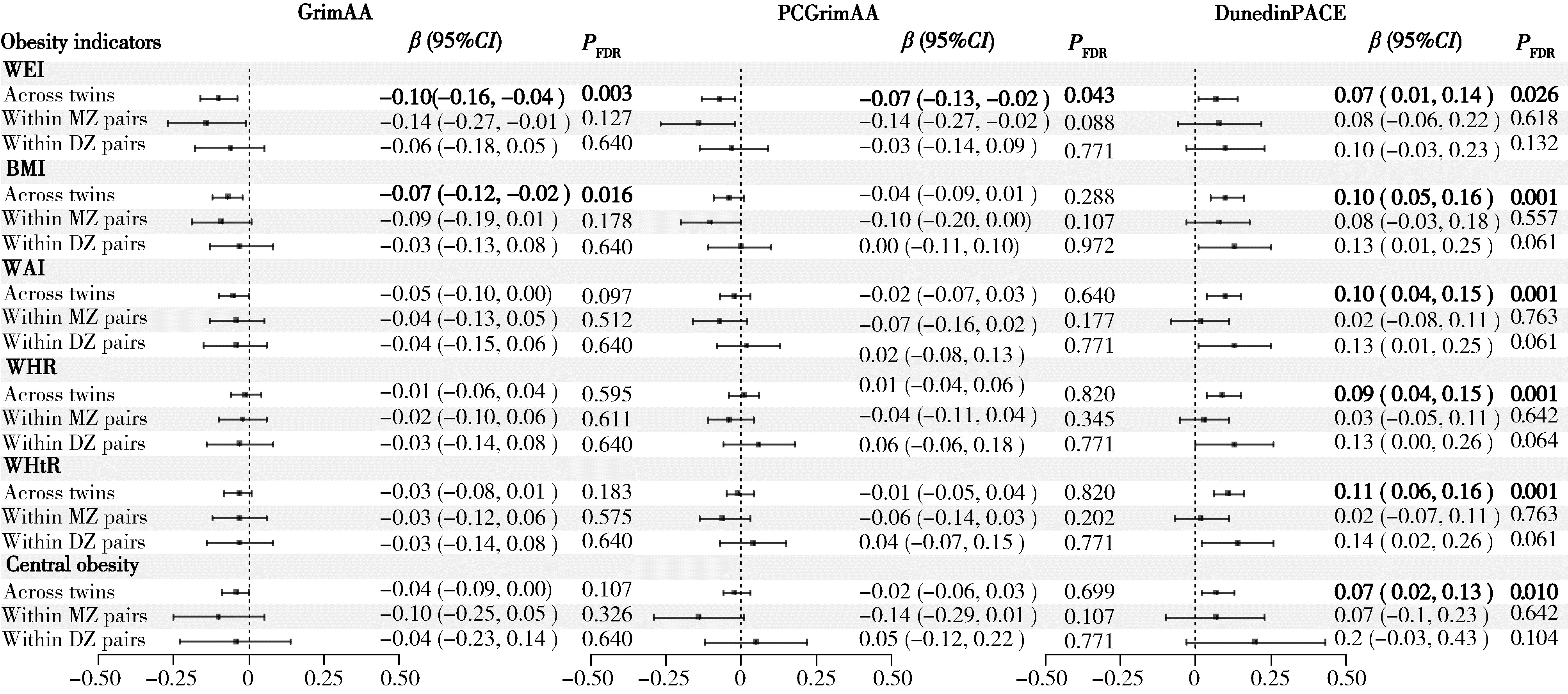
图1

全部双生子与对内分析中GrimAA、PCGrimAA和DunedinPACE与肥胖相关指标的横断面相关性"

表4

双生子肥胖相关指标与DNA甲基化时钟指标交叉滞后关联"

Characteristics Obesity indicators at baseline → DNAm clock metrics at follow-up DNAm clock metrics at baseline → Obesity indicators at follow-up Fit statistics
ρ1 PFDR ρ2 PFDR SRMR CFI
GrimAA
Weight 0.04 0.035 0.02 0.996 0.04 0.96
BMI 0.05 0.414 0.01 0.996 0.05 0.94
Waist circumference 0.03 0.250 0.01 0.996 0.05 0.92
Waist-hip ratio 2.46 0.414 0.00 0.996 0.05 0.88
Waist-height ratio 0.08 0.974 0.00 0.996 0.05 0.92
PCGrimAA
Weight 0.03 < 0.001 0.00 0.966 0.01 1.00
BMI 0.07 0.022 0.01 0.966 0.02 0.99
Waist circumference 0.02 0.040 0.02 0.966 0.02 0.98
Waist-hip ratio 0.95 0.542 0.00 0.966 0.03 0.97
Waist-height ratio 1.99 0.226 0.00 0.966 0.02 0.99
DunedinPACE
Weight 0.00 0.310 -1.06 0.999 0.02 1.00
BMI 0.00 0.310 0.14 0.999 0.02 1.00
Waist circumference 0.00 0.088 0.01 0.999 0.02 0.99
Waist-hip ratio 0.17 0.030 0.02 0.999 0.03 0.98
Waist-height ratio 0.12 0.088 0.01 0.999 0.02 1.00
1
Rutledge J , Oh H , Wyss-Coray T . Measuring biological age using omics data[J]. Nat Rev Genet, 2022, 23 (12): 715- 727.

doi: 10.1038/s41576-022-00511-7
2
Levine ME . Modeling the rate of senescence: Can estimated biological age predict mortality more accurately than chronological age?[J]. J Gerontol A Biol Sci Med Sci, 2013, 68 (6): 667- 674.

doi: 10.1093/gerona/gls233
3
Lu AT , Quach A , Wilson JG , et al. DNA methylation GrimAge strongly predicts lifespan and healthspan[J]. Aging, 2019, 11 (2): 303- 327.

doi: 10.18632/aging.101684
4
Belsky DW , Caspi A , Corcoran DL , et al. DunedinPACE, a DNA methylation biomarker of the pace of aging[J]. ELife, 2022, 11, e73420.

doi: 10.7554/eLife.73420
5
Higgins-Chen AT , Thrush KL , Wang Y , et al. A computational solution for bolstering reliability of epigenetic clocks: Implications for clinical trials and longitudinal tracking[J]. Nat Aging, 2022, 2 (7): 644- 661.

doi: 10.1038/s43587-022-00248-2
6
Pang APS , Higgins-Chen AT , Comite F , et al. Longitudinal study of DNA methylation and epigenetic clocks prior to and following test-confirmed COVID-19 and mRNA vaccination[J]. Front Genet, 2022, 13, 819749.

doi: 10.3389/fgene.2022.819749
7
Faul JD , Kim JK , Levine ME , et al. Epigenetic-based age acce-leration in a representative sample of older Americans: Associations with aging-related morbidity and mortality[J]. Proc Natl Acad Sci USA, 2023, 120 (9): e2215840120.

doi: 10.1073/pnas.2215840120
8
Xu S , Lu F , Gao J , et al. Inflammation-mediated metabolic regulation in adipose tissue[J]. Obes Rev, 2024, 25 (6): e13724.

doi: 10.1111/obr.13724
9
Xu L , Yan X , Zhao Y , et al. Macrophage polarization mediated by mitochondrial dysfunction induces adipose tissue inflammation in obesity[J]. Int J Mol Sci, 2022, 23 (16): 9252.

doi: 10.3390/ijms23169252
10
Kitada M , Koya D . Autophagy in metabolic disease and ageing[J]. Nat Rev Endocrinol, 2021, 17 (11): 647- 661.

doi: 10.1038/s41574-021-00551-9
11
Grun LK , Teixeira NDR Jr , Mengden LV , et al. TRF1 as a major contributor for telomeres' shortening in the context of obesity[J]. Free Radic Biol Med, 2018, 129, 286- 295.

doi: 10.1016/j.freeradbiomed.2018.09.039
12
Gielen M , Hageman GJ , Antoniou EE , et al. Body mass index is negatively associated with telomere length: A collaborative cross-sectional meta-analysis of 87 observational studies[J]. Am J Clin Nutr, 2018, 108 (3): 453- 475.

doi: 10.1093/ajcn/nqy107
13
Blüher M . An overview of obesity-related complications: The epidemiological evidence linking body weight and other markers of obesity to adverse health outcomes[J]. Diabetes Obes Metab, 2025, 27 (Suppl 2): 3- 19.
14
Lin WY , Wang YC , Teng IH , et al. Associations of five obesity metrics with epigenetic age acceleration: Evidence from 2, 474 Taiwan Biobank participants[J]. Obesity (Silver Spring), 2021, 29 (10): 1731- 1738.

doi: 10.1002/oby.23255
15
Kresovich JK , Garval EL , Martinez Lopez AM , et al. Associations of body composition and physical activity level with multiple mea-sures of epigenetic age acceleration[J]. Am J Epidemiol, 2021, 190 (6): 984- 993.

doi: 10.1093/aje/kwaa251
16
Gao W , Cao W , Lv J , et al. The Chinese National Twin Registry: A 'gold mine' for scientific research[J]. J Intern Med, 2019, 286 (3): 299- 308.

doi: 10.1111/joim.12926
17
中华人民共和国卫生和计划生育委员会. WS/T428-2013成人体重判定[S]. 北京: 中国标准出版社, 2013.
18
Wang B , Gao W , Yu C , et al. Determination of zygosity in adult Chinese twins using the 450K methylation array versus questionnaire data[J]. PLoS One, 2015, 10 (4): e0123992.

doi: 10.1371/journal.pone.0123992
19
Ryan J , Wrigglesworth J , Loong J , et al. A systematic review and meta-analysis of environmental, lifestyle, and health factors asso-ciated with DNA methylation age[J]. J Gerontol A Biol Sci Med Sci, 2020, 75 (3): 481- 494.

doi: 10.1093/gerona/glz099
20
Li C , Wang Z , Hardy T , et al. Association of obesity with DNA methylation age acceleration in African American mothers from the InterGEN Study[J]. Int J Mol Sci, 2019, 20 (17): 4273.

doi: 10.3390/ijms20174273
21
Sun D , Zhang T , Su S , et al. Body mass index drives changes in DNA methylation: A longitudinal study[J]. Circ Res, 2019, 125 (9): 824- 833.

doi: 10.1161/CIRCRESAHA.119.315397
22
Etzel L , Hastings WJ , Hall MA , et al. Obesity and accelerated epigenetic aging in a high-risk cohort of children[J]. Sci Rep, 2022, 12 (1): 8328.

doi: 10.1038/s41598-022-11562-5
23
Li J , Wang W , Yang Z , et al. Causal association of obesity with epigenetic aging and telomere length: A bidirectional mendelian randomization study[J]. Lipids Health Dis, 2024, 23 (1): 78.

doi: 10.1186/s12944-024-02042-y
24
Lundgren S , Kuitunen S , Pietiläinen KH , et al. BMI is positively associated with accelerated epigenetic aging in twin pairs discor-dant for body mass index[J]. J Intern Med, 2022, 292 (4): 627- 640.

doi: 10.1111/joim.13528
25
Föhr T , Hendrix A , Kankaanpää A , et al. Metabolic syndrome and epigenetic aging: A twin study[J]. Int J Obes (Lond), 2024, 48 (6): 778- 787.

doi: 10.1038/s41366-024-01466-x
26
Tzanetakou IP , Katsilambros NL , Benetos A , et al. 'Is obesity linked to aging?': Adipose tissue and the role of telomeres[J]. Ageing Res Rev, 2012, 11 (2): 220- 229.

doi: 10.1016/j.arr.2011.12.003
27
Tam BT , Morais JA , Santosa S . Obesity and ageing: Two sides of the same coin[J]. Obes Rev, 2020, 21 (4): e12991.

doi: 10.1111/obr.12991
28
Pérez LM , Pareja-Galeano H , Sanchis-Gomar F , et al. 'Adipa-ging': Ageing and obesity share biological hallmarks related to a dysfunctional adipose tissue[J]. J Physiol, 2016, 594 (12): 3187- 3207.

doi: 10.1113/JP271691
29
Reyes-Farias M , Fos-Domenech J , Serra D , et al. White adipose tissue dysfunction in obesity and aging[J]. Biochem Pharmacol, 2021, 192, 114723.

doi: 10.1016/j.bcp.2021.114723
[1] 张依航, 蔡珊, 陈子玥, 刘云飞, 党佳佳, 师嫡, 李佳欣, 黄天彧, 宋逸. 基于RE-AIM框架儿童青少年近视与肥胖共病综合干预实施性研究结局指标的构建[J]. 北京大学学报(医学版), 2025, 57(3): 436-441.
[2] 李萍, 王海雪, 高晓, 韩亚静, 王辉, 王海俊, 牟莹莹. 基于移动健康技术对超重或肥胖孕妇体重管理的随机对照试验[J]. 北京大学学报(医学版), 2025, 57(3): 465-472.
[3] 刘慧丽, 闻蓓, 白雪, 陈明安, 李民. 体重校正腰围指数与疼痛的相关性:一项横断面研究[J]. 北京大学学报(医学版), 2025, 57(1): 178-184.
[4] 陈敬,单蕊,肖伍才,张晓蕊,刘峥. 青春期和成年早期自制力与抑郁症状和超重肥胖共病风险的关联:基于全国调查的十年前瞻性队列研究[J]. 北京大学学报(医学版), 2024, 56(3): 397-402.
[5] 吴一凡,玉应香,谢岚,张志达,常翠青. 不同体重指数青年男性的静息能量消耗特点及预测方程评价[J]. 北京大学学报(医学版), 2024, 56(2): 247-252.
[6] 陈楚云,孙蓬飞,赵静,贾佳,范芳芳,王春燕,李建平,姜一梦,霍勇,张岩. 北京社区人群促红细胞生成素相关因素及其与10年心血管疾病风险的关系[J]. 北京大学学报(医学版), 2023, 55(6): 1068-1073.
[7] 党佳佳,蔡珊,钟盼亮,王雅琪,刘云飞,师嫡,陈子玥,张依航,胡佩瑾,李晶,马军,宋逸. 室外夜间人工光暴露与中国9~18岁儿童青少年超重肥胖的关联[J]. 北京大学学报(医学版), 2023, 55(3): 421-428.
[8] 陈敬,肖伍才,单蕊,宋洁云,刘峥. DRD2基因rs2587552多态性对儿童肥胖干预效果的影响:一项前瞻性、平行对照试验[J]. 北京大学学报(医学版), 2023, 55(3): 436-441.
[9] 马涛,李艳辉,陈曼曼,马莹,高迪,陈力,马奇,张奕,刘婕妤,王鑫鑫,董彦会,马军. 青春期启动提前与儿童肥胖类型的关联研究: 基于横断面调查和队列调查[J]. 北京大学学报(医学版), 2022, 54(5): 961-970.
[10] 娄雪,廖莉,李兴珺,王楠,刘爽,崔若玫,徐健. 类风湿关节炎患者外周血TWEAK基因启动子区甲基化状态及其表达[J]. 北京大学学报(医学版), 2021, 53(6): 1020-1025.
[11] 朱忆颖,闵赛南,俞光岩. 局部注射环孢素A对非肥胖糖尿病小鼠下颌下腺分泌功能及炎症的影响[J]. 北京大学学报(医学版), 2021, 53(4): 750-757.
[12] 王兆年,高文静,王碧琦,曹卫华,吕筠,余灿清,逄增昌,丛黎明,汪华,吴先萍,刘彧,李立明. 成年双生子空腹血糖、糖化血红蛋白与全基因组DNA甲基化的相关性研究[J]. 北京大学学报(医学版), 2020, 52(3): 425-431.
[13] 那晓娜,朱珠,陈阳阳,王东平,王浩杰,宋阳,马晓川,王培玉,刘爱萍. 身体活动、静坐行为的时间分布与肥胖的关系[J]. 北京大学学报(医学版), 2020, 52(3): 486-491.
[14] 张晓圆,郭成成,玉应香,谢岚,常翠青. 高脂饲料诱导肥胖胰岛素抵抗大鼠模型的建立[J]. 北京大学学报(医学版), 2020, 52(3): 557-563.
[15] 郭成成,张晓圆,玉应香,谢岚,常翠青. 绿原酸对高脂饲料诱导的肥胖大鼠糖耐量及其曲线特征的影响[J]. 北京大学学报(医学版), 2020, 52(2): 269-274.
Viewed
Full text


Abstract

Cited

  Shared   
  Discussed   
No Suggested Reading articles found!