北京大学学报(医学版) ›› 2026, Vol. 58 ›› Issue (1): 145-152. doi: 10.19723/j.issn.1671-167X.2026.01.019

• 论著 • 上一篇    下一篇

基于数据库相似性检索的正颌外科手术规划技术流程可行性研究: 随机对照试验

于录*, 吴灵*, 刘筱菁*(), 李自力*()   

  1. 北京大学口腔医学院·口腔医院口腔颌面外科, 国家口腔医学中心, 国家口腔疾病临床医学研究中心, 口腔生物材料和数字诊疗装备国家工程研究中心, 北京 100081
  • 收稿日期:2025-10-13 出版日期:2026-02-18 发布日期:2026-01-05
  • 通讯作者: 刘筱菁, 李自力
  • 作者简介:

    * These authors contributed equally to this work

  • 基金资助:
    首都卫生发展科研专项(CFH2022-2-4104); 北京市自然科学基金(F2024202104); 北京市自然科学基金(L242111)

Feasibility study of a surgical planning protocol for orthognathic surgery utilizing similarity retrieval from database: A randomized controlled trial

Lu YU, Ling WU, Xiaojing LIU*(), Zili LI*()   

  1. Department of Oral and Maxillofacial Surgery, Peking University School and Hospital of Stomatology & National Center for Stomatology & National Clinical Research Center for Oral Diseases & National Engineering Research Center of Oral Biomaterials and Digital Medical Devices, Beijing 100081, China
  • Received:2025-10-13 Online:2026-02-18 Published:2026-01-05
  • Contact: Xiaojing LIU, Zili LI
  • Supported by:
    Capital's Funds for Health Improvement and Research(CFH2022-2-4104); Beijing Natural Science Foundation(F2024202104); Beijing Natural Science Foundation(L242111)

RICH HTML


摘要:

目的: 建立基于数据库相似性检索的正颌外科手术规划设计流程, 并通过随机对照研究评价该流程与专家手术方案设计的非劣效性。方法: 通过前瞻性随机对照试验研究, 纳入2023年6月至2024年6月于北京大学口腔医院颌面外科拟行正颌手术的患者60例(男性19例, 女性41例, 年龄18~35岁), 随机分为试验组(n=30)与对照组(n=30), 试验组手术方案通过数据库相似性检索的正颌外科手术规划流程制定, 对照组由专家根据临床经验制定, 手术实施均由一位专家完成。分别于术前和术后6个月对患者进行主观和客观评价: 主观评价指标包括患者及医生针对患者实际面型的视觉模拟评分(visual analogue scale, VAS)和FACE-Q量表(FACE questionnaire, FACE-Q)评分, 其中医生主观测评由5位正颌专业高年资医生完成; 客观评价指标包括头影测量指标, 即蝶鞍点-鼻根点-上齿槽座点(sella-nasion-A point, SNA)、蝶鞍点-鼻根点-下齿槽座点(sella-nasion-B point, SNB)、上齿槽座点-鼻根点-下齿槽座点(A point-nasion-B point, ANB), 以及面部对称性指标, 即软、硬组织区域均方根误差(root mean square error, RMSE)。结果: 试验组和对照组术后主观评价指标均较术前明显提升(P<0.05): 患者VAS评分分别提升30.10±19.67和25.43±24.48, 医生VAS评分分别提升28.19±10.21和26.71±7.90, 患者FACE-Q量表评分分别提升33.41±17.75和32.97±17.65, 医生FACE-Q量表评分分别提升37.75±11.60和38.63±10.23, 各评分提升程度在两组间差异均无统计学意义(P>0.05)。术后客观指标分析显示, 试验组和对照组头影测量指标SNA角分别为84.06°±3.73°和85.23°±3.71°, SNB角分别为81.78°±3.63°和83.51°±3.66°, ANB角分别为2.28°±1.09°和1.72°±1.25°, 两组均处于正常值范围, 且两组间差异无统计学意义(P>0.05);三维面部对称性指标RMSE均值, 试验组术前和术后分别为(10.39±2.83) mm和(8.35±2.72) mm, 对照组术前和术后分别为(8.55±4.95) mm和(7.59±3.56) mm, 术后均较术前明显改善(P<0.05), 且术后两组间差异无统计学意义(P>0.05)。结论: 基于数据库检索的相似头颅为依据的手术方案设计与经验丰富的专家方案相比, 在主、客观术后效果评价中均无明显差异, 满足非劣性。

关键词: 牙颌面畸形, 正颌外科, 计算机辅助设计, 数据库平台, 相似病例

Abstract:

Objective: To establish a surgical planning workflow for orthognathic surgery based on similarity retrieval from a historical patient database and to evaluate its non-inferiority with the expert's surgical plan through a randomized controlled trial. Methods: A prospective randomized controlled trial was conducted involving 60 patients (19 males, 41 females; aged 18-35 years) scheduled for orthognathic surgery in the Department of Oral and Maxillofacial Surgery at Peking University School of Stomatology between June 2023 and June 2024. Participants were randomly assigned to a test group (n=30) or a control group (n=30). In the test group, surgical plans were generated using a database-driven similarity retrieval process while in the control group plans were developed by the expert based on clinical expe-rience. All surgeries were performed by the same expert. Outcome measures assessed at 6 months post-operatively included both subjective and objective indicators. Subjective evaluations comprised patient and surgeon visual analogue scale (VAS) scores, and FACE questionnaire (FACE-Q) scores, with surgeon assessments conducted by five independent senior surgeons. Objective measures included cephalometric angles [sella-nasion-A point (SNA), sella-nasion-B point (SNB), A point-nasion-B point (ANB)] and root mean square error (RMSE) of facial symmetry regions. Results: Postoperative subjective assessments demonstrated significant improvements from baseline in both groups (all P < 0.05). Specifically, the VAS scores increased by 30.10±19.67 in the test group versus 25.43±24.48 in the control group as rated by the patients, and by 28.19±10.21 versus 26.71±7.90 as evaluated by the surgeons. Similarly, the FACE-Q scores showed marked enhancements, with patient-reported scores increasing by 33.41±17.75 in the test group and 32.97±17.65 in the control group, and surgeon-assessed scores improving by 37.75±11.60 versus 38.63±10.23, respectively. However, the magnitude of improvement in all these subjective measures did not differ significantly between the test and control groups (all P>0.05 for intergroup comparisons of the change scores). Analysis of postoperative objective measurements revealed that cephalometric values were within the normal range for both groups: SNA angle was 84.06°±3.73° in the test group compared with 85.23°±3.71° in the control group; SNB angle was 81.78°±3.63° versus 83.51°±3.66°; and ANB angle was 2.28°±1.09° versus 1.72°± 1.25°. No statistically significant differences were observed between the two groups for these cephalometric parameters (all P>0.05). Furthermore, three-dimensional facial symmetry, quantified by the average RMSE value, exhibited significant improvement postoperatively compared with preoperative levels [Test group: from (10.39±2.83) mm to (8.35±2.72) mm; Control group: from (8.55±4.95) mm to (7.59±3.56) mm; P < 0.05 for within-group comparisons]. The postoperative average RMSE values between the test and control groups were not statistically different (P>0.05). Conclusion: Surgical planning based on similarity retrieval from a historical database demonstrated non-inferiority when compared with the conventional expert-driven approach, as evidenced by the absence of statistically significant diffe-rences in both subjective and objective postoperative outcome measures.

Key words: Dentofacial deformities, Orthognathic surgery, Computer-aided design, Database platform, Similar cases

中图分类号: 

  • R782.2

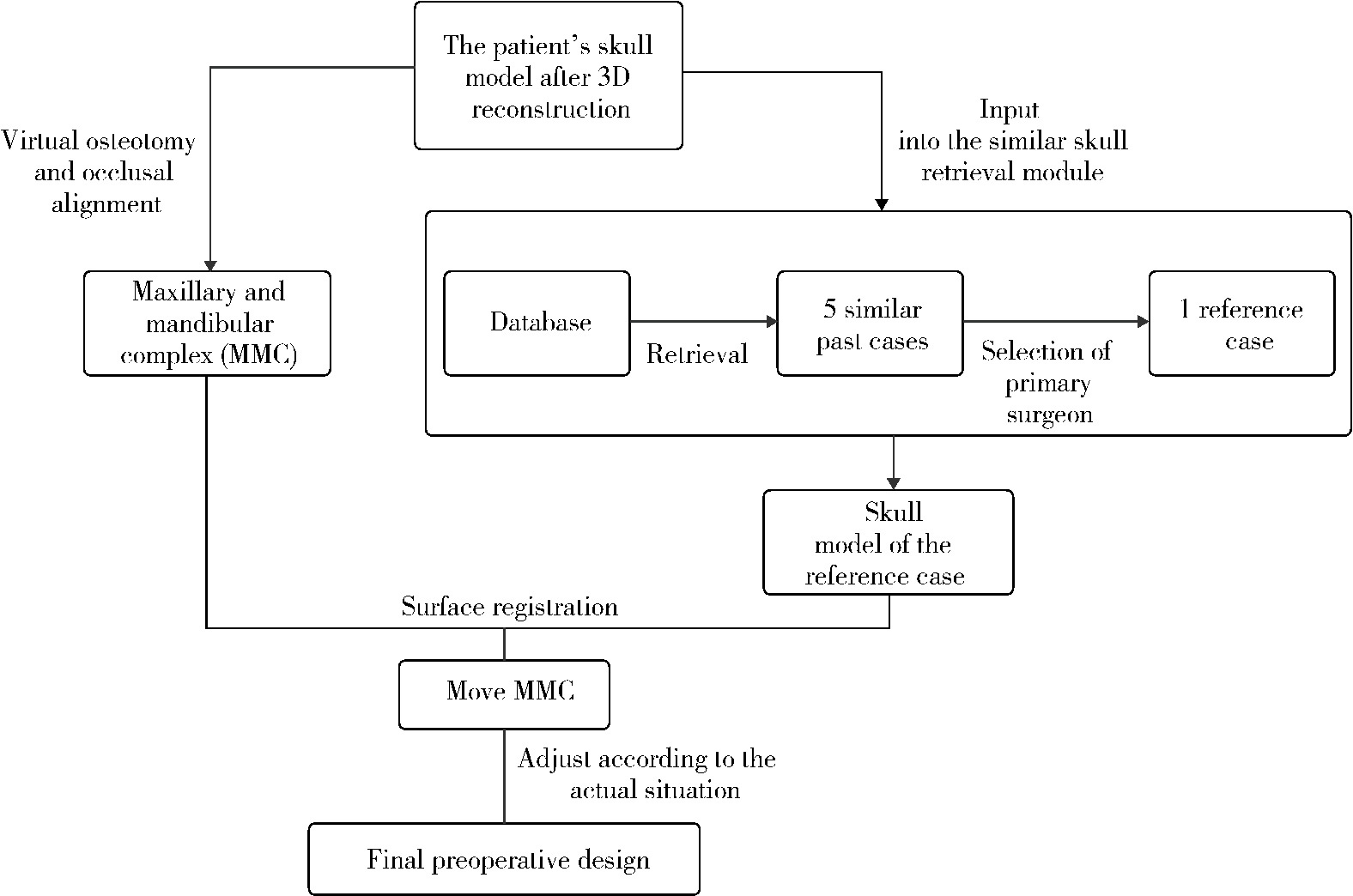
图1

以既往病例为参考的正颌外科手术方案设计流程"

图2

相似患者检索及其参考手术方案示例"

图3

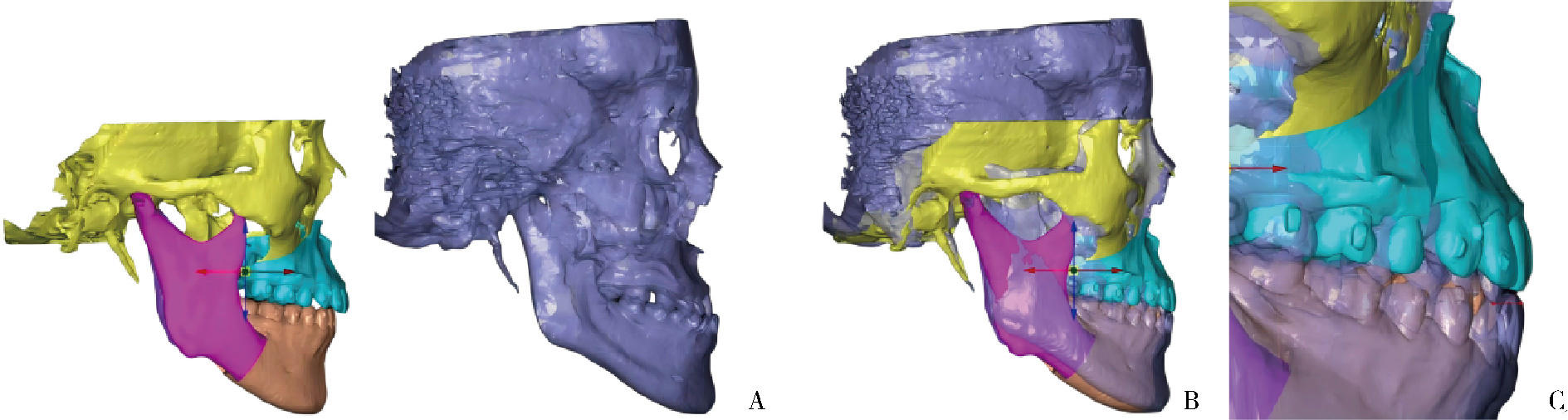
以既往病例为参考的正颌外科手术方案设计"

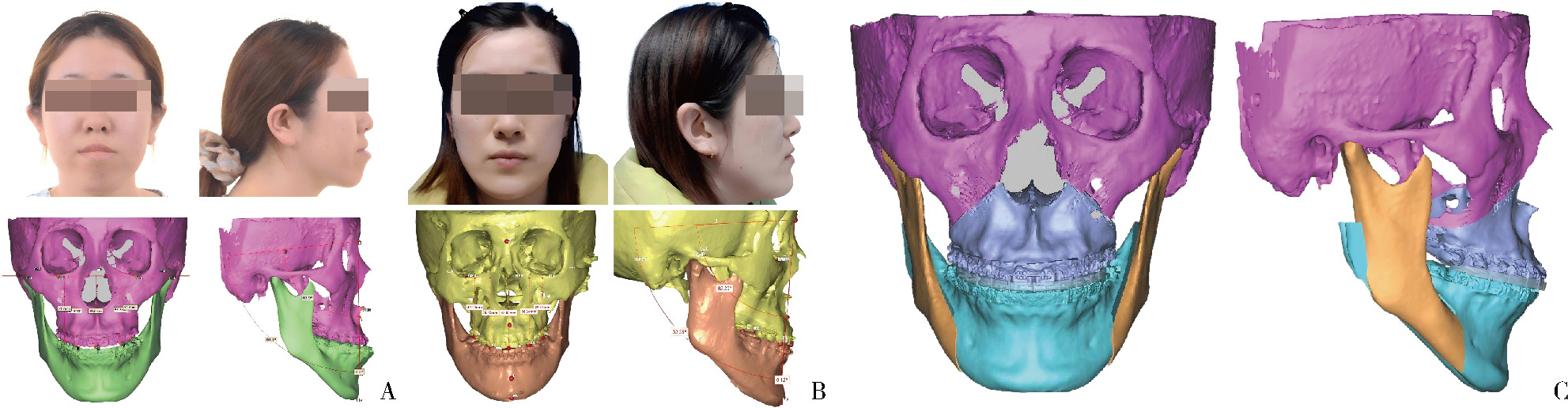
图4

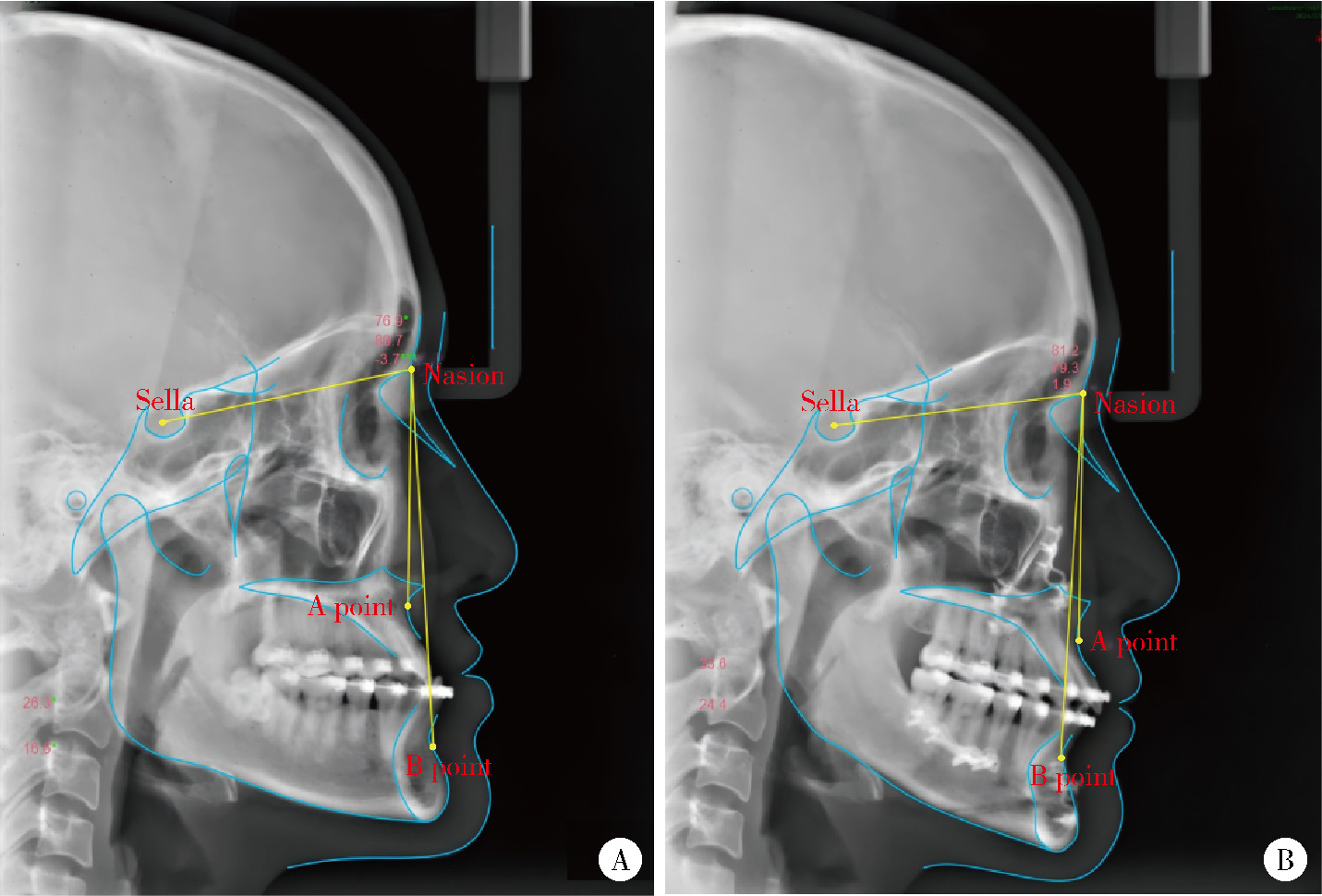
术前(A)和术后6个月(B)头影测量指标"

图5

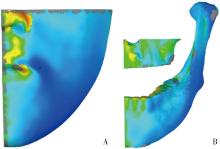
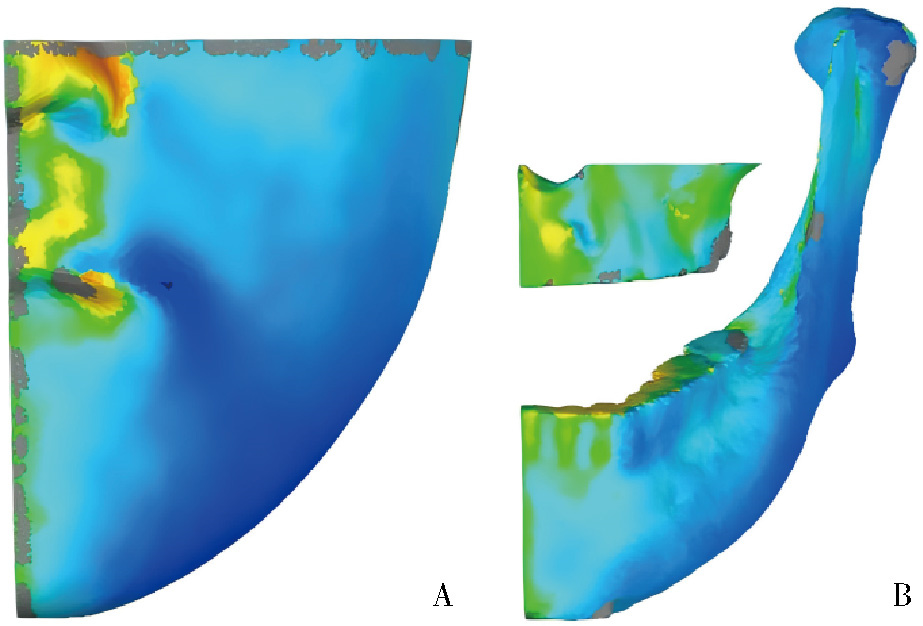
软组织(A)和硬组织(B)对称性评价"

表1

试验组与对照组基线特征及观测指标"

Items Test group (n=29) Control group (n=30) t P value
Male 11 (37.93) 8 (26.67) -0.917 0.363
Age/years 24.41±4.39 24.07±3.67 -0.330 0.742
VAS (Patient) 59.52±22.15 56.27±19.63 -0.597 0.553
FACE-Q (Patient) 62.90±14.63 58.93±11.33 -1.116 0.249
VAS (Surgeon) 59.68±10.60 60.05±7.89 0.153 0.879
FACE-Q (Surgeon) 53.74±7.77 52.64±8.94 -0.506 0.615
Angle SNA/(°) 80.26±3.70 81.95±3.66 1.763 0.083
Angle SNB/(°) 84.90±3.94 86.67±3.67 1.791 0.079
Angle ANB/(°) -4.63±3.31 -4.72±2.46 -0.119 0.906
Average RMSE/mm 10.39±5.63 8.55±4.95 -1.138 0.186

表2

术前及术后6个月VAS、FACE-Q评分"

Items Test group (n=29) Control group (n=30)
Preoperative 6-month postoperative t P Preoperative 6-month postoperative t P
VAS (Patient) 59.52±22.15 89.62±8.68 -8.240 < 0.001 56.27±19.63 81.70±15.21 -5.691 < 0.001
FACE-Q (Patient) 62.90±14.63 96.31±12.92 -10.139 < 0.001 58.93±11.33 91.90±15.11 -10.232 < 0.001
VAS (Surgeon) 59.68±10.60 87.86±5.02 -14.859 < 0.001 60.05±7.89 86.75±4.29 -18.509 < 0.001
FACE-Q (Surgeon) 53.74±7.77 92.00±9.85 -18.619 < 0.001 52.64±8.94 91.27±8.00 -20.674 < 0.001

表3

VAS和FACE-Q评分提升"

Items Test group (n=29) Control group (n=30) t P value
ΔVAS (Patient) 30.10±19.67 25.43±24.48 -0.806 0.424
ΔFACE-Q (Patient) 33.41±17.75 32.97±17.65 -0.097 0.923
ΔVAS (Surgeon) 28.19±10.21 26.71±7.90 -0.623 0.535
ΔFACE-Q (Surgeon) 37.75±11.60 38.63±10.23 0.062 0.951

表4

术前和术后6个月试验组及对照组头影测量结果"

Items Test group (n=29) Control group (n=30) t P value
Preoperative
  Angle SNA/(°) 80.26±3.70 81.95±3.66 1.763 0.083
  Angle SNB/(°) 84.90±3.94 86.67±3.67 1.791 0.079
  Angle ANB/(°) -4.63±3.31 -4.72±2.46 -0.119 0.906
6-month postoperative
  Angle SNA/(°) 84.06±3.73 85.23±3.71 1.207 0.233
  Angle SNB/(°) 81.78±3.63 83.51±3.66 1.830 0.073
  Angle ANB/(°) 2.28±1.09 1.72±1.25 -1.852 0.069

表5

术前和术后6个月试验组与对照组RMSE均值(mm)"

Items Test group (n=29) Control group (n=30) t P value
Preoperative 10.39±5.63 8.55±4.95 -1.138 0.186
6-month postoperative 8.35±2.72 7.59±3.56 -0.925 0.359
1
Shetty SK , Kasrija R . Analog to digital diagnosis and planning in orthognathic surgery: A narrative review[J]. Cureus, 2025, 17 (3): e80858.
2
Miloro M , Han MD , Kwon TG , et al. Predicting the future focus of orthognathic surgery: Outcome-driven planning and treatment with function, esthetics, and occlusion as key indicators[J]. J Oral Maxillofac Surg, 2024, 82 (10): 1329- 1335.

doi: 10.1016/j.joms.2024.06.168
3
Rupperti S , Winterhalder P , Rudzki I , et al. Changes in the facial soft-tissue profile after mandibular orthognathic surgery[J]. Clin Oral Investig, 2019, 23 (4): 1771- 1776.

doi: 10.1007/s00784-018-2609-5
4
Wermker K , Kleinheinz J , Jung S , et al. Soft tissue response and facial symmetry after orthognathic surgery[J]. J Craniomaxillofac Surg, 2014, 42 (6): e339- e345.

doi: 10.1016/j.jcms.2014.01.032
5
Rustemeyer J , Martin A . Soft tissue response in orthognathic surgery patients treated by bimaxillary osteotomy: Cephalometry compared with 2-D photogrammetry[J]. Oral Maxillofac Surg, 2013, 17 (1): 33- 41.

doi: 10.1007/s10006-012-0330-0
6
Yamazaki K , Terada K , Nakamura J , et al. Three-dimensional analysis comparing changes in soft tissue with those in hard tissue following orthognathic surgery in patients showing mandibular prognathism with facial asymmetry[J]. Jpn J Jaw Deform, 2005, 15 (2): 87- 94.

doi: 10.5927/jjjd1991.15.87
7
Hu J , Wang D , Luo S , et al. Differences in soft tissue profile changes following mandibular setback in Chinese men and women[J]. J Oral Maxillofac Surg, 1999, 57 (10): 1182- 1186.

doi: 10.1016/S0278-2391(99)90481-0
8
Berends B , Bielevelt F , Baan F , et al. Soft-tissue prediction based on 3D photographs for virtual surgery planning of orthognathic surgery[J]. Comput Biol Med, 2025, 194, 110529.

doi: 10.1016/j.compbiomed.2025.110529
9
Philip MR , AlFotawi R . The accuracy of soft tissue movement using virtual planning for non-syndromic facial asymmetry cases: A systematic review[J]. Oral Maxillofac Surg, 2023, 27 (2): 187- 200.
10
Rupperti S , Winterhalder P , Krennmair S , et al. Changes in the facial soft tissue profile after maxillary orthognathic surgery[J]. J Orofac Orthop, 2022, 83 (3): 215- 220.

doi: 10.1007/s00056-021-00294-2
11
Huang L , Li Z , Yan J , et al. Evaluation of facial soft tissue thickness in asymmetric mandibular deformities after orthognathic surgery[J]. Maxillofac Plast Reconstr Surg, 2021, 43 (1): 37.

doi: 10.1186/s40902-021-00323-5
12
Czako L , Sufliarsky B , Simko K , et al. Exploring the practical applications of artificial intelligence, deep learning, and machine learning in maxillofacial surgery: A comprehensive analysis of published works[J]. Bioengineering, 2024, 11 (7): 679.

doi: 10.3390/bioengineering11070679
13
Deng HH , Liu Q , Chen A , et al. Clinical feasibility of deep learning-based automatic head CBCT image segmentation and landmark detection in computer-aided surgical simulation for orthognathic surgery[J]. Int J Oral Maxillofac Surg, 2023, 52 (7): 793- 800.

doi: 10.1016/j.ijom.2022.10.010
14
Eissa M . The potential of artificial intelligence for personalized surgical planning: A letter to the editor[J]. J Surg Res Rev, 2024, 1 (1): 1.
15
Oeding JF , Yang L , Sanchez-Sotelo J , et al. A practical guide to the development and deployment of deep learning models for the orthopaedic surgeon: Part Ⅲ, focus on registry creation, diagnosis, and data privacy[J]. Knee Surg Phys Traumatol Arthrosc, 2024, 32 (3): 518- 528.

doi: 10.1002/ksa.12085
16
Deng HH, Wang L, Ren Y, et al. Patient-specific reference model for planning orthognathic surgery[M]//Machine learning in dentistry. Cham, Switzerland: Springer International Publishing, 2021: 105-114.
17
吴灵, 方嘉琨, 刘筱菁, 等. 基于牙颌面畸形患者三维颅面特征相似性度量模型的建立及评估[J]. 北京大学学报(医学版), 2025, 57 (1): 128- 135.

doi: 10.19723/j.issn.1671-167X.2025.01.019
18
Araujo GTT , Peralta-Mamani M , Silva AFMD , et al. Influence of cone beam computed tomography versus panoramic radiography on the surgical technique of third molar removal: A systematic review[J]. Int J Oral Maxillofac Surg, 2019, 48 (10): 1340- 1347.

doi: 10.1016/j.ijom.2019.04.003
19
McGuckin T , Crick K , Myroniuk TW , et al. Understanding challenges of using routinely collected health data to address clinical care gaps: A case study in Alberta, Canada[J]. BMJ Open Qual, 2022, 11 (1): e001491.

doi: 10.1136/bmjoq-2021-001491
20
Luo Y. Study on personalized medical decision support system based on big data[C]//Proceedings of the 2024 4th International Conference on Bioinformatics and Intelligent Computing. Beijing, China: ACM, 2024: 293-296.
[1] 宋凤岐, 徐心雨, 刘筱菁, 李自力. 上颌骨前部和整体顺时针旋转改善骨性Ⅲ类牙颌面畸形患者鼻旁凹陷的对比[J]. 北京大学学报(医学版), 2025, 57(5): 980-988.
[2] 马丽娟, 腾雍辉, 王勇, 赵一姣, 张馨月, 秦庆钊, 尹东. 乳牙缺失数字化丝圈间隙保持器的三维有限元分析[J]. 北京大学学报(医学版), 2025, 57(2): 376-383.
[3] 吴灵, 方嘉琨, 刘筱菁, 李自力, 李阳, 王晓霞. 基于牙颌面畸形患者三维颅面特征相似性度量模型的建立及评估[J]. 北京大学学报(医学版), 2025, 57(1): 128-135.
[4] 徐心雨,吴灵,宋凤岐,李自力,张益,刘筱菁. 基于下颌运动轨迹的正颌外科术中下颌骨髁突定位方法及初步精度验证[J]. 北京大学学报(医学版), 2024, 56(1): 57-65.
[5] 蔡安东,王晓霞,周文娟,柳忠豪. 下颌前突畸形患者上颌骨及髁突虚拟位置与术后现实位置的比较[J]. 北京大学学报(医学版), 2024, 56(1): 74-80.
[6] 李穗,马雯洁,王时敏,丁茜,孙瑶,张磊. 上前牙种植单冠修复体切导的数字化设计正确度[J]. 北京大学学报(医学版), 2024, 56(1): 81-87.
[7] 张雯,刘筱菁,李自力,张益. 基于解剖标志的鼻翼基底缩窄缝合术对正颌患者术后鼻唇部形态的影响[J]. 北京大学学报(医学版), 2023, 55(4): 736-742.
[8] 罗昊,田福聪,王晓燕. 不同椅旁可切削修复材料序列抛光时间及表面粗糙度与光泽度的比较[J]. 北京大学学报(医学版), 2022, 54(3): 565-571.
[9] 冯莎蔚,国慧,王勇,赵一姣,刘鹤. 乳牙数字化参考牙冠模型的初步构建[J]. 北京大学学报(医学版), 2022, 54(2): 327-334.
[10] 李怡,王丽瑜,刘晓强,周倜,吕季喆,谭建国. 不同材料及厚度椅旁CAD/CAM瓷贴面的边缘特征[J]. 北京大学学报(医学版), 2022, 54(1): 140-145.
[11] 邱淑婷,朱玉佳,王时敏,王飞龙,叶红强,赵一姣,刘云松,王勇,周永胜. 姿势微笑位口唇对称参考平面的数字化构建及初步应用验证[J]. 北京大学学报(医学版), 2022, 54(1): 193-199.
[12] 徐啸翔,曹烨,赵一姣,贾璐,谢秋菲. 数字化个齿托盘制取下颌全牙列全冠预备体印模的体外评价[J]. 北京大学学报(医学版), 2021, 53(1): 54-61.
[13] 岳兆国,张海东,杨静文,侯建霞. 数字化评估CAD/CAM个性化基台与成品基台影响粘接剂残留的体外研究[J]. 北京大学学报(医学版), 2021, 53(1): 69-75.
[14] 李峥,柳玉树,王时敏,张瑞,贾璐,叶红强,胡文杰,赵文艳,刘云松,周永胜. 数字化方法复制暂时修复体牙合面形态在重度磨耗病例中的应用[J]. 北京大学学报(医学版), 2021, 53(1): 62-68.
[15] 房硕博,杨广聚,康艳凤,孙玉春,谢秋菲. 数字化辅助确定再定位牙合垫颌位方法的探索和精度评价[J]. 北京大学学报(医学版), 2021, 53(1): 76-82.
Viewed
Full text


Abstract

Cited

  Shared   
  Discussed   
No Suggested Reading articles found!