北京大学学报(医学版) ›› 2019, Vol. 51 ›› Issue (2): 315-320. doi: 10.19723/j.issn.1671-167X.2019.02.022
不同等离子体处理氧化锆对人牙龈成纤维细胞黏附能力的影响
郑苗1,詹凌璐2,刘志强3,4,李和平3,∆( ),谭建国2,∆()
- 1. 北京大学第三医院口腔科, 北京 100191
2. 北京大学口腔医学院·口腔医院修复科, 北京 100081;
3. 清华大学工程物理系, 北京 100084
4. 华北理工大学机械工程学院, 河北唐山 063210
Effect of different plasma treated zirconia on the adhensive behaviour of human gingival fibroblasts
Miao ZHENG1,Ling-lu ZHAN2,Zhi-qiang LIU3,4,He-ping LI3,∆(),Jian-guo TAN2,∆()
- 1. Department of Stomatology, Peking University Third Hospital, Beijing 100191, China
2. Department of Prosthodontics, Peking University School and Hospital of Stomatology, Beijing 100081, China
3. Department of Engineering Phy-sics, Tsinghua University, Beijing 100084, China
4. College of Mechanical Engineering, North China University of Science and Technology, Tangshan 063210, Hebei, China
摘要:
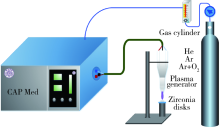
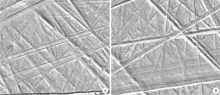
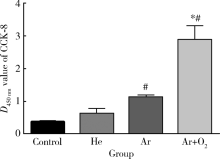
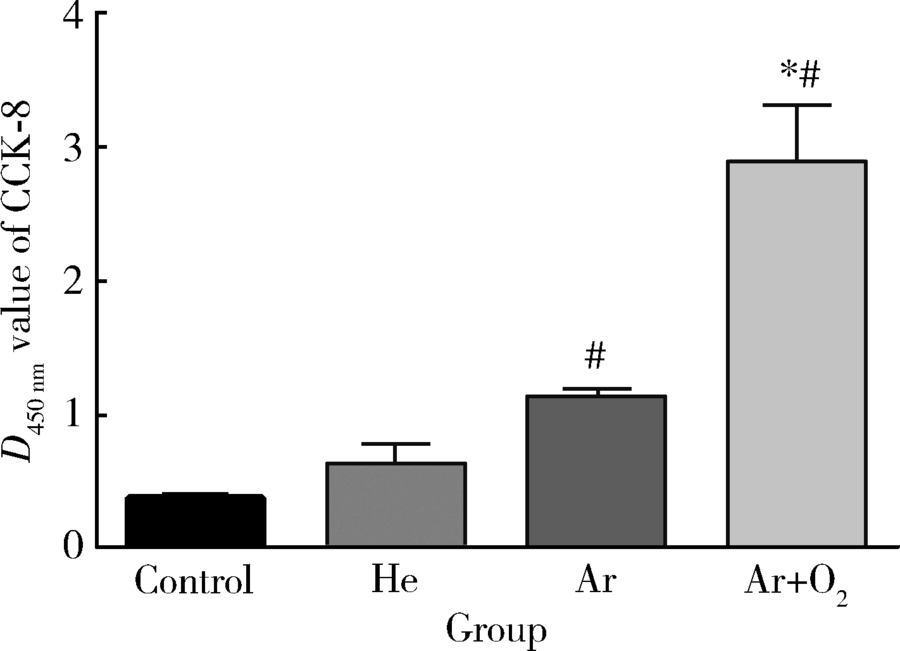
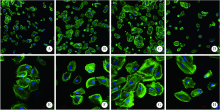
目的: 比较以不同种类气体为工作气体的大气压放电冷等离子体处理氧化锆对氧化锆表面人牙龈成纤维细胞生物学行为的影响。方法: 将20个氧化锆试件随机分为4组:对照组(无处理),氦气大气压介质阻挡放电等离子体处理90 s组(He组),氩气大气压介质阻挡放电等离子体处理90 s组(Ar组),95%氩气+5%氧气大气压介质阻挡放电等离子体处理90 s组(Ar+O2组),每组5个。分组处理后观察氧化锆表面形貌,测定表面粗糙度及润湿性,分析表面元素组成,培养人牙龈成纤维细胞3 h测定细胞在氧化锆表面的初期黏附能力,免疫荧光染色观察细胞黏附初期细胞形态。结果: 等离子体处理后氧化锆表面形貌及粗糙度无明显改变,接触角均显著降低(P<0.05), 其中Ar组及Ar+O2组接触角与He组具有统计学意义(P<0.05)。X射线光电子能谱分析结果显示,等离子体处理后氧化锆表面C/O比分别下降至0.45(He组)、0.36(Ar组)和0.33(Ar+ O2组)。经Ar及Ar+O2混合气体等离子体处理的氧化锆表面人牙龈成纤维细胞黏附初期数量提高,差异具有统计学意义(P<0.05)。相对于对照组,不同等离子体处理后的氧化锆表面成纤维细胞黏附及增殖情况更佳,细胞在黏附初期形态铺展更佳,伸出伪足更多。结论: 不同种类大气压放电冷等离子体处理氧化锆可在不改变材料表面形貌及粗糙度的情况下通过在材料表面引入含氧官能团提高材料表面润湿性;以Ar+O2混合气体为工作气体的大气压放电冷等离子体可显著提高人牙龈成纤维细胞在氧化锆表面的早期黏附能力。
中图分类号:
- R783.3




| [1] | Kawahara H, Kawahara D, Hashimoto K , et al. Morphologic stu-dies on the biologic seal of titanium dental implants. Report Ⅰ. In vitro study on the epithelialization mechanism around the dental implant[J]. Int J Oral Maxillofac Implants, 1998,13(4):457-464. |
| [2] |
Schwarz F, Derks J, Monje A , et al. Peri-implantitis[J]. J Periodontol, 2018,89(Suppl 1):S267-S290.
doi: 10.1002/JPER.16-0350 |
| [3] |
Kim YS, Shin SY, Moon SK , et al. Surface properties correlated with the human gingival fibroblasts attachment on various materials for implant abutments: a multiple regression analysis[J]. Acta Odontol Scand, 2015,73(1):38-47.
doi: 10.3109/00016357.2014.949845 |
| [4] |
Kim JH, Lee MA, Han GJ , et al. Plasma in dentistry: a review of basic concepts and applications in dentistry[J]. Acta Odontol Scand, 2014,72(1):1-12.
doi: 10.3109/00016357.2013.795660 |
| [5] |
Zheng M, Yang Y, Liu XQ , et al. Enhanced biological behavior of in vitro human gingival fibroblasts on cold plasma-treated zirconia[J]. PLoS One, 2015,10:e0140278.
doi: 10.1371/journal.pone.0140278 |
| [6] |
Yin L, Nakanishi Y, Alao AR , et al. A review of engineered zirconia surfaces in biomedical applications[J]. Procedia CIRP, 2017,65:284-290.
doi: 10.1016/j.procir.2017.04.057 |
| [7] |
Rigolin MSM, de Avila ED, Basso FG , et al. Effect of different implant abutment surfaces on OBA-09 epithelial cell adhesion[J]. Microsc Res Tech, 2017,80(12):1304-1309.
doi: 10.1002/jemt.22941 |
| [8] |
Abrahamsson I, Zitzmann NU, Berglundh T , et al. The mucosal attachment to titanium implants with different surface characteristics: an experimental study in dogs[J]. J Clin Periodontol, 2002,29(5):448-455.
doi: 10.1034/j.1600-051X.2002.290510.x |
| [9] |
Schwarz F, Herten M, Sager M , et al. Histological and immunohistochemical analysis of initial and early subepithelial connective tissue attachment at chemically modified and conventional SLA titanium implants. A pilot study in dogs[J]. Clin Oral Investig, 2007,11(3):245-255.
doi: 10.1007/s00784-007-0110-7 |
| [10] |
Schwarz F, Mihatovic I, Becker J , et al. Histological evaluation of different abutments in the posterior maxilla and mandible: an experimental study in humans[J]. J Clin Periodontol, 2013,40(8):807-815.
doi: 10.1111/jcpe.2013.40.issue-8 |
| [11] |
Canullo L, Genova T, Wang HL , et al. Plasma of argon increases cell attachment and bacterial decontamination on different implant surfaces[J]. Int J Oral Maxillofac Implants, 2017,32(6):1315-1323.
doi: 10.11607/jomi.5777 |
| [12] |
Yang Y, Zhou J, Liu X , et al. Ultraviolet light-treated zirconia with different roughness affects function of human gingival fibroblasts in vitro: the potential surface modification developed from implant to abutment[J]. J Biomed Mater Res B Appl Biomater, 2015,103(1):116-124.
doi: 10.1002/jbm.b.v103.1 |
| [13] |
Hoshi N, Negishi H, Okada S , et al. Response of human fibroblasts to implant surface coated with titanium dioxide photocatalytic films[J]. J Prosthodont Res, 2010,54(4):185-191.
doi: 10.1016/j.jpor.2010.04.005 |
| [14] |
An N, Rausch-fan X, Wieland M , et al. Initial attachment, subsequent cell proliferation/viability and gene expression of epithelial cells related to attachment and wound healing in response to dif-ferent titanium surfaces[J]. Dent Mater, 2012,28(12):1207-1214.
doi: 10.1016/j.dental.2012.08.007 |
| [15] |
Canullo L, Genova T, Tallarico M , et al. Plasma of argon affects the earliest biological response of different implant surfaces: an in vitro comparative study[J]. J Dent Res, 2016,95(5):566-573.
doi: 10.1177/0022034516629119 |
| [1] | 吴音格, 黄旸木. 基于层次-K均值混合聚类法的中国人乳头瘤病毒疫苗双边国际合作优先程度评估[J]. 北京大学学报(医学版), 2026, 58(3): 446-454. |
| [2] | 许春春, 简伟研. 基于中国家庭追踪调查的居民主观认知、收入变化与就医点选择转移的关联[J]. 北京大学学报(医学版), 2026, 58(3): 455-463. |
| [3] | 高嘉琪, 李文鹏, 李晓怡, 谭音希, 李奕昕, 段丽萍, 吴涛, 陈大方, 胡永华, 王梦莹. 基于可穿戴设备的老年人身体活动模式与肠道菌群的关联[J]. 北京大学学报(医学版), 2026, 58(3): 551-559. |
| [4] | 张晓悦, 杨晓晨, 林昊翔, 纪颖, 曹望楠, 常春. 基于保护动机理论的我国18~44岁成年人电子烟戒断意愿和戒断行为的影响因素[J]. 北京大学学报(医学版), 2026, 58(3): 575-583. |
| [5] | 袁思妍, 闵鹤葳, 陈平, 吴一波, 崔红霞, 张旭熙, 孙昕霙. 基于大五人格特质的2型糖尿病患者健康教育偏好[J]. 北京大学学报(医学版), 2026, 58(3): 600-605. |
| [6] | 白晓强, 袁芷若, 周永胜, 吕珑薇. 动态牵张促进人骨髓间充质干细胞三维培养的成骨分化[J]. 北京大学学报(医学版), 2026, 58(3): 641-649. |
| [7] | 马小娟, 王好, 马学芹, 宋颖, 于佳卉, 孙艳, 李艳芳, 薛丽香, 李显龙, 杨建岭, 王艳. 高效和稳定提取原代成年小鼠心脏成纤维细胞的新方法[J]. 北京大学学报(医学版), 2026, 58(3): 658-665. |
| [8] | 季加孚, 韦静涛, 季科, 步召德. 胃癌诊疗的瓶颈与破局:迈向精准化与智能化融合的新纪元[J]. 北京大学学报(医学版), 2026, 58(2): 231-238. |
| [9] | 高加勒, 张忠涛. 局部进展期直肠癌精准治疗现状与展望[J]. 北京大学学报(医学版), 2026, 58(2): 247-250. |
| [10] | 杜文, 章文博, 于尧, 刘硕, 苏惠裕, 胡耒豪, 唐祖南, 吴彬彰, 陈震, 李家琦, 王昊, 彭歆. 口腔颌面部肿瘤"数智化外科"诊疗流程探索与临床应用[J]. 北京大学学报(医学版), 2026, 58(2): 278-284. |
| [11] | 李斌, 梁寒. 机器人胃癌根治术:研究进展与实践挑战[J]. 北京大学学报(医学版), 2026, 58(2): 416-422. |
| [12] | 黄宁, 刘笑晗, 郭静. 医疗保险对流动慢性病患者卫生服务利用的影响以及健康风险感知在其中的调节作用[J]. 北京大学学报(医学版), 2026, 58(1): 160-168. |
| [13] | 郑苗, 马欣蓉, 陈昊, 赵恒欣, 张宇, 谭建国, 李和平, 王霄. 大气压放电冷等离子体处理对人牙龈成纤维细胞生物学行为的影响[J]. 北京大学学报(医学版), 2026, 58(1): 60-67. |
| [14] | 魏粤晖, 简伟研. 中国老年人社会经济地位与视力障碍的相关性[J]. 北京大学学报(医学版), 2025, 57(6): 1136-1144. |
| [15] | 赵健霄, 丁茜, 李文锦, 马全诠, 兰一笑, 张磊, 韩建民. 多孔表面结构对立体光固化成型氧化锆疲劳强度的影响[J]. 北京大学学报(医学版), 2025, 57(6): 1165-1173. |
|
||
