北京大学学报(医学版) ›› 2026, Vol. 58 ›› Issue (3): 567-574. doi: 10.19723/j.issn.1671-167X.2026.03.017

• 论著 • 上一篇    下一篇

围术期高血糖与食管切除术后食管鳞癌不良预后相关性

彭博1,*, 刘芳芳1,*, 杨伟2, 徐瑞平3, 陈蕾2, 李保中3, 王新家2, 柯骥1, 杨文蕾1, 何煜4, 刘震1, 侯波林5, 张利群2, 林妙萍2, 张立新3, 张凡2, 蔡奋2, 许铧文2, 刘萌飞1, 刘英1, 潘雅琪1, 何忠虎6,*(), 柯杨6,*()   

  1. 1. 北京大学肿瘤医院暨北京市肿瘤防治研究所遗传学研究室,恶性肿瘤发病机制及转化研究教育部重点实验室,北京 100142
    2. 汕头大学医学院附属肿瘤医院,广东汕头 515031
    3. 安阳市肿瘤医院, 河南安阳 455000
    4. 中华预防医学会, 北京 100062
    5. 零氪科技(北京)有限公司,北京 100080
    6. 北京大学肿瘤医院暨北京市肿瘤防治研究所遗传学研究室,分子肿瘤学全国重点实验室,北京 100142
  • 收稿日期:2026-02-24 出版日期:2026-06-18 发布日期:2026-04-10
  • 通讯作者: 何忠虎, 柯杨
  • 基金资助:
    国家重点研发计划项目资助(2021YFC2500405)

Perioperative hyperglycemia predicts poorer prognosis of esophageal squamous cell carcinoma patients treated with esophagectomy

Bo PENG1, Fangfang LIU1, Wei YANG2, Ruiping XU3, Lei CHEN2, Baozhong LI3, Xinjia WANG2, Ji KE1, Wenlei YANG1, Yu HE4, Zhen LIU1, Bolin HOU5, Liqun ZHANG2, Miaoping LIN2, Lixin ZHANG3, Fan ZHANG2, Fen CAI2, Huawen XU2, Mengfei LIU1, Ying LIU1, Yaqi PAN1, Zhonghu HE6,*(), Yang KE6,*()   

  1. 1. Key Laboratory of Carcinogenesis and Translational Research(Ministry of Education), Department of Genetics, Peking University Cancer Hospital & Institute, Beijing 100142, China
    2. Cancer Hospital of Shantou University Medical College, Shantou 515031, Guangdong, China
    3. Anyang Cancer Hospital, Anyang 455000, Henan, China
    4. Chinese Preventive Medicine Association, Beijing 100062, China
    5. Linkdoc AI Research(LAIR), Beijing 100080, China
    6. State Key Laboratory of Molecular Oncology, Department of Genetics, Peking University Cancer Hospital & Institute, Beijing 100142, China
  • Received:2026-02-24 Online:2026-06-18 Published:2026-04-10
  • Contact: Zhonghu HE, Yang KE
  • About author:

    * These authors contributed equally to this work

  • Supported by:
    the National Key R&D Program of China(2021YFC2500405)

RICH HTML


摘要:

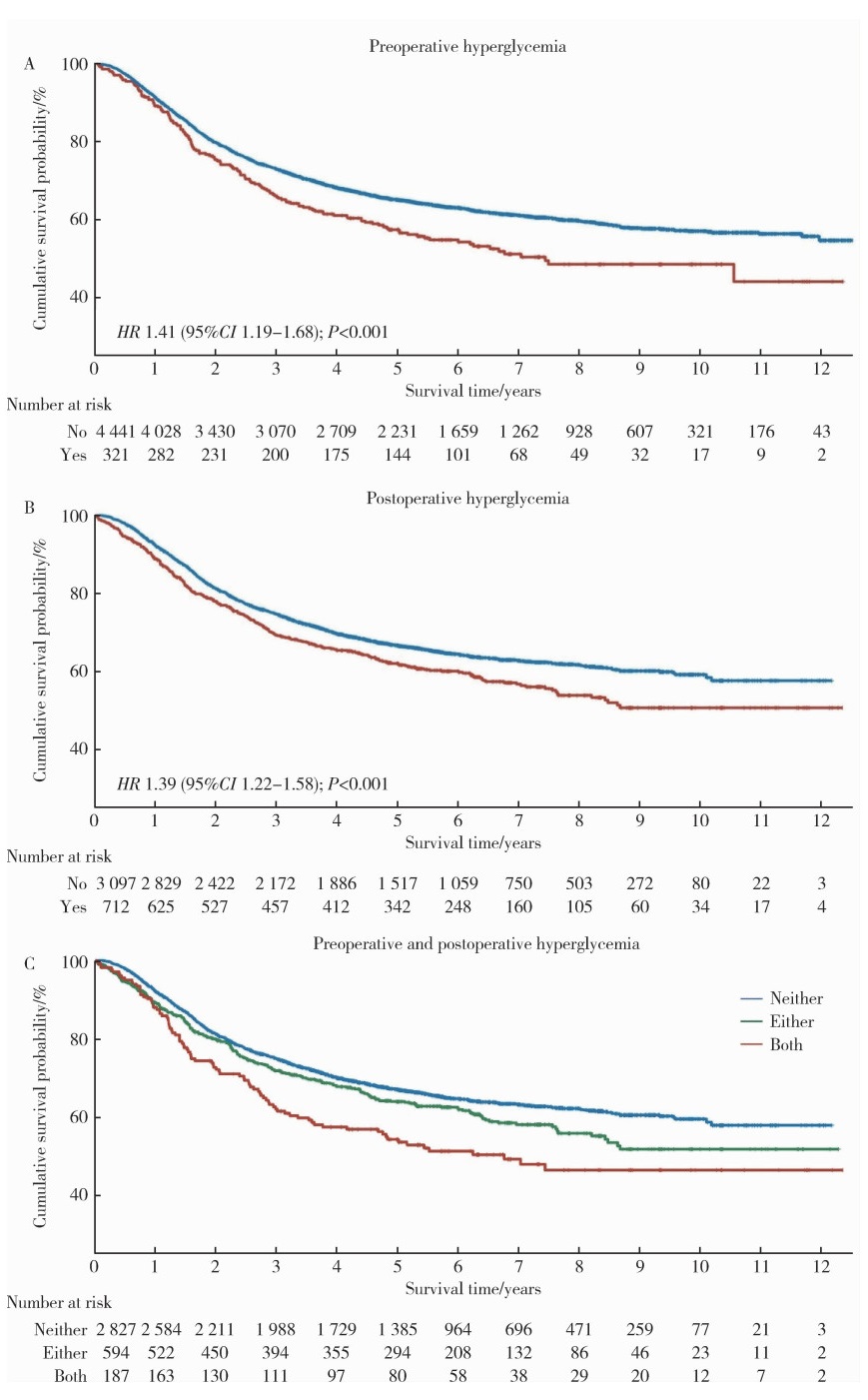
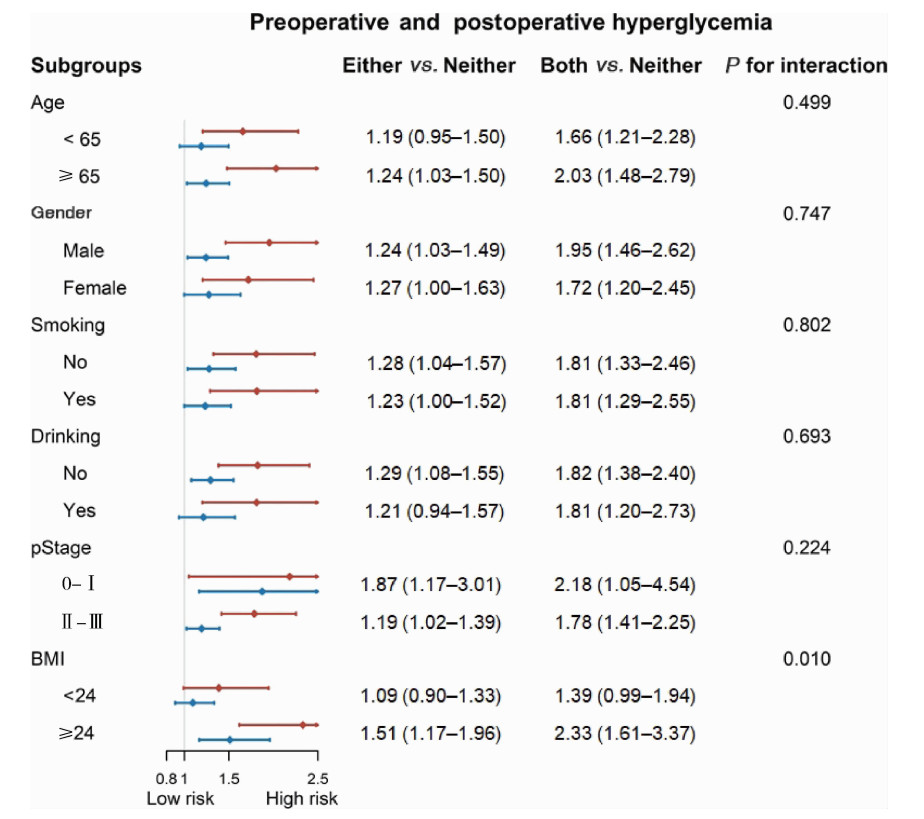
目的: 基于大样本、多中心真实世界数据,系统评估围术期高血糖与食管鳞癌(esophageal squamous cell carcinoma,ESCC)患者术后预后之间的关联。方法: 连续纳入河南省安阳市肿瘤医院(2012年1月至2017年12月)与广东省汕头大学医学院附属肿瘤医院(2009年8月至2018年12月)接受根治性食管切除术的5 952例ESCC患者的病例资料进行回顾性队列研究,围术期空腹血糖数据来源于医院信息系统。将围术期划分为术前和术后两个阶段,术前高血糖定义为术前第14天至第2天平均空腹血糖≥7.0 mmol/L,术后高血糖定义为术后第2天至第14天平均空腹血糖≥7.0 mmol/L。主要结局为总生存期,次要结局包括术后30 d/90 d死亡率及住院期间并发症。采用多因素Cox比例风险模型,评估围术期高血糖与总生存的关联,计算校正后的风险比(hazard ratio,HR)及其95%置信区间(confidence interval,CI)。结果: 研究人群最长随访时间达12年。术前与术后高血糖发生率分别为6.7%和18.3%。术前高血糖患者的5年总生存率低于非高血糖患者(57.3% vs. 65.0%),校正后HR为1.41(95%CI:1.19~1.68);术后高血糖患者的5年生存率亦较低(61.8% vs. 66.4%),校正后HR为1.39(95%CI:1.22~1.58)。联合分析显示,与无高血糖者相比,仅在术前或术后单一阶段出现高血糖的患者死亡风险升高(HR=1.24,95%CI:1.07~1.43),而术前和术后均存在高血糖的患者死亡风险最高(HR=1.86,95% CI:1.49~2.32)。分层分析显示,体重指数(body mass index,BMI)显著修饰了高血糖与不良预后的关联(交互作用P=0.010),该关联在BMI≥24.0 kg/m2的患者中尤为显著。此外,围术期高血糖亦与较差的术后短期结局相关。结论: 围术期高血糖是接受根治性食管切除术的ESCC患者术后长期生存的独立危险因素,提示在ESCC围术期管理过程中加强常规血糖监测与控制,可能有助于改善患者的长期预后。

关键词: 围术期高血糖, 糖尿病, 预后, 并发症, 食管鳞癌

Abstract:

Objective: To systematically evaluate the association between perioperative hyperglycemia and postoperative prognosis in esophageal squamous cell carcinoma (ESCC) patients using large-scale, multicenter real-world data. Methods: A total of 5 952 patients with ESCC who underwent radical esophagectomy were consecutively included in this retrospective cohort study from the Anyang Cancer Hospital in Anyang, Henan Province (January 2012 to December 2017) and the Cancer Hospital of Shantou University Medical College in Shantou, Guangdong Province (August 2009 to December 2018). Perioperative fasting glucose data were obtained from the hospital information system. The perioperative period was divided into preoperative and postoperative phases: Preoperative hyperglycemia was defined as a mean fasting glucose level ≥7.0 mmol/L from day 14 to day 2 before surgery, and postoperative hyperglycemia was defined as a mean fasting glucose level ≥7.0 mmol/L from day 2 to day 14 after surgery. The primary outcome was overall survival (OS), and secondary outcomes included 30 d/90 d postoperative mortality and in-hospital complications. Multivariable Cox proportional hazards models were used to assess the association between perioperative hyperglycemia and OS, with adjusted hazard ratios (HR) and 95% confidence intervals (CI) calculated. Results: The maximum follow-up period was 12 years. The prevalence of preoperative and postoperative hyperglycemia was 6.7% and 18.3%, respectively. Patients with preoperative hyperglycemia had a lower 5-year OS rate than those without (57.3% vs. 65.0%), with an adjusted HR of 1.41 (95%CI: 1.19-1.68). The patients with postoperative hyperglycemia also had reduced 5-year survival (61.8% vs. 66.4%), with an adjusted HR of 1.39 (95%CI: 1.22-1.58). Joint analysis showed that compared with patients without hyperglycemia, those with hyperglycemia in either the preoperative or postoperative phase alone had an elevated mortality risk (HR=1.24, 95%CI: 1.07-1.43), while the patients with hyperglycemia in both phases had the highest mortality risk (HR=1.86, 95%CI: 1.49-2.32). Stratified analysis revealed that BMI significantly modified the association between hyperglycemia and adverse prognosis (Pinteraction=0.010), with the association being particularly pronounced in patients with BMI ≥24.0 kg/m2. Additionally, perioperative hyperglycemia was associated with poorer short-term postoperative outcomes. Conclusion: Perioperative hyperglycemia is an independent risk factor for long-term survival in ESCC patients undergoing curative esophagectomy. These findings suggest that enhanced routine glucose monitoring and control during perioperative management of ESCC may help improve long-term patient outcomes.

Key words: Perioperative hyperglycemia, Diabetes, Prognosis, Complications, Esophageal squamous cell carcinoma

中图分类号: 

  • R735.1

表1

按围术期血糖状态分层的ESCC根治术患者基线特征"

Characteristics Total(n=5 952) Preoperative hyperglycemiaa Postoperative hyperglycemiaa
No (n=5 341) Yes (n=381) P valueb No (n=3 796) Yes (n=848) P valueb
Age/years 63.0 (58.0, 68.0) 63.0 (58.0, 68.0) 64.0 (60.0, 68.0) 0.018 64.0 (59.0, 68.0) 65.0 (60.5, 70.0) < 0.001
Gender < 0.001 < 0.001
  Male 3 840 (64.5) 3 482 (94.6) 197 (5.4) 2 515 (85.3) 433 (14.7)
  Female 2 112 (35.5) 1 859 (91.0) 184 (9.0) 1 281 (75.5) 415 (24.5)
Smokingc < 0.001 < 0.001
  No 2 719 (46.8) 2 385 (91.4) 224 (8.6) 1 710 (77.3) 503 (22.7)
  Yes 3 086 (53.2) 2 827 (95.2) 144 (4.8) 1 978 (86.1) 320 (13.9)
Drinkingc 0.042 < 0.001
  No 3 762 (65.5) 3 349 (92.9) 257 (7.1) 2 386 (80.2) 589 (19.8)
  Yes 1 980 (34.5) 1 805 (94.3) 109 (5.7) 1 253 (84.8) 224 (15.2)
BMI/(kg/m2)c < 0.001 < 0.001
   < 24.0 3 337 (70.0) 3 068 (95.2) 153 (4.8) 2 050 (85.0) 361 (15.0)
  ≥ 24.0 1 431 (30.0) 1 224 (89.6) 142 (10.4) 900 (76.4) 278 (23.6)
pStageb 0.822 0.102
  0 andⅠ 1 356 (22.9) 1 206 (93.1) 89 (6.9) 910 (79.6) 233 (20.4)
  Ⅱ 2 401 (40.6) 2 162 (93.6) 149 (6.4) 1 592 (82.1) 347 (17.9)
  Ⅲ 2 157 (36.5) 1 939 (93.1) 143 (6.9) 1 267 (82.7) 265 (17.3)
Center 0.021 0.065
  Northern 4 001 (67.2) 3 562 (92.8) 276 (7.2) 2 891 (81.2) 671 (18.8)
  Southern 1 951 (32.8) 1 779 (94.4) 105 (5.6) 905 (83.6) 177 (16.4)

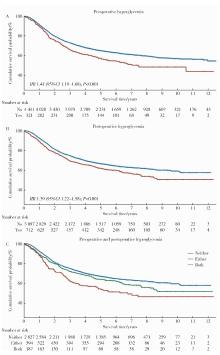
图1

按围术期血糖状态分层的ESCC根治术患者总生存期Kaplan-Meier曲线"

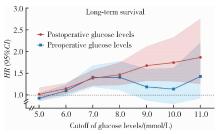
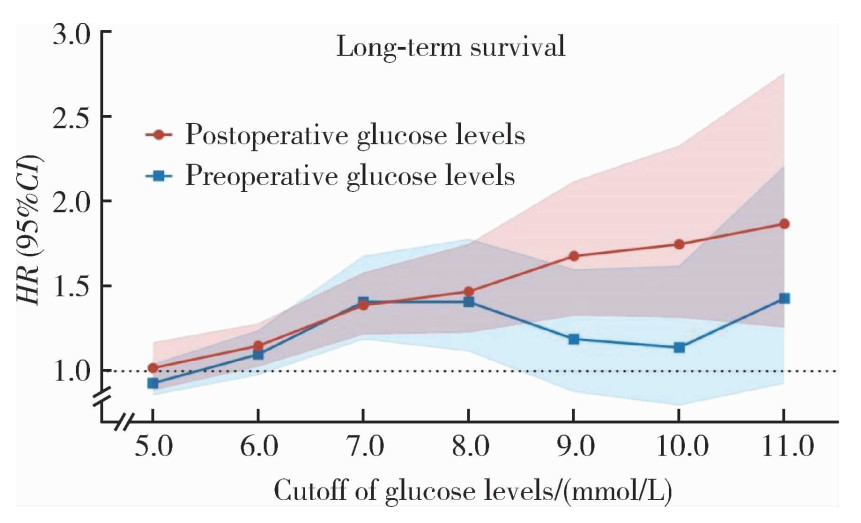
图2

不同血糖临界值定义的围术期高血糖与ESCC根治术患者总生存期的关联"

表2

围术期血糖水平与ESCC根治术患者长期总生存的剂量-反应关系"

Glucose levels/(mmol/L) Total,n (%) Death,n (%) 5-year survival/% (95%CI) Adjusted HR (95%CI)a P valuea
Preoperative
   < 7.0 4 441 (93.3) 1 667 (37.5) 66.5 (64.8-68.1) Reference
  7.0- < 11.0 271 (5.7) 126 (46.5) 56.7 (51.0-63.2) 1.40 (1.17-1.69) < 0.001
  ≥ 11.0 50 (1.1) 21 (42.0) 60.6 (48.3-76.2) 1.47 (0.95-2.27) 0.081
  Ptrend < 0.001
Postoperative
   < 7.0 3 097 (81.3) 1 086 (35.1) 66.4 (64.7-68.2) Reference
  7.0- < 11.0 668 (17.5) 267 (40.0) 63.0 (59.3-66.9) 1.35 (1.18-1.55) < 0.001
  ≥ 11.0 44 (1.2) 26 (59.1) 43.4 (30.5-61.7) 1.98 (1.34-2.94) 0.001
  Ptrend < 0.001

图3

围术期血糖水平与ESCC根治术患者总生存期关联的分层分析"

1
Sung H , Ferlay J , Siegel RL , et al. Global cancer statistics 2020:GLOBOCAN estimates of incidence and mortality worldwide for 36 cancers in 185 countries[J]. CA Cancer J Clin, 2021, 71 (3): 209- 249.
2
Arnold M , Soerjomataram I , Ferlay J , et al. Global incidence of oesophageal cancer by histological subtype in 2012[J]. Gut, 2015, 64 (3): 381- 387.

doi: 10.1136/gutjnl-2014-308124
3
Abnet CC , Arnold M , Wei WQ . Epidemiology of esophageal squamous cell carcinoma[J]. Gastroenterology, 2018, 154 (2): 360- 373.

doi: 10.1053/j.gastro.2017.08.023
4
Liang H , Liang H , Fan JH , et al. Epidemiology, etiology, and prevention of esophageal squamous cell carcinoma in China[J]. Cancer Biol Med, 2017, 14 (1): 33- 41.

doi: 10.20892/j.issn.2095-3941.2016.0093
5
Mao YS , Gao SG , Wang Q , et al. Analysis of a registry database for esophageal cancer from high-volume centers in China[J]. Dis Esophagus, 2020, 33 (8): doz091.

doi: 10.1093/dote/doz091
6
Rice TW , Rusch VW , Apperson-Hansen C , et al. Worldwide esophageal cancer collaboration[J]. Dis Esophagus, 2009, 22 (1): 1- 8.

doi: 10.1111/j.1442-2050.2008.00901.x
7
Watanabe M , Toh Y , Ishihara R , et al. Comprehensive registry of esophageal cancer in Japan, 2015[J]. Esophagus, 2023, 20 (1): 1- 28.

doi: 10.1007/s10388-022-00950-5
8
Allemani C , Matsuda T , Di Carlo V , et al. Global surveillance of trends in cancer survival 2000-14 (CONCORD-3): analysis of individual records for 37 513 025 patients diagnosed with one of 18 cancers from 322 population-based registries in 71 countries[J]. Lancet, 2018, 391 (10125): 1023- 1075.
9
Gallagher EJ , LeRoith D . Obesity and diabetes: The increased risk of cancer and cancer-related mortality[J]. Physiol Rev, 2015, 95 (3): 727- 748.

doi: 10.1152/physrev.00030.2014
10
Giovannucci E , Harlan DM , Archer MC , et al. Diabetes and cancer: A consensus report[J]. CA A Cancer J Clin, 2010, 60 (4): 207- 221.
11
Eshuis WJ , Hermanides J , van Dalen JW , et al. Early postoperative hyperglycemia is associated with postoperative complications after pancreatoduodenectomy[J]. Ann Surg, 2011, 253 (4): 739- 744.

doi: 10.1097/SLA.0b013e31820b4bfc
12
Karl RC , Schreiber R , Boulware D , et al. Factors affecting morbidity, mortality, and survival in patients undergoing IVOR lewis esophagogastrectomy[J]. Ann Surg, 2000, 231 (5): 635- 643.

doi: 10.1097/00000658-200005000-00003
13
Yao W , Meng Y , Lu M , et al. Impact of type 2 diabetes mellitus on short-term and long-term outcomes of patients with esophageal squamous cell cancer undergoing resection: A propensity score analysis[J]. Cancer Commun, 2018, 38, 14.

doi: 10.1186/s40880-018-0275-2
14
Zheng X , Ma X , Deng HY , et al. Diabetes mellitus and survival of esophageal cancer patients after esophagectomy: A systematic review and meta-analysis[J]. Dis Esophagus, 2020, 33 (2): doz098.

doi: 10.1093/dote/doz098
15
Peng F , Hu D , Lin X , et al. Analysis of preoperative metabolic risk factors affecting the prognosis of patients with esophageal squamous cell carcinoma: The Fujian prospective investigation of cancer (FIESTA) study[J]. EBioMedicine, 2017, 16, 115- 123.

doi: 10.1016/j.ebiom.2017.01.035
16
Lin Y , Totsuka Y , Shan B , et al. Esophageal cancer in high-risk areas of China: Research progress and challenges[J]. Ann Epidemiol, 2017, 27 (3): 215- 221.

doi: 10.1016/j.annepidem.2016.11.004
17
Tian H , Yang W , Hu Y , et al. Estimating cancer incidence based on claims data from medical insurance systems in two areas lacking cancer registries in China[J]. EClinicalMedicine, 2020, 20, 100312.

doi: 10.1016/j.eclinm.2020.100312
18
Rice TW , Blackstone EH , Rusch VW . 7th edition of the AJCC cancer staging manual: Esophagus and esophagogastric junction[J]. Ann Surg Oncol, 2010, 17 (7): 1721- 1724.

doi: 10.1245/s10434-010-1024-1
19
Zhang Z . Missing data imputation: Focusing on single imputation[J]. Ann Transl Med, 2016, 4 (1): 9.
20
Groenwold RHH , White IR , Donders ART , et al. Missing covariate data in clinical research: When and when not to use the missing-indicator method for analysis[J]. Can Med Assoc J, 2012, 184 (11): 1265- 1269.

doi: 10.1503/cmaj.110977
21
Baird TA , Parsons MW , Phan T , et al. Persistent poststroke hyperglycemia is independently associated with infarct expansion and worse clinical outcome[J]. Stroke, 2003, 34 (9): 2208- 2214.

doi: 10.1161/01.STR.0000085087.41330.FF
22
Epstein FH . SPECIAL ARTICLE: Hyperglycemia a risk factor in coronary heart disease[J]. Circulation, 1967, 36 (4): 609- 619.

doi: 10.1161/01.CIR.36.4.609
23
Jacob P , Chowdhury TA . Management of diabetes in patients with cancer[J]. Qjm, 2015, 108 (6): 443- 448.

doi: 10.1093/qjmed/hcu218
24
Ramteke P , Deb A , Shepal V , et al. Hyperglycemia associated metabolic and molecular alterations in cancer risk, progression, treatment, and mortality[J]. Cancers, 2019, 11 (9): 1402.
[1] 袁思妍, 闵鹤葳, 陈平, 吴一波, 崔红霞, 张旭熙, 孙昕霙. 基于大五人格特质的2型糖尿病患者健康教育偏好[J]. 北京大学学报(医学版), 2026, 58(3): 600-605.
[2] 舒帆, 葛力源, 邓汉彰, 殷昊明, 欧俊永, 邓绍晖, 郝一昌, 陆敏, 张展奕, 段佩辰, 张树栋. 预后不良的肾细胞癌伴淋巴结转移的分子特征[J]. 北京大学学报(医学版), 2026, 58(3): 631-640.
[3] 张铃福, 陈明, 赵小宇, 王港, 崔龙, 凌晓锋, 王立新, 徐智, 郭丽梅, 侯纯升. 原发灶局限于胆囊壁内胆囊癌大体分型及其与预后和癌前病变的相关性[J]. 北京大学学报(医学版), 2026, 58(1): 184-189.
[4] 田雪丽, 宋志强, 黄永辉, 姚炜. 肌萎缩侧索硬化患者经皮内镜下胃造瘘术后早期并发症及相关危险因素分析[J]. 北京大学学报(医学版), 2026, 58(1): 190-195.
[5] 高雅静, 李正芳, 马梦思, 武丽君. SII和SIRI对白塞病葡萄膜炎的风险预测及疾病活动度和预后的评估[J]. 北京大学学报(医学版), 2025, 57(6): 1067-1073.
[6] 王晓林, 郭邵逸, 陈大召, 温锡杰, 华勇, 张亮, 张秦. 全髋关节置换术治疗系统性红斑狼疮继发股骨头缺血性坏死的随访研究[J]. 北京大学学报(医学版), 2025, 57(6): 1081-1088.
[7] 闵鹤葳, 吴一波, 史宇晖, 李明子, 孙昕霙. 基于健康行动过程取向模型分析2型糖尿病患者膳食模式及血糖控制的影响因素[J]. 北京大学学报(医学版), 2025, 57(6): 1145-1152.
[8] 顾静妍, 李欣艺, 赵金霞, 穆荣. 误诊为类风湿关节炎、痛风的糖尿病致Charcot关节病1例[J]. 北京大学学报(医学版), 2025, 57(6): 1193-1197.
[9] 曹沛, 栾庆先. 牙周炎与全身系统性疾病的思考与探索[J]. 北京大学学报(医学版), 2025, 57(5): 852-858.
[10] 郭博达, 陆敏, 王国良, 张洪宪, 刘磊, 侯小飞, 赵磊, 田晓军, 张树栋. 肾透明细胞癌与非透明细胞癌伴静脉癌栓患者的临床病理特征及预后比较[J]. 北京大学学报(医学版), 2025, 57(4): 644-649.
[11] 左超, 王国立, 杨昆霖, 车新艳, 孟一森, 张凯. 前列腺体积不同的患者经尿道光纤铥激光前列腺剜除术的有效性及安全性比较[J]. 北京大学学报(医学版), 2025, 57(4): 711-716.
[12] 赵兆, 张维宇, 杨文博, 张勇杰, 张晓鹏, 赵慧颖, 周刚, 王强. 低龄、低体重儿童肾移植2例[J]. 北京大学学报(医学版), 2025, 57(4): 803-807.
[13] 陈子砚, 张晓悦, 顾亦梧, 常春. 2型糖尿病患者使用E-health管理疾病意愿与影响机制[J]. 北京大学学报(医学版), 2025, 57(3): 522-528.
[14] 李伟浩, 李晶, 张学民, 李伟, 李清乐, 张小明. 术中回收式自体输血对颈动脉体瘤切除术后肿瘤预后的影响[J]. 北京大学学报(医学版), 2025, 57(2): 272-276.
[15] 王菲, 张馨月, 刘木清, 王恩博, 段登辉. 顺牙长轴拔牙法在下颌近中与水平智齿拔除术中的应用及三维有限元分析[J]. 北京大学学报(医学版), 2025, 57(1): 106-112.
Viewed
Full text


Abstract

Cited

  Shared   
  Discussed   
No Suggested Reading articles found!