北京大学学报(医学版) ›› 2025, Vol. 57 ›› Issue (4): 717-720. doi: 10.19723/j.issn.1671-167X.2025.04.014

• 论著 • 上一篇    下一篇

耻骨后与经闭孔尿道中段悬吊术对术后最大尿流率及残余尿量的影响

王起, 柯涵炜, 丁泽华, 张维宇, 张晓鹏, 徐涛, 许克新*()   

  1. 北京大学人民医院泌尿外科,北京 100044
  • 收稿日期:2025-02-27 出版日期:2025-08-18 发布日期:2025-08-02
  • 通讯作者: 许克新

Effects of retropubic and obturator urethral suspension on postoperative maximum flow rate and residual urine volume

Qi WANG, Hanwei KE, Zehua DING, Weiyu ZHANG, Xiaopeng ZHANG, Tao XU, Kexin XU*()   

  1. Department of Urology, Peking University People' s Hospital, Beijing 100044, China
  • Received:2025-02-27 Online:2025-08-18 Published:2025-08-02
  • Contact: Kexin XU

RICH HTML


摘要:

目的: 比较耻骨后尿道中段悬吊术(tension-free vaginal tape,TVT)和经闭孔尿道中段悬吊术(trans-obturator tape,TOT)治疗女性压力性尿失禁后的最大尿流率及残余尿量的改变。方法: 回顾性分析2022年1月至2024年1月于北京大学人民医院行经阴道尿道中段无张力悬吊术的女性压力性尿失禁患者的临床资料,并在术后1、6、12个月对患者进行随访。所有患者术前均行尿动力学评估尿道括约肌功能,同时测定最大尿流率及膀胱残余尿量(B超),以除外急迫性尿失禁、逼尿肌无力、膀胱出口梗阻,明确诊断为单纯性压力性尿失禁。随访时测定最大尿流率及膀胱残余尿量,并结合国际尿失禁咨询委员会尿失禁问卷表简表,根据患者术后漏尿症状较术前改善的程度,将手术疗效判定为治愈、好转或无效。结果: 共150例女性压力性尿失禁患者纳入本研究,其中60例行TVT,90例行TOT;患者平均年龄(55.12±10.23)岁,随访时间12个月,所有患者均完成术后随访。术后1、6、12个月的总体有效率(治愈+好转)TVT组分别为93.3%(56/60)、91.7%(55/60)、91.7%(55/60),TOT组分别为92.2%(83/90)、90.0%(81/90)、90.0%(81/90);平均最大尿流率TVT组分别为(17.21±4.22) mL/s、(18.05±5.33) mL/s、(18.37±4.92) mL/s,TOT组分别为(18.21±5.32) mL/s、(19.05±4.33) mL/s、(19.27±4.92) mL/s;平均残余尿量TVT组分别为(13.21±5.22) mL、(18.25±5.33) mL、(16.37±7.92) mL,TOT组分别为(11.21±6.32) mL、(13.05±5.33) mL、(11.27±5.92) mL;两组间差异均无统计学意义。两组术后1、6、12个月的平均最大尿流率及残余尿量与术前相比,差异亦无统计学意义。结论: TVT及TOT对压力性尿失禁的治疗效果好,术后并发症少,两种术式对术后最大尿流率及残余尿量的影响没有明显区别。

关键词: 压力性尿失禁, 尿道下悬吊术, 尿动力学, 女性

Abstract:

Objective: To compare the changes of maximun flow rate and residual urine volume after tension-free vaginal tape (TVT) and trans-obturator tape (TOT) in the treatment of stress urinary incontinence in women. Methods: The clinical data of female patients with stress urinary incontinence who underwent transvaginal midsection tension-free urethral suspension in Peking University People' s Hospital from January 2022 to January 2024 were retrospectively analyzed. All the patients were followed up 1 month, 6 months and 12 months after surgery. Urodynamics were performed to evaluate urethral sphincter function before surgery. At the same time, B-ultrasonography was improved to determine the residual urinary volume of the bladder, and urgent incontinence, detrusor weakness and bladder outlet obstruction were excluded, and the diagnosis was clearly stress incontinence. Maximum flow rate and residual urinary volume were measured during follow-up, and combined with the urinary incontinence questionnaire of the International Urinary Incontinence Advisory Committee, the surgical effect was judged to be cured, improved or ineffective according to the degree of improvement of urinary leakage symptoms after surgery. Results: A total of 150 female patients with stress urinary incontinence were included in the study, the average age of the patients was (55.12±10.23) years old, and the follow-up time was 12 months. All patients completed postoperative follow-up, of whom 60 underwent TVT and 90 underwent TOT. The overall effective rates (cure + improvement) 1, 6, and 12 months after surgery in the TVT group were 93.3% (56/60), 91.7% (55/60), and 91.7% (55/60), and those in the TOT group were 92.2% (83/90), 90.0% (81/90), 90.0% (81/90), respectively, and there was no statistical difference between the two groups. The average maximum urinary flow rates 1, 6, and 12 months after surgery in the TVT group were (17.21±4.22) mL/s, (18.05±5.33) mL/s, and (18.37±4.92) mL/s, and those in the TOT group were (18.21±5.32) mL/s, (19.05±4.33) mL/s, and (19.27±4.92) mL/s, respectively, and there was no statistical difference between the two groups. The mean residual urine volume 1, 6, and 12 months after surgery in the TVT group was (13.21±5.22) mL, (18.25±5.33) mL, and (16.37±7.92) mL, and those in the TOT group was (11.21±6.32) mL, (13.05±5.33) mL, and (11.27±5.92)mL, respectively, and there was no statistical difference between the two groups. Compared with preoperative levels, there were no significant differences in the average maximum flow rate and the residual urine volume in both group at 1, 6, and 12 months after surgery. Conclusion: Both TVT and TOT are effective in the treatment of stress incontinence, and have no effect on postoperative maximum flow rate and residual urine volume.

Key words: Stress urinary incontinence, Suburethral slings, Urodynamics, Female

中图分类号: 

  • R694.54

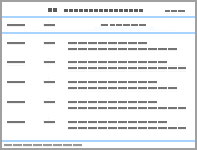
表1

两组女性压力性尿失禁患者术前与术后资料"

Items TVT (n=60) TOT (n=90) P
Age/years 54.65±11.23 55.75±9.83 0.12
Preoperative pads/(/d) 2(0-4) 2(0-4) 0.13
ICI-Q-SF
    Preoperative 14 (13-17) 16 (13-18) 0.41
    1-month postoperative 2 (0-7)* 3 (0-7)* 0.49
    6-month postoperative 2 (0-5)* 2 (0-5)* 0.43
    12-month postoperative 2 (0-6)* 2 (0-6)* 0.41
Maxium flow rate/(mL/s)
    Preoperative 20.13±3.21 21.01±3.28 0.39
    1-month postoperative 17.21±4.22 18.21±5.32 0.42
    6-month postoperative 18.05±5.33 19.05±4.33 0.51
    12-month postoperative 18.37±4.92 19.27±4.92 0.39
Residual urine volume/mL
    Preoperative 12.31±3.32 12.01±4.22 0.38
    1-month postoperative 13.21±5.22 11.21±6.32 0.24
    6-month postoperative 18.25±5.33 13.05±5.33 0.12
    12-month postoperative 16.37±7.92 11.27±5.92 0.13
1
Schreiber Pedersen L , Lose G , Høybye MT , et al. Prevalence of urinary incontinence among women and analysis of potential risk factors in Germany and Denmark[J]. Acta Obstet Gynecol Scand, 2017, 96 (8): 939- 948.
2
Offiah I , Freeman R , Offiah I , et al. Long-term efficacy and complications of a multicentre randomised controlled trial comparing retropubic and transobturator mid-urethral slings: A prospective observational study[J]. BJOG, 2021, 128 (13): 2191- 2199.
3
Lukacz ES , Santiago-Lastra Y , Albo ME , et al. Urinary incontinence in women a review[J]. JAMA, 2017, 318 (16): 1592- 1604.
4
Dwyer PL , Karmakar D . Surgical management of urinary stress incontinence. Where are we now?[J]. Best Pract Res Clin Obstet Gynaecol, 2019, 54, 31- 40.
5
Leone Roberti Maggiore U , Finazzi Agrò E , Soligo M , et al. Long-term outcomes of TOT and TVT procedures for the treatment of female stress urinary incontinence: A systematic review and meta-analysis[J]. Int Urogynecol J, 2017, 28 (8): 1119- 1130.
6
Tommaselli GA , Di Carlo C , Formisano C , et al. Medium-term and long-term outcomes following placement of midurethral slings for stress urinary incontinence: A systematic review and meta-analysis[J]. Int Urogynecol J, 2015, 26 (9): 1253- 1268.
7
Mattson NK , Nieminen K , Heikkinen AM , et al. Validation of the short forms of the pelvic floor distress inventory (PFDI-20), pelvic floor impact questionnaire (PFIQ-7), and pelvic organ prolapse/urinary incontinence sexual questionnaire (PISQ-12) in Finnish[J]. Health Qual Life Outcomes, 2017, 15 (1): 88.
8
Nataie F , Illiano E , Zucchi A , et a1 . Transobturator mid-urethral sling in females with stress urinary incontinence and detrusor underactivity: Effect on voiding phase[J]. Int Urogynecol J, 2019, 30 (9): 1519- 1525.
9
Latthe PM , Singh P , Foon R , et al. Two routes of transobturator tape procedures in stress urinary incontinence: A meta-analysis with direct and indirect comparison of randomized trials[J]. BJU Int, 2010, 106 (1): 68- 76.
10
梁子龙, 宋逸凡, 庞浩峰, 等. 女性压力性尿失禁伴膀胱活动低下治疗新进展[J]. 现代泌尿外科杂志, 2024, 29 (2): 183- 186.
[1] 陈欣, 杨君婷, 郭金鑫, 李淑雅, 刘志科, 朱颖靓, 李奉娟, 詹思延, 郭娟娟. 2022—2024年青岛市10~59岁女性自身免疫性甲状腺病的患病率特征[J]. 北京大学学报(医学版), 2025, 57(3): 507-513.
[2] 刘宁, 满立波, 何峰, 黄广林, 翟建坡. 良性前列腺增生患者排尿中断症状与尿动力学指标的相关性[J]. 北京大学学报(医学版), 2025, 57(2): 328-333.
[3] 柯涵炜, 王起, 许克新. 优化环磷酰胺剂量在间质性膀胱炎/膀胱疼痛综合征啮齿动物模型中的应用[J]. 北京大学学报(医学版), 2024, 56(5): 908-912.
[4] 李雨清,王飚,乔鹏,王玮,关星. 经耻骨后尿道中段悬吊带术治疗女性复发性压力性尿失禁的中长期疗效[J]. 北京大学学报(医学版), 2024, 56(4): 600-604.
[5] 王子恺,莫佳丽,张蒙,廖纪萍. 2013—2020年北京市慢性阻塞性肺疾病急性加重女性住院患者的流行病学和住院费用分析[J]. 北京大学学报(医学版), 2023, 55(6): 1074-1081.
[6] 姬学朝,刘珊,王万州,赵烨彤,李陆一,张文楼,沈国锋,邓芙蓉,郭新彪. 室内挥发性有机物与年轻女性夜间心率变异性关联的定组研究[J]. 北京大学学报(医学版), 2023, 55(3): 488-494.
[7] 孙希雅,陈艺璐,曾琳,闫丽盈,乔杰,李蓉,智旭. 不孕女性维生素D水平与抗苗勒氏管激素的相关性及对妊娠结局的预测[J]. 北京大学学报(医学版), 2023, 55(1): 167-173.
[8] 方伟岗,田新霞,解云涛. 基因多态性对中国汉族女性乳腺癌遗传易感性的影响[J]. 北京大学学报(医学版), 2022, 54(5): 822-828.
[9] 朱琳,张维宇,许克新. 环磷酰胺诱导SD大鼠膀胱疼痛综合征模型的有效性[J]. 北京大学学报(医学版), 2022, 54(4): 735-740.
[10] 王涛,许克新,张维宇,胡浩,张晓威,王焕瑞,刘献辉,陈京文,张晓鹏. 男性膀胱过度活动症的尿动力学分型及临床疗效随访[J]. 北京大学学报(医学版), 2019, 51(6): 1048-1051.
[11] 张晓鹏,张维宇,霍飞,胡浩,王起,许克新. 原发性女性膀胱出口梗阻的手术疗效随访及其发病机制[J]. 北京大学学报(医学版), 2019, 51(6): 1052-1055.
[12] 张维宇,夏秋翔,胡浩,陈京文,孙屹然,许克新,张晓鹏. 门诊女性下尿路症状患者尿动力学检查结果分析及逼尿肌无力患者的随访[J]. 北京大学学报(医学版), 2019, 51(5): 856-862.
[13] 车新艳,吴士良,陈宇珂,黄燕波,杨洋. 女性医务人员尿失禁及其对生活质量影响的现况调查[J]. 北京大学学报(医学版), 2019, 51(4): 706-710.
[14] 刘献辉,张维宇,胡浩,王起,王涛,贺永新,许克新. 耻骨后和经闭孔尿道中段悬吊术对不同分型压力性尿失禁疗效的长期随访[J]. 北京大学学报(医学版), 2019, 51(4): 694-697.
[15] 王丹丹,甘业华,马绪臣,孟娟红. ADAMTS14基因单核苷酸多态性与汉族女性颞下颌关节骨关节炎的相关性研究[J]. 北京大学学报(医学版), 2018, 50(2): 279-283.
Viewed
Full text


Abstract

Cited

  Shared   
  Discussed   
No Suggested Reading articles found!